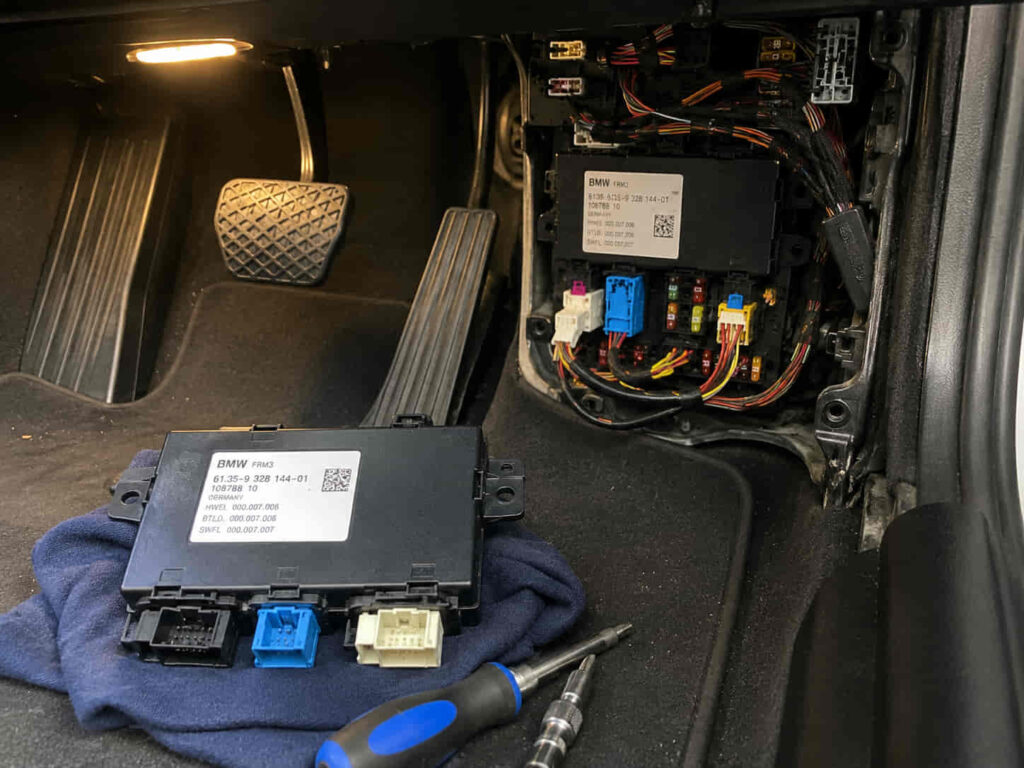
A failing BMW Footwell Module can affect several body-electrical functions, including exterior lighting, interior lighting, power windows, and other systems associated with the FRM. Because one module interacts with multiple electrical functions, an FRM problem can produce several symptoms at the same time rather than one isolated failure. BMW Footwell Module repair should therefore begin with diagnosis instead of replacing the module based on a single lighting or window problem.
The Footwell Module, commonly called the FRM, is used across specific BMW generations to manage or participate in body-electrical functions. When the module stops communicating correctly, develops an internal fault, or cannot perform an expected function, the resulting symptoms can appear in different areas of the vehicle. However, a failed headlight, non-working window, or electrical warning does not by itself prove that the FRM needs repair because wiring, power supply, switches, individual components, and communication faults can create overlapping symptoms.
There are 7 signs that provide a stronger reason to investigate a BMW Footwell Module, especially when several electrical problems appear together or diagnostic communication with the FRM is affected. Identifying these signs, confirming the fault, and determining whether the original module is repairable helps avoid unnecessary replacement and establishes whether repair, coding, programming, or another electrical service is actually required.
What Are the 7 Signs Your BMW Footwell Module Needs Repair?
The 7 signs that can indicate a BMW Footwell Module needs diagnosis and possible repair are malfunctioning exterior lights, abnormal turn signals, non-working power windows, interior lighting problems, multiple electrical functions failing together, loss of diagnostic communication with the FRM, and electrical problems appearing after a battery or voltage-related event. These symptoms become more relevant to BMW Footwell Module repair when several occur together, but each one still requires diagnosis because other electrical faults can produce similar behavior.
Headlights or other exterior lights that stop working correctly are the first sign associated with a possible BMW Footwell Module problem. The FRM participates in lighting-related functions on BMW applications that use this module, so a fault can affect how exterior lights operate. The important diagnostic distinction is whether the problem comes from the module or from the circuit and component being controlled. A failed bulb, damaged connector, wiring problem, loss of power, or another component-level fault can produce an exterior-lighting symptom without requiring FRM repair. When several lighting functions develop problems together or normal component checks do not identify the cause, the Footwell Module becomes a more relevant part of the diagnostic path.
Turn signals that stop operating normally are the second sign that can justify checking the FRM. An indicator problem may appear as a turn signal that does not respond correctly or as abnormal operation that cannot be explained by the obvious lighting components. Because turn-signal behavior is connected to the vehicle’s body-electrical system, an FRM fault can become relevant when the module is unable to perform the expected function. A single indicator symptom should still be traced through the applicable circuit before the module is condemned. The value of the symptom increases when it appears alongside other FRM-related electrical failures.
Power windows that stop working are the third sign associated with BMW Footwell Module problems. Window operation can be affected when the FRM or the electrical functions associated with it are not operating correctly, which is why non-working windows frequently become part of an FRM diagnosis. However, a window that does not move can also result from a switch, motor, regulator, wiring, connector, power-supply, or other electrical problem. Replacing or repairing the FRM without distinguishing between these possibilities can leave the original window fault unchanged. Multiple window-related problems combined with other body-electrical symptoms create a stronger reason to investigate the module than one isolated window failure.
Interior lighting problems are the fourth sign that can place the Footwell Module in the diagnostic path. Interior-lighting behavior is relevant because the FRM is associated with several body-electrical functions rather than one standalone circuit. Unexpected lighting behavior that occurs together with exterior-light, window, or other FRM-related problems can therefore indicate a wider module or communication issue. An isolated interior lamp problem remains weak evidence by itself because individual lamps, wiring, connections, and power-related conditions can create the same visible result.
Several electrical functions failing at approximately the same time are the fifth and more significant sign of a possible FRM problem. A shared module can create a cluster of apparently separate symptoms when it can no longer perform or communicate its expected functions. For example, a BMW that develops lighting and window problems within the same failure event provides a different diagnostic pattern from a vehicle with one failed lamp. The shared nature of the symptoms increases the relevance of the Footwell Module, but it also makes shared electrical conditions important to check. Power supply, ground, wiring, connectors, and vehicle communication can affect multiple functions without an internal FRM failure.
Loss of diagnostic communication with the Footwell Module is the sixth sign and provides stronger diagnostic evidence than a single visible electrical symptom. When compatible diagnostic equipment cannot communicate with the FRM, the module itself becomes an important area of investigation because normal diagnostic access is not occurring. No communication still does not prove that the FRM’s internal electronics or stored data are defective. A module without the correct power or ground, a network communication problem, damaged wiring, or a connector fault can also become inaccessible to diagnostic equipment. Checking these conditions helps determine whether the FRM itself requires repair or whether an external electrical problem is preventing communication.
Electrical problems that appear after a battery or voltage-related event are the seventh sign that can justify FRM diagnosis. The timing is relevant when body-electrical functions operate normally before an electrical event and several FRM-related functions stop operating afterward. This creates a useful diagnostic relationship between the event and the onset of symptoms, particularly when the module subsequently fails to communicate or multiple controlled functions are affected. The timing alone should not be converted into proof that the battery event damaged the FRM. Battery condition, system voltage, power distribution, module communication, and the FRM itself still need to be evaluated before the root cause is established.
The diagnostic value of these 7 signs increases when they form a consistent symptom cluster. One non-working light or window is not enough to establish BMW Footwell Module failure, while multiple FRM-related electrical problems combined with diagnostic evidence provide a stronger reason to test the module. This distinction is important because BMW Footwell Module repair should correct a confirmed module problem rather than become the first response to every electrical fault involving lights, windows, or body functions.
The correct repair sequence is therefore symptom identification, electrical diagnosis, FRM evaluation, and then the repair or replacement decision. This sequence keeps the Footwell Module at the center of the investigation without assuming it is responsible before the evidence supports that conclusion. It also prevents an unnecessary replacement module from introducing additional coding or programming requirements when the original problem exists elsewhere in the vehicle.
Read more: BMW Transfer Case Fluid Change
What Does the BMW Footwell Module Control?
The BMW Footwell Module manages or participates in several body-electrical functions, particularly lighting and other vehicle functions associated with the FRM architecture. This explains why a Footwell Module problem can appear as several apparently separate electrical symptoms rather than one failure located directly at the module. The exact functions depend on the BMW model, production generation, and FRM version, so the module should be evaluated within the electrical architecture of the specific vehicle.
Exterior lighting is one of the most important functional areas associated with the FRM. Headlights, parking lights, turn signals, and other exterior-lighting operations can therefore become part of the diagnostic picture when the module develops a fault. This relationship does not mean that every lighting failure originates inside the Footwell Module. The FRM can command or participate in a circuit while the actual fault exists in a lamp, wiring, connector, power supply, or another component. Module diagnosis becomes more relevant when component-level checks do not explain the problem or several lighting functions fail together.
Interior and body-electrical functions provide additional diagnostic context. Power-window operation and interior-lighting behavior can be associated with the FRM on applicable BMW vehicles, which is why these symptoms frequently appear alongside lighting problems during Footwell Module diagnosis. A cluster involving windows, interior lights, and exterior lighting has greater module-level relevance than one isolated electrical failure because several affected functions can share the same control architecture.
The FRM also exists within the vehicle’s communication and power environment rather than operating independently. Correct power, ground, connectors, wiring, and network communication are necessary for a control module to perform its functions and communicate with diagnostic equipment. This is why a non-responsive FRM should not immediately be classified as internally damaged. External electrical conditions can prevent a functional module from communicating or operating normally.
Understanding what the Footwell Module controls establishes the correct diagnostic relationship between symptoms and BMW Footwell Module repair. The FRM should be investigated when the failed functions match its role in the vehicle, but the module should only be repaired after diagnosis separates an internal FRM problem from faults elsewhere in the electrical system.
What Causes a BMW Footwell Module to Fail?
BMW Footwell Module problems can result from internal module or data-related faults, electrical or voltage-related conditions, power and communication problems, or physical damage affecting the module or its connections. These failure contexts do not produce one universal symptom, which is why the cause should be established through diagnosis rather than inferred from a non-working light or window.
An internal module or data-related problem can prevent the FRM from operating or communicating as expected even when the surrounding electrical system remains functional. This type of failure is particularly relevant to BMW Footwell Module repair because some module faults may allow the original FRM to be recovered instead of replaced. Repairability depends on what has failed inside the module and whether its required data and electronic functions can be restored reliably. An internal fault should therefore be distinguished from external wiring or power problems before a module-repair procedure is selected.
Voltage-related events are another important diagnostic context. Electrical symptoms can appear after a weak-battery condition, battery-related work, interrupted power, or another event involving vehicle voltage. The timing provides useful evidence when several FRM-associated functions stop working immediately afterward. However, chronological sequence is not the same as confirmed causation. A voltage event should prompt checks of system power, module communication, and FRM condition rather than an automatic conclusion that the Footwell Module has been permanently damaged.
Power and ground problems can imitate an internally failed FRM because a control module cannot operate correctly without its required electrical supply. A module that does not communicate with diagnostic equipment may therefore have an internal problem, or it may simply not be receiving the electrical conditions required for communication. Wiring, connectors, power supply, ground integrity, and the applicable communication network should remain part of the diagnostic process before the FRM itself is condemned.
Physical or environmental damage creates a different failure context. Moisture intrusion, connector damage, corrosion, or physical damage affecting the module area can interfere with electrical operation and may change whether repair is practical. A data-related fault in an otherwise intact original module presents a different repair situation from a module with extensive physical or electrical damage. Treating both conditions as the same “FRM failure” can lead to the wrong repair-versus-replacement decision.
The cause of a BMW Footwell Module problem therefore determines the appropriate next step. A recoverable internal or data-related fault may support repair of the original FRM, while an external electrical problem must be corrected outside the module and severe physical damage may make replacement more appropriate. Establishing that distinction before repair prevents the FRM from being treated as the failed component merely because it is associated with the visible symptom.
How Is a BMW Footwell Module Diagnosed?
A BMW Footwell Module is diagnosed by matching the vehicle’s electrical symptoms with FRM functions, checking diagnostic communication and fault information, verifying the module’s power and electrical connections, and then determining whether the fault exists inside or outside the module. Diagnosis should occur before BMW Footwell Module repair because lighting, window, wiring, power-supply, and communication problems can produce symptoms that overlap with an internal FRM failure.
The diagnostic process begins with the symptom pattern rather than the assumption that the Footwell Module has failed. One non-working headlight creates a different diagnostic context from several exterior lights, windows, and interior-lighting functions failing during the same event. A cluster of functions associated with the FRM increases the relevance of module-level diagnosis because one common control point can explain several apparently separate problems. The symptom pattern still needs supporting electrical or diagnostic evidence before the module is identified as the failed component.
Diagnostic communication provides the next layer of evidence. A compatible BMW diagnostic system can be used to determine whether the vehicle communicates with the FRM and whether relevant fault information is available. Successful communication confirms that the module is accessible but does not prove that every function inside it is operating correctly. Failed communication creates a stronger reason to investigate the module, but it also requires checks outside the FRM because missing power, ground, wiring, connector integrity, or vehicle-network communication can make a module appear unresponsive.
Power and electrical checks help separate these external conditions from an internal module fault. A control module cannot be accurately condemned when its required electrical supply or communication path has not been verified. For example, replacing an FRM because a scan tool cannot establish communication will not correct the vehicle when the actual cause is a power-supply or wiring problem. Establishing the electrical conditions first prevents an external fault from being misclassified as module failure.
The module itself becomes the primary repair candidate when the surrounding electrical conditions are correct but FRM operation, communication, or internal data remains defective. At this stage, the diagnostic question changes from “Is the FRM causing the symptoms?” to “What type of FRM failure is present?” That distinction matters because an original module with a recoverable internal or data-related problem creates a different repair path from a module with extensive physical or electrical damage.
BMW Footwell Module diagnosis is complete when the evidence distinguishes an internal FRM fault from an external vehicle-electrical fault. Fault codes and no-communication results are diagnostic evidence rather than standalone proof. Combining the symptom pattern, module communication, electrical supply, wiring context, and module condition creates a stronger basis for deciding whether the original FRM should be repaired, recovered, or replaced.
Can a BMW Footwell Module Be Repaired?
Some BMW Footwell Modules can be repaired, but repairability depends on the type of failure and the physical and electronic condition of the original FRM. An FRM with a recoverable internal or data-related problem can present a better repair candidate than a module with severe electrical, corrosion, moisture, or physical damage. This is why diagnosis must establish the failure type before repair and replacement are compared.
Repairing the original module can be valuable because the existing FRM already belongs to the vehicle’s configuration. When the fault can be recovered while retaining the appropriate original module data and functionality, repair can avoid some of the additional configuration issues associated with introducing another module. This advantage should not be interpreted as proof that every original FRM is repairable. The condition of the module determines whether recovery is technically appropriate.
Data-related or internal module problems create one repair category. In these cases, the FRM may stop communicating or performing expected functions even though there is no obvious external physical destruction. A specialist module-repair process can evaluate whether the required module operation or data can be restored. The purpose of this repair is to return the original module to correct operation, not simply to erase a fault code or temporarily restore communication.
Physical damage creates a different decision. Significant corrosion, moisture-related damage, damaged electronics, or another condition that prevents reliable recovery can reduce the value of repairing the original FRM. A module that can be made to communicate temporarily is not necessarily a successful repair if the underlying physical problem remains. Reliable operation after the repair is more important than preserving the original module at all costs.
An FRM should also not be repaired when diagnosis shows that the module is not the source of the problem. A wiring fault, power-supply issue, damaged connector, failed lighting component, or another external electrical condition must be corrected at its actual location. Sending a functional FRM for module repair in this situation adds cost without addressing the cause of the vehicle’s symptoms.
The decision therefore depends on both diagnosis and module condition. BMW Footwell Module repair is appropriate when an internal FRM fault has been confirmed and the original module can be recovered reliably; replacement becomes more relevant when the module cannot be restored to dependable operation. This distinction also determines the next question in the repair process because installing another FRM can introduce coding, programming, or vehicle-configuration requirements that do not necessarily apply in the same way when the original module is successfully repaired.
Should You Repair or Replace a BMW Footwell Module?
Repairing the original BMW Footwell Module is generally the more direct option when diagnosis confirms a recoverable internal FRM fault, while replacement becomes appropriate when the original module is too damaged to be restored reliably. The decision should be based on the failure type and module condition rather than the assumption that a new or replacement module is automatically a better repair.
Repair has an important advantage when the original FRM and its vehicle-specific data can be retained. The module already belongs to the vehicle’s electrical configuration, so recovering it can reduce the additional configuration work associated with introducing another module. This is particularly relevant when the problem exists within recoverable module operation or data rather than severe physical damage. A successful repair should restore dependable FRM function, not merely make the module communicate long enough to clear a fault.
Replacement creates a different workflow because another Footwell Module must operate correctly within the vehicle in which it is installed. Selecting a replacement by appearance alone is not sufficient. Module compatibility, hardware or software version, vehicle application, and the configuration requirements of the specific BMW must be considered before the replacement is treated as a usable solution. Installing an incompatible or incorrectly configured FRM can replace one electrical problem with another.
The condition of the original module is therefore the main dividing point. An FRM with a recoverable internal fault can justify repair because the existing module remains usable once the fault is corrected. Severe corrosion, moisture damage, damaged electronics, or another condition that prevents reliable recovery makes replacement more relevant. The objective is dependable module operation rather than preserving or replacing the FRM by default.
Cost should be evaluated against the complete repair process rather than the price of the module alone. A replacement FRM can introduce additional diagnostic, coding, programming, or configuration work, while repairing a module that is not actually faulty wastes money without correcting the vehicle. Diagnosis first, repair when the original FRM is recoverable, and replacement when reliable recovery is not practical provides the clearest BMW Footwell Module repair decision path.
Does a Repaired or Replacement BMW FRM Need Coding?
A replacement BMW Footwell Module can require coding or vehicle-specific configuration, while the requirements after repairing the original FRM depend on the repair performed and the condition of its existing data. Repairing an original module and installing another module are therefore different procedures and should not be treated as interchangeable FRM jobs.
Coding is relevant because a control module must operate according to the configuration required by the vehicle. A replacement module cannot be assumed to function correctly simply because its connector fits or its part identification appears similar. The module must be compatible with the vehicle and configured as required for the applicable BMW. This is why FRM replacement can involve more than removing the failed unit and installing another one.
Repairing the original FRM can create a different situation because the module already originates from the vehicle. When its required configuration and data remain valid or can be recovered correctly as part of the repair, the workflow can differ from installing a replacement module that must be integrated into another vehicle. The exact requirement still depends on the FRM generation, failure, repair method, and vehicle condition, so “FRM repair never needs coding” is not a reliable universal rule.
Coding, programming, and data recovery should also remain distinct concepts. Coding configures module behavior for the applicable vehicle, while programming can involve module software, and data recovery addresses information required to restore a damaged or non-responsive module. These operations can appear within the same repair workflow, but performing one does not automatically mean that the others are required.
The correct post-repair process is therefore determined by what happened to the module. An original FRM that has been successfully recovered and a replacement FRM being introduced to the vehicle have different configuration contexts. Verifying module operation after the work is more important than applying the same coding procedure to every BMW Footwell Module repair.
When Should You Use a BMW Footwell Module Repair Service?
Use a BMW Footwell Module repair service when diagnosis indicates an internal FRM problem, the module loses communication despite correct external electrical conditions, several FRM-related functions fail together, or recovery requires module-level data and equipment beyond normal vehicle diagnostics. Professional service is particularly valuable when the objective is to determine whether the original module can be restored before committing to replacement.
Loss of communication becomes a strong reason for specialist evaluation after power, ground, wiring, connectors, and relevant vehicle communication have been checked. At that point, the diagnostic evidence has moved beyond a visible lighting or window symptom and toward the module itself. A repair specialist can evaluate whether the FRM has a recoverable internal or data-related condition instead of treating no communication as an automatic replacement decision.
Multiple electrical failures provide another reason to use a specialist when they form a pattern consistent with FRM operation. Headlight, turn-signal, interior-lighting, and window problems appearing together create a different diagnostic situation from one failed component. The specialist’s role is not simply to repair the FRM because several symptoms exist, but to verify that those symptoms share a module-level cause before work is performed.
Professional module repair is also appropriate when recovering the original FRM requires specialized access to its electronic data or internal functions. General diagnostic equipment is designed primarily to communicate with vehicle modules and perform supported service functions; it does not automatically provide every capability required to recover a non-responsive control module. Specialized equipment and module-level knowledge become more important when normal diagnostic communication is no longer available.
Replacement should still remain an available outcome when inspection shows that the original FRM cannot be restored reliably. A professional repair service should distinguish a repairable module from one with physical or electrical damage that makes dependable recovery impractical. This prevents repair from becoming an objective in itself when replacement provides the more reliable technical solution.
The correct BMW Footwell Module repair process is to diagnose the electrical symptoms, confirm whether the FRM itself is faulty, determine whether the original module is recoverable, and only then choose repair or replacement. This sequence prevents isolated lighting or window faults from being misdiagnosed as FRM failure and avoids introducing a replacement module, coding requirements, and additional cost before they are actually necessary.