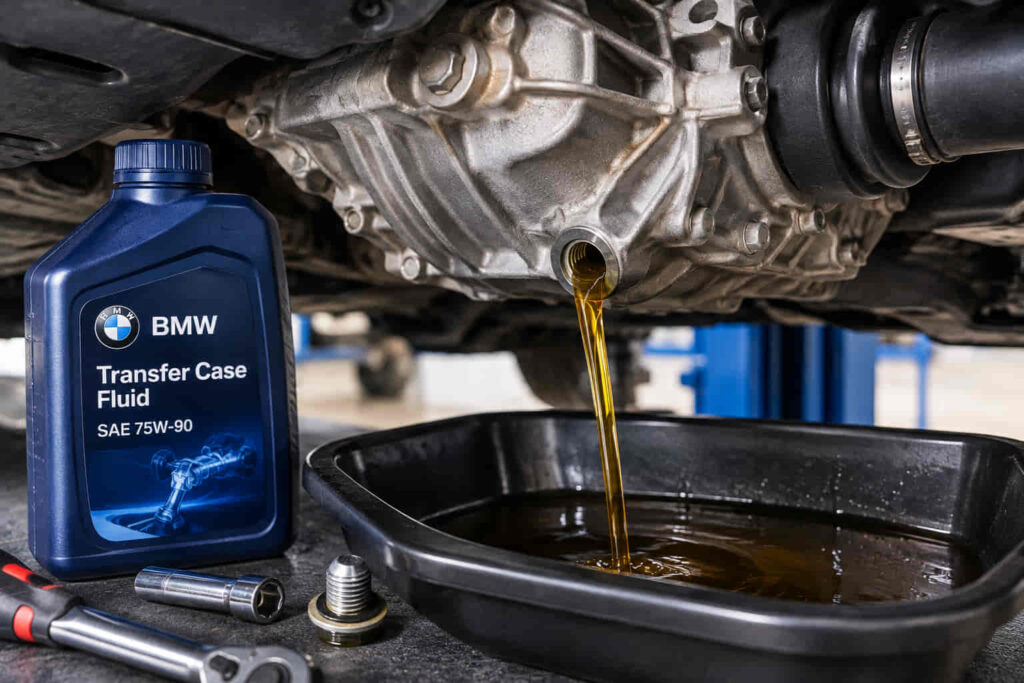
A BMW transfer case fluid change helps maintain proper lubrication inside the transfer case, but the service must use the correct fluid, fill level, and procedure for the specific vehicle. Using an incompatible fluid, filling the unit incorrectly, or treating every BMW xDrive transfer case as identical can turn routine maintenance into a drivetrain problem. The correct service requirements depend on the BMW model, transfer case application, and applicable maintenance procedure rather than the xDrive badge alone.
The transfer case distributes drivetrain torque between the front and rear axles in BMW xDrive applications, placing its internal components and fluid under repeated mechanical and thermal loads. Transfer case fluid lubricates these components and supports their operation, while its condition changes with mileage, operating temperature, contamination, and use. Replacing the fluid is therefore a maintenance task, not a universal repair for every transfer case symptom.
There are 7 BMW transfer case fluid change mistakes that are especially important to avoid. They involve fluid selection, vehicle compatibility, fill level, fill-plug access, old-fluid inspection, post-service procedures, and incorrect diagnosis of transfer case problems. Understanding these mistakes helps distinguish a correctly performed fluid service from procedures that can create new problems or fail to address an existing drivetrain fault.
What Are the 7 BMW Transfer Case Fluid Change Mistakes to Avoid?
The 7 BMW transfer case fluid change mistakes to avoid are using the wrong fluid, assuming every BMW xDrive uses the same fluid, setting the wrong fluid level, draining before checking the fill plug, ignoring the old fluid condition, skipping applicable post-service procedures, and assuming every transfer case problem is caused by the fluid. Each mistake affects a different part of the service, from selecting the lubricant to determining whether a fluid change is the correct response to a drivetrain symptom.
Using the wrong transfer case fluid is the first mistake because fluid compatibility is determined by the transfer case application rather than by viscosity alone. Transfer case fluid must provide the lubrication and operating characteristics required by the specific unit. Selecting a product because it is marketed for AWD vehicles, resembles the drained fluid, or has a seemingly appropriate viscosity does not establish BMW compatibility. The correct approach is to identify the vehicle and applicable transfer case specification before purchasing the replacement fluid. This is especially important when servicing BMW vehicles from different generations because a fluid recommendation for one transfer case should not automatically be transferred to another.
Assuming every BMW xDrive vehicle uses the same transfer case fluid is the second mistake. xDrive identifies BMW’s all-wheel-drive system, but it does not identify one universal transfer case, fluid requirement, or service procedure. BMW has used different drivetrain configurations across models and production periods, so the vehicle application must remain part of the fluid-selection context. A fluid that is correct for one xDrive application is not proven correct for another simply because both vehicles carry the xDrive designation. Matching the fluid to the applicable transfer case specification prevents the brand-level term “BMW xDrive” from being mistaken for a technical fluid specification.
Using the wrong fluid level is the third mistake because both the quantity added and the filling procedure affect the completed service. Adding more fluid than required does not create better lubrication, while an insufficient fill can leave the transfer case operating without the intended amount of lubricant. The vehicle’s position and applicable filling procedure also matter when the service specification uses the fill opening as part of the level-setting process. For this reason, a BMW transfer case should be filled according to the procedure for the specific application rather than by estimating the amount removed and automatically replacing the same volume.
Draining the transfer case before confirming that the fill plug can be removed is the fourth mistake. The fill opening is the route needed to replenish the unit after the old fluid has been drained. Checking access and confirming that the fill plug can be loosened before opening the drain prevents a situation in which the transfer case has been emptied but cannot be refilled normally. This sequence is particularly important on an older vehicle where corrosion, previous over-tightening, damaged plug interfaces, or earlier repairs can make plug removal more difficult than expected. Confirming refill access first is a simple procedural control that reduces the risk of leaving the vehicle immobilized during routine maintenance.
Ignoring the condition of the drained transfer case fluid is the fifth mistake because the old fluid provides useful maintenance context. The removed fluid can be inspected for unusual contamination, debris, or other abnormal characteristics while the transfer case is being serviced. This inspection does not turn fluid appearance into a complete diagnosis. Darkened fluid alone, for example, does not identify a specific failed component, and a visual inspection cannot establish the condition of every internal part. Its value is contextual: an unexpected amount of material or another abnormal finding gives the technician a reason to investigate further instead of treating the job as an ordinary drain-and-fill.
Skipping an applicable post-service procedure is the sixth mistake because the mechanical fluid replacement and the complete service procedure are not always identical. BMW transfer case applications and diagnostic workflows differ, so an adaptation, oil-wear-related service function, or other diagnostic step should only be performed when it is specified for the vehicle and service being completed. The opposite mistake is equally important to avoid: a reset should not be performed merely because a scan tool displays a transfer case service function. The correct procedure is determined by the specific BMW application and service information, not by the availability of a button in diagnostic software.
Treating every transfer case symptom as a fluid problem is the seventh mistake because a BMW transfer case fluid change is a maintenance operation, not a universal drivetrain repair. Shuddering, unusual noises, drivetrain warnings, binding sensations, or changes in vehicle behavior can justify inspection, but those symptoms do not prove that degraded transfer case fluid is the root cause. Transfer case components, actuator or control problems, tire-related conditions, and other drivetrain faults can produce symptoms that overlap with fluid-related concerns. Replacing the fluid without identifying the cause can temporarily change a symptom, leave it unchanged, or delay the diagnosis of the actual fault.
These 7 mistakes share one underlying principle: a BMW transfer case fluid change should be performed according to the specific vehicle and transfer case requirements rather than a universal xDrive procedure. Correct fluid selection establishes compatibility, correct filling establishes the required fluid level, inspection provides maintenance context, and vehicle-specific service information determines whether additional procedures are required. Fluid replacement is appropriate maintenance when the service calls for it, while existing drivetrain symptoms should be diagnosed separately when they indicate a problem beyond routine fluid condition.
How Often Should BMW Transfer Case Fluid Be Changed?
BMW transfer case fluid should be changed according to the maintenance requirements of the specific vehicle and transfer case rather than one universal mileage interval for every BMW xDrive model. BMW has used different transfer case applications across its xDrive lineup, so an interval quoted for one model, generation, or transfer case should not automatically be applied to another. The vehicle’s service information is therefore the primary reference when determining when a transfer case fluid change is due.
Operating conditions and maintenance history provide additional context when evaluating the fluid. A transfer case repeatedly exposed to high drivetrain loads, frequent temperature cycles, towing where applicable, or demanding driving conditions does not operate under the same conditions as a lightly driven vehicle. Previous service history also matters because a BMW with documented transfer case fluid replacement has a known maintenance baseline, while a used vehicle with no service records creates greater uncertainty about the age and condition of the fluid.
Mileage alone should therefore not be treated as a diagnosis of transfer case condition. A vehicle reaching a particular mileage does not prove that its transfer case fluid has caused a drivetrain symptom, just as lower mileage does not prove that the fluid or transfer case requires no inspection. Maintenance interval and fault diagnosis answer different questions: the interval determines when preventive service is appropriate, while symptoms such as shuddering, abnormal noise, binding, or drivetrain warnings require investigation of the underlying cause.
The most reliable BMW transfer case fluid change interval is consequently the interval supported by the service information for the specific vehicle, supplemented by its documented maintenance history and operating conditions. A universal interval should not replace vehicle-specific information when BMW model, production period, transfer case, and usage can change the maintenance context. This approach prevents an arbitrary mileage figure from being presented as a rule for every xDrive vehicle.
How Do You Choose the Correct BMW Transfer Case Fluid?
Choose BMW transfer case fluid according to the fluid specification required by the specific transfer case, not by the BMW badge, xDrive designation, fluid color, or viscosity alone. The purpose of identifying the specification first is to preserve the lubrication and operating characteristics required by the transfer case. A product should be considered compatible because it meets the applicable requirement, not simply because its label mentions BMW or all-wheel-drive vehicles.
Vehicle identification is the starting point because model names alone can cover multiple production years and drivetrain configurations. The relevant BMW model, production information, and transfer case application establish the context needed to identify the required fluid. This is why a recommendation that is correct for one BMW X3, X5, 3 Series, or 5 Series application should not automatically be generalized to every xDrive version carrying the same model family name.
The xDrive designation is also insufficient as a fluid specification. xDrive describes BMW’s all-wheel-drive system at the vehicle level, whereas the transfer case is a specific drivetrain component within that system. Different transfer case applications can create different service requirements. Selecting a generic AWD fluid because the vehicle uses xDrive therefore skips the component-level compatibility check that should occur before the fluid is purchased.
Fluid color and the appearance of the drained lubricant are similarly unreliable selection methods. Used fluid changes as it experiences heat, mechanical operation, contamination, and service life, so its current appearance does not establish its original specification. Matching a new product to the color of the old fluid can consequently produce a false sense of compatibility. The old fluid is useful for observing maintenance condition, but the required replacement fluid should be identified from the applicable specification.
Viscosity should not be used as the only selection criterion either. Two lubricants can appear similar in viscosity while being formulated for different applications and operating requirements. The relevant question is whether the fluid is approved or specified for the transfer case being serviced. This makes specification-based selection more precise than choosing a lubricant because its basic physical description resembles another product.
The correct sequence is therefore vehicle identification → transfer case application → required fluid specification → compatible replacement fluid. This sequence keeps the transfer case, rather than the marketing category of the lubricant, at the center of the decision. It also prevents one of the most consequential BMW transfer case fluid change errors: using a technically incompatible product because it was assumed that all BMW xDrive systems share the same lubrication requirement.
Read more: BMW Keyless Entry Programming
How Much Fluid Does a BMW Transfer Case Need?
The amount of fluid a BMW transfer case needs depends on the specific transfer case and the service procedure being performed, so there is no single fluid capacity that applies to every BMW xDrive vehicle. Capacity should be verified for the exact application before service because different BMW models and drivetrain generations can use different transfer cases. Using a capacity quoted for another BMW simply because both vehicles use xDrive can result in an incorrect fill.
Published transfer case capacity and the amount required during a routine drain-and-fill should also be distinguished. Draining a transfer case does not necessarily mean that every quantity of fluid inside the assembly has been removed. Fluid can remain within internal passages and components after the drain plug is opened. As a result, measuring the drained fluid can provide useful service context, but that quantity should not automatically become the target refill amount when the applicable procedure specifies another method for establishing the correct level.
The fill procedure is therefore as important as the nominal capacity. Where the applicable BMW service procedure establishes fluid level through the fill opening under defined vehicle conditions, the technician should follow that procedure rather than forcing a predetermined quantity into the transfer case. The vehicle must also be positioned as required by the procedure because fluid level relative to the fill opening changes when the drivetrain is not positioned correctly.
Overfilling should not be treated as additional protection. Transfer cases are designed to operate with a specified fluid quantity or level, and adding extra lubricant does not automatically improve component lubrication. Underfilling creates the opposite problem by reducing the available lubricant below the intended level. Correct service therefore targets the specified level rather than the largest amount of fluid the housing will accept.
For the same reason, BMW transfer case fluid capacity should always be presented with its vehicle or transfer case context. A precise quantity is useful only when it applies to the unit being serviced. The correct capacity is the vehicle-specific value or fill level defined for that transfer case, not a universal BMW xDrive fluid quantity.
What Are the Signs Your BMW Transfer Case Needs Service?
Shuddering, abnormal drivetrain noise, binding or jerking behavior, drivetrain warnings, and changes in power delivery can justify inspecting a BMW transfer case, but none of these symptoms proves that old transfer case fluid is the cause. Transfer case service and transfer case diagnosis should remain separate concepts because several drivetrain conditions can produce similar symptoms.
Shuddering or vibration can become noticeable during acceleration, turning, or changes in drivetrain load. The transfer case is one possible area of investigation because it participates in torque distribution within the xDrive system, but the symptom must be interpreted in the context of the complete drivetrain. Tires, wheels, driveline components, transfer case operation, and other mechanical conditions can contribute to vibration or binding behavior. Replacing fluid without determining where the symptom originates can therefore leave the underlying problem unchanged.
Abnormal noise creates a similar diagnostic requirement. A new grinding, whining, clicking, or other drivetrain-related sound indicates that the vehicle should be inspected, but the sound itself does not identify the fluid as the failed component. The location of the noise, operating condition in which it occurs, vehicle speed, drivetrain load, and accompanying symptoms provide more useful diagnostic information than the assumption that a fluid change will correct it.
A drivetrain or xDrive warning deserves greater attention because the vehicle has detected a condition that may require diagnostic information beyond a visual fluid inspection. Reading relevant fault information can help distinguish an electronically detected transfer case or actuator-related problem from a routine maintenance requirement. Clearing a warning or replacing fluid without identifying the stored fault does not establish that the cause has been corrected.
Changes in drivetrain behavior can also justify inspection. Binding during low-speed turns, unusual hesitation in torque transfer, or behavior that was not previously present provides evidence that something in the drivetrain has changed. Fluid condition can be evaluated as part of that inspection, especially when the transfer case service history is unknown, but maintenance history should not substitute for fault diagnosis.
Tire condition is particularly relevant to xDrive troubleshooting because the transfer case operates as part of a system connecting the front and rear drivetrains. Differences in tire dimensions, wear, inflation, or other tire-related conditions can change how the drivetrain operates. A transfer case symptom should therefore be investigated in its complete vehicle context instead of isolating the fluid as the default cause.
The strongest indication for a BMW transfer case fluid change is a valid maintenance requirement, while abnormal drivetrain symptoms are indications for inspection and diagnosis. These situations can occur at the same time, but they answer different questions. Fluid replacement restores the specified lubricant as part of maintenance; diagnosis determines whether a transfer case, actuator, tire-related condition, or another drivetrain component is responsible for an existing symptom.
Can You Change BMW Transfer Case Fluid Yourself?
You can change BMW transfer case fluid yourself when you can correctly identify the required fluid, access the transfer case safely, follow the vehicle-specific fill procedure, and complete any applicable post-service requirements. The mechanical act of draining and refilling fluid can be straightforward on some applications, but completing the service correctly requires more than removing two plugs. Fluid compatibility, vehicle positioning, fill level, plug condition, and the applicable BMW service procedure all affect the result.
An experienced DIY owner should identify the vehicle and transfer case requirements before raising the car or purchasing fluid. This prevents the service from beginning with an assumption that every xDrive model follows the same procedure. The correct lubricant should already be available, the fill and drain locations should be identified, and any required replacement sealing components or service tools should be prepared before the old fluid is removed. Preparation matters because discovering an incompatible fluid or inaccessible fill plug after draining the transfer case can leave the vehicle unable to return to service.
Safe vehicle positioning is equally important. Accessing a transfer case requires working underneath the vehicle, so appropriate lifting and support equipment must keep the BMW stable throughout the procedure. The position of the vehicle can also affect fluid level when the applicable filling method uses the fill opening to establish the final level. A vehicle supported unsafely or positioned incorrectly creates both a safety problem and the possibility of an inaccurate fill.
The old fluid should be observed during the drain rather than discarded without inspection. Unusual debris or another abnormal finding can change the context of the job from preventive maintenance to further investigation. Fluid appearance alone cannot diagnose internal transfer case damage, but an unexpected condition should not be ignored simply because replacement fluid is ready to install. The objective is to complete maintenance while remaining alert to evidence that the transfer case may require diagnosis.
DIY suitability decreases when the procedure requires diagnostic equipment or a vehicle-specific service function that the owner cannot verify or perform correctly. A scan tool displaying transfer case functions does not prove that every displayed reset or adaptation should be performed after every fluid change. The applicable BMW procedure determines whether an additional diagnostic step belongs to the service. Performing an unnecessary reset can be as inappropriate as skipping a required procedure.
A BMW transfer case fluid change is therefore a reasonable DIY maintenance task only when the owner can control the complete process from fluid identification through final level verification. The ability to remove and reinstall the drain plug is not the standard for DIY suitability; the standard is the ability to complete the specified transfer case service correctly and safely.
When Should You Use a BMW Specialist for Transfer Case Service?
Use a BMW specialist when the correct transfer case fluid or procedure cannot be verified, the vehicle already has drivetrain symptoms or warnings, the fill or drain hardware presents a problem, or the service requires diagnostic procedures beyond your equipment and experience. These conditions move the job beyond a predictable fluid replacement and increase the value of vehicle-specific diagnosis and service information.
An existing drivetrain warning is one of the clearest reasons to seek diagnosis before treating fluid replacement as the solution. BMW xDrive operation involves mechanical components, electronic control, and vehicle inputs, so a warning can contain diagnostic information that a simple drain-and-fill does not address. A specialist can retrieve relevant fault information, inspect the system in context, and determine whether routine transfer case maintenance and fault repair are separate requirements.
Persistent shuddering, binding, abnormal noise, or other drivetrain behavior also warrants inspection when the cause has not been established. Replacing transfer case fluid may still be appropriate when maintenance is due, but the service should not be presented as proof that the symptom will disappear. A technician can evaluate the transfer case alongside related drivetrain and tire conditions instead of replacing parts or fluids based on one symptom.
Damaged, seized, previously over-tightened, or difficult-to-access plugs create another point where professional service can prevent a routine job from becoming a larger repair. Forcing damaged hardware can create problems with the transfer case housing or prevent the unit from being sealed and filled correctly. The earlier principle of confirming fill-plug access before draining becomes especially important when the vehicle’s previous service history is unknown.
A specialist is also the stronger choice when post-service diagnostic requirements cannot be established confidently. BMW transfer case applications vary, and diagnostic functions should be used because they belong to the applicable service procedure rather than because a scan tool makes them available. A BMW-focused workshop is more likely to have the service information and diagnostic equipment needed to determine whether a specific transfer case requires an additional procedure after fluid replacement.
Cost should be considered against the frequency and complexity of the work. Purchasing lifting equipment, the correct fluid, service tools, diagnostic hardware, and other required equipment can make sense for an experienced owner who performs repeated BMW maintenance. Professional service is generally more practical when a single fluid change requires equipment the owner would otherwise not use or when the vehicle already needs diagnosis.
Routine BMW transfer case fluid replacement and transfer case fault diagnosis are two different jobs. A correctly performed fluid change maintains the lubricant required by the transfer case, while diagnosis identifies the cause of an existing xDrive or drivetrain problem. Keeping these two purposes separate prevents fluid replacement from being used as a substitute for diagnosis and completes the BMW transfer case service according to the actual condition of the vehicle.