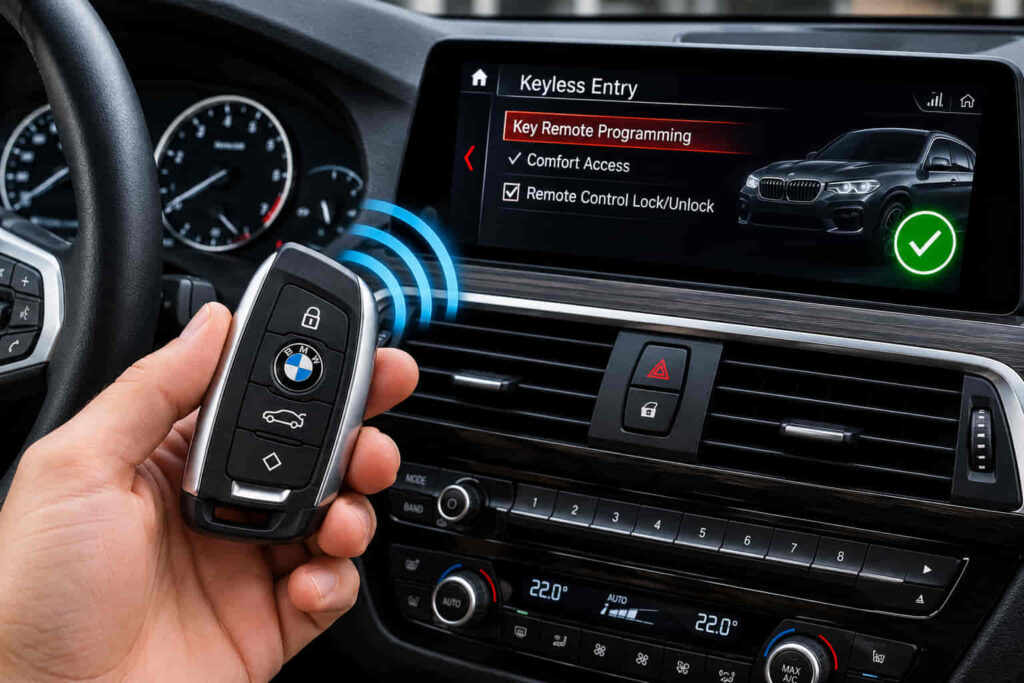
BMW keyless entry programming requires a compatible programming tool when adding a replacement key, working with an immobilizer system, or performing key-related functions that cannot be completed through a basic remote synchronization procedure. The right BMW key programming tool depends on the vehicle generation, supported key system, required programming function, and the experience level of the person performing the work. A programmer that works with an older BMW CAS system, for example, does not automatically provide the same capabilities for vehicles equipped with FEM or BDC modules.
The 7 best BMW keyless entry programming tools should therefore be compared by their actual BMW coverage rather than by the number of general diagnostic functions they advertise. Important factors include supported BMW models and years, CAS/FEM/BDC compatibility, key programming functions, required adapters or software, ease of use, and whether the device is designed for professional locksmiths or less experienced users.
This guide compares 7 BMW key programming tools across those criteria. It explains where each tool fits, which BMW key-programming situations it is designed to handle, and what limitations should be checked before choosing a programmer for a specific BMW.
What Are the 7 Best BMW Keyless Entry Programming Tools?
The 7 best BMW keyless entry programming tools are Autel MaxiIM IM608 Pro II, Xhorse VVDI2, Xhorse Key Tool Plus, Yanhua Mini ACDP2, CGDI BMW, Autel MaxiIM IM508S, and OBDSTAR X300 Classic G3. These tools serve different parts of the BMW key programming market rather than providing identical functions. Autel focuses heavily on integrated immobilizer and diagnostic workflows, while BMW-focused platforms such as VVDI2, CGDI BMW, and Mini ACDP2 are relevant when technicians need more specialized access to BMW immobilizer systems. The correct choice therefore depends on the BMW generation, immobilizer architecture, programming task, required accessories, and technician experience.
Autel MaxiIM IM608 Pro II is one of the strongest all-in-one options for professional locksmiths and automotive workshops that need BMW key programming alongside broader immobilizer and diagnostic functions. Its main advantage is integration: a technician can use one platform for IMMO-related work and vehicle diagnostics instead of maintaining completely separate devices for each basic workflow. This makes the IM608 Pro II particularly relevant to workshops that service BMW alongside other vehicle brands. Its broader capability is also the reason it should not automatically be considered the best purchase for every user. A buyer focused only on BMW key work may not need the diagnostic breadth of the IM608 platform, while complex BMW immobilizer jobs can still require additional hardware, adapters, software, or another specialized programmer. The tool is therefore better positioned as a professional platform than as a simple device for occasional BMW key fob programming.
Xhorse VVDI2 is a BMW-focused choice for technicians who need deeper access to BMW immobilizer and key programming workflows. Its BMW Tool environment covers older CAS-based systems while also providing FEM/BDC key-learning functionality for supported applications. Xhorse documentation describes FEM/BDC functions that include obtaining key information, preparing dealer keys and handling workflows in which the FEM/BDC system must be programmed before a new key can be prepared. This makes VVDI2 substantially different from a consumer-level OBD scanner that merely performs service resets or remote synchronization. The tradeoff is complexity. Some FEM/BDC procedures involve EEPROM data, module-level operations and additional Xhorse hardware, so VVDI2 makes more sense for trained locksmiths and technicians than for BMW owners looking for a one-click key programming solution.
Xhorse Key Tool Plus is a strong option for locksmiths who want BMW key programming inside a portable multi-brand ecosystem. Instead of being limited to BMW, Key Tool Plus combines immobilizer programming with other locksmith functions in a tablet-oriented platform. Its value becomes stronger for a mobile locksmith who handles BMW, Volkswagen, Mercedes-Benz and other brands because the same ecosystem can cover a wider range of daily key work. For BMW specifically, capability still depends on the immobilizer generation, authorization and accessories available for the required procedure. Key Tool Plus should therefore be evaluated as part of the broader Xhorse ecosystem rather than as a universal replacement for every BMW-specific programmer. A shop already using Xhorse remotes, programmers and adapters has a stronger reason to select it than a user purchasing a BMW tool from scratch.
Yanhua Mini ACDP2 is a specialized choice for BMW key and module work where controlled module access is more important than having a large general-purpose diagnostic tablet. The ACDP platform has become relevant to professional BMW workflows because it is designed around module-level operations and specialized adapters rather than relying exclusively on standard OBD communication. This distinction matters on BMW vehicles because key programming capability changes substantially between CAS, FEM, BDC and newer security architectures. Mini ACDP2 is consequently better suited to technicians who understand the BMW system they are working with and can identify the required module and adapter before starting a job. Its specialized design can reduce the need for traditional soldering in supported procedures, but that does not make advanced BMW key programming a beginner-level process.
CGDI BMW is one of the more BMW-specific choices for locksmiths who prioritize CAS, FEM and BDC work over broad multi-brand diagnostics. The platform is commonly positioned around BMW key matching, immobilizer functions, module operations and related BMW programming tasks. Its narrower focus is an advantage when BMW represents a significant percentage of a locksmith’s workload because the software is organized around BMW systems instead of placing BMW functions inside a large generic diagnostic menu. Independent locksmith reports also describe CGDI as useful in situations involving CAS and FEM/BDC work where another general-purpose programmer may not complete the required workflow. The limitation is equally clear: CGDI BMW is a specialized tool, not a replacement for a comprehensive multi-brand diagnostic platform. It makes the most sense as part of a professional BMW locksmith setup or as a complementary programmer alongside a broader tool.
Autel MaxiIM IM508S is a more focused Autel option for users who need immobilizer and key programming capability without paying primarily for the expanded diagnostic functionality of the IM608 Pro II. The distinction is important for locksmiths because the value of a programming tool depends on the functions actually used in daily work. A technician whose workload centers on keys and immobilizer services may obtain better value from an IM508S-based setup than from buying a higher-tier diagnostic platform solely because it has more total functions. BMW coverage still needs to be checked against the exact model, year and immobilizer system before a job is accepted. Required accessories and the specific procedure can also change according to the vehicle, so the IM508S should not be interpreted as proof that every BMW key can be programmed through a basic OBD connection.
OBDSTAR X300 Classic G3 is a multi-brand immobilizer platform suited to professional users who want BMW capability alongside key programming coverage for other manufacturers. Its position is closer to a workshop-level IMMO tool than to a BMW-only programmer, which makes it relevant for locksmith businesses where BMW is one of several important vehicle brands. The advantage of this approach is operational coverage: the technician can use one main platform across a broader vehicle mix and supplement it with specialized BMW tools when a job exceeds the platform’s supported workflow. The disadvantage is that broad brand coverage does not guarantee the deepest capability on every BMW immobilizer generation. BMW model, year, CAS/FEM/BDC generation, software coverage and required accessories should therefore be verified before treating the X300 Classic G3 as the primary solution for a specific BMW.
There is no single BMW key programming tool that is objectively best for every vehicle and every locksmith. The Autel MaxiIM IM608 Pro II is strongest when integrated diagnostics and immobilizer functions are both important, while VVDI2 and CGDI BMW make more sense when BMW-specific capability is the priority. Mini ACDP2 provides another specialized route for module-oriented BMW work, whereas Key Tool Plus and OBDSTAR X300 Classic G3 fit workshops that need broader multi-brand coverage. The IM508S occupies the middle ground for users who prioritize immobilizer work without requiring the full diagnostic scope of the IM608 Pro II. The final choice should therefore be made against the exact BMW system and programming task rather than the number of functions printed on a product specification sheet.
Read more: BMW CarPlay Not Working
How Do the Best BMW Key Programming Tools Compare?
The best BMW key programming tools differ primarily in BMW system coverage, immobilizer functions, specialization, workflow complexity, and intended user. Autel MaxiIM IM608 Pro II and IM508S place BMW key programming inside a broader immobilizer platform, while Xhorse VVDI2, Yanhua Mini ACDP2, and CGDI BMW are more relevant when BMW-specific module and immobilizer work is the priority. Xhorse Key Tool Plus and OBDSTAR X300 Classic G3 take a broader multi-brand approach, making them more suitable for locksmiths who regularly work on BMW alongside other vehicle manufacturers.
BMW system compatibility is one of the most important differences because CAS, FEM, and BDC do not represent one identical programming environment. Older CAS-equipped vehicles and later FEM/BDC-equipped BMWs can require different procedures, hardware, data access, and programming capabilities. A tool advertised as supporting BMW should therefore not be assumed to support every BMW key programming operation. VVDI2, CGDI BMW, and Mini ACDP2 are particularly relevant when a technician needs BMW-oriented workflows, while the Autel platforms combine immobilizer functions with a wider diagnostic ecosystem.
The tools also differ in how much specialization they require from the operator. A comprehensive tablet such as the Autel MaxiIM IM608 Pro II integrates more functions into a guided platform, which can simplify tool management in a professional workshop. BMW-focused systems can provide more specialized workflows, but module-level operations involving EEPROM data, immobilizer information, or FEM/BDC procedures require a stronger understanding of the vehicle’s security architecture. Ease of use should therefore be evaluated against the complexity of the job rather than the appearance of the software interface.
Multi-brand coverage creates another important distinction. Key Tool Plus and X300 Classic G3 provide greater value when a locksmith needs one primary platform for several vehicle manufacturers. VVDI2, CGDI BMW, and BMW-oriented ACDP configurations become more attractive when BMW represents a substantial part of the workload. A multi-brand programmer offers operational flexibility, whereas a specialized BMW tool can provide functions or workflows that are more closely aligned with specific BMW immobilizer systems. Professional workshops may consequently use both categories instead of expecting one device to replace every programmer.
Which BMW Key Programming Tool Should You Choose?
The BMW key programming tool you should choose is the one that supports the exact BMW immobilizer system and key operation you intend to perform. Autel MaxiIM IM608 Pro II is the stronger choice when a professional workshop needs integrated immobilizer and diagnostic capability, while BMW-focused tools such as VVDI2, CGDI BMW, and Mini ACDP2 are more appropriate when specialized BMW key and module work is the main requirement. Multi-brand locksmiths should place greater weight on platforms such as Key Tool Plus or X300 Classic G3 when broader vehicle coverage affects daily productivity.
Professional locksmiths should select tools according to their actual job mix. A workshop that performs diagnostics, immobilizer services, and key work across several manufacturers gains more value from an integrated platform because the same hardware can serve multiple stages of a repair or locksmith workflow. The IM608 Pro II fits this context better than a BMW-only programmer. A BMW specialist has a different requirement: deeper familiarity with CAS, FEM, BDC, EEPROM, and module-specific procedures can make a specialized platform more valuable than having hundreds of unrelated diagnostic functions.
BMW-focused locksmiths should also avoid choosing a programmer solely because it supports the largest number of vehicle brands. BMW coverage depth and total vehicle coverage are different attributes. A programmer may list dozens of manufacturers while offering only selected BMW functions, whereas a specialized BMW solution may cover fewer brands but provide workflows built around BMW immobilizer architectures. This distinction becomes more important as the programming operation moves beyond basic key-related functions and requires access to security or module data.
DIY users have a narrower range of suitable situations. Keyless entry synchronization, remote initialization, and immobilizer key programming are not interchangeable procedures. Some BMW remote functions can involve comparatively simple vehicle-specific processes, while adding or preparing a replacement key for an immobilizer system can require professional programming equipment and technical knowledge. Buying an advanced locksmith programmer does not automatically make an advanced BMW key operation suitable for a first-time user.
The best selection method is therefore to identify the BMW model and production year first, determine whether the vehicle uses the relevant CAS, FEM, BDC, or another supported security architecture, define the exact key operation, and then verify that operation against the tool manufacturer’s current coverage. This sequence prevents a common purchasing error: choosing a programmer based on the phrase “BMW supported” without confirming whether the required function is supported on the specific vehicle. The programming tool should be selected after the BMW system is identified, not the other way around.
What Should You Check Before Buying a BMW Key Programming Tool?
There are 5 primary factors to check before buying a BMW key programming tool: vehicle compatibility, immobilizer system support, supported key functions, additional hardware requirements, and intended user level. These factors are more useful than a general “BMW supported” claim because two tools that both support BMW can provide substantially different functions on the same vehicle generation. The buying decision should begin with the vehicle and required operation before moving to the programmer itself.
Vehicle compatibility should be verified by BMW model, production year, chassis or generation, and the specific function required. Model-level compatibility alone is insufficient because a BMW model produced across several years can use different electronic and security architectures. A programmer that performs the required operation on one generation should not automatically be assumed to provide the same operation on another. Current manufacturer coverage data is therefore more reliable for a purchasing decision than a general BMW logo displayed in a product listing.
Immobilizer system support is the next requirement because BMW key programming is closely connected to the security architecture used by the vehicle. CAS, FEM, and BDC systems require different workflows, and support for one architecture does not establish support for every other architecture. This is particularly important when comparing a BMW-specific programmer with a general multi-brand tool. The relevant question is not simply whether the programmer supports BMW, but whether it supports the required operation on the immobilizer system installed in the target vehicle.
Supported functions must also be distinguished precisely. Key learning, dealer-key preparation, remote synchronization, immobilizer data operations, and module-related programming are not equivalent functions. A tool capable of performing one key-related procedure may not perform another. This distinction prevents buyers from treating “key programming” as a single universal function and helps match the programmer to the actual service being performed.
Additional hardware can change both the cost and capability of a BMW programming setup. Depending on the tool and procedure, a technician may require adapters, programmers, cables, module-specific accessories, software authorization, or other supporting hardware. The advertised price of the primary device therefore does not always represent the complete cost of performing a particular BMW key programming job. A useful comparison should consider the complete required setup rather than the base programmer alone.
The final factor is the intended operator. Professional locksmith tools are designed around capabilities that can involve security data, module access, EEPROM-related work, and vehicle-specific procedures. A guided interface can make a workflow easier to follow, but it does not remove the technical requirements of the underlying operation. DIY buyers should distinguish basic remote or synchronization procedures from immobilizer key programming before purchasing professional equipment. Professional locksmiths should instead evaluate whether the tool adds coverage or capability that complements the equipment already used in the workshop.
Which BMW Systems Affect Keyless Entry Programming?
CAS, FEM, and BDC are 3 important BMW electronic system families that can affect the tools and procedures used for key and immobilizer programming. They should not be treated as interchangeable labels because BMW changed its electronic architecture across vehicle generations. Identifying the relevant system helps determine which programmer, accessories, and workflow are applicable to a specific vehicle.
CAS, or Car Access System, is associated with access, start authorization, and key-related functions across multiple BMW generations. Several versions of CAS exist, which means “CAS support” by itself is still not a complete compatibility statement. A technician needs to match the tool’s supported functions with the applicable CAS version and required key operation. BMW-focused programmers are useful in this context because their workflows can be organized around the immobilizer system rather than only around the vehicle model name.
FEM, or Front Electronic Module, appears in later BMW electronic architectures and integrates functions that extend beyond a simple key receiver. BMW key programming procedures involving FEM-equipped vehicles can therefore differ from earlier CAS workflows. Specialized tools may use vehicle data and module-specific procedures to prepare or learn a key on supported FEM applications. The existence of a FEM menu on a programmer should still not be interpreted as universal support; software version, vehicle application, required operation, and supporting hardware remain part of compatibility.
BDC, or Body Domain Controller, represents another important stage in BMW’s electronic architecture and is relevant to key authorization on supported vehicles. As with FEM, BDC-related key work can require more specialized procedures than basic remote initialization. This is why programmers such as VVDI2, CGDI BMW, Mini ACDP2, and compatible professional platforms are evaluated partly according to their FEM/BDC capabilities rather than only their overall vehicle coverage.
The relationship between CAS, FEM, BDC, and the programming tool explains why BMW keyless entry programming cannot be reduced to one procedure for every BMW. The vehicle’s security architecture determines the programming context, while the required key operation determines which tool capability matters within that context. A buyer who identifies both before selecting a programmer can make a substantially more accurate choice than one who compares devices only by price or total brand coverage.
Can You Program a BMW Keyless Entry Key Yourself?
You can perform some BMW keyless entry procedures yourself, but immobilizer key programming is not the same as basic remote synchronization. Whether a BMW key can be handled without professional equipment depends on the vehicle generation, key type, security architecture, and exact operation required. This distinction is important because the phrase “BMW key programming” is frequently used for several technically different procedures.
Remote synchronization or initialization is the simpler category. On compatible BMW vehicles, the procedure establishes or restores communication between a remote and the vehicle’s central locking functions. This does not necessarily create a new immobilizer-authorized key. A remote that successfully locks and unlocks the doors may therefore still represent a different programming context from a replacement key that must be recognized for vehicle start authorization.
Immobilizer key programming requires a different level of access. CAS, FEM, and BDC systems manage security-related information used to determine whether an authorized key can start the vehicle. Adding or preparing a key for a supported system can require a dedicated BMW key programmer, vehicle or module data, compatible hardware, and a procedure specific to that system. Professional tools such as VVDI2, CGDI BMW, Mini ACDP2, and the appropriate Autel configurations exist for these more specialized workflows rather than merely reproducing a basic remote initialization sequence.
The complexity increases further when the required operation involves module data rather than a straightforward supported programming routine. A procedure that requires reading security information, working with EEPROM-related data, using a module-specific adapter, or programming a control unit creates more opportunities for an incorrect operation to affect the vehicle. A beginner-friendly interface does not change the underlying security architecture or eliminate the need to understand the procedure being performed.
DIY users should therefore identify the required operation before buying a BMW key programming tool. A simple synchronization problem should not automatically lead to the purchase of a professional immobilizer programmer, while a replacement-key operation should not be treated as a basic synchronization procedure simply because both involve a BMW key fob. Correctly classifying the task is the first step toward choosing the appropriate tool.
When Should You Use a BMW Locksmith Instead of a Key Programmer?
A BMW locksmith should be used when the required key operation exceeds the verified capability of the programming tool or the technical experience of the person performing the work. This is particularly relevant to immobilizer-related procedures, unsupported vehicle applications, module-level work, and situations where an earlier programming attempt has failed. Professional service becomes more valuable as the consequences of an incorrect procedure increase.
Vehicle compatibility is one clear decision point. If the programmer’s current coverage information does not confirm the required function for the exact BMW model, generation, and security system, attempting the procedure based only on general BMW support creates unnecessary uncertainty. A professional automotive locksmith who regularly works with BMW vehicles can identify the relevant system and determine which programming platform or module-level procedure is appropriate before modifying vehicle data.
Professional assistance is also appropriate when the job involves specialized hardware or security data that the user cannot reliably access. CAS, FEM, and BDC operations can differ substantially, and some workflows require equipment beyond the primary programming tablet or interface. Buying additional programmers, adapters, cables, and software for a single key replacement can cost more than having the required operation performed professionally.
A failed key programming attempt is another reason to stop rather than repeatedly run different procedures. A key that is not recognized after programming can result from several causes, including an incompatible key, an unsupported programming operation, incorrect system identification, or a problem elsewhere in the vehicle. Repeating programming steps without identifying the cause does not establish that the programmer is defective and can make diagnosis more difficult.
The choice between buying a BMW key programmer and using a locksmith ultimately depends on frequency of use and technical requirements. A professional programming tool provides the greatest value when BMW key and immobilizer work is performed repeatedly, while professional locksmith service is generally more practical for an owner facing a single complex replacement-key job. For a locksmith or workshop, the purchasing decision should instead focus on which tool adds verified BMW coverage to the existing equipment and reduces the number of unsupported jobs.