The Cummins 4BT is a 3.9-liter, four-cylinder, turbocharged diesel engine from the Cummins B Series. Its compact four-cylinder layout, diesel architecture, and torque-focused design have made the 4BT relevant to commercial equipment and automotive engine-swap projects where packaging space matters.
Cummins 4BT engine specs are not represented accurately by a single horsepower, torque, weight, or dimensional figure across every engine. Specifications vary by engine configuration, application, rating, and CPL (Control Parts List). For that reason, identifying the exact 4BT version is important when using specifications to select drivetrain components, evaluate engine-bay clearance, calculate vehicle weight distribution, or plan a swap.
This guide covers the Cummins 4BT’s displacement, bore and stroke, compression ratio, horsepower, torque, dimensions, weight, fuel system, oil capacity, and related technical specifications. It also explains why specifications differ between 4BT versions and how dimensions, weight, and performance characteristics affect automotive applications. Where a specification varies by configuration, the relevant range or distinction should be used instead of treating one value as universal for every Cummins 4BT.
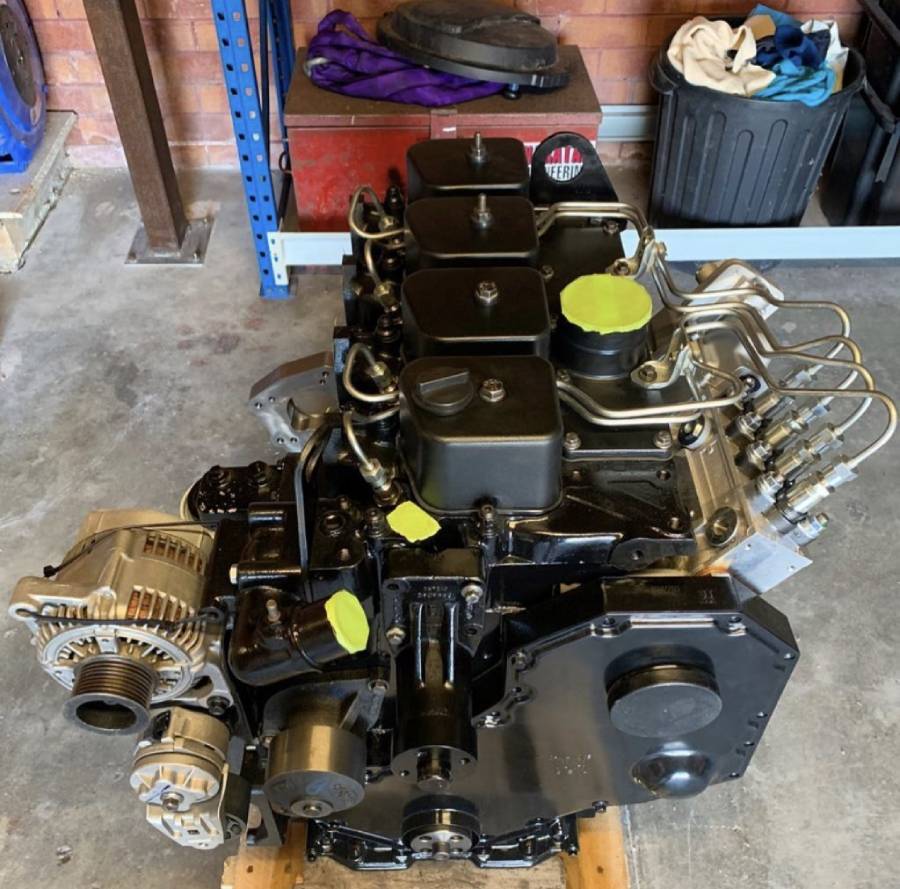
What Are the Cummins 4BT Engine Specs?
The Cummins 4BT is a 3.9-liter inline-four turbocharged diesel engine from the Cummins B Series. Its basic architecture uses four cylinders, a long-stroke configuration, liquid cooling, and direct diesel fuel injection. Exact horsepower, torque, compression ratio, dimensions, weight, and component specifications can vary by engine rating, CPL, and application.
| Specification | Cummins 4BT |
|---|---|
| Engine type | Four-stroke diesel |
| Configuration | Inline-four |
| Displacement | 3.9 L / 239 cu in |
| Number of cylinders | 4 |
| Bore | 4.02 in / 102 mm |
| Stroke | 4.72 in / 120 mm |
| Aspiration | Turbocharged |
| Cooling | Liquid-cooled |
| Fuel type | Diesel |
| Fuel injection | Direct injection |
| Typical horsepower | Varies by rating and application |
| Typical torque | Varies by rating and application |
| Dimensions | Vary by configuration and installed equipment |
| Weight | Varies by configuration and installed equipment |
These specifications describe the basic architecture of the 4BT rather than every engine carrying the 4BT designation. Cummins produced the engine for different commercial and industrial applications, so components and performance ratings were not identical across all versions. Accessories and installation configuration can also change external dimensions and total engine weight.
This distinction matters when specifications are being used for an automotive project. Displacement, bore, and stroke describe the fundamental engine architecture, while horsepower, torque, dimensions, and weight must be matched to the specific engine configuration whenever precise values are required.
What Is the Displacement of a Cummins 4BT?
The Cummins 4BT has a displacement of approximately 3.9 liters, or 239 cubic inches. Total displacement represents the volume swept by all four pistons as they travel through their cylinders.
The 3.9-liter displacement results from the engine’s four-cylinder architecture combined with its 102 mm bore and 120 mm stroke. Bore represents the diameter of each cylinder, while stroke represents the distance traveled by each piston between top dead center and bottom dead center. Multiplying the swept volume of one cylinder across four cylinders produces the engine’s total displacement.
The 4BT’s displacement also places it within the Cummins B Series while distinguishing its four-cylinder architecture from larger six-cylinder members of the same engine family. For automotive applications, this smaller cylinder count affects the engine’s overall packaging and physical length, which is one reason the 4BT is considered for vehicles where fitting a longer inline-six diesel would present additional constraints.
What Are the Bore and Stroke of a Cummins 4BT?
The Cummins 4BT uses a 4.02-inch (102 mm) bore and a 4.72-inch (120 mm) stroke. The stroke is therefore approximately 18 mm longer than the cylinder bore diameter.
Bore determines the cylinder’s internal diameter, while stroke determines how far the piston travels during each cycle. These two measurements, combined with the four cylinders, produce the 4BT’s approximately 3.9-liter displacement. They are fundamental specifications because they describe the engine’s physical cylinder geometry rather than a performance rating that changes substantially between applications.
The 120 mm stroke makes the 4BT a long-stroke, or undersquare, engine because its stroke is greater than its 102 mm bore. This geometry is consistent with an engine designed around diesel operation and useful torque at relatively low engine speeds rather than the high-RPM characteristics associated with many shorter-stroke gasoline engines.
What Is the Compression Ratio of a Cummins 4BT?
The Cummins 4BT uses a high compression ratio appropriate for a compression-ignition diesel engine, but the exact ratio must be matched to the specific engine version and CPL. A single compression-ratio figure should not be treated as universal across every 4BT configuration without identifying the engine being referenced.
Compression ratio compares the cylinder volume when the piston is at bottom dead center with the remaining combustion-chamber volume when the piston reaches top dead center. Diesel engines compress air sufficiently to produce the temperature required for injected diesel fuel to ignite without a spark plug.
For a 4BT owner, compression ratio is therefore more than a general specification when ordering internal engine components or verifying an engine configuration. The engine identification information and corresponding Cummins technical documentation should be used when an exact compression ratio is required for service, rebuilding, or component selection.
How Much Horsepower Does a Cummins 4BT Produce?
The Cummins 4BT produces different horsepower outputs depending on its engine rating, configuration, and original application. There is no single horsepower figure that accurately represents every 3.9-liter 4BT. Factory versions were calibrated for different operating requirements, so horsepower should be matched to the specific engine model and CPL rather than inferred from the 4BT designation alone.
Horsepower measures the rate at which the engine performs work and is affected by both torque output and engine speed. Two Cummins 4BT engines can therefore share the same 3.9-liter displacement, 102 mm bore, and 120 mm stroke while carrying different power ratings. The fundamental engine architecture remains similar, but the operating specification does not have to be identical.
This distinction is particularly important when evaluating a 4BT for an automotive application. A horsepower number found for one industrial or commercial configuration should not automatically be applied to another 4BT. The engine’s identification data and corresponding technical specification should be checked before horsepower is used to select a transmission, estimate vehicle performance, or compare the engine with another diesel platform.
Why Do Cummins 4BT Horsepower Ratings Vary?
Cummins 4BT horsepower ratings vary because the 4BT designation identifies an engine family and basic configuration rather than one universal performance calibration. Different versions were configured to meet the operating requirements of specific equipment and applications.
The engine’s fuel-system configuration and calibration directly affect the amount of fuel delivered under a given operating condition. Turbocharging and related engine components also influence the amount of air available for combustion. These variables allow engines with the same displacement and basic cylinder geometry to operate at different power levels.
Rated engine speed is another specification that must be considered with horsepower. A horsepower rating without its associated RPM and engine configuration provides incomplete information because horsepower depends on both torque and rotational speed. For this reason, comparisons between two 4BT versions should use their complete factory ratings rather than horsepower alone.
For an automotive project, the correct sequence is to identify the specific 4BT first and evaluate its rated output second. Engine identification information and CPL provide a more reliable basis for determining the appropriate factory specification than assuming every 3.9-liter 4BT produces the same power.
How Much Torque Does a Cummins 4BT Produce?
The Cummins 4BT produces different torque outputs according to its factory rating and application, with its useful output concentrated at relatively low engine speeds compared with high-RPM gasoline engines. An exact peak-torque figure should therefore be associated with a specific 4BT configuration rather than presented as a universal specification.
Torque represents rotational force at the crankshaft. The 4BT’s 3.9-liter displacement and 120 mm stroke are part of the physical architecture behind its diesel operating characteristics, but cylinder geometry alone does not determine the final torque rating. Fuel delivery, turbocharger configuration, engine speed, and factory calibration also affect output.
Torque is especially relevant in an automotive context because vehicle acceleration under load, gearing requirements, transmission selection, and drivability depend on where and how the engine produces rotational force. A 4BT swap should consequently be evaluated using both peak torque and the RPM at which that torque is available rather than using peak horsepower as the only performance measurement.
The same principle applies when comparing the 4BT with another engine. A higher peak horsepower figure does not independently establish how two engines will behave at lower engine speeds. Horsepower, torque, RPM, gearing, and vehicle weight need to be considered together when evaluating an engine for a specific vehicle.
At What RPM Does a Cummins 4BT Make Peak Torque?
The RPM at which a Cummins 4BT reaches peak torque depends on the specific engine rating and configuration. A single peak-torque RPM cannot be assigned reliably to every 4BT without identifying the version being evaluated.
Peak-torque RPM identifies the engine speed at which maximum rated rotational force is available. This value is useful because two engines with similar peak-torque figures can deliver that torque at different engine speeds, producing different operating characteristics once connected to a transmission and final-drive ratio.
For an engine swap, the relationship between torque and RPM affects transmission gearing, cruising speed, tire-size selection, and final-drive ratio. Matching these components to the engine’s operating range is more useful than selecting a drivetrain from the peak torque number alone.
The exact factory torque and RPM specifications should therefore be verified from documentation corresponding to the engine’s model and CPL. This approach prevents specifications from one 4BT application from being incorrectly attributed to another configuration that uses the same 3.9-liter basic engine architecture.
What Are the Dimensions of a Cummins 4BT Engine?
The Cummins 4BT is shorter than an inline-six diesel because its inline-four configuration uses two fewer cylinders, but its exact external dimensions depend on the engine configuration and installed components. Length, width, and height should therefore be verified for the specific engine before using the measurements for an engine-swap project.
Engine dimensions include more than the basic cylinder block. Components such as the turbocharger, intake and exhaust hardware, oil pan, fan assembly, accessory drive, alternator, starter, and other installed equipment can change the space required around the engine. A bare-engine measurement consequently does not establish the complete clearance required inside a vehicle.
Length is particularly relevant when comparing the 4BT with an inline-six engine because the four-cylinder layout reduces the longitudinal space occupied by the basic engine. Width and height remain important because turbocharger placement, intake routing, oil-pan configuration, and accessory locations can interfere with the firewall, hood, frame, steering components, or front axle.
For this reason, Cummins 4BT dimensions should be treated as configuration-specific measurements when precise fitment is required. Generic dimensions are useful for preliminary planning, but physical measurements of the intended engine and vehicle provide a stronger basis for final installation decisions.
Will a Cummins 4BT Fit in a Typical Engine Bay?
A Cummins 4BT can fit in many automotive engine bays, but engine dimensions alone do not determine whether a specific vehicle can accept the engine. Fitment depends on the available engine-bay envelope and the clearance required by the complete powertrain.
There are several major dimensions and clearances to evaluate. Engine length affects clearance between the radiator area and firewall. Engine height affects hood and front-axle clearance. Width affects the relationship between the engine, frame rails, steering system, and exhaust components. The transmission and drivetrain then determine where the complete powertrain can sit longitudinally inside the chassis.
Installed components create additional constraints. A turbocharger or exhaust outlet can occupy space that appears available when only block dimensions are measured. The oil pan must clear the axle or crossmember, while the cooling fan and radiator require adequate space at the front of the engine. Engine mounts also have to position the powertrain without creating interference with these components.
A reliable fitment assessment should therefore compare the dimensions of the actual 4BT configuration with measurements from the intended vehicle. Engine-bay length, width, height, firewall clearance, hood clearance, axle or crossmember position, transmission location, and cooling-system space should all be checked before the engine position is finalized.
How Much Does a Cummins 4BT Engine Weigh?
The weight of a Cummins 4BT varies with engine configuration and the components included in the measurement. A weight figure should identify whether it represents a basic engine, a dry configuration, or an assembly equipped with accessories and fluids before it is used for vehicle calculations.
This distinction matters because an installed engine includes more than the cylinder block and cylinder head. The turbocharger, manifolds, starter, alternator, accessory drive, flywheel or flexplate, fluids, and other components contribute to total installed mass. Different accessory arrangements can therefore produce different measured weights for engines that share the same basic 4BT architecture.
Engine weight is a particularly important specification in automotive applications because it becomes part of the vehicle’s sprung mass and changes the load carried by the chassis and suspension. The effect also depends on where the engine is positioned. Adding mass near the front axle has different consequences for vehicle balance than adding the same mass closer to the vehicle’s center.
For preliminary planning, a published 4BT weight can establish the approximate scale of the installation. For suspension calculations, axle-load analysis, or final vehicle setup, the weight of the specific engine configuration and its associated powertrain components provides a more useful figure.
Why Does Cummins 4BT Weight Matter for an Engine Swap?
Cummins 4BT weight matters in an engine swap because engine mass affects front-axle load, suspension requirements, vehicle weight distribution, and handling. An engine that physically fits inside the engine bay is not automatically suitable for the chassis supporting it.
The front suspension must support the static engine load while also controlling movement during braking, cornering, and travel over uneven surfaces. Increasing front-end mass can change ride height and suspension behavior if the existing springs and dampers were designed around a substantially lighter powertrain. The front axle, crossmember, engine mounts, and related structural components must also carry the resulting loads.
Weight distribution is another consideration. Placing a heavy diesel engine farther forward increases the proportion of vehicle mass carried by the front axle. Engine position can therefore be as important as total engine weight. Moving the powertrain rearward within the available packaging space can alter weight distribution, although firewall, transmission, driveline, and service-clearance requirements limit how far the engine can be repositioned.
A 4BT swap should consequently be evaluated as a complete vehicle system. Engine weight, transmission weight, engine position, axle ratings, suspension capacity, mount design, and vehicle gross weight all contribute to whether the installation is mechanically appropriate. Dimensions determine whether the engine can occupy the available space; weight determines whether the vehicle can support that installation correctly.
What Fuel System Does the Cummins 4BT Use?
The Cummins 4BT uses direct diesel fuel injection, with fuel-system components and calibration varying by engine version and application. The injection system delivers metered diesel fuel directly into each cylinder, where combustion begins after the compressed air reaches a sufficiently high temperature.
Fuel delivery has a direct relationship with engine operation because a diesel engine controls output largely through the quantity and timing of injected fuel while sufficient air must remain available for combustion. The injection pump supplies and meters fuel, the injectors deliver it into the combustion chambers, and the turbocharger increases the mass of air available to the engine. These systems must operate as a matched configuration rather than as independent components.
Not every Cummins 4BT should be assumed to have an identical injection-pump configuration. The 4BT was produced in different specifications for different applications, and fuel-system hardware and calibration can vary accordingly. This variation is also one reason two 3.9-liter 4BT engines with the same 102 mm bore and 120 mm stroke can carry different horsepower and torque ratings.
For an automotive installation, identifying the existing fuel system is necessary before selecting replacement components or making changes to the engine. The engine identification information and CPL should be matched with the appropriate technical documentation because a component designed for one 4BT configuration should not automatically be treated as interchangeable with every other version.
The fuel system also affects how a 4BT should be evaluated as a complete powertrain. Fuel delivery, airflow, turbocharger operation, engine speed, and drivetrain loading are connected variables. Changing one component without accounting for the rest of the engine configuration can move the engine away from its original operating specification.
How Much Oil Does a Cummins 4BT Hold?
The oil capacity of a Cummins 4BT must be matched to the specific oil-pan and engine configuration rather than treated as one universal capacity for every 4BT. The available source material for this article does not establish one verified oil-capacity figure that applies across all configurations, so an exact number should not be presented as a universal specification.
Oil capacity can refer to different measurements. Oil-pan capacity describes the amount associated with the sump, while total lubrication-system capacity can include oil contained in the filter and lubrication passages. Whether a published specification includes the oil filter is therefore important when determining how much oil is required during service.
The lubrication system performs several functions inside the 4BT. Engine oil creates a lubricating film between moving surfaces, carries heat away from lubricated components, transports contaminants toward the filter, and supplies oil to components that depend on pressurized lubrication. Maintaining the specified oil level is consequently more important than filling the engine according to a generic capacity found for an unidentified 4BT configuration.
For an oil change, the correct procedure is to identify the engine and oil-pan configuration, use the applicable service specification, account for the filter where required, and verify the final oil level according to the engine’s prescribed checking procedure. This avoids both underfilling and overfilling when different 4BT configurations use different lubrication-system capacities.
Oil capacity should also be separated from oil specification. Capacity determines the required quantity, while the specified lubricant determines properties such as viscosity and performance classification. Selecting the correct quantity does not compensate for using an oil that fails to meet the requirements for the engine and its operating conditions.
Are All Cummins 4BT Engine Specifications the Same?
No, not all Cummins 4BT engines have identical specifications. The 4BT designation identifies the basic 3.9-liter, inline-four, turbocharged diesel architecture, but individual engines can differ in performance ratings, fuel-system configuration, installed components, and application-specific specifications.
This distinction explains why specifications from two references can differ without either necessarily describing the engine family incorrectly. Displacement, cylinder count, bore, and stroke represent fundamental characteristics of the basic 4BT architecture. Horsepower, torque, compression ratio, oil capacity, external dimensions, and operating specifications require more attention to the individual engine configuration.
Application is one source of variation. Cummins engines were configured for different operating requirements, so the complete specification of an engine depends on more than displacement. Fuel-system calibration, installed accessories, turbocharger-related components, oil-pan configuration, and other application-specific equipment can change the specifications relevant to service or installation.
For this reason, a generic Cummins 4BT specification table is most useful for identifying the engine’s basic architecture. Anyone ordering internal components, planning a rebuild, selecting drivetrain parts, or performing an engine swap should identify the specific engine before relying on configuration-dependent specifications.
What Is a Cummins CPL Number?
A Cummins CPL, or Control Parts List, is an identifier used to distinguish a specific engine configuration and its corresponding parts arrangement. For a Cummins 4BT, the CPL provides more precise identification than the general 4BT family name when configuration-specific information is required.
The distinction is important because “Cummins 4BT” describes a broader engine family. Two engines can both be 4BTs while using different components or operating specifications. The CPL helps narrow that broad identity to the configuration needed when matching technical information and replacement parts.
For example, knowing only that an engine is a 3.9-liter 4BT establishes its displacement and basic cylinder arrangement. It does not independently establish every fuel-system component, performance rating, oil-system configuration, or service part. The CPL and other engine identification data provide additional context for determining which specifications apply.
This makes the CPL particularly useful when purchasing a used 4BT for an automotive project. A seller’s statement that an engine is a “4BT” identifies the engine family, but the identification data are required to determine the configuration more precisely before parts compatibility or exact performance specifications are assumed.
How Can You Identify the Correct Specs for a Cummins 4BT?
Identify the specific Cummins 4BT before selecting configuration-dependent specifications by using the engine identification information and matching it with the appropriate technical documentation. Generic online specification tables should be used as an overview rather than as the final authority for every individual engine.
Start with the identification information attached to the engine. Record the available engine identifiers, including the CPL where provided, instead of relying only on visual appearance or the 4BT name. These identifiers provide a stronger basis for distinguishing engines that share the same basic architecture.
Next, match the identification information with documentation for that engine configuration. Verify configuration-dependent specifications such as horsepower, torque, compression ratio, lubrication capacity, fuel-system components, and service parts against that documentation. This prevents a specification belonging to one 4BT version from being applied automatically to another.
Physical measurements should also be verified when the engine is being installed in a vehicle. Published length, width, height, and weight figures can depend on which accessories and components are included. Measuring the actual engine, turbocharger location, oil pan, accessory drive, and transmission combination provides the dimensions needed to evaluate engine-bay clearance.
The same verification process should be used before ordering replacement parts. Identify the engine first, match the relevant configuration second, and select components from the corresponding technical information third. This sequence is more reliable than assuming that every component marketed for a Cummins 4BT fits every 3.9-liter 4BT configuration.
What Vehicles and Equipment Used the Cummins 4BT?
The Cummins 4BT was designed for commercial and industrial applications rather than for one specific passenger-vehicle platform. Its 3.9-liter displacement, inline-four layout, turbocharged diesel configuration, and relatively compact length allowed the engine family to serve applications where a larger inline-six diesel required more installation space.
The exact original application depends on the specific 4BT configuration. Different applications can require different power ratings, fuel-system calibrations, accessory arrangements, oil-pan configurations, and supporting components. This application-specific engineering is one reason a 4BT removed from one type of equipment should not automatically be assumed to have the same specifications as another 4BT.
Original equipment use should also be distinguished from modern automotive engine swaps. A vehicle equipped with a 4BT through an aftermarket conversion is not evidence that the vehicle originally received that engine from the manufacturer. Maintaining this distinction prevents swap applications from being incorrectly presented as factory applications.
For buyers considering a used 4BT, the engine’s original application provides useful context but does not replace engine identification. The CPL and other identification information should still be used to determine the engine’s specific configuration, particularly when horsepower, torque, fuel-system components, service parts, or other configuration-dependent specifications are required.
Is the Cummins 4BT a Good Engine for a Vehicle Swap?
The Cummins 4BT can be suitable for a vehicle swap when its dimensions, weight, torque characteristics, drivetrain requirements, and supporting systems are compatible with the target vehicle. Its four-cylinder architecture reduces engine length compared with a comparable inline-six layout, but physical fit is only one requirement for a successful installation.
Engine dimensions should be evaluated first. The engine must clear the firewall, hood, frame, steering system, front axle or crossmember, and other chassis components. Space must also remain for the turbocharger, exhaust routing, intake system, radiator, cooling fan, accessory drive, and service access. Measuring only the cylinder block does not establish whether the complete installation will fit.
Engine weight creates a second set of requirements. The front axle, springs, dampers, crossmember, and engine mounts must support the installed powertrain. Weight distribution also changes according to the engine’s position in the chassis. A swap that fits geometrically can still require suspension or structural changes if the replacement powertrain places substantially different loads on the vehicle.
The drivetrain is the third major consideration. Transmission compatibility, gearing, final-drive ratio, tire diameter, driveshaft arrangement, and axle capacity should be evaluated against the specific 4BT’s torque output and operating-speed range. Selecting these components from a generic 4BT horsepower figure does not account for differences between engine ratings.
Cooling and fuel delivery form another part of the installation. The radiator and airflow system must remove the heat generated by the engine under the intended operating load, while the fuel system must supply diesel fuel correctly to the engine’s injection system. Exhaust routing, electrical integration, instrumentation, and starting and charging systems also need to function as parts of the completed vehicle.
The suitability of a 4BT swap therefore depends on the complete vehicle-engine combination rather than the reputation of the engine alone. A practical evaluation should connect 4BT dimensions to available space, engine weight to chassis capacity, torque to drivetrain requirements, and the specific engine configuration to the intended vehicle use. This approach determines whether the engine is appropriate for a particular project instead of treating the 4BT as a universal swap solution.
How Do Cummins 4BT and 6BT Specs Compare?
The main difference between the Cummins 4BT and 6BT is their cylinder count and displacement: the 4BT is a 3.9-liter inline-four, while the 6BT is a larger inline-six from the Cummins B Series. The additional two cylinders give the 6BT greater displacement and change its overall length, weight, power potential, and installation requirements.
Both engines belong to the same broader B-Series family, making the 6BT a useful reference point for understanding the 4BT’s physical and performance characteristics. The comparison should not, however, treat every version of either engine as having one horsepower, torque, weight, or external-dimension specification. Those figures depend on the configuration and application being compared.
| Specification | Cummins 4BT | Cummins 6BT |
|---|---|---|
| Engine family | Cummins B Series | Cummins B Series |
| Engine type | Four-stroke diesel | Four-stroke diesel |
| Configuration | Inline-four | Inline-six |
| Cylinders | 4 | 6 |
| Displacement | Approx. 3.9 L | Approx. 5.9 L |
| Aspiration | Turbocharged configurations | Turbocharged configurations |
| Fuel | Diesel | Diesel |
| Cooling | Liquid-cooled | Liquid-cooled |
| Engine length | Shorter basic architecture | Longer basic architecture |
| Horsepower | Depends on rating and application | Depends on rating and application |
| Torque | Depends on rating and application | Depends on rating and application |
| Weight | Depends on configuration | Depends on configuration |
The displacement difference follows directly from the cylinder arrangement. The 4BT uses four cylinders, while the 6BT adds two cylinders to the inline layout. This increases total displacement from approximately 3.9 liters in the 4BT to approximately 5.9 liters in the 6BT and creates a physically longer basic engine architecture.
The size difference has direct consequences for automotive installation. A shorter inline-four can require less longitudinal engine-bay space than an inline-six, which is relevant when firewall-to-radiator clearance is limited. The complete installation still depends on turbocharger placement, accessories, cooling components, oil-pan configuration, transmission position, and other vehicle-specific constraints.
The 6BT’s greater displacement also changes the performance comparison. A larger displacement provides a different basis for factory power and torque output, but displacement alone should not be used to assign an exact performance advantage to every engine. A meaningful comparison requires the factory ratings of the specific 4BT and 6BT configurations being evaluated.
Weight must be considered in the same way. The 4BT’s four-cylinder architecture eliminates two cylinders relative to the inline-six configuration, but an exact weight difference requires comparable specifications measured under equivalent conditions. A dressed engine, a dry engine, and an engine with different accessories cannot be compared accurately from figures that use different measurement definitions.
For an engine swap, the choice between a 4BT and 6BT therefore involves more than selecting the engine with the higher output. The 4BT prioritizes a shorter four-cylinder package, while the 6BT provides the displacement of a six-cylinder platform at the cost of additional packaging requirements. Engine-bay dimensions, chassis capacity, desired output, transmission compatibility, axle loading, gearing, and intended vehicle use should determine which configuration is more appropriate.
A detailed Cummins 4BT vs. 6BT comparison can examine those differences separately. For understanding Cummins 4BT engine specs, the important point is that the 4BT’s 3.9-liter inline-four architecture determines its basic physical identity, while its exact horsepower, torque, weight, and installation dimensions still need to be matched to the individual engine configuration.