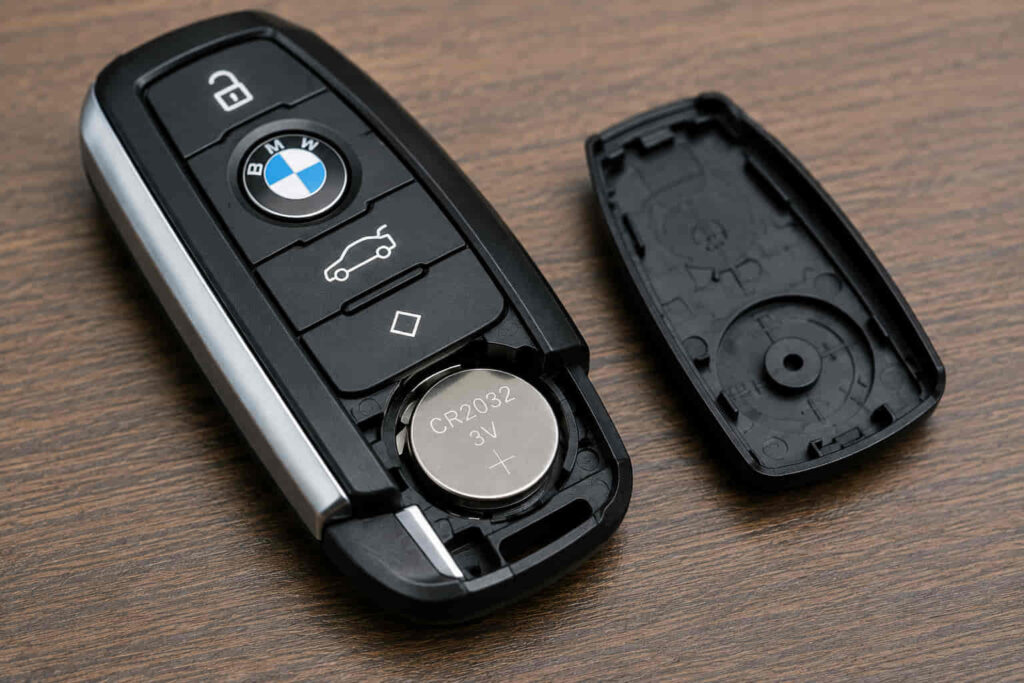
Changing a BMW key fob battery is a straightforward process that involves identifying the correct replacement battery, opening the key fob, removing the depleted battery, installing the new one in the correct orientation, and testing the key afterward. Most of the work can be completed at home without replacing the entire key fob, provided the problem is caused by a depleted battery rather than damage to the key itself.
The exact battery replacement process depends on the BMW key fob design. BMW has used different key designs across its vehicle models and production years, so the battery type, battery compartment, and method used to open the key can differ. Checking the existing battery or the specifications for the specific key fob before purchasing a replacement prevents incorrect battery selection and installation.
This guide explains how to change a BMW key fob battery in 7 steps, from identifying the key and battery type to testing the remote functions after installation. It also covers the signs of a weak key battery, battery selection, whether reprogramming is necessary, and the main reasons a BMW key fob may still fail to work after a new battery is installed.
How Do You Change a BMW Key Fob Battery in 7 Steps?
Changing a BMW key fob battery involves 7 steps: identifying the key and battery type, preparing the replacement battery, removing the mechanical key, opening the battery compartment, removing the old battery, installing the new battery, and reassembling and testing the key fob. The exact opening method can differ between BMW key designs, so confirm the key type before applying pressure to the housing or attempting to remove its cover.
The first step is to identify the BMW key fob and the battery it uses. BMW key fobs are not identical across every model and production year, which means the correct replacement battery should be verified rather than assumed. Examine the existing battery for its identifying code after gaining access to it, or confirm the battery specification for the specific key design. Matching the replacement to the original battery specification prevents problems caused by an incorrectly sized or incompatible battery.
The second step is to prepare the correct replacement battery before disassembling the key. Keep the new battery within reach and work on a clean, stable surface where small components cannot easily be lost. The replacement battery must match the required dimensions and specification because the battery compartment and electrical contacts are designed to hold a particular battery securely. A battery that does not fit correctly may fail to maintain consistent contact even if it can physically be placed inside the key.
The third step is to remove the mechanical or emergency key when the BMW key fob design includes a removable one. Locate the release mechanism on the key fob, operate it, and pull the mechanical key out of the housing. The mechanical key provides manual vehicle access when remote functions are unavailable and, on applicable key designs, its removal also provides access to the area used to open the battery compartment.
The fourth step is to open the battery compartment carefully. Locate the opening point or removable cover designed for battery access and separate the cover without applying excessive force to unrelated parts of the housing. The objective is to expose the battery while keeping the cover, retaining features, and internal components intact. If the housing does not release with reasonable pressure, verify the opening method for that specific BMW key design instead of forcing it apart.
The fifth step is to remove the depleted battery while noting its original position. Check the battery orientation before taking it out because the replacement must be installed with the correct polarity. Remove the battery from its holder without bending or unnecessarily disturbing the electrical contacts around it. Recording the original orientation, such as by taking a photo before removal, provides a direct reference when the new battery is installed.
The sixth step is to install the replacement battery in the same required orientation. Match the positive and negative sides to the orientation used by the original battery and seat the replacement securely against the battery contacts. Correct polarity allows the key fob circuit to receive power as designed, while secure contact prevents intermittent operation caused by a battery that is loose inside the holder. Before closing the housing, check that the battery sits flat and does not move out of position.
The seventh and final step is to reassemble and test the BMW key fob. Refit the battery cover until it is securely seated, then reinstall the mechanical key if it was removed earlier. Test the lock and unlock functions near the vehicle and check other remote functions supported by the specific key and BMW model. The battery replacement is complete when the key fob is correctly reassembled and its remote functions respond normally. If the key remains unresponsive, reopen the battery compartment and verify the battery type, orientation, fit, and electrical contact before assuming that the key itself requires repair or programming.
What Battery Does a BMW Key Fob Use?
The battery used in a BMW key fob depends on the specific key design, so the correct battery should be verified before a replacement is installed. BMW has used different key fobs across vehicle models and production years, and treating every BMW key as if it uses the same battery creates a risk of purchasing the wrong size or specification.
The most reliable reference is the battery already installed in the key fob when it can be safely accessed. Coin-cell batteries have identifying codes printed on their surface, and the replacement should match the specification required by the key. The battery must also fit securely inside the compartment because its surfaces need to maintain consistent contact with the key fob’s electrical terminals. A battery with the wrong dimensions may fit poorly or fail to power the remote reliably.
Battery orientation is as important as battery selection. Before removing the old battery, observe which side faces upward and how it sits against the contacts. Install the replacement in the required positive and negative orientation rather than assuming that every BMW key uses the same arrangement. This simple check reduces the risk of interpreting an incorrectly installed battery as a defective key fob.
For this reason, identify the exact battery specification from the existing battery or documentation applicable to the specific BMW key before buying a replacement. Matching the battery specification, physical fit, and polarity provides a more reliable replacement than selecting a battery solely because it is commonly associated with BMW key fobs.
Read more: BMW Navigation Update
How Can You Tell When a BMW Key Fob Battery Needs Replacing?
A BMW key fob battery should be checked for replacement when remote performance becomes weaker, inconsistent, or stops working because the battery can no longer provide sufficient power for normal key operation. The change may appear gradually as the battery loses charge rather than as an immediate complete failure.
Reduced operating range is one useful warning sign. A key that previously locked or unlocked the vehicle from a normal distance but begins requiring the driver to move closer may have a weakening battery. The remote depends on sufficient battery power to transmit its signal, so declining performance can become noticeable before the battery is completely depleted. Range alone does not prove that the battery is responsible, but it provides a practical reason to inspect the battery when the change is persistent.
Intermittent response provides another indication. The vehicle may respond to one button press but fail to respond consistently to subsequent presses, or the driver may find that a button needs to be pressed repeatedly. When these symptoms appear across remote functions rather than being isolated to one physically damaged button, checking the battery is an appropriate first diagnostic step because battery replacement is simpler than assuming that the entire key has failed.
A vehicle-generated key battery warning, where supported by the specific BMW model and key system, provides a more direct reason to inspect or replace the battery. The exact warning behavior can vary by vehicle and key system, so it should be interpreted according to the applicable BMW documentation rather than assumed to be identical across every model.
A completely unresponsive key can also result from a depleted battery, but a key fob that does not work is not automatically proof of a dead battery. Incorrect battery installation, poor electrical contact, physical key damage, or another key-related fault can produce similar symptoms. Replacing or checking the battery is therefore an efficient first diagnostic action when the remote range declines, operation becomes intermittent, a relevant battery warning appears, or remote functions stop responding.
Do You Need to Reprogram a BMW Key Fob After Changing the Battery?
A BMW key fob does not necessarily need to be reprogrammed simply because its battery has been replaced. Battery replacement and key programming are two different processes: replacing the battery restores the key fob’s power source, while programming concerns how the key communicates with and is recognized by the vehicle. A depleted battery alone does not establish that the key has lost its programming.
Test the key before attempting any additional procedure. After installing the correct battery, close the key fob completely and check whether the vehicle responds to its normal remote functions. If locking, unlocking, and other applicable functions operate normally, the battery replacement has restored the expected operation and there is no reason to treat the key as a programming problem.
Programming or synchronization should therefore not be the first explanation when a BMW key fails immediately after a battery change. The battery itself creates several simpler diagnostic possibilities. It may be installed in the wrong orientation, may not match the specification required by the key, or may not be making consistent contact with the terminals. Checking these installation variables first follows the actual sequence of the repair and prevents a battery-related problem from being misdiagnosed as a programming fault.
The procedure required when a key remains unrecognized can depend on the BMW model, model year, and key system. For that reason, do not apply a generic BMW key programming procedure to every vehicle after replacing the battery. Verify the applicable procedure for the specific vehicle or have the key diagnosed when correct battery installation does not restore operation.
Why Is Your BMW Key Fob Not Working After a Battery Change?
A BMW key fob can remain unresponsive after a battery change when the replacement battery is incorrect, installed incorrectly, making poor electrical contact, or when the fault is located elsewhere in the key or vehicle system. Troubleshooting should begin with the components that were handled during the battery replacement before moving to more complex explanations.
First, reopen the battery compartment and check the battery orientation. The positive and negative sides must correspond with the arrangement required by the key fob. A battery installed in the wrong orientation cannot supply power to the circuit as intended. Comparing the new battery position with a photo or observation of the original installation provides a direct way to identify an orientation error.
Next, confirm that the replacement battery matches the required specification and sits securely inside the holder. A battery that appears similar is not sufficient if its dimensions or specification do not match what the key requires. The battery must remain positioned against the appropriate electrical contacts so that power can flow consistently through the key fob circuit.
The contact area should also be inspected when the battery is correct but the key remains intermittent or completely unresponsive. A battery that is not seated properly may lose electrical contact even when its polarity is correct. Check that it lies flat in the holder and that the accessible contacts have not been displaced during removal or installation. The objective is to confirm a stable physical connection before moving beyond battery-related causes.
If the battery type, orientation, seating, and contacts are correct but the BMW key fob still does not operate, the fault may extend beyond the battery. Physical damage to the key, a failed internal component, or a vehicle/key recognition issue requires a different diagnostic path from ordinary battery replacement. Replacing additional batteries repeatedly will not correct a fault that is unrelated to the battery. At that stage, identify the specific BMW model and key system and diagnose the key itself rather than continuing to treat the problem as a depleted-battery issue.
How Long Does a BMW Key Fob Battery Last?
The lifespan of a BMW key fob battery is not identical for every key because battery life depends on the key design, battery condition, frequency of use, and functions supported by the vehicle. For this reason, a fixed replacement interval should not be applied to every BMW key fob unless that interval is specified for the particular key and vehicle.
Battery consumption occurs whenever the key fob uses electrical power to support its functions. Repeated remote operation contributes to battery discharge, while the design of the key and the communication features available on the vehicle can affect how the battery is used. Two BMW owners can therefore experience different replacement intervals even when both key fobs continue to operate normally for an extended period.
Battery quality and condition also affect service life. A correctly specified replacement battery must provide stable electrical contact and sufficient charge for the key fob to function reliably. Installing a battery that has been stored for a long period, is damaged, or does not match the required specification can result in shorter service life or symptoms that resemble rapid battery depletion.
The practical replacement point is determined by key performance and applicable vehicle warnings rather than by age alone. Reduced remote range, intermittent response, repeated failure to respond, or a supported low-battery warning provides a stronger reason to inspect the battery than replacing it solely because a predetermined amount of time has passed. Replace the BMW key fob battery when its condition begins affecting normal key operation or when the applicable vehicle system indicates that replacement is required.
Can You Replace a BMW Key Fob Battery Yourself?
You can replace a BMW key fob battery yourself when the key uses an accessible replaceable battery and the problem is limited to battery depletion. The process requires identifying the correct battery, opening the designated battery compartment, preserving the original battery orientation, installing the replacement correctly, and testing the key after reassembly. It does not require replacing the entire key simply because its battery has lost charge.
DIY replacement is appropriate when the key housing, battery holder, and accessible contacts are intact. The main objective is to restore the key’s power source without damaging the components around it. Applying excessive force to the housing, using an incorrectly sized battery, reversing the battery orientation, or disturbing the contacts can turn a simple battery replacement into a separate key fob problem.
The result should always be verified at the vehicle. After reassembling the key, test the remote functions that normally operate with that key and confirm that its response has returned to normal. Successful operation indicates that the depleted battery was consistent with the original problem and that the replacement restored the required power supply.
Professional diagnosis becomes more appropriate when correct battery replacement does not restore operation or when the key shows physical or internal damage. A damaged housing, displaced contact, persistent communication failure, or another fault outside the battery compartment cannot be resolved simply by installing another battery. DIY battery replacement addresses a depleted power source; it does not repair every possible BMW key fob fault. Distinguishing between these two situations prevents unnecessary battery changes and directs unresolved problems toward the correct diagnostic process.