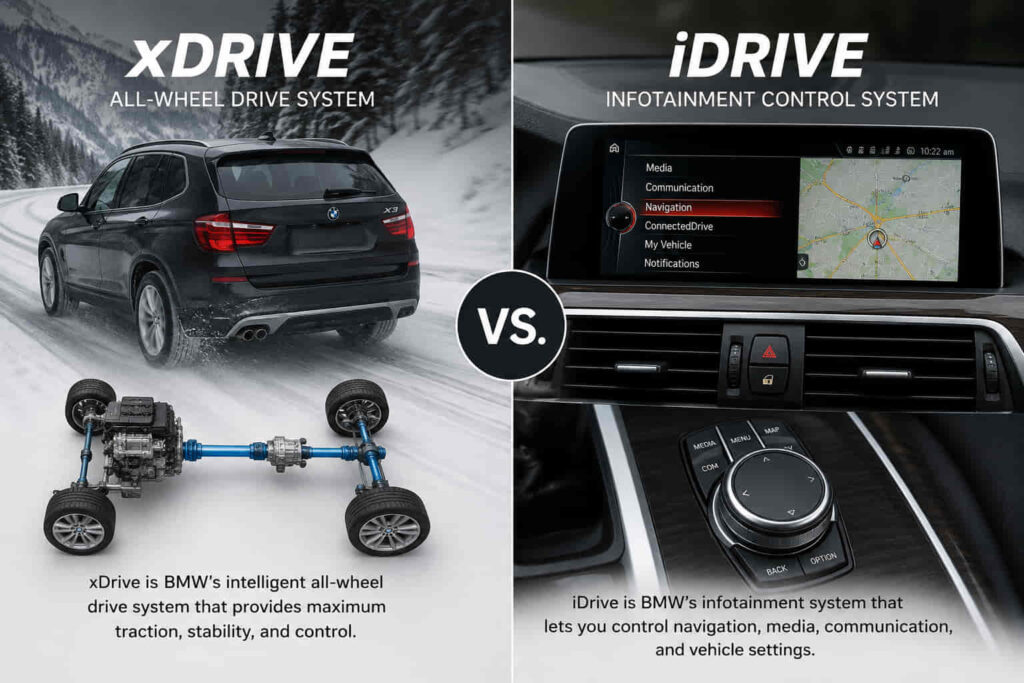
BMW xDrive and iDrive are two different vehicle technologies: xDrive is BMW’s all-wheel-drive system, while iDrive is BMW’s infotainment and vehicle-control interface. xDrive operates within the drivetrain and helps manage how driving force is distributed to support traction. iDrive gives the driver an interface for accessing supported functions such as navigation, media, communication, and vehicle settings. Despite their similar names, the two systems do not perform competing functions.
The distinction also means that choosing between BMW xDrive and iDrive is not a direct either-or decision. A BMW can have both systems because one relates primarily to how the vehicle delivers power to the road and the other relates to how occupants interact with information and vehicle functions. xDrive can influence driving behavior and traction under changing road conditions, whereas iDrive primarily influences the in-car user experience and access to supported features.
Understanding BMW xDrive vs. iDrive therefore requires comparing their purpose, operation, effect on the vehicle, and role for the driver rather than asking which system is universally better. This article explains seven key differences between xDrive and iDrive, including how each technology works, how drivers interact with it, whether the two systems can exist in the same BMW, and which one deserves more attention when evaluating a vehicle.
What is the main purpose of BMW xDrive vs. iDrive?
The main difference between BMW xDrive and iDrive is their purpose: xDrive manages drivetrain power distribution to support traction, while iDrive provides an interface for accessing infotainment and supported vehicle functions. This distinction places the two technologies in different functional areas of a BMW. xDrive is connected to how the vehicle uses available traction, whereas iDrive is connected to how the driver interacts with information, entertainment, communication, and vehicle settings.
BMW xDrive operates as an all-wheel-drive technology. Its purpose is to help distribute driving force according to the vehicle’s drivetrain strategy and current operating conditions. This makes xDrive relevant when evaluating traction, drivetrain behavior, and how a BMW responds when available grip differs between the wheels or axles. Tires, road conditions, and other vehicle systems still influence traction, so xDrive should not be treated as the only factor determining how much grip a vehicle has.
BMW iDrive serves a fundamentally different purpose. It organizes access to supported functions through the vehicle’s infotainment interface. Depending on the BMW model and iDrive generation, the driver may use the system for functions involving navigation, media, communication, connectivity, and vehicle configuration. These functions affect interaction with the car rather than mechanically distributing power to its wheels.
The practical distinction is therefore xDrive → drivetrain and traction, while iDrive → infotainment and vehicle interaction. Their similar names describe BMW technologies but do not indicate that the systems perform similar jobs. This is why comparing xDrive and iDrive as competing options would misrepresent their relationship.
How does BMW xDrive work differently from iDrive?
BMW xDrive works through the vehicle’s drivetrain, while iDrive works primarily as an information and control interface between the vehicle and its occupants. The difference is not simply that one system has different features from the other; each technology operates within a different vehicle context and produces a different type of result.
xDrive is involved in transferring driving force through an all-wheel-drive system. As driving conditions change, the drivetrain can manage how power is delivered to support traction and vehicle operation. The driver does not use xDrive as a menu system to send power manually to individual wheels during normal operation. Instead, the drivetrain system performs its function as the vehicle responds to operating conditions.
iDrive processes a different type of interaction. The driver uses the infotainment environment to view information, select supported functions, adjust available settings, control media, access navigation, or manage compatible communication features. The exact interface and available functions vary by BMW model, equipment, and iDrive generation, but the central role remains interaction rather than drivetrain power distribution.
This creates a clear mechanical and functional separation. Pressing or selecting an option through iDrive does not mean iDrive itself drives the wheels, just as xDrive does not function as the vehicle’s infotainment interface. Some vehicle settings accessed through iDrive can influence how other systems are configured, but that does not make iDrive the mechanical system performing those functions.
The operating relationship can therefore be understood as xDrive managing a drivetrain task while iDrive manages a driver-interface task. A BMW equipped with both systems uses them simultaneously for different purposes: xDrive operates within the driving system, while iDrive provides access to information and supported controls inside the vehicle.
Read more: BMW Bluetooth Not Working
Does xDrive affect how a BMW drives while iDrive controls vehicle functions?
Yes, BMW xDrive can affect how a vehicle uses available traction while iDrive primarily provides access to infotainment and supported vehicle functions. This difference reflects the systems’ positions within the vehicle: xDrive operates as part of the drivetrain, whereas iDrive operates as an interface through which the driver views information and interacts with supported features.
xDrive matters during driving because power delivery and available traction are directly related to how the vehicle transfers driving force to the road. The system can respond to operating conditions by managing power distribution within the all-wheel-drive system. This makes xDrive relevant when traction conditions change, although the resulting grip still depends on factors such as tire condition, tire type, road surface, and the operation of other vehicle systems.
iDrive does not distribute driving force to the wheels. Instead, it gives the driver access to functions such as navigation, media, communication, connectivity, and supported vehicle settings. Selecting a function through iDrive can change a setting or send a request to another vehicle system, but the interface itself is not the mechanical component carrying out a drivetrain function.
This distinction becomes useful when comparing BMW specifications. Seeing xDrive in a model designation or equipment description tells the buyer something about the vehicle’s drivetrain configuration. Seeing a particular iDrive system tells the buyer more about the vehicle’s infotainment environment, available interface, and supported functions. The terms therefore describe different aspects of the same BMW rather than competing versions of one technology.
The practical effect is that xDrive should be evaluated in the context of traction and drivetrain requirements, while iDrive should be evaluated in the context of usability, connectivity, and access to vehicle features. xDrive can influence how the BMW delivers power during driving; iDrive influences how the driver interacts with the vehicle’s information and supported controls.
Do drivers interact with BMW xDrive and iDrive differently?
Yes, drivers interact with xDrive and iDrive differently because iDrive is designed as a direct user interface, while xDrive primarily operates as part of the vehicle’s drivetrain during normal driving. A driver regularly interacts with iDrive to access functions, whereas xDrive generally performs its drivetrain role without requiring continuous manual control.
Depending on the BMW and iDrive generation, interaction with iDrive can involve a central display, physical controller, touchscreen, voice functions, or other supported input methods. The available interface has changed across BMW generations, so one control layout should not be treated as universal. What remains consistent is iDrive’s role as a central environment for accessing information and supported vehicle functions.
xDrive creates a different relationship with the driver. The driver experiences its effects through vehicle behavior and traction rather than operating xDrive as an infotainment menu. The system works with the drivetrain as driving conditions change, making its primary output part of vehicle operation rather than information displayed for the driver’s direct interaction.
A BMW can still provide settings through iDrive that relate to driving behavior or other vehicle systems. This does not mean iDrive becomes the drivetrain technology performing the underlying mechanical action. The interface provides access to a setting, while the relevant vehicle system carries out the function. Separating the control interface from the controlled system prevents the two BMW technologies from being incorrectly treated as equivalent.
For a buyer, this difference also changes what should be evaluated during a test drive. xDrive is relevant to the vehicle’s drivetrain configuration and traction characteristics, while iDrive is evaluated through the usability of its interface and the functionality available in that particular BMW. A driver can therefore assess both technologies in the same vehicle without choosing one instead of the other.
Does BMW xDrive improve traction while iDrive manages infotainment?
BMW xDrive is designed to support traction through the all-wheel-drive system, while iDrive manages the interface used to access infotainment and supported vehicle functions. This difference shows why the two technologies produce fundamentally different outcomes. xDrive affects the drivetrain’s use of available grip, whereas iDrive organizes how the driver interacts with information, entertainment, communication, and configurable functions inside the vehicle.
xDrive supports traction by managing driving force within the all-wheel-drive system according to operating conditions. When available grip changes, drivetrain power distribution can contribute to how effectively the vehicle uses the traction available at the tires. This makes xDrive particularly relevant when comparing drivetrain configurations or considering how a BMW will be used in changing road conditions.
However, xDrive should not be treated as a guarantee of maximum traction in every situation. The tires remain the physical contact points between the BMW and the road, so tire type, tread condition, temperature, and road surface directly affect available grip. xDrive can manage power distribution, but it cannot create tire grip that the road and tires do not provide. This distinction is important when evaluating xDrive for rain, snow, or other low-traction conditions.
iDrive produces a different benefit because its primary role is organizing the driver’s interaction with supported vehicle functions. Depending on the BMW and system generation, these functions can include navigation, media, communication, smartphone connectivity, and configurable vehicle settings. The quality and usefulness of iDrive therefore relate more closely to interface design, available features, compatibility, and ease of operation than to drivetrain performance.
The comparison can consequently be reduced to two different outputs: xDrive supports drivetrain traction, while iDrive supports information and control interaction. A buyer interested in driving conditions should evaluate xDrive alongside tires and the overall drivetrain configuration. A buyer evaluating iDrive should focus on the infotainment generation, available functions, connectivity, and whether the interface meets their usability requirements.
Can a BMW have both xDrive and iDrive?
Yes, a BMW can have both xDrive and iDrive because the two systems perform different functions and are not mutually exclusive technologies. xDrive belongs to the vehicle’s drivetrain context, while iDrive belongs to its infotainment and control-interface context. Having one therefore does not inherently prevent the vehicle from having the other.
A BMW equipped with both systems provides a straightforward example of this relationship. During driving, xDrive can perform its role within the all-wheel-drive system while the driver simultaneously uses iDrive for navigation, media, communication, or supported vehicle settings. The two technologies can operate within the same vehicle because they address separate functional requirements.
This also explains why “xDrive vs. iDrive” can be misleading when interpreted as a purchase choice. A buyer generally does not decide between xDrive and iDrive in the same way they might compare two alternative drivetrain configurations. The relevant drivetrain question is whether a particular BMW has xDrive and whether that configuration suits the buyer’s driving requirements. The separate infotainment question concerns which iDrive system, interface, and features the vehicle provides.
Model descriptions can make the distinction easier to understand. xDrive identifies a drivetrain-related characteristic, whereas iDrive identifies BMW’s infotainment and vehicle-interface technology. The presence of both terms in information about the same vehicle is therefore normal rather than contradictory.
Understanding that coexistence resolves the central terminology confusion behind BMW xDrive vs. iDrive. They share BMW’s “Drive” naming convention, but their names do not establish functional similarity. xDrive helps the vehicle manage driving force and traction; iDrive helps the driver interact with information and supported functions. Their relationship is complementary rather than competitive.
Is BMW xDrive or iDrive more important when choosing a BMW?
Neither BMW xDrive nor iDrive is universally more important when choosing a BMW because the two technologies address different ownership needs. xDrive should be evaluated as part of the vehicle’s drivetrain and traction configuration, while iDrive should be evaluated according to infotainment functionality, connectivity, interface usability, and access to supported vehicle features. The more important system therefore depends on what the buyer is evaluating rather than which technology is objectively better.
xDrive deserves greater attention when drivetrain configuration is a major purchase consideration. A driver who regularly encounters changing traction conditions may place greater value on an all-wheel-drive BMW than someone whose priorities are different. However, xDrive should be considered together with tires, road conditions, vehicle configuration, and intended use. Selecting xDrive does not remove the importance of suitable tires or guarantee the same traction under every driving condition.
iDrive becomes more relevant when the buyer is evaluating the everyday in-car experience. Different BMW models and production periods can use different iDrive generations and provide different displays, control methods, connectivity options, navigation functions, and supported features. Two BMWs can therefore both use iDrive while offering noticeably different infotainment experiences. The specific system fitted to the vehicle matters more than the iDrive name alone.
This difference also changes how each technology should be assessed before buying a used BMW. The drivetrain configuration establishes whether the vehicle has xDrive, while the infotainment equipment determines which iDrive environment and features are available. A buyer should therefore verify both independently rather than assuming that a newer or higher-specification version of one system determines the configuration of the other.
Ownership priorities can also make one system more relevant without making it inherently superior. A buyer focused on drivetrain characteristics may give xDrive greater weight, while someone concerned with navigation, smartphone integration, media, and interface usability may pay closer attention to the iDrive generation. Another buyer may consider both equally important because the vehicle needs to satisfy both driving and technology requirements.
The useful buying questions are therefore not “Should I choose xDrive or iDrive?” but “Does this BMW have the drivetrain configuration I want, and does its iDrive system provide the features and interface I need?” These questions reflect the actual relationship between the technologies. xDrive and iDrive can coexist in the same BMW because one addresses drivetrain operation and the other addresses driver interaction with information and supported vehicle functions.
The central difference between BMW xDrive vs. iDrive is consequently functional rather than competitive. xDrive is BMW’s all-wheel-drive technology and belongs to the drivetrain, while iDrive is BMW’s infotainment and vehicle-control interface. Understanding that distinction makes it possible to evaluate each system according to its own purpose instead of trying to identify a winner between two technologies designed to perform different jobs.