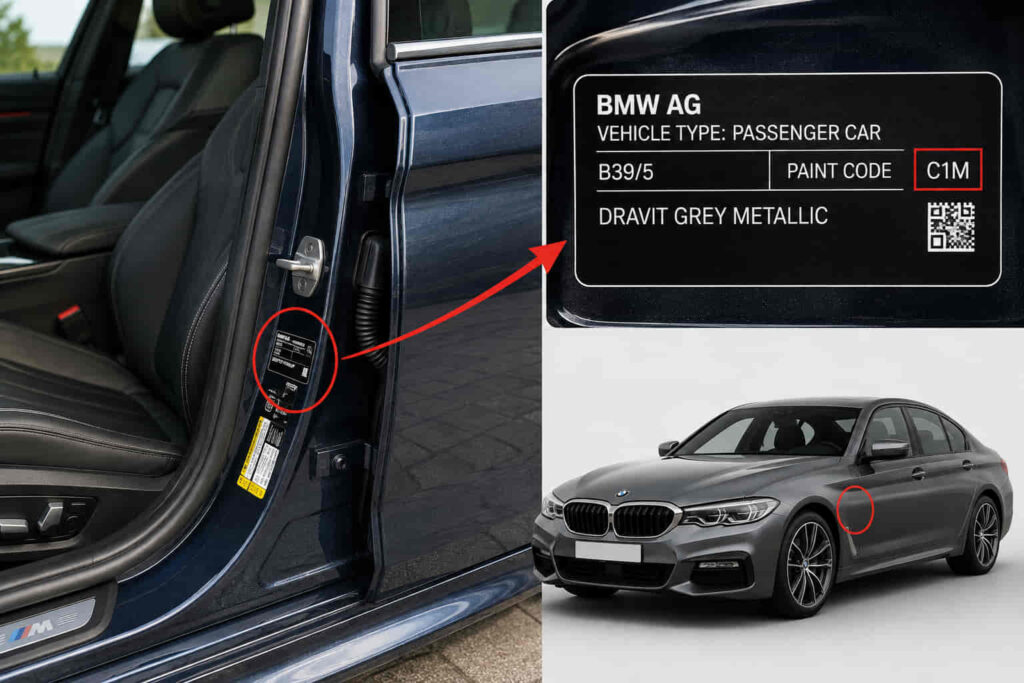
A BMW paint code identifies the specific exterior paint specification associated with a vehicle, but the location of that code can vary by model, generation, production year, and market. Depending on the BMW, paint information may be found on an applicable vehicle label in an under-hood or body-label location, while vehicles without an accessible or readable paint label may require identification through vehicle records or VIN-based information.
Finding a label is only the first part of the process because a BMW can contain multiple numbers, identification codes, and manufacturing details that are unrelated to exterior paint. The paint code must be distinguished from the vehicle identification number and from the human-readable color name. A VIN identifies the vehicle and can support a vehicle-specific color lookup, while the paint code identifies the applicable paint specification. The color name describes the finish but should not automatically be treated as the paint code itself.
There are 7 places or identification sources worth checking when locating a BMW paint code, starting with applicable physical labels and extending to vehicle-specific records when the original sticker cannot be found or read. The goal is not simply to locate a code-like number, but to verify the correct paint code for the specific BMW before ordering touch-up paint, matching a repaired panel, or performing refinishing work.
What Are the 7 Places to Look for Your BMW Paint Code?
The 7 places or sources to check for a BMW paint code include the engine compartment, the strut-tower or nearby under-hood area, the underside or surrounding hood area, the driver-side door jamb and vehicle labels, vehicle documentation or identification records, VIN-based vehicle information, and BMW or a qualified paint or body source that can verify the vehicle’s original exterior color information. The exact location varies between BMW models and generations, so the objective is to identify a paint-specific code rather than assume that every BMW uses the same sticker location.
The engine compartment is one of the first physical areas worth checking for BMW paint information on applicable vehicles. BMWs from certain model and production contexts may have identifying labels or plates under the hood, making this area a logical starting point when searching for the exterior paint code. The important step is to inspect the information carefully because an engine compartment can contain multiple labels, numbers, and identifiers that have nothing to do with exterior paint.
The strut-tower area and nearby under-hood surfaces are another location to inspect on applicable BMW models. Paint information on some vehicles may be positioned around this general area rather than in a location immediately obvious when the hood is opened. The strut tower should therefore be treated as a possible search zone, not as a universal BMW paint code location. If no paint-specific information appears there, that absence does not mean the vehicle has no identifiable paint code.
The underside of the hood and surrounding under-hood area can also be checked for applicable identification labels. Vehicle generations differ in how identification information is positioned, and labels can be located on surfaces that are not visible until the hood is opened and inspected carefully. Any code found in this area still needs to be identified as paint information before it is used to order a refinishing product. A manufacturing number, component identifier, or other label should not be assumed to represent exterior color simply because it appears under the hood.
The driver-side door jamb and other applicable vehicle-information labels provide another area worth inspecting. Door and body labels can contain important manufacturing and vehicle-identification information, but the presence of a label does not guarantee that the paint code is printed there on every BMW. This distinction prevents a common identification error: selecting one of several visible numbers from a door label and treating it as a color code without confirming what that number represents.
Vehicle documentation and existing identification records become useful when the physical paint label cannot be found or is no longer readable. Previous repair information, original vehicle information, or other records associated with the specific BMW may provide context for identifying its exterior finish. Documentation should still be evaluated for what it actually records because not every vehicle document contains the paint code itself. Its value is in creating another identification path rather than proving that every owner’s document will contain a dedicated color-code field.
The VIN can also be used as a vehicle-specific route to identifying the original exterior color information, although the VIN itself is not the BMW paint code. The vehicle identification number identifies the specific vehicle and can support an appropriate BMW, dealer, or vehicle-data lookup that connects the car to its original build information. This is particularly useful when the physical paint label is missing, damaged, inaccessible, or difficult to interpret.
VIN-based identification also creates an important limitation when a BMW has previously been repainted. The original vehicle information can establish the exterior color associated with the car when produced, but it cannot by itself prove that every body panel still carries its original finish. A replacement panel or previous refinishing work can create a difference between factory build information and the paint physically present on the vehicle today.
BMW or a qualified automotive paint or body source provides another verification route when the code cannot be established confidently from the vehicle itself. Using the vehicle’s identification information allows the original exterior color specification to be checked without relying only on visual similarity. This is more reliable than selecting a paint because its displayed color name appears close to the finish on the car.
Professional verification can become particularly valuable when body repair is planned rather than a minor cosmetic touch-up. Even when the original paint code is known, the existing finish can change in appearance through age, environmental exposure, previous refinishing, and other physical variables. The code establishes the relevant paint specification, while actual repair matching may require evaluation of the finish currently on the panel.
These 7 locations and identification sources should therefore be understood as a search sequence rather than seven stickers that exist on the same BMW. A physical paint label can provide the shortest path when it is present and readable. When it is not, vehicle documentation, VIN-linked information, and qualified verification provide additional ways to establish the original exterior color without guessing from appearance alone.
The goal of checking BMW paint code locations is to identify and verify the paint specification for the specific vehicle, not merely to find a number that looks like a color code. Physical location varies across BMW models and generations, while VIN, color name, and paint code remain different forms of information. Correct identification connects the specific BMW to the correct paint code before touch-up paint or refinishing work is selected.
Read more: BMW X5 Service Schedule
What Does a BMW Paint Code Look Like?
A BMW paint code is a specific identifier associated with the vehicle’s exterior paint specification and can appear as a numeric or alphanumeric code depending on the vehicle and paint information being referenced. The exact format should not be treated as universal across every BMW generation, which is why identifying the context of the code is as important as reading the characters themselves.
A BMW can contain numerous numbers and codes on its labels, including manufacturing information, vehicle identifiers, component references, and other technical data. Finding a short sequence of characters therefore does not automatically mean the exterior paint code has been located. The surrounding label information and vehicle-specific context should establish that the identifier actually refers to exterior paint before it is used for touch-up or refinishing.
The paint code may appear alongside descriptive color information on an applicable paint or vehicle label. When both pieces of information are available, they provide stronger identification context because the code can be associated with the exterior finish rather than interpreted as an isolated number. The code remains the more specific identifier for paint selection, while the accompanying name helps a person recognize the color in human-readable form.
Code formatting can also vary enough that character count alone is not a reliable identification method. A rule such as assuming every BMW paint code must contain the same number of digits or letters can cause an unrelated identifier to be selected when the actual vehicle uses a different format. Vehicle-specific verification is therefore stronger than identifying paint information solely by the visual structure of the code.
This becomes especially important when a physical label is aged, damaged, partially missing, or difficult to read. A single unclear character can point to the wrong paint specification if the code is copied incorrectly. When the label cannot be interpreted confidently, the better approach is to confirm the exterior color using vehicle identification information rather than guessing which character appears on the sticker.
A BMW paint code should ultimately be recognized by its relationship to the specific vehicle’s exterior paint information, not simply by its length or appearance. The code format can vary, but its function remains consistent: it identifies the paint specification that should be verified before a matching paint product or refinishing process is selected.
Is the BMW Paint Code the Same as the Color Name?
No. A BMW paint code is the identifier associated with a specific exterior paint specification, while the color name is the descriptive name used to identify that finish. The two pieces of information can refer to the same original exterior color, but they perform different identification functions and should not be treated as interchangeable.
The color name is designed primarily to make a finish understandable to people. It gives the paint a recognizable identity that can be used in vehicle descriptions, sales information, records, and conversations about the car. A paint code provides a more specific technical reference for identifying the applicable paint specification. This is why knowing that a BMW is described as black, white, blue, silver, or even knowing a more specific manufacturer color name does not remove the need to confirm the correct paint code before repair.
Visual appearance alone provides even less certainty than the color name. Two BMW finishes can appear similar under certain lighting conditions while representing different paint specifications. Metallic content, pearl effects, finish characteristics, lighting, and the surrounding environment can affect how a color appears to the eye. Selecting touch-up paint because another color simply “looks close” does not establish that both finishes share the same paint code.
The distinction becomes more important during body repair. A small touch-up and a refinished body panel both require the repair process to begin with the correct paint identification. Using the descriptive color name without confirming the applicable code can introduce uncertainty before actual color matching even begins. The paint code provides the specification reference, while the condition of the existing finish determines whether additional matching work is needed.
A correct color name also does not prove that the current physical finish is unchanged from the vehicle’s original specification. Previous body repair or repainting can alter one or more panels while the vehicle records continue to identify the factory exterior color. This is why original color information and current panel appearance become separate considerations on a BMW with refinishing history.
The VIN belongs to a third identification category and should not be confused with either value. The VIN identifies the vehicle, the color name describes the exterior finish, and the paint code identifies the applicable paint specification. Vehicle identification information can be used to retrieve original color information, but that process does not turn the VIN itself into a paint code.
BMW color name and BMW paint code should therefore be used together when available but should not be treated as the same information. The color name helps identify the finish descriptively, while the paint code provides the more specific reference needed for paint selection. Before ordering touch-up paint or beginning refinishing work, the paint code should be verified for the specific BMW rather than inferred from the color name or visual appearance alone.
Can You Find a BMW Paint Code From the VIN?
Yes, a BMW VIN can be used through an appropriate vehicle-specific information source to help identify the original exterior color and associated paint information, but the VIN itself is not the paint code. The VIN identifies the individual vehicle, while the paint code identifies the exterior paint specification associated with that vehicle. Using the VIN is therefore an identification route rather than a direct substitute for the paint code.
This distinction becomes useful when the physical paint label cannot be found or read. Instead of guessing from the visible body color, the vehicle identification number can connect the specific BMW to original vehicle information. When the appropriate records include exterior color data, that information can help establish which factory paint specification was associated with the vehicle when it was produced.
VIN-based identification can be particularly valuable because the BMW model name alone is not precise enough to determine paint. Two vehicles from the same model line and model year can have different exterior finishes, while visually similar colors can represent different paint specifications. The VIN narrows the lookup to the individual vehicle rather than attempting to identify paint from model information or appearance alone.
The original exterior color identified through vehicle records should still be distinguished from the paint physically present on the BMW today. A vehicle can undergo collision repair, panel replacement, cosmetic refinishing, or a complete color change during its life. In those cases, the original build information remains historically correct while one or more current panels may no longer carry the original factory finish.
This difference matters most when the objective is actual paint repair. If the BMW retains its original finish, VIN-linked color information can provide a strong reference for establishing the applicable paint code. If previous refinishing is suspected, the original code should become the starting specification rather than the only evidence used to determine what paint should be applied to the current panel.
A VIN lookup should also come from a source capable of connecting the vehicle identification information with the relevant BMW color data. Entering a VIN into an unrelated decoder does not guarantee that exterior paint information will be available or accurate enough for refinishing purposes. The useful relationship is not simply VIN input followed by any generated vehicle data; it is vehicle-specific identification connected to reliable original color information.
The VIN can therefore help you find a BMW paint code by identifying the specific vehicle and retrieving its original exterior color information through an appropriate source. The VIN remains the vehicle identifier, not the paint identifier, and any BMW with previous body or paint work may require additional verification before the original paint information is used for a current repair.
What Should You Do If the BMW Paint Code Sticker Is Missing?
If the BMW paint code sticker is missing or unreadable, the paint can still be identified by checking other applicable vehicle-label locations, reviewing vehicle-specific information, using the VIN to establish the original exterior color, and verifying the resulting paint information before ordering paint. A missing sticker removes one identification source; it does not make the original BMW paint specification impossible to determine.
The first step is to establish whether the label is actually absent rather than located somewhere else on that particular BMW. Paint-code locations vary by model and generation, so failing to find a sticker in one commonly mentioned area does not prove that the vehicle has no physical paint information. Other applicable under-hood, body-label, or vehicle-information locations should be considered according to the specific BMW.
An existing label that cannot be read confidently should be treated much like a missing label. Paint identification depends on the complete and correct code, so guessing an unclear digit or letter can direct the repair toward a different specification. A partially legible sticker provides useful evidence only when the uncertain information can be verified through another vehicle-specific source.
Vehicle information and service or ownership records can provide the next identification path. Their usefulness depends on what information was actually recorded, so the presence of documentation should not be treated as proof that the paint code will always appear there. When exterior color information is available, however, it can be compared with other evidence from the vehicle before a paint product is selected.
The VIN provides a stronger fallback when the physical label cannot establish the answer. An appropriate BMW or vehicle-specific lookup can connect the VIN with the vehicle’s original exterior color information. This removes the need to choose a paint specification solely because the visible color resembles an online sample or another BMW with a similar finish.
Visual matching alone is a weak replacement for paint-code identification because exterior color changes with lighting and finish characteristics. Age, environmental exposure, previous repairs, and refinishing can create additional differences between how a color originally appeared and how it looks on the vehicle today. A visual observation can support verification, but it should not replace vehicle-specific identification when the original paint specification can be established.
Previous bodywork deserves particular attention when the sticker is missing. If a panel has already been repainted, identifying the factory paint code solves only the original-specification question. The current finish may still require professional evaluation to determine how closely the repair material must be adjusted or blended with surrounding panels. This is especially relevant when repairing a larger visible area rather than applying a small touch-up.
A missing BMW paint code sticker should therefore trigger an alternative identification process rather than a guess. Check other applicable locations, establish the specific vehicle through its VIN and records, identify the original exterior color information, and verify the paint specification before purchasing or applying paint. The objective remains the same whether a sticker is present or not: connect the specific BMW to the correct paint code with enough certainty to support the intended repair.
Why Can the Correct BMW Paint Code Still Look Different on the Car?
The correct BMW paint code can still produce a visible difference from the paint currently on the vehicle because the code identifies the paint specification, while the appearance of an existing finish can be affected by age, environmental exposure, previous refinishing, application conditions, and the condition of the surrounding panels. Finding the correct code is therefore the foundation of paint identification, but it does not guarantee that newly applied paint will be visually indistinguishable from every existing surface.
Exterior paint remains exposed to sunlight, weather, washing, road contamination, and other environmental conditions throughout the vehicle’s life. These influences can change how the finish appears compared with its original condition. The paint code continues to identify the original specification even when the visible finish has aged, which creates a distinction between identifying the correct paint and matching the current appearance of the vehicle.
Previous body repair introduces another variable. A BMW can retain its original paint code in vehicle records while one or more panels have been refinished during collision or cosmetic repair. A replacement bumper, door, fender, or other panel may therefore have a finish that was matched during an earlier repair rather than the exact factory-applied coating originally associated with the vehicle. In this situation, the paint code remains useful as the starting specification but does not prove that every current panel has an identical finish history.
Paint characteristics can also influence visual perception. Metallic or other effect finishes can appear different depending on lighting, viewing angle, application, and the way the finish interacts with surrounding panels. Two surfaces associated with the same original paint specification can therefore appear closer under one lighting condition and less similar under another. This is one reason visual comparison should not replace paint-code identification.
The size of the repair affects how noticeable a difference becomes. A small touch-up on a stone chip creates a different visual challenge from refinishing an entire body panel. As the repaired area becomes larger and more visible, matching the surrounding finish becomes more important. The paint code establishes which specification should be considered first, while refinishing technique and color matching determine how that specification is integrated with the vehicle’s existing appearance.
This distinction prevents an important diagnostic mistake. If newly applied paint does not appear perfectly identical to an aged panel, that difference does not automatically prove that the paint code was identified incorrectly. The code should first be verified against the specific BMW, after which the current finish, previous repair history, and refinishing variables can be evaluated separately.
A correct BMW paint code identifies the appropriate paint specification, not a guaranteed visual match under every current vehicle condition. Paint identification and paint matching are related but separate processes: the code establishes what the vehicle was specified with, while the condition and history of the existing finish influence how a repair must be matched in practice.
How Do You Verify a BMW Paint Code Before Ordering Touch-Up Paint?
You verify a BMW paint code before ordering touch-up paint by connecting the code to the specific vehicle, confirming that it represents exterior paint information, comparing it with available original color or VIN-linked information, and considering whether the area being repaired still carries the original finish. This process reduces the risk of ordering paint based on an unrelated vehicle number, a similar-looking color, or a descriptive color name alone.
Verification begins with the source of the code. A code read from an applicable paint label has stronger context when the surrounding information clearly identifies it as exterior paint data. If the label contains several numbers without an obvious paint designation, selecting the shortest or most paint-like sequence is not sufficient verification. The identifier should be connected specifically to the vehicle’s exterior color information.
The specific BMW should then be used as the second reference point. Vehicle information or an appropriate VIN-based lookup can help confirm the original exterior color associated with that car. Agreement between physical paint information and vehicle-specific original color data provides greater confidence than either visual appearance or a generic model search. A paint code associated with another BMW of the same model is not proof that the two vehicles were produced in the same exterior color.
The color name can provide supporting confirmation but should remain secondary to the paint code. If the verified vehicle information associates a particular color name with the code found on the BMW, the two identifiers reinforce each other. The name alone remains insufficient because paint selection requires more precision than choosing a finish that sounds or appears similar.
Repair history should then be considered before paint is ordered. If the intended repair area is known to have been refinished previously, the factory paint code identifies the original specification but may not fully describe the current panel appearance. A minor touch-up and a larger refinishing job also have different matching requirements. The larger and more visually continuous the repair, the more important evaluation of the existing finish becomes.
Touch-up paint should therefore be selected only after the identification chain is complete. The objective is not to find a product labeled simply for a particular BMW model or generic color family. It is to connect the product to the verified paint specification associated with the specific vehicle and then consider whether the current finish creates additional matching requirements.
BMW paint code verification should follow the relationship vehicle identity → exterior color information → paint code → current panel condition → paint selection. Confirming each part of that relationship provides a stronger basis for ordering touch-up paint than relying on the color name, visual similarity, or an unverified number from a vehicle label.
Where Is the Most Reliable Place to Find a BMW Paint Code?
The most reliable BMW paint code source is the exterior paint information verified for the specific vehicle, whether that information comes from an applicable physical paint label or is confirmed through reliable vehicle and VIN-linked records. There is no single physical sticker location that should be treated as universally authoritative for every BMW model and generation.
A readable original paint label can provide the shortest identification path because it connects paint information directly with the vehicle. When the label is present in an applicable location and the paint-specific identifier can be recognized confidently, the code can then be verified against the BMW’s vehicle information before paint is ordered.
A missing or unreadable label changes the identification method but not the objective. Vehicle-specific information associated with the VIN can provide a route to the original exterior color without requiring the owner to guess from the visible finish. The VIN remains the identifier used to access that information rather than becoming the paint code itself.
Reliability therefore depends more on vehicle specificity and verification than on one physical location. A code copied from a random online list because it appears to match the vehicle’s color is weaker evidence than information connected directly to the specific BMW. The same principle applies to another vehicle of the same model and year because identical model information does not establish identical exterior paint.
Current paint condition must still be considered when the code will be used for repair. Verified factory information establishes the original paint specification, but a previously refinished panel may require additional matching. This is why professional paint or body evaluation becomes increasingly valuable for larger repairs where visible color integration matters more than simply covering a small chip.
The best way to find a BMW paint code is to locate the vehicle’s applicable paint information when possible and verify it against the specific BMW before using it. When the physical label is unavailable, VIN-linked original color information provides an alternative identification route. The final decision should connect the exact vehicle to the verified paint specification rather than depend on a universal sticker location or visual guess.