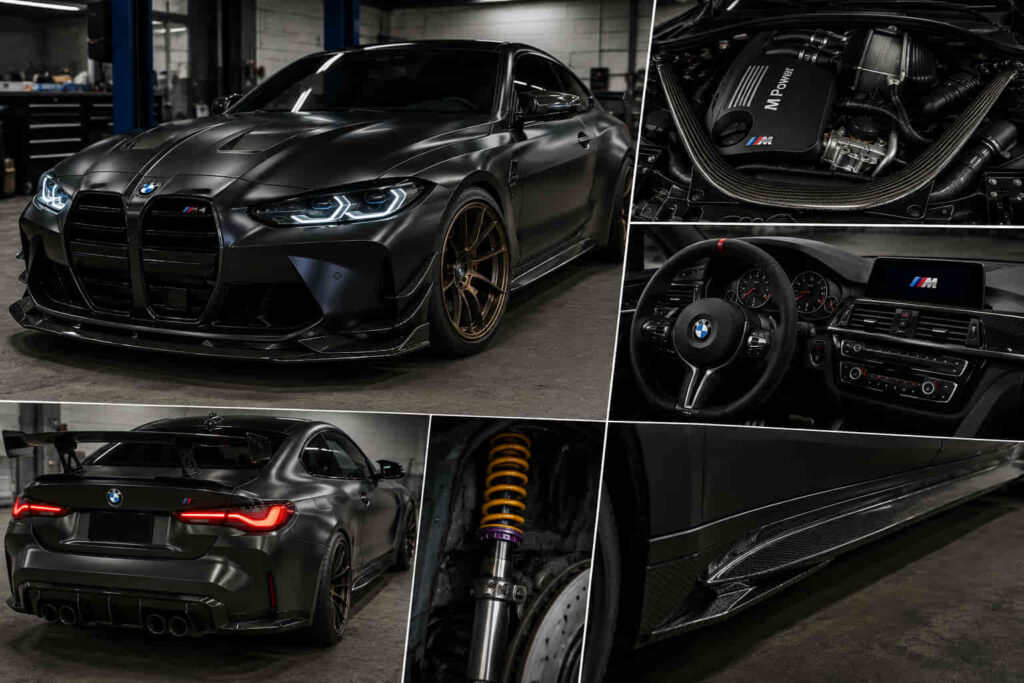
BMW M4 modifications allow owners to improve performance, handling, appearance, and driving experience by upgrading key vehicle systems such as the engine, exhaust, suspension, brakes, wheels, and aerodynamic components. As a high-performance model developed by BMW M Division, the M4 is built with a strong engineering foundation that provides significant potential for aftermarket upgrades.
The BMW M4 has become one of the most popular platforms for enthusiasts because it combines powerful turbocharged engines, advanced chassis engineering, and a large aftermarket ecosystem. The F82 generation uses the BMW S55 twin-turbo inline-six engine, while the newer G82 generation uses the S58 twin-turbo engine, both of which provide strong tuning potential when paired with the right supporting modifications.
However, the best BMW M4 modifications depend on the owner’s goals. Some drivers focus on increasing horsepower through engine tuning, intake improvements, exhaust upgrades, and cooling enhancements. Others prioritize sharper handling through suspension tuning, performance tires, brake upgrades, and chassis improvements. Many owners also modify exterior and interior components to create a more personalized driving experience.
Choosing the right upgrades requires understanding how each modification affects the vehicle. A poorly planned build can create reliability issues, while a properly balanced setup can improve performance without reducing everyday usability.
This guide explains the most effective BMW M4 modifications, including power upgrades, handling improvements, appearance changes, costs, and reliability considerations.
Why Is the BMW M4 a Good Platform for Modifications?
The BMW M4 is a strong platform for modifications because it combines BMW M Division engineering, powerful turbocharged engines, advanced chassis technology, and extensive aftermarket support. Unlike standard BMW models designed primarily for comfort and efficiency, the M4 was developed with performance driving in mind, giving owners a foundation that can handle targeted upgrades.
The BMW M4 platform benefits from high-performance components developed by BMW Motorsport. The vehicle includes upgraded suspension geometry, stronger braking systems, performance-oriented differentials, and engines designed to deliver high output under demanding driving conditions. These characteristics make the M4 suitable for both street performance builds and track-focused modifications.
The engine platform is one of the biggest reasons enthusiasts choose the BMW M4. The F82 and F83 generations use the S55 twin-turbo inline-six engine, while the newer G82 and G83 generations use the S58 twin-turbo inline-six engine. Both engines use forced induction, which provides significant tuning potential because power output can be increased through software calibration and supporting hardware upgrades.
The S55 engine became popular in the aftermarket community because of its strong internal components, efficient turbocharging system, and ability to respond well to modifications. The newer S58 improves on this foundation with updated cooling technology, stronger performance capability, and higher factory output.
The chassis also plays an important role in modification potential. A powerful engine alone does not create a complete performance vehicle. Suspension tuning, tire selection, brake upgrades, and aerodynamic improvements can significantly change how the M4 transfers power and responds during aggressive driving.
For example, a BMW M4 built with engine tuning, improved cooling, upgraded suspension, and performance tires can deliver a completely different driving experience compared with a stock vehicle while maintaining the core characteristics that define the M4 platform.
What Are the Best BMW M4 Performance Modifications?
The best BMW M4 performance modifications focus on improving engine output, airflow efficiency, thermal management, and power delivery without creating unnecessary reliability problems. Because the M4 uses turbocharged engines, performance upgrades can significantly improve acceleration and responsiveness when they are properly matched.
Engine tuning is one of the most common BMW M4 modifications because the factory engine management system leaves room for optimization. An ECU tune adjusts parameters such as boost pressure, fuel delivery, ignition timing, and throttle response to increase power output from the existing engine hardware.
Air intake upgrades can improve airflow into the turbocharger system. A more efficient intake design reduces restrictions and can improve throttle response, especially when combined with other supporting modifications.
Exhaust upgrades are also popular among M4 owners because they can improve exhaust flow and create a more aggressive engine sound. Components such as performance exhaust systems and downpipes can reduce restrictions, allowing turbocharged engines to operate more efficiently.
Cooling upgrades become increasingly important when increasing engine power. Turbocharged engines generate additional heat when producing higher output, so upgraded intercoolers, cooling systems, and supporting components help maintain consistent performance during repeated acceleration or track use.
The effectiveness of performance modifications depends on creating a balanced system. Increasing horsepower without improving cooling, drivetrain support, or traction can reduce the reliability and usability of the vehicle.
For example, a BMW M4 with an ECU tune, upgraded intercooler, and improved exhaust system can achieve stronger performance than a vehicle with only software changes because the supporting components help the engine maintain stable operation.
Read more: BMW Android Auto Not Working
How Much Horsepower Can BMW M4 Modifications Add?
BMW M4 modifications can significantly increase horsepower because the S55 and S58 turbocharged engines have substantial tuning potential when combined with appropriate supporting upgrades. The amount of power gained depends on the engine generation, modification level, fuel quality, and whether the vehicle receives software-only changes or additional hardware improvements.
The stock power output of the BMW M4 varies depending on generation and model configuration. The F82 M4 uses the S55 engine, while the G82 M4 uses the newer S58 engine with improved thermal management and higher factory performance. Both engines respond well to ECU tuning because turbocharged engines can produce more power by optimizing boost pressure, ignition timing, and fuel delivery.
Software tuning is usually the first performance modification because it changes how the engine uses existing hardware. A properly calibrated tune can improve throttle response, torque delivery, and acceleration without requiring major mechanical changes.
However, higher power levels require supporting modifications. Increasing boost pressure creates additional heat and stress, so components such as intercoolers, cooling systems, and intake systems become more important as performance increases. A balanced build focuses not only on horsepower numbers but also on maintaining consistent performance.
The S55 and S58 engines also differ in their tuning characteristics. The S55 has a long history in the aftermarket community with extensive tuning solutions, while the S58 benefits from newer engineering improvements and stronger factory development.
For example, a lightly modified BMW M4 with ECU tuning may provide a noticeable improvement in daily driving performance, while a more aggressive build with upgraded turbochargers, cooling components, and fuel system improvements is designed for maximum power output.
What Are the Best BMW M4 Handling Upgrades?
The best BMW M4 handling modifications improve suspension response, steering feedback, traction, and overall vehicle balance without focusing only on engine power. Since the M4 is designed as a performance vehicle, improving how the car uses its power can create a greater driving improvement than increasing horsepower alone.
Suspension upgrades are among the most effective handling modifications. Components such as coilovers, upgraded dampers, and performance springs allow owners to adjust ride height, stiffness, and vehicle response according to their driving goals.
A properly tuned suspension system improves body control during cornering, reduces unnecessary movement, and creates a more connected driving experience. For street-driven M4 models, a balanced suspension setup can improve responsiveness while maintaining comfort.
Performance tires are another important modification because they directly influence traction and handling. The engine can only deliver power effectively when the tires maintain contact with the road. High-performance tires improve grip during acceleration, braking, and cornering.
Wheel alignment adjustments can also change how the M4 behaves. Performance-oriented alignment settings can improve cornering stability and steering response, especially for owners who use their vehicles on winding roads or track environments.
Additional chassis upgrades, such as sway bars and structural reinforcement components, can further improve handling by reducing unwanted body movement.
For example, a BMW M4 with upgraded suspension, performance tires, and proper alignment may feel significantly sharper during cornering even without additional engine power because the vehicle can use its existing performance more effectively.
What BMW M4 Brake Upgrades Improve Performance?
BMW M4 brake upgrades improve performance by increasing stopping power, heat resistance, and braking consistency during aggressive driving conditions. While the factory braking system is designed for high performance, drivers who increase engine output or use their M4 on track often benefit from additional brake improvements.
Brake pads are one of the most common upgrades because they directly affect braking response and heat management. Performance brake pads are designed to maintain friction at higher temperatures, which is important during repeated hard braking.
Brake fluid is another important factor in maintaining braking performance. High-performance driving generates significant heat, and brake fluid with better temperature resistance helps prevent brake fade during demanding conditions.
Upgraded rotors can improve heat dissipation and durability. Larger brake systems or big brake kits provide additional thermal capacity for drivers who require maximum stopping performance.
The purpose of brake upgrades should match the vehicle’s usage. A daily-driven BMW M4 may only require improved pads and fluid, while a track-focused build may benefit from a complete brake system upgrade.
For example, increasing horsepower through engine modifications without improving braking capability can create an imbalance because the vehicle gains acceleration performance without improving its ability to slow down consistently.
What Are the Best BMW M4 Exterior Modifications?
BMW M4 exterior modifications allow owners to personalize the vehicle’s appearance while improving aerodynamic performance and creating a more aggressive visual identity. Because the M4 already has a performance-focused design from BMW M Division, exterior upgrades usually focus on enhancing existing styling rather than completely changing the vehicle character.
Carbon fiber components are among the most popular exterior modifications for BMW M4 models. Parts such as front splitters, rear diffusers, mirror caps, and spoilers can reduce weight slightly while creating a more performance-oriented appearance. These upgrades are especially common on M4 builds because carbon fiber is strongly associated with BMW’s motorsport-inspired design language.
Aerodynamic components can also influence vehicle behavior at higher speeds. Front splitters, rear diffusers, and properly designed aero parts help manage airflow around the vehicle. However, the effectiveness of aerodynamic upgrades depends on the design quality and intended use because cosmetic parts do not always provide measurable performance benefits.
Wheels and tires are another important area of exterior modification. Changing wheel design can significantly alter the appearance of the M4, while selecting the correct tire size and compound can improve traction and handling performance.
Lighting upgrades, exterior trim changes, and personalized styling elements allow owners to create a unique appearance. These modifications are usually focused on customization rather than performance improvement.
For example, a BMW M4 equipped with carbon fiber aerodynamic parts, upgraded wheels, and performance tires can achieve a more aggressive appearance while also improving certain aspects of handling when the components are properly selected.
What Are the Best BMW M4 Interior Modifications?
BMW M4 interior modifications improve driver engagement, personalization, and cabin experience by upgrading materials, controls, and performance-focused components. While exterior and engine modifications receive more attention, interior changes can significantly influence how the driver interacts with the vehicle.
Steering wheel upgrades are among the most popular interior modifications because the steering wheel is one of the main points of contact between the driver and the vehicle. Carbon fiber trim, Alcantara materials, paddle shifter upgrades, and custom designs can create a more motorsport-inspired environment.
Interior trim upgrades can also change the overall cabin appearance. Replacing standard materials with carbon fiber, aluminum, or premium finishes can create a more customized feel while maintaining the BMW M design philosophy.
Performance-oriented seats and seating improvements are another option for owners who use their M4 for spirited driving or track events. Better support helps maintain driver stability during aggressive cornering and improves comfort during longer drives.
Technology upgrades may include improved displays, audio systems, and connectivity features. These modifications focus on enhancing daily usability rather than increasing vehicle performance.
Interior modifications should maintain the balance between appearance and function. Excessive changes that reduce comfort or interfere with factory systems may negatively affect the ownership experience.
For example, a BMW M4 used as a daily performance vehicle may benefit more from subtle interior upgrades, while a dedicated track-oriented build may prioritize supportive seating and driver-focused equipment.
How Much Do BMW M4 Modifications Cost?
BMW M4 modification costs vary widely depending on the type of upgrade, quality of components, installation requirements, and performance goals. A simple cosmetic modification and a complete performance build represent very different levels of investment.
Performance modifications usually require a larger budget because they involve engineering considerations, specialized components, and professional installation. Engine tuning, exhaust systems, cooling upgrades, and suspension components can involve significant costs because they directly affect vehicle performance.
Handling modifications also vary in price depending on the chosen components. A basic tire upgrade may provide a noticeable improvement at a relatively lower cost, while advanced suspension systems with adjustable settings require a larger investment.
Exterior modifications can range from small styling changes to complete aerodynamic conversions. Carbon fiber parts, custom wheels, and professionally installed body components can become expensive depending on material quality and brand reputation.
Labor costs are another important factor. Professional installation ensures that performance components function correctly and reduces the risk of installation-related problems.
The best approach is to prioritize modifications based on driving goals. A daily driver may benefit most from tires, suspension improvements, and moderate engine tuning, while a track-focused M4 may require more extensive upgrades.
For example, investing in balanced modifications that improve power delivery, traction, and reliability often creates a better driving experience than spending the entire budget on maximum horsepower alone.
Do BMW M4 Modifications Affect Reliability?
BMW M4 modifications can affect reliability depending on the quality of components, installation method, maintenance practices, and the level of performance increase. Properly planned modifications can improve the driving experience without significantly reducing reliability, while poorly executed upgrades can increase mechanical stress.
Engine modifications require careful consideration because increasing horsepower places additional demands on components such as the turbochargers, cooling system, drivetrain, and internal engine parts. Supporting upgrades are often necessary when pursuing higher power levels.
Quality of parts plays an important role in long-term reliability. Professional-grade components designed specifically for BMW M4 applications usually provide better fitment and durability compared with low-quality alternatives.
Maintenance becomes even more important after modifications. Performance upgrades may require more frequent inspections, fluid changes, and monitoring of vehicle systems to ensure everything operates correctly.
Professional installation also influences reliability. Incorrect installation of engine, suspension, or electrical components can create problems that are unrelated to the original modification itself.
A balanced modification strategy focuses on improving the vehicle while respecting the limits of the platform. The goal is not only to produce higher performance numbers but also to maintain drivability and long-term ownership value.
For example, a BMW M4 with a properly calibrated tune, upgraded cooling system, and regular maintenance can remain reliable, while an aggressively modified vehicle without supporting upgrades may experience increased repair risks.