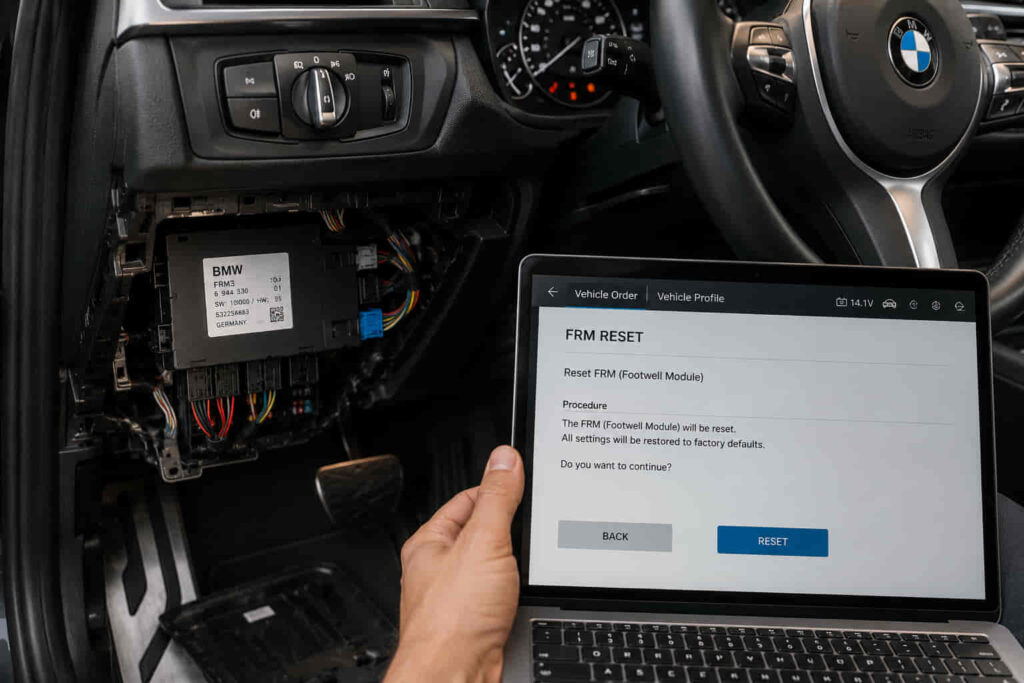
A BMW FRM module reset is a recovery procedure for certain Footwell Module problems, but it is not the same as clearing fault codes, coding the module, programming it, or replacing it. The FRM is part of BMW’s body electronics system and acts as a master for certain single-wire bus systems, which means an FRM-related problem can affect functions such as windows, exterior lighting, and mirrors.
When the FRM stops communicating correctly, the symptoms can look like several unrelated electrical failures at the same time. However, these symptoms do not automatically prove that the FRM itself has failed. A short circuit, communication problem, or other electrical condition can cause the module to become deactivated. BMW technical documentation specifically describes situations where an FRM is deactivated because of a short circuit or SMC malfunction and directs technicians to diagnose the underlying cause before replacing the module.
This distinction is critical when searching for a BMW FRM module reset. A reset or recovery may restore module operation in an applicable fault condition, while coding and programming configure the module for the vehicle, and replacement involves installing another control module. A replacement module may require additional adaptation, coding, or programming depending on the vehicle application.
This guide explains the 7 key things to know about BMW FRM module reset, including common FRM symptoms, recovery, electrical faults, ISTA diagnosis, coding and programming, and when replacing the FRM is actually necessary.
What Does the BMW FRM Module Control?
The BMW FRM, or Footwell Module, is a body-electronics control module that manages communication and functions across several vehicle systems. BMW technical training material identifies the FRM as a master for certain single-wire bus systems, which gives the module an important role in communication between the vehicle’s electronic components.
Because the FRM participates in multiple body-electronics functions, a problem with the module can produce symptoms that initially appear unrelated. Electrical functions such as power windows, exterior lighting, and exterior mirrors can become relevant when investigating an FRM communication or control problem. However, a failure in one of these systems does not by itself prove that the FRM is defective.
The diagnostic relationship is important. A body-electronics function can stop operating because the FRM is not communicating correctly, but the underlying cause can also involve the vehicle’s power supply, wiring, communication network, or another connected component. The FRM should therefore be treated as the central module being investigated rather than automatically identified as the root cause.
This is why a BMW FRM module reset should not begin with the assumption that the module needs to be replaced. First identify which functions have failed and determine whether the FRM is actually communicating with the vehicle’s other control systems. That distinction separates a genuine FRM problem from a symptom caused by another electrical fault.
What Are the Symptoms of a BMW FRM Module Problem?
A BMW FRM problem can produce multiple body-electronics symptoms at the same time, particularly when the module cannot communicate correctly with systems that depend on it. Window operation, exterior lighting, and mirror functions are examples of areas that can become relevant during FRM diagnosis, but these symptoms must be evaluated together with the vehicle’s fault information.
A single malfunction is not enough to establish an FRM failure. For example, one power window that stops operating could have a local motor, switch, wiring, or control problem rather than an FRM problem. When several unrelated body-electronics functions become unavailable simultaneously, however, the FRM and its communication network become more important parts of the diagnostic path.
The reason multiple symptoms can appear together is that the FRM serves as a communication master for certain single-wire bus systems. If communication through the relevant network is interrupted, dependent components may no longer receive or exchange the commands they need to operate normally.
The pattern of symptoms therefore matters more than any single warning. A cluster of simultaneous electrical problems provides stronger evidence for investigating the FRM and its communication circuits than an isolated component failure.
A proper diagnosis should then move from symptom → FRM communication → fault information → underlying electrical condition → recovery or repair. This prevents the common mistake of treating every BMW window, lighting, or mirror problem as proof that the FRM itself needs to be reset or replaced.
Read more: BMW mirrors not folding when locking
Can You Reset a BMW FRM Module?
A BMW FRM module can sometimes be recovered from a deactivated or communication-related condition, but there is no single universal reset procedure that fixes every FRM fault. The appropriate recovery method depends on the vehicle, FRM condition, stored fault information, and underlying cause.
This distinction matters because an FRM that appears to be “dead” may actually have been deactivated as a protective response to another electrical problem. BMW technical documentation describes FRM cases in which a short circuit in the wiring or an SMC malfunction causes the FRM to become deactivated. BMW directs technicians to the applicable ISTA test plan rather than treating immediate module replacement as the solution.
A reset or recovery therefore should follow diagnosis rather than replace it. If the FRM can be recovered after the underlying condition has been corrected, the vehicle may regain the affected body-electronics functions without requiring another module. If the module has a deeper internal failure or cannot be recovered through the applicable procedure, additional programming or replacement may be necessary.
The key point is that “FRM reset” describes a recovery objective, not one button sequence that applies to every BMW. The vehicle’s fault condition determines which diagnostic and recovery procedure is appropriate.
Can a Short Circuit Cause BMW FRM Problems?
Yes. A short circuit can cause the BMW FRM to become deactivated, creating symptoms that can look like an FRM module failure. BMW specifically documents FRM cases where a short in the wiring or an SMC malfunction causes the module to become deactivated.
The mechanism is important. When an electrical circuit connected to the FRM develops a short, the module can enter a protected or deactivated condition. The resulting symptoms may then appear across the systems associated with that module. This can lead to an incorrect diagnosis in which the FRM is replaced even though the original electrical fault remains.
BMW’s documented diagnostic procedure uses the ISTA test plan B6300_70000 — Supply, footwell module (FRM) for the relevant condition. The procedure directs the technician to repair the short circuit and then restart the test module. BMW explicitly notes that replacing the FRM will not fix the underlying short circuit.
This creates an important repair sequence: identify the electrical fault → correct the short circuit → recover or restart the FRM system → verify operation. Replacing the module before addressing the short can simply expose the replacement module to the same underlying problem.
A BMW FRM that appears inactive should therefore be diagnosed for an electrical cause before replacement is considered. The presence of an FRM-related fault code is evidence for further diagnosis, not by itself proof that the module must be replaced.
How Does ISTA Help With BMW FRM Module Reset?
ISTA helps diagnose and recover certain BMW FRM problems by identifying the condition affecting the Footwell Module and guiding the technician through the applicable test plan. It should therefore be understood as a diagnostic and recovery environment rather than simply a tool with a universal “FRM reset” function.
BMW technical documentation identifies the ISTA test plan B6300_70000 — Supply, footwell module (FRM) for a documented FRM deactivation condition. The test plan is designed to determine whether an underlying electrical problem, such as a short circuit, is responsible for the FRM condition before the module is replaced.
This diagnostic approach is important because an FRM can appear inactive when the actual problem exists elsewhere in the circuit. ISTA allows the technician to evaluate the relevant fault information and follow the appropriate diagnostic path instead of assuming that the module itself has suffered an internal failure.
The recovery process therefore depends on what the diagnostic system finds. If a short circuit is identified, that electrical problem needs to be corrected before the FRM recovery process can be considered complete. BMW’s documentation specifically warns that replacing the FRM without repairing the underlying short circuit does not solve the root cause.
ISTA is therefore most valuable when a BMW FRM reset is unsuccessful or when the module shows communication or supply-related faults. It connects the reset/recovery process to the actual cause of the problem instead of treating the reset as an isolated procedure.
Does BMW FRM Reset Require Coding or Programming?
BMW FRM reset, coding, and programming are separate operations, although coding or programming may become necessary when the module has been replaced or its software configuration has been affected. A reset or recovery attempts to restore the module’s operation, while coding configures vehicle-specific settings and programming installs or updates the module’s software.
This distinction becomes particularly important after FRM replacement. BMW technical documentation on control-module replacement explains that a replacement module can require adaptation, coding, or programming according to the specific vehicle application. The replacement therefore is not necessarily a simple matter of physically installing another module and reconnecting the wiring.
Programming and coding also serve different purposes. Programming concerns the software state of the control module, while coding configures the module so that its functions correspond to the vehicle’s equipment and configuration. A recovery procedure, by contrast, is concerned with restoring an FRM that has entered a particular fault or deactivated condition.
This is why the terms should not be used interchangeably when troubleshooting BMW FRM module reset. A vehicle may require only recovery in one situation, while another vehicle may require diagnosis followed by programming or coding after module replacement.
The correct procedure depends on the actual FRM condition and vehicle application. Rather than assuming that every FRM problem requires coding or programming, the diagnostic result should determine whether the module can be recovered or whether additional software configuration is necessary.
Does a BMW FRM Module Need to Be Replaced After a Failed Reset?
A failed BMW FRM reset does not automatically mean that the Footwell Module needs to be replaced. The underlying electrical condition, communication status, and module condition should be established before replacement is considered. BMW’s technical documentation specifically describes cases where FRM deactivation is caused by a short circuit or SMC malfunction and directs technicians to diagnose the underlying condition before replacing the module.
This distinction is important because replacing the FRM without correcting the original electrical problem can leave the root cause unresolved. BMW explicitly notes in its technical material that replacing the FRM does not correct the underlying short circuit. A replacement module can therefore encounter the same problem if the circuit fault remains.
The appropriate decision depends on the diagnostic result. If the FRM can be recovered after the underlying fault has been corrected, replacement may not be necessary. If the module has an internal failure or cannot be recovered through the applicable procedure, replacement becomes a more reasonable repair path.
FRM replacement should therefore be the result of diagnosis, not the automatic next step after a failed reset. The objective is to determine whether the problem is caused by the module itself or by an electrical condition affecting the module.
Why Do BMW Windows Stop Working When the FRM Fails?
BMW power-window problems can occur in the context of an FRM communication or control problem because the FRM participates in the vehicle’s body-electronics network. However, a window that stops working does not by itself establish that the FRM has failed.
The FRM serves as a master for certain single-wire bus systems, meaning communication between the module and connected electronic components is an important part of its operation. If that communication is interrupted, functions associated with the relevant network can become unavailable or behave abnormally.
The diagnostic pattern matters more than the individual window symptom. A single window failure may originate from a local switch, motor, wiring problem, or another component. When several unrelated body-electronics functions fail simultaneously, investigating FRM communication becomes more relevant.
Window failure should therefore be treated as an FRM-related symptom only after the vehicle’s diagnostic information supports that relationship. Resetting the FRM without identifying the cause can leave a separate electrical or component fault unresolved.
Why Do BMW Mirrors or Lights Stop Working With an FRM Problem?
Exterior mirrors and lighting can also become relevant when diagnosing an FRM-related body-electronics problem, but their failure does not automatically prove that the FRM is defective. The FRM’s role in certain body-electronics communication networks means that a module or communication problem can affect more than one function at the same time.
The strongest diagnostic clue is the combination of symptoms. If windows, exterior lighting, and mirrors become unavailable together, the common control and communication network deserves attention. If only one mirror or one light fails, a local component or circuit fault may be more likely.
This distinction prevents overdiagnosis. The FRM should be connected to the symptoms through actual diagnostic information rather than simply because several body-electronics functions are not working.
The presence of multiple simultaneous body-electronics failures makes FRM diagnosis more relevant, but the underlying fault still needs to be identified before recovery or replacement.
Can You Reset BMW FRM Without ISTA?
Whether a BMW FRM can be recovered without ISTA depends on the vehicle and the specific fault condition, so a universal no-tool FRM reset procedure should not be presented as applicable to every BMW. BMW technical documentation describes the use of the instrumented diagnostic environment for specific FRM fault conditions, including the documented FRM supply test plan.
This is different from a simple service reset such as resetting an oil or Vehicle Check interval. An FRM is a vehicle control module, and a module that has become deactivated because of an electrical condition requires diagnosis of that condition rather than simply clearing a counter.
If the FRM has a recoverable software or communication condition, the applicable BMW recovery procedure may restore operation. If the module has been affected by a short circuit, however, that circuit problem must be corrected first. BMW’s technical documentation specifically places diagnosis of the underlying fault before the relevant FRM recovery process.
The safest principle is therefore not “reset the FRM without a scan tool,” but “use the diagnostic method appropriate to the vehicle and fault.” This avoids applying an unsupported reset procedure to a control module with an unresolved electrical problem.
What Should You Check Before Replacing a BMW FRM?
Before replacing a BMW FRM, the vehicle’s power supply, communication condition, relevant fault information, and possible short circuits should be checked. This establishes whether the module itself is defective or whether an external electrical problem has caused the FRM to become deactivated.
BMW’s documented FRM procedure is particularly clear on this point. When the relevant fault is caused by a short circuit, the short circuit must be repaired before the FRM is replaced or recovered. BMW specifically warns that replacing the module does not eliminate the underlying short.
The diagnostic process should also establish whether the FRM can communicate with the vehicle and whether its condition matches the symptoms being reported. This prevents an expensive module replacement when the actual problem exists in wiring, a connected component, or the vehicle’s electrical supply.
FRM replacement should therefore follow diagnosis, not precede it. If the root cause is corrected and the original FRM remains recoverable, recovery can be preferable to replacement.
How Is a Replacement BMW FRM Programmed?
A replacement BMW FRM may require programming, coding, or adaptation so that the module is correctly configured for the vehicle. BMW technical documentation on control-module replacement explains that these operations can be required depending on the vehicle and module application.
Physical installation alone does not necessarily make a replacement control module fully functional. The replacement must correspond to the vehicle’s configuration and may require software or configuration procedures before all supported functions operate correctly.
This is why FRM replacement and FRM reset are separate repair paths. A recoverable original module may need a recovery procedure, while a replacement module can require programming or coding after installation.
The exact programming requirements depend on the BMW model, module version, and vehicle configuration. The diagnostic system should therefore determine the appropriate procedure rather than applying a generic programming sequence.
When Should a BMW FRM Problem Be Diagnosed Professionally?
A BMW FRM problem should be professionally diagnosed when multiple body-electronics functions fail, the FRM cannot communicate correctly, recovery is unsuccessful, or diagnostic information indicates an electrical or control-module fault. These conditions indicate that the problem has moved beyond a simple assumption that the module only needs to be reset.
Professional diagnosis is especially important when the vehicle has a documented short-circuit condition. BMW’s technical information shows that the underlying circuit problem must be addressed before the FRM is replaced, because a replacement module will not correct the original electrical fault.
The appropriate diagnostic sequence is identify the symptoms → establish FRM communication → identify the underlying fault → repair the cause → perform the applicable recovery → verify operation → program or code when required → replace the module only when justified.
A BMW FRM module reset should therefore be viewed as one stage of a diagnostic process rather than a guaranteed repair. Correctly identifying the cause protects the replacement module, avoids unnecessary parts costs, and provides a more reliable path to restoring the vehicle’s body-electronics functions.