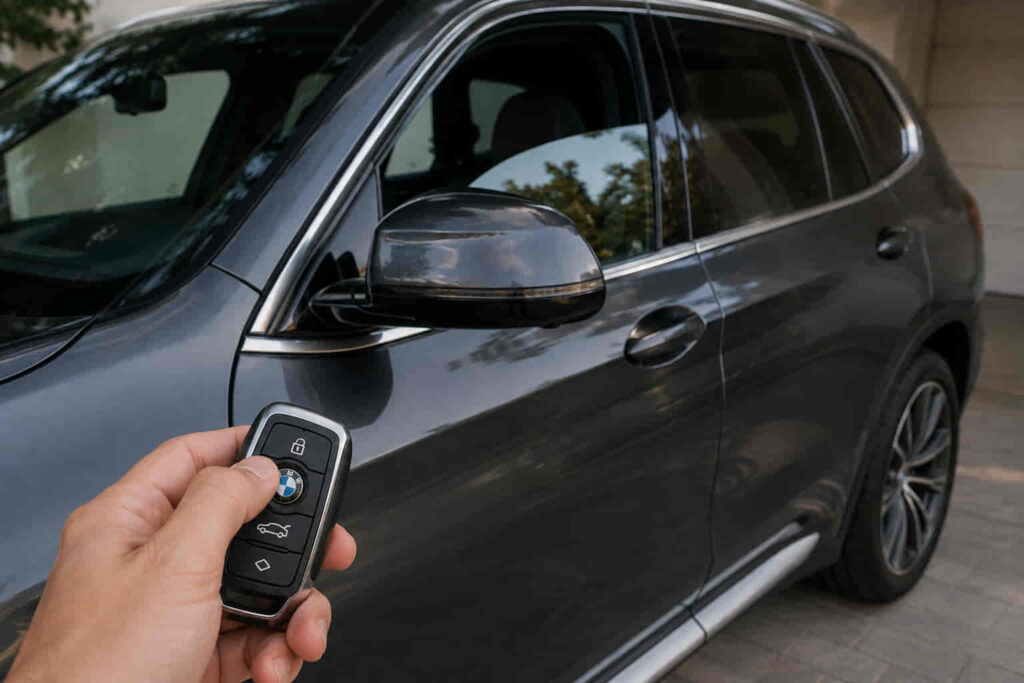
BMW mirrors not folding when locking is usually caused by a disabled automatic-folding setting, incompatible vehicle equipment, a different locking method or driver profile, or a problem within the mirror’s electrical or mechanical system. Before assuming that the mirror motor has failed, the automatic folding configuration should be checked because BMW provides a specific “Fold mirrors on lock/unlock” setting on applicable vehicles with BMW Operating System 7 or newer.
The locking method can also affect the expected behavior. BMW’s documentation connects automatic exterior-mirror folding with supported vehicle-access functions such as Comfort Access, while remote locking through the My BMW App can also depend on settings associated with the BMW ID and vehicle profile. This means a mirror that does not fold when the car is locked is not automatically evidence of a mechanical failure.
The correct troubleshooting process should move from the simplest configuration checks to physical diagnosis. First, verify that automatic mirror folding is enabled and that the BMW has the required equipment. Then check the locking method, active driver profile and key or app behavior before testing whether the mirror can operate through its supported manual controls.
This guide explains the 7 main reasons BMW mirrors may not fold when locking, how to identify each cause, and when the problem indicates a setting issue versus an electrical or mechanical fault.
Is the BMW Automatic Mirror Folding Setting Turned On?
The most common reason BMW mirrors are not folding when locking is that the automatic mirror-folding function is disabled in the vehicle settings. On applicable BMW vehicles with Operating System 7 or newer, BMW provides a “Fold mirrors on lock/unlock” setting that controls whether the exterior mirrors automatically fold when the vehicle is locked or unlocked.
When this setting is disabled, the mirrors can continue to adjust electrically and operate normally through other supported controls while remaining unfolded after the vehicle is locked. This behavior can easily be mistaken for a failed mirror motor because there may be no warning message indicating that automatic folding has simply been turned off.
On supported systems, BMW places the setting within the vehicle’s door and locking configuration. The current BMW guidance identifies the path through Apps → Vehicle → Doors and windows → Lock / Lock-unlock → Fold mirrors on lock/unlock, although the exact menu structure can vary with the vehicle and software configuration.
The setting should therefore be the first check when BMW mirrors stop folding when locking. If activating the function restores automatic folding, there is no reason to assume that the mirror motor or wiring has failed. A configuration problem should be eliminated before moving to electrical or mechanical diagnosis.
Does Your BMW Have the Equipment Needed for Automatic Mirror Folding?
BMW mirrors may not fold automatically when locking if the vehicle does not have the equipment required for the supported automatic-folding function. Having electrically adjustable exterior mirrors does not necessarily mean that the vehicle has the same power-folding and automatic-locking functionality.
BMW’s documentation associates automatic exterior-mirror folding and unfolding with supported vehicle-access functions such as Comfort Access in the relevant locking and remote-service context. This means equipment configuration needs to be considered before diagnosing a non-folding mirror as a fault.
The distinction matters because several mirror functions can exist independently. A BMW may allow the driver to electrically adjust the mirror position while lacking a particular automatic-folding feature, depending on its equipment configuration. The presence of one electrical mirror function therefore does not prove that every automatic mirror function is available.
This is particularly important when comparing two BMWs that look similar but have different factory equipment or option packages. The same iDrive menu or locking behavior should not automatically be expected if the vehicles were configured differently.
Before diagnosing a mirror motor, verify that the BMW is equipped for automatic mirror folding and that the relevant feature is supported by its vehicle configuration. If the required equipment is present and the automatic-folding setting is enabled, the troubleshooting process can then move to the locking method, driver profile, key or app behavior, and eventually the mirror mechanism itself.
Read more: bmw vehicle check reset
Are You Using a Locking Method That Should Fold the BMW Mirrors?
The way you lock the BMW can affect whether the exterior mirrors perform their automatic folding function. BMW supports several vehicle-access methods, including the key fob, Comfort Access and remote functions through the My BMW App, and these methods can interact with the vehicle’s stored settings and equipment differently.
For example, BMW documents automatic mirror folding in connection with remote locking and unlocking functions. The expected behavior therefore depends not only on whether the mirror-folding setting is enabled, but also on whether the vehicle is being locked through a supported access method. A mirror that folds when locked with one method but remains open with another provides useful diagnostic information because the physical mirror mechanism may still be operating correctly.
This distinction is especially relevant when using the My BMW App. BMW states that folding and unfolding the exterior mirrors through the app can depend on the vehicle settings associated with the BMW ID and guest profile. A difference between key-based locking and app-based locking should therefore be investigated as a configuration or access-method issue before assuming that the mirror itself has failed.
The practical test is to compare the mirror behavior using the normal locking method supported by the vehicle. If the mirrors fold correctly with one supported method but not another, the problem is more likely related to the access method, settings, or profile than to a completely failed mirror mechanism.
Is the Correct BMW ID or Driver Profile Active?
A different BMW ID or driver profile can affect stored vehicle settings and may change the behavior of supported convenience functions such as automatic mirror folding. BMW uses driver profiles to associate individual vehicle settings with the person using the vehicle, while certain remote-service functions can also depend on the active BMW ID or guest profile.
This matters when the mirror-folding function worked previously but stopped after another driver used the vehicle or a different profile became active. The vehicle may still have the automatic-folding capability, but the active profile may contain different settings from the profile that originally enabled the function.
BMW’s documentation specifically notes that exterior-mirror folding and unfolding through the My BMW App can depend on settings saved for the BMW ID and guest profile. This creates a direct relationship between BMW ID → driver profile → stored vehicle settings → mirror-folding behavior.
The correct response is not to immediately reset the mirror system or replace components. First verify which profile is active and whether the “Fold mirrors on lock/unlock” setting is enabled for that profile. If the function works after switching to the expected profile or restoring its setting, the mirror hardware was not the root cause.
A profile-related problem is particularly likely when the mirrors work normally for one driver but not for another. In that situation, comparing the stored vehicle settings is more useful than beginning with mechanical diagnosis.
Is the Key Fob or My BMW App Causing the BMW Mirrors Not to Fold?
A different key, BMW Digital Key, or My BMW App access method can produce different mirror-folding behavior when the associated vehicle settings or BMW ID profile are different. BMW documents exterior-mirror folding through remote services in connection with the vehicle’s stored settings and BMW ID or guest profile.
This becomes relevant when the mirrors fold normally with the physical key but do not fold when the vehicle is locked through the My BMW App, or when the behavior changes after switching between drivers. In that situation, the mirror mechanism may still be functioning correctly. The difference can instead indicate that the locking command is being processed under a different access or profile context.
The useful diagnostic comparison is to test the same vehicle with the normal key-based locking method and then compare the result with the relevant digital or app-based method. If the mirrors respond correctly to one method but not another, the result points toward the access method, BMW ID, or stored vehicle configuration rather than immediately indicating a failed mirror motor.
BMW’s documentation also indicates that remote-service mirror behavior can depend on settings associated with the BMW ID and guest profile. Before replacing a mirror component, verify the active BMW ID, driver profile, and relevant locking method.
Is the BMW Mirror Mechanism Working Manually?
If the BMW mirrors can fold and unfold through their supported manual control but do not fold automatically when the vehicle is locked, the automatic-folding command is more likely to be the area that needs investigation. This test helps separate a configuration or access problem from a physical mirror problem.
A mirror that responds normally to its manual folding function has demonstrated that the mirror’s mechanical movement and at least part of its electrical control path are operating. The automatic locking function, however, depends on additional conditions such as the vehicle’s automatic-folding setting and supported access equipment.
The opposite result is more significant. If a mirror cannot fold through either the automatic locking function or its supported manual control, a physical or electrical problem becomes more plausible. A seized mechanism, damaged wiring, failed motor, or related control issue can prevent the mirror from responding regardless of how the locking command is generated.
This comparison should therefore be performed before assuming that the automatic-folding setting is the only problem. Manual operation provides a useful diagnostic boundary: manual folding works but automatic folding fails points toward configuration or access behavior, while failure of both functions warrants closer inspection of the mirror system itself.
Is There an Electrical or Mechanical Fault With the BMW Mirrors?
If the automatic-folding setting is enabled, the BMW has the required equipment, the correct locking method and driver profile have been verified, and the mirrors still do not fold, an electrical or mechanical fault becomes more likely. At this stage, continuing to change iDrive settings is unlikely to resolve the problem if the mirror itself cannot respond to the folding command.
The mirror assembly depends on electrical power and a mechanism that physically moves the mirror into its folded position. A problem with the mirror motor, wiring, connector, control electronics, or the folding mechanism can therefore prevent automatic operation even when the vehicle’s configuration is correct. Physical obstruction or damage can also restrict the mirror from completing its movement.
The behavior of the mirrors can help narrow down the problem. If both mirrors stop folding at the same time, a shared configuration, access, power, or control issue becomes more relevant. If only one mirror fails while the other folds normally, the affected mirror assembly or its local electrical connection deserves greater attention.
The correct approach at this stage is to stop treating the problem as a simple setting issue and move toward vehicle-specific diagnosis. A persistent failure after configuration and access checks is a reason to inspect the mirror system rather than repeatedly resetting the same setting.
How Do You Turn On BMW Mirrors Folding When Locking?
On applicable BMW vehicles with Operating System 7 or newer, automatic mirror folding can be enabled through the iDrive vehicle settings. BMW identifies the relevant option as “Fold mirrors on lock/unlock.”
The BMW-provided menu path is Apps → Vehicle → Doors and windows → Lock / Lock-unlock → Fold mirrors on lock/unlock. The exact wording or menu structure can vary according to the BMW’s software and equipment configuration, so the displayed options on the vehicle should take priority over a procedure written for another model.
When the setting is enabled, the vehicle can command the exterior mirrors to fold as part of the supported locking behavior. If the option is missing entirely, that is useful information because it may indicate a difference in vehicle equipment, software generation, or available functionality rather than a simple disabled setting.
Checking this setting should be the first troubleshooting step when BMW mirrors are not folding when locking. It is faster and less invasive than resetting vehicle data, disconnecting the battery, or replacing mirror components.
Does Comfort Access Affect BMW Mirror Folding?
Comfort Access can affect the automatic exterior-mirror folding behavior supported by BMW because the feature is associated with vehicle locking and unlocking functions. BMW’s documentation specifically describes automatic exterior-mirror folding and unfolding in the context of supported Comfort Access and remote-service functionality.
This does not mean that every mirror-folding problem is caused by Comfort Access. The vehicle must first have the appropriate equipment and configuration, and the automatic-folding setting must be enabled. Comfort Access is one part of the system that determines how supported locking and unlocking functions interact with the exterior mirrors.
The distinction is important because automatic mirror folding is a convenience function built on top of the vehicle’s access and mirror systems. A BMW can have electrically adjustable mirrors without necessarily having every automatic folding function available.
If the vehicle is equipped for the feature but the mirrors do not respond during supported locking operations, the next step is to compare the locking method, active profile, and mirror behavior rather than assuming that Comfort Access itself has failed.
Why Do BMW Mirrors Fold With the Key but Not With the My BMW App?
If the BMW mirrors fold when the vehicle is locked with the key but not when using the My BMW App, the difference points toward the remote-service or profile configuration rather than an immediately failed mirror mechanism. BMW specifically notes that exterior-mirror folding and unfolding through the My BMW App can depend on settings stored for the BMW ID and guest profile.
The physical mirror does not need to be mechanically defective for this difference to occur. Key-based locking and app-based remote services can involve different access contexts, while the vehicle may apply settings associated with the active BMW ID or profile.
The useful test is therefore to compare both behaviors under otherwise similar conditions. If the physical key consistently causes the mirrors to fold while the app does not, the mirror mechanism has demonstrated that it can perform the requested movement. The investigation should then focus on the remote-service configuration, BMW ID, vehicle profile, and applicable settings.
A difference between key-based and app-based behavior is valuable diagnostic evidence because it narrows the problem before physical components are replaced.
Why Do BMW Mirrors Fold Manually but Not When Locking?
If the BMW mirrors fold manually but remain open when the vehicle is locked, the mirror mechanism is capable of moving and the problem is more likely related to the automatic-folding command or its configuration.
Manual folding demonstrates that the mirror can physically move through its supported control. Automatic folding adds another layer because the vehicle must issue the appropriate command when the locking event occurs. The automatic-folding setting, vehicle equipment, access method, and driver profile can all influence that behavior.
This does not completely eliminate an electrical problem. A partial electrical fault can affect one control path while leaving another operational. However, the difference between manual and automatic behavior provides a useful starting point for diagnosis.
Manual folding works + automatic folding fails should therefore lead to configuration and access checks first. If both manual and automatic folding fail, inspection of the mirror mechanism and electrical system becomes more relevant.
Why Do BMW Mirrors Stop Folding After a Software or Profile Change?
A change in BMW software, vehicle configuration, or active driver profile can affect the settings that control supported convenience functions, so a previously working mirror-folding function should be checked for configuration changes before assuming hardware failure.
The most direct issue is a changed vehicle setting. If “Fold mirrors on lock/unlock” is no longer enabled, the mirrors can stop folding even though the physical system remains functional. BMW’s documentation confirms that this setting can be controlled through iDrive on applicable vehicles.
A profile change can produce a similar symptom when different drivers use the vehicle. BMW associates certain vehicle settings with BMW ID and driver profiles, and its remote-service documentation specifically references these settings when describing exterior-mirror folding through the My BMW App.
The correct response is to verify the active profile and mirror-folding setting before performing a broader system reset. A configuration change should be ruled out before treating a change in behavior as evidence of a failed mirror component.
Should You Reset BMW iDrive if the Mirrors Are Not Folding?
An iDrive reset should not be the first response when BMW mirrors are not folding because the automatic-folding setting may simply be disabled. A system restart is more appropriate when there is evidence of an iDrive or infotainment malfunction rather than an isolated mirror-folding configuration issue.
The troubleshooting sequence should begin with the “Fold mirrors on lock/unlock” setting, then move through equipment, locking method, BMW ID or driver profile, and manual mirror operation. BMW’s documentation provides the automatic-folding setting specifically for applicable vehicles, making it a more targeted first check than resetting the entire infotainment system.
An iDrive restart becomes more reasonable when the setting cannot be accessed normally, the vehicle’s infotainment interface is malfunctioning, or other iDrive-related functions are also behaving abnormally. Even then, the restart should be treated as an infotainment troubleshooting step rather than a guaranteed repair for the mirror system.
Do not use an iDrive reset as a substitute for diagnosing a physical mirror fault. If the correct setting is enabled and the mirrors still fail after the relevant access and manual-operation checks, the problem requires a more targeted diagnosis.
When Should a BMW Mirror Folding Problem Be Diagnosed Professionally?
A BMW mirror-folding problem should be professionally diagnosed when the automatic-folding setting is enabled, the vehicle has the required equipment, the correct locking method and profile have been verified, and the mirrors still fail to fold. At that point, the probability of a configuration-only problem decreases and inspection of the mirror’s electrical and mechanical system becomes more appropriate.
Professional diagnosis is particularly useful when one mirror works while the other does not, the mirror stops halfway, the mechanism makes unusual noises, manual folding also fails, or other body-electronics functions malfunction at the same time. These symptoms provide information that cannot be resolved simply by changing the iDrive setting.
The diagnostic process should preserve the correct hierarchy: configuration first, equipment second, access method and profile third, physical operation fourth, and electrical or mechanical diagnosis last. This prevents unnecessary component replacement when the actual problem is a disabled feature or incorrect vehicle profile.
The goal is not simply to make the mirrors fold again; it is to identify why the automatic folding command is not producing the expected result. Once the configuration and access conditions are confirmed, a persistent failure should be treated as a vehicle-specific technical problem.