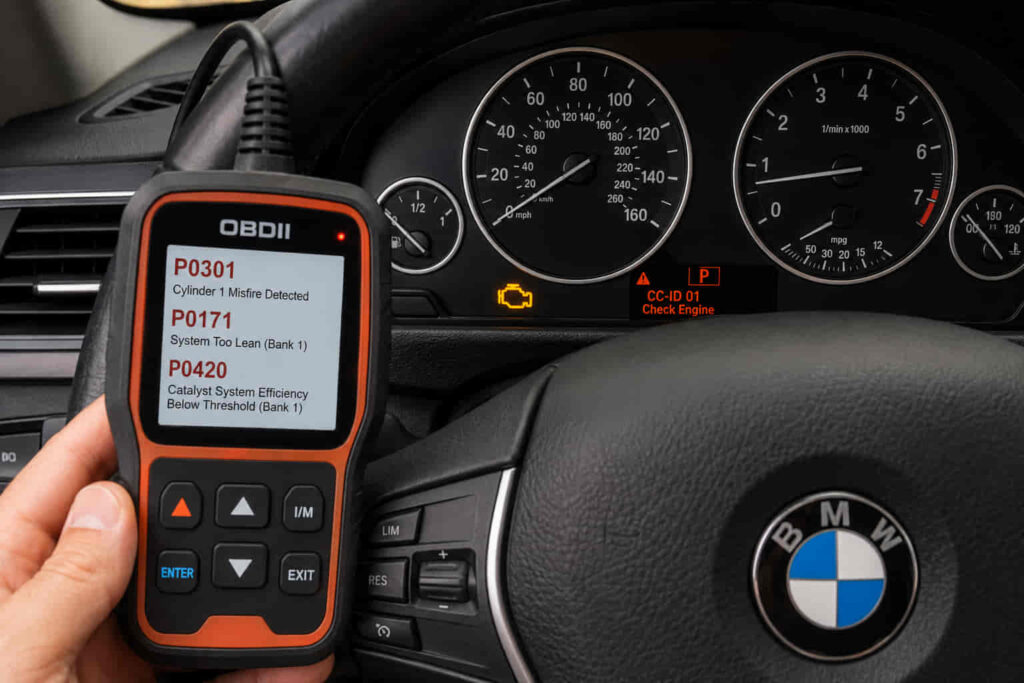
BMW Check Engine Light codes are Diagnostic Trouble Codes (DTCs) stored by the vehicle’s diagnostic system when it detects a monitored fault condition. The Check Engine Light, formally known as the Malfunction Indicator Light, tells the driver that the vehicle has detected a problem; the stored DTC provides diagnostic information about the system or condition involved. BMW documentation explains that the light is illuminated when the OBD system determines that a problem exists and stores a corresponding Diagnostic Trouble Code in the engine control module.
A code should not be interpreted as an automatic instruction to replace a specific component. The same diagnostic condition can have several possible causes, so proper diagnosis requires interpreting the code together with the vehicle’s symptoms, related fault information, and applicable test results. This distinction is especially important with BMW because the vehicle can store manufacturer-specific diagnostic information beyond the basic emissions-related information available through a generic OBD-II scan.
The Check Engine Light is also different from a BMW Check Control message. Check Control monitors broader vehicle functions and can display warning messages in the instrument cluster or control display, while the Check Engine Light is associated with the vehicle’s diagnostic and emissions monitoring system.
This guide explains the 7 key things to know about BMW Check Engine Light codes, including what the codes mean, how to read them, the major fault categories, how to judge warning severity, why codes return after being cleared, and when professional diagnosis is necessary.
What Is a BMW Check Engine Light Code?
A BMW Check Engine Light code is a Diagnostic Trouble Code (DTC) stored by the vehicle’s diagnostic system after it detects a fault condition in a monitored system. The code gives diagnostic information about the detected condition, while the Check Engine Light alerts the driver that the vehicle has identified a problem requiring attention.
The BMW OBD system continuously monitors applicable engine and emissions-related systems while the vehicle operates. When the system detects a condition that meets its fault criteria, it can store a DTC and illuminate the Malfunction Indicator Light. This creates a direct relationship between the monitored system, the detected fault, the stored code, and the warning displayed to the driver.
A DTC does not necessarily identify the exact component that has failed. For example, an emissions-related code may indicate that a system is operating outside its expected parameters without proving that one particular sensor or component is defective. The technician must interpret the code together with related fault information, vehicle symptoms, and diagnostic testing.
This distinction is essential when interpreting BMW Check Engine Light codes. The code identifies a diagnostic condition; it does not automatically provide the final repair. Clearing the code without correcting the condition can also cause the warning to return when the vehicle detects the same fault again.
How Do You Read BMW Check Engine Light Codes?
BMW Check Engine Light codes are retrieved by connecting compatible diagnostic equipment to the vehicle and reading the stored Diagnostic Trouble Codes from the relevant control module. A basic OBD-II scanner can access supported emissions-related information, while BMW-specific diagnostic equipment can provide access to additional manufacturer-specific control-module data.
The diagnostic process begins when the scanner communicates with the vehicle’s diagnostic system and retrieves the available fault information. The resulting code should then be interpreted according to the BMW system involved rather than treated as an isolated number. Related codes are particularly important because several DTCs appearing at the same time can indicate a common underlying condition.
The distinction between generic and BMW-specific diagnostics matters because modern BMW vehicles contain numerous electronic control modules. A generic OBD-II scan may identify an emissions-related powertrain code without providing the complete vehicle-level information available through BMW-specific diagnostic equipment.
Reading the code is therefore the first stage of diagnosis, not the final stage. The correct process is to retrieve the DTC, understand the affected system, compare the code with the vehicle’s symptoms and related faults, and then perform the appropriate diagnostic tests before replacing components.
This approach prevents a common mistake in Check Engine Light troubleshooting: treating the first displayed code as proof that a particular part has failed. A BMW DTC is evidence that narrows the diagnostic path; it is not automatically a parts-replacement instruction.
Read more: BMW FRM Module Reset
What Do Different BMW DTC Code Categories Tell You?
Different BMW Check Engine Light codes point toward different systems or fault conditions, but the code category alone does not identify the exact failed component. A diagnostic code provides a starting point for determining which part of the engine management or emissions system requires further testing.
BMW diagnostic information can involve conditions related to engine performance, fuel and air mixture, ignition, emissions control, sensors, and other monitored systems. Generic OBD-II codes commonly use standardized categories, while BMW-specific diagnostic information can provide additional manufacturer-level details about the vehicle’s control modules and operating conditions.
The category becomes useful because it narrows the diagnostic path. A misfire-related code directs attention toward combustion, ignition, fuel delivery, and related engine conditions. A mixture-related code directs attention toward the relationship between the amount of air entering the engine and the fuel being delivered. An emissions-related code can require investigation of sensors, exhaust components, catalyst efficiency, or the conditions affecting the emissions system.
However, a code category does not automatically identify the component that should be replaced. The same fault condition can result from different causes. A mixture code, for example, may require checking for an intake leak, fuel-delivery problem, sensor issue, or another condition before a repair decision is made.
The most useful interpretation therefore connects the DTC → affected system → operating condition → related symptoms → diagnostic test. This creates a more accurate diagnosis than interpreting the code as an isolated component name.
What Are the Most Common BMW Check Engine Light Code Categories?
The most common BMW Check Engine Light code categories involve misfires, fuel and air mixture, oxygen-sensor and emissions conditions, EVAP faults, catalytic-converter efficiency, and broader engine-management problems. These categories cover many of the conditions that can cause the BMW diagnostic system to illuminate the Check Engine Light.
Misfire-related codes indicate that the engine control system has detected abnormal combustion in one or more cylinders. Fuel and air mixture codes point toward conditions in which the measured or calculated mixture does not match the expected operating range. These faults can involve several parts of the engine management system, which is why the stored code should be followed by additional testing rather than an immediate parts replacement.
Oxygen-sensor and emissions-related codes can involve the sensors that monitor exhaust conditions or the systems that control emissions. Catalytic-converter efficiency codes, for example, describe a detected efficiency condition rather than automatically proving that the catalytic converter itself is the only possible cause. EVAP-related codes similarly point toward a problem within the fuel-vapor control system and require interpretation according to the specific fault.
The code family is useful because it establishes the semantic relationship between the warning and the monitored vehicle system. A BMW owner who sees a misfire-related DTC should investigate combustion-related causes, while an emissions code requires a different diagnostic path. The code narrows the field of possible causes without eliminating the need for testing.
BMW Check Engine Light codes should therefore be organized by diagnostic system and fault condition rather than treated as a long list of unrelated numbers. This approach gives the reader useful context for understanding what a code means while preserving the distinction between identifying a fault condition and determining its root cause.
Does a BMW Check Engine Light Code Tell You What Part to Replace?
A BMW Check Engine Light code does not automatically identify the exact part that needs to be replaced. A DTC describes a detected fault condition or points toward a monitored system, while the actual cause must be established through additional diagnostic testing.
For example, a fault related to fuel and air mixture can result from an intake leak, fuel-delivery problem, sensor signal, or another engine-management condition. Replacing the first component associated with the code can therefore fail to correct the problem if the actual cause exists elsewhere in the system.
The same principle applies to emissions-related codes. An oxygen-sensor-related DTC does not automatically prove that the oxygen sensor has failed, just as a catalytic-converter efficiency code does not by itself establish that the catalytic converter must be replaced. The code identifies a condition that requires investigation within the relevant system.
The correct diagnostic relationship is DTC → affected system → possible causes → testing → root cause → repair. This approach is more accurate than treating a BMW fault code as a direct parts catalog reference.
A BMW DTC should narrow the diagnostic path, not end it. The most reliable repair decision comes from combining the stored code with symptoms, related codes, vehicle data, and appropriate testing.
Is a Flashing BMW Check Engine Light More Serious Than a Solid Light?
Yes. A flashing BMW Check Engine Light indicates a more urgent condition than a continuously illuminated light and should not be treated as an ordinary maintenance reminder. BMW’s OBD documentation explains that the Malfunction Indicator Light can flash when a severe misfire condition is detected that could cause damage to the catalytic converter.
A flashing light is associated with an active fault condition that requires prompt attention because continued operation under the relevant conditions can increase the risk of emissions-system damage. This is different from a steady Check Engine Light, which indicates that the diagnostic system has detected and stored a fault but does not necessarily represent the same immediate severity.
The light’s behavior should also be interpreted together with the vehicle’s symptoms. Rough running, significant loss of power, abnormal engine operation, or other serious symptoms increase the importance of addressing the problem promptly. The warning itself provides the severity signal, while the stored DTC helps identify the system requiring diagnosis.
A flashing Check Engine Light should therefore be treated as a diagnostic priority rather than simply another code to clear. Clearing the DTC without resolving the condition does not remove the underlying cause and can allow the warning to return when the fault is detected again.
Can You Clear BMW Check Engine Light Codes Yourself?
You can clear stored BMW Check Engine Light codes with compatible diagnostic equipment, but clearing a code does not repair the underlying fault. The correct diagnostic sequence is to retrieve the DTC, identify and repair the cause, clear the stored fault when appropriate, and then verify that the fault does not return.
The distinction matters because a DTC is generated when the vehicle detects a condition that meets its diagnostic criteria. BMW’s OBD documentation explains that the system monitors applicable engine and emissions-related functions, stores diagnostic information when a malfunction is detected, and controls the Malfunction Indicator Light based on the detected condition.
If the underlying condition remains after the code is cleared, the vehicle can detect the same fault again during subsequent monitoring. The Check Engine Light may then return, which does not mean that the scanner necessarily failed to erase the code. It means that the vehicle has detected evidence that the original condition is still present.
This is why clearing a DTC should be treated as a verification step after diagnosis and repair, rather than the repair itself. A successful code clear only changes the stored diagnostic status; it does not correct a misfire, intake leak, sensor problem, fuel-delivery fault, emissions issue, or other mechanical or electrical cause.
BMW Check Engine Light codes are most useful when they are used to guide diagnosis rather than simply being erased. The goal is to remove the underlying fault and then confirm through subsequent monitoring that the vehicle is operating normally.
What Is the Difference Between BMW Check Engine Light and Check Control?
The BMW Check Engine Light and BMW Check Control are different warning systems, even though both can display information about problems detected by the vehicle. The Check Engine Light is associated with the engine and emissions diagnostic system, while Check Control provides broader vehicle warning messages.
The Check Engine Light is controlled by the vehicle’s OBD monitoring system. When applicable engine or emissions conditions meet the criteria for a malfunction, the system can store a DTC and illuminate the Malfunction Indicator Light.
Check Control serves a broader purpose. BMW describes Check Control as a system that displays messages relating to vehicle conditions and warnings, with relevant messages available through the vehicle’s information displays. This means a Check Control message does not automatically represent a Check Engine Light code.
The distinction is useful when troubleshooting a BMW because the two systems require different interpretations. A Check Engine Light points toward diagnostic information associated with the engine/emissions monitoring system, while a Check Control message can concern a much wider range of vehicle functions.
Can a BMW OBD2 Scanner Read All BMW Fault Codes?
A generic OBD-II scanner can retrieve supported standardized diagnostic information, but it should not be assumed to access every BMW-specific fault stored across the vehicle’s control modules. BMW vehicles contain multiple electronic control modules, and manufacturer-specific diagnostic information can extend beyond the standardized emissions-related data available through generic OBD-II communication.
This distinction becomes important when a Check Engine Light is accompanied by other electronic symptoms. A generic scan may retrieve the powertrain-related DTC responsible for the warning while providing limited information about faults stored in other BMW control modules.
BMW-specific diagnostic equipment can provide broader access to vehicle-specific diagnostic information and test functions. The appropriate tool therefore depends on what needs to be diagnosed rather than simply whether the vehicle has an OBD connector.
An OBD-II scanner is useful for retrieving supported Check Engine Light codes, but a complete BMW diagnosis may require BMW-specific diagnostic access when the fault involves additional control modules or manufacturer-specific information.
Why Does the BMW Check Engine Light Come Back After Clearing the Code?
The BMW Check Engine Light can return after clearing when the vehicle detects the same underlying fault condition again. Clearing the stored DTC changes the diagnostic memory, but it does not change the mechanical, electrical, or emissions condition that originally triggered the code.
For example, if a mixture-related fault is caused by an unresolved air leak, clearing the DTC does not eliminate the leak. When the engine control system again detects the mixture condition during its monitoring process, the relevant diagnostic information can be stored again and the warning can return.
The same principle applies to misfires, emissions-system faults, sensor-related conditions, and other monitored problems. The recurrence of the code is therefore useful diagnostic information because it indicates that the condition has not been adequately resolved or that another related fault remains.
A returning BMW Check Engine Light should be diagnosed rather than repeatedly cleared. The stored code should be compared with the original fault, current symptoms, and any related diagnostic information to determine why the condition persists.
Can a Bad Oxygen Sensor Cause BMW Check Engine Codes?
An oxygen-sensor fault can cause a BMW Check Engine Light code, but an oxygen-sensor-related DTC does not automatically prove that the sensor itself needs replacement. The diagnostic system is identifying a condition involving the sensor signal or the monitored emissions system, and the underlying cause still needs to be established.
The sensor depends on electrical power, wiring, connectors, exhaust conditions, and the engine’s operating state to produce the expected signal. A fault in one of those areas can create a diagnostic condition that appears to be related to the sensor even when the sensor is not the root cause.
This is why an oxygen-sensor code should be interpreted alongside related fault codes, engine behavior, fuel-trim information where available, and appropriate testing. Replacing the sensor without verifying the cause can leave an electrical, exhaust, or engine-management problem unresolved.
An oxygen-sensor DTC identifies a diagnostic path, not an automatic replacement decision.
Can BMW Misfires Trigger Check Engine Light Codes?
Yes. BMW engine misfires can trigger Check Engine Light codes when the diagnostic system detects combustion irregularities that meet its fault criteria. Misfire detection is particularly important because severe misfires can create excessive heat in the exhaust system and potentially damage the catalytic converter.
BMW’s OBD documentation specifically describes flashing Malfunction Indicator Light behavior in connection with severe misfire conditions that could damage the catalytic converter.
A misfire can have different causes, including ignition, fuel delivery, air intake, engine mechanical conditions, or control-system problems. A misfire code therefore identifies the affected combustion condition but does not automatically prove which component caused it.
Misfire diagnosis should connect the DTC with the affected cylinder or cylinders, vehicle symptoms, related codes, and appropriate testing. If the Check Engine Light is flashing, the condition deserves higher priority than an ordinary stored fault.
Can a Loose Gas Cap Cause a BMW Check Engine Light?
A fuel-system sealing or EVAP-related problem can trigger a Check Engine Light when the vehicle detects an abnormal condition in the fuel-vapor control system. A loose or improperly sealed fuel cap is one possible cause on vehicles where the cap and fuel-system sealing arrangement are part of the monitored system.
However, the presence of an EVAP-related code does not automatically prove that the fuel cap is the problem. The system can also be affected by hoses, valves, leaks, electrical components, or other parts of the vapor-control system.
The correct approach is to use the stored DTC to identify the relevant EVAP condition and then test the system. The code should determine the diagnostic direction rather than the assumption that the simplest component is always responsible.
Should You Drive With a BMW Check Engine Light On?
The urgency of driving with a BMW Check Engine Light depends on whether the light is steady or flashing and whether the vehicle has serious operating symptoms. A steady warning and a flashing warning do not represent the same diagnostic priority.
A flashing Malfunction Indicator Light is particularly significant because BMW associates this condition with severe misfire that can potentially damage the catalytic converter. If the vehicle is also experiencing severe shaking, substantial power loss, abnormal engine operation, overheating, smoke, or other serious symptoms, continued operation should not be treated as routine driving.
A steady Check Engine Light still requires diagnosis, but the appropriate response depends on the stored code and vehicle behavior. The warning should not simply be ignored because the vehicle continues to drive normally.
The light state provides an important severity signal, while the DTC and vehicle symptoms provide the diagnostic context. These two pieces of information should be considered together before deciding how urgently the vehicle needs professional attention.
When Should BMW Check Engine Light Codes Be Diagnosed Professionally?
Professional diagnosis is appropriate when the Check Engine Light is flashing, returns after the underlying repair, appears with significant drivability problems, or produces multiple DTCs that require BMW-specific diagnostic information. These situations indicate that reading and clearing the code alone is not enough to establish the root cause.
A professional diagnostic process can combine the stored DTC with related fault information, vehicle symptoms, live operating data, and manufacturer-specific test procedures. This is particularly valuable when the same code can result from several possible causes or when multiple control modules are involved.
The correct diagnostic hierarchy is scan → interpret → test → identify the root cause → repair → clear the relevant fault → verify the repair. This approach preserves the distinction between diagnostic evidence and the actual repair decision.
BMW Check Engine Light codes are most valuable when they shorten the path to the root cause. They should guide the diagnosis rather than become a reason to replace parts or repeatedly clear warnings without resolving the underlying condition.