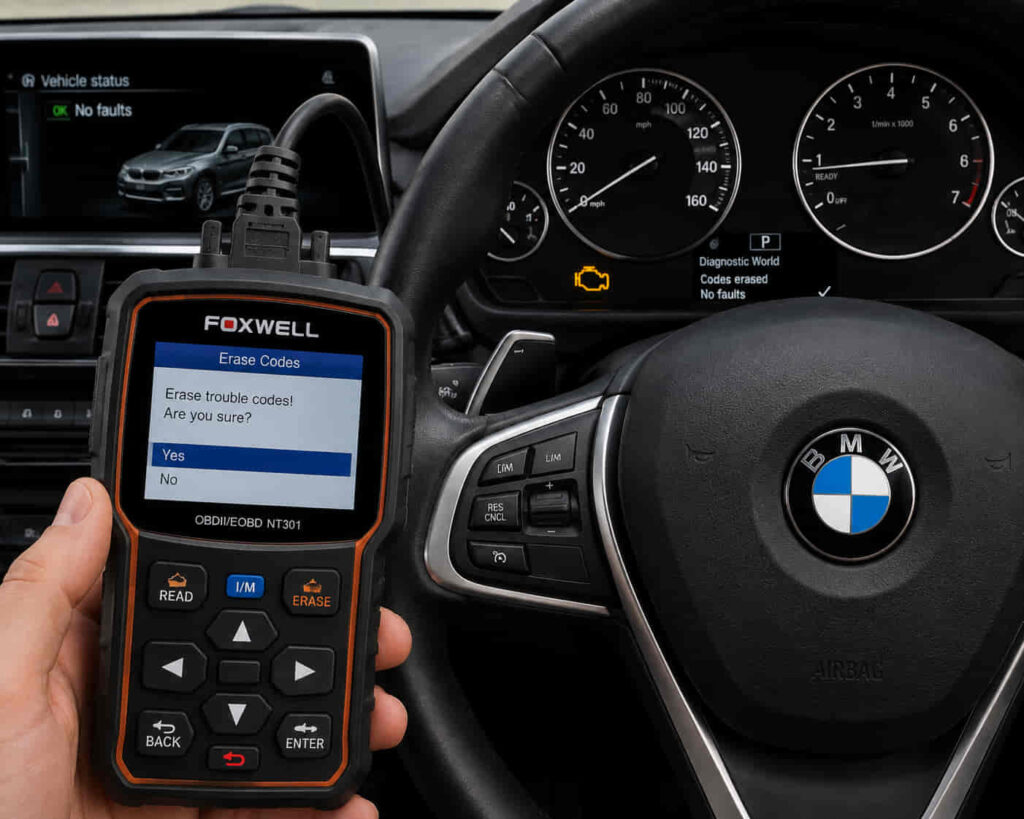
A BMW Check Engine Light reset clears or changes the stored diagnostic status, but it does not repair the condition that caused the warning to appear. The Check Engine Light, also known as the Malfunction Indicator Light (MIL), is controlled by the vehicle’s OBD diagnostic system. When BMW detects a monitored fault condition, the system stores a Diagnostic Trouble Code (DTC) and activates the warning light.
The purpose of a reset is to remove the stored warning status after the underlying issue has been diagnosed and repaired. It does not correct problems such as misfires, fuel-system faults, air leaks, sensor failures, or emissions-related conditions. If the original fault remains, the BMW diagnostic system can detect the condition again and illuminate the Check Engine Light after the appropriate monitoring process.
This distinction is important because many drivers search for a BMW Check Engine Light reset when their actual problem is a recurring fault. Clearing the warning without identifying the cause only removes the symptom temporarily and can make diagnosis more difficult by removing useful stored information.
A BMW Check Engine Light reset should therefore be viewed as the final stage of a diagnostic process, not the first repair step. The correct sequence is to identify the Diagnostic Trouble Code, determine the root cause, repair the condition, clear the stored fault if necessary, and verify that the warning does not return.
This guide explains the 7 key things to know about BMW Check Engine Light reset, including how the reset works, why the light returns, the role of scanners, drive cycles, battery disconnects, and when professional diagnosis is required.
Can You Reset a BMW Check Engine Light Without Fixing the Problem?
Resetting a BMW Check Engine Light without repairing the underlying problem only removes the stored warning temporarily and does not correct the condition that caused the fault. The Check Engine Light is triggered when the vehicle’s diagnostic system detects a condition outside its expected operating parameters and stores a Diagnostic Trouble Code (DTC).
The relationship between the fault and the warning is important. The process begins when a monitored system detects an abnormal condition, the ECM records diagnostic information, and the Malfunction Indicator Light is activated. A reset changes the stored diagnostic status, but it does not change the mechanical, electrical, or emissions condition that originally triggered the code.
For example, if a BMW develops a misfire caused by an ignition problem, fuel delivery issue, air leak, or another engine-management condition, clearing the DTC does not eliminate the cause. The engine control system continues monitoring operation, and if the same condition is detected again, the Check Engine Light can return.
This is why a reset should not be treated as a repair method. A successful reset only indicates that the stored warning has been cleared; it does not confirm that the vehicle is operating correctly.
The correct diagnostic sequence is identify the stored code → determine the cause → repair the condition → clear the code when appropriate → verify that the warning does not return. This approach preserves useful diagnostic information and prevents repeated resets from hiding an unresolved problem.
How Do You Reset a BMW Check Engine Light?
A BMW Check Engine Light is normally reset by clearing stored Diagnostic Trouble Codes with compatible diagnostic equipment after the fault condition has been addressed. Unlike some maintenance reminders, there is no universal button combination that resets the Check Engine Light across all BMW models.
The reset process begins with retrieving the stored DTC information. This information identifies the system involved and provides a starting point for diagnosis. After the cause has been corrected, a compatible scanner or BMW diagnostic system can clear the stored fault memory and reset the warning status.
The reason diagnostic equipment is involved is that the Check Engine Light belongs to the vehicle’s engine and emissions monitoring system. The warning is controlled by the ECM and related diagnostic functions, not by the infotainment system or standard vehicle settings.
After clearing the codes, the vehicle must continue operating under normal conditions so the diagnostic system can verify that the fault is no longer present. If the monitored condition remains, the BMW can store the code again and reactivate the warning.
A BMW Check Engine Light reset is therefore a verification step after repair, not a shortcut around diagnosis. Clearing the code without understanding why it appeared can remove valuable diagnostic information and delay finding the actual cause.
Read more: BMW Check Engine Light Codes
Can BMW Check Engine Light Turn Off Automatically?
A BMW Check Engine Light can turn off automatically when the vehicle no longer detects the fault condition during its monitoring process. The OBD system does not only store faults; it also evaluates whether the condition that triggered the warning continues to exist during subsequent drive cycles.
When a fault is first detected, the ECM stores the related Diagnostic Trouble Code and activates the Malfunction Indicator Light. After the underlying issue has been corrected, the vehicle continues monitoring the affected system while driving. If the required conditions are met and the fault does not reappear, the warning status can change without a manual code-clearing procedure.
This behavior is important because not every Check Engine Light requires an immediate manual reset after a repair. The vehicle’s diagnostic system is designed to verify whether the monitored condition has returned to normal operation. However, the exact behavior depends on the type of fault, the BMW model, and the diagnostic criteria associated with that system.
A temporary fault, such as a condition that no longer exists, may disappear after successful monitoring. A persistent fault, however, will continue to trigger the warning because the vehicle keeps detecting the same abnormal condition.
An automatic reset does not mean the fault was ignored or erased randomly. It means the vehicle’s diagnostic system has determined that the condition is no longer being detected according to its monitoring logic. If the warning returns later, the vehicle has likely detected evidence that the original or a related problem still exists.
Why Does My BMW Check Engine Light Come Back After Reset?
A BMW Check Engine Light comes back after a reset when the vehicle detects the same or a related fault condition again. This usually means that clearing the stored code removed the warning status, but the original cause of the problem was not fully corrected.
The diagnostic system continuously monitors important engine and emissions-related functions. If a repaired component, temporary condition, or incomplete repair does not restore normal operation, the ECM can recognize the abnormal condition again and store a new DTC.
For example, clearing a mixture-related fault does not fix an unresolved intake leak, fuel-delivery problem, or incorrect sensor signal. Similarly, clearing a misfire-related code does not correct an ignition problem, fuel issue, or mechanical condition causing incomplete combustion.
A returning Check Engine Light is therefore useful diagnostic information. It confirms that the vehicle is still detecting a condition that requires attention rather than indicating that the scanner failed to perform the reset.
The correct approach is to treat the returning warning as a new diagnostic signal. The stored code should be reviewed together with current symptoms, related fault codes, and any repair work already performed.
A BMW Check Engine Light reset is successful only when the underlying fault is resolved and the warning remains inactive during normal vehicle monitoring. Repeatedly clearing the same code without addressing the cause only delays the actual diagnosis.
Can Disconnecting the BMW Battery Reset the Check Engine Light?
Disconnecting the BMW battery is not a reliable replacement for properly diagnosing and clearing a Check Engine Light fault. While removing battery power can affect certain stored electrical states, it does not repair the condition that caused the diagnostic system to activate the warning.
The Check Engine Light is controlled by the vehicle’s OBD diagnostic system and is linked to stored Diagnostic Trouble Codes. A battery disconnect does not remove the mechanical, electrical, or emissions problem that created the fault. If the ECM detects the same abnormal condition after power is restored and the vehicle completes its monitoring process, the warning can return.
This is especially important because stored diagnostic information can provide valuable evidence about the original problem. Disconnecting the battery before diagnosis may remove useful information that helps identify the root cause, depending on the vehicle system and diagnostic equipment being used.
The difference between a power reset and a diagnostic reset should be clear. A power reset interrupts electrical supply, while a diagnostic reset involves communicating with the vehicle’s control system and clearing stored fault information through appropriate equipment.
Battery disconnection should therefore not be considered a proper BMW Check Engine Light reset method. The correct approach is to retrieve the DTC, understand why the warning appeared, repair the cause, and then clear the stored fault when appropriate.
Is BMW iDrive Reset the Same as Check Engine Light Reset?
BMW iDrive reset and BMW Check Engine Light reset are completely different procedures that affect different vehicle systems. An iDrive reset addresses infotainment system behavior, while a Check Engine Light reset involves the engine diagnostic system and stored fault information.
BMW describes iDrive software reset as a method for addressing issues such as software performance problems, unresponsive controls, or infotainment-related behavior. This process restarts the vehicle’s central information display system but does not clear engine fault codes or reset the Malfunction Indicator Light.
The confusion happens because both procedures are often described using the word “reset.” However, the systems involved are separate. The iDrive system manages functions such as display, menus, communication features, and user interface behavior. The Check Engine Light is controlled through the engine control module and OBD diagnostic system.
For example, restarting iDrive will not remove a stored misfire code, emissions fault, fuel-system fault, or sensor-related DTC. Likewise, clearing an engine fault code will not repair a frozen navigation screen or an infotainment software issue.
A BMW iDrive reset is a software restart; a BMW Check Engine Light reset is a diagnostic fault-memory operation. Understanding this distinction prevents drivers from applying the wrong reset procedure to the wrong vehicle system.
Should You Reset BMW Check Engine Light Codes After Repair?
Clearing BMW Check Engine Light codes after a repair helps verify whether the original fault condition has been corrected, but the timing of the reset is important. The diagnostic information stored before the repair can provide valuable evidence about what caused the warning, so the code should be interpreted before it is removed.
The correct process begins with retrieving the stored Diagnostic Trouble Code and understanding the system involved. After the underlying problem has been repaired, the stored fault can be cleared using compatible diagnostic equipment. The vehicle then needs to operate through normal monitoring conditions so the diagnostic system can confirm that the fault does not return.
This verification process is important because a successful code clear does not prove that the repair was correct. The vehicle must continue monitoring the affected system after the reset. If the same condition is detected again, the Check Engine Light can return and the diagnostic process must continue.
For example, if a BMW has a misfire code caused by an ignition problem, replacing the faulty component and clearing the code should result in normal operation. If the misfire returns, the repeated warning indicates that another cause may still exist.
A BMW Check Engine Light reset should therefore be used as part of the repair verification process, not as a replacement for diagnosis. The goal is not simply to turn off the warning but to confirm that the vehicle no longer detects the original fault condition.
What Is the Difference Between BMW Check Engine Light Reset and BMW Check Control Reset?
BMW Check Engine Light reset and BMW Check Control reset affect different warning systems and should not be treated as the same procedure. The Check Engine Light belongs to the engine and emissions diagnostic system, while Check Control monitors a broader range of vehicle conditions and displays general warning messages.
The Check Engine Light is activated when the OBD system detects a monitored fault condition and stores diagnostic information related to that condition. A reset involves clearing or changing the diagnostic status associated with those stored faults.
BMW Check Control operates differently. It communicates vehicle status information and warnings through the instrument cluster or vehicle display system. These messages can relate to many areas outside the engine diagnostic system, such as vehicle conditions, maintenance information, or detected system warnings.
This distinction matters because clearing a Check Control message does not clear an engine fault code, and clearing an engine fault code does not remove every vehicle warning message. Each system requires the appropriate diagnostic process.
A BMW Check Engine Light reset should therefore focus on DTCs and engine diagnostic information, while Check Control messages require their own interpretation and resolution.
Can an OBD2 Scanner Reset BMW Check Engine Light?
A compatible OBD-II scanner can clear supported BMW Check Engine Light codes, but the available functions depend on the scanner, BMW model, and the type of fault stored. Basic scanners can access standardized diagnostic information, while BMW-specific diagnostic equipment can provide deeper access to manufacturer-level data and testing functions.
The purpose of a scanner reset is to communicate with the vehicle control module, retrieve stored diagnostic information, and clear the relevant fault memory after the cause has been addressed. It does not replace the diagnostic process needed to determine why the code appeared.
The difference between reading and resetting is also important. A scanner can remove the stored warning status, but it cannot repair a mechanical problem, restore a failed component, or correct an unresolved electrical issue.
For example, clearing a fuel-mixture code with a scanner does not fix an intake leak, and clearing a misfire code does not repair an ignition or fuel problem. The scanner performs the communication task; the diagnosis determines the correct repair.
An OBD-II scanner is therefore a diagnostic tool, not a repair solution. The value comes from using the information correctly before and after the reset.
Why Does BMW Check Engine Light Stay On After Clearing Codes?
A BMW Check Engine Light stays on after clearing codes when the vehicle continues detecting the same fault condition or when the reset procedure did not address the underlying problem.
The diagnostic system continuously monitors engine and emissions-related conditions. If the fault remains active, the ECM can immediately or eventually store the DTC again depending on the type of malfunction and the conditions required for detection.
A warning that remains after clearing can indicate several situations. The code may not have been successfully cleared, the fault may still be active, another related fault may exist, or the vehicle may not have completed the necessary monitoring process after repair.
The correct response is not to repeatedly clear the warning. A returning or persistent Check Engine Light provides additional diagnostic information that should be evaluated together with the stored codes, vehicle symptoms, and previous repair work.
A Check Engine Light that remains after reset is evidence that the diagnostic process is incomplete. The vehicle is communicating that the condition causing the warning has not been fully resolved.
Can You Drive After Resetting a BMW Check Engine Light?
Driving after resetting a BMW Check Engine Light should be considered a verification period rather than a repair method. After clearing the stored fault, the vehicle needs normal operating conditions to determine whether the monitored system continues to function correctly.
During this period, the ECM evaluates the same systems that originally triggered the warning. If the vehicle completes its monitoring process without detecting the previous fault, the warning may remain inactive. If the problem continues, the Check Engine Light can return.
The urgency depends on the warning behavior and vehicle symptoms. A steady warning with normal operation is different from a flashing warning accompanied by severe engine problems. BMW associates flashing Malfunction Indicator Light behavior with serious misfire conditions that can potentially damage the catalytic converter.
The reset should therefore be followed by observation, not ignored. If the warning returns, the stored diagnostic information should be reviewed again.
The purpose of driving after a reset is to confirm the repair, not to prove that clearing the code solved the problem.
When Should BMW Check Engine Light Reset Be Done Professionally?
Professional diagnosis is recommended when the Check Engine Light returns after reset, flashes during operation, appears with significant drivability problems, or involves multiple related diagnostic codes.
A professional diagnostic process combines stored DTC information with vehicle symptoms, operating data, and system testing. This is especially important because the same diagnostic code can have multiple possible causes.
The correct diagnostic hierarchy is:
retrieve the code → interpret the system → identify the cause → repair the condition → clear the fault → verify operation
This process avoids the common mistake of repeatedly resetting the warning without correcting the condition that created it.
A BMW Check Engine Light reset is most effective when it is the final step of a complete diagnostic process. The objective is not only to turn off the warning but to confirm that the vehicle is operating correctly and that the fault condition has been resolved.