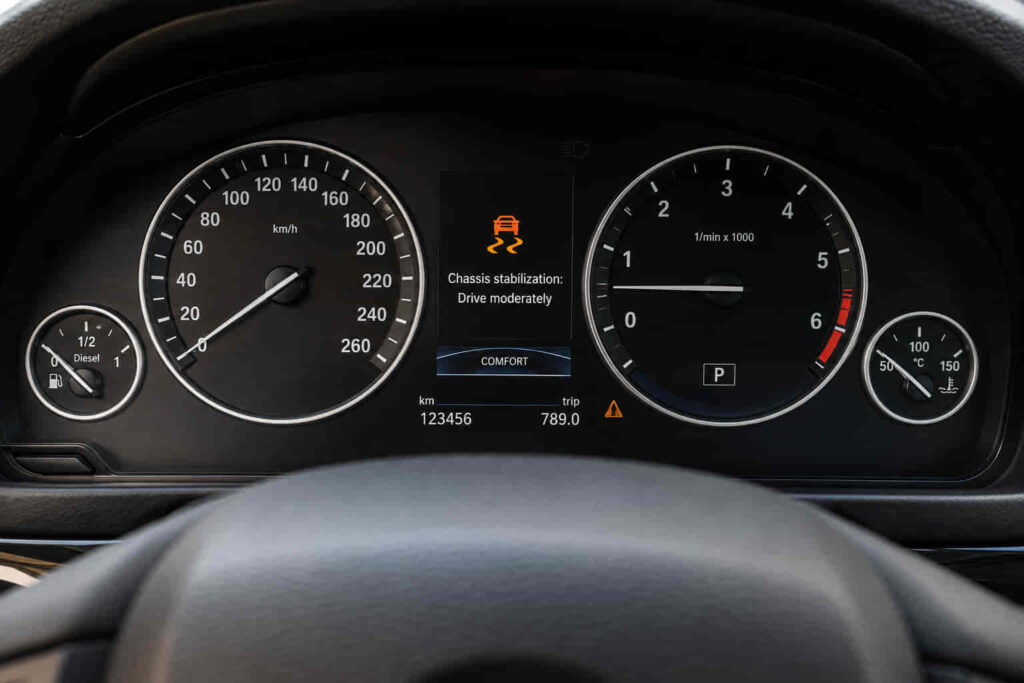
A BMW “Chassis Stabilization” warning means the vehicle has detected a condition affecting one or more systems responsible for stability, traction, braking, or vehicle-dynamics control. The message does not identify a single failed component. BMW’s chassis-control functions depend on information from sensors and electronic control systems, so the same warning can result from different underlying conditions.
The distinction between the warning and the cause is important. A chassis-stabilization message does not automatically mean that the suspension is damaged, the xDrive system has failed, or the vehicle needs a new stability-control module. The actual fault can originate in a sensor, electrical circuit, control system, or another component whose information is required for stability management.
The most useful diagnostic approach is to identify which part of the vehicle-dynamics system has lost reliable information or control. Wheel-speed signals, steering input, braking information, vehicle-motion data, electrical voltage, and communication between control modules can all affect how the system evaluates stability.
There are 7 important reasons a BMW can display a Chassis Stabilization warning, ranging from sensor and ABS/DSC problems to low voltage, electrical communication faults, drivetrain-related conditions, and persistent control-system faults. Understanding the relationship between these systems is more useful than simply clearing the warning, because a reset does not repair an active fault.
Can a Wheel-Speed Sensor Cause BMW Chassis Stabilization?
A faulty or unreliable wheel-speed signal can trigger a BMW Chassis Stabilization warning because the vehicle’s stability-control system depends on wheel-speed information to evaluate wheel behavior. BMW’s Dynamic Stability Control (DSC) is designed to help keep the vehicle on a steady course by reducing drive power and individually braking wheels when it detects unstable conditions such as skidding or loss of front-wheel adhesion.
Each wheel-speed sensor provides information that allows the vehicle’s electronic control systems to compare wheel behavior. If one signal becomes inaccurate, intermittent, or unavailable, the stability system can lose part of the information it needs to determine whether the vehicle is behaving as expected. The result can be a chassis-stabilization warning even though the physical suspension may be intact.
The warning itself does not prove that the wheel-speed sensor has failed. A sensor signal can be affected by the sensor, its wiring, connector, or another part of the system responsible for processing the signal. BMW’s Check Control system is designed to report faults in monitored vehicle functions, and messages can remain stored or reappear when the underlying fault has not been eliminated.
The diagnostic relationship is therefore wheel → speed sensor → electronic signal → stability-control system. If the warning appears together with ABS or other stability-related messages, the wheel-speed signal becomes an important area to investigate. A diagnostic scan should identify the affected system before replacing a sensor based only on the Chassis Stabilization message.
Can a Steering-Angle or Yaw Sensor Cause BMW Chassis Stabilization?
An incorrect steering-angle or vehicle-motion signal can contribute to a BMW Chassis Stabilization warning because stability control needs to compare the driver’s intended direction with the vehicle’s actual behavior. Steering input and vehicle-motion information are therefore part of the broader data used to maintain driving stability.
The mechanism is based on comparing related signals. The steering system provides information about the direction the driver intends to travel, while other vehicle-dynamics sensors provide information about how the vehicle is actually moving. BMW’s DSC uses this information to help stabilize the vehicle when it detects conditions such as oversteer or understeer.
A sensor-related problem does not necessarily mean that the sensor itself has failed. Calibration, wiring, connector integrity, or another electronic condition can affect the reliability of the information reaching the stability-control system. This is why replacing a steering-angle or motion sensor solely because a Chassis Stabilization warning appeared can lead to an incorrect repair.
The useful diagnostic question is whether the vehicle is receiving consistent steering and vehicle-motion information. If the warning appears after steering, suspension, alignment, or related electronic work, those circumstances provide additional context for diagnosis. The warning should be treated as evidence of a stability-system problem, not as automatic proof that one specific sensor needs replacement.
Can an ABS or DSC Fault Trigger BMW Chassis Stabilization?
An ABS or Dynamic Stability Control (DSC) fault can trigger a BMW Chassis Stabilization warning because these systems are directly involved in controlling braking, traction, and vehicle stability. BMW describes DSC as a system that helps keep the vehicle on a steady course by regulating drive power and applying individual wheel brakes when it detects unstable driving conditions.
ABS and DSC perform different but closely connected functions. ABS helps prevent the wheels from locking during braking, while DSC uses information from multiple vehicle-dynamics inputs to detect conditions such as oversteer or understeer and intervene when necessary. When a fault prevents one of these systems from operating normally or receiving reliable information, the vehicle can display a broader chassis-stabilization warning.
This is why a Chassis Stabilization message should not automatically be interpreted as a suspension problem. The warning can originate within the electronic stability and braking architecture even when the suspension components themselves are mechanically intact. BMW’s Check Control system reports detected faults in monitored vehicle functions, but the displayed message does not necessarily identify the specific component that caused the problem.
The diagnostic relationship is therefore ABS/DSC → braking and stability information → vehicle-dynamics control → Chassis Stabilization warning. If the warning appears together with an ABS or DSC indicator, those systems become important diagnostic areas. The underlying fault should be identified before attempting to clear the warning or replacing a component.
Can Low Battery Voltage Cause BMW Chassis Stabilization?
Low or unstable electrical voltage can contribute to a BMW Chassis Stabilization warning because the stability-control system depends on electronic control modules, sensors, and reliable electrical power. A voltage problem can therefore produce a stability-related warning even when the mechanical chassis components are not the original source of the problem.
The mechanism is straightforward: vehicle battery and charging-system conditions affect the electrical supply available to multiple control modules. If voltage falls outside the conditions expected by the vehicle’s electronic systems, several modules can report faults at the same time. This is why a BMW with a low-voltage condition may display multiple unrelated-looking electronic warnings rather than a single battery message.
However, low voltage should be treated as a possible cause, not as proof that the battery is responsible for every Chassis Stabilization warning. A wheel-speed sensor, ABS/DSC fault, wiring problem, or control-module issue can produce a similar warning while the battery and charging system are functioning normally.
The number and combination of warnings provide useful diagnostic context. If Chassis Stabilization appears together with several other electronic warnings immediately after a weak-battery event, battery voltage becomes a stronger area to investigate. If the Chassis Stabilization warning returns while electrical voltage is normal and the vehicle has a specific stability-system fault stored, the investigation should move toward the affected subsystem.
The correct relationship is battery/voltage → electronic system operation → stability-control function, not battery warning → automatic chassis fault diagnosis. A voltage test and diagnostic scan are more useful than replacing the battery or repeatedly resetting the vehicle based only on the Chassis Stabilization message.
Can an Electrical or Communication Fault Cause BMW Chassis Stabilization?
An electrical, wiring, connector, power-supply, or communication fault can trigger a BMW Chassis Stabilization warning because the stability system depends on reliable information from multiple electronic components. BMW’s Dynamic Stability Control uses vehicle information to detect unstable conditions and intervene through engine-power reduction and individual wheel braking. If the required information or communication is interrupted, the system may restrict or disable its stabilization function.
The electronic path can be understood as sensor → wiring/connector → control module → stability-control function. A wheel-speed sensor, for example, may be physically intact while its signal is disrupted by wiring or a connector problem. Likewise, a control module can report a communication fault even when the mechanical component associated with that system is functioning normally.
This distinction matters because replacing a sensor or control module based only on the dashboard message can result in the wrong repair. BMW’s Check Control system reports detected vehicle-function faults, but the warning message itself does not necessarily identify the failed component. The diagnostic fault information is therefore more useful for locating the affected subsystem than the generic “Chassis Stabilization” message alone.
The combination of warnings also provides useful context. If Chassis Stabilization appears together with several electronic warnings, an electrical or communication problem becomes more relevant to investigate. If only one specific stability function reports a persistent fault, diagnosis should focus more closely on that system and its associated components.
The correct relationship is not “Chassis Stabilization warning = bad sensor.” It is “stability function detects unreliable information or control → system reports a warning → diagnostic data identifies the affected circuit or subsystem.”
Can xDrive or Drivetrain Problems Trigger Chassis Stabilization?
An xDrive or drivetrain-related condition can be associated with chassis-stabilization behavior because BMW’s xDrive system works together with Dynamic Stability Control to manage traction and vehicle control. BMW describes xDrive as an intelligent all-wheel-drive system that works in tandem with DSC and can distribute power to wheels according to available traction.
The relationship is based on wheel behavior and torque management. When xDrive detects changing traction conditions, it can alter how drive power is distributed, while DSC can intervene through individual wheel braking and power reduction to maintain stability. A fault affecting information required by these systems can therefore create overlapping drivetrain, traction, or stability symptoms.
However, an xDrive-related symptom does not automatically mean that the xDrive hardware is defective. The same vehicle-dynamics warning can originate from a wheel-speed signal, electrical fault, DSC-related problem, or another condition that affects the information used by both systems. Diagnosis must establish which system is actually reporting the fault.
This is particularly important when the Chassis Stabilization warning appears with drivetrain-related messages, changes in traction behavior, or abnormal vehicle response. BMW’s xDrive architecture is integrated with stability control, so a problem in one area can influence the vehicle’s overall dynamics management.
The useful diagnostic relationship is drivetrain/xDrive → torque and wheel behavior → stability-control interaction → warning. A Chassis Stabilization message should therefore be treated as evidence that vehicle-dynamics control has detected an abnormal condition, not as proof that the xDrive system itself needs replacement.
Can a BMW Chassis Stabilization Control System Fault Cause the Warning?
A fault within a BMW stability-control system can keep the Chassis Stabilization warning active when the vehicle detects that the required stability functions cannot operate normally. The stability system depends on coordinated information from sensors, control modules, braking functions, and drivetrain-related systems, so a persistent fault can remain even after the vehicle is restarted.
The control system continuously evaluates information related to vehicle movement and stability. BMW describes Dynamic Stability Control as a system that helps maintain vehicle stability by regulating drive power and applying individual wheel brakes when necessary. If the control system detects a condition that prevents it from reliably performing those functions, the vehicle can report a stability-related warning.
A persistent warning should therefore be treated differently from a temporary electronic condition. If the message disappears after restarting but repeatedly returns during driving, the recurrence is evidence that an underlying condition remains. BMW’s Check Control system is designed to notify the driver when monitored vehicle functions have a fault, so the warning should be investigated rather than repeatedly cleared without identifying its cause.
The warning does not prove that the control module itself has failed. The fault may originate from an input sensor, wiring, voltage supply, communication path, or another related subsystem. Diagnostic fault information is needed to establish which part of the stability-control chain is responsible.
What Does BMW Chassis Stabilization Mean?
BMW Chassis Stabilization refers to vehicle systems that work together to help maintain stability, traction, and controlled vehicle behavior. It is not the name of a single suspension component that can be replaced whenever the message appears.
BMW’s Dynamic Stability Control uses information about vehicle behavior and can intervene by reducing drive power or applying individual wheel brakes when it detects conditions such as oversteer or understeer. This makes chassis stabilization a broader vehicle-dynamics function involving several electronic and mechanical systems.
The distinction explains why the same warning can have different causes. A problem with wheel-speed information can affect stability calculations, while an ABS/DSC fault can directly limit stability-control functions. An electrical or communication problem can also prevent the system from receiving reliable information.
The correct interpretation is therefore Chassis Stabilization warning → vehicle-dynamics system has detected an abnormal condition → specific subsystem must be identified. It should not be interpreted as Chassis Stabilization warning → suspension is broken.
Can You Drive a BMW With a Chassis Stabilization Warning?
You should not assume that a BMW with a Chassis Stabilization warning has normal stability-control capability. BMW’s DSC system is designed to help maintain vehicle stability, so a malfunction can affect the electronic assistance available during conditions such as wheel slip, oversteer, or understeer.
The driving risk depends on what caused the warning and whether other systems are affected. A single electronic warning with otherwise normal vehicle behavior is different from a Chassis Stabilization message accompanied by ABS, brake, steering, drivetrain, or multiple electronic warnings. Abnormal braking, steering, traction, or vehicle behavior should be treated as a stronger reason to stop driving and seek assistance.
The warning also should not be evaluated only by asking whether the vehicle can physically move. A BMW may remain capable of driving while one or more electronic stability functions are unavailable. The relevant question is whether the vehicle can provide the expected level of stability, traction, and braking assistance under changing road conditions.
If the vehicle handles normally but the warning persists, diagnosis should still be arranged rather than assuming the message is harmless. If braking, steering, traction, or stability behavior is abnormal, the priority is to stop operating the vehicle and have the problem assessed.
How Do You Reset BMW Chassis Stabilization?
A BMW Chassis Stabilization warning can sometimes disappear after the vehicle is switched off and restarted if the condition was temporary, but restarting the vehicle is not a repair for an active fault. BMW’s Check Control system is designed to display warnings when the vehicle detects faults in monitored functions, so a warning that returns after restarting indicates that the underlying condition still requires attention.
A restart can be useful as a diagnostic observation because it shows whether the warning is persistent or temporary. If the warning disappears and does not return, the original condition may have been transient. If it immediately returns, or reappears during driving, the system has likely detected a condition that remains unresolved.
There is no single universal “Chassis Stabilization reset” procedure that should be applied to every BMW. The appropriate response depends on the vehicle generation, the system reporting the fault, and the diagnostic information stored in the vehicle.
The correct sequence is therefore restart → observe the warning → check vehicle behavior → scan persistent faults → repair the underlying condition → verify the warning does not return. Clearing the message without resolving an active fault does not establish that the chassis-stabilization system is functioning correctly.
Can a BMW Battery Reset Clear Chassis Stabilization?
A BMW battery reset should not be treated as a universal solution for a Chassis Stabilization warning. A low-voltage event can contribute to electronic warnings, but disconnecting or resetting the battery does not repair a defective sensor, ABS/DSC fault, wiring problem, or control-system failure.
Voltage becomes more relevant when multiple electronic warnings appear simultaneously, particularly after a weak-battery or power-related event. In that situation, the electrical supply should be evaluated because stability-control modules require reliable power to operate correctly.
However, a persistent Chassis Stabilization warning after normal electrical voltage is restored points toward another diagnostic area. If the vehicle stores a specific DSC, ABS, wheel-speed, steering-angle, communication, or drivetrain fault, that evidence is more useful than repeatedly disconnecting the battery.
Battery reset and chassis-stabilization diagnosis therefore belong to different levels of the troubleshooting process. A voltage problem can be corrected first when supported by evidence, but an active stability-system fault still needs to be identified and repaired.
Why Does BMW Chassis Stabilization Keep Coming Back?
A BMW Chassis Stabilization warning keeps returning when the condition that triggered the warning has not been eliminated or when the affected system continues to detect unreliable information. A temporary disappearance after restarting does not prove that the fault has been repaired.
A recurring warning can follow different patterns. If it appears together with ABS or traction-control warnings, the braking and stability-control systems become important diagnostic areas. If several unrelated electronic warnings appear simultaneously, electrical voltage or communication problems deserve closer attention. If the warning occurs alongside drivetrain or xDrive symptoms, the interaction between those systems should also be investigated.
The timing of the warning provides additional evidence. A message that appears immediately after startup differs diagnostically from one that appears only after driving, turning, braking, or encountering wheel-slip conditions. The operating condition can help identify which vehicle-dynamics input or subsystem is triggering the warning.
The recurrence itself is therefore diagnostic evidence. If the warning repeatedly returns after a restart, the correct next step is to identify the stored fault and its affected subsystem rather than performing the same reset repeatedly.
How Do You Diagnose a BMW Chassis Stabilization Warning?
The most reliable way to diagnose a BMW Chassis Stabilization warning is to identify the specific fault stored in the vehicle and then test the affected system rather than replacing components based on the dashboard message alone. The generic warning establishes that a stability-related condition has been detected, but it does not identify the root cause.
Diagnosis should begin by recording all active Check Control messages and observing whether the warning appears with ABS, brake, steering, drivetrain, or other electronic warnings. BMW’s Check Control system provides information about detected vehicle-function faults, making the complete set of warnings more useful than isolating the Chassis Stabilization message.
The next step is to identify the relevant diagnostic fault information and connect it to the vehicle’s symptoms. A wheel-speed-related fault directs attention toward the sensor and its circuit, while an ABS/DSC communication fault directs attention toward the relevant electronic network or control system. A voltage-related fault requires a different diagnostic path.
The objective is warning → fault information → affected subsystem → component/circuit testing → repair → verification. This approach prevents unnecessary replacement of expensive components such as control modules when the actual cause is a sensor, connector, wiring problem, or electrical condition.
When Should a BMW Chassis Stabilization Warning Be Diagnosed Professionally?
A BMW Chassis Stabilization warning should be professionally diagnosed when it persists, returns after restarting, appears with other brake or stability warnings, or is accompanied by abnormal vehicle behavior. These conditions indicate that the problem cannot be safely reduced to a temporary dashboard message.
Professional diagnosis becomes particularly important when the vehicle has abnormal braking, steering, traction, or handling behavior. BMW’s DSC system is intended to help maintain vehicle stability through interventions involving drive power and individual wheel braking, so a fault can affect the assistance available during unstable driving conditions.
A persistent warning also warrants diagnosis when the vehicle appears to drive normally. The absence of an obvious driving symptom does not prove that the stability system is fully operational. A stored fault can indicate that one of its inputs or functions is unavailable even before the driver notices a change in handling.
The appropriate diagnostic journey is therefore understand the warning → identify related symptoms → check all associated warnings → retrieve fault information → diagnose the affected subsystem → repair the root cause → verify normal operation. A reset can be useful when a condition was temporary, but a recurring Chassis Stabilization warning should be treated as a diagnostic problem rather than a message to repeatedly clear.