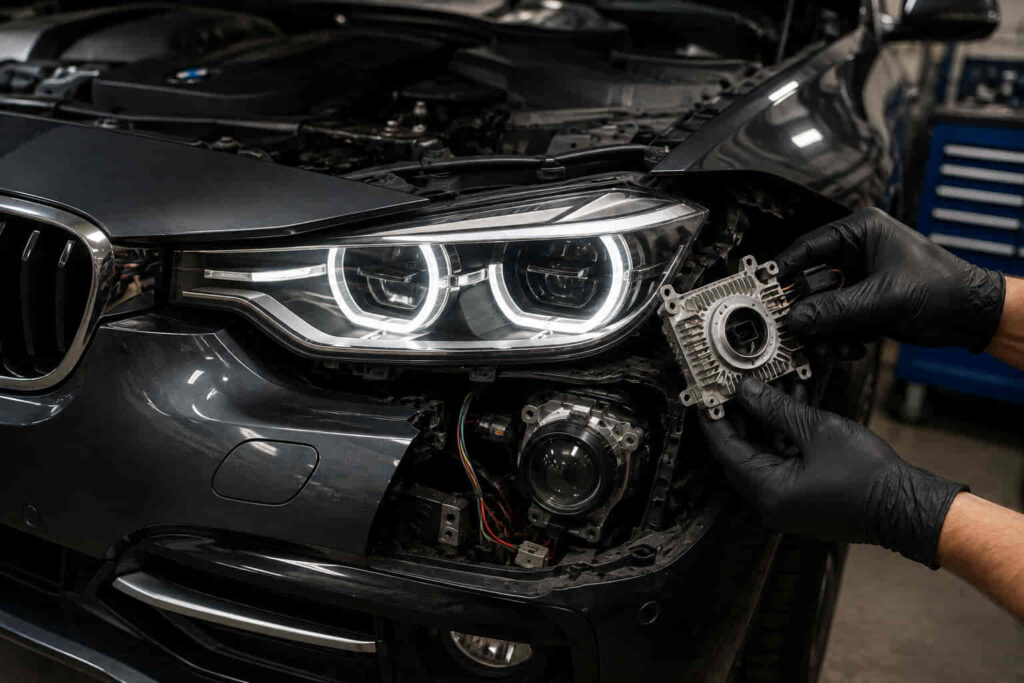
BMW Adaptive Headlight repair is required when the vehicle’s intelligent lighting system cannot properly adjust beam direction, leveling, or communication between its electronic components. The Adaptive Headlight System (AHL) is designed to improve nighttime visibility by automatically adjusting the direction and height of the headlight beam based on driving conditions, steering input, and vehicle movement.
Unlike traditional headlights, BMW Adaptive Headlights rely on multiple electronic and mechanical components working together. The system uses control modules, sensors, motors, and headlight assemblies to ensure the light beam follows the road correctly, especially when driving through curves or changing road conditions.
When one component fails, the entire system may stop functioning properly. Drivers may notice warning messages such as Adaptive Headlight Malfunction, headlights that no longer move during cornering, incorrect beam positioning, or automatic leveling problems. However, these symptoms do not always mean the entire headlight assembly needs replacement.
BMW Adaptive Headlight problems can come from different sources, including faulty motors, damaged sensors, failed control modules, wiring issues, or moisture intrusion. Proper diagnosis is necessary because replacing expensive headlight assemblies without identifying the actual cause can lead to unnecessary repair costs.
This guide explains how BMW Adaptive Headlights work, the common causes of failure, diagnostic methods, repair options, and the factors that determine repair costs.
How Does the BMW Adaptive Headlight System Work?
The BMW Adaptive Headlight System works by using electronic sensors, control modules, and mechanical adjustment components to change the direction and position of the light beam according to driving conditions. Unlike standard headlights that project light in a fixed direction, Adaptive Headlights actively respond to vehicle movement to improve visibility and safety during nighttime driving.
The system continuously collects information from different vehicle components, including the steering angle sensor, vehicle speed sensor, and ride height sensors. The Adaptive Headlight control module processes this data and determines how the headlight assembly should adjust.
When the driver turns the steering wheel, the system calculates the vehicle’s direction and activates the headlight swivel motor to rotate the light beam toward the upcoming road path. This allows drivers to see around corners more effectively instead of relying only on fixed forward illumination.
The system also manages automatic headlight leveling. BMW vehicles monitor changes in vehicle position caused by acceleration, braking, or different passenger and cargo loads. The leveling motor adjusts the headlight angle to maintain proper illumination while preventing the beam from pointing too high or affecting other drivers.
BMW uses different Adaptive Headlight technologies depending on the vehicle model and production year. Older BMW models may use adaptive xenon systems, while newer models often use adaptive LED technology with more advanced electronic controls.
Because the system depends on communication between multiple components, a failure in one area can affect overall operation. A faulty sensor may send incorrect information, while a damaged motor or control module may prevent the headlights from moving correctly.
For example, when a BMW enters a corner at night, a properly functioning Adaptive Headlight system will slightly rotate the headlight beam in the direction of the turn, allowing the driver to see the road ahead more clearly.
What Are the Symptoms of a BMW Adaptive Headlight Problem?
A BMW Adaptive Headlight problem can appear through warning messages, incorrect beam movement, leveling issues, or complete loss of adaptive lighting functions. Since the system contains multiple electronic and mechanical components, different failures can create different symptoms.
One of the most common signs is an Adaptive Headlight Malfunction warning appearing on the instrument cluster. This warning indicates that the vehicle has detected a problem within the lighting system, but further diagnosis is required to identify whether the issue involves the module, sensor, motor, or wiring.
Another common symptom is that the headlights no longer move when the vehicle turns. During normal operation, Adaptive Headlights should adjust horizontally based on steering input. If the swivel motor or control system fails, the headlights may remain fixed in a straight position.
Incorrect headlight leveling is another indicator of a problem. Drivers may notice that the light beam points too high, too low, or does not adjust when the vehicle position changes. This can reduce nighttime visibility and may affect other drivers on the road.
A single headlight behaving differently from the other side can also indicate a component failure. For example, one headlight may continue adjusting normally while the other remains stationary due to a failed motor or internal headlight component.
Electrical symptoms may also appear when the issue involves the control module or wiring system. Communication errors, intermittent operation, or problems occurring after battery replacement or electrical repairs can suggest a power or module-related problem.
However, these symptoms do not always mean the entire headlight assembly is damaged. A sensor, connector, or control module failure may create similar behavior while requiring a much smaller repair.
For example, a BMW displaying an Adaptive Headlight warning after a minor electrical issue may only need system diagnosis and module calibration rather than a complete headlight replacement.
What Causes BMW Adaptive Headlight Failure?
BMW Adaptive Headlight failure can be caused by problems with motors, sensors, control modules, wiring, software communication, or moisture damage inside the lighting system. Because Adaptive Headlights depend on multiple electronic and mechanical components working together, a failure in one part can prevent the entire system from operating correctly.
A failed headlight swivel motor is one of the common causes of Adaptive Headlight problems. This motor controls the horizontal movement of the headlight assembly and allows the beam to follow steering input during cornering. When the motor stops working, the headlight may remain fixed even though other parts of the system continue operating.
The leveling motor can also cause Adaptive Headlight issues. This component adjusts the vertical position of the light beam based on vehicle movement and load conditions. A damaged leveling motor or incorrect position feedback can cause the headlights to point at an incorrect angle.
Sensor failures are another important cause. The system depends on accurate information from components such as the steering angle sensor and ride height sensors. If these sensors provide incorrect data, the control module may disable adaptive functions to prevent improper headlight movement.
The Adaptive Headlight control module can also fail. This module processes information from different vehicle systems and controls the motors inside the headlight assembly. Internal electronic faults, communication errors, or software problems can prevent the module from controlling the lighting system correctly.
Wiring and connector problems may create symptoms similar to component failure. Damaged wiring, corrosion, or loose connections can interrupt communication between the headlight assembly and the vehicle’s control systems.
Moisture intrusion is another possible cause, especially in older BMW headlights. Water entering the headlight housing can damage electronic components, control units, or internal motors, leading to intermittent or complete system failure.
For example, a BMW with an Adaptive Headlight warning after driving in heavy rain may have a moisture-related electrical issue rather than a failed headlight assembly.
How Do You Diagnose BMW Adaptive Headlight Problems?
Diagnosing BMW Adaptive Headlight problems requires testing the complete lighting system, including control modules, sensors, motors, wiring, and communication signals. Since multiple components can create similar symptoms, replacing parts without proper diagnosis can result in unnecessary repair costs.
The first diagnostic step is usually scanning the vehicle with BMW-specific diagnostic equipment. Tools such as BMW ISTA can read fault codes stored in the lighting control modules and identify communication problems or component failures.
Fault codes provide important information, but they do not always identify the failed component directly. A technician must analyze the code information together with physical inspection and system testing.
The next step involves checking communication between the Adaptive Headlight module and other vehicle systems. The module must receive accurate information from sensors and communicate correctly with the vehicle network to control headlight movement.
Sensor testing is also important because incorrect input data can prevent normal operation. Technicians may inspect steering angle sensor readings, ride height sensor signals, and other information used by the Adaptive Headlight system.
The headlight motors and mechanical adjustment components should also be tested. If the control module sends the correct command but the headlight does not move, the problem may be inside the headlight assembly or adjustment mechanism.
Electrical testing helps identify problems with power supply, ground connections, and wiring continuity. A damaged wire or poor connector connection can interrupt system operation without creating obvious external damage.
Physical inspection is especially important for identifying moisture damage, damaged housings, or visible component failures.
A complete diagnosis helps determine whether the repair requires a small component replacement, module programming, internal headlight repair, or complete headlight replacement.
For example, if diagnostic testing shows that the Adaptive Headlight module communicates correctly but one headlight does not move, the issue may be limited to the swivel motor rather than the entire lighting system.
Can BMW Adaptive Headlights Be Repaired?
BMW Adaptive Headlights can often be repaired when the failure is limited to specific components such as motors, control modules, wiring connections, or software-related issues. Repairing individual components is usually more cost-effective than replacing the entire headlight assembly, especially because BMW Adaptive Headlights contain multiple separate electronic and mechanical parts.
A damaged swivel motor or leveling motor may be repaired or replaced depending on the design of the headlight assembly. These motors control the physical movement of the light beam, and failure in either component can prevent the Adaptive Headlight system from adjusting correctly.
Control module problems can also sometimes be repaired. The Adaptive Headlight module manages communication between sensors, vehicle systems, and the headlight assembly. If the problem involves software corruption, communication errors, or specific electronic failures, specialized repair or reprogramming may restore normal operation.
Coding and programming are important parts of BMW Adaptive Headlight repair. When a control module or headlight assembly is replaced, the vehicle may require coding to recognize the new component and integrate it with existing vehicle systems.
Wiring repairs can solve problems caused by damaged connectors, broken wires, or corrosion. Since Adaptive Headlights rely on communication between multiple components, restoring proper electrical connections can return the system to normal operation.
However, not every Adaptive Headlight can be repaired economically. Severe internal damage, extensive water intrusion, or major damage to the headlight housing may require complete assembly replacement.
The correct repair approach depends on identifying the failed component first. Replacing an expensive headlight assembly without confirming the cause can result in unnecessary costs.
For example, a BMW with a failed Adaptive Headlight motor may only require a component repair, while a headlight damaged by water intrusion may need a complete replacement.
How Much Does BMW Adaptive Headlight Repair Cost?
BMW Adaptive Headlight repair costs depend on the failed component, vehicle model, headlight technology, labor requirements, and whether programming is required after repair. The difference in cost between repairing a small component and replacing an advanced LED or xenon headlight assembly can be significant.
Diagnostic costs are usually the first step because technicians need to identify the exact source of the problem. Since Adaptive Headlight failures can involve sensors, modules, wiring, or motors, accurate diagnosis prevents unnecessary replacement of expensive parts.
Repairs involving sensors or wiring are typically less expensive because they involve smaller components and limited labor. A faulty connector, damaged wire, or sensor issue may be resolved without replacing the entire lighting system.
Adaptive Headlight module repairs or replacements usually involve higher costs because the module controls communication between different lighting components and may require coding or programming after installation.
Replacing the complete headlight assembly is often the most expensive solution. BMW Adaptive LED and xenon headlights contain advanced electronics, motors, and control units, making them significantly more expensive than traditional headlight systems.
The final repair cost also depends on the BMW model and production year. A newer BMW equipped with advanced LED or Laserlight technology may require more expensive components compared with an older model using a simpler xenon system.
For example, a BMW with a faulty leveling sensor may require a relatively small repair, while a damaged Adaptive LED headlight assembly may require a much larger investment.
Should You Repair or Replace a BMW Adaptive Headlight?
The decision to repair or replace a BMW Adaptive Headlight depends on the extent of damage, repair availability, component cost, and the overall condition of the vehicle. Repairing individual components is usually preferred when the headlight assembly remains structurally intact and the failure comes from a replaceable part.
Repair is often the better option when the problem involves a motor, sensor, wiring connection, or software issue. This approach preserves the original headlight assembly and avoids the higher cost of installing a complete replacement unit.
Replacement becomes more appropriate when the headlight housing is damaged, internal electronics have suffered severe water damage, or multiple components inside the assembly have failed.
Used replacement headlights can sometimes reduce costs, but compatibility must be verified carefully. BMW headlights are linked to vehicle-specific configurations, and replacement units may require coding or programming before they function correctly.
The vehicle’s age and value should also influence the decision. Investing in a complete Adaptive Headlight replacement may make sense for a newer BMW, while repairing existing components may provide better value for an older vehicle.
A professional diagnosis remains the most important step because the visible symptom does not always identify the failed component.
For example, a BMW showing an Adaptive Headlight warning may only need module coding after a repair, while another vehicle with physical headlight damage may require a complete assembly replacement.
How Can You Prevent BMW Adaptive Headlight Problems?
Preventing BMW Adaptive Headlight problems requires maintaining the vehicle’s electrical system, protecting lighting components from moisture, and addressing early warning signs before failures become more expensive. Since Adaptive Headlights depend heavily on electronic communication, proper maintenance plays an important role in system reliability.
Maintaining battery health is important because unstable voltage can affect BMW electronic modules, including lighting control systems. Weak batteries or charging problems can create communication errors that appear as Adaptive Headlight failures.
Protecting headlights from moisture is also essential. Damaged seals, cracked housings, or blocked drainage areas can allow water to enter the headlight assembly and damage internal electronics.
Electrical problems should be repaired quickly because wiring faults and poor connections can interrupt communication between the Adaptive Headlight module and other vehicle systems.
Drivers should also pay attention to early warning signs such as intermittent headlight movement, unusual noises from the headlight assembly, or occasional warning messages. Addressing these issues early can prevent more extensive damage.
Regular diagnostic checks can help identify stored faults before the system completely fails. BMW-specific diagnostic equipment can detect communication problems and component issues that may not yet create obvious symptoms.
For example, repairing a minor wiring issue or replacing a weak battery early can prevent damage to more expensive Adaptive Headlight components.