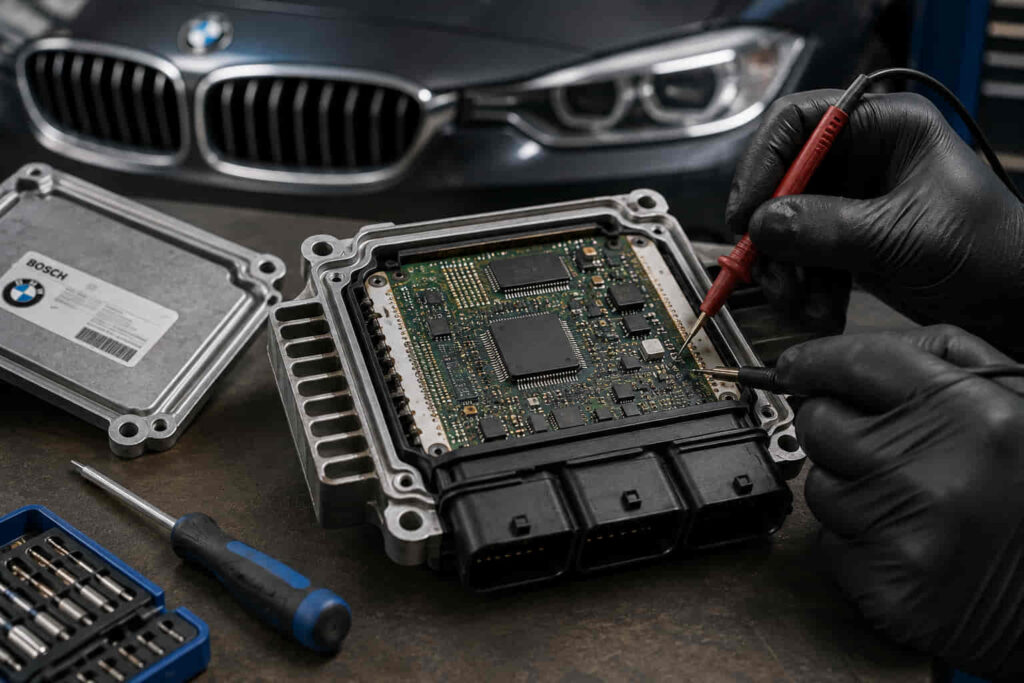
BMW DME repair is required when the Digital Motor Electronics module develops electronic, software, or communication problems that affect engine operation. The DME functions as the central control unit for the BMW engine management system, processing information from multiple sensors and controlling critical operations such as fuel delivery, ignition timing, and engine performance.
Modern BMW vehicles rely heavily on electronic control systems, which means a DME problem can create symptoms that appear to be related to mechanical components. A faulty DME may cause starting problems, reduced engine power, warning lights, poor drivability, or communication failures between vehicle modules.
However, not every engine problem indicates a failed DME. Issues involving sensors, wiring, battery voltage, fuel systems, or other engine components can create similar symptoms. Proper diagnosis is necessary before deciding whether the DME requires repair, programming, or replacement.
BMW DME repair focuses on restoring the module’s ability to communicate with the vehicle and correctly manage engine functions. Depending on the type and severity of the failure, solutions may include electronic component repair, software recovery, programming, or replacing the module entirely.
Understanding how BMW DME works, why failures occur, and how repairs are performed helps owners avoid unnecessary replacements and choose the correct solution for restoring engine performance.
What Is a BMW DME and What Does It Do?
A BMW DME is the electronic control unit responsible for managing engine operation by processing sensor data and controlling critical engine functions. The Digital Motor Electronics module acts as the central processing system of the BMW engine management system, allowing the engine to operate efficiently, smoothly, and within manufacturer specifications.
The DME continuously receives information from different sensors throughout the vehicle. These sensors monitor conditions such as engine temperature, air intake, crankshaft position, camshaft position, exhaust performance, and throttle operation. The DME analyzes this information and adjusts engine parameters in real time.
Fuel management is one of the primary responsibilities of the BMW DME. The module controls fuel injector timing and duration to maintain the correct air-fuel mixture under different driving conditions. When the DME receives inaccurate data or develops internal faults, fuel delivery can become inconsistent, affecting engine performance and efficiency.
The DME also controls ignition timing by managing when spark plugs ignite the fuel mixture inside the combustion chamber. Precise ignition control is essential for smooth acceleration, fuel economy, and emissions compliance.
Turbocharged BMW engines rely heavily on DME management because the module regulates boost pressure and communicates with systems such as electronic throttle control and variable valve timing. Engines such as the BMW B48, B58, N20, and N55 depend on accurate DME operation to deliver their expected performance.
The DME also communicates with other vehicle modules, including the transmission control module, body control systems, and diagnostic systems. This communication allows different vehicle systems to operate together and enables technicians to identify faults through BMW diagnostic tools.
For example, when a BMW detects abnormal engine sensor readings, the DME can adjust engine operation, store diagnostic fault codes, and activate warning indicators to protect the engine from potential damage.
What Are the Symptoms of a Bad BMW DME?
A faulty BMW DME can create symptoms that affect engine starting, performance, communication, and overall vehicle operation. Because the DME controls many engine functions, a failure in the module can appear as multiple unrelated problems, making accurate diagnosis essential.
One common symptom is an engine that does not start or starts inconsistently. The DME controls important starting processes, including fuel delivery and ignition signals. If the module cannot communicate correctly with engine components, the vehicle may crank without starting or fail to respond normally.
A Check Engine Light is another possible indicator of DME-related problems. However, the warning light alone does not confirm that the DME has failed because many engine components can trigger similar warnings. Diagnostic testing is required to determine whether the issue originates from the control module or another component.
Reduced engine performance or limp mode can also indicate DME problems. BMW vehicles may enter a protective operating mode when the control system detects abnormal information or communication failures. This reduces engine output to prevent further damage.
Communication errors between vehicle modules are another important warning sign. A damaged DME may fail to communicate correctly with diagnostic equipment or other control units, creating fault codes related to network communication.
Other possible symptoms include rough engine operation, incorrect throttle response, fuel delivery problems, or unusual behavior after electrical repairs. Voltage-related issues, such as improper battery connections or electrical surges, can affect sensitive electronic modules.
However, these symptoms do not automatically mean the DME needs replacement. Problems with sensors, wiring, battery voltage, or other control modules can create similar conditions. A complete diagnostic process is necessary before performing DME repair.
For example, a BMW that suddenly enters limp mode after a battery issue may have a DME-related communication problem, but it could also require battery testing, software adaptation, or inspection of affected sensors before replacing the engine control module.
Read more: Best Year for BMW X3
What Causes BMW DME Failure?
BMW DME failure can occur because of electrical problems, software issues, moisture exposure, wiring faults, or internal electronic component damage. Since the DME is a sensitive control module that manages critical engine functions, any interruption in power supply, communication, or internal processing can affect vehicle operation.
Electrical problems are one of the most common causes of DME-related failures. BMW control modules require stable voltage to operate correctly, and voltage spikes, incorrect jump-start procedures, weak batteries, or charging system problems can damage sensitive electronic circuits inside the module.
Battery-related issues are especially important because many BMW systems depend on accurate power management. A failing battery or alternator problem may create unstable voltage conditions that affect communication between the DME and other vehicle modules.
Water or moisture damage is another possible cause of DME failure. Although BMW places electronic modules in protected locations, damaged seals, blocked drains, or water intrusion in the engine compartment can expose electrical components to moisture. Corrosion inside the module can interrupt electrical connections and cause intermittent or complete failure.
Software corruption can also affect DME operation. BMW vehicles use complex programming that controls engine behavior, and incorrect software updates, failed programming procedures, or communication interruptions during coding can create module errors.
Wiring and connector problems may produce symptoms that appear to be DME failure. Damaged wires, poor connections, or corrosion at electrical terminals can prevent the DME from receiving accurate signals or communicating with other systems.
Internal electronic failure can occur when components inside the DME become damaged due to age, heat exposure, or electrical stress. In these cases, professional repair may be required to restore the module.
For example, a BMW that suddenly develops multiple engine control errors after a battery replacement may not have a mechanical engine problem. The issue may involve incorrect voltage conditions, damaged communication circuits, or a DME-related electrical fault.
How Do You Diagnose a BMW DME Problem?
Diagnosing a BMW DME problem requires testing the entire engine management system rather than assuming the control module itself has failed. Because many components communicate with the DME, a complete diagnosis helps separate genuine module failure from issues caused by sensors, wiring, or power supply problems.
The diagnostic process usually begins with scanning the vehicle using BMW-specific diagnostic equipment. Tools such as BMW ISTA can retrieve fault codes stored in the DME and other connected modules. These codes provide information about communication failures, sensor problems, and system errors.
Power supply testing is another important step. Technicians check battery voltage, charging system performance, and electrical connections because unstable voltage can create false DME-related symptoms.
Communication testing helps determine whether the DME is properly connected to the vehicle network. If the diagnostic tool cannot communicate with the DME, technicians inspect power sources, ground connections, wiring, and network communication before concluding that the module has failed.
Sensor data analysis is also necessary because faulty sensors can cause engine behavior that resembles DME failure. The technician compares live data from components such as oxygen sensors, crankshaft sensors, camshaft sensors, and throttle systems to determine whether the DME is receiving accurate information.
Physical inspection may also reveal problems that cannot be detected through software. Technicians check the DME housing, connectors, wiring condition, and signs of moisture or corrosion.
A proper diagnosis prevents unnecessary replacement because DME modules are expensive components that often require programming and synchronization with the vehicle.
For example, if a BMW shows communication faults with the DME, a technician must first verify battery voltage, wiring integrity, and module power supply before replacing the engine control unit.
Can a BMW DME Be Repaired?
A BMW DME can often be repaired when the failure is caused by specific electronic, software, or communication problems rather than complete internal damage. Repairing the DME can be a practical alternative to replacement because the original module already contains vehicle-specific programming and configuration data.
DME repair usually focuses on restoring damaged electronic components, repairing internal circuits, recovering corrupted software, or resolving communication problems. Specialized technicians can inspect the module, identify failed components, and determine whether the damage can be repaired without replacing the entire unit.
Software-related problems are among the issues that may be resolved through reprogramming or recovery procedures. BMW DME modules store important software information that controls engine operation, and incorrect programming or communication interruptions can prevent the module from functioning correctly.
Another repair option is DME cloning, which involves transferring important programming data from an original module to another compatible unit. This process may be required when the original DME cannot be repaired but the vehicle-specific software information needs to be preserved.
However, not every DME can be repaired. Severe internal circuit damage, extensive corrosion, or physical destruction may make repair impractical. In these cases, replacing the module may be the more reliable solution.
The repair decision depends on the type of failure, vehicle model, DME generation, and the condition of the module. A professional evaluation is necessary because symptoms alone cannot determine whether repair or replacement is the correct option.
For example, a BMW DME affected by corrupted software may be restored through programming, while a module damaged by severe water intrusion may require replacement.
How Much Does BMW DME Repair Cost?
BMW DME repair costs vary depending on the type of failure, vehicle model, DME generation, diagnostic requirements, and whether the module needs repair, programming, or replacement. The total cost is influenced by both the technical work required and the complexity of integrating the module with the vehicle.
Diagnostic costs are usually the first expense because technicians need to confirm whether the DME is actually faulty. Since many BMW electrical and engine problems create similar symptoms, proper testing prevents unnecessary replacement of expensive components.
Electronic DME repair is generally less expensive than replacing the entire module because the original unit can often be restored if the internal damage is limited. Repair costs depend on the failed components and the amount of labor required to restore functionality.
Programming and coding can add additional costs because BMW DME modules must communicate correctly with the vehicle. A repaired or replacement module may require synchronization with other control units to ensure proper engine operation and security system compatibility.
Replacing a BMW DME is usually the most expensive option because the module itself can be costly, and additional programming may be required. The final expense depends on the BMW model, engine type, and whether a new, used, or refurbished module is installed.
The vehicle’s age and availability of compatible modules can also affect repair decisions. Older BMW models may have more affordable replacement options, while newer vehicles often require advanced programming procedures.
For example, repairing a damaged circuit inside a BMW DME may cost significantly less than installing a new module that requires complete vehicle programming and configuration.
Should You Repair or Replace a BMW DME?
The choice between repairing and replacing a BMW DME depends on the extent of damage, repair feasibility, cost difference, and long-term reliability considerations. Both options can restore engine operation when performed correctly, but each approach has different advantages.
Repairing the existing DME is often beneficial because the original module already matches the vehicle’s programming, hardware configuration, and security system. This can simplify the restoration process when the damage is limited to repairable electronic components.
Replacement may be necessary when the DME has severe internal damage or cannot reliably communicate with the vehicle. A replacement module must usually be programmed and coded to match the BMW, including vehicle-specific information and security settings.
The vehicle’s overall condition should also influence the decision. Installing an expensive replacement module on a vehicle with other major electrical or mechanical problems may not provide good long-term value.
A proper diagnosis is the most important factor before choosing either option. Replacing a DME when the actual problem is a weak battery, damaged wiring, or faulty sensor can result in unnecessary costs without solving the original issue.
For example, a BMW with a repairable software fault may benefit from DME programming, while a module with burned internal components may require replacement for reliable operation.
How Can You Prevent BMW DME Problems?
Preventing BMW DME problems requires maintaining stable electrical conditions, protecting vehicle electronics, and addressing warning signs before they develop into major failures. Since the DME depends on consistent power supply and communication with other systems, electrical maintenance plays an important role in long-term reliability.
Maintaining battery health is one of the most effective ways to protect the DME. Weak batteries and unstable voltage conditions can place additional stress on electronic modules and create communication problems.
The charging system should also be monitored because alternator problems can cause voltage fluctuations that affect sensitive control units. Early diagnosis of charging issues can prevent unnecessary damage to electronic components.
Electrical repairs should be performed carefully because incorrect jump-start procedures, improper wiring work, or failed programming attempts can affect BMW control modules.
Protecting the engine compartment from moisture is another important consideration. Water intrusion can damage connectors, wiring, and electronic components, especially when drainage systems or protective seals are not maintained.
Regular diagnostic checks can also identify developing issues before complete module failure occurs. Addressing communication errors, warning lights, or unusual electrical behavior early can reduce repair complexity.
For example, maintaining a healthy battery, repairing electrical problems quickly, and using proper BMW programming procedures can significantly reduce the risk of DME-related failures.