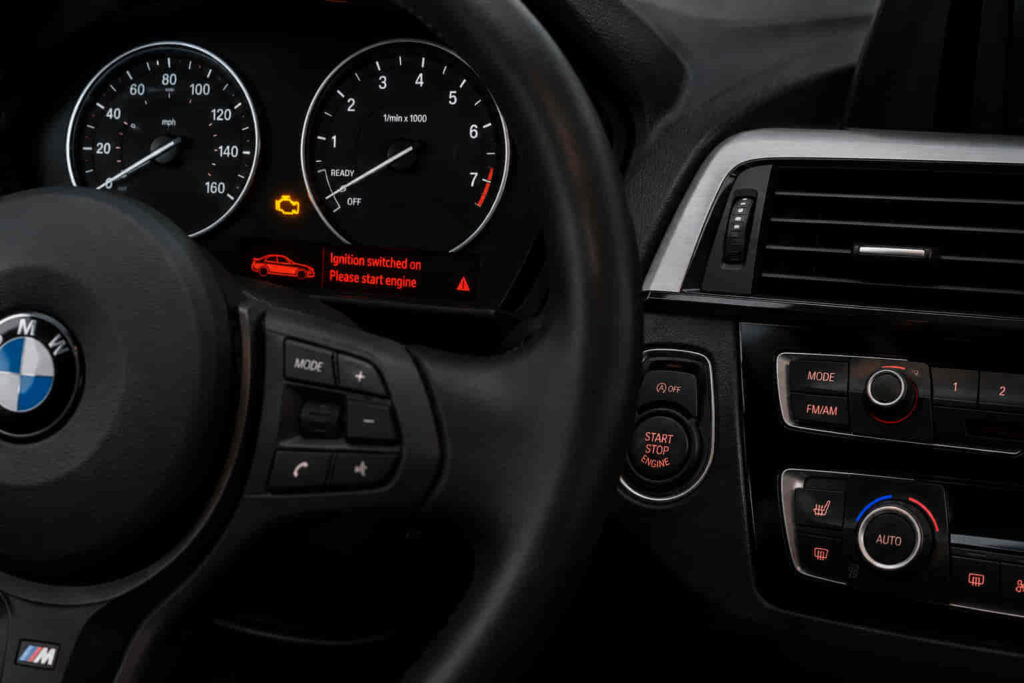
A BMW 1 Series can fail to start because of 7 main problems: a weak or dead 12V battery, poor battery connections, a starter motor fault, a fuel delivery problem, an ignition or engine-management fault, an immobilizer or key problem, or an electrical control fault. The symptom that occurs when you attempt to start the car is important because a BMW 1 Series that does not crank requires a different diagnostic path from one that cranks normally but fails to start.
A no-crank condition directs attention toward the 12V battery, battery connections, starter system, start authorization, and related electrical controls. If the engine cranks at its normal speed but does not start, the starter has already demonstrated that it can turn the engine, so the investigation shifts toward fuel delivery and the engine-management conditions required for the engine to run. Clicking without successful cranking creates another diagnostic pattern in which battery condition, electrical connections, and starter operation become more relevant.
Identifying these symptoms before replacing components helps separate the cause of the starting failure from its visible effect. The following sections explain the 7 main reasons a BMW 1 Series may not start, how each fault interrupts the starting process, and which symptoms can help narrow down the problem.
What Are the 7 Reasons Your BMW 1 Series Is Not Starting?
The 7 main reasons a BMW 1 Series is not starting are a weak or dead 12V battery, poor battery connections, starter motor failure, a fuel delivery problem, an ignition or engine-management fault, an immobilizer or key problem, and an electrical control fault. These failures interrupt different stages of the starting process, so the sound and behavior of the vehicle when the Start button is pressed provide useful diagnostic evidence. A car that does not crank, a car that clicks, and an engine that cranks normally but does not start should not be diagnosed in the same way.
A weak or discharged 12V battery is a primary cause to investigate when a BMW 1 Series does not crank normally. Starting the engine requires the battery to supply a substantially higher electrical load than operating dashboard electronics, interior lights, or other low-power systems. When available battery power is insufficient, the starter may turn the engine slowly, produce a clicking response, or fail to crank it at all. This explains why working lights do not prove that the battery is healthy enough to start the car. Battery condition should be tested under the appropriate electrical load rather than judged only by whether accessories still operate.
Poor battery connections can produce similar symptoms even when the battery itself retains sufficient charge. The starting circuit depends on a low-resistance electrical path between the battery, vehicle electrical system, ground connections, and starter. A loose, contaminated, damaged, or otherwise poor connection increases resistance and can restrict the current available during a starting attempt. The result may be slow cranking, clicking, a complete no-crank condition, or an intermittent problem in which the BMW starts normally on one attempt but fails on another. Testing the electrical path helps distinguish a connection problem from a battery that actually needs replacement.
A starter motor or related starter-system fault can prevent the engine from cranking after the battery and its electrical connections have been established as functional. The starter converts electrical energy into the mechanical rotation required to turn the engine during startup. When the starter cannot perform this function, the vehicle may receive electrical power while the engine remains stationary. However, a starter that does not operate should not automatically be diagnosed as a failed starter motor. The starting circuit, control signal, start authorization, and electrical supply must also allow the starter to operate, so those conditions need to be checked before replacement is justified.
A fuel delivery problem becomes more relevant when the BMW 1 Series cranks but does not start. Cranking confirms that the starter is capable of turning the engine, but the engine still requires the correct fuel supply to begin and sustain combustion. A fuel pump, its electrical supply, or another part of the delivery system can prevent the required fuel from reaching the engine under the correct conditions. This produces a fundamentally different diagnostic path from a no-crank problem. Replacing a battery or starter will not correct a crank-no-start condition caused by inadequate fuel delivery.
An ignition or engine-management fault can also allow the engine to crank without allowing it to run. Starting depends on the engine-control system receiving and processing the information required to manage combustion. Relevant position information, control inputs, and ignition-related functions must occur in the correct relationship while the engine is cranking. A fault involving a crankshaft position signal or another critical engine-management input can therefore prevent startup even though the starter turns the engine normally. Diagnosis should use the observed symptom, fault information, and system data to identify which requirement is missing instead of replacing sensors simply because they are associated with starting.
An immobilizer or BMW key problem can interfere with starting when the vehicle cannot complete the required start-authorization process. The key and vehicle security system form part of the logic that determines whether starting is permitted. When authorization is not completed correctly, the resulting symptom can resemble a mechanical or electrical starting fault even though the underlying problem is related to vehicle access or security control. Key-related warnings, inconsistent recognition, or a change in behavior when another authorized key is used can provide useful diagnostic evidence, but the exact failure still needs to be confirmed before a key or control component is replaced.
An electrical control fault can prevent a BMW 1 Series from starting by interrupting power or control signals required by the starter, fuel system, or engine-management system. Fuses, relays, wiring, connectors, grounds, and control circuits create electrical paths between multiple starting-related components. A failure in one of these paths can therefore cause no cranking, crank-no-start behavior, or intermittent starting depending on the affected circuit. Intermittent electrical faults are particularly important to diagnose systematically because the vehicle may operate normally when the connection or signal temporarily returns. Electrical measurements and fault data can determine whether a component has actually failed or is simply not receiving the power or command required to operate.
Read more: BMW X3 Air Conditioning Not Working
How Can You Tell Why Your BMW 1 Series Is Not Starting?
You can narrow down why a BMW 1 Series is not starting by determining whether the engine does not crank, cranks but does not start, produces a clicking sound, or starts only intermittently. These symptoms represent different stages of the starting process and therefore point toward different diagnostic directions. Identifying the starting behavior first is more reliable than replacing a battery, starter, fuel pump, or sensor based only on the fact that the vehicle will not start.
When the BMW 1 Series does not crank at all, diagnosis should begin on the electrical and starting side of the system. The 12V battery must provide sufficient electrical power, the battery and ground connections must carry the required current, and the starter must receive the conditions necessary to operate. Start authorization and related electrical controls also matter because a functional starter cannot crank the engine when the required power or control command does not reach it. Dashboard lights may still illuminate during this type of failure because powering electronic accessories requires different electrical conditions from operating the starter under load.
When the engine cranks at a normal speed but does not start, the diagnostic context changes. The starter has already demonstrated that it can rotate the engine, so repeatedly focusing on starter replacement does not address the most relevant part of the failure. The engine now needs the correct fuel delivery and engine-management conditions to begin combustion. Fuel-system operation, critical engine-position information, ignition-related functions, and relevant control inputs therefore become more important diagnostic targets. Fault codes and live system information can help identify which required condition is absent, but the evidence needs to be interpreted in relation to the crank-no-start symptom.
A clicking sound without successful cranking directs diagnosis back toward the high-current starting circuit. A weak battery may retain enough energy to activate electrical controls while failing under the greater load required by the starter. Poor battery terminals, ground connections, or other high-resistance connections can produce a similar effect by restricting current flow. Starter-system faults can also result in clicking without engine rotation. The clicking sound is therefore a diagnostic clue, not proof that the starter motor itself has failed. Battery condition and circuit integrity should be established before the starter is condemned.
Intermittent starting requires the failure to be evaluated when possible under the conditions in which it occurs. A BMW 1 Series that starts normally most of the time but occasionally fails can have an unstable electrical connection, starter-system problem, start-authorization issue, or another control fault that is not continuously present. The behavior during the failed attempt remains important: intermittent no-crank and intermittent crank-no-start conditions still represent different diagnostic paths. Recording warning messages, sounds, cranking behavior, and conditions surrounding the failure can provide more useful evidence than simply reporting that the vehicle sometimes does not start.
What Should You Check First When Your BMW 1 Series Won’t Start?
First determine whether the BMW 1 Series engine cranks when you attempt to start it, because this single observation separates two major diagnostic paths. If the engine does not crank, check the 12V electrical supply, battery condition, electrical connections, and starting-system operation before investigating fuel delivery. If the engine cranks normally but does not start, shift the diagnosis toward the conditions required for combustion rather than continuing to treat the problem as a starter fault.
Battery condition is a logical early check for a no-crank, slow-crank, or clicking condition because the starter places a substantial electrical demand on the 12V system. The presence of dashboard lights should be recorded but should not be used as the only battery test. A battery can operate lower-load electronics while its voltage or available current becomes inadequate under starting load. Testing battery performance under the appropriate conditions provides stronger evidence than judging it from accessory operation alone.
Electrical connections should be evaluated when battery condition appears adequate but cranking remains slow, inconsistent, or absent. The starting circuit depends on reliable positive and ground paths, and excessive resistance can reduce the power that reaches the starter even when battery charge is sufficient. This is particularly relevant when the starting problem is intermittent because a poor connection can change with movement, temperature, or other operating conditions.
Further diagnosis should follow the symptom established by these initial checks. A confirmed no-crank condition requires investigation of starter operation, electrical control, and start authorization. Normal cranking with no engine start requires investigation of fuel delivery and relevant engine-management conditions. Following this sequence keeps each test connected to the observed failure and reduces unnecessary component replacement.
Can a BMW 1 Series Have a Dead Battery Even if the Lights Still Work?
Yes, a BMW 1 Series can have enough battery power to operate the lights and dashboard electronics but still lack the electrical capacity required to crank the engine. The starter places a much greater electrical demand on the 12V battery than lighting, infotainment, or instrument systems. Working lights therefore confirm that some electrical power remains available, but they do not confirm that the battery can support the starting load.
This difference becomes important when the dashboard illuminates normally but the engine cranks slowly, produces clicking sounds, or does not crank. Battery voltage can drop significantly when the starter attempts to draw current, causing the starting process to fail even though lower-load electrical equipment continues to function. Battery testing should therefore evaluate its condition during an appropriate load rather than relying only on its ability to power accessories.
Poor electrical connections can create a similar symptom. A charged battery cannot deliver the required starting current effectively when excessive resistance exists at a terminal, ground point, cable, or another connection in the high-current circuit. For this reason, a BMW 1 Series that has working lights but does not start should not automatically receive a new battery. Battery condition and the electrical path to the starter need to be distinguished before the failed component can be identified.
Why Does Your BMW 1 Series Crank but Not Start?
A BMW 1 Series that cranks but does not start has progressed beyond the initial starter function, so diagnosis should shift toward fuel delivery and the engine-management conditions required for combustion. The starter is already rotating the engine in this situation. Replacing it will not correct a no-start condition when the missing requirement occurs after cranking begins.
Fuel delivery is one condition that must be verified. The engine requires fuel to reach the combustion process under the correct operating conditions, so a fuel pump or its electrical supply can contribute to a crank-no-start condition when the required delivery is interrupted. The diagnostic objective is not simply to hear or assume that a fuel-system component operates; it is to determine whether the engine receives the required fuel supply while the starting failure is present.
Engine-management information is another part of the starting process. The control system needs relevant inputs to determine engine position and manage combustion while the engine turns. A missing critical position signal or another control-related fault can leave the starter cranking normally without allowing the engine to run. Diagnostic fault codes and live data can provide evidence in this situation, but a code should be interpreted within the actual failure mechanism rather than treated as an automatic instruction to replace the component named by the code.
The distinction between cranking and starting prevents two separate processes from being combined into one diagnosis. Cranking describes the starter physically rotating the engine, while starting requires the engine to transition from that externally driven rotation to sustained operation. Once normal cranking has been confirmed, diagnosis should concentrate on why that transition is not occurring.
Why Does Your BMW 1 Series Click but Not Start?
A BMW 1 Series that clicks but does not start should first be investigated for insufficient battery power, excessive resistance in the starting circuit, or a starter-system fault. Clicking indicates that part of the electrical starting process is responding, but it does not establish that sufficient current reaches the starter or that the starter can rotate the engine.
A weak 12V battery can produce clicking because the electrical system initially responds to the starting request but battery performance drops when the higher starter load is applied. This is why clicking can occur while the dashboard and lights continue to work. Testing the battery under load provides stronger diagnostic evidence than judging its condition from accessory operation.
High resistance in the electrical path can produce a similar result even when the battery itself is serviceable. Loose or poor battery connections, ground paths, cables, or other circuit problems can restrict the current available to the starter. The symptom may also be intermittent if the quality of the connection changes between starting attempts. Confirming battery condition without checking circuit integrity can therefore leave the actual cause unidentified.
Starter-system failure becomes a stronger diagnostic direction after adequate battery power and circuit integrity have been established. The important sequence is to verify the electrical conditions required by the starter before concluding that the starter motor itself has failed. Clicking is evidence of a starting-system problem, not a component-level diagnosis by itself.
Which BMW 1 Series Starting Problems Can You Check Yourself?
BMW 1 Series owners can perform basic starting-system checks such as observing the starting symptom, checking visible battery connection issues, confirming key recognition, and identifying warning messages before seeking professional diagnosis. These checks help collect useful information, but they do not replace electrical testing, fuel-system diagnosis, or control-module analysis when the cause involves hidden system faults.
The first useful observation is what happens when the Start button is pressed. Listening for cranking speed, clicking sounds, or complete silence creates an initial diagnostic direction. A slow crank or repeated clicking suggests that battery condition or the high-current starting circuit should be investigated, while normal cranking without engine operation indicates that the starting process has moved beyond the starter and toward fuel delivery, ignition, or engine-management conditions.
Visible battery-related issues can also provide useful clues. Corrosion, looseness, or damage around battery connections can affect the electrical path required for starting. However, a visual inspection cannot confirm whether the battery can provide sufficient current under starting load. A battery that appears clean and connected may still fail when the starter demands a high amount of electrical power.
Key-related behavior should also be considered when the BMW 1 Series displays security-related warnings or behaves differently with different authorized keys. The immobilizer system is part of the vehicle’s start authorization process, so unusual key recognition behavior can provide important diagnostic information. However, replacing a key or security component should only occur after confirming that the authorization system is actually responsible for the starting failure.
When Should You Take a BMW 1 Series to a Technician for a Starting Problem?
A BMW 1 Series should be professionally diagnosed when the starting problem involves repeated failure, electrical faults, suspected immobilizer issues, normal cranking without startup, or a condition that cannot be identified through basic inspection. Starting problems often involve multiple connected systems, and replacing components without confirming the failure mechanism can result in unnecessary repairs.
A technician should inspect the vehicle when a new battery does not resolve a no-start condition or when the starting problem returns after temporary improvement. A battery replacement may restore operation when the battery was actually the cause, but repeated failures can indicate an underlying charging problem, electrical drain, poor connection, or another system fault that continues affecting the vehicle.
Professional diagnosis is especially important for crank-but-no-start conditions because the starter has already shown that it can rotate the engine. The investigation must then determine whether the engine receives the required fuel delivery, ignition conditions, and control information. These checks require system-level testing rather than simply replacing common starting components.
Electrical and intermittent faults also benefit from professional diagnosis because the failure may not be present during every inspection. A loose connection, control issue, relay fault, or sensor-related problem can disappear temporarily and make the vehicle appear normal. Diagnostic equipment and electrical testing allow the technician to evaluate system behavior when the fault occurs instead of relying only on the symptom reported after the event.
How Can You Help Prevent BMW 1 Series Starting Problems?
You can reduce BMW 1 Series starting problems by maintaining battery health, addressing early warning signs, and diagnosing electrical or starting changes before complete failure occurs. Starting problems often provide early indicators before the vehicle becomes unable to start completely, so recognizing these changes can prevent unexpected breakdowns.
A weak battery commonly develops warning signs before total failure. Slow engine cranking, delayed startup response, or inconsistent starting behavior can indicate that the battery or charging system requires attention. Addressing these symptoms early provides more diagnostic information because the vehicle still demonstrates partial operation rather than only a complete failure state.
Maintaining reliable electrical connections also supports consistent starting performance. Battery terminals, ground connections, and related electrical paths must maintain stable current flow during the high electrical demand created by the starter. A small increase in resistance may have little effect on normal electronics but can become significant during engine starting.
Starting issues that appear intermittently should not be ignored. A BMW 1 Series that occasionally fails to start is already showing evidence of an unstable condition, whether related to battery performance, electrical connections, control systems, or another component. Early diagnosis helps identify the actual cause before the failure progresses into a complete no-start situation.