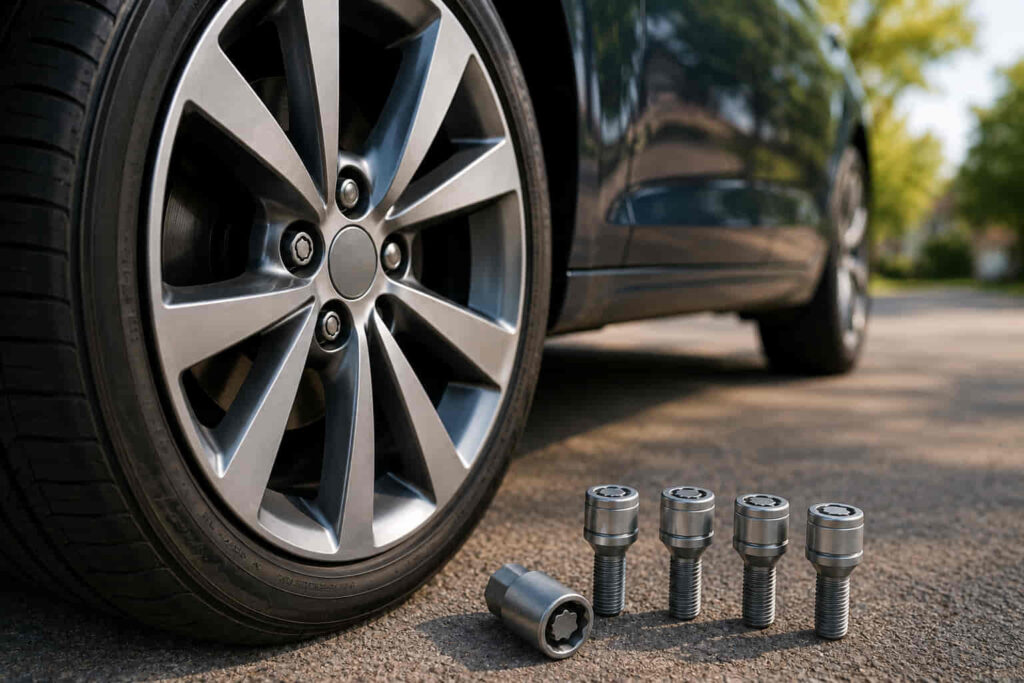
Wheel theft remains a common problem in many cities because modern alloy wheels, premium factory rims, and aftermarket wheel packages can be removed within minutes using basic tools. A complete set of wheels and tires often represents thousands of dollars in replacement costs, making them an attractive target for thieves. As wheel designs become more valuable and interchangeable across different vehicle models, many owners look for simple ways to improve security without investing in expensive electronic anti-theft systems. One of the most common solutions is installing wheel locks, also known as locking lug nuts, which replace one standard lug nut on each wheel with a uniquely patterned fastener that requires a matching key for removal.
Although wheel locks are inexpensive compared with the value of the wheels they protect, opinions about their effectiveness vary. Some drivers consider them an essential security upgrade that discourages opportunistic theft, while others argue that determined thieves can still remove them using specialized tools. The truth lies somewhere between these two perspectives. Wheel locks are not designed to make wheel theft impossible. Instead, they increase the time, effort, and equipment required to remove a wheel, making many vehicles less attractive targets than neighboring vehicles without additional protection.
This guide explains how wheel locks work, how effective they are at preventing wheel theft, their advantages and disadvantages, the situations where they provide the greatest value, and whether they are a worthwhile investment for your vehicle. By understanding both their capabilities and limitations, drivers can make informed decisions about whether locking lug nuts should be part of their overall vehicle security strategy.
Are Wheel Locks Worth It?
For most vehicle owners, wheel locks are worth the investment because they provide an inexpensive layer of physical security that makes wheel theft more difficult without requiring major modifications to the vehicle. While wheel locks cannot completely prevent a determined thief from stealing wheels, they significantly increase the amount of time, specialized equipment, and effort required to remove them. Since most wheel thefts are crimes of opportunity where speed is critical, adding even a modest obstacle often encourages thieves to move on to vehicles that can be accessed more quickly. In this sense, wheel locks function as a deterrent rather than an impenetrable security device.
The effectiveness of wheel locks comes from their unique locking pattern. Unlike standard lug nuts that can be removed using common sockets found in virtually every toolbox, locking lug nuts feature specially shaped grooves or patterns that require a matching wheel lock key. Without the correct key, conventional sockets cannot properly grip the fastener, preventing quick removal with ordinary hand tools or impact wrenches. Although professional thieves may possess extraction tools capable of removing certain wheel locks, doing so generally requires additional time and increases the likelihood of being noticed. The added complexity is often enough to discourage theft in locations where criminals seek fast, low-risk targets.
Wheel locks provide the greatest value for vehicles equipped with expensive wheels. Factory alloy wheels on luxury vehicles, performance cars, trucks, and SUVs often command high resale prices in secondary markets. Custom aftermarket wheels may be even more valuable because they are produced in smaller quantities and frequently include premium finishes or lightweight construction materials. Since replacing a complete wheel and tire package can cost several thousand dollars, spending a relatively small amount on wheel locks represents an affordable form of risk reduction. Even if wheel locks only discourage a single attempted theft during the life of the vehicle, they can easily justify their purchase price.
The level of protection provided by wheel locks also depends on where the vehicle is regularly parked. Owners who keep their vehicles inside secured garages generally face a lower risk of wheel theft than those who park overnight on public streets, apartment parking lots, commuter parking facilities, or unattended commercial areas. Vehicles left for extended periods in locations with limited surveillance are naturally more attractive to thieves because they allow additional time to remove wheels without interruption. In these environments, wheel locks become a more valuable security investment because they increase the effort required to complete the theft before someone notices suspicious activity.
Geographic location plays an equally important role when evaluating whether wheel locks are worthwhile. Some urban areas experience significantly higher rates of wheel theft due to demand for replacement wheels and easier access to resale markets. Vehicles equipped with popular OEM wheels that fit multiple models may face greater theft risk because stolen wheels can be sold quickly or installed on similar vehicles. Owners living in regions where wheel theft is relatively uncommon may derive less measurable benefit from wheel locks, although the relatively low purchase cost still makes them an attractive preventive measure for many drivers.
One of the greatest advantages of wheel locks is that they operate continuously without requiring electricity, software, subscriptions, or routine maintenance. Unlike electronic vehicle security systems that depend on batteries, sensors, or wireless communication, wheel locks remain effective whenever they are properly installed. They cannot be disabled remotely, lose connectivity, or malfunction because of software updates. Their purely mechanical design allows them to provide passive protection every time the vehicle is parked, regardless of whether the owner remembers to activate another security feature.
Despite these advantages, wheel locks should not be viewed as a complete theft prevention solution. Experienced thieves may carry dedicated removal sockets, extraction tools, or specialized locking lug removal kits capable of defeating certain wheel lock designs. Online demonstrations often show wheel locks being removed without the original key, leading some owners to question their effectiveness. However, these demonstrations typically occur under ideal workshop conditions with unlimited time, proper lighting, and unrestricted tool access. Real-world theft occurs under much different circumstances where criminals usually attempt to minimize time spent at the vehicle to reduce the risk of detection. Increasing removal time by even several minutes can substantially reduce the attractiveness of the target.
Wheel locks are most effective when combined with other security measures. Parking inside secured garages, choosing well-lit parking areas, using security cameras, selecting monitored parking facilities, and installing vehicle alarm systems all reduce theft risk independently. Together, these layers of protection create multiple obstacles that discourage criminals seeking the easiest available target. Rather than relying exclusively on wheel locks, vehicle owners achieve the highest level of protection by integrating physical, environmental, and electronic security measures into a comprehensive theft prevention strategy.
Owners should also consider the minor inconveniences associated with wheel locks before deciding whether to install them. Tire rotations, brake repairs, flat tire service, and seasonal tire changes all require access to the wheel lock key. Misplacing the key may delay emergency roadside repairs until a replacement key or removal service becomes available. Although manufacturers generally offer replacement keys when identification information is available, maintaining the key in a secure yet easily accessible location becomes an important part of ownership. Fortunately, this inconvenience is relatively minor compared with the potential financial consequences of replacing stolen wheels and tires.
Ultimately, wheel locks are worth installing for most drivers because they offer a cost-effective method of reducing wheel theft risk without significantly affecting normal vehicle operation. They are particularly valuable for vehicles equipped with expensive alloy wheels, aftermarket wheel packages, or factory wheels that are frequently targeted by thieves. While no mechanical security device can completely eliminate theft, wheel locks increase the time, difficulty, and uncertainty associated with removing a wheel, making many criminals more likely to abandon the attempt in favor of an easier opportunity. When combined with sensible parking practices and other vehicle security measures, locking lug nuts provide an additional layer of protection that far exceeds their modest purchase cost.
How Do Wheel Locks Work?
Wheel locks work by replacing one standard lug nut or lug bolt on each wheel with a specially designed locking fastener that can only be removed using a matching security key. Unlike conventional lug nuts that feature a standard hexagonal shape compatible with common sockets, wheel locks incorporate a unique external pattern or internal groove that prevents ordinary tools from gripping the fastener. Without the correct wheel lock key, removing the wheel becomes significantly more difficult because the locking pattern is specifically engineered to resist standard sockets, impact wrenches, and basic hand tools commonly used during wheel theft.
Every wheel lock set includes a dedicated key that matches the locking pattern of the installed fasteners. The key acts as an adapter between the irregular security pattern and a conventional socket or lug wrench. When the correct key is inserted over the wheel lock, the external surface of the key provides the familiar hexagonal shape needed for removal with ordinary tools. During routine maintenance such as tire rotations, brake service, or wheel replacement, technicians simply attach the key before loosening the locking lug nut in the same manner as any other wheel fastener. Without this key, however, the lock cannot be removed quickly using normal equipment.
The effectiveness of wheel locks comes from increasing the complexity of removing the wheel rather than making removal impossible. A standard wheel typically requires only a lug wrench or impact gun fitted with the appropriate socket. Because these tools are inexpensive and widely available, experienced thieves can remove conventional lug nuts in only a few minutes. Installing even a single locking lug nut on each wheel interrupts this process by introducing a fastener that requires specialized equipment or additional removal techniques. Since every wheel must be completely detached before it can be stolen, one locking fastener is often sufficient to slow the entire theft attempt.
Manufacturers produce wheel locks using numerous proprietary locking patterns to reduce the likelihood that one key fits multiple vehicles. The locking surfaces may include irregular splines, spiral grooves, star-shaped profiles, flower patterns, or asymmetrical geometries designed to maximize security while maintaining reliable engagement with the matching key. Premium wheel lock manufacturers often produce hundreds or even thousands of unique key combinations, making it unlikely that a thief carrying a random wheel lock key will encounter a compatible pattern. This diversity significantly reduces the effectiveness of attempting removal with generic keys alone.
The materials used to manufacture wheel locks also contribute to their security. Most quality locking lug nuts are produced from hardened steel that resists deformation under high torque while providing greater resistance to drilling, cutting, or forced removal attempts. Protective surface coatings help prevent corrosion that could otherwise damage the locking pattern over time, ensuring the key continues fitting securely after years of exposure to moisture, road salt, and changing weather conditions. High manufacturing precision is particularly important because even minor wear or distortion within the locking pattern can complicate removal during legitimate vehicle servicing.
Wheel locks are designed to withstand the same mechanical loads as conventional lug nuts while maintaining proper wheel retention. During installation, they are tightened according to the vehicle manufacturer’s specified torque using a calibrated torque wrench rather than excessive force from an impact gun. Proper torque ensures the wheel remains securely attached while preventing damage to the locking pattern or the key itself. Over-tightening can make future removal unnecessarily difficult and may increase the risk of damaging the key during routine maintenance, while under-tightening compromises wheel safety regardless of whether standard lug nuts or locking lug nuts are installed.
Although wheel locks provide meaningful protection, they should not be confused with high-security locking systems capable of completely preventing wheel removal. Specialized extraction sockets, reverse-thread removal tools, welded adapters, and other professional techniques can sometimes remove locking lug nuts without the original key. However, these methods generally require additional equipment, greater technical skill, and considerably more time than removing conventional lug nuts. Because most wheel thieves attempt to minimize the amount of time spent beside a vehicle, the additional effort introduced by wheel locks often discourages opportunistic theft even if removal remains technically possible.
The design philosophy behind wheel locks reflects a broader principle of physical security: increasing the time and difficulty required to commit a theft reduces the likelihood that criminals will choose that target. Professional thieves rarely evaluate only whether a security device can eventually be defeated. They also consider how long removal will take, how much noise the process will create, whether specialized tools are required, and how visible the activity becomes while attempting removal. A vehicle protected by wheel locks presents greater uncertainty than one equipped only with standard lug nuts, encouraging many thieves to seek easier opportunities where the risk of interruption is lower.
Wheel lock effectiveness also depends on proper ownership practices. The security key should always be stored in a location that is both accessible during emergencies and protected against loss. Many owners keep the key inside the glove compartment, center console, spare tire compartment, or vehicle tool kit so that roadside assistance personnel and tire service technicians can access it when necessary. Recording the wheel lock identification number supplied by the manufacturer also simplifies obtaining a replacement key if the original becomes misplaced. Maintaining this information helps avoid unnecessary delays during flat tire repairs or scheduled maintenance.
Compatibility represents another important aspect of wheel lock operation. Wheel locks must match the thread size, thread pitch, seat design, and overall dimensions specified for the vehicle. Conical seat, ball seat, and flat seat lug nuts are not interchangeable because each is designed to mate with a specific wheel design. Installing an incompatible wheel lock may prevent proper clamping force, increase vibration, or damage the wheel mounting surface. Selecting wheel locks manufactured specifically for the vehicle or approved by the wheel manufacturer ensures both security and safe wheel installation throughout the life of the vehicle.
Ultimately, wheel locks function by replacing the simplicity of a standard lug nut with a uniquely coded mechanical fastener that requires a dedicated removal key. Their value lies not in making wheel theft impossible, but in increasing the time, effort, and uncertainty associated with removing a wheel. By introducing an additional physical barrier that cannot be overcome using ordinary tools alone, wheel locks discourage many opportunistic thieves while providing vehicle owners with an affordable layer of protection against one of the most common forms of automotive property theft. When properly installed, correctly maintained, and combined with sensible parking habits, locking lug nuts remain one of the simplest and most practical mechanical security upgrades available for protecting valuable wheels.
Do Wheel Locks Really Prevent Wheel Theft?
Wheel locks can significantly reduce the risk of wheel theft, but they do not make theft impossible. Their primary purpose is to delay unauthorized wheel removal by introducing a mechanical obstacle that requires additional time, specialized tools, and greater effort to overcome. This distinction is important because wheel locks are often misunderstood as absolute anti-theft devices when they are actually designed to function as theft deterrents. In practical terms, they discourage many opportunistic thieves by making a protected vehicle more difficult to target than one equipped with only standard lug nuts.
Most wheel thefts are committed under time pressure. Thieves generally seek locations where they can remove wheels quickly and leave before attracting attention from vehicle owners, pedestrians, security personnel, or surveillance cameras. A vehicle fitted with conventional lug nuts allows every wheel to be removed using common sockets and an impact wrench in only a few minutes. Installing wheel locks interrupts this process because at least one fastener on each wheel cannot be removed using standard equipment alone. Even if the thief possesses the knowledge required to defeat the lock, the additional time increases the likelihood of detection, reducing the overall attractiveness of the target.
The effectiveness of wheel locks is based on changing the thief’s risk assessment rather than relying solely on physical strength. Criminals typically evaluate how quickly they can complete a theft, how visible their activity will be, and whether easier opportunities are available nearby. If two vehicles are parked side by side and only one is protected by locking lug nuts, many thieves will naturally choose the vehicle requiring the least effort. This behavioral principle explains why relatively simple mechanical security devices continue to provide meaningful protection despite not being impossible to bypass.
Wheel locks are particularly effective against opportunistic theft because these crimes often involve limited planning and readily available tools. A thief carrying only standard sockets and impact equipment cannot immediately remove locking lug nuts without first identifying an alternative removal method. Searching for additional tools, changing techniques, or attempting to force the lock increases both the duration and visibility of the theft attempt. Since criminals generally prefer predictable, low-risk opportunities, even modest delays can influence their decision to abandon the target entirely.
Professional thieves present a different challenge because they may possess specialized extraction sockets, removal kits, reverse-thread extractors, or other equipment specifically designed to remove damaged or locked lug nuts. Experienced individuals can sometimes defeat wheel locks without the original key by sacrificing the lock during the extraction process. However, even these methods rarely provide the same speed or convenience as removing standard lug nuts. Specialized removal techniques often generate more noise, require greater physical effort, and increase the time spent beside the vehicle. While these tools reduce the effectiveness of wheel locks against highly experienced criminals, they do not eliminate the deterrent value that wheel locks provide in most real-world situations.
The quality of the wheel lock itself also influences its effectiveness. Premium manufacturers typically use hardened steel, precision machining, and highly complex locking patterns that resist deformation and provide stronger resistance to forced removal. Lower-cost products may utilize softer materials or simpler security patterns that are easier to grip with extraction tools. Investing in a well-engineered wheel lock from a reputable manufacturer generally provides better long-term durability and greater resistance to common theft techniques than choosing inexpensive universal alternatives designed primarily around cost rather than security.
Vehicle type and wheel value also affect the practical benefit of installing wheel locks. Luxury vehicles, performance models, trucks equipped with premium wheels, and vehicles fitted with expensive aftermarket wheel packages represent more attractive targets because stolen wheels command higher resale values. Certain factory wheel designs are also frequently stolen because they fit multiple vehicle generations, making them easier to sell through secondary markets. Owners of these vehicles often receive greater value from wheel locks because the financial consequences of wheel theft substantially exceed the relatively low cost of installing mechanical protection.
Parking environment plays an equally important role in determining how effective wheel locks become. Vehicles parked overnight on public streets, apartment complexes, commuter parking lots, or remote outdoor locations remain exposed for extended periods and therefore face greater theft risk. In these situations, wheel locks provide valuable additional protection because they force thieves to spend more time working in locations where interruption becomes increasingly likely. Conversely, vehicles stored inside locked residential garages or monitored commercial parking facilities already benefit from multiple layers of environmental security, reducing the relative importance of locking lug nuts while still providing an additional safeguard.
Wheel locks perform best when incorporated into a layered vehicle security strategy rather than serving as the only protective measure. Exterior lighting, visible security cameras, monitored parking, alarm systems, steering wheel locks, GPS tracking devices, and careful parking choices each increase the difficulty or risk associated with vehicle-related crimes. Combining these measures forces potential thieves to overcome multiple independent obstacles rather than relying on defeating a single mechanical component. This layered approach reflects modern security principles where several moderate barriers often provide greater protection than one highly specialized device operating in isolation.
It is also important to recognize that successful theft prevention cannot always be measured by whether a wheel lock is physically defeated. If a thief abandons the attempt after encountering locking lug nuts, chooses another vehicle nearby, or decides the additional effort is not worthwhile, the wheel lock has already accomplished its intended purpose. Mechanical security devices frequently succeed by influencing behavior before theft occurs rather than by resisting unlimited physical attack. This preventive function explains why wheel locks continue to be recommended by many vehicle manufacturers and automotive security specialists despite the existence of professional removal techniques.
Ultimately, wheel locks do help prevent wheel theft by increasing the time, complexity, and uncertainty associated with removing a vehicle’s wheels. They are not impenetrable security devices, and determined thieves equipped with specialized tools may still overcome them under certain circumstances. Nevertheless, most wheel thefts depend on speed and convenience rather than technical sophistication. By disrupting that speed advantage, wheel locks reduce the likelihood that a vehicle will become the preferred target. For owners of valuable factory wheels or aftermarket wheel packages, especially those who regularly park in public or high-risk locations, locking lug nuts remain one of the most practical and cost-effective mechanical deterrents available as part of a comprehensive vehicle security strategy.
What Are the Advantages and Disadvantages of Wheel Locks?
Wheel locks offer a practical balance between affordability and additional vehicle security, making them one of the most widely used anti-theft accessories for protecting factory and aftermarket wheels. However, like any physical security device, they provide meaningful benefits while also introducing certain limitations that vehicle owners should understand before installation. Evaluating both their strengths and weaknesses allows drivers to determine whether wheel locks are appropriate for their specific vehicle, parking environment, and theft risk rather than assuming they provide either complete protection or no protection at all.
One of the greatest advantages of wheel locks is their ability to increase the difficulty of wheel theft at a relatively low cost. A complete set of quality locking lug nuts typically costs only a small fraction of the price required to replace a set of alloy wheels and tires. Premium factory wheels, forged performance wheels, and custom aftermarket wheel packages often represent investments worth several thousand dollars. Compared with these replacement costs, installing wheel locks provides an economical method of reducing financial risk without requiring modifications to the vehicle or ongoing maintenance expenses. The cost-benefit ratio alone makes wheel locks attractive for many owners, particularly those driving vehicles equipped with expensive wheels.
Wheel locks also function as passive security devices that require no electricity, batteries, software updates, or user interaction after installation. Unlike electronic alarm systems or GPS tracking devices, locking lug nuts remain active every time the vehicle is parked. Their effectiveness does not depend on wireless signals, subscription services, smartphone applications, or battery voltage. Once properly installed and torqued according to manufacturer specifications, they continuously provide an additional mechanical barrier without changing how the vehicle is driven or maintained. This simplicity contributes to their long-term reliability because there are few components capable of failing during normal ownership.
Another important advantage is their compatibility with virtually every type of passenger vehicle. Wheel locks are available in numerous thread sizes, seat configurations, and finishes designed to match factory steel wheels, OEM alloy wheels, aftermarket performance wheels, SUVs, pickup trucks, and luxury vehicles. Most installations require replacing only one lug nut or lug bolt per wheel, allowing the remaining factory hardware to remain unchanged. Because installation follows the same procedure used for conventional lug nuts, professional installation is generally straightforward and can often be completed during routine tire service or wheel replacement.
Wheel locks also complement other vehicle security measures rather than replacing them. Parking inside secure garages, using surveillance cameras, selecting well-lit parking areas, installing vehicle alarms, and utilizing steering wheel locks all reduce theft risk independently. Adding locking lug nuts strengthens this broader security strategy by introducing another obstacle that thieves must overcome before removing the wheels. Security professionals frequently recommend layered protection because multiple independent deterrents increase the overall effort and uncertainty associated with committing theft, making protected vehicles less attractive than nearby alternatives.
Despite these benefits, wheel locks are not without disadvantages. The most frequently cited limitation is that they cannot completely prevent wheel theft. Determined thieves equipped with specialized extraction sockets, removal tools, or professional equipment may still remove locking lug nuts without the original key. Although these methods usually require additional time and increase the likelihood of detection, their existence demonstrates that wheel locks should be viewed as deterrents rather than absolute security devices. Owners expecting complete theft prevention may therefore overestimate the level of protection provided by locking lug nuts alone.
The requirement for a dedicated wheel lock key introduces another potential inconvenience during routine vehicle ownership. Every tire rotation, brake service, flat tire repair, suspension inspection, or wheel replacement requires access to the matching key before the locking lug nut can be removed. If the key has been misplaced, forgotten at home, or accidentally discarded, routine maintenance may be delayed until a replacement key is obtained or the lock is professionally removed. Emergency roadside tire changes become particularly frustrating under these circumstances because the spare tire cannot be installed until the wheel lock is removed successfully. Maintaining the key in a secure but easily accessible location therefore becomes an important responsibility for every owner using locking lug nuts.
Improper installation can also create avoidable problems. Wheel locks should always be tightened using the manufacturer’s recommended torque specification with a calibrated torque wrench rather than being excessively tightened using high-powered impact tools. Over-tightening may damage the locking pattern, deform the removal key, or make future removal unnecessarily difficult. Conversely, insufficient torque may compromise wheel retention in the same manner as improperly installed standard lug nuts. Following correct installation procedures protects both the wheel lock itself and the wheel mounting system throughout the vehicle’s service life.
Compatibility issues occasionally arise when aftermarket wheels are installed without verifying the proper lug seat design. Wheel locks are manufactured with different seating profiles, including conical, ball, and flat seat configurations. Installing an incorrect design prevents proper contact between the fastener and the wheel, potentially affecting clamping force and wheel alignment. Selecting wheel locks specifically engineered for the vehicle or approved by the wheel manufacturer eliminates these concerns while ensuring both safety and optimal theft protection.
Another consideration involves tire service performed by repair shops. Professional technicians require the wheel lock key before removing the wheels for tire rotations, balancing, brake inspections, or suspension work. If the owner forgets to provide the key, scheduled service may be interrupted until it is located. Some repair facilities also recommend replacing worn wheel lock keys after years of repeated use because excessive wear may eventually reduce engagement with the locking pattern. Although these situations are relatively uncommon, they illustrate that wheel locks introduce small procedural differences during normal maintenance that owners should anticipate.
Wheel locks also vary significantly in manufacturing quality. Lower-cost products may use softer steel, simpler locking patterns, or less precise machining that reduces both durability and resistance to forced removal. Premium products generally feature hardened steel construction, corrosion-resistant finishes, tighter manufacturing tolerances, and a much larger number of unique key combinations. While these higher-quality designs often command a higher purchase price, they typically provide superior long-term reliability and greater resistance to common removal techniques. Selecting a reputable manufacturer therefore influences the overall value of the investment more than choosing the least expensive product available.
Ultimately, the advantages of wheel locks outweigh their disadvantages for most vehicle owners, particularly those driving vehicles equipped with valuable factory or aftermarket wheels. Their low purchase cost, passive operation, broad compatibility, and ability to discourage opportunistic theft make them an effective addition to a comprehensive vehicle security strategy. Their limitations—such as the possibility of professional removal, dependence on a dedicated key, and minor maintenance inconveniences—are generally manageable when owners understand their purpose and use them correctly. Rather than viewing wheel locks as a standalone solution, drivers should consider them one component of a layered security approach that combines physical deterrence, thoughtful parking habits, and other protective measures to reduce the overall risk of wheel theft.
Are Wheel Locks Easy to Remove?
Wheel locks are intentionally designed to be easy for authorized owners to remove while making unauthorized removal significantly more difficult. When the correct wheel lock key is available, removing a locking lug nut is almost identical to removing a standard lug nut. The key fits over the unique locking pattern, allowing a conventional socket, lug wrench, or torque wrench to loosen the fastener without additional effort. During routine tire rotations, brake repairs, wheel balancing, or seasonal tire changes, technicians simply install the matching key before removing the wheel in the normal service sequence. Under these conditions, wheel locks add very little time to regular maintenance.
The situation changes completely when the correct key is unavailable. Because the locking pattern does not match conventional sockets, ordinary hand tools cannot grip the fastener securely enough to apply removal torque. This is the security principle behind locking lug nuts. Instead of preventing the wheel from ever being removed, they prevent quick removal using the common tools that most thieves carry. Without the matching key, anyone attempting to remove the wheel must first identify an alternative extraction method, increasing both the time and complexity of the process.
Vehicle owners occasionally lose the wheel lock key, creating inconvenience during routine maintenance rather than during theft attempts. If the key cannot be located, the first step is identifying the manufacturer and key code associated with the wheel lock set. Many manufacturers engrave identification numbers on the original packaging or provide registration information that allows replacement keys to be ordered. Obtaining the correct replacement key is generally the safest and least expensive solution because it preserves both the locking lug nut and the wheel without requiring destructive removal methods.
If a replacement key is unavailable, professional repair facilities have several techniques for removing locking lug nuts safely. Specialized extraction sockets are among the most commonly used tools. These hardened sockets feature aggressive internal cutting surfaces that bite into the outside of the locking lug nut as torque is applied. Once sufficient grip is established, the lock can often be loosened without damaging the wheel itself. Although the locking lug nut is usually destroyed during this process, the wheel remains undamaged when removal is performed correctly by an experienced technician.
Some repair shops utilize reverse-thread extraction tools specifically designed for damaged or seized fasteners. As torque increases, these tools tighten their grip around the locking lug, allowing gradual removal without relying on the original key pattern. Other techniques involve carefully drilling the center of the lock or welding a sacrificial nut onto the surface to create a new gripping point. These procedures require specialized equipment, precision, and experience because improper execution can damage alloy wheels, wheel studs, brake components, or surrounding finishes. For this reason, destructive removal methods are generally considered a last resort after replacement key options have been exhausted.
The material quality of the wheel lock also influences removal difficulty. Premium locking lug nuts manufactured from hardened steel resist deformation and extraction more effectively than lower-quality products made from softer alloys. While this improves theft resistance, it also means legitimate removal without the key may require more advanced equipment. High-quality wheel locks therefore create a balance between increased security and more demanding service procedures should the key ever become unavailable.
Installation practices have a significant impact on future removal. Wheel locks should always be tightened using a calibrated torque wrench according to the vehicle manufacturer’s specified torque value. Excessive tightening with a high-powered impact wrench can distort the locking pattern, damage the key, or seize the fastener against the wheel hub. In these situations, even the correct key may struggle to remove the lock without additional force, increasing the risk of breaking the key or damaging the locking mechanism. Proper torque not only maintains wheel safety but also preserves the serviceability of the wheel lock throughout its lifespan.
Corrosion is another factor that affects removal difficulty, particularly in regions where vehicles are regularly exposed to road salt, coastal environments, or high humidity. Moisture can gradually cause oxidation between the wheel lock and the wheel stud, increasing friction during removal. Although quality wheel locks typically feature corrosion-resistant coatings, years of environmental exposure may still make removal more difficult than when the locks were first installed. Periodic wheel removal during routine tire service helps prevent long-term corrosion from permanently seizing the locking fastener to the wheel assembly.
Professional thieves sometimes use many of the same extraction techniques employed by repair shops, leading some vehicle owners to question whether wheel locks provide meaningful protection. While specialized removal tools can defeat certain locking lug nuts, the key difference lies in the environment in which removal occurs. Repair technicians operate inside fully equipped workshops with adequate lighting, stable vehicle lifts, and unlimited time to perform careful extraction. Thieves generally work outdoors, often at night, under significant time pressure and with a limited selection of portable tools. Methods that are practical inside a repair facility become considerably less attractive when every additional minute beside the vehicle increases the likelihood of being interrupted or detected.
Owners can reduce the likelihood of future removal problems by adopting a few simple maintenance habits. Keeping the wheel lock key inside the vehicle’s tool kit, glove compartment, or spare tire compartment ensures it is available whenever roadside assistance or service technicians need access. Recording the key code separately from the vehicle provides a straightforward method of ordering a replacement if the original is lost. During tire service, verifying that technicians use the correct torque specification rather than relying solely on impact tools also helps preserve both the lock and the key for future use.
Ultimately, wheel locks are easy to remove when the correct key is available and significantly more difficult to remove without it. This difference is precisely what gives them value as a theft deterrent. Although professional extraction methods exist, they typically require specialized equipment, additional time, and greater technical expertise than removing standard lug nuts. For legitimate owners, maintaining the wheel lock key, following proper installation procedures, and addressing corrosion during routine maintenance ensures that wheel locks remain both secure against theft and practical to service throughout the life of the vehicle.
Wheel Locks vs Standard Lug Nuts: What’s the Difference?
Wheel locks and standard lug nuts perform the same primary function of securing a wheel to the vehicle’s hub, but they differ significantly in design, security, maintenance requirements, and intended purpose. Standard lug nuts are engineered solely to clamp the wheel securely to the wheel hub, allowing straightforward installation and removal using commonly available sockets. Wheel locks, by contrast, combine this structural function with an additional layer of mechanical security by incorporating a uniquely patterned locking mechanism that requires a dedicated key for removal. Understanding these differences helps vehicle owners determine whether replacing one lug nut on each wheel with a locking version provides meaningful value for their driving environment and theft risk.
The most obvious distinction is the external design of the fastener. A standard lug nut features a conventional hexagonal profile that can be removed with any correctly sized socket or lug wrench. Because this design is standardized across millions of vehicles, virtually every repair shop, roadside assistance technician, and vehicle owner possesses the necessary tools to remove it. A wheel lock replaces this universal shape with a proprietary locking pattern consisting of splines, grooves, stars, or irregular geometries that cannot be engaged by ordinary sockets. Only the matching wheel lock key provides the correct interface between the locking pattern and standard removal tools, making unauthorized wheel removal substantially more difficult.
From a security perspective, standard lug nuts offer virtually no resistance against wheel theft. Anyone carrying a compatible socket and impact wrench can remove every lug nut within minutes, making wheels one of the easiest external vehicle components to steal. Wheel locks introduce uncertainty into this process because thieves cannot assume they possess the correct removal equipment. Although professional extraction tools may eventually remove many locking lug nuts, the additional time, specialized equipment, and increased likelihood of detection significantly reduce the convenience of the theft. This difference illustrates why wheel locks are classified as deterrent devices rather than absolute theft prevention systems.
Ease of maintenance represents one of the primary advantages of standard lug nuts. Tire rotations, brake repairs, suspension work, wheel balancing, and seasonal tire changes can all be completed immediately without searching for additional tools. Every technician has access to the required sockets, and emergency roadside tire changes are straightforward even if the vehicle owner is unavailable. Wheel locks introduce one additional procedural step because the dedicated removal key must always be available before maintenance begins. While this requirement adds only a small amount of time during routine service, losing the key may delay repairs until a replacement key is obtained or the lock is professionally removed.
Installation procedures are nearly identical for both types of fasteners. Standard lug nuts and wheel locks are installed using the vehicle manufacturer’s specified torque value to ensure proper clamping force between the wheel and hub. Neither fastener should be over-tightened with excessive impact wrench force because improper torque may damage wheel studs, distort wheel mounting surfaces, or complicate future removal. The only practical difference during installation is that the wheel lock key functions as an adapter between the locking pattern and the torque wrench. Once installed correctly, both fasteners contribute equally to maintaining safe wheel retention throughout normal driving conditions.
Material quality is another important consideration. Premium standard lug nuts are typically manufactured from hardened steel with corrosion-resistant finishes capable of withstanding repeated installation and removal over many years. High-quality wheel locks utilize similar materials but often incorporate additional precision machining to produce the complex locking patterns required for security. Because the locking surfaces must maintain precise engagement with the matching key, manufacturing tolerances are generally more demanding than those of conventional lug nuts. Inferior products made from softer materials may experience premature wear that reduces both security and long-term serviceability.
Cost represents one of the clearest differences between the two options. Standard replacement lug nuts are inexpensive because they are mass-produced using relatively simple manufacturing processes. Wheel locks command higher prices due to their specialized designs, proprietary key systems, and precision machining. Despite this premium, the total investment remains relatively small compared with the cost of replacing stolen alloy wheels and tires. For owners of vehicles equipped with valuable OEM or aftermarket wheels, the modest additional expense often represents a practical insurance against opportunistic theft rather than a significant increase in overall ownership costs.
Long-term ownership considerations also differ slightly. Standard lug nuts require little attention beyond occasional inspection for corrosion or thread damage during routine maintenance. Wheel locks require the same inspections but also depend on responsible management of the removal key. Keeping the key in an accessible yet secure location becomes part of normal vehicle ownership because emergency tire changes, roadside assistance, and repair facilities all require access to it. Recording the manufacturer’s key identification number further simplifies obtaining a replacement if the original key is lost, reducing the likelihood of expensive emergency removal procedures later.
Vehicle compatibility is generally excellent for both fastener types, provided the correct specifications are selected. Thread diameter, thread pitch, seat style, and overall dimensions must match the wheel and wheel hub regardless of whether a standard lug nut or wheel lock is installed. Conical seat, ball seat, and flat seat designs are not interchangeable because each distributes clamping force differently across the wheel mounting surface. Selecting vehicle-specific wheel locks from reputable manufacturers ensures that security improvements do not compromise proper wheel installation or long-term reliability.
The intended purpose of each fastener ultimately defines which option provides greater value. Standard lug nuts prioritize simplicity, convenience, and universal serviceability, making them appropriate for vehicles where wheel theft risk is minimal or wheel value remains relatively low. Wheel locks prioritize theft deterrence by sacrificing a small degree of maintenance convenience in exchange for increased security. Because only one locking fastener is typically installed on each wheel while the remaining fasteners remain standard, vehicle owners receive additional protection without significantly changing routine maintenance procedures.
Ultimately, wheel locks and standard lug nuts should not be viewed as competing products but as components serving different priorities. Standard lug nuts excel in ease of service and universal compatibility, while wheel locks introduce a valuable layer of mechanical security that discourages opportunistic theft. For drivers parking in secure private garages or operating vehicles with inexpensive steel wheels, conventional lug nuts may provide sufficient practicality. However, owners of vehicles equipped with valuable alloy wheels, aftermarket wheel packages, or frequently parked in public or high-risk locations often benefit from replacing one standard lug nut per wheel with a quality wheel lock. This simple modification preserves the structural reliability of the wheel mounting system while adding a meaningful obstacle that reduces the likelihood of wheel theft without imposing significant long-term maintenance burdens.
Who Should Use Wheel Locks?
Wheel locks are not essential for every vehicle, but they provide meaningful value for owners whose wheels represent an attractive target for theft. The decision to install locking lug nuts should be based on the value of the wheels, where the vehicle is parked, local theft rates, and the potential financial consequences of replacing stolen wheels. While virtually any vehicle can benefit from an additional layer of mechanical security, the return on investment is considerably higher for certain drivers and ownership situations where wheel theft is more likely to occur.
Owners of vehicles equipped with expensive alloy wheels are among those who benefit most from wheel locks. Modern alloy wheels are significantly more valuable than basic steel wheels because they combine lightweight construction, attractive styling, and compatibility with multiple vehicle models. Premium factory wheels installed on luxury sedans, performance cars, high-end SUVs, and pickup trucks frequently command high prices in the used parts market. Their popularity makes them desirable targets for thieves seeking components that can be resold quickly or installed on similar vehicles. Installing wheel locks on these vehicles adds an inexpensive layer of protection compared with the substantial cost of replacing an entire wheel and tire package.
Drivers who invest in aftermarket wheels should also strongly consider installing wheel locks. Forged wheels, custom finishes, oversized wheel packages, and performance-oriented designs often cost significantly more than factory equipment while being produced in lower quantities. Their uniqueness may increase resale value within enthusiast communities, making them attractive to organized thieves familiar with specialty automotive parts. Because aftermarket wheels often represent a significant financial investment, protecting them with locking lug nuts becomes a practical extension of that investment rather than an unnecessary accessory.
Parking habits have a major influence on whether wheel locks are worthwhile. Vehicles parked overnight on public streets, in apartment complexes, at commuter parking lots, or in large outdoor parking facilities remain exposed for extended periods with limited owner supervision. These environments provide thieves with more opportunities to work without interruption, increasing the likelihood of wheel theft. In contrast, vehicles stored inside locked residential garages or secured commercial facilities protected by surveillance cameras and controlled access generally face lower theft risk. Although wheel locks still provide additional protection in secure environments, they become considerably more valuable when vehicles are routinely left in publicly accessible locations.
Geographic location should also influence the decision. Urban areas with higher rates of vehicle-related property crime typically experience more wheel theft because stolen wheels can be sold more easily through local markets or online platforms. Certain metropolitan regions are known for recurring theft of specific OEM wheel designs that fit multiple vehicle generations, making those wheels especially attractive to criminals. Drivers living in these higher-risk regions often gain greater practical value from wheel locks than owners in rural communities where wheel theft occurs far less frequently. Evaluating local crime trends provides useful context when deciding whether additional wheel security is justified.
Owners of popular vehicle models should pay particular attention to theft risk because compatibility increases resale potential for stolen wheels. Wheels designed for widely sold pickup trucks, crossovers, and SUVs often fit numerous trim levels or model years, expanding the number of potential buyers in secondary markets. Criminals generally target components that can be sold quickly rather than rare parts with limited demand. Vehicles equipped with highly desirable OEM wheel packages therefore benefit disproportionately from the added difficulty created by locking lug nuts.
Drivers who frequently travel or leave their vehicles unattended for long periods should also consider wheel locks. Airports, hotels, convention centers, university campuses, and long-term commuter parking areas expose vehicles to extended periods without owner supervision. Even when these facilities incorporate lighting or surveillance systems, thieves often prefer locations where vehicles remain stationary for many hours or days. Wheel locks reduce the speed at which wheels can be removed, making these vehicles less appealing than nearby alternatives lacking additional protection.
Commercial vehicle owners may also benefit from wheel locks, particularly when managing fleets equipped with valuable wheels or operating in urban service environments. Fleet vehicles parked overnight in unsecured lots represent repeated opportunities for theft, and replacing multiple sets of stolen wheels can result in substantial operational costs beyond the price of replacement parts alone. Lost productivity, insurance claims, scheduling disruptions, and repair downtime often exceed the direct cost of the stolen wheels themselves. Installing wheel locks across a fleet can therefore reduce both financial losses and operational interruptions.
Wheel locks may provide less value for vehicles equipped with inexpensive steel wheels and decorative hubcaps. These wheels generally have lower resale value and are less frequently targeted because removing and reselling them produces smaller financial returns for thieves. Owners who primarily drive older economy vehicles stored inside secure garages may reasonably conclude that the likelihood of wheel theft does not justify additional security hardware. In these situations, the convenience of standard lug nuts may outweigh the modest increase in theft protection offered by wheel locks.
Vehicle owners who regularly perform their own maintenance should also consider their willingness to manage the wheel lock key responsibly. Tire rotations, brake repairs, suspension upgrades, and seasonal wheel changes all require access to the matching key. Drivers comfortable maintaining organized tool storage and recording key identification numbers typically experience few ownership inconveniences. Conversely, individuals who frequently misplace tools or documentation may find the additional responsibility slightly less convenient, although this concern can usually be addressed by storing the key permanently with the vehicle’s factory tool kit.
Ultimately, wheel locks are most valuable for owners whose vehicles combine high-value wheels with elevated theft exposure. Expensive alloy wheels, aftermarket wheel packages, frequent public parking, urban environments, extended unattended parking, and popular vehicle models all increase the practical benefits of installing locking lug nuts. Drivers whose vehicles face relatively low theft risk may derive less measurable value, but the modest purchase cost still makes wheel locks an attractive preventive measure for many owners. Rather than asking whether every vehicle needs wheel locks, the better question is whether replacing your specific wheels would cost substantially more than the small investment required to make stealing them significantly more difficult. For many drivers, the answer is clearly yes, making wheel locks a sensible and cost-effective addition to their overall vehicle security strategy.
What Problems Can Wheel Locks Cause?
Although wheel locks provide valuable protection against wheel theft, they can occasionally create practical challenges during vehicle ownership if they are not installed, maintained, or managed correctly. Most problems associated with locking lug nuts do not arise because the product itself is defective, but because of lost keys, improper installation, corrosion, or incorrect service procedures. Understanding these potential issues allows vehicle owners to prevent unnecessary repairs while preserving both the security and serviceability of their wheel locking system.
The most common problem is losing the wheel lock key. Every locking lug nut requires its matching key for removal, meaning routine maintenance cannot proceed if the key cannot be located. Tire rotations, brake repairs, suspension work, flat tire replacement, and seasonal wheel changes all require access to the key before the wheels can be removed. If the key is missing, technicians must either obtain a replacement from the manufacturer or remove the lock using specialized extraction tools. Both options consume additional time and may increase repair costs compared with servicing standard lug nuts. Keeping the key inside the factory tool kit, spare tire compartment, or another permanent location inside the vehicle greatly reduces the likelihood of this inconvenience.
Damaged wheel lock keys represent another common issue. The locking pattern is manufactured with precise tolerances so the key fits securely around the fastener. If excessive force is applied using a high-powered impact wrench, the key may deform, crack, or strip before the wheel lock loosens. Repeated use with worn tools or incorrect sockets can also accelerate wear on both the key and the locking pattern. Once the engagement surfaces become rounded or damaged, removing the wheel lock becomes increasingly difficult even when the correct key is available. Using a calibrated torque wrench during installation and removal significantly reduces the risk of damaging these precision-machined components.
Over-tightening is one of the primary causes of wheel lock service problems. Vehicle manufacturers specify precise torque values that provide sufficient clamping force while allowing future removal without excessive effort. Unfortunately, some repair facilities rely exclusively on impact wrenches that may exceed recommended torque specifications by a substantial margin. Excessive tightening increases the likelihood of seized threads, damaged locking patterns, broken keys, and stretched wheel studs. Proper installation using the correct torque specification not only protects the locking lug nut but also preserves the integrity of the wheel mounting system and ensures accurate clamping force across all wheel fasteners.
Corrosion can gradually affect wheel locks, particularly in regions exposed to road salt, heavy rainfall, coastal humidity, or winter deicing chemicals. Although quality locking lug nuts typically feature chrome plating, nickel coatings, or other corrosion-resistant finishes, years of environmental exposure may still allow oxidation to develop around the threads or locking surfaces. Corrosion increases friction during removal and may eventually cause the wheel lock to seize against the wheel stud if routine maintenance is neglected. Periodically removing the wheels during tire service allows technicians to inspect the fasteners, clean accumulated debris, and verify that corrosion has not begun affecting the locking mechanism.
Thread damage represents another potential concern when wheel locks are installed improperly. Cross-threading may occur if the locking lug nut is started using power tools rather than being threaded by hand before final tightening. Because wheel studs are manufactured with relatively fine threads, forcing a misaligned fastener onto the stud may permanently damage both components. Damaged threads reduce clamping force, complicate future removal, and may ultimately require replacement of the wheel stud. Beginning installation by hand and confirming smooth thread engagement before applying torque helps eliminate this risk.
Compatibility problems occasionally occur when owners purchase wheel locks that do not match the specifications of their wheels. Lug nuts are manufactured with different thread diameters, thread pitches, seat designs, and lengths depending on the vehicle and wheel type. Installing a conical-seat wheel lock on a wheel requiring a ball-seat design, for example, prevents proper contact between the fastener and the wheel. This improper seating may reduce clamping force, increase vibration, or damage the wheel mounting surface over time. Selecting wheel locks designed specifically for the vehicle or approved by the wheel manufacturer ensures proper fitment while maintaining both safety and security.
Service delays are another practical inconvenience associated with wheel locks. If the owner forgets to provide the wheel lock key before visiting a tire shop or dealership, technicians cannot immediately remove the wheels to begin repairs. Although this situation is easily avoided, it occasionally results in postponed appointments or additional labor while the key is retrieved. Drivers who regularly visit multiple repair facilities may find it helpful to inform service advisors that wheel locks are installed before maintenance begins, ensuring technicians request the key during vehicle check-in rather than discovering its absence after the vehicle is already on the lift.
Emergency roadside situations highlight another potential challenge. A flat tire requiring immediate replacement becomes more complicated if the wheel lock key is unavailable inside the vehicle. Roadside assistance providers typically carry conventional tire-changing equipment but may not possess manufacturer-specific replacement keys for every wheel lock design. Without the proper key, even a simple spare tire installation can require specialized removal procedures. Maintaining the key inside the vehicle at all times ensures emergency repairs can proceed without unnecessary delays regardless of where the breakdown occurs.
Some owners mistakenly believe wheel locks require no inspection after installation because they are passive mechanical devices. While locking lug nuts generally require very little maintenance, periodic visual inspection remains important. Checking for corrosion, physical damage, cracked finishes, or unusual wear during tire rotations helps identify developing issues before they interfere with future service. Confirming that the locking pattern remains clean and free of debris also ensures the key seats fully during removal, reducing the possibility of slipping or damaging the locking surfaces.
Many of these problems are entirely preventable through proper ownership practices. Storing the key in a permanent location, recording the manufacturer’s key code, using the correct torque specification, selecting vehicle-specific wheel locks, inspecting the fasteners during routine maintenance, and avoiding excessive impact wrench use all contribute to long-term reliability. These simple habits preserve the effectiveness of the locking system while minimizing the inconveniences sometimes associated with wheel lock ownership.
Ultimately, wheel locks create relatively few problems when they are installed correctly and maintained responsibly. The most common issues—lost keys, damaged locking patterns, excessive torque, corrosion, and service delays—are generally the result of improper handling rather than inherent design flaws. By understanding these potential challenges and following recommended maintenance practices, vehicle owners can enjoy the theft-deterrent benefits of locking lug nuts while avoiding the complications that occasionally arise during routine maintenance or emergency roadside repairs.
Read more: What Electric Cars Have the Longest Range
Are There Better Alternatives to Wheel Locks?
Wheel locks provide an effective mechanical deterrent against wheel theft, but they deliver the greatest level of protection when combined with other security measures rather than being relied upon as the only line of defense. No single anti-theft device can eliminate every security risk because determined thieves often adapt their methods to overcome individual obstacles. Modern vehicle security is therefore based on layered protection, where multiple independent barriers increase the time, effort, and risk required to commit a theft. Instead of asking whether there is one solution that is better than wheel locks, vehicle owners should consider how different security measures complement each other to create a stronger overall defense.
Parking location remains one of the most effective theft prevention strategies. Vehicles stored inside locked residential garages or secured commercial parking facilities are significantly less exposed than those left overnight on public streets or unattended parking lots. Choosing well-lit areas with visible pedestrian traffic, surveillance cameras, or security patrols further discourages criminal activity because thieves generally prefer locations where they can work without interruption. Even the most advanced wheel lock cannot compensate for consistently parking in isolated, poorly monitored environments where criminals have ample time to remove wheels without attracting attention.
Visible surveillance systems also reduce theft risk by increasing the likelihood that criminal activity will be recorded. Residential security cameras, commercial parking surveillance, and modern vehicle dash cameras equipped with parking mode all create additional uncertainty for potential thieves. Although cameras cannot physically prevent wheel removal, they increase the probability of identification and prosecution while encouraging criminals to seek easier targets. The psychological effect of visible surveillance often works together with wheel locks to discourage theft before any removal attempt begins.
Vehicle alarm systems offer another complementary layer of protection. Traditional alarms primarily detect unauthorized entry into the passenger compartment, but many modern systems also monitor changes in vehicle angle or suspension height. Because wheel theft requires lifting the vehicle with a jack, tilt sensors can trigger an alarm before the wheels are removed completely. While alarm systems alone may not stop determined thieves, the combination of audible warnings and mechanical obstacles significantly increases the complexity of the theft. Criminals forced to work quickly under the attention of a sounding alarm are less likely to complete wheel removal successfully.
GPS tracking technology serves a different purpose by assisting with vehicle recovery rather than preventing theft itself. Although tracking devices cannot stop thieves from removing wheels, they can provide valuable location data if the entire vehicle is stolen. Some advanced fleet management systems also notify owners when unauthorized movement is detected, allowing faster reporting to law enforcement. However, because wheel theft often occurs without stealing the vehicle, GPS tracking should be viewed as a complementary technology rather than a direct replacement for wheel locks.
Wheel security systems designed for commercial fleets and high-value vehicles provide another alternative. These systems may combine specialized locking hardware with electronic monitoring, tamper sensors, or proprietary fastener designs that are considerably more difficult to defeat than conventional locking lug nuts. While they offer higher levels of security, they also involve greater installation complexity and significantly higher costs. For most private vehicle owners, these advanced systems provide limited additional value compared with quality wheel locks combined with sensible parking practices and basic vehicle security measures.
Insurance also contributes indirectly to wheel theft protection. Comprehensive vehicle insurance frequently covers stolen wheels and tires, reducing the financial impact of theft even though it does not prevent the crime itself. Owners should review policy details carefully because coverage limits, deductibles, aftermarket wheel endorsements, and replacement value vary between insurers. For vehicles equipped with expensive custom wheels, confirming adequate insurance coverage remains an important complement to physical security measures such as locking lug nuts.
Ultimately, no alternative completely replaces the role of wheel locks because each security measure addresses a different aspect of theft prevention. Cameras increase visibility, alarms attract attention, secure parking reduces opportunity, insurance limits financial loss, and tracking devices improve recovery. Wheel locks uniquely increase the mechanical difficulty of removing the wheels themselves. The most effective vehicle security strategy therefore combines these approaches into a layered system where each component compensates for the limitations of the others, creating multiple independent obstacles that discourage theft far more effectively than any single device operating alone.
Should You Install Wheel Locks on Your Vehicle?
For most drivers, installing wheel locks is a practical and worthwhile investment because they provide an affordable layer of protection against one of the most common forms of automotive property theft. Their effectiveness should not be measured by whether they make wheel theft impossible, but by how successfully they increase the time, effort, and uncertainty involved in removing a vehicle’s wheels. Since opportunistic thieves generally seek the fastest and least risky targets, adding even one specialized locking fastener to each wheel often changes the risk calculation enough to encourage them to move on to an easier vehicle.
The value of wheel locks becomes even clearer when compared with the potential cost of replacing stolen wheels and tires. Factory alloy wheels, premium OEM packages, and aftermarket performance wheels often cost several thousand dollars to replace, particularly when tires, tire pressure monitoring sensors, wheel balancing, and alignment are included. Against these replacement costs, the purchase price of a quality wheel lock set is relatively small. Even if the locks prevent only a single attempted theft during the lifetime of the vehicle, they frequently pay for themselves many times over through avoided repair expenses and insurance claims.
Drivers should evaluate wheel locks according to their individual circumstances rather than assuming every vehicle requires the same level of protection. Owners of luxury vehicles, performance cars, pickup trucks, SUVs, and vehicles equipped with valuable aftermarket wheels generally benefit the most because these wheels are attractive targets in secondary markets. Likewise, individuals who regularly park on public streets, in apartment complexes, commuter parking lots, airports, or other unattended locations gain greater practical value than owners whose vehicles remain inside secured private garages each night. Matching the security solution to the actual theft risk ensures that wheel locks deliver meaningful long-term value rather than becoming an unnecessary accessory.
It is equally important to recognize the responsibilities associated with wheel lock ownership. Keeping the removal key inside the vehicle, recording the manufacturer’s key identification number, using proper torque specifications during installation, and inspecting the locks during routine maintenance all contribute to reliable long-term performance. These simple habits eliminate most of the inconveniences commonly associated with locking lug nuts while preserving their ability to function effectively whenever maintenance or emergency roadside repairs become necessary.
Wheel locks should also be viewed as one component within a broader vehicle security strategy rather than a complete solution by themselves. Secure parking, visible surveillance, vehicle alarms, responsible maintenance, and comprehensive insurance all address different aspects of theft prevention and financial protection. When these measures are combined, they create multiple barriers that significantly reduce both the likelihood and potential consequences of wheel theft. Layered security consistently provides stronger protection than relying on any single anti-theft device regardless of its design.
Ultimately, the answer to the question “Are wheel locks worth it?” is yes for most vehicle owners, particularly those driving vehicles equipped with valuable wheels or regularly parking in locations where theft risk is elevated. While locking lug nuts cannot guarantee that a determined criminal will never remove a wheel, they substantially increase the difficulty of doing so while requiring only a modest financial investment. Their combination of affordability, simplicity, passive operation, and proven deterrent value makes them one of the most practical mechanical security upgrades available. For drivers seeking an inexpensive way to reduce wheel theft risk without affecting everyday vehicle performance, quality wheel locks remain a sensible investment and an important part of a comprehensive automotive security strategy.