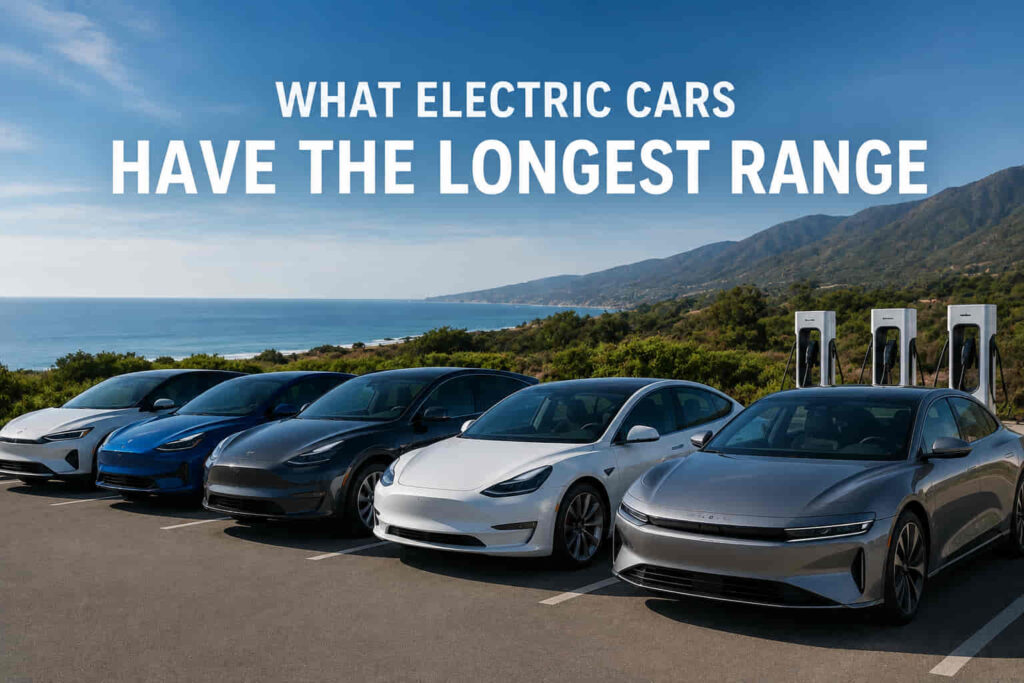
Driving range has become one of the most important factors influencing electric vehicle purchasing decisions. While performance, technology, charging speed, and interior features all contribute to the ownership experience, the maximum distance an electric vehicle can travel on a single charge often determines whether it can comfortably meet a driver’s daily needs. As battery technology continues to improve, manufacturers are introducing electric cars capable of traveling well over 300 miles—and in some cases more than 500 miles—without recharging. However, advertised driving range does not always reflect what owners experience in everyday driving because weather, speed, terrain, driving habits, and charging conditions all influence real-world efficiency.
Modern electric vehicles achieve long driving ranges through a combination of larger battery packs, improved energy efficiency, lightweight construction, advanced battery management systems, regenerative braking, and increasingly aerodynamic vehicle designs. Manufacturers also optimize electric motors, thermal management systems, and software algorithms to maximize every kilowatt-hour stored within the battery. As a result, two vehicles with similar battery capacities may deliver significantly different driving ranges depending on how efficiently they convert stored electrical energy into forward motion.
This guide explains which electric cars currently offer the longest driving range, how official EPA ratings compare with real-world performance, the engineering factors that influence range, and how buyers can determine how much range they actually need before purchasing an electric vehicle. Rather than focusing solely on the highest published numbers, the article examines the technologies that allow certain EVs to travel farther while helping drivers understand which long-range electric vehicle provides the best overall value for different driving lifestyles.
What Electric Cars Have the Longest Range?
The electric cars with the longest driving range combine high-capacity battery packs, exceptional energy efficiency, advanced aerodynamics, intelligent battery management, and optimized electric powertrains to maximize the distance traveled on a single charge. While battery size remains an important factor, it is no longer the only determinant of range. Modern electric vehicles achieve outstanding efficiency through sophisticated engineering that minimizes energy consumption while extracting the maximum usable capacity from every kilowatt-hour stored inside the battery. As battery technology continues to evolve, several manufacturers now offer production electric vehicles capable of exceeding 400 miles of EPA-estimated driving range, reducing range anxiety and making long-distance travel increasingly practical.
Lucid Motors currently produces some of the longest-range electric vehicles available, with the Lucid Air demonstrating how efficiency can rival battery size as a determining factor in overall driving distance. Rather than relying exclusively on an exceptionally large battery, Lucid combines lightweight engineering, highly efficient electric motors, low aerodynamic drag, and advanced battery management software to deliver remarkable energy efficiency. This integrated approach allows certain Lucid Air configurations to achieve EPA-estimated ranges exceeding 500 miles under ideal testing conditions, placing the model among the industry leaders for maximum driving distance.
Tesla continues to be one of the benchmark manufacturers for long-range electric vehicles due to its consistent focus on efficiency across both hardware and software. Models such as the Model S Long Range combine a large battery pack with highly optimized electric motors, over-the-air software improvements, regenerative braking systems, and aerodynamic body design. Tesla’s proprietary battery management system continuously monitors temperature, charging behavior, and energy consumption to maximize usable battery capacity while protecting long-term battery health. The company’s Supercharger network further complements long-range capability by reducing charging time during extended road trips, allowing drivers to travel significant distances with minimal interruption.
Mercedes-Benz has also demonstrated that efficiency plays an equally important role as battery capacity through models such as the EQS. The vehicle’s streamlined exterior design produces one of the lowest drag coefficients among production automobiles, allowing it to consume less energy while maintaining highway speeds. Combined with sophisticated thermal management systems and efficient electric drive units, the EQS delivers impressive driving range while providing the comfort and refinement expected from a luxury sedan. Its engineering illustrates how aerodynamic optimization directly contributes to extending range without necessarily requiring dramatically larger battery packs.
Hyundai and Kia have emerged as strong competitors in the long-range EV segment by focusing on balanced efficiency rather than maximum battery size alone. Vehicles built on the Electric-Global Modular Platform utilize high-voltage electrical architecture, lightweight construction, advanced regenerative braking, and efficient power electronics to achieve competitive driving ranges while supporting extremely fast DC charging. These vehicles demonstrate that intelligent electrical system design can deliver both long-range capability and shorter charging times, reducing two of the primary concerns associated with electric vehicle ownership.
BMW, Chevrolet, Rivian, Porsche, and several other manufacturers also offer electric vehicles with substantial driving ranges, although each company prioritizes different aspects of vehicle performance. Luxury sedans typically emphasize aerodynamic efficiency and highway comfort, while electric pickup trucks and performance SUVs often sacrifice some range in exchange for higher power output, greater towing capacity, or off-road capability. Because vehicle size, weight, tire design, and intended use directly influence energy consumption, comparing driving range across different vehicle categories requires considering each model’s primary purpose rather than evaluating EPA numbers alone.
Official EPA driving range remains the most widely recognized benchmark for comparing electric vehicles in the United States because every model is tested using standardized procedures. These controlled evaluations provide consumers with a consistent method of comparing different vehicles under identical testing conditions. However, EPA ratings represent estimated performance rather than guaranteed real-world results. Environmental conditions, traffic patterns, road gradients, outside temperature, tire pressure, passenger load, and average driving speed all influence actual energy consumption, causing many drivers to experience driving ranges that differ from official estimates during everyday use.
Battery capacity, measured in kilowatt-hours, often receives significant attention during vehicle comparisons, yet larger batteries alone do not automatically produce longer driving range. Two electric vehicles equipped with similarly sized battery packs may differ substantially in efficiency because of variations in motor design, vehicle weight, rolling resistance, software optimization, and aerodynamic performance. Manufacturers increasingly focus on reducing energy consumption per mile rather than continuously increasing battery size because higher efficiency improves range while controlling vehicle weight and production costs.
Another important consideration when evaluating long-range electric vehicles is charging infrastructure. A vehicle capable of traveling over 400 miles on a single charge offers impressive flexibility, but overall ownership convenience also depends on access to reliable charging stations at home, work, and along major travel routes. Manufacturers with extensive fast-charging networks or compatibility with widely available public charging systems often provide a better long-distance ownership experience than vehicles offering slightly greater range but limited charging accessibility. Driving range and charging convenience therefore work together rather than serving as independent purchase considerations.
Ultimately, the electric cars with the longest range represent far more than simply the vehicles equipped with the largest batteries. They combine advanced battery technology, efficient electric motors, sophisticated thermal management, lightweight engineering, optimized aerodynamics, intelligent software, and carefully designed energy recovery systems to maximize every unit of stored electricity. Buyers evaluating long-range electric vehicles should therefore consider efficiency, charging capability, real-world performance, and overall vehicle design alongside published EPA ratings, ensuring the chosen model delivers the best balance between maximum driving distance and everyday usability.
Which Electric Car Currently Has the Longest EPA Range?
The electric car with the longest EPA-estimated driving range represents the highest level of efficiency currently achieved by production electric vehicles under standardized testing conditions. Although several manufacturers now produce electric cars capable of exceeding 400 miles on a single charge, only a small number consistently reach the highest EPA range ratings through a combination of battery capacity, energy efficiency, aerodynamic engineering, and sophisticated power management. Understanding how these vehicles achieve their published range figures helps buyers compare models more accurately while avoiding the common assumption that the largest battery always delivers the greatest driving distance.
The Lucid Air currently stands among the industry’s benchmark vehicles for maximum EPA-certified range. Certain configurations exceed 500 miles under EPA testing, demonstrating how efficiency can outperform battery size alone. Lucid achieves these results through an integrated engineering philosophy that focuses on minimizing energy consumption across every aspect of the vehicle. The electric motors operate at exceptionally high efficiency, the battery management system carefully controls energy delivery, and the vehicle’s aerodynamic profile minimizes drag at highway speeds. Together, these technologies allow the Lucid Air to travel farther while consuming less electricity per mile than many competitors with similarly sized battery packs.
Tesla remains another leader in long-range electric vehicle performance. The Model S Long Range consistently ranks among the highest-range production EVs because Tesla has spent years refining both hardware and software to maximize efficiency. Its dual-motor drivetrain, lightweight construction, regenerative braking strategy, and continuous over-the-air software updates all contribute to extending usable driving distance. Rather than relying solely on increasing battery capacity, Tesla continuously improves energy management algorithms that optimize power delivery, battery temperature, and regenerative braking under varying driving conditions. These software enhancements allow the vehicle to extract additional efficiency throughout its ownership life without requiring physical hardware changes.
Mercedes-Benz has demonstrated that aerodynamic design can significantly influence driving range through the EQS. The vehicle features one of the lowest aerodynamic drag coefficients ever measured on a production automobile, allowing it to require less energy to maintain highway speeds than conventional luxury sedans. Reducing aerodynamic resistance becomes increasingly important above approximately 50 miles per hour, where air resistance represents the largest source of energy consumption for most passenger vehicles. By carefully shaping the body, underbody panels, mirrors, and cooling systems, Mercedes-Benz improves efficiency without dramatically increasing battery size, illustrating the growing importance of aerodynamics in long-range EV development.
BMW, Hyundai, Kia, Chevrolet, and several other manufacturers also offer highly competitive electric vehicles that deliver EPA ranges exceeding 300 miles. Although these models may not reach the absolute maximum range figures achieved by Lucid or Tesla, they often balance efficiency with affordability, charging speed, interior practicality, and overall ownership cost. Vehicles such as the Hyundai IONIQ 6 and Kia EV6 demonstrate that intelligent electrical architecture, efficient permanent magnet motors, and optimized battery cooling systems can deliver impressive range while supporting ultra-fast charging capabilities. For many buyers, this balance between driving range and charging convenience provides greater real-world value than maximizing EPA mileage alone.
Vehicle category plays a significant role when comparing EPA range figures. Luxury sedans generally achieve higher range ratings because their low rooflines, streamlined shapes, and smaller frontal areas reduce aerodynamic drag. Electric SUVs, crossover vehicles, and pickup trucks typically consume more energy because larger bodies create greater air resistance while additional weight increases rolling resistance and acceleration demands. Consequently, a premium sedan capable of traveling more than 450 miles on a charge cannot be directly compared with an electric pickup designed to tow heavy loads or an SUV engineered for greater passenger capacity. Each vehicle category prioritizes different performance characteristics that naturally influence overall efficiency.
Battery capacity remains an important contributor to EPA range, but its influence has become increasingly balanced by improvements in energy efficiency. Early electric vehicles often relied primarily on larger batteries to extend driving distance, resulting in heavier vehicles with higher production costs. Modern manufacturers increasingly pursue efficiency gains through improved motor design, silicon carbide power electronics, lightweight construction materials, advanced thermal management systems, and intelligent software that minimizes unnecessary energy consumption. As battery technology matures, maximizing miles per kilowatt-hour has become just as important as increasing total battery capacity.
EPA testing provides an essential benchmark for comparing electric vehicles because every model is evaluated using standardized laboratory procedures. These tests simulate city and highway driving under controlled environmental conditions while measuring total energy consumption and projected driving distance. Because each manufacturer follows identical testing protocols, EPA ratings offer consumers a consistent method for comparing vehicles across different brands. However, standardized testing cannot reproduce every real-world driving scenario. Ambient temperature, road elevation, traffic congestion, wind conditions, tire pressure, passenger load, and driving style all influence actual range, meaning drivers rarely achieve identical results under every circumstance.
Real-world range frequently differs from EPA estimates because everyday driving introduces variables absent from laboratory testing. Cold weather reduces battery efficiency by slowing chemical reactions within lithium-ion cells while increasing energy consumption for cabin heating. High highway speeds dramatically increase aerodynamic drag, requiring more electricity to maintain cruising speed than city driving. Frequent acceleration, steep terrain, heavy cargo, towing, and continuous use of climate control systems further reduce available range. Conversely, moderate temperatures, steady speeds, efficient driving habits, and effective regenerative braking may allow some drivers to approach or even exceed official EPA estimates under favorable conditions.
Charging infrastructure also influences the practical importance of maximum driving range. A vehicle capable of traveling 500 miles between charges provides outstanding flexibility for long-distance travel, but ownership convenience also depends on the availability of reliable fast-charging stations. Manufacturers supporting extensive charging networks or broad compatibility with public charging infrastructure often provide a better overall ownership experience than vehicles with slightly longer range but fewer charging options. As public charging continues expanding, the relationship between driving range and charging accessibility becomes increasingly important when evaluating electric vehicles for everyday use.
Ultimately, the electric cars with the longest EPA range demonstrate the highest level of engineering efficiency currently available in the electric vehicle industry. Models such as the Lucid Air, Tesla Model S Long Range, and Mercedes-Benz EQS achieve exceptional driving distances not because of battery size alone, but because they integrate advanced battery technology, highly efficient electric motors, aerodynamic optimization, intelligent thermal management, and sophisticated energy management software into one coordinated system. Buyers should therefore view EPA range as one component of a broader evaluation that also includes charging speed, efficiency, real-world performance, ownership costs, and the specific driving conditions they expect to encounter throughout everyday vehicle use.
How Does Battery Capacity Affect Driving Range?
Battery capacity is one of the most important factors influencing how far an electric vehicle can travel on a single charge, but it is not the only factor that determines driving range. Battery capacity, measured in kilowatt-hours (kWh), represents the amount of electrical energy the battery can store, much like the size of a fuel tank in a conventional gasoline vehicle. A larger battery generally provides more available energy for propulsion, allowing the vehicle to travel farther before recharging becomes necessary. However, the total distance an electric vehicle can achieve depends equally on how efficiently that stored energy is converted into forward motion. Two electric cars equipped with batteries of similar capacity can produce dramatically different driving ranges because of differences in vehicle efficiency, weight, aerodynamics, drivetrain design, and software optimization.
Battery capacity defines the maximum amount of usable energy available to the electric motors during operation. For example, an electric vehicle equipped with a 100 kWh battery stores significantly more energy than one equipped with a 60 kWh battery. Under identical driving conditions, the larger battery provides a greater energy reserve, enabling longer trips before the battery reaches a low state of charge. This explains why flagship luxury sedans and premium touring EVs frequently utilize larger battery packs to support extended highway travel. Nevertheless, simply increasing battery size does not guarantee proportionally longer driving range because larger batteries also increase vehicle weight, requiring additional energy to accelerate, climb hills, and maintain motion.
Energy efficiency ultimately determines how effectively a vehicle uses every kilowatt-hour stored inside its battery. Electric vehicle efficiency is commonly expressed as miles per kilowatt-hour or kilowatt-hours consumed per 100 miles. A highly efficient vehicle requires less electricity to travel a given distance, allowing it to achieve greater range even with a smaller battery pack. Conversely, a heavier or less aerodynamic vehicle consumes more energy during operation, reducing the total distance achievable from the same battery capacity. This relationship explains why certain midsize electric sedans equipped with moderately sized batteries outperform larger SUVs carrying substantially greater battery capacity.
Vehicle weight has a direct influence on the relationship between battery capacity and driving range. Larger battery packs increase stored energy but also add considerable mass to the vehicle. Every additional pound requires energy to accelerate, decelerate, and climb changes in elevation. Engineers therefore face a continual balance between expanding battery capacity and limiting vehicle weight. Excessively large batteries may provide diminishing returns because the additional energy stored is partially offset by the increased energy required to move the heavier vehicle. Manufacturers increasingly focus on lightweight chassis materials, aluminum structures, and optimized battery packaging to maximize usable range without unnecessarily increasing vehicle mass.
Aerodynamic efficiency becomes increasingly important as driving speed rises. At highway speeds, aerodynamic drag represents the largest source of energy consumption for most passenger vehicles. Even a large battery cannot compensate efficiently for excessive air resistance because the electric motors must continuously overcome aerodynamic forces that increase exponentially with speed. Manufacturers designing long-range electric vehicles devote significant engineering resources to reducing drag through streamlined body shapes, smooth underbody panels, optimized wheel designs, flush-mounted door handles, and carefully managed airflow around the vehicle. These improvements reduce energy consumption at cruising speed, allowing every kilowatt-hour stored within the battery to propel the vehicle farther.
Electric motor efficiency also influences how battery capacity translates into usable driving distance. Modern permanent magnet synchronous motors and advanced induction motors convert a high percentage of electrical energy into mechanical motion, minimizing losses caused by heat and internal resistance. Improvements in inverter technology, silicon carbide power electronics, and motor control software further reduce energy waste while optimizing torque delivery under varying driving conditions. As electric drivetrain technology continues advancing, manufacturers increasingly achieve longer driving ranges without proportionally increasing battery size, demonstrating that drivetrain efficiency has become just as important as battery capacity itself.
Battery management systems play a critical role in maximizing usable battery capacity while protecting long-term battery health. The Battery Management System continuously monitors cell voltage, temperature, charging rates, and discharge patterns across thousands of individual battery cells. Rather than allowing the battery to utilize its entire theoretical capacity, manufacturers intentionally reserve a small percentage of energy at both the upper and lower ends of the charge range. This protective buffer reduces long-term battery degradation while maintaining consistent performance throughout years of operation. Consequently, the usable battery capacity available for driving is often slightly lower than the battery’s total physical capacity, ensuring greater durability over the life of the vehicle.
Driving conditions frequently have a greater influence on practical range than battery capacity alone. High speeds, rapid acceleration, steep terrain, strong headwinds, heavy passenger loads, towing, and continuous climate control operation all increase electricity consumption. Cold weather introduces an additional challenge because lithium-ion batteries become less chemically efficient at lower temperatures while simultaneously requiring energy to heat both the battery pack and passenger cabin. Under these conditions, even vehicles equipped with very large battery packs may experience substantial reductions in achievable driving distance. Conversely, moderate temperatures, smooth acceleration, regenerative braking, and steady cruising speeds allow drivers to maximize the usable energy stored within the battery.
Charging habits also influence long-term battery performance. Frequent exposure to extremely high charging rates, repeated deep discharges, and maintaining the battery at either 100 percent or near-zero state of charge for extended periods may accelerate gradual battery degradation. Although modern battery management systems significantly reduce these risks through sophisticated thermal control and charging algorithms, following manufacturer recommendations regarding routine charging practices helps preserve usable battery capacity over many years. Maintaining battery health directly contributes to preserving driving range because battery degradation gradually reduces the amount of energy available for daily operation.
Advances in battery chemistry continue changing the relationship between battery size and driving range. New cell technologies offer greater energy density, allowing manufacturers to store more energy within the same physical space while reducing overall battery weight. Improvements in lithium-ion chemistry, cell packaging, cooling systems, and structural battery integration enable future electric vehicles to achieve substantially longer driving distances without requiring proportionally larger battery packs. These technological developments suggest that future gains in range will increasingly result from improved battery efficiency and energy density rather than simply increasing total battery capacity.
Ultimately, battery capacity establishes the foundation for an electric vehicle’s driving range, but efficiency determines how effectively that energy is used. Long-range electric vehicles achieve exceptional performance not by relying exclusively on larger batteries, but by integrating efficient electric motors, lightweight construction, aerodynamic optimization, intelligent battery management, and advanced software into a unified energy management system. Buyers comparing electric vehicles should therefore evaluate battery capacity together with efficiency ratings, EPA estimates, charging performance, and real-world driving conditions rather than assuming that the vehicle with the largest battery will always deliver the greatest practical driving range.
What Factors Reduce an Electric Car’s Range?
An electric vehicle’s driving range is influenced by far more than battery capacity alone. While official EPA estimates provide a standardized benchmark for comparing different models, real-world driving introduces environmental, mechanical, and behavioral variables that continuously affect energy consumption. Every mile traveled requires electrical energy to overcome aerodynamic drag, rolling resistance, changes in elevation, and accessory power demands. As these variables change throughout a journey, the distance an electric vehicle can travel on a full charge also changes. Understanding these factors allows drivers to predict real-world range more accurately while adopting driving habits that maximize battery efficiency.
Ambient temperature is one of the most significant factors affecting electric vehicle range. Lithium-ion batteries operate most efficiently within a moderate temperature window, typically between approximately 68°F and 77°F (20°C to 25°C). When temperatures fall below this range, the chemical reactions inside battery cells slow, reducing the battery’s ability to deliver energy efficiently. At the same time, the vehicle must consume additional electricity to warm the battery pack and heat the passenger cabin. Unlike gasoline vehicles that generate abundant waste heat from combustion, electric vehicles rely almost entirely on battery power for cabin heating. As a result, winter driving can reduce practical driving range by 10 to 40 percent depending on temperature, vehicle design, and trip length. Some manufacturers mitigate these losses by equipping vehicles with heat pump systems, which consume significantly less energy than conventional electric resistance heaters.
Driving speed has an equally important influence because aerodynamic drag increases exponentially as vehicle speed rises. At lower urban speeds, electric vehicles consume relatively little energy overcoming air resistance, allowing regenerative braking and efficient motor operation to maximize driving range. Once highway speeds exceed approximately 60 miles per hour, aerodynamic drag becomes the dominant force opposing vehicle motion. Maintaining a constant speed of 75 or 80 miles per hour requires substantially more electrical energy than traveling at 60 miles per hour, even though the increase in speed appears relatively small. This explains why many drivers observe noticeably shorter highway range compared with city driving despite maintaining steady cruising conditions.
Vehicle aerodynamics determine how efficiently an electric vehicle moves through the air. Manufacturers invest heavily in streamlined body shapes, smooth underbody panels, aerodynamic wheels, active grille shutters, and carefully designed airflow management systems because reducing drag directly lowers energy consumption. Even small increases in aerodynamic resistance caused by roof cargo boxes, bicycle racks, open windows, or towing trailers can reduce efficiency during long-distance highway travel. These accessories disturb airflow around the vehicle, forcing the electric motors to consume more electricity to maintain speed. Drivers who frequently travel long distances often achieve greater efficiency by minimizing unnecessary external accessories whenever possible.
Terrain also plays a major role in determining real-world driving range. Climbing steep hills requires considerable energy because the electric motors must overcome both gravity and vehicle mass. Although regenerative braking recovers part of that energy during descents, the recovery process is never completely efficient. Some energy is inevitably lost through electrical conversion, heat generation, and drivetrain resistance. Consequently, routes featuring continuous elevation gain generally produce lower overall efficiency than relatively flat highways, even when total travel distance remains unchanged. Drivers living in mountainous regions should therefore expect lower practical range than drivers traveling primarily on level roads.
Vehicle weight influences energy consumption during acceleration, climbing, and stop-and-go traffic. Additional passengers, cargo, towing equipment, or heavy loads increase the amount of work performed by the electric motors each time the vehicle accelerates. Although regenerative braking recovers some kinetic energy during deceleration, repeated acceleration of heavier loads still increases overall electricity consumption throughout a journey. Electric pickup trucks and large SUVs naturally require larger battery packs because their greater weight demands higher energy consumption than smaller passenger cars under comparable driving conditions.
Driving style significantly affects energy efficiency regardless of vehicle design. Rapid acceleration, aggressive overtaking, sudden braking, and repeated high-speed driving increase electrical demand while reducing opportunities for regenerative braking to recover energy smoothly. In contrast, gradual acceleration, maintaining consistent speeds, anticipating traffic flow, and allowing regenerative braking to slow the vehicle naturally improve overall efficiency. Many modern electric vehicles provide real-time energy consumption displays that encourage efficient driving habits by showing how acceleration and speed directly influence battery usage throughout every trip.
Climate control systems consume additional electricity because they operate independently of vehicle propulsion. Air conditioning compressors, cabin heaters, heated seats, heated steering wheels, windshield defrosters, and battery thermal management systems all draw energy from the high-voltage battery. During extremely hot weather, cooling both the passenger cabin and battery pack increases electrical consumption, while cold weather requires substantial energy for cabin heating and battery conditioning. Although these systems are essential for passenger comfort and battery protection, their energy requirements inevitably reduce the amount of electricity available for propulsion, particularly during short trips where climate systems operate continuously.
Tire condition also affects electric vehicle range more than many drivers realize. Underinflated tires increase rolling resistance by enlarging the tire’s contact patch with the road surface, forcing the electric motors to consume additional energy during every mile traveled. Likewise, aggressive performance tires generally generate greater rolling resistance than low-resistance touring tires specifically designed for electric vehicles. Maintaining manufacturer-recommended tire pressure and replacing worn tires with models optimized for EV efficiency helps preserve driving range while improving handling and tire longevity.
Wind conditions frequently explain unexpected differences between outbound and return journeys. A strong headwind increases the relative airspeed experienced by the vehicle, effectively simulating higher driving speeds and increasing aerodynamic drag. Even moderate headwinds can noticeably reduce driving range during highway travel because the electric motors must continuously overcome additional air resistance. Tailwinds produce the opposite effect by reducing relative airflow and lowering energy consumption. Drivers planning long-distance trips should consider weather forecasts because sustained winds may significantly influence charging requirements over extended highway routes.
Battery age gradually affects maximum driving range over many years of ownership. Lithium-ion batteries naturally lose a small percentage of usable capacity through repeated charging cycles, chemical aging, and long-term exposure to high temperatures. Modern battery management systems minimize degradation through sophisticated thermal control and charging algorithms, allowing many electric vehicles to retain the majority of their original capacity after hundreds of thousands of miles. Nevertheless, gradual battery degradation slightly reduces available driving range as the vehicle ages, making proper charging practices and thermal management increasingly important for preserving long-term performance.
Ultimately, real-world electric vehicle range results from the interaction of battery capacity, energy efficiency, environmental conditions, vehicle design, and driver behavior rather than any single specification published by the manufacturer. Cold weather, highway speeds, steep terrain, heavy loads, climate control usage, tire condition, wind resistance, and battery health all influence how efficiently stored electrical energy is converted into usable driving distance. Buyers evaluating long-range electric vehicles should therefore view EPA ratings as standardized comparison tools rather than guaranteed everyday results. Understanding the factors that reduce range enables drivers to plan trips more effectively, maximize battery efficiency, and select an electric vehicle that matches their actual driving environment rather than relying exclusively on laboratory estimates.
Is EPA Range Accurate in Real-World Driving?
EPA driving range is the most widely recognized benchmark for comparing electric vehicles in the United States, but it should be viewed as a standardized estimate rather than a guaranteed real-world result. The Environmental Protection Agency developed its testing procedures to provide consumers with a consistent method for comparing different electric vehicles under controlled conditions. Because every manufacturer follows the same testing methodology, EPA ratings create a level playing field that allows buyers to evaluate efficiency and projected driving distance across multiple brands. However, everyday driving introduces countless variables that cannot be fully reproduced inside a laboratory, meaning actual driving range frequently differs from official EPA estimates.
The EPA testing process measures how efficiently an electric vehicle consumes electricity during simulated city and highway driving cycles. Vehicles are tested using standardized procedures that include controlled acceleration, braking, cruising speeds, ambient temperatures, and predefined driving patterns. The electricity consumed during these cycles is then used to calculate an estimated driving range based on the vehicle’s usable battery capacity. Since every vehicle is evaluated under nearly identical conditions, EPA ratings provide a reliable comparison tool even though they cannot account for every real-world driving environment.
Real-world driving is considerably more complex than standardized laboratory testing because energy consumption changes continuously throughout every trip. Ambient temperature, traffic congestion, road elevation, wind speed, passenger weight, tire pressure, road surface conditions, and driving style all influence how much electricity an electric vehicle consumes. A driver traveling through mountainous terrain during winter while operating the cabin heater will almost certainly experience a shorter driving range than another driver traveling on flat highways in mild weather. These variations explain why two owners driving the same vehicle can report noticeably different range figures despite identical EPA ratings.
Highway driving is one of the most common reasons actual driving range falls below EPA estimates. As vehicle speed increases, aerodynamic drag rises exponentially, requiring substantially more energy to maintain higher cruising speeds. Many drivers regularly travel at speeds exceeding those represented during standardized testing, particularly on interstate highways where traffic commonly flows between 70 and 80 miles per hour. At these speeds, energy consumption increases rapidly, reducing total driving range even when traffic remains smooth and uninterrupted. Long-distance highway travel therefore often produces lower efficiency than the official EPA estimate suggests.
Temperature has an equally significant impact because lithium-ion batteries perform best within a moderate thermal range. Cold weather reduces battery efficiency by slowing the chemical reactions responsible for storing and releasing electrical energy. Simultaneously, the vehicle must consume additional electricity to heat the battery pack and maintain a comfortable cabin temperature. During extremely cold conditions, these combined energy demands can reduce practical driving range by a substantial margin. Hot climates also influence efficiency because battery cooling systems and air conditioning compressors require additional electrical power to regulate battery temperature and maintain passenger comfort. Although EPA testing includes standardized environmental conditions, it cannot fully represent these seasonal variations experienced by drivers throughout the year.
Driving behavior further influences the relationship between EPA estimates and actual performance. Rapid acceleration, frequent lane changes, aggressive overtaking, and sustained high-speed driving increase electrical demand while reducing overall efficiency. Conversely, gradual acceleration, maintaining consistent speeds, anticipating traffic flow, and making effective use of regenerative braking often allow drivers to approach or occasionally exceed official EPA estimates under favorable conditions. Many experienced EV owners learn to maximize efficiency by adapting their driving habits rather than relying solely on the vehicle’s published specifications.
Battery state of charge also affects real-world range planning. While EPA ratings assume the vehicle begins with a fully charged battery and can utilize its available operating capacity, many owners rarely charge to 100 percent during everyday use. Manufacturers often recommend limiting routine charging to approximately 80 percent to help preserve long-term battery health, particularly for vehicles using lithium-ion battery chemistry. Likewise, drivers generally avoid completely depleting the battery before recharging. As a result, the practical distance traveled between daily charging sessions is often lower than the maximum range published by the manufacturer, even though the vehicle itself remains capable of achieving the full EPA estimate under ideal circumstances.
Another important consideration is the difference between EPA and WLTP testing standards. The EPA procedure, used primarily in the United States, is generally regarded as more conservative because it incorporates higher energy consumption assumptions and more demanding testing conditions. The Worldwide Harmonised Light Vehicles Test Procedure, commonly used in Europe and many international markets, often produces higher published driving range figures for the same vehicle. While neither standard perfectly represents every real-world driving scenario, buyers comparing electric vehicles across different markets should recognize that WLTP ratings are typically more optimistic than EPA estimates. Understanding which testing standard applies prevents misleading comparisons between otherwise similar vehicles.
Independent real-world testing conducted by automotive publications and consumer organizations often provides additional perspective beyond official laboratory ratings. These evaluations typically involve highway driving, urban commuting, varying weather conditions, elevation changes, and practical charging scenarios that more closely resemble everyday vehicle use. Although individual test results naturally differ because of varying methodologies and environmental conditions, they often provide valuable insight into how specific vehicles perform outside standardized laboratory environments. Buyers considering long-range electric vehicles benefit from reviewing both EPA ratings and independent real-world testing before making purchasing decisions.
Modern electric vehicles also include increasingly sophisticated software that continuously estimates remaining driving range based on current driving conditions rather than relying exclusively on EPA calculations. Navigation systems analyze terrain, traffic conditions, weather forecasts, historical driving behavior, and energy consumption to predict remaining range with greater accuracy during each journey. These dynamic estimates provide considerably more useful information than static laboratory ratings because they adapt continuously as operating conditions change throughout the trip. Drivers therefore rely increasingly on real-time energy management systems rather than solely on the published EPA figure when planning longer journeys.
Ultimately, EPA driving range remains the most reliable standardized benchmark for comparing electric vehicles because every model is evaluated using identical testing procedures. However, it should be understood as a comparative measurement rather than a promise of everyday driving performance. Real-world range depends on weather, speed, terrain, traffic, vehicle load, driving habits, battery condition, and numerous other variables that cannot be fully replicated during laboratory testing. Buyers who understand the strengths and limitations of EPA ratings are better equipped to compare electric vehicles objectively while selecting a model that delivers sufficient range for their actual driving needs rather than relying exclusively on the highest published number.
Does Fast Charging Affect Long-Term Range?
DC fast charging has a measurable impact on long-term battery health, but under normal ownership conditions it is not the primary factor determining how much driving range an electric vehicle will lose over its lifetime. Modern electric vehicles are designed with sophisticated battery management systems that regulate charging speed, battery temperature, voltage, and current flow to minimize degradation during high-power charging sessions. While repeated exposure to extremely high charging rates generates additional heat and chemical stress inside lithium-ion battery cells, manufacturers have developed advanced thermal management technologies that significantly reduce these effects. As a result, occasional or even regular fast charging does not automatically lead to substantial range loss when the vehicle is operated according to manufacturer recommendations.
Understanding why fast charging influences battery health requires examining how lithium-ion batteries store and release energy. During DC fast charging, electricity flows directly into the battery at a much higher rate than during conventional Level 1 or Level 2 AC charging. Rapid charging increases the movement of lithium ions between the battery’s electrodes, producing additional heat within the cells. Elevated temperatures accelerate chemical reactions that gradually reduce the battery’s ability to store energy over time. This natural aging process, known as battery degradation, occurs in every lithium-ion battery regardless of charging method, but excessive heat and prolonged exposure to high charging currents can increase the rate at which usable battery capacity declines.
Battery temperature is often more influential than charging speed itself. Modern electric vehicles continuously monitor battery temperature through hundreds of sensors distributed throughout the battery pack. Before high-power charging begins, many vehicles automatically precondition the battery by warming or cooling it to an optimal operating temperature. Maintaining the battery within this temperature range allows charging to occur more efficiently while reducing thermal stress on individual cells. Vehicles equipped with advanced liquid-cooled battery systems generally experience less degradation during repeated fast charging than earlier designs relying on passive cooling because temperature remains more consistent throughout the charging process.
Manufacturers also intentionally limit charging speed as the battery approaches a higher state of charge. While charging may begin at extremely high power levels when the battery is nearly empty, the Battery Management System gradually reduces charging current as the battery fills. This charging curve protects the battery from excessive voltage and heat during the final portion of the charging cycle, where lithium-ion cells become increasingly sensitive to stress. Although this tapering process slightly increases charging time beyond approximately 80 percent state of charge, it significantly improves long-term battery durability by reducing chemical strain during the most sensitive phase of charging.
The frequency of fast charging also influences long-term battery performance. Drivers who rely almost exclusively on DC fast charging every day expose the battery to more frequent high-temperature charging events than drivers who primarily charge overnight using slower Level 2 chargers. Over many years, this additional thermal cycling may contribute to slightly greater battery degradation. However, extensive research and real-world fleet data indicate that the difference is generally modest for modern electric vehicles equipped with effective thermal management systems. Most vehicles retain a high percentage of their original battery capacity even after years of mixed charging habits, demonstrating that occasional fast charging is well within the design expectations established by manufacturers.
State of charge plays another important role in preserving battery health. Lithium-ion batteries experience the greatest long-term stress when maintained at either extremely high or extremely low charge levels for extended periods. Many manufacturers therefore recommend limiting routine charging to approximately 80 percent for everyday driving while reserving full charges for long trips requiring maximum range. Likewise, allowing the battery to remain completely discharged for prolonged periods should be avoided because deep discharge places additional stress on battery chemistry. These recommendations apply regardless of whether charging occurs through Level 2 equipment or high-power DC fast chargers.
Battery chemistry has also evolved significantly during the past decade. New generations of lithium-ion cells feature improved electrode materials, more stable electrolytes, enhanced separators, and higher energy density than earlier battery designs. These advancements increase resistance to degradation while allowing batteries to tolerate more charging cycles without significant capacity loss. Some manufacturers now utilize lithium iron phosphate battery chemistry for selected models, offering exceptional cycle life and improved resistance to repeated charging, while premium long-range vehicles continue refining nickel-based chemistries to maximize energy density without sacrificing durability. Continuous improvements in battery design reduce the practical impact of fast charging on long-term driving range compared with earlier generations of electric vehicles.
Software plays an equally important role in protecting battery health. The Battery Management System continuously analyzes charging behavior, cell voltage balance, internal resistance, and temperature distribution across the battery pack. Based on these measurements, the system adjusts charging current, activates cooling systems, balances individual battery cells, and limits charging power whenever conditions could accelerate degradation. These protective algorithms operate automatically without driver intervention, ensuring that the battery remains within safe operating limits even during repeated high-power charging sessions. Software updates released by manufacturers occasionally refine these charging strategies further, improving both charging efficiency and long-term battery preservation throughout the vehicle’s service life.
Real-world ownership data provides reassuring evidence regarding battery longevity. Numerous high-mileage electric vehicles that regularly utilize public fast-charging networks continue operating with relatively modest battery degradation after hundreds of thousands of miles. Although every battery gradually loses a small percentage of its original capacity through normal aging, most owners experience only incremental reductions in driving range rather than sudden declines. For many vehicles, calendar age, ambient temperature, and total charging cycles contribute more to long-term battery degradation than fast charging alone. This explains why many manufacturers confidently provide battery warranties extending eight years or approximately 100,000 miles while guaranteeing a substantial percentage of original battery capacity throughout the warranty period.
Drivers can further reduce long-term degradation by adopting balanced charging habits. Using Level 2 charging for routine daily driving, reserving DC fast charging for road trips, avoiding unnecessary full charges, preconditioning the battery before fast charging when available, and minimizing prolonged exposure to extreme temperatures all contribute to preserving battery capacity. These practices allow the Battery Management System to operate under optimal conditions while reducing cumulative thermal and chemical stress throughout the battery’s service life. Although modern electric vehicles are engineered to tolerate frequent charging, thoughtful charging habits help maximize both battery longevity and long-term driving range.
Ultimately, DC fast charging does influence long-term battery degradation, but its impact is often overstated when discussing modern electric vehicles. Advances in battery chemistry, thermal management, software control, and charging algorithms have significantly reduced the stress associated with high-power charging compared with earlier EV generations. For most owners, occasional or regular fast charging used as intended will have only a modest effect on long-term driving range. Preserving battery health depends more on the combined effects of temperature management, charging habits, battery age, and overall vehicle usage than on fast charging alone, allowing today’s electric vehicles to maintain reliable range and performance throughout many years of everyday driving.
How Does Cold Weather Affect Electric Vehicle Range?
Cold weather has one of the greatest impacts on electric vehicle driving range because low temperatures reduce battery efficiency while simultaneously increasing the amount of energy required to operate the vehicle. Unlike internal combustion engines that generate large amounts of waste heat during normal operation, electric vehicles rely almost entirely on stored battery energy to power both propulsion and cabin heating. When outside temperatures fall, the battery becomes less chemically efficient, the heating system consumes additional electricity, and rolling resistance often increases because of colder road conditions and tire behavior. These combined factors explain why many EV owners notice a significant reduction in driving range during winter, even when the vehicle is functioning exactly as designed.
The primary reason range decreases in cold weather lies within the chemistry of lithium-ion batteries. Electricity is stored and released through electrochemical reactions that become slower as temperatures decline. Lower temperatures increase the internal resistance of battery cells, reducing the battery’s ability to deliver energy efficiently to the electric motors. As a result, the Battery Management System may temporarily limit power output and regenerative braking until the battery reaches its optimal operating temperature. Although the battery still contains the same physical amount of stored energy, a smaller portion of that energy can be used efficiently until the cells warm sufficiently. This temporary reduction in efficiency directly decreases the distance the vehicle can travel on a single charge.
Battery thermal management systems are designed to minimize these temperature-related losses. Modern electric vehicles continuously monitor battery temperature and use liquid cooling or heating systems to maintain the battery within an ideal operating range. Before driving or charging, many vehicles automatically activate battery conditioning systems that warm the battery pack when ambient temperatures are extremely low. This process improves charging efficiency, enhances regenerative braking performance, and restores the battery’s ability to deliver power more effectively. Although battery preconditioning itself consumes electricity, it often improves overall efficiency during longer trips by allowing the battery to operate under more favorable conditions throughout the journey.
Cabin heating represents another major source of winter energy consumption. In gasoline-powered vehicles, heating the passenger compartment requires little additional energy because waste heat from the engine is already available. Electric vehicles, however, must generate cabin heat using electricity drawn directly from the high-voltage battery. Traditional electric resistance heaters consume considerable power, especially during the first several minutes after startup when both the cabin and battery require warming. Continuous operation of the heater throughout long winter drives further increases energy demand, reducing the electricity available for propulsion and shortening overall driving range.
Many modern electric vehicles reduce winter energy consumption by incorporating heat pump technology. Unlike conventional resistance heaters that convert electricity directly into heat, a heat pump transfers thermal energy from the surrounding environment into the cabin using significantly less electrical power. Even when outside temperatures are relatively low, modern heat pump systems can extract usable heat from ambient air while consuming considerably less energy than traditional heating systems. This improved efficiency allows vehicles equipped with heat pumps to preserve more battery energy for driving, reducing winter range loss compared with vehicles relying solely on electric resistance heating.
Regenerative braking performance also changes during cold weather. Under normal operating conditions, regenerative braking captures kinetic energy during deceleration and converts it back into electrical energy stored within the battery. When battery temperatures are very low, however, the Battery Management System may temporarily restrict regenerative braking because cold battery cells cannot safely accept high charging currents. Drivers may therefore notice reduced regenerative braking immediately after starting the vehicle on cold mornings. As the battery gradually warms during driving, regenerative braking typically returns to normal operation, allowing the vehicle to recover more energy and improve overall efficiency.
Charging behavior is also influenced by winter temperatures. Cold batteries accept electrical energy more slowly than batteries operating within their preferred temperature range. For this reason, many electric vehicles automatically preheat the battery before arriving at a DC fast charging station if the destination is entered into the vehicle’s navigation system. Battery preconditioning ensures the cells reach an optimal temperature before charging begins, allowing higher charging speeds while reducing stress on the battery. Without preconditioning, charging sessions may take considerably longer because the Battery Management System limits charging power to protect the battery from damage.
Driving conditions commonly associated with winter further reduce efficiency beyond battery chemistry alone. Snow-covered roads, slush, rain, and icy surfaces increase rolling resistance between the tires and the road, requiring additional energy to maintain speed. Winter tires, while improving traction and safety, generally create more rolling resistance than low-resistance summer or all-season tires optimized for maximum efficiency. Strong winter headwinds and denser cold air further increase aerodynamic drag, requiring the electric motors to consume additional energy during highway travel. These environmental factors combine with battery-related efficiency losses to produce the range reductions many drivers observe during colder months.
Trip length has a significant influence on winter driving efficiency. Short journeys often produce the greatest percentage reduction in range because much of the available energy is consumed warming the battery and passenger cabin before the vehicle reaches stable operating conditions. During longer trips, the battery gradually reaches its optimal temperature, allowing the electric motors, regenerative braking system, and battery management system to operate more efficiently. Consequently, the percentage reduction in range often decreases as trip distance increases, even though winter conditions remain unchanged.
Drivers can minimize cold-weather range loss by adopting several practical strategies that improve overall efficiency. Parking the vehicle inside a garage reduces battery cooling overnight, while preconditioning the cabin and battery before departure using grid electricity instead of battery power preserves more energy for driving. Maintaining moderate highway speeds, using heated seats instead of maximizing cabin temperature when appropriate, keeping tires properly inflated, and scheduling charging immediately before departure all contribute to improving winter driving efficiency. Vehicles equipped with intelligent navigation systems can also optimize charging stops and battery preconditioning automatically, further reducing the practical impact of cold weather on long-distance travel.
Ultimately, cold weather reduces electric vehicle range because it affects both the battery’s ability to deliver energy and the vehicle’s demand for electricity. Lower battery efficiency, increased cabin heating requirements, reduced regenerative braking, slower charging, greater rolling resistance, and higher aerodynamic drag all contribute to shorter winter driving distances. However, modern battery thermal management systems, heat pumps, intelligent preconditioning, and increasingly sophisticated energy management software have significantly reduced these seasonal effects compared with earlier generations of electric vehicles. Buyers evaluating long-range EVs should therefore consider winter performance alongside official EPA ratings, particularly if the vehicle will be operated regularly in colder climates where seasonal range variation becomes an important part of everyday ownership.
How Much Driving Range Do You Really Need?
The ideal driving range for an electric vehicle depends far more on your daily driving habits, charging accessibility, travel frequency, and local climate than on the highest EPA rating available. Although many buyers initially believe that purchasing the longest-range electric vehicle is always the best decision, the reality is that most drivers rarely use the full capacity of a 400- or 500-mile battery during everyday ownership. Selecting an EV with more range than you regularly need often increases purchase price, vehicle weight, and insurance costs without delivering meaningful practical benefits. Understanding your actual driving requirements allows you to balance range, efficiency, charging convenience, and overall ownership value more effectively.
For most drivers, daily commuting requires considerably less range than many people expect. Transportation studies consistently show that the average daily driving distance in many markets is well below 50 miles. An electric vehicle capable of traveling 250 to 300 miles on a full charge can therefore accommodate several days of commuting before requiring another charging session, especially if home charging is available. Even after accounting for seasonal efficiency losses, battery degradation over time, and occasional detours, this level of range provides a comfortable margin for routine transportation without creating unnecessary charging anxiety.
Home charging significantly changes how much driving range a driver actually needs. Owners who can charge overnight begin each morning with a battery that is either fully charged or charged to their preferred level, making the vehicle function much like a smartphone that is recharged while not in use. Under these conditions, the maximum range of the vehicle becomes less important because the battery is replenished regularly rather than being depleted over several days. A driver traveling 40 miles each day with reliable home charging experiences little practical advantage from a 500-mile battery compared with one offering 300 miles, since both vehicles easily meet daily transportation needs.
Drivers who depend primarily on public charging infrastructure often benefit from greater driving range because charging opportunities may be less predictable. Apartment residents, urban drivers without dedicated parking, and individuals who frequently travel through areas with limited charging availability may prefer a larger battery to reduce charging frequency and increase flexibility. Additional range also provides a larger energy reserve when charging stations are occupied, temporarily unavailable, or located farther apart than expected. In these situations, longer driving range contributes not only to convenience but also to greater confidence during everyday travel.
Long-distance travel places different demands on an electric vehicle than daily commuting. Drivers who regularly undertake highway trips of several hundred miles benefit from vehicles that combine long EPA range with high-speed DC fast charging capability. A vehicle capable of traveling 350 miles between charging stops but requiring extended charging sessions may provide a less convenient road-trip experience than another model offering slightly shorter range but substantially faster charging performance. Total travel time therefore depends on both the distance traveled per charge and the amount of time required to replenish the battery during each stop.
Climate should also influence range requirements. Drivers living in regions with consistently cold winters often experience noticeable reductions in practical driving range because battery efficiency declines while energy consumption for cabin heating increases. Choosing an electric vehicle with additional range capacity provides a useful safety margin during winter months, ensuring that seasonal efficiency losses do not interfere with everyday transportation needs. Similarly, drivers operating in mountainous terrain or frequently towing trailers should account for increased energy consumption when determining the minimum acceptable driving range for their vehicle.
Battery degradation deserves consideration when evaluating long-term ownership. Although modern lithium-ion batteries retain most of their original capacity for many years, gradual reductions in usable energy storage occur naturally through aging and repeated charging cycles. Purchasing an electric vehicle with moderate reserve capacity allows the vehicle to continue meeting everyday driving requirements even after experiencing normal battery degradation over its service life. This approach provides greater long-term flexibility without requiring buyers to focus exclusively on obtaining the highest available EPA rating.
Vehicle efficiency can be just as valuable as maximum battery capacity when determining practical driving range. An efficient electric vehicle converts stored electrical energy into usable mileage more effectively, reducing operating costs while requiring less frequent charging. Two vehicles may offer similar EPA ranges despite using battery packs of very different sizes because one vehicle achieves substantially greater energy efficiency. Buyers should therefore compare efficiency ratings alongside total driving range rather than assuming that larger batteries automatically represent better long-term value.
Budget remains an important part of the purchasing decision. Premium long-range electric vehicles typically command higher purchase prices because larger battery packs are among the most expensive components in any EV. Buyers whose daily driving rarely exceeds moderate distances may achieve significantly better value by selecting a more affordable model offering sufficient range for routine use while investing the savings elsewhere. As public charging infrastructure continues expanding and charging speeds continue improving, the financial benefit of purchasing the longest-range model becomes less significant for many households.
Future ownership plans should also influence how much range is appropriate. Families expecting changes in commuting patterns, relocation to colder climates, or more frequent long-distance travel may benefit from selecting an electric vehicle with additional range beyond current daily needs. Conversely, urban drivers using an EV primarily for local transportation often place greater value on affordability, compact dimensions, and charging convenience than on maximizing single-charge distance. Matching vehicle capability to expected ownership patterns produces a more satisfying ownership experience than selecting an EV based solely on one headline specification.
Ultimately, the best electric vehicle is not necessarily the one with the longest advertised driving range but the one whose capabilities align most closely with your real-world transportation needs. Daily mileage, charging availability, seasonal weather, highway travel frequency, long-term ownership plans, and overall efficiency all influence how much range provides genuine value. For many drivers, an EV offering approximately 300 miles of EPA-estimated range delivers an excellent balance between practicality, purchase cost, charging flexibility, and long-term usability. Buyers who regularly travel long distances or have limited access to charging infrastructure may benefit from models exceeding 400 miles, while others can confidently choose shorter-range vehicles without sacrificing everyday convenience. Evaluating range within the broader context of total ownership ensures that the chosen electric vehicle delivers both the performance and value expected throughout years of reliable use.
Read more: Electric Power Steering Problems

Should You Buy an EV Based Only on Driving Range?
Driving range should be one of the most important considerations when buying an electric vehicle, but it should never be the only factor influencing the final decision. While a long EPA-rated range reduces charging frequency and increases confidence during long-distance travel, overall ownership satisfaction depends on a combination of battery efficiency, charging performance, operating costs, reliability, charging infrastructure, and how well the vehicle matches your daily driving habits. Buyers who focus exclusively on the highest published range often overlook other characteristics that have an equal or even greater impact on everyday usability.
Driving range represents only one part of an electric vehicle’s overall energy ecosystem. A vehicle capable of traveling 500 miles on a full charge appears impressive on paper, but if it requires considerably longer charging sessions than competing models, the practical advantage may be smaller than expected. Likewise, an electric vehicle offering 330 miles of range combined with extremely fast DC charging can often complete long road trips in nearly the same overall travel time because shorter charging stops compensate for the reduced distance between charges. Evaluating range together with charging speed provides a more realistic understanding of long-distance ownership than considering either specification independently.
Energy efficiency is equally important because it determines how effectively the vehicle converts stored electricity into usable driving distance. Two electric vehicles may deliver similar EPA range ratings despite having battery packs of different capacities because one vehicle consumes less electricity per mile. A more efficient vehicle reduces charging costs throughout its lifetime while placing less demand on public charging infrastructure during extended travel. Higher efficiency also means that seasonal range reductions caused by cold weather or highway driving generally have a smaller practical impact because the vehicle begins with lower baseline energy consumption. Buyers comparing electric vehicles should therefore consider both EPA range and efficiency ratings rather than assuming the largest battery automatically provides the greatest long-term value.
Charging accessibility often has a greater influence on ownership experience than maximum driving range. Drivers with reliable home charging typically recharge overnight, allowing the vehicle to begin each day with a battery ready for routine transportation. Under these conditions, an EV with approximately 300 miles of range may satisfy nearly every daily driving requirement while avoiding the additional purchase cost associated with significantly larger battery packs. Conversely, buyers who rely exclusively on public charging stations benefit from greater driving range because additional battery capacity reduces charging frequency and provides greater flexibility when charging stations are busy or unavailable. Understanding where and how charging will occur is therefore just as important as evaluating official range estimates.
Battery technology also deserves careful consideration because long-term ownership extends far beyond the initial driving range displayed in manufacturer specifications. Modern battery management systems, advanced thermal management, and improved lithium-ion chemistry have dramatically increased battery durability compared with earlier electric vehicles. Manufacturers now routinely provide battery warranties covering approximately eight years or around 100,000 miles while guaranteeing a substantial percentage of original battery capacity throughout the warranty period. Buyers should therefore evaluate warranty coverage, battery cooling design, software support, and long-term reliability alongside maximum range when comparing different electric vehicle models.
Driving conditions should always influence purchasing decisions because laboratory testing cannot replicate every real-world environment. Drivers living in regions with cold winters, mountainous terrain, or frequent highway travel often experience greater energy consumption than drivers operating primarily in mild urban environments. Selecting a vehicle with additional range provides a useful reserve under demanding conditions, but that reserve should be based on realistic operating requirements rather than the assumption that the highest available range always represents the best investment. Matching the vehicle to local climate and driving patterns generally produces a better ownership experience than pursuing the highest published EPA figure.
Vehicle category further affects how range should be evaluated. Luxury sedans typically achieve outstanding efficiency because their low aerodynamic profiles reduce energy consumption at highway speeds. Electric SUVs and pickup trucks naturally consume more electricity because greater weight, larger frontal areas, and increased cargo or towing capability require additional energy. Comparing range across these categories without considering intended vehicle use may lead to misleading conclusions. Buyers needing family transportation, cargo space, towing capability, or off-road performance often obtain greater overall value from a slightly shorter-range SUV than from a longer-range sedan that cannot meet those practical requirements.
Purchase price remains closely connected to battery size because the battery pack represents one of the most expensive components within any electric vehicle. Models offering the industry’s longest driving ranges typically command premium prices due to larger battery packs and advanced engineering. Buyers should evaluate whether the additional cost provides measurable benefits for their specific driving habits. If daily travel rarely exceeds moderate distances and reliable charging is readily available, investing in the longest-range model may provide relatively little practical advantage compared with choosing a more affordable vehicle that satisfies everyday transportation needs while reducing total ownership costs.
Technology integration also contributes significantly to overall ownership satisfaction. Intelligent navigation systems capable of planning charging stops automatically, battery preconditioning before fast charging, advanced regenerative braking strategies, over-the-air software updates, and sophisticated energy management systems all improve practical driving efficiency regardless of maximum battery capacity. These technologies help drivers maximize available range under varying conditions while simplifying long-distance travel. An electric vehicle equipped with well-developed software and charging intelligence may deliver a superior ownership experience despite offering a slightly lower EPA range than competing models.
Long-term ownership considerations should extend beyond today’s driving requirements. Public charging infrastructure continues expanding rapidly, battery technology continues improving, and charging speeds continue increasing across new vehicle generations. As charging becomes faster and more widely available, the importance of carrying the largest possible battery gradually decreases for many drivers. Future improvements in charging convenience may ultimately provide greater real-world value than purchasing additional battery capacity that remains unused during most daily trips. Buyers should therefore consider how evolving charging infrastructure may influence ownership throughout the life of the vehicle rather than focusing exclusively on present-day range comparisons.
Ultimately, driving range is an essential specification, but it should be evaluated as one element within a much broader purchasing decision. Battery efficiency, charging speed, charging accessibility, operating costs, vehicle category, climate, battery durability, software capabilities, and expected driving habits all determine whether an electric vehicle will satisfy its owner’s long-term transportation needs. The best electric car is rarely the one with the highest EPA range alone. Instead, it is the vehicle that provides the optimal balance between real-world range, energy efficiency, charging convenience, reliability, and overall value for the way it will actually be driven. Buyers who evaluate these factors together rather than relying solely on a single headline specification are far more likely to choose an electric vehicle that delivers consistent performance, lower operating costs, and a satisfying ownership experience for many years to come.