The Hyundai Palisade offers solid reliability for a three row SUV, especially in recent model years. The 2024 and 2025 models have earned strong reliability ratings. However, the redesigned 2026 Palisade still lacks enough long term ownership data. Buyers should therefore evaluate Palisade reliability by model year.
Several factors determine how well a Hyundai Palisade performs over time. Engine condition, transmission performance, electrical systems, and maintenance history play major roles. Mileage, recall status, and previous ownership also affect long term dependability. Some model years have fewer reported problems than others. A properly maintained used Palisade can also provide better reliability than a newer vehicle with poor service history.
Regular maintenance helps the Hyundai Palisade deliver dependable long term performance. Owners should follow scheduled service intervals and fix mechanical problems early. Used car buyers should also review service records and check for open recalls. A professional inspection can reveal problems that a test drive may not expose.
This guide explains Hyundai Palisade reliability by model year. It also covers common problems, expected lifespan, recalls, maintenance needs, and important checks before buying a new or used Palisade.
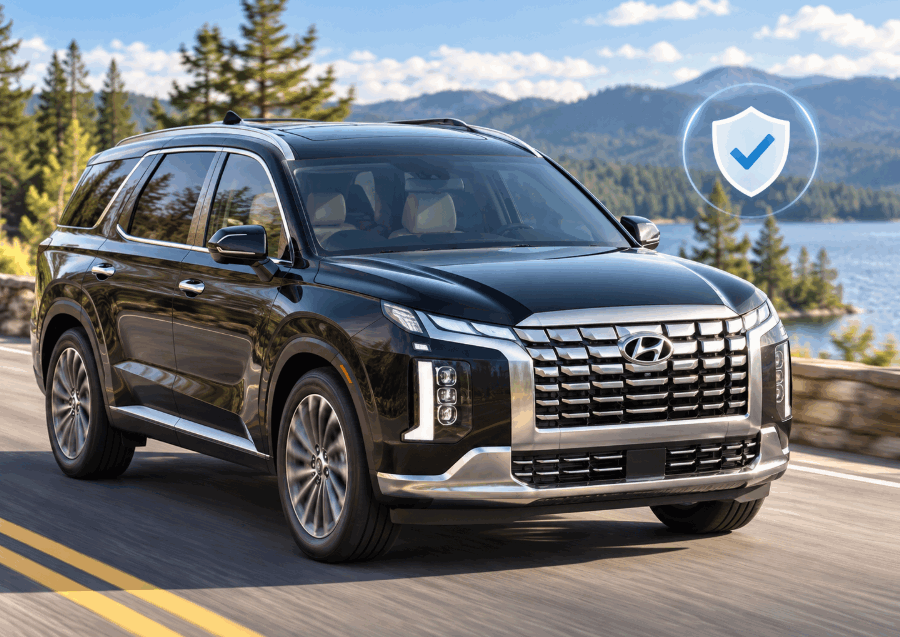
Are Hyundai Palisade Reliable?
The Hyundai Palisade is generally reliable, but reliability varies significantly by model year. Recent first generation models have stronger ratings than the earliest Palisade. Maintenance history also becomes more important as mileage increases.
J.D. Power gives the 2024 Hyundai Palisade a Quality and Reliability score of 85 out of 100. The 2025 Palisade scores 84 out of 100. J.D. Power classifies both scores as Great. Its rating considers defects, malfunctions, and design problems reported by verified vehicle owners.
Consumer Reports provides a more cautious view of some model years. It rates the 2025 Palisade at about average reliability compared with other 2025 vehicles. It also identifies the 2020 Palisade as less reliable than other vehicles from the same year. These differences show why buyers should review each model year separately.
The 2026 Hyundai Palisade requires a separate reliability assessment. Hyundai redesigned the Palisade for its second generation in 2026. Consumer Reports expects about average reliability for this model. However, that prediction relies partly on data from the previous Palisade generation. Long term data for the new generation remains limited.
Therefore, buyers should not treat every Hyundai Palisade as equally reliable. Model year, mileage, maintenance, recalls, and vehicle condition all affect ownership risk.
What Do Reliability Ratings Say About the Hyundai Palisade?
Current reliability ratings place recent Hyundai Palisade models between average and strong, depending on the rating source. J.D. Power gives recent first generation models high Quality and Reliability scores. Consumer Reports gives the 2025 model a more moderate assessment.
J.D. Power combines quality and dependability information in its vehicle reliability evaluations. Quality data focuses on problems during early ownership. Dependability data considers problems that appear after several years. A higher score indicates that owners reported fewer defects and malfunctions.
The 2024 Palisade received 85 out of 100 for Quality and Reliability. The 2025 model received 84 out of 100. These scores support a positive reliability assessment for recent first generation Palisade models. However, one score cannot predict every vehicle’s future condition.
Consumer Reports uses owner surveys to identify reliability problems across vehicle systems. Its 2025 data describes Palisade reliability as about average. This result does not contradict the J.D. Power scores. The organizations use different data sources and evaluation methods.
Buyers should therefore use reliability ratings as one part of the purchasing process. Service records, recall status, mileage, and inspection results provide additional evidence about an individual Palisade.
Does Hyundai Palisade Reliability Depend on the Model Year?
Yes. Hyundai Palisade reliability depends heavily on the model year because design changes and specific defects affect different vehicles.
Hyundai introduced the Palisade for the 2020 model year. Consumer Reports currently describes the 2020 model as less reliable than other vehicles from that year. Owner survey data identifies problems across several systems. These include suspension, climate equipment, electrical accessories, drivetrain components, and transmission components.
Later first generation models show stronger evidence in several reliability assessments. The 2024 and 2025 models both receive J.D. Power scores above 80 for Quality and Reliability. However, specific recalls still affect some vehicles. A strong overall rating does not mean every Palisade remains free from defects.
The 2026 model creates another important distinction. Hyundai introduced the second Palisade generation for 2026. The redesign includes a new 3.5 liter V6 engine and other major changes. Consumer Reports therefore treats 2026 as a redesign year. It currently expects about average reliability rather than assigning proven long term dependability.
For this reason, buyers should compare Palisades within the correct generation and model year. This approach gives a more accurate view than relying on one overall Hyundai Palisade reliability rating.
What Are the Most Common Hyundai Palisade Problems?
The main Hyundai Palisade problem areas include engine components, transmission components, electrical equipment, suspension parts, climate systems, and several recall related defects. However, these problems do not affect every Palisade or every model year.
The type of evidence also matters. Owner complaints identify problems that individual drivers experienced. A safety recall confirms that the manufacturer and regulators identified a defect in a defined vehicle population. Buyers should not treat these two evidence types as equal.
For example, Consumer Reports owner surveys identify several trouble areas on the 2020 Palisade. These include suspension, electrical accessories, climate equipment, drivetrain components, and transmission components. Official recalls identify separate defects in specific Palisade production groups.
What Engine Problems Can Affect a Hyundai Palisade?
Engine problems are not universal across the Palisade lineup, but specific model years have documented engine concerns.
One important example affects certain 2024 Hyundai Palisade vehicles. Hyundai recalled 4,245 vehicles because engine valve springs could fracture while driving. A broken spring could cause a loss of drive power. In rare cases, internal damage could also create a hole in the engine block.
Hyundai instructed dealers to replace the engine subassembly on affected vehicles. The recall applies to certain 2024 Palisades produced from August 21 through October 12, 2023. Therefore, buyers should check the VIN instead of assuming every 2024 Palisade has this defect.
Consumer Reports also records engine related complaints from some 2020 Palisade owners. Reported experiences include oil consumption and engine replacement. These reports show that serious engine problems can occur. However, owner reports alone do not establish a defect across the entire 2020 model year.
A buyer should inspect engine condition before purchasing a used Palisade. Warning lights, unusual noises, oil consumption, poor service records, and unresolved recalls require additional investigation.
What Transmission and Drivetrain Problems Can Affect a Hyundai Palisade?
Some Hyundai Palisade owners have reported transmission and drivetrain problems, especially on earlier vehicles. The available evidence does not show that every Palisade transmission has the same weakness.
Consumer Reports records transmission complaints from 2020 Palisade owners. Reported symptoms include slipping, hard shifting, and transmission replacement. The same owner survey also contains reports involving CV axles and other drivetrain components.
These reports matter most when evaluating an individual used vehicle. A smooth test drive does not always reveal an intermittent transmission problem. Buyers should test the vehicle at low speeds, highway speeds, and during acceleration.
Service history also provides useful evidence. Records can show previous transmission repairs, software updates, leaks, or repeated dealer visits. A professional inspection can identify additional signs of drivetrain wear.
What Electrical Problems Can Affect a Hyundai Palisade?
Electrical problems can affect Palisade accessories, displays, sensors, and safety related equipment. Earlier model years provide several documented examples.
Consumer Reports lists electrical accessories among the reported trouble areas for the 2020 Palisade. Owners reported problems with warning systems, displays, lighting, and other electronic equipment. Some owners also reported infotainment failures or replacement of electronic components.
A separate safety issue affected the tow hitch wiring on certain 2020 through 2022 Palisade vehicles. Moisture could enter the tow hitch harness module and cause an electrical short. NHTSA warned that the short could create a fire risk while driving or while parked. The recall covered about 245,000 Palisade vehicles.
This recall does not mean every electrical problem creates a fire risk. It involved a defined accessory wiring defect. Buyers should check the VIN to determine whether a specific vehicle required the recall repair.
What Other Problems Should Hyundai Palisade Owners Watch For?
Owners should also monitor suspension, climate control, brakes, electronics, and other components as the vehicle ages.
Consumer Reports identifies suspension and steering among the trouble areas reported by some 2020 Palisade owners. Several owners reported shock or strut replacement. Climate system complaints included air conditioning compressor problems and other climate control issues.
The 2020 model also received complaints involving brakes and in car electronics. Reported electronic problems included infotainment screens, phone connectivity, cameras, and related hardware. Again, these owner reports describe individual experiences rather than a defect affecting every vehicle.
Certain 2020 and 2021 Palisade vehicles also faced a windshield wiper recall. Hyundai identified a condition that could cause intermittent wiper operation. A failure during rain or snow can reduce visibility and increase driving risk.
The most effective way to manage these risks is to evaluate the exact vehicle. Buyers should review its model year, VIN, service history, recall repairs, mileage, and mechanical condition. This process provides better reliability evidence than a list of general Palisade problems.
Does the Hyundai Palisade Have Any Recalls?
Yes. Hyundai has recalled several Palisade model years for safety defects involving air bags, windshield wipers, electrical wiring, engine components, and other systems. A recall does not automatically mean a Palisade is unreliable. However, buyers should confirm that the vehicle received every required repair.
One major recall now affects certain 2020 through 2025 Palisade vehicles. Hyundai recalled 568,576 vehicles in January 2026. The side curtain air bags for third row passengers may deploy incorrectly during a crash. This condition can increase the risk of injury.
Earlier Palisade models also faced other safety recalls. Certain 2020 through 2022 vehicles had a tow hitch wiring defect. Moisture could enter the harness module and create an electrical short. Hyundai and NHTSA warned that the defect could increase fire risk.
Windshield wiper problems affected certain 2021 through 2023 Palisade vehicles. Snow or ice could interfere with the wiper system. This condition could cause intermittent operation or complete failure. Reduced windshield visibility increases crash risk.
The 2024 model also had an engine related recall. Certain vehicles contained valve springs that could fracture while driving. A fractured spring could cause loss of power and internal engine damage.
Recall counts also differ by model year. Consumer Reports currently lists five NHTSA recalls for the 2020 Palisade. It lists six for 2021 and five for 2022. The 2023 and 2024 models each have five listed recalls. The 2025 model currently has three.
Buyers should not use recall count alone to rank reliability. One serious recall can matter more than several minor recalls. Repair completion also changes the risk. A vehicle with completed recall repairs may present less risk than one with an unresolved safety defect.
How Can You Check Whether a Hyundai Palisade Has an Open Recall?
Check the vehicle identification number through the NHTSA recall database before buying a Hyundai Palisade. A VIN search shows open safety recalls that still require repair.
The VIN contains 17 characters. Drivers can find it near the lower left corner of the windshield. It also appears on vehicle registration documents and many insurance documents.
Enter the VIN into the NHTSA recall lookup tool. The system will show unrepaired recalls associated with that specific vehicle. NHTSA states that a result of zero unrepaired recalls means its system does not currently show an open recall for that VIN.
Contact a Hyundai dealer when an open recall appears. Federal safety recall repairs normally require the manufacturer to provide the remedy without charging the owner. NHTSA also recommends completing open recall repairs promptly.
Buyers should keep one limitation in mind. The VIN tool does not show every completed recall. It may also take time for newly announced recalls to appear for every affected VIN. Therefore, buyers should combine the VIN search with service records and dealer confirmation.
How Reliable Is Each Hyundai Palisade Model Year?
Hyundai Palisade reliability varies noticeably from 2020 through 2026. The strongest evidence currently favors some recent first generation models. Earlier years and the redesigned 2026 model require more careful evaluation.
| Model Year | Reliability Evidence | General Assessment |
|---|---|---|
| 2020 | J.D. Power 77 out of 100 | Average |
| 2021 | J.D. Power 73 out of 100 | Average |
| 2022 | J.D. Power 74 out of 100 | Average |
| 2023 | J.D. Power 81 out of 100 | Great |
| 2024 | J.D. Power 85 out of 100 | Great |
| 2025 | J.D. Power 84 out of 100 | Great |
| 2026 | Consumer Reports predicts about average reliability | Too new for long term data |
J.D. Power scores show a clear improvement across several later first generation years. However, Consumer Reports does not always reach the same conclusion. Different organizations collect different data and measure reliability differently.
For example, Consumer Reports rates the 2023 Palisade below average compared with other vehicles from the same year. J.D. Power gives the same model year a Quality and Reliability score of 81. This difference shows why buyers should use several evidence sources.
How Reliable Are the 2020 Through 2022 Hyundai Palisade Models?
The 2020 through 2022 Palisade models have mixed reliability records, with the 2020 model requiring the most careful inspection.
The 2020 Palisade was the first model year sold in the United States. J.D. Power gives it a Quality and Reliability score of 77 out of 100. Consumer Reports provides a more negative assessment. It states that the 2020 Palisade is less reliable than other vehicles from the same year.
The 2020 owner survey identifies problems across several vehicle systems. These include suspension, electrical accessories, drivetrain components, climate equipment, and transmission components. Age also matters because 2020 vehicles now have several years of accumulated use.
The 2021 Palisade receives a J.D. Power Quality and Reliability score of 73 out of 100. J.D. Power places this score in its Average category. Consumer Reports also describes 2021 reliability as about average compared with other vehicles from the same year.
The 2022 Palisade follows a similar pattern. J.D. Power gives it 74 out of 100 for Quality and Reliability. Consumer Reports also rates its reliability at about average. Owner reports include cooling system and radiator problems, although these reports do not affect every 2022 Palisade.
Among these three years, buyers should give extra attention to the 2020 model. The vehicle has the longest ownership history and Consumer Reports identifies weaker overall reliability. A complete inspection and service history become especially important for this model year.
How Reliable Are the 2023 Through 2025 Hyundai Palisade Models?
The 2023 through 2025 Palisade models receive stronger J.D. Power scores, but individual reliability evidence still varies by year.
The 2023 Palisade earns 81 out of 100 for Quality and Reliability from J.D. Power. This score falls within the Great category. However, Consumer Reports currently describes the 2023 Palisade as less reliable than other vehicles from the same year.
Consumer Reports owner data for 2023 identifies several trouble areas. Reports involve drivetrain components, body hardware, electronics, suspension, and other systems. Some owners reported differential repairs and repeated suspension work. These reports explain why buyers should not rely on one numerical score.
The 2024 Palisade has stronger evidence. J.D. Power gives it 85 out of 100 for Quality and Reliability. Consumer Reports also describes the 2024 Palisade as more reliable than other vehicles from the same model year.
This makes the 2024 model one of the stronger Palisade years based on current rating data. Buyers still need to check recall completion. Certain 2024 vehicles were included in the engine valve spring recall.
The 2025 Palisade earns 84 out of 100 for Quality and Reliability from J.D. Power. Consumer Reports gives a more moderate assessment and describes its reliability as about average.
The 2024 model currently shows the strongest agreement between major reliability sources in this group. The 2023 and 2025 models receive less consistent assessments across different rating systems.
How Reliable Is the 2026 Hyundai Palisade?
The 2026 Hyundai Palisade does not yet have enough long term data for a firm reliability verdict. Hyundai redesigned the vehicle for the 2026 model year, which started a new Palisade generation.
Consumer Reports currently predicts about average reliability for the 2026 Palisade. However, Consumer Reports bases this prediction on data from the previous Palisade generation. The rating therefore represents an estimate rather than established long term reliability.
The new generation also introduces mechanical and design changes. These changes reduce the value of using older Palisade data to predict every future problem. Several years of owner data will provide a clearer picture.
The 2026 model has already received safety recalls. Consumer Reports currently lists three NHTSA recalls for this model year. One recall involved third row seat belt buckle wiring on certain vehicles. Hyundai reported five known cases related to that defect when it decided to conduct the recall. NHTSA documents reported no related crashes, injuries, fires, or deaths at that time.
Buyers should therefore treat the 2026 Palisade as an unproven model rather than an unreliable one. Current evidence does not support a strong long term conclusion in either direction.
Which Hyundai Palisade Model Years Are the Most Reliable?
The 2024 Hyundai Palisade currently has the strongest reliability evidence among first generation model years. J.D. Power gives it 85 out of 100 for Quality and Reliability. Consumer Reports also considers it more reliable than other vehicles from the same model year.
This agreement matters because the two organizations use different methods. J.D. Power measures owner reported defects, malfunctions, and design problems. Consumer Reports relies on subscriber surveys across multiple vehicle systems. Both sources currently give the 2024 Palisade a positive reliability assessment.
The 2025 Palisade also has strong supporting data. J.D. Power gives it 84 out of 100 for Quality and Reliability. That score falls within the Great category. However, Consumer Reports gives the 2025 model a more moderate reliability assessment. Therefore, the 2025 Palisade has strong evidence but less agreement between sources.
The 2023 Palisade requires more caution despite its strong J.D. Power score. J.D. Power gives it 81 out of 100 for Quality and Reliability. Consumer Reports reaches a different conclusion. It considers the 2023 Palisade less reliable than other vehicles from the same year.
Based on current published evidence, the 2024 model offers the strongest reliability case. The 2025 model also deserves consideration. However, buyers should still inspect each vehicle and verify its recall history.
A reliable model year does not guarantee a reliable individual vehicle. Maintenance, mileage, accident history, driving conditions, and previous repairs can change the condition significantly.
Which Hyundai Palisade Years Should Buyers Approach With More Caution?
Buyers should give the 2020 Palisade the most careful inspection among first generation models. The 2023 model also deserves additional review because major reliability sources disagree about its performance.
The 2020 Palisade represents the first model year of the vehicle. J.D. Power gives it 77 out of 100 for Quality and Reliability. This score falls within the Average category. Consumer Reports gives the model a weaker assessment. It considers the 2020 Palisade less reliable than other vehicles from the same year.
Consumer Reports also records owner reported problems across several systems in the 2020 model. These areas include suspension, drivetrain parts, electrical accessories, and other components. The model also has five listed NHTSA recalls. These factors justify a more detailed inspection before purchase.
The 2021 Palisade has an Average Quality and Reliability score of 73 from J.D. Power. This score does not make the vehicle unreliable. However, it provides less confidence than the scores for recent first generation models.
The 2022 Palisade performs slightly better. J.D. Power gives it 74 out of 100 for Quality and Reliability. The score still falls within the Average category. Buyers should therefore place more weight on maintenance records and vehicle condition.
The 2023 model creates a different concern. Its J.D. Power score reaches 81 out of 100. However, Consumer Reports considers it less reliable than other 2023 vehicles. Owner survey reports include transmission, steering, drivetrain, and other problems.
This disagreement does not make the 2023 Palisade a model year to avoid. Instead, it increases the value of an independent inspection. Buyers should also review service records before making a decision.
The 2026 Palisade deserves caution for another reason. It begins a new generation and lacks extensive long term ownership data. A redesigned model contains enough changes that older reliability data cannot predict every future issue.
Therefore, buyers should not create a simple list of good and bad Palisade years. The evidence supports a more precise conclusion. The 2024 model currently has the strongest support. The 2020 model requires the most careful evaluation. The 2023 model has conflicting reliability evidence. The 2026 model remains too new for a confident long term verdict.
How Long Does a Hyundai Palisade Last?
No reliable public dataset currently establishes an exact maximum lifespan for the Hyundai Palisade. Hyundai introduced the model for 2020, so even the oldest Palisades have limited long term history compared with older SUV nameplates.
This limitation matters when discussing mileage claims. Statements such as 200,000 or 250,000 miles require enough high mileage vehicles to support the estimate. Current Palisade reliability data does not establish either figure as a typical lifespan.
Maintenance still provides the strongest controllable factor in vehicle longevity. Hyundai specifies regular service for the Palisade rather than treating major components as maintenance free for life.
For example, Hyundai’s 2022 maintenance guide calls for engine oil and filter replacement every 7,500 miles or 12 months under normal use. Severe use reduces that interval to 3,750 miles or six months. Hyundai also calls for repeated inspections of brakes, suspension parts, drive shafts, and other systems.
The same schedule includes longer interval maintenance. Hyundai specifies the first coolant replacement at 120,000 miles or 10 years. It specifies spark plug replacement at 97,500 miles for the 3.8 liter GDI engine. Severe driving conditions also require automatic transmission fluid replacement at 60,000 miles.
These intervals show that long term ownership requires more than oil changes. Owners need to inspect and service several systems as mileage increases.
Can a Hyundai Palisade Last 200,000 Miles?
A Hyundai Palisade can potentially reach 200,000 miles, but current data does not prove that 200,000 miles is a typical lifespan. The model has not existed long enough to produce the same high mileage population as older SUVs.
Reaching 200,000 miles depends heavily on maintenance and operating conditions. Owners need to complete routine service before small problems create larger failures. Engine oil condition becomes especially important because poor lubrication can accelerate internal wear.
Cooling system maintenance also matters. Overheating can damage engine components and shorten engine life. Hyundai therefore includes coolant replacement in its scheduled maintenance program.
Transmission care becomes more important under severe operating conditions. Hyundai specifies transmission fluid replacement at 60,000 miles for severe use on the 2022 Palisade. Severe conditions can include operating patterns that place additional stress on mechanical components.
Owners should also repair suspension, brake, steering, and drivetrain problems early. These systems accumulate wear as mileage increases. Regular inspection helps identify problems before they affect other components.
A Palisade with 150,000 well maintained miles can therefore present less risk than one with lower mileage and poor service history. Mileage provides only one part of the reliability picture.
What Shortens the Lifespan of a Hyundai Palisade?
Deferred maintenance, unresolved mechanical problems, severe driving conditions, and accident damage can shorten a Hyundai Palisade’s useful lifespan.
Deferred maintenance creates cumulative wear. Old engine oil loses its ability to protect internal components effectively. Worn fluids, filters, and mechanical parts can also increase stress on connected systems.
Severe driving conditions require additional attention. Hyundai shortens several maintenance intervals for vehicles under severe use. For example, the oil service interval drops from 7,500 miles to 3,750 miles in the 2022 maintenance guide. Automatic transmission fluid also requires replacement at 60,000 miles under severe use.
Ignoring warning signs can also increase repair costs. Transmission slipping, engine noise, overheating, warning lights, and fluid leaks require investigation. Continuing to drive with these symptoms can turn a repairable problem into a major component failure.
Accident history adds another variable. Structural damage can affect alignment, suspension geometry, tire wear, and body integrity. Poor collision repairs can create problems that standard reliability scores cannot predict.
Incomplete recall repairs also create unnecessary risk. Buyers should check the VIN and confirm that Hyundai completed every applicable recall repair.
Long term Palisade reliability therefore depends on both vehicle design and ownership history. The model year provides an initial risk profile. Maintenance and vehicle condition determine much of what happens after that point.
How Much Maintenance Does a Hyundai Palisade Need to Stay Reliable?
A Hyundai Palisade needs regular scheduled maintenance to protect its engine, transmission, brakes, suspension, and other major systems. The exact service intervals depend on the model year and driving conditions. Owners should follow the maintenance schedule for their specific Palisade.
Engine oil and filter changes are among the most important services. For example, Hyundai specifies an 8,000 mile or 12 month interval for the 2023 Palisade under normal use. Severe use reduces the interval to 5,000 miles or six months. Hyundai also recommends tire rotation every 8,000 miles or 12 months.
Hyundai also requires regular inspections of several mechanical systems. The 2023 schedule calls for brake inspections every 8,000 miles or 12 months. It also includes inspections of the battery, exhaust system, and other components. Drive shafts and boots receive inspection every 16,000 miles or 24 months.
Air filters also require periodic attention. Hyundai specifies inspection of the engine air cleaner at 8,000 miles or 12 months for the 2023 Palisade. It specifies replacement at 24,000 miles or 36 months under normal use. The climate control air filter has a 16,000 mile or 24 month replacement interval.
Driving conditions can change these intervals. Frequent short trips, heavy traffic, extreme temperatures, towing, and other demanding conditions can increase vehicle stress. Hyundai therefore provides separate severe use schedules for several maintenance items.
Owners should not apply one maintenance schedule to every Palisade model year. Hyundai can change service requirements when engines, transmissions, or other components change. The 2026 redesign makes this distinction especially important. Owners should follow the manual that matches their exact model year and powertrain.
Maintenance records also affect the value of a used Palisade. Complete records show when previous owners changed fluids, replaced filters, rotated tires, and inspected major components. Missing records create uncertainty because the buyer cannot verify previous maintenance.
Hyundai also provides maintenance tracking through MyHyundai. Owners can use the platform to review service history and schedule recommended maintenance. This information can help owners follow the correct service timeline.
The 2025 Palisade included four basic complimentary maintenance visits for the original owner. Hyundai required owners to use these visits within three years or 36,000 miles. The program included oil changes, oil filter changes, tire rotations, and multipoint inspections.
Regular maintenance cannot prevent every mechanical failure. However, it reduces avoidable wear and helps owners identify problems earlier. That makes scheduled service an important part of long term Palisade reliability.
Does Hyundai’s Warranty Cover Major Palisade Reliability Problems?
Hyundai provides substantial warranty coverage for new Palisade vehicles, but coverage depends on ownership status, mileage, time, and the failed component.
Hyundai provides a 5 year or 60,000 mile New Vehicle Limited Warranty. This warranty covers eligible defects during the applicable coverage period. The warranty does not mean Hyundai will pay for every repair or maintenance item. Owners must meet the conditions in the warranty handbook.
The Powertrain Limited Warranty provides longer protection for the original owner. Hyundai covers eligible powertrain components for 10 years or 100,000 miles. Covered components include selected engine and transmission parts that fail because of defects in materials or factory workmanship.
Used Palisade buyers need to understand an important limitation. The 10 year or 100,000 mile powertrain coverage applies to the original owner. Hyundai states that subsequent owners receive powertrain coverage under the 5 year or 60,000 mile New Vehicle Limited Warranty.
This difference can change the financial risk of buying a used Palisade. A vehicle may still fall below 100,000 miles but no longer qualify for the original owner’s longer powertrain warranty. Buyers should verify the warranty status instead of assuming the advertised 100,000 mile coverage transfers automatically.
Warranty coverage and recall coverage also serve different purposes. A warranty covers eligible defects during a defined period. A safety recall addresses a specific safety defect identified by Hyundai or NHTSA.
A recall can remain relevant after the standard warranty expires. NHTSA states that manufacturers must provide remedies for active safety recalls. Owners should contact a dealer when their VIN shows an open recall.
Buyers should therefore verify three items separately. They should confirm remaining vehicle warranty coverage, remaining powertrain coverage, and open recall status. These checks provide a clearer picture of future repair exposure.
Is a Used Hyundai Palisade Reliable?
A used Hyundai Palisade can be reliable when it has a strong model year, complete maintenance history, completed recall repairs, and good mechanical condition. The individual vehicle matters as much as the overall reliability rating.
Model year provides the first screening factor. Current evidence gives the 2024 Palisade one of the strongest reliability profiles. Earlier models such as the 2020 Palisade require more careful evaluation. The redesigned 2026 model still lacks enough long term data for the same type of assessment.
Mileage provides useful information, but mileage alone cannot determine reliability. A lower mileage Palisade may have missed important maintenance. A higher mileage vehicle may have received every required service. Buyers should evaluate mileage together with service history.
Maintenance records provide stronger evidence about previous ownership. Records should show routine oil changes, inspections, tire service, and other scheduled work. Repeated visits for the same mechanical problem also deserve attention.
Recall status provides another important check. NHTSA allows buyers to search a specific vehicle with its 17 character VIN. The system shows unrepaired recalls associated with that VIN.
However, the NHTSA VIN tool has limitations. It does not display safety recalls that owners already repaired. It may also exclude some recently announced recalls while manufacturers identify affected VINs. Buyers should therefore combine the VIN search with service records and dealer information.
Vehicle condition provides the final layer of evidence. Buyers should inspect the engine, transmission, suspension, brakes, tires, electronics, and body. Warning lights, fluid leaks, unusual noises, and irregular shifting require further diagnosis.
A professional inspection becomes especially valuable on older Palisades. A technician can identify wear that a short test drive may not reveal. The inspection can also uncover previous collision repairs, fluid leaks, suspension wear, and other mechanical concerns.
What Should You Check Before Buying a Used Hyundai Palisade?
Check the VIN, service history, engine, transmission, electronics, suspension, brakes, tires, and warranty status before buying a used Hyundai Palisade. These checks provide more useful evidence than mileage alone.
Start with the VIN. Enter the 17 character number into the NHTSA recall search. An open recall means the vehicle still requires a safety repair. NHTSA recommends completing open recalls as soon as possible.
Next, review the service history. Look for consistent oil changes and scheduled inspections. Compare the records with Hyundai’s maintenance requirements for that specific model year. Long gaps between services can indicate deferred maintenance.
Inspect the engine from a cold start when possible. Listen for unusual knocking, tapping, or other abnormal sounds. Watch for excessive exhaust smoke and warning lights. Check for visible fluid leaks around the engine compartment.
Test the transmission under several driving conditions. Include slow acceleration, normal acceleration, highway driving, and low speed maneuvering. The transmission should shift consistently without severe hesitation, slipping, or harsh engagement.
Test the electrical equipment before completing the purchase. Check the infotainment display, cameras, power seats, climate controls, exterior lighting, and driver assistance features. Electrical faults can become expensive when several components require diagnosis.
Inspect the suspension and tires for evidence of uneven wear. Uneven tire wear can indicate alignment or suspension problems. Listen for knocking or clunking noises while driving over uneven roads.
Review the vehicle history for reported accidents. Accident history does not automatically make a Palisade unreliable. However, poor structural or mechanical repairs can create future problems.
Confirm the remaining warranty directly with Hyundai or a Hyundai dealer. This step becomes especially important for used vehicles. The original owner’s 10 year or 100,000 mile powertrain coverage does not transfer in full to later owners.
Finally, arrange an independent pre purchase inspection. A qualified technician can evaluate the exact vehicle rather than the model’s average reliability. This inspection gives buyers stronger evidence before they accept long term ownership risk.
A used Hyundai Palisade can therefore be a dependable purchase. The strongest candidates combine a good model year with documented maintenance and completed recalls. Good mechanical condition should confirm that history before the buyer makes a final decision.
How Does Hyundai Palisade Reliability Compare With Other Three Row SUVs?
The Hyundai Palisade compares well with the Kia Telluride, Honda Pilot, and Toyota Highlander for reliability. No model leads every reliability source. Ratings also change by model year.
The 2025 Palisade earns 84 out of 100 for Quality and Reliability from J.D. Power. Consumer Reports considers its reliability about average for the model year. This combination places the Palisade in a competitive position rather than a clear first place.
The 2025 Toyota Highlander produces a similar result. J.D. Power gives it 84 out of 100 for Quality and Reliability. Consumer Reports also describes its reliability as about average. Therefore, current rating data does not show a clear reliability advantage for either vehicle.
The 2025 Honda Pilot receives a lower J.D. Power Quality and Reliability score of 81 out of 100. Consumer Reports provides a more critical assessment. It considers the 2025 Pilot less reliable than other vehicles from the same model year. Owner reports include transmission, electrical, engine, and other problems.
The Kia Telluride remains another close Palisade competitor. Consumer Reports considers the 2025 Telluride about average for reliability. J.D. Power also named the 2025 Telluride its Highest Quality Upper Midsize SUV. The award uses owner feedback about problems during the first 90 days of ownership.
The Telluride and Palisade also share a close corporate and mechanical relationship. However, buyers should not assume that both vehicles have identical reliability records. Different components, production changes, recalls, and model years can create different ownership experiences.
The table below compares the available 2025 evidence.
| Vehicle | J.D. Power Quality and Reliability | Consumer Reports Reliability | Current Assessment |
|---|---|---|---|
| Hyundai Palisade | 84 out of 100 | About average | Competitive |
| Toyota Highlander | 84 out of 100 | About average | Competitive |
| Honda Pilot | 81 out of 100 | Less reliable than average | More mixed |
| Kia Telluride | Highest Quality award in its J.D. Power class | About average | Competitive |
These ratings should not become the only buying criteria. Reliability scores summarize groups of vehicles. They cannot describe the mechanical condition of one used SUV.
Model year also changes the comparison. A strong 2024 Palisade may present a different risk than an earlier Palisade. The same rule applies to the Highlander, Pilot, and Telluride.
Buyers should compare vehicles from similar years and mileage ranges. They should also review recalls, service records, and inspection results. This method provides a more useful reliability comparison than brand reputation alone.
Is the Hyundai Palisade a Good SUV to Buy for Long Term Ownership?
Yes. The Hyundai Palisade can be a good SUV for long term ownership when buyers choose the right model year and maintain it correctly. Current evidence supports recent first generation models more strongly than several earlier Palisades.
The 2024 Palisade currently provides the strongest reliability case. J.D. Power gives it 85 out of 100 for Quality and Reliability. Consumer Reports also rates it more positively than other vehicles from the same year. These results make the 2024 model a strong starting point for used buyers.
The 2025 Palisade also deserves consideration. Its J.D. Power Quality and Reliability score reaches 84 out of 100. Consumer Reports provides a more moderate assessment and places its reliability around average. Buyers should therefore evaluate the individual vehicle rather than rely only on the rating.
The 2020 Palisade needs more careful evaluation. Consumer Reports considers it less reliable than other vehicles from the same model year. Owner reports also cover several mechanical and electrical systems. Age and accumulated mileage add another layer of risk.
The 2026 Palisade creates a different situation. Hyundai redesigned the vehicle for this model year. Current data cannot establish its long term reliability because owners have not accumulated enough years or mileage. Buyers should treat it as an unproven generation rather than an unreliable one.
Maintenance history becomes increasingly important for long term ownership. Regular oil service protects internal engine components. Fluid maintenance, brake inspections, tire service, and suspension checks also reduce avoidable wear. Owners should follow the schedule for their specific model year.
Recall completion provides another important ownership check. A vehicle with an open recall still requires a manufacturer remedy. Buyers should use the VIN to verify recall status before completing a purchase.
Warranty coverage can reduce repair exposure on newer vehicles. Hyundai provides substantial coverage to original owners. However, later owners do not receive the full 10 year or 100,000 mile original owner powertrain coverage. Used buyers should confirm remaining coverage before relying on warranty protection.
Vehicle condition should make the final decision. A 2024 Palisade with poor maintenance can present more risk than an older vehicle with complete service records. Mileage should support the assessment rather than control it.
For a used Palisade, buyers should prioritize four factors. Choose a model year with strong reliability evidence. Confirm consistent maintenance records. Verify completed recall repairs. Complete an independent inspection before purchase.
The Hyundai Palisade is therefore a reliable choice for many long term owners, but the 2024 model currently offers the strongest overall reliability evidence. Buyers should approach the 2020 model more carefully. They should also wait for more ownership data before making firm conclusions about the redesigned 2026 generation.
Are Hyundai Palisade Reliable Enough to Buy?
Yes. The Hyundai Palisade is reliable enough to consider for both new and used SUV buyers, but the model year and vehicle condition matter. Current evidence gives the 2024 Palisade the strongest reliability profile. The 2025 model also performs well, while the 2020 model requires a more careful inspection. The redesigned 2026 Palisade still needs more long term ownership data.
A reliable Palisade should have consistent maintenance records, completed recall repairs, and no unresolved engine, transmission, electrical, or suspension problems. Buyers should also confirm warranty status and inspect the vehicle before purchase. These checks matter more as mileage increases.
For used buyers, the best approach is to compare reliability by model year rather than judging every Palisade the same way. Reviewing the Hyundai Palisade years to avoid can also help narrow the search before choosing a specific vehicle.
Overall, the Hyundai Palisade offers competitive reliability among three row SUVs. A well maintained example from a stronger model year can provide dependable long term ownership.