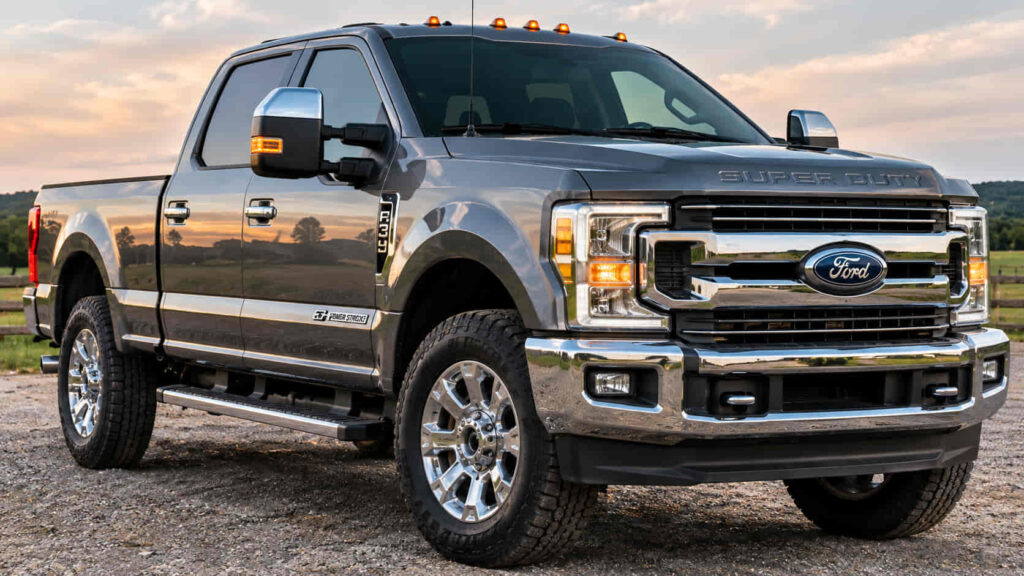
The best years for 6.7 Powerstroke engines are generally 2018, 2019, 2016, 2017, and 2015 for buyers prioritizing established performance, repairability, and used-truck value. The 2023 and 2024 model years are also attractive for drivers who want newer technology and greater towing capability, although their long-term reliability history is less extensive.
Among used Ford Super Duty trucks, the 2019 6.7L Power Stroke is one of the strongest overall choices. It represents the final year of the second-generation engine before Ford introduced major powertrain changes for 2020. The 2019 engine produces 450 horsepower and 935 lb-ft of torque, paired with the established TorqShift 6-speed automatic transmission.
The 2018 model offers almost the same advantages, making it another excellent option for buyers who want strong diesel performance without the higher purchase price of a newer truck.
For buyers with a smaller budget, the 2015 and 2016 models deserve consideration. Ford introduced a substantially revised turbocharger and additional engine improvements for 2015, addressing some concerns associated with the first-generation 2011–2014 engines.
However, no independent, exposure-adjusted reliability study establishes one universally superior 6.7 Power Stroke model year. The rankings in this guide reflect documented engineering changes, powertrain configurations, repair considerations, and practical used-truck buying priorities rather than a manufacturer-certified failure-rate comparison.
Another important factor is Ford’s high-pressure fuel pump recall. In December 2024, Ford announced safety recall 24S78, covering certain 2020–2022 Super Duty and 2021–2022 medium-duty trucks. A revised NHTSA filing submitted in January 2026 identifies approximately 295,449 potentially affected vehicles.
This means that newer 6.7L engines are not automatically free of fuel injection concerns.
The best truck ultimately depends on the exact vehicle, maintenance records, recall status, mechanical condition, and intended workload.
What Are the Best Years for 6.7 Powerstroke?
The strongest used-market choices are the 2015–2019 Ford 6.7L Power Stroke trucks, particularly the 2018 and 2019 models, because they combine the revised second-generation engine with established six-speed transmission hardware.
Ford introduced the 6.7L Power Stroke for the 2011 model year.
Unlike the earlier 7.3L and 6.0L Power Stroke engines, the 6.7L was developed by Ford rather than sourced through its historical International/Navistar engine relationship.
The engine uses a turbocharged V8 configuration with a compacted graphite iron block, aluminum cylinder heads, and high-pressure common-rail diesel injection.
Its design has evolved through several generations.
The original 2011–2014 engines established the architecture but were associated with problems involving early turbocharger hardware and certain other components.
Ford introduced significant changes for 2015.
The second-generation engines received a redesigned turbocharger, updated fuel system components, and additional refinements.
The 2017 model year introduced a substantially redesigned Super Duty truck platform while retaining the six-speed automatic transmission.
For 2018 and 2019, Ford increased factory output to 450 horsepower and 935 lb-ft.
The 2020 model year brought another major transition.
Ford introduced the third-generation 6.7L engine and the 10-speed TorqShift automatic transmission for Super Duty pickups.
The 2023 redesign added an available High Output engine producing 500 horsepower and 1,200 lb-ft.
Each generation offers advantages, but the ideal choice depends on whether the buyer values established service history, maximum performance, or newer vehicle features.
1. 2019 Ford 6.7 Powerstroke — Best Overall Used Model Year
The 2019 Ford 6.7 Powerstroke is one of the best overall choices for buyers seeking a powerful, established diesel powertrain without moving into the substantially revised 2020 generation.
The 2019 model represents the final year of the second-generation 6.7L Power Stroke.
Ford rated the pickup engine at 450 horsepower and 935 lb-ft of torque.
This provides considerably more output than the original 2011 engine.
The 2019 Super Duty uses the TorqShift 6-speed automatic transmission with the 6.7L diesel.
This transmission had already accumulated several years of production use.
For buyers who prefer an established transmission design, this can be an advantage.
The engine also benefits from Ford’s 2015 turbocharger redesign and later refinements.
The 2017 redesign of the Super Duty introduced a stronger modern truck platform, updated chassis engineering, and extensive towing-related improvements.
By 2019, buyers received this newer truck architecture without having to purchase the first model year of the 10-speed diesel powertrain.
However, this does not mean the 2019 engine is mechanically perfect.
The high-pressure common-rail fuel system still requires careful maintenance.
Fuel contamination can create expensive problems.
The exhaust gas recirculation system, diesel particulate filter, and selective catalytic reduction equipment also require attention.
A 2019 truck that has experienced poor maintenance or aggressive tuning may be a worse purchase than a properly maintained 2020 or 2021 model.
Nevertheless, the 2019 model provides an attractive balance of factory power, powertrain maturity, and used-truck availability.
2. 2018 Ford 6.7 Powerstroke — Best for Reliability and Value
The 2018 Ford 6.7 Powerstroke is another highly attractive used-truck choice because it combines the second-generation engine with 450 horsepower, 935 lb-ft of torque, and the six-speed TorqShift transmission.
Ford increased the engine’s factory output for 2018.
The revised rating provided additional horsepower and torque compared with the 2017 configuration.
However, the engine retained the established architecture introduced with the 2015 improvements.
The larger single-sequential turbocharger was designed to improve airflow and engine response.
This is particularly useful when towing heavy loads or driving through mountainous terrain.
The 2018 Super Duty also belongs to the redesigned truck generation introduced for 2017.
Its aluminum-alloy body panels and high-strength steel frame differ significantly from those of the earlier 2011–2016 trucks.
These changes affect vehicle weight, construction, and repair considerations.
However, the engine’s long-term durability still depends on maintenance.
The 2018 6.7L uses a high-pressure fuel injection system that requires clean diesel fuel.
The turbocharger depends on proper lubrication.
The cooling and emissions systems must also function correctly.
Some owners may prefer the 2018 model because it can cost less than a comparable 2019 truck while offering nearly identical factory performance.
However, the used market does not always follow predictable pricing.
Mileage, condition, trim level, modifications, and local demand can change the value comparison.
For buyers choosing between similar 2018 and 2019 trucks, service history should matter more than the single-year difference.
3. 2016 Ford 6.7 Powerstroke — Best for an Established Pre-2017 Platform
The 2016 Ford 6.7 Powerstroke is an appealing option for buyers who want the revised turbocharger and engine improvements introduced in 2015 while retaining the earlier Super Duty body and chassis generation.
The engine produces 440 horsepower and 860 lb-ft of torque in the relevant pickup configurations.
It uses the six-speed TorqShift automatic transmission.
The most important advantage over the 2011–2014 engines is the revised turbocharger system.
Ford replaced the original turbocharger arrangement with an updated, larger turbocharger for 2015.
Additional changes involved fuel delivery, cooling arrangements, and supporting components.
The 2016 engine carries forward these improvements.
For buyers who prefer the traditional steel-body Super Duty generation, this can be an attractive combination.
The truck also predates the major body and chassis redesign introduced for 2017.
However, an older platform should not automatically be considered more reliable.
A 2016 truck is now approximately ten years old.
Its cooling hoses, suspension components, seals, electrical systems, and drivetrain components may have accumulated substantial wear.
Fuel injection system condition is also important.
The engine still uses a Bosch common-rail high-pressure fuel pump.
A contaminated or damaged fuel system can require expensive repairs.
A properly maintained 2016 Super Duty can be a strong purchase.
However, buyers should avoid assuming that the revised turbocharger eliminates every significant Power Stroke problem.
4. 2017 Ford 6.7 Powerstroke — Best for the Redesigned Super Duty Platform
The 2017 Ford 6.7 Powerstroke offers an important combination of the revised second-generation diesel engine and the redesigned Super Duty truck platform.
Ford introduced major vehicle changes for the 2017 model year.
The Super Duty received a high-strength steel frame and aluminum-alloy body construction.
The truck also introduced updated driver assistance, towing, and interior technologies.
These changes helped modernize the vehicle while retaining the established 6.7L diesel engine family.
For 2017, Ford rated the pickup engine at 440 horsepower and 925 lb-ft of torque.
This represented a substantial torque increase compared with the 2015–2016 versions.
The engine continued using a six-speed TorqShift automatic transmission.
This is an important detail because the 10-speed diesel transmission was not introduced in the Super Duty pickup until 2020.
The 2017 model is therefore attractive for buyers who want newer truck construction without the later transmission change.
However, 2017 was the first model year of a redesigned vehicle generation.
Some buyers prefer the following years because the platform had additional production time.
This does not establish that every 2017 truck is less reliable.
The vehicle should be evaluated according to its actual mechanical condition.
Fuel injection, turbocharger, cooling, and emissions system inspections remain important.
A well-maintained 2017 can provide better ownership value than a neglected 2018 or 2019 truck.
5. 2015 Ford 6.7 Powerstroke — Best Budget-Friendly Revised Engine
The 2015 Ford 6.7 Powerstroke is one of the most important model years in the engine’s development history because Ford introduced major hardware improvements over the original 2011–2014 version.
The revised engine produces 440 horsepower and 860 lb-ft of torque in the relevant Super Duty pickup applications.
Ford updated the turbocharger arrangement.
The newer design replaced the earlier GT32-based system with a larger GT37-family turbocharger.
This addressed some of the concerns associated with the original engine’s turbocharger hardware.
Ford also revised aspects of the fuel injection system.
Additional improvements involved cooling arrangements and supporting components.
The 2015 model therefore represents a meaningful technical change rather than a simple software power increase.
For used buyers, it can offer a more affordable entry into the improved 6.7L engine generation.
However, price should be balanced against mileage and condition.
A 2015 truck may have accumulated many years of towing or commercial work.
The high-pressure fuel system should be inspected carefully.
Maintenance records are particularly important.
Oil changes, fuel filter service, coolant maintenance, and previous repairs can influence the engine’s remaining life.
The 2015 model also retains the earlier Super Duty truck body design.
For buyers who prefer that platform, this may be an advantage.
However, a 2015 truck with extensive corrosion or drivetrain wear may not offer better value than a newer model.
6. 2024 Ford 6.7 Powerstroke — Best for Modern Performance and Technology
The 2024 Ford 6.7 Powerstroke is an attractive modern choice because it offers both standard-output and High Output engine configurations, strong towing capability, and newer vehicle technology.
The standard engine produces 475 horsepower and 1,050 lb-ft of torque.
The High Output version produces 500 horsepower and 1,200 lb-ft.
Ford’s 2024 towing documentation confirms these figures for the applicable pickup configurations.
Both engines are paired with a modern 10-speed automatic transmission.
The High Output version includes additional engine hardware designed to support its greater factory output.
Ford identifies a turbocharger with a cooled compressor and stainless-steel exhaust manifolds among the relevant components.
The newer Super Duty platform also offers extensive towing technology.
Depending on configuration, buyers may find trailer assistance systems, advanced cameras, integrated electronic controls, and other driver aids.
These features can be valuable for commercial use or frequent towing.
However, the 2024 model has a much shorter long-term service record than the 2018 or 2019 versions.
Its greater power output does not automatically establish better reliability.
Modern diesel fuel injection and exhaust aftertreatment systems also remain complex.
Repair costs can be substantial when specialized components fail.
The 2024 model therefore ranks highly for technology and capability rather than proven low failure rates.
Buyers seeking maximum modern performance may prefer it.
Those prioritizing an established used-engine history may find the 2018–2019 trucks more appealing.
7. 2023 Ford 6.7 Powerstroke — Best for the High Output Engine Introduction
The 2023 Ford 6.7 Powerstroke is an important model year because Ford introduced the available High Output configuration producing 500 horsepower and 1,200 lb-ft of torque.
The 2023 engine received significant development changes.
Ford’s technical training material identifies a strengthened cylinder block, updated cylinder heads, revised connecting rods, and other improvements.
The High Output version also features a redesigned electronically controlled variable geometry turbocharger.
The engine uses high-pressure common-rail injection.
Ford’s training material specifies a fuel injection system operating at pressures up to approximately 2,500 bar, equivalent to 36,000 psi.
The system can deliver multiple injection events during the combustion cycle.
These technologies support improved combustion control and engine output.
The 2023 Super Duty also received a new vehicle-generation redesign.
Updated towing technology, electrical systems, and interior features distinguish it from previous years.
However, 2023 was an introduction year for several major changes.
This does not mean the truck is inherently unreliable.
It does mean that buyers should be careful about drawing long-term durability conclusions from relatively limited service history.
A 2023 truck with complete maintenance records and no unresolved faults may be a strong purchase.
However, it should not be ranked above older engines solely because it delivers more horsepower.
For buyers who prioritize newer engineering and high factory torque, the 2023 model offers considerable appeal.
Why Are 2015–2019 Considered the Best Used 6.7 Powerstroke Years?
The 2015–2019 6.7L Power Stroke engines are attractive because they combine significant improvements over the first generation with several years of production before the larger 2020 powertrain redesign.
Ford’s 2015 changes addressed important aspects of the original engine.
The turbocharger was substantially revised.
Fuel system and cooling-related components also received updates.
The engine’s factory power increased.
For 2017, Ford introduced a redesigned Super Duty truck platform.
The diesel powertrain retained its six-speed automatic transmission while gaining additional torque.
The 2018 and 2019 engines delivered 450 horsepower and 935 lb-ft.
These figures remain strong for towing and work applications.
However, the real advantage is not simply horsepower.
The 2015–2019 engines occupy a period when Ford had already developed the 6.7L architecture through several years of production.
Buyers can also find extensive repair information and aftermarket service support.
Nevertheless, no public data establishes that these years have the lowest failure rates after controlling for mileage, operating conditions, and maintenance.
A 2019 truck used for intensive commercial towing may be heavily worn.
A 2020 truck used mostly for moderate highway driving may be in better condition.
The best buying strategy combines model-year preference with a vehicle-specific inspection.
Which 6.7 Powerstroke Years Should You Avoid?
The 2011–2014 6.7 Powerstroke engines deserve more careful inspection because of early turbocharger concerns, while certain 2020–2022 trucks require particular attention to the high-pressure fuel pump recall.
However, these years should not automatically be rejected.
The original 2011 engine introduced a new diesel architecture.
Its early turbocharger design became associated with reliability complaints.
Certain early engines also experienced other mechanical and supporting-system issues.
Ford revised several components during the following years.
The most significant turbocharger change arrived for 2015.
For this reason, buyers seeking lower mechanical risk may prefer the later second-generation engines.
However, some early trucks have already received replacement turbochargers or other repairs.
A properly repaired 2013 or 2014 truck may still be worthwhile.
The 2020–2022 generation requires a different evaluation.
These trucks received a stronger engine architecture and a 10-speed automatic transmission.
However, certain vehicles are included in Ford recall 24S78 concerning the high-pressure fuel pump.
Recall eligibility depends on the exact vehicle, engine configuration, and production information.
Therefore, it is inaccurate to claim that every 2020–2022 truck has a defective fuel pump.
The best approach is to investigate known concerns and verify repairs before purchase.
Read more: Who Makes Predator Engines
Why Are 2011–2014 6.7 Powerstroke Engines More Controversial?
The first-generation 2011–2014 6.7 Power Stroke engines are more controversial because they introduced new turbocharging and supporting-system hardware that Ford subsequently revised.
The engine originally used a compact turbocharger system designed to provide responsive performance.
However, the early turbocharger arrangement developed a reputation for failures in certain applications.
Turbocharger problems can cause reduced boost pressure, excessive noise, or poor engine performance.
A severe failure may require replacement of the turbocharger and inspection of related components.
The first-generation engines also use a high-pressure diesel injection system.
Fuel contamination can damage its precision components.
Some owners have also reported issues involving exhaust sensors, cooling components, and other supporting systems.
However, the presence of complaints does not establish that all engines from 2011–2014 are defective.
Ford made changes during production.
Replacement parts and previous repairs can also alter a truck’s current condition.
An early truck equipped with an updated turbocharger and documented maintenance may be mechanically sound.
Conversely, a later model can still develop major problems through poor maintenance or heavy use.
For buyers considering the first generation, a detailed pre-purchase inspection is especially important.
The engine’s current condition should outweigh assumptions based solely on the production year.
What Changed in the 2015 6.7 Powerstroke?
Ford introduced one of the most important 6.7L Power Stroke updates for 2015, including a revised turbocharger, fuel injection improvements, and changes to supporting engine components.
The original turbocharger arrangement was replaced by a larger unit.
This helped support higher engine output.
Factory power increased to 440 horsepower.
Torque rose to 860 lb-ft.
The new turbocharger design also represented an important reliability-related development because the earlier arrangement had generated complaints.
Other changes involved the fuel injection equipment and cooling system.
Ford revised certain fuel pressure sensing components and EGR cooling arrangements.
These modifications were part of the ongoing development of the 6.7L engine family.
However, the 2015 engine still uses a modern common-rail fuel injection system.
Its precision components require clean diesel fuel.
The engine also retains exhaust emissions equipment.
Therefore, the 2015 changes should not be interpreted as eliminating every possible failure.
They establish a useful technical boundary for buyers comparing early and later engines.
A 2015 or 2016 truck can be attractive when the vehicle’s history confirms appropriate maintenance.
The most important benefit is that buyers receive the revised hardware without having to purchase a substantially newer truck.
What Changed in the 2017 6.7 Powerstroke?
The 2017 model year combined additional diesel torque with a redesigned Ford Super Duty truck platform.
The 6.7L Power Stroke’s factory output remained approximately 440 horsepower.
However, peak torque increased to 925 lb-ft.
This additional torque improved the engine’s capability under demanding loads.
The vehicle itself also underwent substantial changes.
Ford introduced a high-strength steel frame and aluminum-alloy body construction for the Super Duty.
The redesign included changes to suspension, towing equipment, and vehicle electronics.
However, the engine remained a member of the second-generation 6.7L family.
The diesel pickup continued to use the six-speed TorqShift automatic transmission.
This is often misunderstood in online comparisons.
The Ford 10-speed diesel transmission belongs to the later 2020 generation.
For buyers, the 2017 model represents an intermediate option.
It provides newer vehicle construction and stronger torque than the 2015–2016 trucks.
However, it predates the 2020 engine and transmission redesign.
The correct evaluation should include the transmission’s condition, maintenance history, and evidence of prior towing or commercial use.
A higher factory torque rating does not automatically mean lower maintenance costs.
What Changed in the 2018 and 2019 6.7 Powerstroke?
The 2018 and 2019 Ford 6.7 Powerstroke engines received factory ratings of 450 horsepower and 935 lb-ft of torque, making them the highest-output versions of the second-generation pickup engine.
The increase improved the available power compared with the 2017 model.
However, the basic engine architecture remained related to the revised design introduced in 2015.
The trucks retained the six-speed TorqShift transmission.
They also used the redesigned Super Duty vehicle platform introduced for 2017.
This combination appeals to buyers looking for substantial torque without the 2020 powertrain changes.
Ford’s 2019 product guide confirms the six-speed transmission and the engine’s published output.
However, performance alone does not establish reliability.
The engine still depends on a high-pressure fuel injection system.
The turbocharger, cooling system, and exhaust aftertreatment components require proper maintenance.
A truck used for repeated maximum-load towing may experience different wear from one used primarily for highway transportation.
The best 2018 or 2019 example is therefore one with complete service records and a sound mechanical condition.
These two model years are close enough in engineering that the individual truck should usually determine the final choice.
A well-maintained 2018 may be preferable to a poorly maintained 2019.
Is the 2020 Ford 6.7 Powerstroke a Good Year?
The 2020 Ford 6.7 Powerstroke is an important technological upgrade, but buyers should verify high-pressure fuel pump recall status and evaluate the 10-speed transmission before purchase.
Ford introduced the third-generation 6.7L diesel for 2020.
The engine’s factory output increased to 475 horsepower and 1,050 lb-ft.
Important internal changes supported the increased performance.
Ford revised the cylinder block, cylinder heads, pistons, connecting rods, and other components.
The engine also received updated fuel injection equipment.
Another major change was the introduction of the 10-speed TorqShift automatic transmission in Super Duty pickups.
This provides more gear ratios than the earlier six-speed.
However, the transition also makes 2020 a first-year powertrain combination.
The transmission’s operation and service history deserve attention.
More importantly, the 2020 model year falls within the population identified by Ford’s high-pressure fuel pump recall.
The relevant affected vehicles were built within a specific production period.
Recall eligibility must therefore be checked using the VIN.
The updated NHTSA report identifies 2020–2022 vehicles but does not establish that every truck in those model years contains the affected pump.
A 2020 Super Duty can be an excellent work truck.
However, it should not be recommended simply because it is newer or more powerful than a 2019 model.
Are 2021 and 2022 6.7 Powerstroke Engines Reliable?
The 2021 and 2022 6.7 Powerstroke engines benefit from the third-generation architecture introduced in 2020, but certain vehicles remain relevant to the 24S78 high-pressure fuel pump recall.
These trucks deliver substantial factory torque.
The pickup engine produces 475 horsepower and 1,050 lb-ft.
The 10-speed automatic transmission is also part of the modern powertrain configuration.
However, the fuel system requires careful attention.
Ford’s recall documentation identifies certain vehicles equipped with the Bosch CP4 RP7 high-pressure fuel pump.
The concern involves deposits associated with aged biodiesel.
These deposits can interfere with internal pump components.
A pump failure may cause rough running, reduced power, or a loss of propulsion.
The recall documents describe a powertrain control module software remedy.
However, the software update should not be interpreted as a guarantee that every possible high-pressure fuel pump failure is eliminated.
A vehicle with actual fuel system damage still requires appropriate diagnosis and repair.
The production date is important because not every truck built during 2021 or 2022 is part of the affected population.
A properly maintained truck with completed applicable recall work may remain an attractive purchase.
Buyers should request service documentation and verify the VIN through Ford.
What Is Ford Recall 24S78 for the 6.7 Powerstroke?
Ford recall 24S78, identified by NHTSA as 24V957, addresses a high-pressure fuel pump concern affecting certain 2020–2022 Super Duty and 2021–2022 medium-duty trucks equipped with the 6.7L diesel.
Ford submitted the original recall decision in December 2024.
The manufacturer’s revised NHTSA filing dated January 23, 2026 identifies approximately 295,449 potentially involved vehicles.
The recall applies to a defined production population.
For the relevant Super Duty vehicles, the report identifies production dates from February 19, 2019 through August 23, 2021.
The manufacturer describes deposits forming on certain internal high-pressure fuel pump components.
The condition can cause pump failure.
A failed pump may result in loss of engine power, increasing crash risk.
Ford’s published remedy involves updating the powertrain control module software according to the recall procedure.
However, a model year alone does not determine eligibility.
The VIN must be checked.
A 2022 truck built outside the relevant production range may not be part of the recall.
Likewise, a 2020 truck within the affected range may require documented recall completion.
In March 2026, Transport Canada also published a separate follow-up recall for certain vehicles whose previous 24S78 repairs were not completed correctly.
This reinforces the importance of checking official recall status rather than relying solely on a seller’s statement that the truck was previously serviced.
Did Ford Replace the CP4 Fuel Pump in 2020?
No. It is inaccurate to claim that Ford completely eliminated the Bosch CP4 high-pressure fuel pump from every 6.7L Power Stroke when the 2020 generation was introduced.
Ford’s own recall chronology identifies a Bosch CP4 RP7 pump used during 2020 model-year Super Duty production.
The RP7 configuration also appeared in specified later medium-duty applications.
The recall documentation states that Ford introduced the RP8 variant into production on August 23, 2021.
The updated design incorporated changes to internal clearances intended to improve fuel flow and cooling.
However, this history does not establish that every earlier CP4 pump will fail.
It also does not establish that every later pump is immune to all potential problems.
The important point is that 2020 was not a universal transition away from the CP4 pump family.
Some online buyers’ guides incorrectly describe the entire 2020-and-newer generation as having completely eliminated the CP4.
Ford’s NHTSA documents contradict that simplified claim.
Buyers should identify the specific vehicle and any applicable recall campaigns.
The fuel system’s current condition and maintenance history are more important than assuming that one production year guarantees a particular pump configuration.
Are 2023–2026 Powerstroke Engines Better Than Older Models?
The 2023–2026 Power Stroke engines offer greater technology and available towing performance, but their relative long-term reliability cannot yet be measured as confidently as that of older generations.
The 2023 Super Duty introduced the available High Output 6.7L engine.
Its factory rating reaches 500 horsepower and 1,200 lb-ft of torque.
The standard 6.7L version produces 475 horsepower and 1,050 lb-ft.
Ford continued offering these engine configurations for 2024, 2025, and 2026.
The newer trucks also feature updated towing assistance, electronic systems, and driver conveniences.
However, greater power and newer technology are not the same as lower failure risk.
The engines have accumulated fewer years of real-world service.
Some high-mileage commercial trucks can provide useful evidence, but a complete long-term comparison requires more time and operating data.
The 2025 and 2026 models are especially difficult to rank for long-term reliability because they are still relatively new.
For a buyer who wants the latest features and factory warranty coverage, a newer truck may be the better purchase.
For someone seeking a well-established second-generation powertrain, 2018 or 2019 remains an attractive alternative.
The appropriate choice depends on budget, towing needs, and tolerance for repair costs.
Which 6.7 Powerstroke Year Is Best for Towing?
The 2023–2026 High Output 6.7L Power Stroke is the strongest choice for maximum modern Ford diesel towing performance, while 2018–2019 trucks remain capable options for buyers seeking established used powertrains.
Ford’s 2026 High Output engine produces 500 horsepower and 1,200 lb-ft of torque.
The standard 6.7L produces 475 horsepower and 1,050 lb-ft.
These figures exceed the factory output of earlier generations.
Ford’s 2026 towing guide identifies a maximum available trailer towing rating of 40,000 pounds for a properly equipped High Output Super Duty configuration.
However, this rating does not apply to every truck.
Maximum towing capability depends on the vehicle’s exact axle ratio, gross combined weight rating, body configuration, hitch equipment, and other factors.
A buyer should never assume that a truck can tow 40,000 pounds simply because it has the High Output engine.
Earlier models also provide substantial towing capability.
The 2018 and 2019 engines deliver 935 lb-ft of torque.
This is more than enough for many recreational and commercial applications when paired with an appropriately rated truck.
The best towing choice therefore depends on the trailer’s actual weight and the required vehicle ratings.
Buying a much newer truck may not be necessary when an older Super Duty already meets the workload safely.
Which 6.7 Powerstroke Years Have the Best Transmission?
The 2015–2019 trucks use Ford’s six-speed TorqShift transmission, while the 2020-and-newer Super Duty pickups use the 10-speed TorqShift automatic.
The six-speed transmission is commonly associated with the 6R140 family.
It has an extensive service history in Super Duty applications.
The combination is attractive for buyers who prefer an established drivetrain.
For 2020, Ford introduced a heavy-duty 10-speed automatic transmission.
The additional gear ratios allow the powertrain to select more closely spaced operating ratios.
This can improve how the engine’s torque is used under changing driving conditions.
However, more ratios do not automatically establish better reliability.
Transmission performance depends on design, manufacturing, calibration, maintenance, and operating conditions.
A poorly maintained six-speed can fail.
A correctly serviced ten-speed can provide dependable operation.
During a used-truck inspection, the transmission should be evaluated under normal driving and towing-related conditions.
Abnormal slipping, delayed engagement, harsh shifts, or fluid leakage deserve attention.
The transmission’s service records should also be reviewed.
For buyers who specifically want the six-speed diesel combination, 2019 is the final model year to consider in the pickup lineup.
For those prioritizing the newer engine and ten-speed arrangement, 2020 or later is the relevant starting point.
Which 6.7 Powerstroke Is Best for High Mileage?
A well-maintained 2015–2019 6.7 Powerstroke is an attractive high-mileage used-truck candidate, but actual mechanical condition matters more than its model year.
The 6.7L engine was designed for demanding truck applications.
Its compacted graphite iron block and heavy-duty components support substantial operating loads.
However, no single mileage figure guarantees that an individual engine remains healthy.
Some trucks accumulate miles through long-distance highway operation.
Others spend significant time idling or towing heavy equipment.
Engine hours provide useful information alongside odometer mileage.
A vehicle with relatively few miles may still have experienced extensive stationary operation.
Maintenance history is equally important.
The engine oil must meet Ford’s specifications.
Fuel filtration must also be performed at the appropriate intervals.
Water contamination in diesel fuel can create severe damage.
A high-mileage truck should be evaluated for oil consumption, turbocharger performance, cooling system condition, and fuel system faults.
The transmission should also be inspected.
A 2019 truck with complete records and verified mechanical condition may be preferable to a lower-mileage truck with no documented maintenance.
The best high-mileage engine is the one that has been properly serviced and remains mechanically sound.
What Are the Most Common 6.7 Powerstroke Problems?
Common 6.7 Powerstroke concerns include fuel injection faults, turbocharger problems, oil or coolant leaks, and diesel exhaust aftertreatment issues.
However, the prevalence and causes differ across engine generations.
The early 2011–2014 engines have a history of complaints involving the original turbocharger design.
Later engines received revised turbocharging hardware.
The fuel injection system is another important concern.
Modern common-rail diesel systems operate at extremely high pressure.
Fuel contamination or internal pump damage can be expensive.
The 2020–2022 recall population also requires VIN-based verification.
Exhaust aftertreatment components introduce additional service requirements.
The diesel particulate filter captures soot.
The selective catalytic reduction system uses diesel exhaust fluid to control nitrogen oxide emissions.
Sensors, heaters, and other components can create warning messages when faults occur.
A coolant leak may involve hoses, connections, or other cooling system components.
An oil leak may originate from seals or gaskets.
However, a visible leak does not automatically mean internal engine damage.
The correct diagnosis should identify the failed component before repair.
General online discussions about Power Stroke problems are useful starting points but should not replace model-specific service information.
What Should You Check Before Buying a Used 6.7 Powerstroke?
A used 6.7 Powerstroke should undergo a detailed inspection of its fuel system, turbocharger, cooling system, transmission, exhaust aftertreatment equipment, and maintenance records.
The vehicle identification number should be checked first.
This confirms the model year and helps identify applicable recall campaigns.
The seller should provide maintenance documentation when available.
Fuel filter replacement history is especially important.
Clean fuel protects the high-pressure injection equipment.
The truck should be inspected for external oil and coolant leaks.
A cold-start evaluation can reveal problems that disappear after the engine reaches operating temperature.
Abnormal knocking, excessive smoke, or unusually long cranking require further diagnosis.
The engine should also be scanned for diagnostic trouble codes.
However, the absence of an illuminated check engine light does not guarantee that the powertrain is healthy.
The transmission should shift normally.
The turbocharger should respond appropriately under load.
The exhaust aftertreatment system should not display unresolved warning messages.
Any aftermarket tuning or emissions modifications should be documented and evaluated for legal and mechanical implications.
The frame, suspension, brakes, axles, and towing equipment should also be inspected.
A mechanically sound engine installed in a severely worn truck can still be a poor purchase.
A professional pre-purchase inspection is especially valuable because diesel repairs can be expensive.
How Much Should You Pay for a Used 6.7 Powerstroke?
A used 6.7 Powerstroke’s value depends on model year, mileage, trim level, body condition, drivetrain configuration, service history, and local market conditions.
A 2019 Super Duty may be more expensive than a 2015 truck with similar mileage.
However, the difference is not determined by engine design alone.
The newer truck may offer updated towing equipment, interior technology, or other options.
A truck with extensive commercial use may sell for less than one with a lighter operating history.
However, a lower purchase price can be misleading.
An engine requiring a high-pressure fuel system repair may create substantial additional expense.
Transmission repairs can also be costly.
Cooling and emissions system problems may require specialized components.
A buyer should therefore compare the total ownership investment rather than the advertised price.
Maintenance records can improve confidence.
A truck that has received timely service and documented repairs may justify a higher price.
However, records should be verified where possible.
The vehicle’s recall status is also important.
An open safety recall should be addressed according to Ford’s official procedure.
The best deal is not necessarily the cheapest truck.
It is the truck whose condition, capabilities, and expected service costs provide the strongest overall value.
How Long Does a 6.7 Powerstroke Last?
A properly maintained 6.7 Powerstroke can provide substantial service life, but Ford does not guarantee that every engine will reach a specific mileage without major repairs.
Engine longevity depends on several factors.
Oil maintenance is important because bearings, turbocharger components, and other moving parts rely on proper lubrication.
Fuel filtration is equally critical.
High-pressure diesel injection equipment has tight internal tolerances.
Water and debris can cause expensive damage.
Cooling system condition also affects durability.
Repeated overheating can damage major engine components.
Driving conditions matter.
A truck used primarily for highway travel may experience different demands from one that tows near its rated limits every day.
Extended idling also contributes to engine hours without increasing odometer mileage significantly.
Some owners report operating 6.7L engines for several hundred thousand miles.
However, individual examples should not be treated as a universal average.
The most useful longevity assessment considers compression, oil consumption, oil pressure, fuel system condition, engine hours, and documented maintenance.
A vehicle with 200,000 miles and complete service records can be a better purchase than one with half the mileage but severe neglect.
How Often Should You Change Oil in a 6.7 Powerstroke?
Ford’s oil change guidance depends on engine generation, operating conditions, and the Intelligent Oil-Life Monitor rather than one fixed interval for every 6.7 Powerstroke.
Ford’s 2017 Super Duty owner’s manual provides useful examples.
Under normal driving conditions, the oil change reminder may appear at approximately 7,500–10,000 miles.
For more demanding operation, the interval may decrease to approximately 5,000–7,499 miles.
Under extreme operating conditions, it may fall to approximately 3,000–4,999 miles.
However, these are examples from the 2017 documentation.
They should not automatically be applied to every later model year.
The actual owner’s manual should determine the requirements.
Heavy towing, frequent idling, extreme temperatures, and dusty environments can influence maintenance timing.
Ford also specifies appropriate diesel engine oil classifications.
Using incorrect oil can affect engine lubrication and exhaust aftertreatment compatibility.
Fuel filters have their own replacement intervals.
The engine-mounted and frame-mounted fuel filters must be serviced according to the relevant schedule.
The fuel and water separator should also be maintained.
Correct oil and fuel maintenance are especially important for engines expected to provide long-term service under heavy loads.
How Can You Make a 6.7 Powerstroke More Reliable?
The most effective ways to support 6.7 Powerstroke reliability are using clean diesel fuel, following Ford’s maintenance requirements, monitoring the cooling and exhaust systems, and addressing abnormal symptoms before they cause major damage.
Fuel quality is a primary consideration.
The high-pressure injection system is expensive and sensitive to contamination.
The correct fuel should be purchased from dependable suppliers.
Water separators and filters must be serviced according to the manufacturer’s instructions.
Engine oil should meet Ford’s specifications.
The oil-life monitor and applicable service schedule should be followed.
The cooling system should also be inspected for leakage and contamination.
Turbocharger performance can be affected by lubrication problems or abnormal exhaust conditions.
Unusual noises or reduced boost should therefore be investigated.
The emissions system requires proper care.
Exhaust filter warning messages should not be ignored.
Unauthorized removal of emissions equipment can violate road vehicle regulations and create additional technical problems.
Engine tuning also deserves attention.
Increasing power beyond factory specifications may place additional stress on the rotating assembly, fuel system, cooling components, and transmission.
A truck used for heavy towing should remain within its published ratings.
Finally, recall campaigns should be checked regularly.
A properly maintained and correctly serviced truck has a stronger foundation for long-term reliability than one selected solely because of a desirable production year.
Is a 2019 6.7 Powerstroke Better Than a 2020?
The 2019 6.7 Powerstroke is attractive for buyers who prefer the mature second-generation engine and six-speed transmission, while the 2020 provides greater factory power and a newer 10-speed powertrain.
The 2019 pickup engine produces 450 horsepower and 935 lb-ft.
The 2020 engine increases output to 475 horsepower and 1,050 lb-ft.
This is a meaningful performance difference.
The 2020 engine also introduced internal component upgrades and a revised fuel injection system.
The truck received Ford’s new 10-speed TorqShift transmission.
However, additional performance does not automatically make the newer engine more reliable.
The 2020 model represents the beginning of a revised powertrain generation.
Certain 2020 trucks are also included in the high-pressure fuel pump recall population.
The 2019 model avoids that specific 24S78 model-year population while retaining a known diesel transmission configuration.
However, its fuel system still requires proper maintenance and can experience other faults.
The comparison therefore depends on buyer priorities.
For an established used powertrain, the 2019 may be preferable.
For greater output and newer transmission technology, a properly maintained 2020 can be attractive.
The final choice should depend on actual condition, recall status, and maintenance history.
Should You Buy a 2025 or 2026 Ford 6.7 Powerstroke?
A 2025 or 2026 Ford 6.7 Powerstroke is a sensible option for buyers who prioritize newer vehicle features, factory warranty coverage, and modern towing performance, but these models do not yet have enough service history to establish superior long-term durability.
Ford continues offering standard and High Output versions of the engine.
For 2026, the standard 6.7L produces 475 horsepower and 1,050 lb-ft.
The High Output produces 500 horsepower and 1,200 lb-ft.
The trucks use a 10-speed automatic transmission.
They also offer advanced towing equipment and electronic driver assistance features.
However, newer technology increases the number of systems that may eventually require service.
The exact maintenance costs will depend on long-term component durability and the vehicle’s operating conditions.
A new truck offers benefits that an older used truck cannot.
It has not accumulated years of unknown towing or maintenance history.
The buyer may also receive the applicable new-vehicle warranty.
However, buying new does not eliminate manufacturing defects or service campaigns.
Owners should monitor official recall information and follow the manufacturer’s maintenance schedule.
For buyers who plan to keep the truck for many years, a new model can provide a controlled ownership history from the beginning.
For those focused on used-truck value, the 2018–2019 generation remains attractive.
Which Is the Best 6.7 Powerstroke Year for the Money?
The best value often comes from a well-maintained 2018 or 2019 Super Duty, although a 2015 or 2016 truck may provide better affordability when the buyer does not need the newer chassis and additional torque.
The 2018 and 2019 engines offer strong performance.
Their 450-horsepower and 935-lb-ft ratings are still useful for demanding work.
The six-speed transmission and second-generation engine provide a well-established configuration.
However, these trucks may command higher prices than earlier models.
A 2015 or 2016 can be an attractive alternative.
Both benefit from the redesigned turbocharger and related engine improvements.
Their lower factory torque may be acceptable for many applications.
The older body and chassis design may also appeal to buyers who prefer traditional Super Duty construction.
However, the truck’s age must be considered.
Suspension wear, transmission condition, frame corrosion, and previous modifications can affect total ownership cost.
A bargain purchase may become expensive if major repairs are required.
The best value is therefore determined by comparing the complete vehicle.
A documented maintenance history, clean diagnostic scan, sound fuel system, and healthy transmission are more important than saving a relatively small amount on a questionable truck.
What Is the Single Best Year for 6.7 Powerstroke?
The 2019 model year is a strong overall recommendation for a used 6.7 Powerstroke because it combines the highest factory output of the second-generation pickup engine with the established six-speed TorqShift powertrain.
However, this recommendation is based on engineering and ownership considerations rather than an official statistical failure-rate ranking.
The 2019 model offers 450 horsepower and 935 lb-ft.
It benefits from Ford’s 2015 engine revisions.
It also uses the redesigned Super Duty platform introduced in 2017.
For buyers who want to avoid the first model year of the 2020 engine and 10-speed transmission combination, 2019 provides a logical alternative.
The 2018 model is nearly identical in its basic powertrain specifications.
Therefore, the difference between an individual 2018 and 2019 truck may be small.
A well-maintained 2018 should not be rejected simply because a 2019 is ranked slightly higher.
Likewise, a 2016 truck with excellent service records may be a better purchase than a damaged or neglected 2019.
The most useful ranking should guide the search, not replace a mechanical inspection.
For modern maximum towing output, the 2023–2026 High Output engine is the stronger choice.
For affordable ownership of the improved earlier powertrain, the 2015–2016 models are worth considering.
Final Verdict: Best Years for 6.7 Powerstroke Engines
The best years for 6.7 Powerstroke engines are 2018–2019 for a balanced used-truck purchase, 2015–2016 for an affordable revised engine, and 2023–2026 for maximum modern performance.
The 2019 model is a particularly strong overall choice.
It combines 450 horsepower, 935 lb-ft of torque, and the six-speed TorqShift transmission.
The 2018 model offers nearly the same mechanical advantages.
For buyers who prefer the earlier Super Duty platform, the 2016 model is attractive because it benefits from the turbocharger and engine revisions introduced in 2015.
The 2017 version provides a redesigned truck platform and increased torque.
However, the 2011–2014 engines deserve more careful inspection because of their early turbocharger history and other first-generation concerns.
The 2020–2022 engines provide greater factory performance and the 10-speed transmission.
Nevertheless, certain vehicles are included in Ford’s high-pressure fuel pump recall 24S78/24V957.
The applicable VIN and repair status must be verified.
Newer 2023–2026 trucks provide significantly more technology.
The available High Output engine produces 500 horsepower and 1,200 lb-ft.
However, the long-term reliability of these newer configurations cannot yet be established as confidently as that of older generations.
For most used Ford Super Duty buyers, 2018 and 2019 are excellent starting points, with 2016 offering a compelling alternative for a smaller budget.
Ultimately, the best 6.7 Powerstroke is not determined by model year alone.
Engine oil and fuel filter maintenance, operating hours, towing history, previous modifications, recall completion, and the complete vehicle’s condition all influence reliability.
A properly maintained truck from a less desirable year may provide better service than a neglected example from a highly recommended year.
Choosing a sound vehicle with documented maintenance remains the most dependable strategy for long-term 6.7 Power Stroke ownership.