The correct 6.0 Powerstroke injector torque is 24 lb-ft (33 Nm) for early-build engines and 26 lb-ft (35 Nm) for late-build engines. Early-build configurations use T40 Torx injector hold-down bolts, while late-build configurations use T45 Torx bolts. Identifying the correct hardware is essential because the two configurations have different tightening specifications.
The injector hold-down bolt secures the fuel injector inside the cylinder head and maintains the clamping force required for proper seating. Incorrect torque can compromise the injector’s seal or damage the mounting hardware. Excessive tightening can damage bolt threads or the cylinder head, while insufficient tightening can allow injector movement and contribute to combustion gas leakage.
The Ford 6.0L Power Stroke diesel engine uses a hydraulically actuated, electronically controlled unit injector (HEUI) system. Each injector relies on proper mechanical installation, sealing components, and high-pressure engine oil to operate correctly. The injector hold-down bolt torque must therefore be distinguished from the torque specifications for the high-pressure oil rail and other components removed during injector replacement.
This guide explains the 24 vs. 26 lb-ft injector torque specifications, how to identify early- and late-build configurations, the correct injector tightening procedure, and common installation mistakes that can affect injector sealing and engine performance.
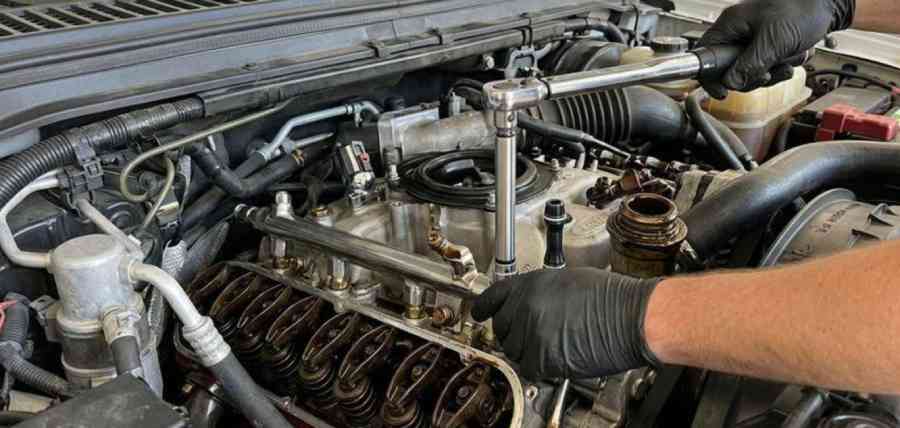
What Is the Correct Injector Torque for a 6.0 Powerstroke?
The correct 6.0 Powerstroke injector hold-down bolt torque is 24 lb-ft (33 Nm) for early-build engines and 26 lb-ft (35 Nm) for late-build engines. Ford specifies different torque values because the injector hold-down hardware changed during engine production. The correct specification depends on the installed bolt and clamp configuration, not simply the vehicle’s model year.
The following table compares the two injector hold-down configurations.
| Specification | Early-Build Engine | Late-Build Engine |
|---|---|---|
| Injector hold-down torque | 24 lb-ft | 26 lb-ft |
| Torque in Newton-meters | 33 Nm | 35 Nm |
| Torx bolt drive | T40 | T45 |
| Torque in inch-pounds | 288 lb-in | 312 lb-in |
| Hardware configuration | Early-style hold-down | Revised hold-down |
These torque values apply specifically to the injector hold-down bolts. They do not apply to the high-pressure oil rail, valve cover, or other fasteners involved in injector replacement.
What Is the Injector Torque for Early-Build 6.0 Powerstroke Engines?
The early-build 6.0 Powerstroke injector torque is 24 lb-ft (33 Nm) for the original T40 Torx hold-down bolt configuration. This bolt secures the injector clamp against the cylinder head, maintaining the mechanical force needed to hold the injector in its installed position.
Early-build engines use the original injector hold-down hardware, which differs from the revised configuration introduced during production. Applying the later 26 lb-ft specification to an early-style assembly exceeds its specified tightening torque by 2 lb-ft, or approximately 8.3%. Although this difference appears small, the correct torque is necessary to achieve the intended clamping force without unnecessarily stressing the fastener or cylinder head threads.
Before tightening an early-build injector, verify that the installed bolt and clamp match the original configuration. Engine repairs and previous injector replacements may have introduced different hardware, making the vehicle’s model year alone an insufficient identifier.
What Is the Injector Torque for Late-Build 6.0 Powerstroke Engines?
The late-build 6.0 Powerstroke injector torque is 26 lb-ft (35 Nm) for the revised T45 Torx hold-down bolt configuration. This specification applies to the corresponding late-style injector mounting hardware.
The revised configuration uses a larger Torx drive and a different hold-down design. The T45 drive must be engaged with the correct bit to prevent damage to the bolt head during tightening. Using a T40 bit on a T45 fastener can result in improper engagement and damage to the drive recess.
The difference between 24 and 26 lb-ft represents approximately an 8.3% increase in specified tightening torque. However, the higher value should not be interpreted as a universal upgrade for every 6.0 Powerstroke injector. It applies only when the installed hardware matches the configuration covered by that specification.
For both configurations, use a calibrated torque wrench and confirm the applicable Ford service procedure before installation. Proper injector seating, clean bolt holes, and compatible hold-down hardware are necessary for the specified torque to produce the intended clamping force.
Why Does the 6.0 Powerstroke Have Two Injector Torque Specifications?
The 6.0 Powerstroke has two injector torque specifications because Ford revised the injector hold-down bolt and clamp assembly during engine production. Early-build engines use a T40 Torx bolt tightened to 24 lb-ft (33 Nm), while late-build engines use a T45 Torx bolt tightened to 26 lb-ft (35 Nm). Each torque value corresponds to a specific injector mounting configuration.
The injector hold-down assembly secures the fuel injector inside the cylinder head. Its clamp transfers the tightening force from the bolt to the injector body, keeping the injector seated against its copper combustion sealing washer. The early configuration uses a square-end hold-down clamp, while the revised configuration uses a tapered-end design. These clamp styles are not interchangeable because their contact geometry and mounting characteristics differ.
The revised hold-down assembly also uses a larger T45 Torx drive instead of the original T40 drive. This change provides a different tool engagement interface, but the larger drive alone does not establish the correct tightening torque. The specified value must match the complete bolt and clamp assembly rather than the Torx size in isolation.
Ford introduced these hardware changes during the 6.0L Power Stroke production period, which means vehicles from different production dates can have different injector mounting configurations. Previous engine repairs, cylinder head replacements, or injector service may also affect which hardware is currently installed.
The correct torque must therefore be determined by the actual injector hold-down configuration and the applicable Ford service documentation. Applying 26 lb-ft to an early-style assembly or 24 lb-ft to a late-style assembly deviates from the manufacturer’s specified clamping requirements. Identifying the installed hardware before tightening helps prevent installation errors and ensures the injector is secured according to its intended design.
How Can You Identify the Correct Injector Torque for Your 6.0 Powerstroke?
To identify the correct 6.0 Powerstroke injector torque, inspect the injector hold-down bolt, verify the clamp configuration, and compare the installed hardware with the applicable Ford service specifications. Early-style assemblies require 24 lb-ft (33 Nm), while late-style assemblies require 26 lb-ft (35 Nm). The bolt drive and clamp design provide useful identification clues, but both must match the manufacturer’s documented configuration.
The first identification method is checking the injector hold-down bolt’s Torx drive. Early-style bolts use a T40 drive, while revised bolts use a T45 drive. A properly sized Torx bit should fit fully into the bolt head without excessive movement. Never force an oversized bit into the recess or use an undersized bit to turn the fastener, as improper engagement can damage the bolt head and complicate removal.
The second method is examining the injector hold-down clamp. Early configurations use a square-end clamp, while late configurations use a tapered-end clamp. These components have different contact geometries and must be matched with their corresponding mounting hardware. A replacement injector does not automatically determine which clamp configuration is required because the injector mounting arrangement depends on the engine’s installed hardware.
The third method is checking the vehicle’s production information. The Ford 6.0L Power Stroke was installed in Super Duty trucks across multiple model years, and injector mounting hardware changed during production. The vehicle identification number (VIN), production date, and engine service records can help locate the appropriate Ford workshop instructions. However, model year alone cannot reliably establish the correct torque when the engine or cylinder heads have previously been replaced.
For example, a truck originally equipped with early-style injector hardware may have undergone engine repairs involving replacement mounting components. Using the original model-year specification without inspecting the installed assembly could result in applying the wrong torque.
The most reliable approach is to match the bolt, clamp, and engine configuration to the appropriate Ford service procedure before tightening. Confirm that the components are compatible, inspect the bolt threads for damage, and ensure the mounting hole is clean and free of accumulated oil or debris. Contamination inside a blind bolt hole can interfere with proper tightening and may damage the cylinder head when the fastener is installed.
Once the hardware configuration has been verified, select the corresponding 24 or 26 lb-ft specification and use a calibrated torque wrench with the correct Torx socket. This prevents torque selection based solely on assumptions about the vehicle’s production year.
How Do You Torque 6.0 Powerstroke Injectors Correctly?
To torque 6.0 Powerstroke injectors correctly, prepare the injector bore, install the appropriate sealing components, position the injector and hold-down clamp, and tighten the bolt to the specification matching the installed hardware. Early-style T40 hold-down assemblies require 24 lb-ft (33 Nm), while late-style T45 assemblies require 26 lb-ft (35 Nm). The injector must be fully seated before the final tightening torque is applied.
Correct installation requires more than reaching the specified torque reading. The injector’s copper sealing washer must contact its seat properly, the hold-down clamp must engage the injector correctly, and the mounting bolt must turn freely without interference from damaged threads or contamination. A torque wrench measures resistance to rotation, which means an incorrect reading can occur when friction or debris prevents the bolt from producing the intended clamping force.
How Do You Prepare a 6.0 Powerstroke Injector for Installation?
Prepare a 6.0 Powerstroke injector by inspecting the injector bore, replacing the required sealing components, and confirming that the injector and hold-down hardware are clean and undamaged. Proper preparation prevents sealing problems that cannot be corrected simply by applying additional bolt torque.
Begin by following the Ford service procedure for removing the valve cover, high-pressure oil rail, and existing injector. Keep dirt and loose debris away from the exposed injector bore and oil passages. Inspect the injector seating surface for carbon deposits, damage, or remnants of the previous copper sealing washer. A washer left inside the bore can prevent the replacement injector from reaching its intended installed position.
Install the specified replacement O-rings and copper sealing washer according to the injector manufacturer’s instructions. Use only the approved lubricant on components that require lubrication. Incorrectly installed O-rings can become pinched or damaged during insertion, creating potential fuel or high-pressure oil sealing problems.
Inspect the injector hold-down bolt and clamp before reuse or replacement. Verify that the clamp matches the installed engine configuration and that the bolt threads are undamaged. The threaded mounting hole must be free of trapped oil, coolant, and debris. Fluid trapped inside a blind hole can create hydraulic pressure as the bolt is tightened, potentially damaging the cylinder head.
Position the injector squarely in its bore and seat it using the method specified in the applicable Ford workshop procedure. Do not use the hold-down bolt to force an improperly aligned injector into position.
How Do You Tighten the Injector Hold-Down Bolt Correctly?
Tighten the 6.0 Powerstroke injector hold-down bolt by positioning the correct clamp, engaging the bolt threads by hand, and applying the specified torque with a calibrated torque wrench. Use 24 lb-ft (33 Nm) for the verified early-style assembly or 26 lb-ft (35 Nm) for the verified late-style assembly.
Position the hold-down clamp against the injector according to the applicable service procedure. Confirm that its contact surfaces are correctly aligned and that the injector remains seated. Start the bolt by hand to reduce the risk of cross-threading the cylinder head. The bolt should engage smoothly without requiring excessive force.
Fit the appropriate T40 or T45 Torx socket securely into the bolt head. Select a torque wrench with a working range suitable for 24–26 lb-ft and use the manufacturer’s specified tightening conditions. Apply force smoothly until the wrench indicates the required torque. Do not continue tightening after reaching the specified value.
After tightening, inspect the injector and clamp for visible misalignment or improper seating. A completed torque reading does not prove that the injector is correctly installed if the clamp is misplaced, the sealing washer is obstructed, or the bolt has encountered abnormal resistance.
Reinstall the high-pressure oil rail and other removed components using their separate Ford torque specifications and assembly procedures. Before returning the engine to service, complete the required fuel and high-pressure oil system checks. These steps help identify installation-related sealing problems before they develop into starting or operating issues.
What Happens If a 6.0 Powerstroke Injector Is Over-Torqued?
Over-torquing a 6.0 Powerstroke injector hold-down bolt can damage the bolt, strip the cylinder head threads, or place excessive stress on the injector mounting assembly. The specified tightening torque is 24 lb-ft (33 Nm) for early-style hardware and 26 lb-ft (35 Nm) for late-style hardware. Exceeding these values increases the risk of fastener and mounting damage without providing a verified improvement in injector sealing.
The injector hold-down bolt converts tightening torque into clamping force that secures the injector against its seat. Excessive torque can stretch the bolt beyond its intended operating range or overload the threaded connection in the cylinder head. Because the cylinder head is made from aluminum, damaged internal threads are a particular concern when excessive force is applied to the steel mounting bolt.
Over-tightening can also place abnormal loads on the injector hold-down clamp. The clamp distributes force to the injector body, and excessive loading can damage mounting components or interfere with proper seating. However, an injector that develops a leak or misfire after installation does not automatically indicate excessive torque. Damaged O-rings, an incorrectly positioned copper washer, and high-pressure oil system faults can produce similar symptoms.
For example, tightening an early-style injector bolt to 30 lb-ft instead of the specified 24 lb-ft applies 25% more tightening torque than recommended. This does not translate directly into a 25% increase in clamping force because thread friction and contact conditions also influence the resulting bolt tension.
If an injector hold-down bolt has been over-torqued, inspect the fastener, cylinder head threads, clamp, and injector seating components before reassembly. Simply loosening the bolt and tightening it again to the correct specification does not repair stretched hardware or damaged threads. Replace damaged components and follow the applicable Ford service procedure to restore the injector mounting assembly.
What Happens If a 6.0 Powerstroke Injector Is Under-Torqued?
Under-torquing a 6.0 Powerstroke injector hold-down bolt can reduce injector clamping force, compromise combustion sealing, and allow unwanted injector movement inside the cylinder head. Early-style injector assemblies require 24 lb-ft (33 Nm), while late-style assemblies require 26 lb-ft (35 Nm). Tightening below the applicable specification may leave insufficient force to maintain proper injector seating during engine operation.
The injector hold-down clamp keeps the injector seated against its copper combustion sealing washer. During combustion, cylinder pressure creates forces that act on the injector assembly. The hold-down bolt and clamp must maintain sufficient clamping force to resist these loads and preserve the seal between the injector and cylinder head. Insufficient bolt tension can allow movement that interferes with the sealing surfaces.
Combustion gas leakage is a potential consequence of inadequate injector clamping. When the copper washer fails to maintain an effective seal, combustion gases can escape around the injector seat. Repeated leakage may contribute to carbon accumulation, sealing surface damage, and injector removal difficulties. However, these conditions can also result from a damaged washer, contaminated injector bore, or incorrect installation.
For example, tightening a late-style injector hold-down bolt to 20 lb-ft instead of the specified 26 lb-ft leaves the applied tightening torque approximately 23% below the required value. This difference does not directly establish the reduction in clamping force because thread friction and bolt condition also affect the relationship between torque and tension.
An improperly secured injector may contribute to abnormal engine operation, but symptoms such as rough idle, hard starting, or misfires are not specific evidence of under-torquing. These symptoms can also originate from fuel delivery problems, injector electrical faults, or high-pressure oil system leaks.
Correcting an under-torqued injector requires verifying the installed hardware, inspecting the injector seating and sealing components, and applying the proper Ford torque specification. Do not assume that additional tightening alone will repair a compromised copper washer or damaged injector seat. Replace defective sealing components and inspect the mounting assembly before returning the engine to service.
Should You Replace the Injector Hold-Down Bolt During Installation?
Replace a 6.0 Powerstroke injector hold-down bolt if it has damaged threads, a worn Torx drive, visible deformation, or other signs of mechanical deterioration. An undamaged bolt should only be reused when the applicable Ford service procedure permits reuse. The replacement bolt must match the injector hold-down clamp configuration and its corresponding torque specification.
The injector hold-down bolt maintains the clamping force that secures the fuel injector inside the cylinder head. Repeated tightening, previous over-torquing, corrosion, or improper removal can damage the fastener and affect its ability to maintain the required tension. A bolt with stretched threads or a damaged head may not produce reliable clamping force even when a torque wrench indicates the specified value.
Inspect the bolt’s threaded section, shank, and Torx recess before installation. The threads should be intact, without flattening, galling, or visible distortion. The Torx drive must allow full engagement with the correct T40 or T45 socket. Inspect the hold-down clamp for cracks, deformation, or damaged contact surfaces that could interfere with injector seating.
Replacement hardware must match the installed injector mounting configuration. Early-style assemblies use T40 hold-down bolts with a 24 lb-ft (33 Nm) specification, while late-style assemblies use T45 bolts with a 26 lb-ft (35 Nm) specification. The corresponding clamp designs must not be interchanged without an approved service procedure.
For example, installing a late-style T45 bolt with an incompatible early-style clamp does not create a properly matched assembly simply because the bolt can be threaded into the cylinder head. The bolt, clamp, and mounting arrangement must function together to distribute clamping force correctly.
When replacing the bolt, use hardware specified for the engine’s verified configuration and follow Ford’s instructions regarding fastener replacement, lubrication, and tightening. Do not apply threadlocker or additional lubricant unless the service procedure requires it, because changes in thread friction can alter the clamping force produced at a given torque.
What Other Torque Specifications Matter During 6.0 Powerstroke Injector Replacement?
The high-pressure oil rail bolts and valve cover bolts have separate torque specifications that must be followed during 6.0 Powerstroke injector replacement. These fasteners secure different engine components and must not be tightened using the 24 or 26 lb-ft injector hold-down bolt specifications.
The 6.0L Power Stroke uses a hydraulically actuated, electronically controlled unit injector (HEUI) system. High-pressure engine oil operates the injectors, making the oil rail and its sealing connections essential to proper fuel injection. During injector replacement, technicians must remove and reinstall components that provide access to the injectors and distribute high-pressure oil.
The following table identifies the relevant fasteners and their functions.
| Component | Function | Torque Requirement |
|---|---|---|
| Early-style injector hold-down bolt | Secures the injector clamp | 24 lb-ft (33 Nm) |
| Late-style injector hold-down bolt | Secures the injector clamp | 26 lb-ft (35 Nm) |
| High-pressure oil rail bolts | Secure the high-pressure oil rail | Verify against the applicable Ford service procedure |
| Valve cover bolts | Secure the valve cover and gasket | Verify against the applicable Ford service procedure |
The high-pressure oil rail distributes pressurized engine oil to the fuel injectors. Its mounting bolts must be tightened according to the correct service procedure to maintain proper rail positioning and protect the sealing connections. Incorrect installation can contribute to high-pressure oil leaks, which may cause extended cranking, hard starting, or insufficient injection control pressure.
The valve cover protects the upper cylinder head components and provides a sealing surface that prevents external engine oil leakage. Its bolts require a separate tightening specification because the valve cover and gasket are not designed to withstand the same clamping loads as the injector hold-down assembly. Excessive tightening can damage the gasket or mounting components, while insufficient tightening can compromise the seal.
Do not substitute injector hold-down torque values for oil rail or valve cover fasteners. Confirm the engine configuration, fastener specifications, and required tightening sequence using the appropriate Ford workshop manual. This is especially important when servicing engines with replacement cylinder heads or previously modified components.
After reinstalling the oil rail and valve cover, complete the manufacturer-specified inspection and testing procedures. Proper installation of these components helps maintain high-pressure oil system integrity and reduces the risk of leaks following injector replacement.
Read more: 6.7 Cummins HP and Torque: Specs by Year
What Are the Most Common 6.0 Powerstroke Injector Torque Mistakes?
The most common 6.0 Powerstroke injector torque mistakes include using the wrong torque specification, installing mismatched hold-down hardware, tightening an improperly seated injector, using an incorrect Torx bit, and ignoring damaged bolt threads. These errors can prevent the injector from receiving the intended clamping force, even when a torque wrench appears to indicate a successful installation.
The following table summarizes five installation mistakes, their potential consequences, and the correct preventive actions.
| Installation Mistake | Potential Consequence | Prevention |
|---|---|---|
| Using 26 lb-ft on early-style hardware | Excessive bolt and thread loading | Verify the 24 lb-ft specification |
| Using 24 lb-ft on late-style hardware | Insufficient specified tightening torque | Verify the 26 lb-ft specification |
| Mixing incompatible bolts and clamps | Incorrect clamp engagement | Match the complete hardware configuration |
| Tightening an improperly seated injector | Compromised combustion sealing | Inspect the bore, washer, and injector position |
| Using damaged bolts or incorrect Torx bits | Fastener damage and unreliable tightening | Inspect hardware and use the correct tools |
Selecting torque based only on the vehicle’s model year is a significant installation mistake. The 6.0L Power Stroke underwent injector hold-down hardware revisions during production, and previous engine repairs may have changed the installed components. The correct torque must match the actual bolt and clamp configuration rather than an assumed production specification.
Another mistake is tightening the injector before confirming that the copper sealing washer is correctly installed. A damaged washer, contaminated injector bore, or improperly positioned clamp can prevent the injector from seating against the cylinder head. Additional bolt torque cannot compensate for these mechanical obstructions and may instead damage the mounting hardware.
Incorrect tool selection also affects installation reliability. Early-style hold-down bolts use a T40 Torx drive, while late-style bolts use a T45 drive. An undersized bit can damage the bolt recess, and an improperly calibrated torque wrench may produce an inaccurate tightening result. Use a torque wrench with a suitable operating range and apply force smoothly until the specified value is reached.
Finally, never use additional tightening torque as a substitute for diagnosing an injector sealing problem. If an injector develops combustion leakage, abnormal movement, or other installation-related symptoms, inspect the sealing washer, hold-down clamp, bolt threads, and injector seat. Correct the underlying mechanical problem before reinstalling the injector according to the applicable Ford service procedure.
How Can You Check for Injector Installation Problems After Torquing?
Check for 6.0 Powerstroke injector installation problems by inspecting injector seating, verifying high-pressure oil system connections, checking for leaks, and evaluating engine operation after reassembly. These inspections help identify improperly installed injectors, damaged sealing components, and assembly errors that may remain undetected after the hold-down bolts have been tightened to their specified torque.
Begin with a visual inspection before reinstalling the high-pressure oil rail and valve cover. Confirm that each injector is seated correctly in its cylinder head bore and that the hold-down clamp is properly positioned. Inspect accessible mounting components for visible damage, misalignment, or signs of abnormal movement. A correct torque wrench reading does not guarantee proper injector seating when the copper sealing washer or clamp has been installed incorrectly.
Next, inspect the high-pressure oil rail connections and sealing components during reassembly. The 6.0L Power Stroke HEUI system depends on pressurized engine oil to operate its fuel injectors. Damaged oil rail seals, improperly installed connections, or disturbed high-pressure oil components can cause pressure loss and affect injector operation. Follow the applicable Ford service procedure for oil rail installation and any required pressure or leak testing.
After completing reassembly, perform the manufacturer-specified fuel system preparation and starting procedures. Monitor the engine for extended cranking, rough idle, unusual combustion noises, and diagnostic trouble codes. These symptoms may indicate an installation problem, but they do not independently confirm incorrect injector torque. Fuel supply restrictions, injector electrical faults, and injection control pressure problems can produce similar operating conditions.
A diagnostic scan tool can provide additional information when abnormal engine operation occurs. Relevant checks include injector electrical fault codes, fuel injection control module (FICM) operation, and injection control pressure (ICP) readings during cranking and engine operation. Comparing these measurements with Ford’s specified diagnostic criteria helps distinguish high-pressure oil system faults from injector electrical or mechanical problems.
If an injector-related problem appears after installation, diagnose the cause before adjusting the hold-down bolt torque. Verify the applicable 24 or 26 lb-ft specification, inspect the installed hardware, and examine the injector sealing components when necessary. Do not tighten bolts beyond their specified values to compensate for leaks or poor engine performance. Correcting the actual installation defect is essential for restoring reliable injector operation.