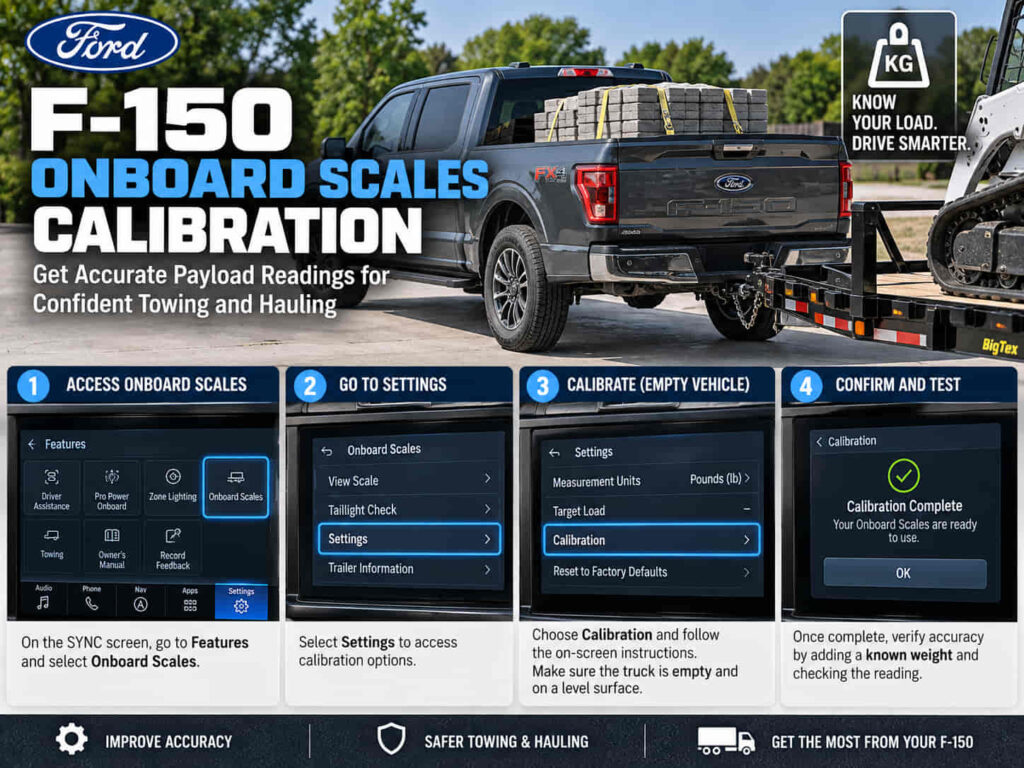
The Ford F-150 onboard scales system is designed to help drivers understand how much weight is being carried in the truck and how that load affects available payload. By using sensors and the vehicle’s electronic systems, the onboard scales can estimate the weight of cargo in the pickup bed and present the information through the truck’s display or connected interface, depending on the F-150 configuration.
When the displayed weight does not appear to match the actual cargo, the issue is not necessarily a simple calibration problem. The reading can be influenced by how the load is positioned, whether the truck is on a level surface, the vehicle’s configuration, and the operating conditions of the scale system. Understanding these factors is essential before attempting to reset or recalibrate an F-150 onboard scale.
This guide explains how Ford F150 onboard scales work, what calibration means in the context of the system, how to obtain more reliable readings, why inaccurate measurements can occur, and how onboard scale information relates to the truck’s payload capacity.
What Are Ford F150 Onboard Scales?
Ford F150 onboard scales are an integrated weight-monitoring feature available on certain F-150 configurations. The system is intended to help the driver estimate the amount of cargo being carried in the truck bed rather than requiring the vehicle to be taken to a separate commercial scale every time the load changes.
The onboard scale is part of the truck’s electronic vehicle systems and relies on information from sensors associated with the vehicle’s suspension and load conditions. As weight is added to or removed from the truck, the system can detect changes and use that information to estimate the current cargo load.
This distinction is important because an onboard scale is not necessarily measuring the cargo in the same way as a standalone platform scale. It is an integrated vehicle feature that interprets changes in the truck’s condition to produce a weight estimate. Consequently, the displayed value can be affected by factors that would not influence a conventional stationary scale in the same way.
The feature is also different from the F-150’s payload rating. Payload is the maximum amount of weight the vehicle is designed to carry under specified conditions, while the onboard scale provides information about the load currently being carried. A scale reading should therefore be treated as a measurement aid rather than a replacement for the vehicle’s official payload specifications.
How Ford F150 Onboard Scales Measure Weight
The onboard scales system works by detecting how the truck responds to a load. When cargo is placed in the bed, the additional weight changes the vehicle’s suspension and other measurable conditions. The electronic system uses these changes to estimate the weight being carried.
Because the system is integrated into the truck, the location and distribution of cargo can matter. A load concentrated in one area of the bed can affect the vehicle differently from the same total weight distributed more evenly. This is one reason why obtaining a consistent reading requires the truck to be positioned and loaded appropriately.
The system is intended to provide useful information about cargo weight while the vehicle is stationary or under the conditions specified by Ford. It should not be assumed that every displayed number represents an exact laboratory measurement. Instead, the value should be interpreted within the operating conditions and accuracy limitations of the particular F-150 system.
The model year and equipment configuration also matter. Ford has introduced different versions of vehicle technology across F-150 generations, so the exact display behavior, sensor architecture, available settings, and instructions can vary. A calibration or reset procedure described for one F-150 should therefore not automatically be applied to every model year.
Does the Ford F150 Onboard Scale Need Calibration?
The term calibration is often used broadly when discussing vehicle weight readings, but it is important to distinguish calibration from normal system operation. A factory-integrated onboard scale is designed to operate using the vehicle’s sensors and electronic control systems, and the driver should not assume that a manual calibration procedure is required whenever a displayed weight seems incorrect.
An apparently inaccurate reading can result from the way the cargo is positioned, the condition of the truck, the surface on which it is parked, or the way the system interprets the current load. In some situations, allowing the vehicle to settle and ensuring that the truck is positioned correctly can produce a more consistent reading without any special calibration procedure.
A true calibration or relearning procedure, when supported for a particular F-150 system, is different from simply resetting a displayed value. Calibration establishes or adjusts the relationship between sensor information and the resulting weight estimate. Resetting an electronic feature may only clear stored information or return a setting to a defined state.
For this reason, the correct procedure should always be determined from the owner’s information for the specific F-150. If Ford does not specify a user-performed calibration procedure for a particular model, attempting to create one by manipulating vehicle sensors, suspension components, or electronic modules can introduce new problems and may affect the accuracy of the system.
Read more: Ford F150 Tie Down Anchors
How to Get an Accurate Ford F150 Onboard Scale Reading
Obtaining a reliable onboard scale reading begins with the condition of the truck. The F-150 should be positioned according to the conditions specified for the scale system, and the vehicle should be allowed to settle before the displayed weight is interpreted. A significantly uneven surface can change the way the suspension is loaded and may affect the result.
Cargo should also be placed securely and in a stable position. Moving a heavy object from one side or end of the bed to another can change the load distribution even though the total cargo weight remains unchanged. If the objective is to compare two readings, the truck should be placed under similar conditions each time.
The driver should also distinguish between the weight of the cargo and the total additional load affecting the vehicle. Depending on how the system operates and what the display is designed to report, the displayed information may relate specifically to bed cargo rather than representing every kilogram or pound currently carried by the truck.
For important payload decisions, the onboard scale should be used together with the F-150’s official payload information. The scale provides an estimate of current cargo weight, while the vehicle’s certification information establishes the limits that apply to that particular truck.
Why Is My Ford F150 Onboard Scale Inaccurate?
An F-150 onboard scale can appear inaccurate when the reading does not correspond with an expected cargo weight. Before assuming that the sensor or software has failed, it is useful to consider the conditions under which the measurement was taken.
Load distribution is one possible factor. The same cargo can produce different sensor responses depending on where it is positioned in the bed. The condition of the truck and suspension can also influence the information available to the onboard system. Changes in tire condition, suspension components, or other vehicle characteristics may therefore affect the way the system interprets a load.
Environmental and operating conditions can also matter. Temperature changes, uneven ground, vehicle movement, and other conditions can influence sensor readings or the time required for the system to stabilize. A reading that changes slightly after the vehicle settles should not automatically be interpreted as evidence of a failed scale.
The comparison method is another common source of confusion. A commercial truck scale, household scale, axle scale, or calculated cargo weight may measure something different from what the F-150 onboard system is reporting. Before judging accuracy, the measurement methods need to be comparable.
If the system continues to display implausible values under appropriate operating conditions, or if the reading changes dramatically without a corresponding change in load, the issue may require vehicle diagnostics rather than a user-performed calibration.
Ford F150 Onboard Scale Calibration Problems
Calibration-related problems can involve either the underlying sensor system or the driver’s interpretation of the displayed information. If the vehicle has undergone suspension work, sensor replacement, or other repairs involving components used by the weight-monitoring system, the appropriate service procedure may be different from a normal user reset.
A persistent abnormal reading can indicate a problem with a sensor, wiring, electronic control module, or another component involved in calculating vehicle load. In such cases, changing settings without identifying the underlying fault may not correct the measurement.
It is also possible for a driver to interpret a normal system behavior as a calibration fault. A small difference between an estimated onboard reading and an independently calculated cargo weight does not necessarily mean that the system requires adjustment. The appropriate question is whether the reading is within the expected operating behavior for the particular F-150 configuration.
When the onboard scale is consistently inaccurate after confirming proper vehicle positioning and load conditions, the safest approach is to consult the vehicle-specific Ford service information or have the system inspected by a qualified technician rather than attempting to alter sensor calibration manually.
Ford F150 Onboard Scales and Payload Capacity
The relationship between onboard scales and payload is one of the most important concepts for F-150 owners. The onboard scale can help estimate how much cargo has been added to the truck, but it does not increase the vehicle’s payload rating.
Payload capacity is determined by the specific vehicle configuration and includes more than cargo placed directly in the bed. Depending on the circumstances, occupants, accessories, cargo, and other additional weight can all contribute to the vehicle’s total load. A bed-scale reading therefore should not be interpreted as the entire amount of weight being carried by the vehicle unless the system and display specifically define it that way.
For example, if the onboard system indicates that a particular amount of cargo has been placed in the bed, that information can help the driver understand how much of the available payload is being consumed. It does not mean that the displayed cargo value can simply be added to an arbitrary payload limit without considering the actual vehicle configuration and other occupants or equipment.
This makes the onboard scale particularly useful as a load-management tool. It can help drivers make better decisions about how much material to place in the bed, while the official payload rating remains the governing specification for the truck.
How to Reset or Relearn the F150 Onboard Scale System
Resetting an onboard scale and calibrating the system are not necessarily the same operation. A reset may clear information used by the vehicle’s display or electronic system, while calibration or relearning can involve a more specific procedure defined by Ford for a particular component or vehicle configuration.
The correct reset or relearn process depends on the model year and equipment. Ford’s instructions should therefore be followed for the specific F-150 rather than using a generic procedure intended for another generation.
If the onboard scale has become inaccurate after a repair, sensor replacement, suspension modification, or other mechanical work, a technician may need to perform a diagnostic or relearn procedure using the appropriate service equipment. This is different from simply restarting the vehicle or clearing a message on the instrument cluster.
Attempting to manipulate the system without knowing which sensors and control modules are involved can cause an incorrect reading to persist or create additional diagnostic issues. For a vehicle-specific calibration requirement, the owner’s manual and official service information should take priority over generalized instructions.
When Should the F150 Onboard Scale System Be Checked?
An onboard scale should be investigated when its readings remain inconsistent under normal operating conditions or when the displayed weight changes substantially without a corresponding change in cargo. A problem is more significant when inaccurate readings occur repeatedly rather than as a single unusual measurement.
Inspection is particularly appropriate when the truck has recently undergone suspension repairs, sensor-related work, electrical repairs, or modifications that could affect the components used by the load-monitoring system. Physical damage around the bed, suspension, wiring, or sensor mounting areas can also justify further diagnosis.
The objective should be to identify why the system is producing an abnormal reading rather than simply forcing the display to match an expected number. Because the onboard scale is part of the vehicle’s electronic and mechanical systems, accurate diagnosis is more reliable than manually changing values without understanding the cause.
For drivers who regularly carry heavy loads, the onboard scale can be a useful part of a broader payload-management process. However, important loading decisions should continue to consider the F-150’s official specifications, the condition of the vehicle, and the requirements of the cargo being transported.
Frequently Asked Questions About Ford F150 Onboard Scales Calibration
Can I calibrate the Ford F150 onboard scales myself?
Whether a user-performed calibration is available depends on the specific F-150 model and onboard scale system. A displayed weight that seems incorrect does not automatically mean that manual calibration is required. The vehicle-specific Ford instructions should be followed before attempting any reset or calibration procedure.
Why does my F150 onboard scale show the wrong weight?
An unexpected reading can be related to load distribution, vehicle position, operating conditions, sensor information, or a system fault. Comparing the onboard reading with another scale does not always provide a direct accuracy test because the two systems may measure different things.
Does resetting the F150 onboard scale calibrate it?
Not necessarily. Resetting and calibration are separate concepts. A reset may clear information or restore a system state, while calibration establishes how sensor information is converted into a weight measurement.
Does the F150 onboard scale measure payload?
The onboard scale is designed to provide information about vehicle load, particularly cargo in the truck bed on equipped vehicles. It should not be treated as a replacement for the official payload rating of the specific F-150.
Can suspension changes affect F150 onboard scale readings?
They can potentially affect a system that relies on vehicle load and suspension-related sensor information. If the truck has been modified or repaired and the onboard scale subsequently behaves differently, the vehicle-specific service information should be consulted.
Is Ford F150 onboard scale calibration the same for every model year?
No. The F-150 has different generations, configurations, and equipment packages, so the available onboard scale functions and applicable procedures can vary. The instructions for the exact model year and configuration should always take precedence.