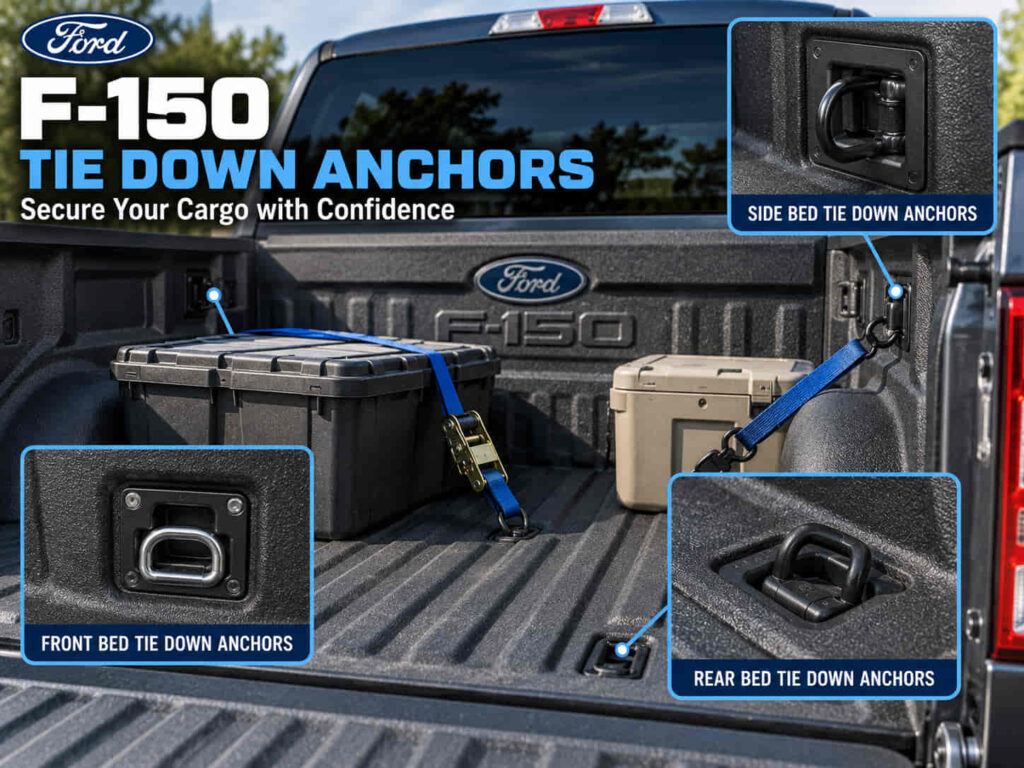
Securing cargo properly is an essential part of using a Ford F-150 pickup bed, whether you are transporting lumber, tools, furniture, camping equipment, motorcycles, or everyday loads. Ford F150 tie down anchors provide dedicated points for attaching tie down straps and other cargo restraint equipment, helping keep items stable while the truck is moving. Understanding how these anchor points work, where they are located, how much load they can support, and which type is appropriate for a particular F-150 configuration can make cargo transportation safer and more efficient.
The term Ford F150 tie down anchors can refer to several related components, including factory bed anchor points, removable tie down cleats, retractable anchors, D-rings, stake-pocket anchors, and aftermarket cargo attachment systems. These products can look similar but may differ significantly in mounting method, compatibility, adjustability, and load rating. For that reason, choosing a tie down anchor should begin with the specific F-150 model, bed configuration, cargo requirements, and intended method of securing the load.
This guide explains the different types of Ford F150 tie down anchors, their locations and functions, compatibility considerations, installation methods, load capacity, and the differences between factory and aftermarket solutions. It also explains how to select and use an anchor system without confusing cargo tie down capacity with the truck’s overall payload or towing capacity.
What Are Ford F150 Tie Down Anchors?
Ford F150 tie down anchors are designated attachment points used to secure cargo inside or around the pickup bed. They provide a connection between the truck and a restraint system such as a tie down strap, rope, or other approved cargo-securing equipment. Instead of wrapping a strap around an arbitrary part of the truck, a dedicated anchor creates a more predictable attachment point designed for cargo management.
On F-150 configurations equipped with the corresponding cargo management system, Ford uses anchor points that can accept removable tie down cleats. The cleat is positioned into the anchor point and secured so that a strap can be connected to it. This creates a flexible way to restrain cargo while allowing the cleats to be removed or repositioned when the bed needs to be used for other purposes.
The distinction between an anchor point and a tie down cleat is important. The anchor point is the mounting location integrated into the truck, while the cleat is the component that provides the practical attachment point for securing cargo. Aftermarket products can use different designs, including D-rings, retractable mechanisms, bed rails, stake pockets, or bolt-on mounting brackets. Although these systems perform a similar basic function, their installation requirements and rated capacities are not necessarily interchangeable.
The purpose of a tie down anchor is therefore not simply to give a strap somewhere to attach. A properly selected anchor establishes a secure load path between the cargo restraint and the truck while allowing the force generated by movement, braking, acceleration, and cornering to be managed more predictably. The anchor, mounting hardware, strap, and cargo itself all form part of the overall cargo-securing system.
Where Are the Tie Down Anchors on a Ford F150?
The location of Ford F150 tie down anchors depends on the model year, bed configuration, and equipment installed on the truck. Many F-150 models use dedicated points around the pickup bed that are integrated into the cargo management system. Because Ford has changed bed designs and available equipment across different generations, an anchor location found on one F-150 should not automatically be assumed to exist in exactly the same position on another model.
The pickup bed is the primary area to look for cargo tie down points. Depending on the configuration, anchor points may be positioned toward the front and rear portions of the bed or incorporated into a bed rail and cleat system. These locations allow cargo to be restrained from different directions, which is important when a load needs to resist both forward and lateral movement.
The tailgate should be considered separately from the pickup bed. A tailgate-mounted attachment point can move independently from the bed, so it should not automatically be treated as equivalent to a fixed bed anchor. Ford specifically cautions against securing cargo between a bed anchor and a tailgate anchor because their movement can create an unsafe load condition.
Before using any Ford F150 tie down anchor, inspect the actual attachment point on the truck and confirm that it is intended for cargo restraint. The presence of a convenient opening, hook, bolt, or other structural feature does not by itself mean that it is rated as a cargo tie down point.
Types of Ford F150 Tie Down Anchors
The Ford F-150 can use several different approaches to cargo attachment depending on its factory equipment and aftermarket modifications. Factory tie down cleats are among the most integrated solutions because they are designed around the truck’s existing bed anchor system. They can provide a convenient attachment point without requiring a separate mounting system to be installed in the bed.
Aftermarket Ford F150 tie down anchors expand the available cargo-management options. D-ring anchors create a fixed attachment loop, while retractable anchors can remain relatively flush with the surrounding surface when they are not being used. Stake-pocket anchors use existing bed structures to create additional attachment points, and rail-mounted systems allow the position of the tie down point to be adjusted along a track.
Bolt-on anchors are another option when a more permanent attachment is preferred. These systems typically use mounting hardware to connect the anchor to an appropriate structural location. Clamp-on designs can provide an alternative where drilling or permanent modification is undesirable, although compatibility and load rating must be evaluated carefully.
The best type of Ford F150 tie down anchor depends on how the truck is used. A driver who regularly carries changing types of cargo may benefit from an adjustable or retractable system, while someone transporting heavy or repetitive loads may prioritize a fixed mounting solution with a clearly defined load rating. Convenience is useful, but the anchor’s actual mounting method and rated capacity remain more important than its appearance or advertised versatility.
Ford F150 Tie Down Anchor Load Capacity
Load capacity is one of the most important attributes to evaluate when selecting a tie down anchor. However, the capacity of an individual anchor should not be confused with the Ford F-150’s payload rating, towing capacity, or the breaking strength of a tie down strap. These are separate specifications that describe different parts of the vehicle and cargo restraint system.
For equipped F-150 systems, Ford provides specific limits for the factory tie down cleats. In certain configurations covered by Ford’s owner’s information, the maximum force between directly opposed cleats is specified as 276 pounds, while the maximum force between diagonally opposed cleats is specified as 600 pounds. These figures apply to the relevant factory system and should not be generalized to every F-150 model year or aftermarket anchor.
An aftermarket anchor can have a different working load limit depending on its design, mounting hardware, installation location, and manufacturer specifications. A heavy-duty D-ring, for example, may have a substantially different rating from a small retractable anchor even if both are marketed for the F-150. The weakest component in the complete cargo restraint system can determine the practical limit, which means the anchor, mounting point, fasteners, and tie down equipment all need to be considered together.
Cargo weight also affects how the restraint system should be configured. A heavy object can generate substantially greater forces when the vehicle brakes suddenly, accelerates, changes direction, or travels over uneven terrain. For this reason, simply matching the static weight of the cargo to an anchor’s advertised capacity is not sufficient. The restraint system must be appropriate for the dynamic forces that can occur during transportation.
How to Install Ford F150 Tie Down Anchors
Installation depends on whether the F-150 uses its original factory anchor system or an aftermarket product. Factory tie down cleats designed for the truck’s existing anchor points generally follow the manufacturer’s intended installation method and do not require the same type of modification as a universal aftermarket anchor.
Aftermarket installation can involve bolts, brackets, clamps, rails, or other hardware. The mounting location matters as much as the anchor itself because an anchor is only as reliable as the structure to which it is attached. A high-strength anchor mounted to an unsuitable surface does not automatically create a high-capacity tie down point.
For this reason, installation should always follow the anchor manufacturer’s instructions and the specifications applicable to the particular F-150 configuration. Hardware should be properly fitted and tightened, and the finished installation should be inspected before cargo is secured. If drilling or structural modification is required, the effect on the truck’s bed structure, corrosion protection, and warranty should also be considered.
How to Use Ford F150 Tie Down Anchors
Using a Ford F150 tie down anchor correctly means creating a restraint system that prevents the cargo from shifting in the directions that matter during transportation. The number and position of attachment points should correspond to the size, shape, weight, and center of gravity of the load.
A strap connected to a suitable anchor should maintain enough tension to keep the cargo stable without damaging the cargo or the anchor itself. Multiple attachment points can provide better control when a load is large or capable of moving in more than one direction. The straps should also be positioned so that they do not become cut, crushed, or detached as the vehicle moves.
Before driving, inspect the cargo and every connection point. The anchor should be free from visible damage, the strap should be properly seated, and the cargo should not be able to move excessively. After beginning a journey, checking the load again is particularly important when transporting heavy or irregularly shaped objects.
OEM vs Aftermarket Ford F150 Tie Down Anchors
OEM and aftermarket Ford F150 tie down anchors serve the same broad purpose but approach cargo management differently. OEM components are designed around the specific truck and factory cargo-management system, which can simplify compatibility and installation. They can be a strong choice when maintaining the original configuration and appearance of the F-150 is important.
Aftermarket anchors are valuable when the factory system does not provide enough attachment points or when the owner needs a particular configuration. Retractable anchors, D-rings, stake-pocket systems, and adjustable rails can provide functionality that is not available on every factory-equipped truck.
The key consideration is not simply whether an anchor is OEM or aftermarket. Compatibility, mounting structure, load rating, hardware quality, and intended use are more meaningful factors when evaluating the safety and practicality of the system.
Ford F150 Tie Down Anchors by Model Year and Bed Size
Compatibility should always be evaluated against the specific F-150 model year and bed configuration. The F-150 has been produced across multiple generations with different bed designs, cargo-management systems, and available equipment. As a result, an anchor marketed for one generation or bed configuration may not be a direct fit for another.
Bed length can also influence compatibility and cargo-management requirements. F-150 configurations commonly include different bed lengths, and the location or availability of factory attachment points can vary accordingly. A product described simply as fitting a “Ford F-150” therefore requires additional verification before purchase.
When selecting an aftermarket tie down anchor, the most useful compatibility information includes the F-150 model year or generation, cab configuration where relevant, bed length, existing bed-rail or anchor system, mounting method, and required hardware. Checking these attributes before installation reduces the risk of purchasing an anchor that physically fits the truck but is not appropriate for its intended mounting position.
Read more: Ford F150 Spark Plug Gap Specs
Ford F150 Tie Down Anchor Safety
A tie down anchor is part of a cargo restraint system, not a substitute for proper load management. The anchor should never be used beyond its rated capacity, and damaged or deformed attachment points should not be relied upon to secure cargo. The condition of the tie down strap and its connection to the anchor also matters because a strong anchor cannot compensate for damaged or improperly attached restraint equipment.
It is also important to distinguish cargo tie down anchors from towing equipment. A pickup-bed anchor is designed for securing cargo and should not automatically be treated as a recovery point, towing point, or attachment point for another vehicle. Using an anchor outside its intended function can introduce forces that the mounting system was never designed to withstand.
For everyday F-150 use, the safest approach is to match the anchor system to the cargo, use the manufacturer’s stated load rating, distribute the load appropriately, and inspect the entire restraint system before driving. When the truck’s factory owner’s information provides a specific limitation, that vehicle-specific specification should take precedence over a generic aftermarket claim.
Frequently Asked Questions About Ford F150 Tie Down Anchors
Does every Ford F150 have tie down anchors?
Not every F-150 has exactly the same tie down system. Equipment varies by model year and configuration, so the physical anchor points and available tie down cleats should be verified for the specific truck.
How much weight can a Ford F150 tie down anchor hold?
There is no single capacity that applies to every F-150 tie down anchor. Factory and aftermarket systems can have different ratings, and the applicable Ford specification should be checked for the specific configuration.
Can I add aftermarket tie down anchors to a Ford F150?
Yes, aftermarket systems are available for many F-150 configurations. The anchor must be compatible with the truck’s bed structure and installed according to the manufacturer’s specifications.
Are Ford F150 tie down anchors universal?
No. Compatibility can depend on model year, generation, bed length, factory equipment, mounting location, and anchor design. A product described as fitting an F-150 should still be checked against the exact vehicle configuration.
Can Ford F150 tie down anchors be used for towing?
Cargo tie down anchors should not be treated as towing or recovery points unless the manufacturer specifically rates the component for that purpose. Cargo restraint and vehicle towing involve different types of loads and attachment requirements.
Are OEM or aftermarket F150 tie down anchors better?
Neither is automatically better for every application. OEM anchors can provide straightforward compatibility with the factory system, while aftermarket anchors can offer additional mounting locations, adjustability, or specialized designs. The appropriate choice depends on the truck configuration and intended cargo use.