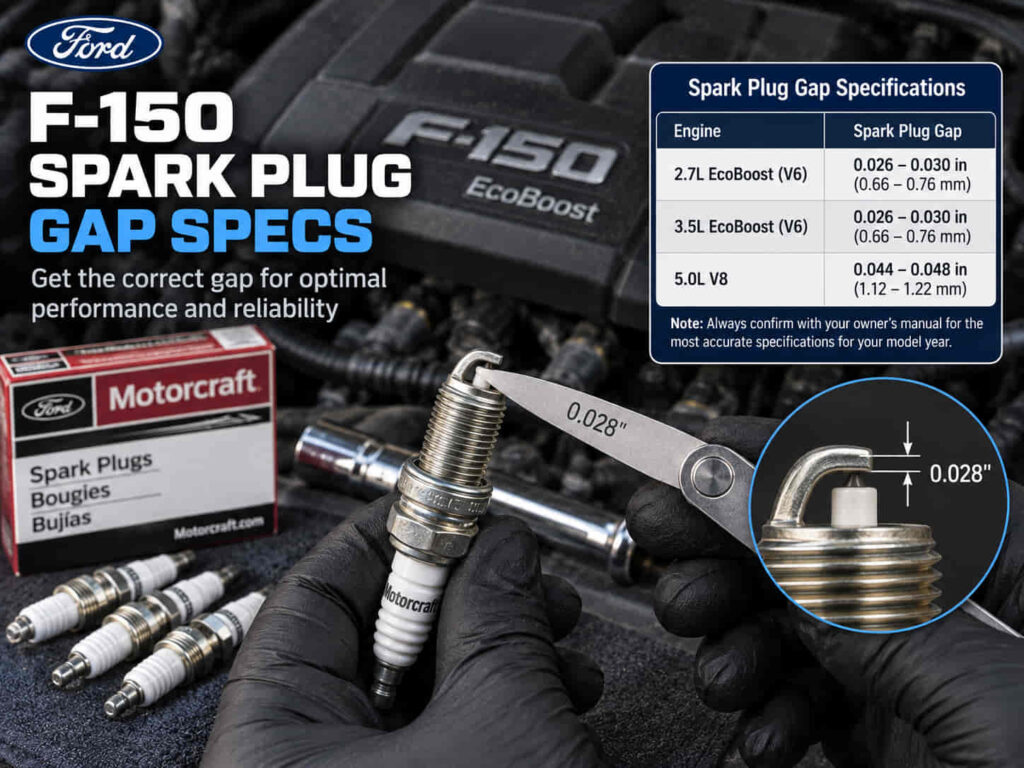
If your Ford F150 is starting to feel rough at idle, hesitating under acceleration, or using more fuel than usual, the spark plugs may be one of the first components worth checking. However, choosing the right replacement is not as simple as picking a popular brand from the parts store. The correct spark plug depends on your F150 model year, engine configuration, factory ignition system, and the specifications designed for that particular application.
The best spark plugs for a Ford F150 should provide the correct fit, heat range, electrode design, and ignition performance while maintaining the manufacturer’s required spark plug gap. The installation torque also matters because an incorrectly installed plug can create problems that range from misfires to damaged threads.
This guide explains how to choose the right spark plugs for a Ford F150 and what to know about spark plug gap, plug type, torque specifications, replacement intervals, and common installation mistakes. Whether you drive an F150 with a 5.0L V8, 3.5L EcoBoost, 2.7L EcoBoost, or another engine configuration, understanding these specifications can help you avoid buying the wrong parts and spending money on unnecessary repairs. More importantly, it can help your truck maintain reliable starting, smooth combustion, strong acceleration, and dependable performance.
How to Choose the Right Spark Plugs for a Ford F150
Choosing the right spark plugs for a Ford F150 starts with one important detail: there is no single spark plug specification that applies to every F150. Ford has produced the truck with a wide range of engines and ignition systems over the years, and each combination can require a different plug design, heat range, electrode configuration, gap specification, and installation procedure. This is why searching only by “Ford F150 spark plugs” is not enough when you are preparing for a replacement.
The model year and engine are the two most important pieces of information to identify before purchasing a plug. A 5.0L V8, for example, does not necessarily use the same spark plug specification as a 3.5L EcoBoost, even when both engines are installed in an F150. Older 4.6L and 5.4L V8 models also have their own application requirements. Using a plug simply because it physically fits the cylinder head can result in incorrect ignition performance or premature wear if its specifications do not match the engine.
Spark plug material is another factor worth considering. Modern F150 applications commonly use long-life designs such as iridium or platinum, depending on the original equipment specification. These materials can provide durable electrodes and consistent ignition performance over a long service interval. However, a more expensive material does not automatically make a spark plug better for every truck. Compatibility with the engine’s original calibration and ignition system remains the priority.
The spark plug gap is equally important. The gap is the distance between the center electrode and ground electrode where the ignition spark occurs. If the gap is outside the specified range, the ignition system may have difficulty producing a consistent spark under certain operating conditions. This can become particularly noticeable when the engine is under heavy load, accelerating, towing, or operating with increased cylinder pressure.
For that reason, the best spark plugs for a Ford F150 are not necessarily the plugs with the highest price or the most aggressive marketing claims. They are the plugs that match the specific year, engine and factory requirements of your truck. Once those details are confirmed, spark plug gap, plug construction and torque specifications can be used together to ensure the replacement is installed correctly and performs as intended.
Read more: Ford F150 Transmission Shift Issues
Best Spark Plugs for Ford F150
Finding the best spark plugs for a Ford F150 is ultimately a matter of matching the plug to the engine rather than choosing a particular brand based solely on reputation. Ford F150 models have used different gasoline engines across generations, including naturally aspirated V8s and turbocharged EcoBoost engines, and the ignition requirements can vary significantly between applications. A spark plug that performs well in a 5.0L V8 should not automatically be considered the right choice for a 3.5L EcoBoost simply because both plugs may appear similar.
For most F150 owners, an original equipment replacement or a high-quality aftermarket plug that directly matches the factory application is the safest starting point. The original specification is designed around the engine’s combustion characteristics, ignition system and calibration. This becomes particularly important on EcoBoost engines, where turbocharging increases cylinder pressure and places greater demands on the ignition system. A plug with the correct electrode design and thermal characteristics can help maintain a stable spark under both normal driving and higher engine loads.
Spark plug construction also influences long-term performance. Platinum and iridium plugs are commonly associated with extended service life because their durable electrode materials resist wear better than conventional designs. That does not mean an iridium plug should automatically replace every factory-specified plug, however. The correct application, dimensions, heat range and gap remain more important than the material alone. Installing an incompatible premium plug can create more problems than using a correctly specified standard replacement.
The best choice can also depend on how the F150 is used. A truck primarily driven for commuting may place relatively modest demands on its ignition system, while an F150 regularly used for towing, hauling or extended highway driving operates under substantially different loads. Consistent ignition becomes especially important when cylinder pressure rises, because the ignition system must produce a reliable spark at precisely the right point in the combustion cycle.
Brand selection should therefore come after application verification. Major spark plug manufacturers produce plugs specifically engineered for Ford applications, but part numbers can change according to engine and model year. Even within the same F150 generation, a change in engine configuration can mean a different plug is required. Checking the vehicle’s exact year and engine before ordering is therefore more reliable than relying on a generic “F150 compatible” description.
There is also an important distinction between a replacement spark plug and a performance-oriented spark plug. For a stock F150, the factory specification is generally the logical baseline because the engine management system was calibrated around that configuration. A different plug design may be appropriate for a modified engine, but modifications such as increased boost, altered engine calibration or other changes can affect the ideal ignition setup. In those cases, spark plug selection should be based on the complete engine configuration rather than the original truck specification alone.
Ultimately, the best spark plugs for a Ford F150 are the ones that provide the correct physical fit and ignition characteristics for the specific engine while meeting the required gap and installation specifications. Once the correct application is identified, the next step is to verify the Ford F150 spark plug gap, because even a high-quality plug can perform poorly when its electrode gap does not match the required specification.
Ford F150 Spark Plug Gap Specifications
The Ford F150 spark plug gap is one of the most important specifications to verify before installing a new set of plugs. The gap refers to the distance between the center electrode and the ground electrode, creating the space across which the ignition spark must travel. Although the measurement may appear small, this distance has a direct relationship with the voltage required to produce a reliable spark and the way the air and fuel mixture is ignited inside the cylinder.
There is no universal Ford F150 spark plug gap that applies to every model year and engine. Ford has used numerous engine families throughout the F150’s production history, and the required specification can change between engines and generations. A naturally aspirated V8 and a turbocharged EcoBoost engine, for example, operate under different combustion conditions. Even when two engines use physically similar spark plugs, their recommended gap can be different.
This is particularly important when replacing factory plugs with aftermarket alternatives. A replacement plug may arrive pre-gapped, but “pre-gapped” does not necessarily mean that the gap is correct for your specific F150. Manufacturing tolerances, transportation and the intended vehicle application can all affect the final measurement. The correct approach is to identify the exact spark plug specification for the vehicle and then verify the installed gap before fitting the plug.
A gap that is too wide can increase the voltage demand placed on the ignition system. Under light engine load, the difference may not always be obvious, but problems can become more apparent during acceleration, towing or other conditions in which cylinder pressure increases. The result can include an intermittent misfire, hesitation or rough engine operation. Turbocharged F150 engines can be particularly sensitive to ignition problems because boost increases the pressure inside the combustion chamber.
A gap that is too narrow presents a different problem. The spark can occur more easily, but the resulting ignition characteristics may not match the engine’s intended combustion requirements. Rather than assuming that a smaller gap is safer, the correct specification should always be treated as the reference point. The objective is not simply to make ignition easier but to provide the spark characteristics for which the engine and ignition system were designed.
Checking the gap requires an appropriate spark plug gap gauge or feeler-style measuring tool. The measurement should be taken carefully without applying excessive force to the electrode. If an adjustment is necessary, it should be made according to the manufacturer’s guidance and the construction of the specific spark plug. Modern fine-wire plugs can be more sensitive to improper handling, so bending or striking the electrode carelessly can damage the plug.
The correct gap should also be considered together with the condition of the rest of the ignition system. A worn ignition coil, damaged coil boot, poor electrical connection or another ignition fault can produce symptoms that resemble an incorrect spark plug gap. Replacing the plugs without addressing an underlying ignition problem may therefore fail to resolve a misfire.
For this reason, the most reliable way to determine the Ford F150 spark plug gap is to start with the exact model year and engine rather than a generic F150 specification. Once the correct plug and gap have been confirmed, installation torque becomes the next critical consideration. A correctly gapped spark plug still needs to be installed properly to create a reliable seal and maintain the correct relationship between the plug, cylinder head and combustion chamber.
Ford F150 Spark Plug Torque Specifications
Spark plug torque is just as important as the correct spark plug gap when servicing a Ford F150. The torque specification determines how firmly the plug is installed in the cylinder head and helps establish the correct mechanical seating of the plug. While it can be tempting to tighten a spark plug by feel, this approach can create problems because both insufficient and excessive torque can affect the reliability of the installation.
A spark plug that is not tightened sufficiently may fail to seat correctly against the cylinder head. Depending on the plug design and application, this can affect sealing around the combustion chamber and allow unwanted movement or vibration. In severe cases, an improperly secured plug can contribute to combustion leakage or damage to the plug and surrounding components.
Over-tightening creates a different risk. Spark plugs are installed into threaded openings in the cylinder head, and excessive torque can damage those threads or place unnecessary stress on the spark plug shell and cylinder head. This is particularly concerning on aluminum cylinder heads because damaged threads can turn a relatively simple maintenance procedure into a much more expensive repair.
The correct Ford F150 spark plug torque is not a universal number for every F150. It depends on the engine, spark plug design and the specific service specification associated with that application. For this reason, torque should be verified using the correct service information for the exact model year and engine rather than applying a generic torque value found on an unrelated F150 application.
Installation technique also matters. The spark plug threads and cylinder head should be clean, and the plug should start threading by hand to reduce the risk of cross-threading. If the plug does not turn smoothly by hand, forcing it with a ratchet can damage the threads before the correct torque is ever reached. Using a suitable torque wrench for the final tightening step provides much greater consistency than relying on hand feel.
Another common question concerns anti-seize compound. Modern spark plugs and their coatings are often designed to be installed without additional anti-seize unless the manufacturer specifically recommends it. Adding lubricant can change the friction characteristics of the threads and may cause the actual clamping force to differ from what the torque value was designed to produce. The correct procedure should therefore follow the spark plug manufacturer’s installation instructions and the vehicle’s service information.
The same principle applies to dielectric grease. It should not be treated as a substitute for proper electrical contact or applied indiscriminately to the spark plug electrode or threaded portion. When appropriate, a small amount may be used around the inside of the ignition coil boot according to the applicable service procedure, helping protect the connection from moisture without interfering with the spark itself.
Once the correct spark plug, gap and torque specification have been confirmed, replacement becomes a straightforward maintenance procedure. However, careful installation remains essential because a new plug cannot compensate for damaged threads, contaminated plug wells or a failing ignition coil. The next step is understanding how the spark plugs should actually be replaced on a Ford F150 and what problems are most likely to occur during the process.
How to Replace Spark Plugs on a Ford F150
Replacing spark plugs on a Ford F150 is a maintenance procedure that can be handled by many experienced DIY owners, but the exact process varies according to the engine and model year. Access to the ignition coils, plug wells and surrounding components can be different between generations, so the first step is always to identify the specific engine and understand the layout before removing anything. Taking a few minutes to prepare can prevent damaged connectors, cross-threaded plugs and unnecessary complications during installation.
The engine should be completely cool before the spark plugs are removed. Working on a hot cylinder head can make removal more difficult and increases the risk of damaging threads. Once the engine has cooled, the ignition coil or coil-on-plug assembly covering the spark plug must be accessed. Depending on the F150 engine, this may require removing an electrical connector, retaining hardware or other components that restrict access to the coil.
After the ignition coil is removed, the area around the spark plug should be inspected and cleaned before the plug is loosened. Dirt, sand or debris around the plug well can fall into the cylinder when the plug is removed. Compressed air can be useful for clearing loose contamination, provided it is used carefully and the surrounding components are protected. This small preparation step is especially important on trucks that regularly operate in dusty, dirty or wet environments.
The old spark plug can then be removed with the appropriate spark plug socket and extension. If the plug feels unusually tight, forcing it immediately is not always the best approach. A seized or damaged plug can cause thread damage or, on certain older Ford applications, create additional removal challenges. Slow and controlled removal gives the technician a better opportunity to recognize a problem before it becomes expensive.
Inspecting the old plug can also provide useful information about engine operation. Normal wear, carbon deposits, oil contamination, unusual electrode erosion or signs of overheating can reveal conditions that may not be obvious from the driver’s seat. If one plug looks significantly different from the others, replacing the entire set may restore ignition performance, but the underlying cause of the abnormal plug should also be investigated.
Before installing the replacement, the new spark plug should be checked against the specification for the exact F150 engine. This includes confirming the part number, physical dimensions and required electrode gap. Even when a replacement plug is advertised as pre-gapped, verifying the gap is a worthwhile step because the correct specification is determined by the vehicle application rather than the general product description.
The new plug should be started by hand and threaded carefully into the cylinder head. It should turn smoothly without excessive resistance. If the threads do not engage naturally, the plug should be removed and the alignment checked rather than forcing it with a ratchet. Cross-threading can damage the cylinder head and create a repair that is far more complicated than the original spark plug replacement.
Once the plug is properly seated, it should be tightened to the correct specification using a calibrated torque wrench. The exact Ford F150 spark plug torque depends on the engine and plug application, so the applicable service specification should be confirmed before final tightening. After installation, the ignition coil and electrical connector can be reinstalled, ensuring that the coil boot is properly seated on the spark plug.
After all plugs have been replaced, the engine should start and idle smoothly. A short inspection for abnormal noises, warning lights or rough running can help identify an installation problem. If the Check Engine Light begins flashing or the engine develops a severe misfire, continued driving should be avoided until the cause is diagnosed. A new set of spark plugs should improve ignition reliability, but it cannot correct a failing ignition coil, fuel system problem, vacuum leak or mechanical engine fault.
Proper installation therefore involves more than simply removing the old plugs and installing new ones. Correct application, gap verification, careful threading and accurate torque all work together to ensure that the new spark plugs perform as intended throughout their service life.
Signs Your Ford F150 Needs New Spark Plugs
Spark plugs gradually wear as the engine accumulates mileage, and the symptoms are not always obvious at first. A Ford F150 may continue to start and drive normally even as the electrodes become worn, but ignition performance can deteriorate under conditions that place greater demands on the engine. Recognizing these changes early can help prevent a minor maintenance issue from developing into poor drivability or a more complicated ignition problem.
One of the most noticeable symptoms is a rough or unstable idle. When a spark plug fails to ignite the air and fuel mixture consistently, the affected cylinder may contribute less power than the others. The driver may feel vibration through the steering wheel, seat or body of the truck, particularly when the engine is idling. A rough idle does not automatically mean the spark plugs are worn, but they are one of the components worth inspecting when ignition performance changes.
Hesitation during acceleration is another common warning sign. An F150 that feels smooth at light throttle but hesitates when accelerating may be experiencing an ignition problem that becomes more apparent as engine load increases. A worn plug, incorrect spark plug gap or weak ignition coil can make it more difficult to maintain a consistent spark when cylinder pressure rises. Turbocharged EcoBoost engines can make these symptoms especially noticeable during hard acceleration or towing.
A decline in fuel economy can also accompany deteriorating spark plug performance. When combustion becomes less efficient, the engine may require more fuel to produce the same useful output. However, fuel economy is influenced by many variables, including driving conditions, tire pressure, fuel quality, vehicle load and engine operating temperature. Spark plugs should therefore be considered as part of a broader diagnosis rather than assumed to be the sole cause.
Hard starting can be another indication that the ignition system needs attention. A healthy ignition system should produce a reliable spark during startup, but worn electrodes or an incorrect gap can increase the demands placed on the ignition system. If the truck consistently takes longer to start, particularly when combined with rough running or hesitation, inspecting the plugs and ignition components can be worthwhile.
A Check Engine Light may also appear when a spark plug contributes to a misfire. Modern F150 engines use sophisticated engine management systems capable of detecting combustion irregularities, and a misfire may generate a diagnostic trouble code associated with a particular cylinder. This information can help narrow the diagnosis, but a cylinder-specific misfire code does not automatically prove that the spark plug itself is defective.
The same symptoms can be caused by a failing ignition coil, damaged coil boot, fuel injector problem, vacuum leak, sensor fault or mechanical issue such as low compression. Replacing spark plugs without identifying the actual cause can therefore waste money and leave the original problem unresolved. If a new set of correctly specified plugs does not eliminate the misfire, further diagnosis is necessary.
The condition of the removed spark plugs can provide useful evidence. Excessive electrode wear, abnormal deposits, oil contamination or unusual discoloration can indicate how the engine has been operating. When all plugs show similar wear, normal service-related deterioration may be the most likely explanation. When one plug looks dramatically different from the others, however, the difference may point toward a cylinder-specific problem that deserves further investigation.
For F150 owners, the most reliable approach is to treat spark plug replacement as part of routine ignition-system maintenance rather than waiting for severe symptoms. Following the appropriate replacement interval for the specific engine, using the correct plug and verifying the required gap can help maintain consistent combustion. When symptoms do appear, spark plugs are an important diagnostic starting point, but they should always be evaluated alongside the rest of the ignition, fuel and engine systems.
OEM vs. Aftermarket Spark Plugs for Ford F150
When choosing replacement spark plugs for a Ford F150, many owners eventually face the question of whether to stay with an original equipment specification or choose an aftermarket alternative. Both approaches can work well when the application is correct, but the important distinction is not simply whether a plug carries a Ford-related label or comes from a well-known manufacturer. The real question is whether the replacement matches the requirements of the specific engine.
OEM-style spark plugs offer a straightforward approach because they are designed to meet the specifications associated with the original application. For an F150 that remains mechanically stock, maintaining the original specification can reduce uncertainty around plug dimensions, electrode configuration, heat range and ignition characteristics. This is particularly useful for owners who prioritize predictable operation and want the replacement process to remain as close as possible to the factory setup.
Aftermarket spark plugs can also be an excellent choice when they are specifically engineered for the correct F150 application. Major spark plug manufacturers produce replacement products using materials and electrode designs intended to provide long service life and consistent ignition. Some aftermarket options may offer an equivalent specification at a competitive price, which can make them attractive when servicing an older or higher-mileage truck.
The key is to avoid treating brand recognition as a substitute for compatibility. A premium spark plug from a reputable manufacturer is not automatically appropriate for every F150 engine. The part number, dimensions, heat range, electrode design and required gap all need to correspond with the vehicle’s application. This is particularly important when shopping online, where a product page may group multiple F150 engines under a broad compatibility description.
There is also a misconception that upgrading to a more expensive spark plug will automatically increase horsepower or fuel economy. On a stock F150, replacing a worn or incorrectly specified plug with the correct factory-equivalent component can restore lost ignition performance, but it does not necessarily create additional power beyond the engine’s intended output. Spark plugs are primarily responsible for delivering the required ignition event, not transforming the fundamental characteristics of the engine.
For modified trucks, the situation can be different. Changes to boost pressure, engine calibration, fuel system components or other aspects of the combustion system can alter ignition requirements. An aftermarket plug may then be selected for a specific reason, but that decision should be based on the complete engine setup rather than the assumption that a performance-branded plug is universally better.
Cost should also be considered over the entire service interval. A less expensive plug that requires replacement sooner may not provide better value than a higher-quality long-life design that matches the factory application. Conversely, paying substantially more for a specialized plug offers little benefit if the truck’s engine does not require its particular characteristics.
For most F150 owners, the best strategy is therefore simple: identify the exact model year and engine, determine the factory spark plug specification, and then compare OEM and aftermarket products that meet those requirements. Once compatibility has been established, factors such as electrode material, expected service life, manufacturer reputation and price can help determine which option offers the best value.
The goal is not to find the most expensive spark plug or the most heavily marketed product. It is to install a plug that works correctly with the engine’s ignition system, maintains the required gap and can withstand the operating conditions of the truck. That approach provides a more reliable foundation for long-term F150 performance than choosing a replacement based on brand or price alone.
Common Ford F150 Spark Plug Mistakes to Avoid
Replacing spark plugs on a Ford F150 may appear to be a straightforward maintenance task, but small mistakes can affect ignition performance or create expensive repair problems. Many issues begin with an assumption that all F150 engines use the same spark plug, gap or installation procedure. In reality, Ford has produced the F150 with numerous engine configurations, and the correct service information can change from one application to another.
One of the most common mistakes is purchasing a spark plug based only on the vehicle name. A listing that says a plug fits a Ford F150 does not necessarily mean it is correct for every F150 engine. Model year, engine displacement and specific application should be confirmed before ordering. This is especially important when comparing older V8 engines with newer EcoBoost applications, because their ignition requirements can be substantially different.
Another mistake is assuming that a new spark plug does not need its gap checked. Some replacement plugs are supplied pre-gapped for a particular application, but the final specification should still be verified against the requirements of the engine. A gap that is slightly different from the intended specification can affect ignition reliability, particularly when the engine is operating under high load.
Improper gap adjustment can be just as problematic. Spark plugs with fine-wire electrodes can be damaged if the electrode is bent or forced using an unsuitable tool. The objective is to achieve the specified gap without deforming the electrode or damaging the plug. If a plug cannot be adjusted safely, replacing it with the correct application-specific component may be preferable to attempting an aggressive adjustment.
Installation torque is another area where mistakes are common. Some technicians rely on how tight the plug feels instead of using the applicable torque specification. This can lead to an under-tightened plug that does not seat correctly or an over-tightened plug that damages the threads. Because many F150 cylinder heads use aluminum, thread damage can turn a routine spark plug service into a much more involved repair.
Cross-threading should also be avoided at all costs. The spark plug should engage the cylinder head threads smoothly by hand before a ratchet or torque wrench is used. If resistance is felt immediately, the plug should be removed and its alignment checked. Forcing a misaligned plug into the cylinder head can permanently damage the threads and may require specialized repair.
Using anti-seize without checking the applicable instructions is another potential problem. Modern spark plugs may have coatings designed to allow installation without additional lubricant. Adding anti-seize can alter thread friction and change the relationship between the torque applied by the wrench and the actual clamping force. The spark plug manufacturer’s instructions should therefore take precedence rather than assuming that anti-seize is always beneficial.
It is also a mistake to replace spark plugs and ignore the ignition coils or boots when a misfire is already present. A worn plug may be the cause, but a damaged coil, contaminated plug well, poor electrical connection or another engine problem can produce nearly identical symptoms. If the problem remains after installing correctly specified plugs, the diagnosis should move beyond the spark plugs rather than repeatedly replacing them.
Finally, some owners replace the spark plugs at an arbitrary interval without considering the specific engine and service conditions. A vehicle used primarily for light commuting may experience different operating conditions from an F150 that regularly tows heavy loads, idles for extended periods or operates in severe environments. Following the appropriate maintenance schedule and inspecting the actual condition of the ignition system provides a more reliable approach than relying on a universal mileage figure.
Avoiding these mistakes makes spark plug replacement more than a simple parts swap. Correct application, proper gap verification, careful installation and accurate torque work together to protect the ignition system and help the F150 deliver consistent combustion. When those fundamentals are followed, the chances of introducing a new misfire or installation-related problem are significantly reduced.
Ford F150 Spark Plug FAQ
What is the correct spark plug gap for a Ford F150?
There is no single spark plug gap specification for every Ford F150. The correct gap depends on the model year, engine and specific spark plug application. A 5.0L V8, 3.5L EcoBoost and older 5.4L V8, for example, can have different ignition requirements. The safest approach is to identify the exact engine and verify the applicable Ford or spark plug manufacturer specification before installation. Even when a replacement plug comes pre-gapped, the gap should be checked against the specification for that particular F150.
How often should you change spark plugs on an F150?
Spark plug replacement intervals vary according to the engine, model year, plug design and vehicle operating conditions. Long-life platinum and iridium plugs can generally remain in service for substantially longer than conventional plugs, but the correct maintenance interval should come from the service information for the specific vehicle. Heavy towing, frequent short trips and severe operating conditions can also affect how the ignition system performs. Instead of applying one mileage interval to every F150, use the maintenance schedule associated with the exact engine.
Do new Ford F150 spark plugs need to be gapped?
A new spark plug should have its gap verified even if the manufacturer describes it as pre-gapped. Pre-gapped means the plug has been prepared for an intended application, but it does not eliminate the need to confirm that the gap matches the engine being serviced. The plug should be inspected carefully before installation, and any adjustment should be performed using an appropriate method that does not damage the electrode.
What happens if the spark plug gap is wrong?
An incorrect spark plug gap can affect ignition reliability. A gap that is too wide may require greater ignition voltage and can contribute to misfire or hesitation, particularly when the engine is under heavy load. A gap that is too narrow changes the intended spark characteristics and may also affect combustion performance. Symptoms can include rough running, reduced acceleration, poor fuel economy or a Check Engine Light, although these symptoms can also result from other ignition, fuel or mechanical problems.
What is the Ford F150 spark plug torque specification?
Spark plug torque varies according to the F150 engine, spark plug design and applicable service specification. There is therefore no single torque value that should be applied to every F150. Correct torque is important because excessive tightening can damage the spark plug or cylinder head threads, while insufficient tightening can prevent the plug from seating correctly. Always verify the torque specification for the exact engine and plug before installation and use a suitable torque wrench for final tightening.
Are OEM spark plugs better than aftermarket spark plugs for an F150?
OEM spark plugs are a strong choice for a stock F150 because their specifications are designed around the original engine application. However, a high-quality aftermarket plug can perform equally well when it is specifically engineered to match the same application. The most important factors are compatibility, heat range, electrode design, dimensions and required gap rather than whether the packaging carries an OEM or aftermarket label.
Can bad spark plugs cause an F150 to misfire?
Yes. A worn, damaged or incorrectly gapped spark plug can contribute to a cylinder misfire. However, a misfire does not automatically mean the spark plug is the problem. Ignition coils, coil boots, fuel injectors, vacuum leaks, sensors and mechanical engine conditions can create similar symptoms. If an F150 continues to misfire after correctly specified spark plugs have been installed, the rest of the ignition and engine systems should be diagnosed rather than replacing plugs repeatedly.
Should I use iridium spark plugs in my Ford F150?
Iridium spark plugs can offer excellent durability and long service life, but the correct choice depends on the specific F150 application. If the factory specification calls for a particular iridium design, using a high-quality equivalent can be appropriate. If the engine was designed around another plug specification, simply choosing an iridium plug because it is more expensive does not necessarily provide a performance advantage. Compatibility should always come before electrode material.
Can spark plugs improve F150 horsepower or fuel economy?
Replacing worn or incorrectly specified spark plugs can restore normal ignition performance, but spark plugs generally should not be viewed as a simple horsepower upgrade on a stock F150. When the original plugs are functioning correctly, installing a different premium plug does not automatically increase engine output. Properly specified plugs can help maintain efficient combustion, consistent starting and smooth operation, while noticeable performance problems may indicate that another part of the ignition or fuel system needs attention.
Final Thoughts on the Best Spark Plugs for Ford F150
Choosing the best spark plugs for a Ford F150 is less about finding the most expensive product and more about finding the correct specification for the engine in front of you. The model year, engine configuration, spark plug design, electrode material, gap and installation requirements all work together to determine whether a replacement plug will deliver reliable ignition performance. A plug that is an excellent choice for one F150 may not be the correct option for another.
The Ford F150 spark plug gap deserves particular attention because even a high-quality replacement can perform poorly when the electrode gap does not match the required specification. The same principle applies to installation torque. Proper seating protects the cylinder head, supports reliable sealing and helps ensure that the spark plug remains secure throughout its service life.
For most stock F150s, an OEM-equivalent or application-specific aftermarket spark plug is a sensible starting point. Instead of choosing a product based solely on brand, price or claims about improved performance, verify that its part number and specifications match the exact engine. This is especially important when comparing naturally aspirated V8 and EcoBoost applications, where operating conditions and ignition requirements can differ considerably.
If your F150 is experiencing rough idle, hesitation, hard starting, reduced fuel economy or a misfire, spark plugs are worth inspecting, but they should not automatically be blamed for every ignition problem. A failing ignition coil, fuel system issue, vacuum leak or mechanical fault can create similar symptoms. A proper diagnosis is therefore just as important as selecting the right replacement part.
Ultimately, the best spark plugs for your Ford F150 are the ones that match its exact application and are installed according to the correct specifications. Before placing an order, confirm your truck’s model year and engine, verify the recommended plug and gap, and follow the applicable installation procedure. Taking those extra steps can help protect the ignition system, avoid unnecessary repairs and keep your F150 running smoothly for many miles to come.