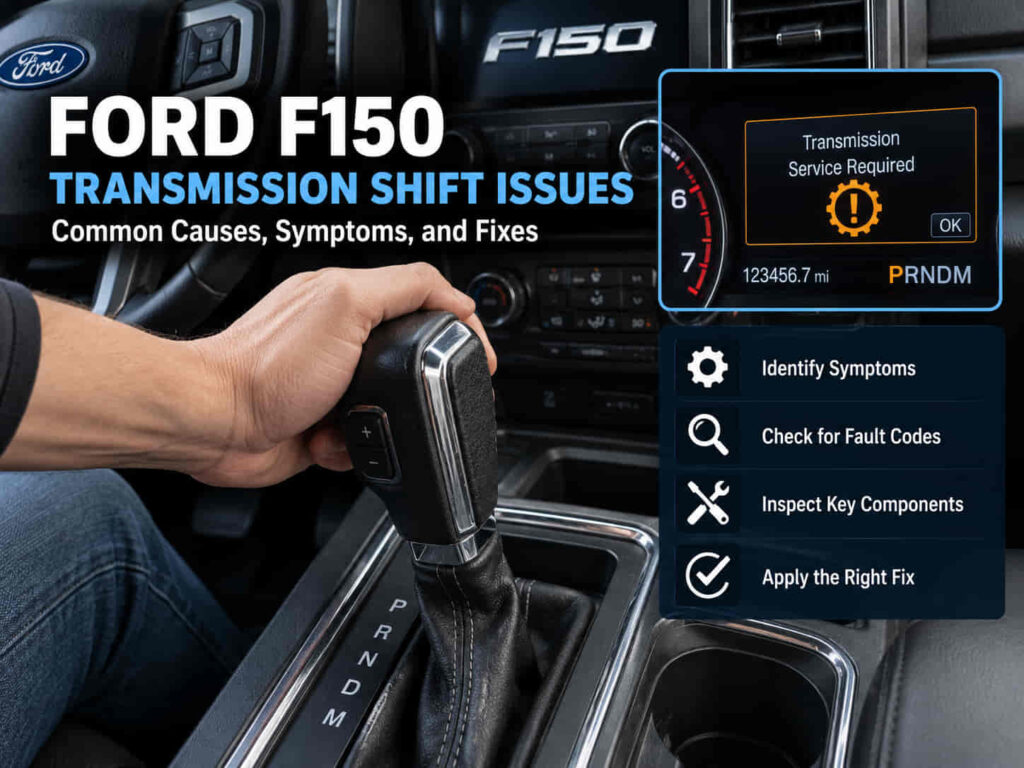
A Ford F-150 can feel almost indestructible when everything is working properly. But when the transmission starts shifting differently, even a small change in the way the truck accelerates can become difficult to ignore. A hard shift between gears, a noticeable hesitation before engagement, an unexpected surge in engine RPM, or a transmission that seems reluctant to select the right gear may all point to Ford F150 transmission shift issues.
The important thing is that unusual shifting does not automatically mean the transmission needs to be rebuilt or replaced. The underlying cause can range from transmission fluid condition and electronic controls to solenoids, sensors, adaptive shift behavior, valve body problems, or internal mechanical wear. The symptoms can also vary considerably depending on the F-150 model year, engine, transmission configuration, mileage, driving conditions, and maintenance history.
That makes diagnosis more important than simply treating the symptom.
In this guide, we will examine why a Ford F-150 may shift hard, hesitate, slip, jerk, or behave unpredictably. We will also look at the relationship between transmission fluid, electronic controls, modern multi-speed transmissions, and mechanical components, while explaining when a shifting problem may require professional attention.
If your F-150 has recently started shifting differently from the way it normally does, understanding the pattern of the problem is the first step toward finding the right solution.
What Are the Most Common Ford F150 Transmission Shift Issues?
Understanding the exact way a Ford F-150 is shifting can provide important clues about what is happening inside the transmission. A transmission does not simply move from one gear to another. It relies on hydraulic pressure, electronic control modules, sensors, solenoids, transmission fluid and mechanical components working together to determine when and how each gear should engage. When one part of that system does not operate as expected, the driver may notice a change in shift quality long before a complete transmission failure occurs.
One of the most noticeable Ford F150 transmission shift issues is hard or harsh shifting. Instead of a smooth transition between gears, the truck may produce a noticeable bump, jerk or sudden engagement. This can happen during acceleration, when slowing down, or when the transmission changes from a lower gear to a higher gear. In some situations, the problem may be more noticeable when the transmission is cold, while other trucks may develop harsher shifts after reaching normal operating temperature.
Delayed shifting is another common complaint. The engine may increase in RPM while the transmission takes longer than expected to engage the next gear. A similar sensation can occur when moving from Park or Neutral into Drive or Reverse. The delay may be relatively minor at first, but a noticeable increase in engagement time can indicate that the transmission is not building or controlling hydraulic pressure correctly, or that an electronic control component is not responding as intended.
Some drivers experience transmission slipping rather than a hard shift. In this situation, the engine may rev higher without producing a proportional increase in vehicle speed. The transmission can feel as though it temporarily loses its connection with the engine before engaging again. Slipping is particularly important because continued operation under these conditions can increase heat and accelerate wear on internal friction components.
Jerking and shuddering can create another type of shifting complaint. The truck may feel as though it is repeatedly engaging and disengaging during light acceleration or while cruising at a steady speed. This sensation can sometimes be associated with the transmission’s shift strategy or torque converter operation, although other drivetrain problems can produce similar symptoms. That is why the sensation itself should not be treated as a definitive diagnosis.
Erratic shifting is also worth paying attention to. Instead of selecting gears predictably, the F-150 may shift earlier or later than expected, repeatedly move between gears, or appear uncertain about which gear it should use. Modern automatic transmissions use information from multiple sensors and control systems to determine shift timing. Changes in throttle position, vehicle speed, engine load and operating temperature can all influence the transmission’s behavior. When the information reaching the control system is inaccurate or when the transmission cannot execute the requested shift properly, abnormal shift behavior may develop.
In more severe cases, an F-150 may remain in a single gear or enter a protective operating strategy commonly described as limp mode. This behavior is designed to reduce the risk of further damage when the vehicle detects a potentially serious transmission or control-system fault. A warning light or diagnostic trouble code may accompany the problem, but the absence of a warning light does not necessarily mean the transmission is functioning normally.
The key point is that Ford F150 transmission shift issues are not one single problem with one universal repair. Hard shifting, delayed engagement, slipping, shuddering and erratic gear changes are symptoms that can originate from different parts of the transmission system. The most useful next step is therefore to connect the specific symptom with the conditions under which it occurs, including vehicle speed, engine temperature, transmission temperature, throttle input and the gear involved.
That distinction becomes especially important when diagnosing newer F-150 models, where electronically controlled transmissions can adapt shift behavior based on operating conditions and learned parameters. A transmission that feels different after a repair, fluid service, control-system change or other maintenance event may require a different diagnostic approach from one showing clear signs of mechanical wear.
For this reason, the severity and pattern of the shift problem matter just as much as the fact that the transmission is shifting poorly. Identifying those details can help determine whether the problem may involve fluid condition, electronic control, hydraulic operation or internal transmission components.
Read more: Ford F150 Rear Differential Fluid Change
What Causes Ford F150 Transmission Shift Issues?
The cause of Ford F150 transmission shift issues can be difficult to identify because the transmission depends on several systems operating together. A shift that feels harsh or delayed does not necessarily mean the internal gears are damaged. In many cases, the transmission is reacting to a problem with fluid pressure, electronic inputs or control strategy. At the same time, persistent symptoms should not be dismissed because continued abnormal shifting can place additional stress on internal components.
Transmission fluid is one of the first areas that deserves attention. Automatic transmission fluid does much more than lubricate moving parts. It helps transfer hydraulic pressure, control clutch engagement, manage heat and allow valves and other components to operate correctly. If the fluid level is incorrect, the fluid has deteriorated, or the wrong type of fluid has been used, shift quality can change significantly. A transmission operating with inadequate fluid can have difficulty maintaining the hydraulic pressure required for consistent gear engagement, while overheated or degraded fluid may no longer provide the intended protection and operating characteristics.
Fluid-related problems can also be connected to leaks. A transmission that gradually loses fluid may continue to operate normally for some time before shifting problems become obvious. As the fluid level drops further, delayed engagement, slipping or harsh shifting may become more noticeable. This is why a new shifting problem accompanied by visible fluid leakage deserves prompt attention rather than simply being treated as a normal characteristic of an older truck.
Electronic control is another major part of modern transmission operation. The F-150 uses information from sensors and control modules to determine when a shift should occur and how much hydraulic pressure is required. Inputs such as vehicle speed, engine load, throttle position and temperature can influence shift timing. If a sensor sends inaccurate information, or if communication between control components is disrupted, the transmission may behave differently from what the driver expects.
Shift solenoids can also play an important role. These electronically controlled components regulate hydraulic flow inside the transmission. When a solenoid becomes restricted, electrically faulty or unable to respond correctly, the transmission may have difficulty applying the appropriate hydraulic pressure at the right time. Depending on the specific fault, this can produce harsh shifts, delayed engagement, incorrect gear selection or other abnormal behavior.
The valve body is closely related to this process. It acts as a hydraulic control center that directs transmission fluid to different circuits responsible for operating internal clutches and other components. Wear, contamination or a malfunction within the valve body can interfere with fluid control. The result may be inconsistent shift quality even when the transmission still has adequate fluid and the electronic system appears to be functioning.
Software and adaptive transmission behavior can add another layer of complexity. Modern automatic transmissions are designed to adjust shift operation according to driving conditions and learned parameters. Changes in operating conditions or work performed on the vehicle can sometimes affect how the transmission behaves. However, software should not automatically be blamed for every shifting complaint. A proper diagnosis needs to establish whether the control system is actually reporting or commanding an abnormal condition before treating calibration as the root cause.
Internal mechanical wear represents a more serious possibility. Automatic transmissions contain friction materials, clutches, bearings, gears, seals and other components that can wear over time. When internal components can no longer maintain the required hydraulic pressure or hold a gear properly, symptoms such as slipping, delayed engagement, harsh shifting or abnormal noises may appear. The likelihood of mechanical wear generally becomes more relevant when symptoms persist across different driving conditions or are accompanied by other evidence of internal transmission problems.
Heat is another factor that connects many of these causes. Excessive transmission temperature can accelerate fluid degradation and increase stress on internal components. A truck that regularly tows heavy loads, operates under demanding conditions or experiences repeated slipping can generate substantial transmission heat. Over time, thermal stress can contribute to deterioration throughout the system.
The challenge is that several of these causes can produce similar symptoms. A harsh shift could result from an electronic control problem, hydraulic issue or mechanical wear. A delayed engagement could involve fluid level, pressure control or internal components. This is why replacing a component based solely on the sensation felt from the driver’s seat can become expensive without necessarily solving the underlying problem.
A better diagnostic approach begins by identifying exactly when the shift problem occurs and how the transmission responds. The model year, engine, transmission configuration, mileage, maintenance history and driving conditions all provide useful context. From there, inspection of the fluid and transmission system, diagnostic scanning and appropriate testing can help narrow the problem to the relevant system.
Ultimately, Ford F150 transmission shift issues should be treated as a symptom rather than a diagnosis. Understanding the relationship between fluid, hydraulic pressure, electronic controls and mechanical components makes it easier to determine whether the problem is likely to be relatively straightforward or a sign of deeper transmission damage.
Ford F150 Hard Shifting: Causes and Fixes
A hard shift in a Ford F-150 is more than simply a gear change that feels noticeable. When the transmission shifts normally, the transition between gears should generally feel controlled and predictable. If the truck suddenly produces a pronounced bump, jerk or jolt during acceleration or deceleration, the change in shift quality can indicate that the transmission is not controlling gear engagement as smoothly as it should.
The first step is to pay attention to when the hard shifting occurs. A transmission that shifts harshly only when cold may behave differently from one that becomes increasingly aggressive after the truck reaches operating temperature. Likewise, a single harsh shift under a particular load is different from a transmission that consistently bangs into gear during everyday driving. These patterns help narrow down whether the issue may be related to fluid condition, electronic control, hydraulic operation or mechanical wear.
Transmission fluid is an important starting point because hydraulic pressure is fundamental to automatic transmission operation. The transmission uses fluid pressure to control the application of internal components during gear changes. If fluid level or condition is outside the required specification, the transmission may not be able to manage those pressure changes as intended. This can affect the timing and feel of gear engagement, creating a shift that feels harder than normal.
Electronic controls can produce similar symptoms. The transmission control system continuously processes information about vehicle speed, engine load, throttle input and operating temperature. It then uses that information to determine shift timing and pressure requirements. When a sensor, solenoid or related control component does not behave correctly, the transmission may command or execute a shift differently from normal.
This is particularly important because a hard shift does not automatically prove that the transmission itself has suffered internal damage. A control-related fault can create a symptom that feels mechanical from the driver’s seat. Diagnostic equipment can help determine whether the vehicle has stored transmission-related fault codes or whether the control system is detecting an abnormal operating condition.
Adaptive shift behavior can also influence how an F-150 feels during gear changes. Modern transmissions are designed to adjust their operation based on learned conditions and driving behavior. Consequently, shift quality may change after certain service procedures or changes in vehicle operation. However, unusual shifting that continues, becomes progressively worse or occurs together with slipping, warning lights or delayed engagement should not simply be attributed to adaptation.
Another important distinction is between hard shifting and a drivetrain shock caused by something outside the transmission itself. Driveshaft components, engine operation, mounts and other parts of the drivetrain can sometimes create a sensation that the driver interprets as a transmission problem. This is why an accurate diagnosis should consider the entire powertrain rather than assuming every jolt originates inside the transmission.
If the hard shift is accompanied by slipping, burning odors, fluid leakage, abnormal noises or difficulty engaging Drive or Reverse, the situation deserves greater attention. These additional symptoms can indicate that the problem extends beyond shift calibration or normal operating behavior. Continuing to drive aggressively under those conditions can increase heat and potentially accelerate wear.
The appropriate fix therefore depends on the underlying cause. A fluid-related problem may require correcting the fluid level or performing the appropriate service using the specified fluid and procedure. An electronic issue may require diagnostic testing and, depending on the fault, inspection of sensors, solenoids, wiring or transmission control components. If testing points toward hydraulic or internal mechanical damage, the repair may require considerably more extensive work.
The most important mistake to avoid is assuming that a harsh shift automatically means the transmission needs replacement. At the opposite extreme, ignoring a persistent hard shift because the truck remains drivable can also be costly. The right approach is to identify the conditions under which the symptom occurs, establish whether any diagnostic codes are present and determine whether the transmission is experiencing a fluid, electronic, hydraulic or mechanical problem.
For F-150 owners, the difference between an occasional unusual shift and a developing transmission fault is often revealed by the pattern. A symptom that becomes more frequent, more severe or associated with additional transmission behavior should be investigated rather than monitored indefinitely. Early diagnosis can help prevent a relatively contained problem from developing into more extensive transmission damage.
Ford F150 Transmission Slipping or Delayed Shifting
Transmission slipping and delayed shifting can be more concerning than a simple change in shift feel because they may indicate that the transmission is struggling to maintain proper engagement. When a Ford F-150 is operating normally, the transmission should transfer engine power through the selected gear without a noticeable interruption. If engine speed rises without a corresponding increase in vehicle speed, or if there is a noticeable pause before the truck engages the next gear, the transmission deserves closer attention.
Transmission slipping often feels like the engine suddenly revs higher even though the truck does not accelerate as expected. The sensation may occur during acceleration, when climbing a hill, while towing or when the transmission is under increased load. In some cases, the transmission may eventually engage the appropriate gear and continue operating normally, making the problem easy to dismiss. However, repeated slipping can generate additional heat and place greater stress on internal friction components.
The relationship between transmission fluid and slipping is important. Automatic transmissions depend on hydraulic pressure to apply internal clutches and other components securely. If fluid level is too low, the transmission may not maintain the pressure required for consistent engagement. A leak can therefore become more than a fluid-loss problem because continued operation with insufficient fluid can affect shift quality and increase the possibility of internal wear.
Fluid condition can also matter. Transmission fluid operates under significant heat and mechanical stress, and its condition can deteriorate over time. Contaminated or degraded fluid may affect hydraulic operation and component protection. However, simply changing the fluid should not be considered a universal cure for transmission slipping. If internal components are already worn or damaged, servicing the fluid may not eliminate the underlying mechanical problem.
Delayed shifting presents a slightly different symptom. Instead of immediately selecting the next gear, the transmission may hesitate before completing the shift. The driver may notice a brief increase in engine RPM, a pause in acceleration or a sudden engagement after the delay. If the problem occurs primarily during a particular shift, that information can be useful when diagnosing the transmission.
Electronic control problems can contribute to delayed shifting because the transmission relies on sensor information and solenoid operation to manage hydraulic circuits. An inaccurate sensor signal or malfunctioning solenoid can alter when a gear is commanded or how quickly the required hydraulic pressure is applied. In these situations, the transmission may still be mechanically capable of changing gears, but the control process is not operating correctly.
A delayed engagement when selecting Drive or Reverse is also worth distinguishing from a delayed upshift while driving. If there is a noticeable pause after selecting a gear from Park or Neutral, the problem may involve hydraulic pressure, fluid level, seals or other transmission components. If the delay occurs only during an upshift or downshift, electronic control and shift-specific hydraulic operation may become more relevant.
The driving conditions under which slipping occurs provide another valuable clue. A truck that slips only under heavy acceleration or towing may be experiencing a problem that becomes apparent when transmission load increases. If slipping occurs during ordinary light-throttle driving, the issue may be more advanced. Either situation should be evaluated if it is recurring rather than treated as a normal characteristic of the F-150.
It is also important to distinguish transmission slipping from an engine or drivetrain problem. An engine misfire, driveline vibration or another powertrain issue can sometimes create sensations that resemble a transmission fault. Diagnostic testing should therefore establish whether the engine is producing consistent power and whether the transmission is actually losing gear engagement.
The urgency increases when slipping is accompanied by a burning smell, visible fluid leakage, severe shifting, abnormal noises or a transmission warning indicator. These symptoms can suggest increasing heat or internal component damage. Continuing to drive under heavy load when the transmission is repeatedly slipping may make an existing problem more expensive to repair.
The best response to Ford F150 transmission shift issues involving slipping or delayed engagement is therefore to diagnose the cause before replacing major components. Checking for leaks, verifying fluid condition and level according to the appropriate service procedure, scanning for diagnostic codes and evaluating transmission operation under controlled conditions can help determine the correct direction. When these symptoms are investigated early, there is a better chance of identifying a controllable issue before it develops into extensive internal transmission damage.
Ford F150 10-Speed Transmission Shifting Problems
The 10-speed automatic transmission used in many Ford F-150 configurations has added another layer of complexity to diagnosing Ford F150 transmission shift issues. With more available forward gears, the transmission can keep the engine within a more efficient operating range and make frequent gear changes to balance acceleration, fuel economy and engine load. However, that also means drivers may be more aware of shift behavior when the transmission is not operating as expected.
Some owners describe the problem as harsh or abrupt shifts, while others notice hesitation, gear hunting, shuddering or inconsistent shift timing. The important point is that not every noticeable gear change represents a transmission failure. A modern multi-speed automatic can make frequent adjustments based on vehicle speed, throttle position, engine load, temperature and other operating conditions. What matters is whether the behavior is consistent with normal operation for that particular vehicle or represents a significant change from its established behavior.
One reason diagnosis can be complicated is the relationship between electronic control and mechanical operation. The transmission relies on electronically controlled solenoids and hydraulic circuits to manage gear changes. The control system evaluates information from various sensors and uses that information to determine when and how a shift should occur. If the system receives incorrect information or a component does not respond as commanded, the resulting shift can feel harsh, delayed or unpredictable.
Adaptive transmission behavior is another factor that should be considered. Modern automatic transmissions can adjust shift operation based on learned characteristics and operating conditions. This means a transmission may not always feel identical under every combination of temperature, load, throttle input and driving style. However, a persistent or worsening symptom should not automatically be dismissed as adaptive behavior. A significant change in shift quality deserves diagnosis, particularly when it is accompanied by slipping, delayed engagement, warning indicators or unusual noises.
Temperature can also influence how a 10-speed transmission behaves. Transmission fluid changes in viscosity as temperature changes, while the control system continuously adjusts operation according to current conditions. A shift concern that appears only during cold operation may point toward a different diagnostic path from one that appears after extended driving or heavy towing. Recording when the symptom occurs can therefore provide useful information for a technician.
The same principle applies to load. An F-150 used for towing or carrying substantial loads places different demands on the powertrain from an unloaded truck used primarily for commuting. Under greater load, the transmission may shift more frequently as it manages engine torque and vehicle speed. If the transmission begins slipping, shuddering or producing unusually harsh shifts under these conditions, the additional load can make an underlying problem more noticeable.
Software and calibration can also be relevant when diagnosing electronically controlled transmission behavior. A control strategy can influence shift timing, pressure management and the way the transmission responds to changing conditions. If a manufacturer has issued a service procedure or software update applicable to a specific vehicle, that information may become part of the diagnostic process. At the same time, software should not be used as a substitute for mechanical diagnosis when physical wear or damage is present.
Fluid condition remains important even with an electronically sophisticated transmission. Electronic controls cannot compensate indefinitely for incorrect fluid level, leaks or a transmission operating outside its intended hydraulic conditions. The correct fluid specification and service procedure should always be determined for the specific F-150 configuration rather than relying on a generic transmission-fluid recommendation.
When a 10-speed F-150 develops a noticeable shift problem, the most useful approach is to document the behavior before attempting repairs. Note whether the issue happens during upshifts, downshifts, low-speed driving, highway acceleration, cold starts or heavy-load operation. Also pay attention to whether engine RPM rises unexpectedly, whether the vehicle hesitates before engaging, and whether a warning light appears.
A professional diagnostic process can then combine those observations with scan-tool data, diagnostic trouble codes, fluid inspection and appropriate transmission testing. This is more reliable than replacing individual components based only on how a particular shift feels.
The goal is not simply to make the transmission shift more smoothly. It is to determine why its behavior changed. A minor control or service-related issue and an internal mechanical failure can produce surprisingly similar sensations from behind the wheel, but they require very different solutions. For that reason, owners experiencing persistent Ford F150 10-speed transmission shifting problems should focus on identifying the underlying cause rather than assuming that every harsh or unusual shift means the entire transmission needs replacement.
How to Diagnose Ford F150 Transmission Shift Issues
Diagnosing Ford F150 transmission shift issues correctly requires more than identifying that the truck is shifting hard or hesitating. The same symptom can be produced by very different faults, so replacing a transmission component before establishing the actual cause can lead to unnecessary expense. A reliable diagnosis starts with the behavior of the vehicle and gradually moves toward fluid condition, electronic controls, hydraulic operation and mechanical components.
The first useful piece of information is the exact driving condition in which the problem occurs. A technician will want to know whether the shifting problem happens during acceleration, deceleration, low-speed driving, highway cruising or heavy towing. Engine and transmission temperature can also change the behavior. A problem that appears only when the truck is cold may have a different cause from one that develops after prolonged driving. Likewise, a shift problem occurring only under heavy load provides different diagnostic clues from one that happens during normal unloaded driving.
The next consideration is transmission fluid. The fluid level and condition need to be evaluated according to the procedure appropriate for the specific F-150 transmission. Looking at fluid alone is not enough to diagnose every transmission problem, but leaks, incorrect fluid level or obvious signs of deterioration can provide important evidence. A technician may also inspect the surrounding transmission area for signs of fluid loss because an unresolved leak can continue to affect transmission operation.
Electronic diagnosis is particularly important in modern F-150 models. The transmission control system monitors numerous operating parameters and can store diagnostic trouble codes when it detects conditions outside expected limits. A scan tool can provide information that is impossible to obtain from the driver’s seat, including whether the vehicle has recorded transmission-related faults or whether certain sensors and control circuits are behaving abnormally.
However, the presence of a diagnostic trouble code does not always identify the failed component by itself. A code may indicate that a particular circuit or operating condition has been detected, but further testing is often necessary to determine why it occurred. Wiring, connectors, sensors, solenoids and mechanical components can sometimes produce related symptoms, so replacing the part named in a code without confirming the fault can result in an incomplete repair.
A road test can provide another layer of information. Under controlled conditions, a technician can observe when the transmission changes gears, how quickly it engages, whether engine RPM changes unexpectedly and whether the symptom occurs during a specific shift. Data recorded during the road test can then be compared with the transmission’s expected operating behavior.
Hydraulic operation may need to be investigated when electronic diagnosis does not fully explain the symptom. Automatic transmissions depend on carefully controlled fluid pressure to apply internal components. If pressure is outside the expected range or is not being directed correctly, the transmission may shift harshly, slip or hesitate even when the electronic control system appears to be functioning.
When the evidence points toward internal wear, further mechanical diagnosis may be necessary. Worn clutches, damaged seals, valve-body problems or other internal faults can affect the transmission’s ability to maintain proper engagement. At this stage, continuing to replace external components without confirming the internal condition can become increasingly expensive.
The diagnostic process should also consider the possibility that the perceived transmission problem originates elsewhere in the powertrain. Engine performance issues, drivetrain components and mounting problems can sometimes create jerking or vibration that feels like a transmission fault. A complete diagnosis therefore looks at the relationship between the engine, transmission and driveline rather than treating the transmission as an isolated system.
The vehicle’s history can provide equally valuable information. Model year, engine configuration, transmission type, mileage, previous transmission repairs, fluid services, towing history and the circumstances under which the symptoms first appeared can all influence the diagnostic direction. A sudden change after service may warrant a different investigation from a problem that developed gradually over tens of thousands of miles.
Most importantly, diagnosis should precede major repair decisions. A transmission replacement is a significant expense, and the symptom alone is rarely sufficient evidence that replacement is necessary. Establishing whether the issue involves fluid, electronic control, hydraulic pressure or internal mechanical components gives the owner a much clearer basis for deciding what repair is appropriate.
For anyone experiencing Ford F150 transmission shift issues, the goal of diagnosis is therefore not simply to retrieve a fault code or identify a single symptom. It is to build a complete picture of how the transmission is behaving and why. Once the underlying cause is established, the appropriate repair becomes considerably easier to determine.
How Much Does It Cost to Fix Ford F150 Transmission Problems?
The cost of repairing Ford F150 transmission shift issues can vary dramatically because a shifting problem is a symptom rather than a specific repair. A truck with a fluid leak or control-related fault may require a relatively straightforward service, while one with significant internal transmission damage can require a rebuild or complete replacement. Understanding this difference is important before approving an expensive repair.
A diagnostic inspection is often the first expense because the cause needs to be established before the appropriate repair can be selected. A professional diagnosis may involve scanning the vehicle for diagnostic trouble codes, examining transmission data, inspecting fluid condition, checking for leaks and performing a road test. Although this adds an initial cost, accurate diagnosis can prevent the much larger expense of replacing components that are not actually responsible for the problem.
If the issue is related to transmission fluid, the repair may be less extensive than an internal transmission failure. Correcting a fluid leak, restoring the fluid level or performing the appropriate transmission service can sometimes improve shift quality when the underlying problem has not caused internal damage. The exact service procedure depends on the transmission installed in the particular F-150, so fluid type and service requirements should not be assumed based solely on the truck’s model name.
Electronic problems can produce another range of repair costs. A faulty sensor, wiring problem, solenoid or other control component may require testing and replacement without requiring the entire transmission to be removed. In some situations, a control-system diagnosis or applicable software procedure may resolve the problem. In others, the electronic fault may be a symptom of an underlying hydraulic or mechanical issue, which is why testing remains important.
Valve body problems can occupy a middle ground between simple service and major transmission repair. Because the valve body controls hydraulic fluid flow within the transmission, wear or malfunction can create significant shift-quality problems. The repair may require specialized diagnosis and labor, particularly when access to the component is difficult or additional transmission testing is necessary.
A transmission rebuild or replacement represents a substantially different level of repair. If internal clutches, seals, gears or other components are worn or damaged, repairing the individual cause may require significant disassembly. A replacement transmission can also involve substantial parts and labor costs. Whether rebuilding or replacing makes more financial sense depends on the condition of the existing unit, the vehicle’s mileage, the availability of parts, warranty considerations and the overall value of the truck.
Labor rates also make it difficult to publish one universal price for a Ford F-150 transmission repair. Repair shops in different regions can charge very different hourly rates, while dealerships and independent transmission specialists may use different labor procedures and pricing structures. The same repair can therefore produce significantly different estimates even when the underlying problem is identical.
The transmission configuration and model year matter as well. Different F-150 generations have used different transmission technologies, and a repair procedure appropriate for one configuration should not automatically be applied to another. This is particularly relevant when discussing multi-speed automatic transmissions, where electronic control, hydraulic operation and software can all be closely integrated.
The best way to evaluate a repair estimate is to ask what has actually been diagnosed. An estimate that simply states “transmission problem” provides little information about why the repair is necessary. A more useful assessment explains the observed symptoms, diagnostic findings, suspected failed component, proposed repair and whether there is evidence of internal damage.
It is also worth comparing the cost of immediate repair with the potential cost of continued driving. If a transmission is slipping repeatedly, operating under those conditions can increase heat and wear. A problem that might initially involve a controllable component could become substantially more expensive if internal damage develops.
For that reason, owners should avoid choosing a repair based solely on the lowest quoted price. The quality of the diagnosis, the technician’s experience with the specific transmission, the parts being installed and the warranty provided can be just as important as the initial estimate.
Ultimately, there is no single Ford F150 transmission repair cost that applies to every shifting problem. The most meaningful price is the one based on a confirmed diagnosis for the specific truck. Once the cause is identified, owners can make a more informed decision about whether a service, component repair, transmission rebuild or replacement represents the most sensible solution.
When Should You Stop Driving a Ford F150 With Transmission Problems?
Not every transmission shift problem means a Ford F-150 needs to be parked immediately, but certain symptoms should never be ignored. The important distinction is between a minor change in shift quality that can be safely investigated and a developing transmission fault that could leave the truck unable to move or cause additional damage if driving continues.
A transmission that occasionally produces a slightly different shift may not present the same level of risk as one that repeatedly slips between gears. If the engine RPM rises without a corresponding increase in vehicle speed, the transmission may not be maintaining proper engagement. Repeated slipping can generate significant heat and place additional stress on internal friction components. Continuing to drive under heavy load or aggressive acceleration can make that situation worse.
A noticeable delay when selecting Drive or Reverse is another symptom that deserves attention. If the truck takes an unusually long time to engage and then suddenly moves, the transmission may not be establishing the required hydraulic pressure or engagement correctly. The problem can have several possible causes, but repeatedly forcing the vehicle into gear can place unnecessary stress on the transmission and driveline.
Fluid leakage is equally important. A small amount of residue around a transmission does not necessarily indicate an immediate catastrophic failure, but an active leak can cause the fluid level to fall. Because transmission fluid is essential to hydraulic operation and heat management, continuing to operate the truck while fluid is being lost can increase the risk of transmission damage.
A burning smell can also indicate excessive heat or fluid-related problems. Transmission components operate under substantial thermal stress, and repeated slipping can generate additional heat. If an unusual burning odor appears together with slipping, harsh shifting or other abnormal behavior, the vehicle should be inspected promptly rather than driven normally and monitored indefinitely.
Severe noises provide another warning sign. Grinding, loud banging or unusual mechanical sounds that occur together with shifting problems can suggest that the issue extends beyond normal shift behavior. While not every drivetrain noise originates inside the transmission, the combination of abnormal noise and transmission symptoms warrants professional diagnosis.
The situation becomes more urgent if the truck loses the ability to engage a gear or suddenly enters a protective operating mode. A vehicle that cannot reliably accelerate, select a gear or maintain normal control should not be treated as an ordinary maintenance issue. Continuing to drive may create a safety concern in traffic as well as increase the possibility of mechanical damage.
Drivers should also pay attention to warning indicators. A transmission or powertrain warning light can indicate that the vehicle’s control system has detected an abnormal condition. The absence of a warning light, however, does not guarantee that the transmission is healthy. Mechanical and fluid-related problems can develop without immediately triggering a dashboard warning.
Towing is often the safer option when the truck cannot reliably engage a gear, is losing fluid rapidly, is experiencing severe slipping or produces significant mechanical noise. The cost of a tow may be inconvenient, but it can be considerably less expensive than turning a developing transmission problem into extensive internal damage.
If the F-150 remains fully drivable and the symptom is relatively mild, driving directly to a qualified repair facility may be reasonable in some circumstances. Even then, it is sensible to avoid heavy towing, aggressive acceleration and unnecessary long-distance driving until the cause has been established.
The broader principle is simple: a transmission that is behaving differently should not automatically be assumed to be failing, but persistent or worsening symptoms should not be ignored either. Ford F150 transmission shift issues become particularly concerning when they are accompanied by slipping, fluid loss, burning odors, severe noises, delayed engagement or loss of drive.
Early diagnosis gives the owner more options. Once internal damage becomes extensive, the range of possible repairs can become more expensive and disruptive. Paying attention to the warning signs and responding before the transmission suffers additional damage is therefore one of the most effective ways to protect both the truck and the repair budget.
How to Prevent Ford F150 Transmission Shift Issues
Preventing Ford F150 transmission shift issues is largely about maintaining the conditions that allow the transmission to control hydraulic pressure, manage heat and engage its internal components correctly. No maintenance strategy can eliminate the possibility of transmission failure, but paying attention to fluid condition, leaks, operating conditions and early symptoms can reduce the likelihood of a small problem developing into a major repair.
Transmission fluid is central to this process. Because automatic transmission fluid performs lubrication, cooling and hydraulic functions, using the correct fluid and following the service requirements for the specific F-150 configuration is important. Fluid service should not be treated as a one-size-fits-all procedure because transmission designs, specifications and maintenance requirements can vary between model years and transmission configurations.
Leaks deserve particular attention. A transmission can continue operating after a small leak begins, which makes the problem easy to overlook. Over time, however, continued fluid loss can affect hydraulic operation and increase heat and wear. Any unexplained fluid accumulation around the transmission or under the truck should therefore be investigated rather than repeatedly wiped away without identifying its source.
Driving conditions also influence transmission stress. An F-150 used regularly for towing, hauling or demanding terrain operates under different thermal and mechanical conditions from one used primarily for light commuting. Heavy loads can increase transmission workload and heat, particularly when the transmission is frequently changing gears or the vehicle is operating under sustained load. Using the truck within its intended operating limits and paying attention to temperature and shift behavior can help reduce unnecessary stress.
Early symptoms are perhaps the most valuable warning mechanism. A transmission that begins shifting differently may be communicating that something has changed before a major failure occurs. A new hesitation, repeated harsh shift, unusual shudder or intermittent slipping should not automatically be dismissed simply because the truck remains drivable. Monitoring a problem while it is still minor can make diagnosis easier and may prevent additional wear.
The same principle applies after transmission-related service. If shift behavior changes significantly after maintenance or repair, the change should be documented and investigated. The transmission should operate according to the specifications and procedures applicable to that particular vehicle. Assuming that a new behavior is normal simply because the vehicle has recently been serviced can delay identification of a problem.
Keeping accurate maintenance records can also make future diagnosis more efficient. Information about previous fluid services, transmission repairs, mileage, towing use and the circumstances under which a symptom first appeared gives a technician useful context. This becomes especially valuable when the same truck develops an intermittent problem that is not present during every test drive.
Modern transmission control systems also make electronic diagnosis increasingly important. When a warning light appears or abnormal shifting becomes persistent, retrieving relevant diagnostic information can help identify problems before they progress. Software and control-system updates may be relevant in certain circumstances, but they should be considered alongside mechanical and fluid-related diagnosis rather than treated as a universal solution.
Preventive maintenance should also avoid unnecessary intervention. Performing an inappropriate fluid service, using an incorrect fluid or replacing components without a confirmed diagnosis can create additional problems rather than preventing them. The correct maintenance approach is the one specified for the exact vehicle and transmission configuration.
Ultimately, prevention comes down to recognizing that transmission health is influenced by several connected systems. Fluid condition affects hydraulic operation. Hydraulic pressure affects clutch and gear engagement. Electronic controls influence shift timing. Heat affects fluid and component durability. When one part of that system begins to behave abnormally, the resulting symptom may appear as a simple shift problem even though the underlying cause lies elsewhere.
For F-150 owners, the best defense against expensive Ford F150 transmission shift issues is therefore not waiting until the truck can no longer move. Consistent maintenance, prompt attention to leaks and abnormal behavior, appropriate use of the vehicle and accurate diagnosis can help identify problems earlier and preserve the transmission’s long-term reliability.
Conclusion
Ford F150 transmission shift issues can range from a relatively straightforward fluid or control problem to a more serious hydraulic or internal mechanical failure. That is why unusual shifting should be treated as a symptom that requires investigation rather than an automatic indication that the entire transmission needs to be replaced.
Hard shifting, delayed engagement, slipping, shuddering and inconsistent gear changes can all provide useful clues about what is happening inside the transmission. Transmission fluid condition and level, leaks, solenoids, sensors, electronic controls, hydraulic pressure and internal components can influence the way an F-150 changes gears. The model year, transmission configuration, mileage, maintenance history and driving conditions also matter when determining the most likely cause.
The most important step is to diagnose the problem before choosing a repair. A scan for diagnostic trouble codes, appropriate fluid inspection, road testing and further hydraulic or mechanical testing can help separate a control-related issue from genuine internal transmission damage. This approach can prevent unnecessary parts replacement and provide a clearer understanding of the repair that the truck actually needs.
If your F-150 has recently developed harsh shifting, slipping or delayed engagement, do not wait until the vehicle can no longer move. Pay attention to whether the symptoms are becoming more frequent or severe, particularly if they occur alongside fluid leakage, burning odors, unusual noises or loss of drive. Early attention can sometimes prevent a manageable problem from becoming a much more expensive transmission repair.
Ultimately, the right response to Ford F150 transmission shift issues is not to guess, but to understand the symptoms and identify their underlying cause. A properly diagnosed transmission problem gives you a much better chance of choosing the right repair and keeping your F-150 dependable for the miles ahead.
If your Ford F-150 is currently experiencing a shifting problem, sharing the model year, engine, transmission, mileage and exact symptom can help narrow down the most relevant diagnostic possibilities.