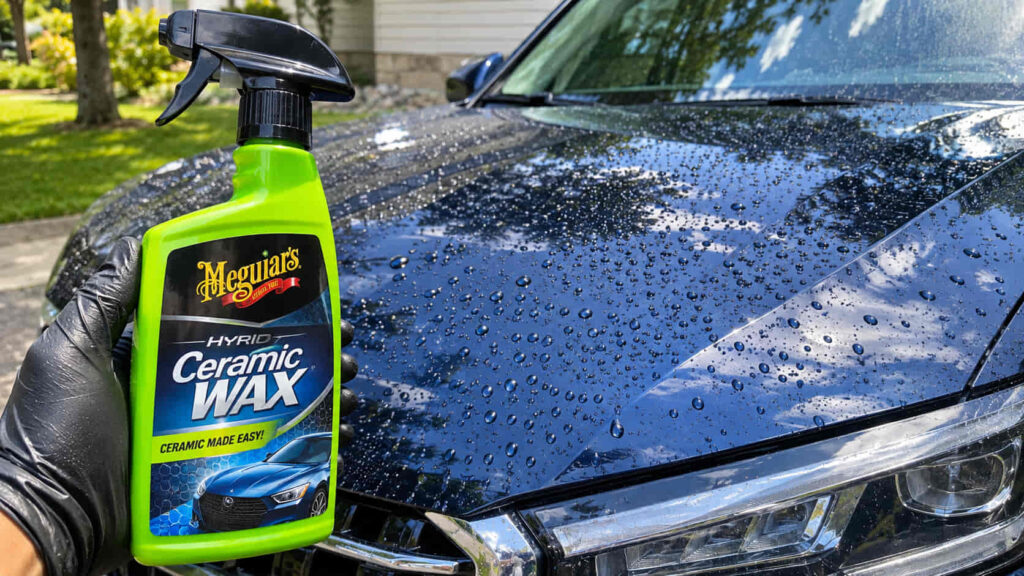
Meguiar’s Hybrid Ceramic Wax works well for improving water beading, enhancing paint gloss, and providing convenient protection during routine car maintenance. Its SiO2-based formula creates a hydrophobic layer that helps water roll off painted surfaces, while its spray-on, rinse-off application reduces the effort required compared with traditional hand-applied waxes. However, its durability depends on proper application, washing frequency, and environmental exposure, making it better suited to regular maintenance than long-term ceramic protection.
Meguiar’s Hybrid Ceramic Wax reviews highlight its strong water-repellent performance and convenient application, although users also report inconsistent longevity and occasional streaking. The product requires an initial foundation layer applied to clean, wet paint, while subsequent applications use a simplified spray-and-rinse method. Applying too much product or distributing it unevenly can leave visible residue, particularly on dark-colored vehicles.
This review examines Meguiar’s Hybrid Ceramic Wax G190526 based on its water beading, paint gloss, protection durability, application process, and documented customer experiences. It also evaluates common problems, compares the product with traditional waxes and ceramic coatings, and explains whether its performance justifies the purchase price. These findings help car owners determine whether this hybrid ceramic spray wax matches their detailing routine and paint protection expectations.
What Is Meguiar’s Hybrid Ceramic Wax?
Meguiar’s Hybrid Ceramic Wax is a SiO2-based spray wax designed to protect automotive paint, improve water repellency, and simplify routine vehicle maintenance. Available as product G190526 in a 26-ounce (768 mL) bottle, it uses hybrid ceramic technology containing silicon dioxide (SiO2) to create a hydrophobic protective layer. This layer encourages water to form droplets and roll off painted surfaces, helping reduce water accumulation during washing and rinsing.
The product’s defining feature is its spray-on, rinse-off application method, which eliminates the traditional process of spreading wax across dry paint and buffing away dried residue. After washing the vehicle, users apply the formula to wet paint and use a strong stream of water to distribute it evenly before drying with a microfiber towel. The initial treatment requires establishing a foundation layer, while subsequent applications follow a simplified maintenance process.
Unlike Meguiar’s Hybrid Ceramic Liquid Wax, which requires direct application and removal, the spray version relies on rinse water for distribution. Its primary purpose is to maintain paint protection and hydrophobic performance rather than remove scratches, correct oxidation, or replace professional paint correction.
Read more: acura rdx trim packages
Does Meguiar’s Hybrid Ceramic Wax Really Work?
Meguiar’s Hybrid Ceramic Wax works effectively as a water-repellent paint protectant, delivering noticeable water beading and improved surface appearance when applied correctly. Its SiO2-based formula creates a hydrophobic layer that reduces water adhesion, allowing droplets to form and move across painted surfaces more easily. This performance makes the product useful for maintaining a vehicle’s exterior between regular washes. However, its protective benefits depend on application quality, environmental exposure, and maintenance frequency rather than the presence of ceramic ingredients alone.
Independent user testing supports the product’s initial hydrophobic performance. In a January 2026 comparison of four spray-on, rinse-off sealants published in the AutoDetailing community, Meguiar’s Hybrid Ceramic Wax demonstrated strong water beading and was rated favorably against Sonax Spray + Seal, Nanoskin Supercharger, and Mother’s Ceramic Spray & Rinse. The reviewer considered its initial water-repellent performance comparable to Gyeon WetCoat, although this assessment came from an enthusiast test rather than controlled laboratory research. These observations support its effectiveness for short-term water repellency but do not establish superior long-term durability.
The product’s performance decreases with prolonged environmental exposure. In the same comparison’s 30-day follow-up, all four tested sealants showed substantially weaker hydrophobic behavior after exposure to rain, freezing temperatures, and outdoor contamination. None prevented water spots from forming, demonstrating that water repellency does not eliminate the need for regular washing. Other owners report longer-lasting results on garaged vehicles, indicating that storage conditions and maintenance significantly influence performance.
Meguiar’s Hybrid Ceramic Wax is therefore an effective option for drivers seeking convenient water-repellent protection during routine detailing. Its strongest verified advantage is visible hydrophobic performance, not permanent paint protection or scratch resistance. Owners who maintain their vehicles regularly are better positioned to preserve its benefits through periodic reapplication.
How Well Does Meguiar’s Hybrid Ceramic Wax Repel Water?
Meguiar’s Hybrid Ceramic Wax provides effective water repellency by creating a hydrophobic layer that encourages water to form droplets and move off automotive paint. Its SiO2-based formula modifies the surface’s interaction with water, reducing the tendency of moisture to spread into a continuous film. This effect becomes visible during rinsing or rainfall, when water collects into distinct beads instead of remaining evenly distributed across the paint.
Independent reviews confirm noticeable water beading, although the intensity varies with application conditions. In a hands-on review published by The Track Ahead, Scott Lam observed visible water beads and water runoff after applying the product using Meguiar’s spray-and-rinse method. However, he found the hydrophobic effect less pronounced than expected from certain traditional waxes and dedicated ceramic coatings. This demonstrates that the product delivers functional water repellency without necessarily producing the strongest hydrophobic performance in its category.
Water beading and water sheeting describe two different aspects of hydrophobic performance. Beading refers to water forming rounded droplets, while sheeting describes how efficiently water moves off a surface. Meguiar’s Hybrid Ceramic Wax supports both behaviors, but the results depend on paint condition, application coverage, and the amount of contamination present. Strong water beading does not guarantee faster drying or prevent mineral deposits from forming when droplets evaporate.
The product’s water-repellent performance is most useful for routine vehicle maintenance rather than permanent protection. Its hydrophobic layer can reduce the amount of water remaining after rinsing, particularly when water flows freely across properly maintained paint. However, regular washing and appropriate drying remain necessary because the protective layer cannot completely prevent water spots, road grime, or environmental contamination.
Does Meguiar’s Hybrid Ceramic Wax Improve Paint Gloss and Shine?
Meguiar’s Hybrid Ceramic Wax can enhance paint gloss and shine by leaving a smooth-looking protective finish that improves the appearance of clean, properly maintained paint. Its formula includes dimethicone, identified in Meguiar’s ingredient disclosure as a gloss enhancer, alongside other ingredients responsible for water repellency. The resulting finish can make reflections appear more consistent, particularly on vehicles with existing clear-coat gloss.
The improvement depends heavily on the condition of the underlying paint. A clean, polished surface already reflects light evenly, allowing the protective finish to complement its appearance. In contrast, paint affected by oxidation, embedded contaminants, or swirl marks will retain those imperfections after application. The product contains no dedicated abrasive polishing system and cannot remove scratches or restore damaged clear coat. For example, a black vehicle with visible swirl marks may gain a fresher-looking finish, but those defects will remain noticeable under direct sunlight.
Gloss enhancement is a secondary benefit rather than the product’s strongest distinguishing feature. Meguiar’s markets Hybrid Ceramic Wax as providing shine alongside hydrophobic protection, and long-term reviewer Jason Siu reports satisfactory results on glossy automotive finishes. However, available observations do not establish a consistent, measurable increase in gloss across different paint conditions. Buyers seeking maximum paint clarity should prioritize surface decontamination and polishing before applying a protective wax, while those maintaining paint already in good condition can use Hybrid Ceramic Wax to preserve its appearance.
How Long Does Meguiar’s Hybrid Ceramic Wax Last?
Meguiar’s Hybrid Ceramic Wax can maintain noticeable water-repellent performance for several weeks to approximately three months, depending on vehicle storage, weather exposure, and maintenance conditions. However, no fixed protection lifespan has been established through standardized independent testing. Vehicles parked outdoors generally experience faster deterioration in water beading than garage-kept vehicles because their painted surfaces encounter continuous sunlight, rainfall, airborne contamination, and temperature changes.
A February 2026 comparison found that Meguiar’s Hybrid Ceramic Wax lost substantial hydrophobic performance after 30 days of outdoor exposure. The test involved four spray-on, rinse-off sealants applied to separate panels exposed to rain, freezing temperatures, leaves, and environmental debris in Texas. All four products showed significant reductions in water beading, although some continued to shed water. This result demonstrates that strong initial water repellency does not guarantee consistent performance throughout extended outdoor exposure. However, reduced beading alone does not prove that the entire protective layer has disappeared.
Vehicle storage conditions have a measurable influence on reported durability. In the same detailing discussion, one Meguiar’s user reported more than three months of protection on garage-kept vehicles but approximately 30 days on vehicles parked outdoors. Another long-term reviewer, Jason Siu of Tunerzine, described satisfactory durability compared with competing spray waxes, although his review did not establish a controlled protection lifespan. These experiences indicate that maintenance habits and environmental conditions influence the interval between applications.
Reapplying Meguiar’s Hybrid Ceramic Wax every five to six weeks is a practical maintenance interval recommended in Meguiar’s New Zealand car-care guidance. This schedule is intended to maintain water repellency rather than guarantee that every application lasts exactly six weeks. Owners should assess water behavior after washing and consider reapplication when beading or sheeting becomes noticeably weaker. Regular cleaning, proper initial application, and periodic maintenance help preserve the product’s protective performance without relying on an unsupported long-term durability claim.
What Do Customers Say About Meguiar’s Hybrid Ceramic Wax?
Customer reviews of Meguiar’s Hybrid Ceramic Wax are generally positive, with buyers praising its water beading, paint shine, and convenient application while reporting mixed experiences with streaking and durability. Harbor Freight lists the product at 4.6 out of 5 stars based on 153 customer reviews, with 92% of reviewers recommending it. Advance Auto Parts reports a lower average of 4.11 out of 5 stars from 66 reviews, with 77% recommending the product. These ratings indicate favorable overall customer satisfaction, although differences between retailers show that the experience is not universally consistent.
Positive customer feedback frequently emphasizes the product’s hydrophobic performance and ease of maintenance. In a February 2025 discussion on Reddit’s AutoDetailing community, one truck owner reported strong water repellency, improved surface slickness, and no visible streaking after applying the wax to freshly washed paint. Verified Harbor Freight customers have similarly described noticeable water beading, improved shine, and straightforward application. One buyer reviewing the product in October 2026 highlighted its ease of use and satisfactory longevity, while another praised the visible water beads and glossy finish after treatment. These experiences suggest that the product delivers its most noticeable benefits when applied to clean paint using an appropriate drying method.
Negative reviews primarily involve streaking, uneven residue, and inconsistent application results. Some AutoDetailing users report difficulty removing visible streaks, particularly on dark-colored vehicles, even after reducing the amount of product applied. Other owners describe successful applications without these problems, indicating that technique, product quantity, and microfiber towel selection influence the outcome. Durability feedback also varies, with certain users reporting satisfactory protection across multiple washes while others prefer competing spray sealants for their longer-lasting hydrophobic performance.
Overall, customer feedback supports Meguiar’s Hybrid Ceramic Wax as a practical paint-maintenance product rather than a replacement for professional ceramic coatings. Its strongest reported advantages are visible water repellency, improved paint appearance, and convenient application after washing. However, retail ratings and individual experiences cannot establish a universal protection lifespan or guarantee streak-free results. Buyers who follow the recommended application instructions and maintain their vehicles regularly are better positioned to achieve the benefits described in positive reviews.
How Easy Is Meguiar’s Hybrid Ceramic Wax to Apply?
Meguiar’s Hybrid Ceramic Wax is easy to apply because it uses a spray-on, rinse-off process that eliminates the need for traditional wax applicators, extended curing periods, or intensive buffing. The product requires a clean, wet vehicle, a spray bottle, running water, and a quality microfiber drying towel. However, the first application differs from subsequent treatments because Meguiar’s recommends establishing a foundation layer before switching to its faster maintenance method.
The initial application requires spraying Hybrid Ceramic Wax onto clean, wet paint and drying it directly with a microfiber towel. After thoroughly washing and rinsing the vehicle, apply approximately two to three light sprays per panel while the paint remains wet. Use a clean microfiber towel to distribute the product and dry the surface without performing a second rinse. This process establishes an even foundation layer across the paint, providing a suitable base for future applications. The vehicle should remain cool and shaded throughout the procedure to prevent the product from drying prematurely.
Subsequent applications are faster because water distributes the protective formula across the vehicle. After washing and rinsing away the shampoo, spray a small amount of Hybrid Ceramic Wax onto the wet painted panels. Follow with a strong stream of water, working from the roof downward, to spread the product evenly before drying with a microfiber towel. Meguiar’s recommends this method for routine maintenance because it reduces direct wiping and simplifies the application process. For example, owners who wash their vehicles regularly can renew water-repellent protection during the normal rinsing and drying stages without adding a separate conventional waxing session.
Why Does Meguiar’s Hybrid Ceramic Wax Leave Streaks?
Meguiar’s Hybrid Ceramic Wax leaves streaks primarily when too much product is applied, the formula dries before removal, or residue is distributed unevenly across the paint. Streaking appears as cloudy patches, oily-looking marks, or irregular reflections, particularly on black and other dark-colored vehicles. These marks generally result from application problems rather than permanent paint damage. Meguiar’s specifically warns that excessive spraying makes the product more difficult to distribute and dry evenly.
Applying Hybrid Ceramic Wax in direct sunlight or on hot body panels increases the likelihood of visible residue. Heat accelerates moisture evaporation, allowing concentrated product to remain on the surface before it has been properly distributed or removed. Inadequate rinsing during maintenance applications can also leave excess material behind, while a saturated or contaminated microfiber towel may spread residue instead of removing it. For example, spraying several heavy coats onto a warm black hood and allowing them to dry before wiping can produce visible streaks even when the paint was clean before application.
Light streaking can usually be removed with a damp microfiber towel or a fine mist of water followed by gentle wiping. Meguiar’s recommends reintroducing a small amount of moisture to the affected area and wiping away the residue with a clean microfiber cloth. More persistent marks may require washing the affected panel again before applying a lighter amount of product. Preventing streaks is generally easier than correcting them: using approximately two to three light sprays per panel, working in the shade, rinsing thoroughly during maintenance applications, and drying promptly helps achieve a more uniform finish. These precautions are particularly important for owners with dark-colored vehicles, where uneven residue is easier to see.
What Are the Pros and Cons of Meguiar’s Hybrid Ceramic Wax?
The main advantages of Meguiar’s Hybrid Ceramic Wax are strong water repellency, convenient application, improved paint appearance, and affordable maintenance, while its disadvantages include inconsistent durability, potential streaking, and limited protection compared with dedicated ceramic coatings. These characteristics make it a practical choice for car owners who regularly wash their vehicles but less suitable for those seeking long-term protection with minimal maintenance.
One of the biggest advantages of Meguiar’s Hybrid Ceramic Wax is its ability to simplify paint protection without requiring specialized detailing equipment. Once the initial foundation layer is established, subsequent applications involve spraying the product onto wet paint, rinsing it with water, and drying the vehicle. Its SiO2-based formula creates noticeable hydrophobic behavior, helping water collect into droplets and flow across the painted surface. The product can also enhance the appearance of clean paint without requiring a separate waxing session. Customer reviews frequently highlight its ease of use, visible water beading, and satisfactory results for routine vehicle maintenance.
The primary disadvantage is that protection durability varies considerably with environmental exposure and maintenance conditions. In an August 2026 AutoDetailing discussion, one owner reported that the initial hydrophobic protection began weakening after approximately four weeks despite following the recommended application instructions. Other users reported longer-lasting performance when maintaining the protective layer through periodic reapplication. Streaking is another limitation, particularly when excessive product is applied or residue remains unevenly distributed. These problems can increase the time required to achieve a clean finish, reducing the convenience that makes the product attractive.
Meguiar’s Hybrid Ceramic Wax is most beneficial for drivers who prioritize easy application and regular paint maintenance over maximum coating durability. Its spray-on, rinse-off process reduces the effort associated with conventional waxing, while the protective finish provides useful water-repellent performance between washes. However, the product cannot correct scratches, remove oxidation, or provide the same long-term protection expected from a properly installed dedicated ceramic coating. Buyers seeking convenient hydrophobic maintenance will find its advantages relevant, while those requiring extended protection without frequent reapplication should consider more durable alternatives.
Is Meguiar’s Hybrid Ceramic Wax Worth the Money?
Meguiar’s Hybrid Ceramic Wax is worth the money for car owners who want effective water-repellent protection, convenient application, and improved paint appearance without investing in an expensive ceramic coating. The 26-ounce (768 mL) bottle typically retails for approximately $23 in the United States, although promotional discounts can reduce the purchase price. As of November 15, 2026, Meguiar’s Direct and O’Reilly Auto Parts list the product at $22.99, while Walmart advertises a discounted price of $17.59. This makes it an accessible option for drivers seeking routine paint protection.
The product delivers its strongest value through reduced application effort and convenient maintenance. Unlike traditional paste waxes that require manual spreading and buffing, Meguiar’s Hybrid Ceramic Wax uses a spray-on, rinse-off process after the initial foundation layer has been established. Its SiO2-based formula provides noticeable water beading and a glossy finish without requiring specialized detailing equipment. The 26-ounce bottle supports repeated applications, although the number of treatments depends on vehicle size, spray quantity, and application technique. For drivers who wash their vehicles regularly, integrating paint protection into the normal washing process provides a practical advantage over more labor-intensive products.
Long-term value depends on how frequently the protective layer requires renewal. Vehicles exposed to frequent rainfall, road contamination, and outdoor parking may need more regular applications to maintain strong hydrophobic performance. Although repeated treatments increase product consumption, the relatively affordable purchase price and simplified application process help offset this limitation. However, buyers seeking protection that lasts for many months without maintenance may find a more durable synthetic sealant or dedicated ceramic coating better suited to their requirements.
Overall, Meguiar’s Hybrid Ceramic Wax offers good value for DIY car owners who prioritize convenience, water repellency, and affordable maintenance. Its strongest benefit is making routine paint protection easier rather than delivering the longest possible durability. Buyers willing to reapply the product periodically can obtain useful hydrophobic protection at a reasonable cost, while those expecting permanent ceramic protection should consider alternatives designed for longer service intervals.
How Does Meguiar’s Hybrid Ceramic Wax Compare to Traditional Wax and Ceramic Coatings?
Meguiar’s Hybrid Ceramic Wax combines the convenient application of a spray wax with SiO2-based water repellency, while traditional waxes emphasize surface gloss and dedicated ceramic coatings provide longer-lasting protection. Its hybrid formula contains SiO2 within a polymer-based system, delivering some hydrophobic characteristics associated with ceramic coatings without requiring the same preparation, application process, or curing time. However, its protective layer is not equivalent to a professionally applied ceramic coating.
Traditional carnauba wax generally requires more direct application and removal than Meguiar’s Hybrid Ceramic Wax. Paste and liquid waxes are typically spread across clean paint, allowed to haze according to product instructions, and buffed with a microfiber towel. Meguiar’s Hybrid Ceramic Wax instead establishes its initial protective layer during microfiber drying, while subsequent treatments use a spray-on, rinse-off method. Conventional carnauba waxes are valued for their warm, glossy finish, whereas Meguiar’s emphasizes water beading and convenient maintenance. Protection longevity varies by formulation, so traditional waxes should not be treated as having one fixed durability rating.
Dedicated ceramic coatings generally provide longer-lasting paint protection because their formulations are designed to form a more persistent protective layer on properly prepared surfaces. Professional and consumer ceramic coatings require thorough cleaning, surface preparation, controlled application, and curing according to the manufacturer’s instructions. Depending on the formulation and maintenance conditions, their protection can extend substantially beyond that of routine spray waxes. Meguiar’s Hybrid Ceramic Wax does not require a comparable coating installation process, but its easier application comes with the expectation of more frequent maintenance. Neither treatment makes paint completely scratch-proof or eliminates the need for washing.
Meguiar’s Hybrid Ceramic Wax is the more practical option for drivers who prioritize application speed and regular maintenance, while dedicated ceramic coatings better suit buyers seeking extended protection. A driver who washes a vehicle every few weeks can incorporate Hybrid Ceramic Wax into the existing cleaning routine without scheduling a separate coating application. In contrast, an owner seeking longer service intervals may prefer a properly installed ceramic coating despite its higher initial cost and preparation requirements. Traditional wax remains an alternative for drivers who enjoy manual detailing and prefer its particular finish characteristics.
How Does Meguiar’s Hybrid Ceramic Wax Compare to Other Ceramic Spray Waxes?
Meguiar’s Hybrid Ceramic Wax competes closely with Gyeon Q²M WetCoat and Sonax Spray + Seal in water repellency and application convenience, while Turtle Wax Hybrid Solutions Ceramic Spray Coating offers a different application method and durability proposition. All four products are designed to improve paint protection and hydrophobic performance, but they differ in surface preparation, application technique, and maintenance requirements. Meguiar’s is particularly suitable for drivers who prefer a spray-and-rinse product that integrates into regular car washing.
Gyeon Q²M WetCoat is one of the closest alternatives to Meguiar’s Hybrid Ceramic Wax because both products are applied to wet surfaces and distributed with rinse water. Gyeon recommends applying one or two sprays per panel and rinsing immediately with strong water pressure. Unlike Meguiar’s, WetCoat does not require a separate foundation-layer application. Gyeon claims protection lasting up to 12 weeks, depending on conditions, and identifies compatibility with paint, glass, plastic trim, and wheels. These characteristics make WetCoat attractive to owners seeking a single rinse-off product for multiple exterior surfaces.
Sonax Spray + Seal provides similar wash-stage convenience, with an emphasis on maintaining existing paint protection and improving surface smoothness. Sonax recommends spraying the product sparingly onto wet panels, rinsing immediately, and drying with a microfiber towel. In a January 2026 enthusiast comparison involving four spray-on, rinse-off sealants, Meguiar’s Hybrid Ceramic Wax received favorable marks for initial water beading and purchase value compared with Sonax Spray + Seal and the other tested products. However, the 30-day follow-up showed declining hydrophobic performance across the tested sealants, preventing a definitive conclusion about long-term superiority.
Turtle Wax Hybrid Solutions Ceramic Spray Coating differs because it is applied directly to dry paint and buffed with a microfiber towel rather than distributed through a second rinse. Turtle Wax recommends allowing 24 hours before applying an optional second coat for maximum protection. The manufacturer promotes extended durability, but its claims should not be interpreted as independently verified superiority over Meguiar’s. Buyers who prefer direct application and additional finishing control may favor Turtle Wax, while those prioritizing convenient maintenance after washing may find Meguiar’s, Gyeon, or Sonax more practical.
Meguiar’s Hybrid Ceramic Wax remains a competitive choice for affordable, water-repellent maintenance, but the best alternative depends on application preferences and protection expectations. Gyeon WetCoat offers straightforward rinse-off application and broad exterior-surface compatibility, Sonax Spray + Seal emphasizes convenient sealant maintenance, and Turtle Wax Ceramic Spray Coating suits drivers willing to perform a separate wipe-and-buff treatment. Without controlled testing under identical conditions, no single product can be established as the most durable or effective across all vehicles.
Can Meguiar’s Hybrid Ceramic Wax Be Applied Over Existing Wax or Ceramic Coatings?
Meguiar’s Hybrid Ceramic Wax can be applied over existing carnauba wax, synthetic paint sealants, and ceramic coatings without removing the original protective layer. Meguiar’s confirms that its SiO2-based formula is compatible with these paint-protection products and can function as a supplementary maintenance layer. This allows vehicle owners to improve water repellency between detailing sessions without stripping previously applied protection.
Applying Hybrid Ceramic Wax over an existing coating adds a hydrophobic maintenance layer rather than replacing the original treatment. For example, a vehicle protected with a ceramic coating can receive Hybrid Ceramic Wax after washing to refresh its water-beading behavior. Similarly, owners using traditional carnauba wax can apply the spray product to maintain surface protection between waxing sessions. However, applying additional wax does not repair a damaged coating, remove embedded contaminants, or guarantee an extension of the underlying coating’s original lifespan.
The product is primarily intended for automotive paint, and compatibility with other exterior materials should not be assumed to provide identical results. Meguiar’s advises against using conventional paint-protection products on windshields because their bonding behavior differs on glass and excessive residue can cause streaking that affects visibility. Owners should therefore follow the manufacturer’s surface-specific recommendations instead of treating Hybrid Ceramic Wax as a universal glass, plastic, or trim coating.
Who Should Buy Meguiar’s Hybrid Ceramic Wax?
Meguiar’s Hybrid Ceramic Wax is best suited to DIY car owners who want convenient water-repellent protection, improved paint appearance, and an affordable product for regular vehicle maintenance. Its spray-on, rinse-off application makes it particularly useful for drivers who wash their vehicles frequently and prefer to maintain existing protection without performing a complete hand-waxing treatment. The 26-ounce bottle also provides an accessible starting point for buyers interested in SiO2-based paint protection without investing in specialized coating equipment.
Drivers who prioritize easy maintenance and visible water beading will benefit most from Hybrid Ceramic Wax. For example, an owner who washes a daily-driven vehicle every two to four weeks can incorporate the product into the rinsing process after establishing the initial foundation layer. Its hydrophobic finish helps water move across the paint during washing and rainfall, while the straightforward application reduces the effort associated with traditional waxing. The product is also suitable for maintaining cars that already have conventional wax, synthetic sealant, or ceramic coating protection.
Meguiar’s Hybrid Ceramic Wax is less suitable for buyers seeking extended protection without regular reapplication. Vehicles exposed continuously to harsh weather, road contamination, and frequent washing may experience a faster decline in hydrophobic performance. Owners expecting professional ceramic coating durability, paint scratch correction, or permanent water-spot prevention should choose products specifically designed for those purposes. Improper application can also produce streaking, particularly on dark paint, making careful product distribution and drying important.
Overall, Meguiar’s Hybrid Ceramic Wax is worth buying for convenient hydrophobic maintenance, but it should not be considered a substitute for a long-lasting ceramic coating. Its strongest advantages are ease of use, noticeable water repellency, and compatibility with existing paint protection. Buyers willing to maintain the finish periodically can achieve useful results without complicated detailing procedures. Those who prioritize maximum durability and minimal maintenance should consider a dedicated ceramic coating or longer-lasting paint sealant instead.