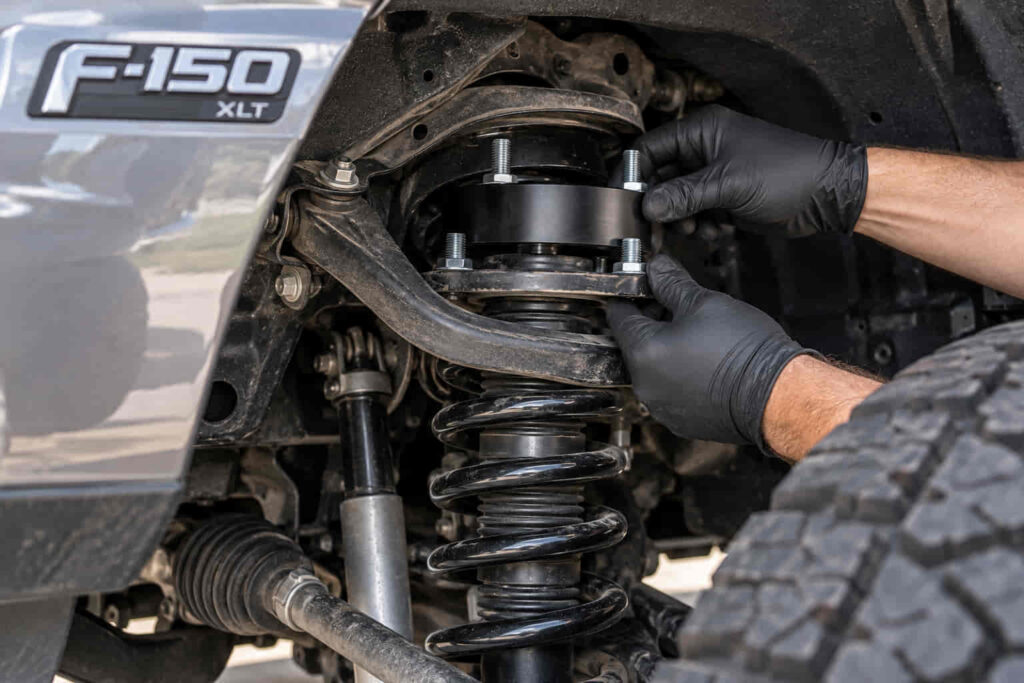
Installing a leveling spacer on a Ford F-150 is a common way to reduce the factory front-to-rear stance and create a more level appearance without replacing the entire suspension system. A properly installed spacer can raise the front of the truck by a specified amount, improve the visual balance of the vehicle, and provide additional clearance for certain wheel and tire combinations. However, the installation process involves components that are under suspension load, so the correct procedure depends on the F-150 model year, suspension configuration, spacer design, and installation method.
Ford F150 leveling spacer install steps generally involve safely lifting and supporting the truck, removing the necessary front suspension components, installing the spacer in its intended position, reassembling the suspension, and checking the vehicle after installation. The exact sequence can vary between top-mounted strut spacers, spring spacers, preload spacers, and other leveling systems. Because of these differences, the spacer manufacturer’s instructions and the service procedure for the specific F-150 should always take priority over a generic installation sequence.
This guide explains the main stages involved in installing a Ford F150 leveling spacer, how the spacer changes the front suspension geometry, what tools and preparation may be required, and what should be checked after installation.
What Is a Ford F150 Leveling Spacer?
A Ford F150 leveling spacer is a suspension component designed to increase the ride height at the front of the truck. The F-150 is commonly manufactured with a noticeable difference between the front and rear ride height, partly to accommodate payload and normal truck operation. A leveling kit changes this stance by raising the front suspension rather than substantially lowering the rear.
A leveling spacer can be installed in different locations depending on the suspension design and the kit. Some products are mounted above the factory strut assembly, while others interact with the spring or use a different mounting arrangement. Although these products are all marketed as leveling spacers, they do not necessarily produce the same changes in suspension geometry or ride characteristics.
The amount of lift is another important attribute. A small spacer may provide a modest front-height increase, while a larger spacer produces a more noticeable change and can have a greater effect on suspension angles. The advertised spacer thickness should not automatically be interpreted as the exact amount of front lift because the relationship between spacer dimensions and final ride height depends on the suspension design.
How Ford F150 Leveling Spacers Work
The basic purpose of a leveling spacer is to reposition the front suspension at a higher ride height. By adding material at the appropriate point in the strut or spring assembly, the spacer changes the installed position of the suspension component and increases front ride height.
This changes more than the visual stance of the truck. Raising the front suspension can alter alignment angles, suspension travel, and the relationship between components such as the upper control arm, steering knuckle, and strut. The effect depends on how much the truck is raised and where the spacer is installed.
For this reason, a leveling spacer should be treated as a suspension modification rather than simply an appearance accessory. The final installation needs to preserve proper component engagement, maintain adequate clearance, and allow the suspension and steering components to operate through their intended range of motion.
What to Check Before Installing a Ford F150 Leveling Spacer
Before beginning the installation, confirm that the spacer is designed for the exact F-150 model year and suspension configuration. Ford F-150 suspension systems have changed across generations, and differences can also exist between two-wheel-drive and four-wheel-drive configurations, trim levels, factory suspension packages, and other equipment.
The spacer’s installation position should also be confirmed before disassembling the vehicle. A top-mounted strut spacer requires a different procedure from a spring-mounted or preload-style spacer. The kit should include the appropriate hardware and installation instructions, and the installer should understand whether any factory components need to be reused.
The vehicle should be inspected for existing suspension problems before installation. Worn ball joints, damaged control arms, leaking struts, deteriorated bushings, or other suspension issues should not be concealed by installing a leveling kit. Raising a vehicle with worn components can make existing problems more significant.
The workspace is equally important. Suspension installation requires the truck to be securely supported, with the appropriate lifting equipment and enough room to remove and reinstall the necessary components. A hydraulic jack should not be considered a substitute for properly rated jack stands when working underneath the vehicle.
Ford F150 Leveling Spacer Install Steps
The installation begins with preparing the F-150 and safely supporting the vehicle so that the front suspension can be unloaded. The wheels are removed after the truck is securely supported, providing access to the strut and related suspension components. Before loosening any suspension hardware, it is important to understand which components are carrying spring or suspension load and which fasteners must remain controlled during removal.
The next stage involves disconnecting the components necessary to remove the factory strut or spring assembly. Depending on the F-150 configuration and leveling spacer design, this may involve removing or loosening the upper strut mounting hardware, lower strut attachment, sway bar connection, brake line brackets, or other components that restrict removal. Not every installation requires all of these components to be disconnected, so the kit-specific procedure should determine the actual sequence.
Once the factory assembly is removed, the leveling spacer is positioned according to the manufacturer’s instructions. A top-mounted spacer is typically installed between the factory strut assembly and the vehicle mounting location, while other designs may be installed in a different part of the suspension. The orientation of the spacer matters because incorrect positioning can interfere with suspension movement or prevent the mounting hardware from seating correctly.
After the spacer is installed, the strut or spring assembly is returned to the truck and the mounting hardware is reinstalled. The suspension components should be aligned naturally rather than forced into position. Fasteners should be tightened according to the specified torque values for the particular vehicle and kit, because incorrect torque can affect both component security and suspension performance.
The wheels are then reinstalled and the vehicle is lowered carefully. After the truck is back on the ground, the suspension should be allowed to settle before measuring the final ride height. The steering should be checked through its available range of movement, and the installer should verify that the brake lines, ABS wiring, control arms, tires, and other nearby components have adequate clearance.
How the Leveling Spacer Affects Front Suspension Geometry
Raising the front of an F-150 changes the operating angles of several suspension and steering components. The exact effect depends on the amount of lift and the suspension architecture, but changes can occur in alignment values such as camber and caster as well as in the working angle of suspension components.
This is why a wheel alignment is normally an important part of completing a leveling spacer installation. Even if the truck drives normally immediately after installation, the alignment can change when ride height changes. An alignment helps restore the wheel angles to the appropriate specifications for the vehicle and ensures that the tires contact the road correctly.
Larger leveling spacers can produce more pronounced geometry changes. The installer should therefore consider the intended lift height rather than assuming that every leveling kit has the same effect. If a particular kit requires additional suspension components or alignment correction, those requirements should be addressed as part of the installation rather than after problems appear.
Read more: Ford F150 Onboard Scales Calibration
What Happens After Installing a Ford F150 Leveling Spacer?
The truck may sit differently immediately after installation, but the final ride height should be evaluated after the suspension has settled. Measuring the truck before and after installation provides a more meaningful way to determine the actual change than relying only on the advertised spacer thickness.
A wheel alignment should be performed after the suspension modification. The alignment technician can check the front suspension angles and determine whether they can be brought within the appropriate specifications using the factory adjustment range or whether additional components are required.
The first drive should be treated as a verification period. Steering response, unusual noises, vibration, tire clearance, and suspension behavior should be monitored. The wheel and suspension hardware should also be rechecked according to the kit manufacturer’s instructions after the initial driving period.
Ford F150 Leveling Spacer Compatibility
Compatibility is one of the most important considerations when choosing a leveling spacer. An F-150 leveling spacer is not automatically universal across every model year, trim, cab configuration, or drivetrain.
The correct application can depend on the front suspension design, factory ride height, four-wheel-drive or two-wheel-drive configuration, and whether the truck has a special suspension package. Model year should therefore be verified before purchasing a spacer, and the product’s fitment information should be compared with the exact vehicle configuration.
Wheel and tire fitment should also be considered. A leveling kit can create additional front-end clearance, but it does not guarantee that any particular tire size will fit without rubbing. Tire width, wheel offset, backspacing, suspension travel, and the amount of leveling all influence final clearance.
Common Problems After F150 Leveling Spacer Installation
Incorrect installation can lead to several symptoms. Uneven ride height may indicate an installation or component issue, while unusual suspension noise can result from improperly seated components, incorrect hardware installation, or interference between suspension parts.
Changes in steering feel or tire wear can be related to wheel alignment. Because raising the front suspension changes geometry, driving for an extended period without checking alignment can result in uneven tire wear or less-than-optimal handling.
Clearance problems are another consideration. A tire that appears to fit while the truck is stationary may contact a suspension component, fender liner, or other structure when the steering is turned or the suspension compresses. Clearance should therefore be checked through the relevant steering and suspension movement rather than only by looking at the truck while parked.
If a newly installed leveling spacer causes persistent clunking, vibration, abnormal steering behavior, or visible component interference, the vehicle should be inspected before continued use. These symptoms should not be considered a normal consequence of leveling the truck.
Do You Need an Alignment After Installing a Leveling Spacer?
A front-end alignment is an important part of completing a leveling spacer installation because changing ride height can alter suspension geometry. Even when a spacer is advertised as a simple bolt-on modification, the vehicle’s wheel angles can change when the front suspension is raised.
The alignment should be performed after installation and after the suspension has settled. The technician can then measure the current geometry and make the appropriate adjustments for the specific F-150.
Alignment is also useful as a diagnostic step. If the suspension cannot be brought within the appropriate adjustment range, the result may indicate that the leveling height, existing suspension condition, or combination of aftermarket components needs further attention.
Ford F150 Leveling Spacer Installation Safety
A leveling spacer installation involves suspension components that can store significant mechanical energy. The most important part of the procedure is therefore controlling the vehicle and suspension safely during disassembly and reassembly.
The F-150 must be supported by equipment rated for the vehicle, and the suspension should never be disassembled without understanding where spring and strut forces are being retained. If the installation requires compressing a factory coil spring or disassembling a strut assembly, the appropriate spring-compression equipment and procedure are essential.
The manufacturer’s torque specifications should also be followed rather than relying on general estimates. Suspension fasteners perform structural functions, and both under-tightening and over-tightening can create safety problems.
A professional installation may be appropriate when the procedure requires strut disassembly, spring compression, specialized tools, or suspension modifications beyond the installer’s experience. The goal of a leveling kit is to improve the truck’s stance and functionality without compromising the integrity of the suspension system.
Frequently Asked Questions About Ford F150 Leveling Spacer Install Steps
How long does it take to install a Ford F150 leveling spacer?
Installation time depends on the F-150 configuration, spacer design, available tools, and whether the factory strut or spring assembly must be disassembled. A simple bolt-on design can require less work than a spacer that requires suspension or strut disassembly.
Do I need to remove the strut to install an F150 leveling spacer?
It depends on the spacer design. Some spacers are installed above the complete strut assembly, while other leveling systems require partial or complete disassembly of suspension components. The manufacturer’s installation instructions determine the required procedure.
Does a leveling spacer affect ride quality?
It can. The effect depends on the spacer design, lift height, and condition of the original suspension. A leveling spacer that changes the operating position of the suspension can also affect available travel and component angles.
Will a Ford F150 leveling spacer change alignment?
Raising the front suspension can change alignment geometry. A wheel alignment after installation is therefore an important part of completing the modification.
Can I install a Ford F150 leveling spacer myself?
A mechanically experienced owner with the appropriate tools and a safe work environment may be able to perform some installations. However, procedures involving spring or strut disassembly require specialized equipment and an understanding of suspension safety.
Does a leveling spacer increase tire clearance?
It can increase available front-end clearance by raising the front of the truck, but the amount of usable clearance depends on tire dimensions, wheel offset, suspension travel, and the specific F-150 configuration. A leveling spacer does not guarantee that a particular wheel and tire combination will fit without rubbing.