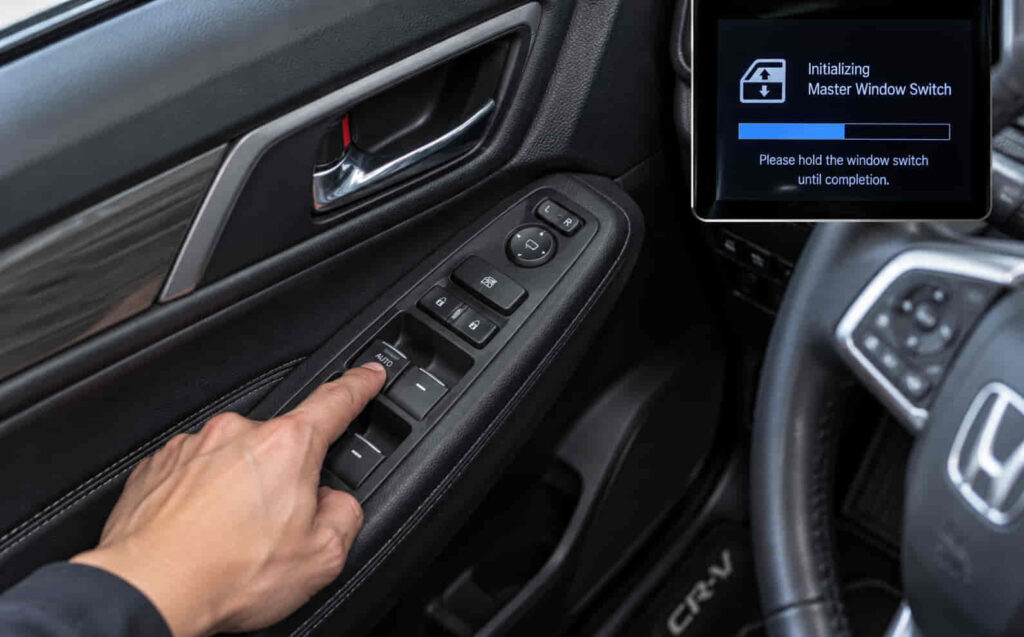
Programming a Honda CR-V master window switch usually means initializing or relearning the power window system so functions such as automatic window operation work correctly, rather than installing new software in the switch. This procedure can become relevant after master switch replacement, certain power interruptions, or repairs involving the power window system.
The important distinction is between a window that has lost an initialized function and a window system with an electrical or mechanical failure. If the glass still moves when the switch is held manually but the AUTO function no longer operates correctly, initialization can be part of the appropriate diagnostic path. If the window does not move at all, repeatedly performing a reset may not solve the problem because the fault can involve the switch, power supply, wiring, window motor, regulator, or another part of the control system.
The exact reset or relearn procedure should also be matched to the Honda CR-V model year and system configuration. A sequence that works on one generation should not automatically be treated as a universal programming method for every CR-V.
This guide explains what Honda CR-V master window switch programming means, when initialization is needed, how the reset and relearn process works, how to verify the AUTO window function, and what to diagnose when programming does not restore normal operation.
What Does Honda CR-V Master Window Switch Programming Mean?
Honda CR-V master window switch programming generally refers to initializing or relearning the power window control function so the system can operate its automatic window features correctly. In this context, “programming” does not necessarily mean loading software into the master switch or coding a replacement module with a scan tool. The term is commonly used to describe a reset or initialization process performed through the power window system.
The distinction matters because the master window switch does more than provide a simple command to move the glass up or down. On CR-V configurations equipped with automatic window operation, the control system must manage functions that allow the window to continue moving after the driver activates the AUTO position of the switch. Normal manual movement and automatic movement are therefore related functions but are not identical operating modes.
Initialization establishes the operating state required for these automatic functions after that state has been lost or disrupted. The procedure typically involves controlled operation of the window through specified positions so the relevant power window control system can establish the information required for normal operation. The exact sequence depends on the CR-V model year and system design, which is why a reset method should be matched to the specific vehicle rather than copied from an unrelated Honda model.
The terms reset, relearn, initialization, and programming can describe overlapping processes in owner discussions, repair information, and search queries. “Reset” usually describes restoring the system after a learned function has been lost, while “relearn” emphasizes establishing the required window operating information again. “Initialization” is the more precise concept when the system requires a defined procedure before automatic operation can function normally.
This terminology should not be confused with replacement. Installing a new master window switch changes a physical component, while initialization establishes the operating state required by the power window system when applicable. A correctly installed replacement can therefore still require a relearn procedure before all automatic functions operate as expected.
Programming should also not be treated as a universal repair for every window complaint. Initialization can restore a lost learned function, but it cannot repair worn switch contacts, damaged wiring, a failed window motor, a mechanical regulator problem, or a missing power supply. Those conditions require diagnosis of the component or circuit responsible for the failure.
Honda CR-V master window switch programming is therefore best understood as a functional initialization or relearn process, not automatically as software coding. Establishing that distinction prevents unnecessary replacement or repeated reset attempts when the actual problem is electrical or mechanical.
When Does a Honda CR-V Master Window Switch Need to Be Reset or Relearned?
A Honda CR-V master window switch or power window system may need initialization when an event has disrupted the learned state required for automatic window operation, particularly when the AUTO function stops working even though the window can still move manually. The need for a reset should be determined from the vehicle’s model year, system configuration, recent repair history, and actual symptoms.
Master window switch replacement is one context in which initialization should be considered. Installing another switch restores the physical control interface, but the power window system may still need the applicable initialization procedure before automatic operation is restored. This is why a replacement can appear partly successful: the window may respond when the switch is held while AUTO UP or AUTO DOWN does not behave normally.
Repairs involving the power window system can create a similar situation. Work involving relevant window components or control functions can require the system to establish its operating state again. The important diagnostic clue is the relationship between the repair event and the change in window behavior. If an automatic function worked before service and stopped afterward while basic manual movement remains available, initialization becomes more relevant to the diagnostic path.
A power interruption can also be relevant on systems whose learned state is affected by loss of power. However, battery disconnection should not be treated as proof that every Honda CR-V automatically requires the same master window switch reset. Power window designs vary by model year and configuration, so the applicable service procedure should determine whether initialization is required for that vehicle.
The symptom pattern is more useful than the word “programming” alone. A window that moves normally while the switch is held but no longer completes an automatic up or down cycle suggests a different problem from a window that does not respond to the switch at all. The first condition can support checking initialization. The second requires a broader examination of power supply, switch input, wiring, motor operation, regulator condition, and other relevant components.
Repeated loss of the learned function also deserves diagnosis rather than repeated resetting. If initialization restores AUTO operation temporarily but the function disappears again, the reset itself may not be the root solution. A recurring condition indicates that the system should be evaluated for the reason the expected operation is not being retained or completed.
The same principle applies after installing a replacement master switch. Initialization cannot compensate for an incompatible part, poor electrical connection, damaged connector, or defective replacement component. The correct switch must first communicate and operate properly within the vehicle’s power window system before a relearn procedure can restore applicable automatic functions.
A Honda CR-V power window reset is most appropriate when the system can operate the window but has lost an initialized automatic function after a relevant power or repair event. When basic window movement is absent or the reset repeatedly fails, the diagnostic path should expand beyond programming instead of assuming another relearn attempt will correct the fault.
Read more: Honda CRV Engine Splash Shield
What Are the Signs That the Honda CR-V Window System Needs Initialization?
The clearest sign that a Honda CR-V power window may need initialization is that the window still moves when the switch is operated manually, but an automatic function such as AUTO UP or AUTO DOWN no longer works as expected. This symptom indicates that basic window movement remains available while the control function associated with automatic operation may not be properly initialized.
Manual operation provides an important diagnostic distinction. When holding the switch causes the glass to travel normally through its range, the window motor and regulator are at least capable of producing movement under those conditions. If releasing the switch stops the glass instead of allowing the expected automatic cycle to continue, the problem is more closely associated with the automatic control function than with a complete loss of window operation.
Timing can strengthen the case for initialization. If AUTO operation changes immediately after master switch replacement, relevant window-system service, or another event that can affect the system’s initialized state, a relearn procedure becomes a logical early step. The relationship between the event and the symptom provides more useful diagnostic information than simply assuming that every power window problem requires programming.
Another indication is a window system that begins operating differently after a repair even though no obvious mechanical problem is present. For example, normal switch-held movement combined with loss of a previously functioning automatic mode points toward a control-state issue before it points toward complete motor or regulator failure. Initialization can then be used to determine whether restoring the learned function returns the system to normal operation.
A completely unresponsive window presents a different diagnostic pattern. If the glass does not move when the switch is held in either direction, the system has not demonstrated the basic operation needed to treat lost AUTO functionality as the only problem. Power supply, fuse protection, switch input, electrical connectors, wiring, window motor, regulator, and related control components can become relevant depending on the specific CR-V and symptom.
Intermittent or mechanically abnormal movement should also not be reduced to an initialization problem. A window that moves slowly, binds, tilts, makes abnormal mechanical noise, or stops at inconsistent physical positions can have a problem involving the glass run channel, regulator, motor, or another mechanical component. Relearning an automatic function does not correct physical resistance or damaged window hardware.
Repeated failure after a successful reset provides another useful distinction. If the AUTO function returns immediately after initialization but repeatedly disappears, the procedure has demonstrated that the system can perform the function under some conditions. The next diagnostic question is why the expected operation is not being retained rather than how many times the same reset can be repeated.
Initialization is therefore most relevant when basic Honda CR-V window movement remains functional but the expected automatic behavior has been lost, especially after a related service or power event. When manual movement is absent or the window shows mechanical symptoms, diagnosis should extend beyond the master window switch reset.
How Do You Program or Reset a Honda CR-V Master Window Switch?
To program or reset a Honda CR-V master window switch, the applicable power window initialization procedure must be completed so the system can relearn the operating information required for its automatic function. The exact sequence should be matched to the CR-V model year and power window system because Honda has used different system configurations across generations.
The underlying principle is controlled window operation rather than software installation. During initialization, the relevant window is operated through specified movement using the window switch so the control system can establish the information it needs for normal automatic operation. This is why the process is commonly called programming even though it may not involve connecting a programming device or loading software into the switch.
Before attempting initialization, basic window operation should be confirmed. The glass needs to respond appropriately to manual switch commands because a relearn procedure depends on the system being able to move the window through the required travel. If the motor does not operate or the window cannot move normally because of a mechanical problem, the initialization sequence cannot substitute for repairing that fault.
The vehicle should then be placed in the operating condition specified by the applicable Honda procedure. The driver’s window switch is used to move the window according to the required sequence, typically involving defined fully open and fully closed positions and specific switch operation. The important point is to follow the sequence for the particular CR-V rather than combining instructions from different model years or other Honda vehicles.
Switch operation during this process matters because manual and AUTO switch positions represent different inputs. A procedure that requires the switch to be held in a defined position must be performed as specified rather than replaced with a quick AUTO command. Releasing the switch too early or changing the sequence can prevent the system from completing initialization even when every component is functional.
The fully open and fully closed positions are significant because they provide defined points in the window’s travel. If the glass cannot reach the required position because it binds, stops early, or encounters a mechanical problem, the system may not complete the relearn successfully. A failed initialization in that situation should lead to inspection of window operation rather than repeated attempts to force the programming sequence.
After the applicable procedure is completed, AUTO operation should be tested instead of assuming that the reset succeeded. The window should respond normally to manual commands and perform the automatic functions provided by that vehicle configuration. Verification is part of the programming process because it establishes whether the learned operation was actually restored.
If AUTO operation remains unavailable, the procedure should first be checked against the exact CR-V model year and system configuration. Using an initialization method intended for another generation can produce an apparent programming failure even when the master switch and window hardware are functioning normally.
If the correct procedure has been confirmed and repeated initialization still fails, the problem should no longer be treated as a reset-only issue. The diagnostic path then expands to switch installation and compatibility, electrical connections, power supply, wiring, window motor operation, regulator movement, and other system-specific causes.
The correct Honda CR-V master window switch programming method is therefore a vehicle-specific initialization process: confirm that the window can operate normally, perform the prescribed window-travel and switch sequence, and then verify that the applicable AUTO function has been restored. Programming should be considered successful only when normal window behavior returns, not simply because the reset sequence was completed.
How Do You Relearn the Honda CR-V Auto-Up and Auto-Down Window Function?
Relearning the Honda CR-V AUTO UP and AUTO DOWN window function requires completing the applicable power window initialization procedure and then confirming that the window can complete automatic travel without the switch being held continuously. The exact relearn sequence depends on the CR-V model year and power window configuration, so the procedure for the specific vehicle should take priority over a generic reset method.
The difference between manual and automatic switch operation is central to the relearn process. In manual mode, the window moves while the driver continues to hold the switch. In AUTO mode, the control system recognizes a different switch input and continues operating the window after the driver releases the switch. A CR-V can therefore retain manual window movement while losing the initialized function required for automatic operation.
Relearning restores this relationship when the applicable system has lost its initialized state. The window is operated through the movement required by the vehicle-specific procedure so the control system can establish the information necessary for automatic operation. Fully open and fully closed positions can be important during this process because they provide defined points within the window’s travel.
The window must be mechanically capable of completing the required movement before a relearn can succeed. A regulator that binds, a glass channel that creates excessive resistance, or another mechanical condition that prevents consistent travel can interfere with initialization. In that situation, repeatedly performing the switch sequence addresses the control function without correcting the physical reason the window cannot move normally.
Switch input must also be consistent with the prescribed procedure. Manual and AUTO positions should not be treated as interchangeable during initialization because they represent different commands to the power window system. If the procedure specifies controlled manual movement or requires the switch to remain operated at a particular stage, using a quick AUTO input instead can prevent the relearn from being completed as intended.
After initialization, the AUTO function should be tested independently from manual movement. The window should first demonstrate normal controlled movement when the switch is held. The applicable automatic function can then be activated to determine whether the glass continues through the expected travel after the switch is released. Successful manual operation alone does not establish that AUTO relearn has succeeded.
The available automatic functions can differ with vehicle configuration, so the verification should be based on the functions the specific CR-V is equipped to perform. A feature that is not provided by that configuration should not be used as a test for programming failure.
If AUTO UP or AUTO DOWN remains unavailable after the correct initialization procedure, the next step is to determine whether the procedure was completed correctly and whether the window can travel normally through its full required range. If both conditions are confirmed, diagnosis should expand to the master switch, electrical connections, power window control components, motor operation, and related circuitry rather than repeatedly performing the same relearn.
The Honda CR-V AUTO window relearn is successful when the system progresses from normal manual window movement to the expected automatic operation for that vehicle configuration. The purpose of the procedure is not merely to cycle the glass up and down but to restore the control state that allows the AUTO function to operate correctly.
How Do You Know If the Master Window Switch Programming Was Successful?
Honda CR-V master window switch programming is successful when the window operates normally in manual mode and the applicable AUTO UP or AUTO DOWN function works consistently after the initialization procedure. Completing the reset sequence is not sufficient evidence by itself; successful programming is established by the resulting window behavior.
Manual operation provides the first functional check. The glass should respond predictably when the switch is held and should travel in the commanded direction without abnormal stopping, binding, or inconsistent movement. This confirms that the system can perform the basic window movement required before automatic operation is evaluated.
The AUTO function provides the more specific verification of initialization. When the applicable AUTO position is activated correctly, the window should continue through its intended automatic movement after the switch is released. If the driver must continue holding the switch for the entire travel, manual operation is present but the automatic function has not been demonstrated.
Consistency is also important. A programming procedure should restore normal operation rather than produce a one-time successful movement that cannot be repeated. Testing the applicable function again helps distinguish a properly initialized system from an intermittent condition.
The result should remain normal through subsequent vehicle operation when the system has not experienced another event that requires initialization. If the AUTO function repeatedly disappears after apparently successful programming, the problem should not be treated as a need to perform the same reset indefinitely. Recurring loss of function indicates that the underlying system condition requires further diagnosis.
Mechanical behavior during verification provides additional information. A window that hesitates, binds, moves at an abnormal rate, or cannot reach its normal position may have a physical problem that affects operation independently of programming. Initialization establishes a control state; it does not repair damaged regulator components, correct glass alignment, or restore a failing motor.
The same principle applies to electrical faults. If switch commands are intermittent or the window stops responding completely after initialization, the diagnostic focus should move beyond the learned state. Switch connections, wiring, power supply, control components, and motor operation become relevant according to the symptom pattern.
Successful programming should therefore be evaluated as a complete functional result rather than a memorized sequence. The correct procedure must be used, the window must move normally, and the automatic function provided by the vehicle must operate consistently afterward.
The practical confirmation is simple: if the Honda CR-V window retains normal manual control and the applicable AUTO function operates correctly and consistently after relearning, the master window switch initialization has achieved its intended result. If those functions are not restored, the next step is diagnosis rather than assuming that programming was successful.
Why Does the Honda CR-V Master Window Switch Reset Fail?
A Honda CR-V master window switch reset can fail when the wrong initialization procedure is used, the window cannot complete the required travel, or an electrical or mechanical fault prevents the power window system from relearning normal automatic operation. A failed reset therefore does not automatically mean the programming sequence should simply be repeated.
The procedure itself should be checked first because Honda CR-V power window systems can differ by model year and configuration. A sequence found for another CR-V generation or a different Honda model may appear similar but still use different operating conditions or switch inputs. If the procedure does not correspond to the vehicle, completing every step as described may still fail to initialize the actual system.
Window travel is another important requirement. Initialization depends on the glass being able to move through the positions required by the applicable procedure. If the window binds, stops before reaching its normal limit, moves inconsistently, or encounters excessive mechanical resistance, the control system may not complete the relearn as expected. Repeating the reset does not remove the physical condition preventing normal movement.
The master switch and its electrical connection can also affect the result. A switch that does not consistently provide the expected input cannot reliably complete an initialization sequence. This becomes particularly relevant after replacement because an incorrectly connected, incompatible, or defective switch can create symptoms that resemble unsuccessful programming.
Power and wiring faults create a similar distinction. Initialization assumes that the relevant power window components can communicate and operate normally enough to complete the required movement. A poor connector connection, damaged wiring, missing power supply, or related electrical fault can interrupt window operation before the learned function is established.
A window motor or regulator problem can also prevent successful programming. The motor provides the force required to move the glass, while the regulator controls its physical movement within the door. If either component produces abnormal or incomplete travel, a programming procedure cannot restore the mechanical capability that the system requires.
Symptom patterns help separate these possibilities. If manual window movement is normal but AUTO operation remains unavailable, procedure accuracy and initialization remain relevant. If the window does not move at all, operates only intermittently, or shows abnormal mechanical behavior, the evidence increasingly points beyond a simple learned-state problem.
Repeated unsuccessful reset attempts should therefore change the diagnostic strategy. Once the correct vehicle-specific procedure has been confirmed and performed properly, continuing to repeat it provides little additional information. The next useful step is determining which required condition for successful initialization is missing.
A failed Honda CR-V master window switch reset should be treated as diagnostic evidence: verify the correct procedure first, then determine whether window travel, switch input, electrical supply, wiring, motor operation, or regulator movement is preventing the system from completing initialization. Resetting can restore a lost learned function, but it cannot compensate for a component that is not functioning correctly.
Does a Honda CR-V Master Window Switch Need Programming After Replacement?
A replacement Honda CR-V master window switch may require power window initialization or relearning before the applicable automatic window functions operate normally, but the requirement and procedure should be verified for the specific model year and system configuration. Installing the switch and initializing the window system are separate parts of restoring full operation.
Replacement addresses the physical switch. If the original master switch has failed and the correct replacement is installed, the new component must first provide the expected window-control inputs. Initialization then addresses the learned operating state required for functions such as AUTO window movement when the applicable system requires it.
This distinction explains why a newly replaced master switch can appear to work only partially. The driver may be able to raise and lower the window by holding the switch while the AUTO function remains unavailable. When the switch and basic window movement are functioning correctly, the applicable initialization procedure becomes an important next step before concluding that the replacement part is defective.
The opposite situation is equally important. A relearn procedure cannot make an incorrect master switch compatible with the vehicle. Honda CR-V master switch designs can vary with model year and equipment configuration, so replacement-part fitment must be established independently from programming. If the switch does not correspond to the vehicle’s power window system, repeated initialization attempts do not correct that mismatch.
Electrical installation also needs to be correct before relearning begins. A connector that is not fully seated, a damaged terminal, or another connection problem can interfere with switch operation. The initialization process depends on reliable inputs and normal window movement, so these basic conditions must exist before programming can succeed.
The replacement event also provides useful diagnostic context. If the window operated normally before the master switch was changed and basic manual movement works with the new switch but AUTO operation is missing, initialization becomes a logical next step. If the replacement produces no window response or introduces multiple new control problems, part compatibility and installation should be checked before assuming the system only needs programming.
A successful post-replacement initialization should restore the functions supported by the specific CR-V. Manual operation should remain normal, and the applicable automatic operation should work consistently after the relearn. This functional verification establishes that both the replacement and initialization have achieved the intended result.
If the AUTO function still does not operate after the correct switch has been installed and the applicable initialization procedure has been completed, the diagnostic path should expand to the rest of the power window system. The replacement switch should not automatically be condemned, but programming should also not be repeated indefinitely without investigating other causes.
Replacing a Honda CR-V master window switch can therefore involve two separate requirements: installing the correct compatible component and completing the applicable power window initialization. Correct fitment establishes that the switch belongs in the vehicle; successful relearning establishes that the power window system has restored the automatic functions it is designed to provide.
Does Disconnecting the Battery Reset the Honda CR-V Power Windows?
Disconnecting the battery can affect the initialized state of the power window system on some Honda CR-V configurations, but it should not be assumed that every CR-V requires the same window reset after battery power is disconnected. The correct response depends on the model year, power window system, and whether automatic window operation changes after power is restored.
A battery disconnect removes electrical power from vehicle systems, but loss of power and loss of power window initialization are not identical concepts. Whether an AUTO window function needs to be relearned depends on how the specific system stores and manages the information required for automatic operation. This is why a battery-related reset procedure should be verified against the applicable CR-V rather than generalized across every generation.
Window behavior after power is restored provides useful diagnostic evidence. If the window continues to move normally when the switch is held but the applicable AUTO function no longer works, initialization becomes relevant. The system has demonstrated basic motor and window operation while showing a change in the automatic control function, which is consistent with checking whether a relearn procedure is required.
If both manual and automatic operation remain normal after reconnecting the battery, there is no reason to assume that the master switch must be reprogrammed solely because power was interrupted. Programming is intended to restore a function that requires initialization, not to create an additional maintenance step when the system is already operating correctly.
A completely nonfunctional window after battery service requires a different approach. The timing may make the battery event appear to be the cause, but the absence of window movement should lead to confirmation of electrical power, relevant protection circuits, connections, switch response, and other system conditions. A relearn procedure depends on the window being able to perform the movement required for initialization.
Battery condition can also matter when evaluating symptoms that appear after electrical service. If the vehicle has unstable or inadequate electrical power, inconsistent operation should not automatically be interpreted as lost programming. The power window system needs a suitable electrical supply to operate before its learned functions can be meaningfully evaluated.
The same reasoning applies when the battery was disconnected during another repair. The event provides useful context, but it does not prove that every window symptom afterward has the same cause. A connector disturbed during door service, a replacement component, or an unrelated window fault can occur in the same repair timeline.
Battery disconnection should therefore be treated as a possible trigger for Honda CR-V power window initialization when the applicable automatic function is lost, not as proof that every master window switch needs programming. Check how the window behaves after power is restored, then use the model-year-specific initialization procedure when the symptoms and service information indicate that relearning is required.
Can a Bad Master Window Switch Be Fixed by Reprogramming It?
A physically or electrically failed Honda CR-V master window switch cannot normally be repaired by performing a power window relearn because initialization restores learned operation; it does not repair damaged switch hardware or electrical connections. Reprogramming is relevant when the system has lost an initialized function, while switch failure requires diagnosis of the component and its circuit.
The difference becomes clear when manual window operation is compared with AUTO operation. If the master switch consistently moves the window when held but the automatic function is missing, initialization remains a plausible solution. If a switch position produces no input, works intermittently, or fails to control functions it should control even though the rest of the system has the necessary power, the diagnostic focus moves toward the switch or related circuitry.
Internal switch failure is a hardware problem. Electrical contacts and circuitry within the master switch must produce the appropriate commands when the driver operates the controls. A relearn procedure can establish the window system’s operating state, but it cannot restore a damaged contact or repair an internal electrical failure that prevents the command from being generated.
Connector and wiring problems can imitate a bad switch. A poor terminal connection, damaged wiring in the door area, or another circuit problem can interrupt the command between the switch and the rest of the power window system. Replacing or resetting the master switch without checking these conditions can therefore leave the original symptom unchanged.
The number of affected windows can provide additional diagnostic context. A problem isolated to one window does not automatically identify the master switch because the individual window circuit, motor, regulator, wiring, or other components can be involved. Conversely, loss of several functions controlled through the master switch can make the switch, its power supply, connections, or associated control path more relevant. The symptom pattern narrows the diagnosis but does not replace electrical testing.
Mechanical window problems also cannot be corrected through programming. If the glass binds, the regulator is damaged, or the motor cannot move the window normally, resetting the master switch does not remove that physical restriction. Initialization assumes that the window system can complete the movement required for relearning.
This distinction prevents unnecessary parts replacement in both directions. A master switch should not be replaced merely because AUTO operation was lost if initialization restores the function, but a genuinely failed switch should not be subjected to repeated reset attempts when the evidence shows that its electrical commands are unreliable.
Reprogramming can correct a Honda CR-V power window initialization problem, but it cannot turn a defective master window switch into a functioning component. The deciding question is whether the system has lost a learned automatic function or whether the switch, wiring, power supply, motor, regulator, or another component is failing to perform its basic function.
What Should You Check If the Honda CR-V Power Window Still Does Not Work After Resetting It?
If the Honda CR-V power window still does not work after resetting it, first confirm that the correct initialization procedure was used for the vehicle, then determine whether the remaining problem involves automatic operation, basic switch response, electrical power, wiring, the window motor, or the regulator. A reset that does not restore normal operation is a reason to expand the diagnosis rather than continue repeating the same programming procedure.
The first distinction is whether the window still operates manually. If holding the switch moves the glass normally but the applicable AUTO function remains unavailable, the system has demonstrated that basic window movement is possible. In that situation, the initialization procedure, vehicle-specific requirements, switch input, and automatic control function remain the most relevant areas to verify. The reset sequence should be compared with the procedure applicable to the exact CR-V model year rather than assumed to be correct because it works on another Honda vehicle.
A window that does not move manually requires a different diagnostic direction. Initialization depends on the window being able to travel, so a completely unresponsive system cannot be treated only as a relearn problem. Electrical power and the relevant circuit conditions need to be established before the programming process can be expected to work.
Switch response provides another important distinction. If one control on the master switch fails while other window controls operate normally, the symptom should be traced through the circuit associated with the affected function. If several functions available through the master switch disappear together, the switch assembly, its connection, power supply, or a shared part of the control path becomes more relevant. The pattern of affected functions helps narrow the diagnostic area without proving which component has failed.
Electrical connections deserve particular attention after master window switch replacement or door-related work. A replacement switch can be the correct part while still failing to operate properly if its connector is not fully seated or a terminal has been damaged. Programming cannot compensate for an electrical command that never reaches the rest of the power window system.
Wiring should also be considered when operation is intermittent or changes as the door moves. The master switch is installed in the door, while its electrical commands depend on connections between the door and the vehicle. A wiring or connection problem can therefore imitate switch failure or create symptoms that remain unchanged after initialization.
The window motor and regulator become increasingly relevant when electrical commands are present but glass movement is abnormal. The motor supplies the force needed to move the window, while the regulator controls the physical travel of the glass. Slow movement, binding, abnormal noise, uneven travel, or failure to complete the required range can prevent normal window operation and interfere with initialization. Resetting the master switch does not repair those mechanical conditions.
The timing of the failure should be used as diagnostic context rather than proof of cause. If the problem appeared immediately after master switch replacement, switch compatibility, installation, connections, and initialization deserve early attention. If it followed window motor or regulator work, the repaired components and window travel should also be considered. If the symptom appeared without a recent repair event, diagnosis should begin from the actual window behavior rather than assuming the system spontaneously lost programming.
The result of the reset itself can provide useful information. If initialization restores AUTO operation and the function remains stable, a learned-state problem is consistent with the symptom. If manual operation remains normal but AUTO operation cannot be restored with the correct procedure, the automatic control path requires further investigation. If neither manual nor automatic operation is available, the problem has moved beyond a simple programming issue.
The correct diagnostic sequence is therefore to verify the Honda CR-V-specific reset procedure, determine whether manual window operation remains available, evaluate master switch response and electrical connections, and then investigate the motor, regulator, wiring, or other relevant power window components when the symptom requires it. A master window switch reset should restore a lost initialized function; when it does not, the remaining symptom should determine the next diagnostic step instead of another identical reset attempt.