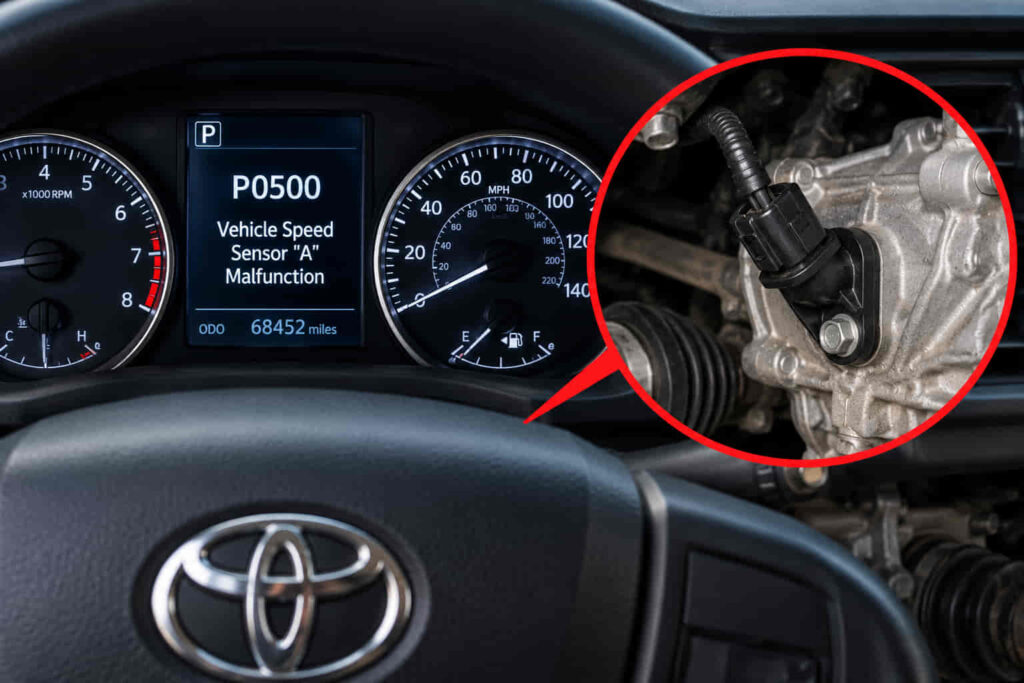
The Toyota P0500 code indicates a malfunction involving the vehicle speed signal used by the engine control system. The code is commonly described as a Vehicle Speed Sensor “A” malfunction, but P0500 does not confirm that the vehicle speed sensor itself has failed. The actual fault can involve the source of the speed signal, its electrical circuit, wiring or connectors, or another system responsible for providing vehicle speed information to the ECM.
A Toyota with P0500 may illuminate the Check Engine Light and can develop an inaccurate or inoperative speedometer, abnormal transmission shifting, or additional ABS, VSC, or traction-control warnings, depending on the model and system configuration. Some vehicles can remain drivable with few noticeable symptoms even though the ECM is no longer receiving the expected vehicle speed information. The exact effect therefore depends on how the specific Toyota generates and distributes its vehicle speed signal.
Correct diagnosis starts by reading all stored trouble codes and checking live vehicle speed data before replacing a sensor or control module. The signal source, wiring, connectors, related control systems, and electrical conditions can then be tested according to the vehicle’s model and year. This guide explains what Toyota P0500 means, its symptoms and causes, how to diagnose and fix the underlying fault, and when the code can affect normal driving.
What Does the P0500 Code Mean on a Toyota?
The Toyota P0500 code means the engine control system has detected a malfunction involving the vehicle speed signal. P0500 is commonly defined as a Vehicle Speed Sensor “A” malfunction, but the code identifies a problem with the speed information received or processed by the control system rather than proving that one specific speed sensor has failed. Diagnosis must therefore determine where the vehicle speed information originates and why the expected signal is missing, incorrect, or inconsistent.
Vehicle speed information allows electronic control systems to determine how fast the vehicle is moving. The ECM can use this information as part of its engine-management strategy, while other vehicle systems may also rely on speed data for functions involving transmission operation, stability control, traction control, or instrument displays. A fault in the generation or transmission of this information can therefore affect more than one system even though P0500 is the code retrieved during the initial engine-control scan.
The source of the vehicle speed signal is an important diagnostic distinction. Depending on the Toyota model, model year, powertrain, and electronic architecture, speed information can involve a dedicated vehicle speed sensor or information originating from another control system. This means a generic instruction to replace the Vehicle Speed Sensor whenever P0500 appears can produce an incorrect diagnosis. The actual signal path needs to be identified for the vehicle being repaired.
P0500 should consequently be interpreted as evidence of a vehicle-speed information problem rather than a component replacement instruction. If scan-tool data shows an abnormal vehicle speed value, the result confirms that the speed information requires further investigation but still does not identify the failed component by itself. The signal source, wiring, connectors, related DTCs, and applicable control systems must be evaluated before the root cause can be established.
How Serious Is the Toyota P0500 Code?
Toyota P0500 is a moderately serious diagnostic code because incorrect or missing vehicle speed information can affect the speedometer and electronic systems that depend on vehicle speed data. The vehicle may remain capable of driving, but normal movement does not confirm that every related function is operating correctly. Severity should be determined from the symptoms, accompanying DTCs, warning lights, and the systems affected on the specific Toyota.
An inaccurate or inoperative speedometer increases the importance of the fault because the driver can no longer reliably determine road speed from the instrument display. Vehicle speed information can also influence other electronic functions, so a speed-signal malfunction may create effects beyond the speedometer. The exact consequences depend on how speed information is generated and distributed within that vehicle’s electronic architecture.
Transmission behavior can also become relevant when the applicable transmission-control strategy depends on vehicle speed information. Missing or implausible speed data can interfere with the information used to determine operating conditions, which can contribute to abnormal shifting on affected configurations. P0500 should not automatically be blamed for every transmission symptom, however. Transmission-related DTCs and live data need to support that relationship before the two conditions are treated as the same fault.
ABS, VSC, or traction-control warnings can increase the diagnostic scope when they appear with P0500. These systems use vehicle-motion information for their own control strategies, and an additional warning indicates that the corresponding module should also be scanned. The presence of P0500 does not establish that an ABS wheel speed sensor has failed, just as an ABS warning does not prove that the engine-control code and chassis fault have the same root cause. The complete set of DTCs is required to establish the relationship.
The urgency becomes greater when P0500 is accompanied by an inoperative speedometer, significant shifting problems, multiple safety-system warnings, or other abnormal vehicle behavior. A Toyota that appears to drive normally still requires diagnosis because the code confirms that the control system detected an abnormal condition. Correcting the vehicle speed signal fault restores the information required by the affected systems and prevents an unresolved P0500 from becoming a recurring diagnostic problem.
Read more: Toyota C1203
What Symptoms Can Appear With Toyota Code P0500?
The main symptoms of Toyota P0500 are a Check Engine Light, inaccurate or missing speedometer readings, abnormal transmission behavior, and additional ABS, VSC, or traction-control warnings when the affected systems depend on the same vehicle speed information. Not every Toyota develops all of these symptoms. The actual effects depend on where the vehicle generates its speed signal, which control modules receive that information, and the type of failure that caused P0500 to be stored.
The Check Engine Light is the most direct warning associated with P0500 because the engine control system has detected a problem with the expected vehicle speed information. The light can appear even when the vehicle still accelerates and drives normally. This happens because an electronic signal fault does not necessarily create an immediate mechanical drivability problem. The DTC can therefore be present before the driver notices a significant change in vehicle behavior.
An inaccurate, intermittent, or inoperative speedometer can provide stronger evidence of a vehicle-speed information problem. If the displayed speed remains at zero while the vehicle is moving, drops unexpectedly, or changes inconsistently with actual road speed, the diagnostic process should compare the instrument reading with vehicle speed data available through the scan tool. A matching loss of speed information in multiple systems can help identify where the signal is being interrupted, while a normal reading in one module and an abnormal reading in another can point diagnosis toward a different part of the signal path.
Abnormal shifting can occur on Toyota configurations where transmission operation relies on vehicle speed information. The control system uses operating data to determine appropriate transmission behavior, so missing or implausible speed information can interfere with that strategy. Symptoms can include unusual shift timing or other changes in transmission operation. These symptoms should still be checked against transmission DTCs and live data because P0500 alone does not prove that every shifting problem originates from the vehicle speed signal.
ABS, VSC, or traction-control warnings can also appear when related control systems detect their own faults or cannot use the required vehicle-motion information correctly. These warning lights expand the diagnostic scope beyond the ECM. The corresponding modules should be scanned because a chassis-system DTC can reveal information that a generic engine scan does not provide. An ABS warning combined with P0500 is therefore a reason to retrieve ABS codes, not a reason to automatically replace a wheel speed sensor.
Some Toyota vehicles can store P0500 with few noticeable symptoms beyond the Check Engine Light. This occurs when enough vehicle functions remain operational for normal driving even though the ECM has identified invalid or missing speed information under specific conditions. The absence of a failed speedometer or severe drivability problem does not invalidate the code. It means diagnosis must rely more heavily on stored DTCs, live data, electrical testing, and the vehicle-specific signal path.
What Causes the P0500 Code on a Toyota?
Toyota P0500 is caused when the engine control system does not receive the expected vehicle speed information, with the root fault potentially originating from the speed-signal source, its electrical circuit, wiring or connectors, or the control system that processes and transmits the data. A failed Vehicle Speed Sensor is one possible cause on applicable vehicles, but it is not the only cause and should not be replaced until testing identifies it as the failed part.
A faulty speed-signal source can cause P0500 when it stops producing information that corresponds with actual vehicle movement. On a configuration that uses a dedicated Vehicle Speed Sensor, an internal sensor failure can prevent the expected signal from reaching the control system. On another configuration, vehicle speed information may depend on data generated or distributed through other vehicle systems. The correct component to test therefore depends on the Toyota model, year, powertrain, and signal architecture.
Wiring faults can produce the same code even when the speed-signal source itself remains functional. An open circuit can prevent the signal from reaching its destination, while a short circuit can change the electrical characteristics of the signal sufficiently for the control system to recognize it as invalid. Physical damage, previous repairs, abrasion, or other harness problems can create permanent or intermittent faults. Circuit testing is necessary to distinguish a failed signal source from a signal that is being lost between components.
Electrical connectors and terminals are another possible failure point because a valid signal still requires a reliable electrical connection. Loose terminals, corrosion, contamination, damaged connector housings, or poor terminal contact can interrupt the signal or make it intermittent. This type of fault can be difficult to identify when the connection works during inspection but fails with vehicle vibration or movement. Connector condition should therefore be evaluated in the specific circuit identified by the wiring diagram rather than by replacing the sensor first and inspecting the connector afterward.
Power and ground problems can contribute to P0500 when the component responsible for generating or processing speed information does not receive the electrical conditions required for normal operation. Diagnostic evidence such as additional voltage-related codes, abnormal measurements, or inconsistent module operation should determine whether this path needs investigation. Battery or charging-system components should not be replaced solely because P0500 is present without measurements that confirm an electrical-supply problem.
A communication or control-system fault becomes relevant when vehicle speed information is generated correctly but is not transmitted or processed as expected. Additional communication DTCs and differences between speed values reported by separate control modules can provide evidence for this type of problem. Comparing available live data is valuable because it helps determine whether speed information is absent throughout the vehicle or disappears only at a particular stage of the electronic signal path.
A failed ECM or another control module remains possible but belongs near the end of the diagnostic hierarchy. A module should not be replaced until its relevant power supply, grounds, wiring, connectors, communication path, signal inputs, and accompanying DTCs have been tested according to the applicable procedure. P0500 confirms that the expected vehicle speed information is abnormal; it does not independently prove which electronic component caused the abnormality.
The root cause is therefore found by tracing vehicle speed information from its source to the system that reports the fault. When the signal is absent at its source, diagnosis focuses on the source and its electrical requirements. When the source produces valid information but the ECM does not receive it, diagnosis shifts toward the circuit, communication path, or signal processing between those points. This signal-based approach identifies the actual failure more reliably than treating P0500 as an automatic instruction to replace the Vehicle Speed Sensor.
What Other Trouble Codes Should You Check With Toyota P0500?
Check for additional engine, transmission, ABS, wheel-speed, communication, and voltage-related DTCs when Toyota P0500 is stored because these codes can identify where the vehicle speed signal is being lost or corrupted. P0500 establishes that the ECM detected an abnormal vehicle speed signal, but an accompanying code can provide more specific evidence about the system responsible for that condition.
ABS or wheel-speed-related DTCs become particularly relevant when the vehicle obtains or distributes speed information through systems associated with wheel-speed data. If P0500 appears together with an ABS warning light, the ABS control system should be scanned rather than assuming the problem is a dedicated Vehicle Speed Sensor. A chassis DTC can identify a specific circuit or input that requires testing and can explain why valid speed information is unavailable to another control system.
Transmission-related codes also provide useful diagnostic context when abnormal shifting occurs with P0500. Vehicle speed is one of the operating parameters that can be used by electronic transmission-control strategies. If the transmission module stores additional faults, those codes and the corresponding live data should be evaluated before the shifting symptom is attributed entirely to P0500. This separates a speed-signal problem affecting transmission operation from an independent transmission malfunction that happens to be present at the same time.
Communication DTCs change the diagnostic direction because vehicle speed information can be generated correctly in one part of the vehicle but fail to reach another control module. When one module reports plausible vehicle speed and another does not receive the expected information, the fault can exist in the communication or signal path between them. Additional communication codes help distinguish this condition from a sensor that produces no usable speed information at its source.
Voltage-related codes should also be considered when the vehicle shows broader electrical symptoms. Electronic sensors and control modules require stable power and ground conditions to generate, transmit, and process data correctly. A voltage DTC combined with abnormal electrical measurements provides a reason to investigate the relevant supply circuit. P0500 alone, however, does not justify replacing a battery, alternator, sensor, or control module without supporting test results.
The complete code set should be recorded before anything is erased. Freeze-frame information and available diagnostic records can provide operating conditions associated with the malfunction, while related DTCs can establish which system detected a problem first. The objective is to identify the code or condition that best explains the loss of valid vehicle speed information and use that evidence to determine the next test.
How Do You Diagnose Toyota Code P0500?
Diagnosing Toyota P0500 requires confirming the vehicle speed fault with scan data, identifying the source and path of the speed signal, testing the relevant electrical circuit, and repairing the component or connection proven to be defective. Replacing the Vehicle Speed Sensor before completing these checks can fail to repair the vehicle because P0500 identifies an abnormal speed signal rather than a confirmed failed sensor.
Diagnosis begins with a complete scan before clearing any stored DTCs. P0500 should be recorded together with available engine, transmission, ABS, VSC, communication, and electrical codes. The diagnostic information should then be matched to the exact Toyota model, model year, powertrain, and control-system configuration. This step matters because the source and routing of vehicle speed information can differ between vehicles carrying the same Toyota badge and the same P0500 code.
Live vehicle speed data provides one of the most useful early tests. The scan tool can be monitored while the vehicle is operated under appropriate and safe test conditions to determine whether the reported speed changes with actual vehicle movement. A value that remains at zero, becomes intermittent, or differs substantially from expected vehicle speed confirms that the signal requires further investigation. It does not, by itself, establish whether the problem originates in the sensor, wiring, connector, communication path, or receiving control module.
Comparing vehicle speed information between available control modules can narrow the fault further. If valid speed information exists in one module but is missing or implausible in another, the source may still be functioning and diagnosis can shift toward the path used to transmit or process that information. If the relevant systems all lack valid speed information, the diagnostic path moves closer to the original signal source and its associated electrical circuit. This comparison turns live data into evidence about where the failure occurs rather than simply confirming that P0500 exists.
The next inspection should follow the vehicle-specific wiring diagram. The relevant harness and connectors need to be checked for damaged wires, loose or corroded terminals, open circuits, short circuits, and poor electrical connections. Power and ground conditions should also be verified when the signal source or control component requires them. Electrical measurements are more reliable than appearance alone because a wire or terminal can look intact while failing to carry the required signal under operating conditions.
The speed-signal source should be tested according to the applicable Toyota procedure after its circuit conditions are known. If the vehicle uses a dedicated Vehicle Speed Sensor in the relevant signal path, its input, output, power, ground, and signal characteristics can be checked as specified for that system. If vehicle speed originates through another control system, diagnosis should follow that architecture instead of searching for a standalone VSS that may not perform the assumed function on that model.
A basic generic OBD2 scanner can retrieve P0500 and may display engine-related vehicle speed data, but it can be insufficient when diagnosis requires access to ABS, VSC, transmission, or other manufacturer-specific information. A scan tool capable of communicating with the relevant Toyota modules provides a broader view of stored DTCs and live data. This is especially valuable when the ECM reports incorrect speed information while another module still reports vehicle movement correctly.
Control-module replacement should remain one of the final diagnostic possibilities. The ECM or another module should be suspected only after the applicable signal source, wiring, connectors, power supplies, grounds, and communication paths have been tested and shown to operate correctly. A module that stores P0500 is reporting a detected condition; that fact alone does not establish that the reporting module created the fault.
After the confirmed problem is repaired, the DTCs should be cleared and the vehicle should undergo an appropriate verification test. Live vehicle speed data should correspond with vehicle movement, affected warning indicators should operate normally, and P0500 should remain absent after the system has had an opportunity to monitor the repaired condition. If the code returns, the underlying signal problem remains active or intermittent and diagnosis should continue from the new diagnostic evidence rather than repeating the same parts replacement.
How Do You Fix the P0500 Code on a Toyota?
Fixing Toyota P0500 requires restoring the correct vehicle speed signal to the engine control system by repairing the sensor, circuit, connector, signal source, or control-system fault confirmed during diagnosis. Replacing the Vehicle Speed Sensor is the correct repair only when testing proves that the sensor is responsible for the missing or incorrect signal. If the signal is being interrupted elsewhere, replacing a functioning sensor will leave the underlying problem unresolved.
A failed Vehicle Speed Sensor should be replaced when the specific Toyota uses that sensor in the affected signal path and testing confirms that it does not produce the required output despite having the correct electrical conditions. The replacement should match the vehicle’s model, year, powertrain, and system configuration. The circuit should still be checked before installation because a new sensor cannot correct an open circuit, short circuit, poor ground, or damaged connector.
Wiring faults require restoration of the affected circuit. A damaged wire can prevent a valid speed signal from reaching the ECM even when the signal source operates normally. Repairing the wiring restores electrical continuity and signal integrity between the relevant components. The repaired circuit should be tested afterward because physical repair alone does not prove that the required signal reaches its destination under operating conditions.
Connector problems require the same evidence-based approach. Loose terminals, corrosion, damaged pins, poor terminal tension, or contamination can create intermittent or permanent signal loss. Repairing or replacing the affected connector restores the electrical path without unnecessarily replacing the sensor or control module connected to it. Intermittent connector faults deserve particular attention when P0500 disappears temporarily and returns after vibration, temperature changes, or vehicle movement.
A fault involving the system that generates or distributes vehicle speed information must be repaired according to that system’s diagnostic procedure. This distinction is important on Toyota vehicles where the ECM may receive speed information through another control system rather than directly from a standalone sensor. In this configuration, replacing a component labeled as a Vehicle Speed Sensor without tracing the actual signal path can target the wrong part of the system.
Power and ground faults should be corrected when electrical measurements confirm that the relevant sensor or control component lacks the conditions required for normal operation. A weak connection, excessive resistance, unstable supply, or poor ground can prevent otherwise functional electronics from generating or processing valid speed information. The repair should address the confirmed electrical fault rather than treating the battery or charging system as a default cause of P0500.
An ECM or another control module should be repaired or replaced only after external causes have been eliminated and the applicable diagnostic procedure identifies the module as defective. Relevant wiring, connectors, power supplies, grounds, signal inputs, and communication paths need to operate correctly before module failure becomes a supported conclusion. Depending on the Toyota model and replacement component, additional programming, initialization, or calibration may also be required after installation.
The repair is complete only after the vehicle speed signal has been verified. Once the confirmed fault has been corrected, P0500 and its accompanying DTCs can be cleared and the vehicle can be tested under appropriate conditions. Live vehicle speed data should respond correctly to vehicle movement, related warning lights should remain off when their systems are functioning normally, and P0500 should not return. This verification separates a confirmed repair from a temporary disappearance of the code.
Can You Clear Toyota P0500 Without Fixing the Problem?
Toyota P0500 can be cleared with a compatible scan tool, but clearing the code does not repair the vehicle speed signal malfunction that caused it. If the ECM continues to receive missing, incorrect, or implausible speed information, it can detect the fault again and restore P0500 after the applicable monitoring conditions are met.
Diagnostic information should be recorded before the code is erased. P0500 may be accompanied by engine, transmission, ABS, communication, or electrical DTCs that help identify the source of the problem. Freeze-frame information and live data can also provide evidence about the operating conditions associated with the fault. Erasing this information before diagnosis can remove useful context without changing the physical or electrical condition of the vehicle.
Disconnecting the battery is not a repair for P0500. Removing battery power can reset information on some vehicles, but it cannot restore a broken speed-signal wire, repair a corroded connector, make a failed sensor generate the correct signal, or correct a malfunction elsewhere in the vehicle speed information path. Battery disconnection can also affect settings or systems that require initialization on certain Toyota models.
Clearing P0500 becomes useful after the root cause has been repaired because it establishes a clean starting point for verification. The vehicle can then be operated while vehicle speed data is monitored and the relevant systems perform their diagnostic checks. If the speed information remains valid and P0500 does not return, the results support the conclusion that the original fault has been corrected.
A code that disappears temporarily should not be confused with a confirmed repair. Intermittent wiring, terminal contact, or signal faults can operate normally during one test and fail again under different temperature, vibration, moisture, or driving conditions. When P0500 repeatedly returns after being cleared, the correct response is to identify the recurring signal fault rather than continue erasing the DTC.
Can You Drive a Toyota With the P0500 Code?
A Toyota with the P0500 code may remain drivable, but whether it should continue to be driven normally depends on the accuracy of the speedometer, transmission behavior, active warning lights, and the underlying vehicle speed signal fault. P0500 does not automatically mean that the vehicle will stop operating. However, a vehicle that can still move is not necessarily operating with all of its speed-dependent functions available or working correctly.
An inaccurate or inoperative speedometer makes continued driving more problematic because the driver may not have a reliable indication of road speed. If the speedometer remains at zero, becomes intermittent, or displays a value that does not correspond with actual vehicle movement, the vehicle speed signal should be diagnosed before the condition is treated as a minor Check Engine Light issue. The same signal problem can also affect electronic systems that use vehicle speed information.
Abnormal transmission behavior increases the urgency of diagnosis when it appears with P0500. A transmission-control strategy can depend on vehicle operating information that includes road speed, so invalid speed data can contribute to abnormal operation on applicable Toyota configurations. Delayed, unusual, or inconsistent shifting should be evaluated together with transmission DTCs and live data. Significant shifting problems are a stronger reason to limit driving than an isolated P0500 with otherwise normal vehicle behavior.
ABS, VSC, or traction-control warnings also change the risk assessment. These warning lights indicate that the corresponding control systems have detected conditions that require their own diagnosis. If P0500 appears with one or more chassis-system warnings, the relevant modules should be scanned to determine whether electronic braking or stability functions are restricted. The presence of P0500 alone is not sufficient to determine which safety-related functions remain available.
A Toyota that drives normally, displays an accurate speedometer, and has no significant additional symptoms may still be physically capable of short-term operation, but P0500 should be diagnosed promptly rather than ignored. A vehicle with an unreliable speedometer, severe shifting problems, abnormal braking behavior, or multiple safety-system warnings requires greater caution and should be inspected before normal driving continues. The decision should be based on the complete vehicle condition rather than the assumption that every P0500 fault has the same severity.
How Much Does It Cost to Fix Toyota Code P0500?
The cost to fix Toyota P0500 depends on the confirmed root cause because P0500 identifies a vehicle speed signal malfunction rather than a specific component that must be replaced. Repair cost can therefore range from electrical diagnosis and a localized wiring or connector repair to replacement of a failed signal source or, less commonly, a control component confirmed by testing. An accurate estimate requires diagnosis before parts are priced.
Diagnostic labor is part of the repair cost because retrieving P0500 is only the beginning of the process. A technician may need to scan multiple control modules, compare live vehicle speed data, identify the source of the speed information, inspect the applicable wiring diagram, and perform electrical measurements. An intermittent fault can require additional diagnostic time because the circuit may operate normally during the first inspection and fail only under specific vibration, temperature, or driving conditions.
A wiring or connector problem can have a different cost structure from a failed sensor. A localized damaged wire or connector terminal may require relatively limited parts but additional labor to locate and repair the electrical fault. Damage deeper within a wiring harness can require more diagnostic and repair time. The cost is therefore determined by the location and extent of the circuit problem rather than by the P0500 code itself.
Sensor replacement becomes part of the estimate when the specific Toyota uses a replaceable speed sensor in the affected signal path and testing confirms that the sensor has failed. The cost can differ by model, model year, sensor location, and labor required for access. Replacing a sensor before this diagnosis may add unnecessary parts cost while leaving P0500 active if the actual fault exists in the wiring, connector, power supply, or signal path.
A control-module-related repair can be more expensive because the component itself may have a higher replacement cost and may require programming, initialization, or calibration. This repair should remain a later diagnostic possibility rather than the starting estimate for P0500. Module replacement is justified only when the external circuits and signal source have been tested and the applicable diagnostic procedure supports module failure.
The most accurate P0500 repair estimate is therefore produced after the vehicle speed signal has been traced to the point where it fails. Two Toyota vehicles displaying the same code can require substantially different repairs because one may have a damaged electrical connection while another has a confirmed sensor or control-system fault. Diagnosing the signal path first prevents a generic P0500 estimate from being mistaken for the actual cost of repairing the vehicle.
Does Toyota P0500 Mean the Vehicle Speed Sensor Is Bad?
No, Toyota P0500 does not by itself prove that the Vehicle Speed Sensor is bad. The code confirms that the engine control system detected a malfunction involving vehicle speed information, but several components and circuits can participate in generating, transmitting, and processing that information. A sensor should therefore be replaced only when testing confirms that it fails to produce the required signal under the correct operating and electrical conditions.
The distinction between a DTC and a failed component is important. P0500 describes the abnormal condition detected by the control system, while the Vehicle Speed Sensor is only one possible source of that condition on vehicles where such a sensor provides the relevant speed input. A functioning sensor can generate a valid signal that never reaches the ECM because of an open circuit, short circuit, damaged wire, loose terminal, corroded connector, or another problem in the signal path. Replacing the sensor in that situation does not restore the missing information.
The vehicle’s electronic architecture also determines whether a standalone Vehicle Speed Sensor is the correct component to investigate. Toyota models and generations can obtain and distribute vehicle speed information differently. A diagnostic procedure that correctly identifies a VSS on one vehicle should not automatically be applied to another Toyota with a different speed-signal architecture. The model, model year, powertrain, wiring diagram, and applicable repair information establish where the ECM receives its speed information.
Live data can help separate a sensor assumption from an evidence-based diagnosis. If the scan tool reports no vehicle speed while the car is moving, the result confirms that the expected information is unavailable at that diagnostic point. The next question is where the signal disappears. If another relevant control module still reports plausible vehicle speed, the original source may be functioning and the fault can exist farther along the communication or signal path.
Electrical testing provides the evidence required to condemn a sensor. When an applicable speed sensor has the specified power, ground, circuit integrity, and operating conditions but does not generate the expected output, sensor failure becomes a supported diagnosis. When the sensor output is correct but the receiving system does not obtain the same information, diagnosis should move downstream toward wiring, connectors, communication, or signal processing.
Replacing the Vehicle Speed Sensor based only on P0500 is therefore parts swapping rather than complete diagnosis. The correct sequence is to confirm the speed-data problem, identify the signal source, determine where the valid information stops, and replace a component only when the test results identify that component as the cause.
Why Can P0500 Affect the Speedometer or Transmission?
P0500 can affect the speedometer or transmission when those functions depend on the same vehicle speed information that the engine control system has identified as missing or incorrect. Vehicle speed is not useful only for displaying how fast the car is moving. Electronic systems can use speed information as an operating input, so one signal fault can produce symptoms in more than one part of the vehicle depending on its architecture.
A speedometer requires valid vehicle speed information to display road speed accurately. If the fault responsible for P0500 also interrupts the information supplied to the instrument display, the speedometer can remain at zero, operate intermittently, or show an incorrect value. However, P0500 does not guarantee a failed speedometer because the ECM and instrument display do not necessarily receive or process speed information through an identical path on every Toyota.
Comparing the speedometer with scan-tool data can provide useful diagnostic context. If both the instrument display and ECM data lose vehicle speed at the same time, the shared portion of the signal path becomes more relevant. If the speedometer displays plausible road speed while ECM vehicle-speed data remains abnormal, the fault may exist after the point where the available speed information is distributed. The vehicle-specific circuit architecture determines how that difference should be interpreted.
Transmission behavior can also change when the applicable control strategy requires vehicle speed information. Electronic transmission control evaluates operating conditions to manage transmission behavior, and invalid speed data can remove one of the inputs used by the system. On an affected configuration, this can contribute to unusual or inconsistent shifting. The mechanism is a loss of required operating information rather than P0500 mechanically damaging the transmission.
A transmission symptom should still be diagnosed independently enough to exclude a separate transmission fault. If P0500 appears with transmission-related DTCs, those codes and the relevant live data provide evidence about whether the problems share a root cause. Attributing every shifting problem to P0500 without checking the transmission system can hide an unrelated malfunction, just as replacing a transmission component without investigating the speed signal can miss the actual cause.
The relationship between P0500, the speedometer, and transmission is therefore determined by the flow of vehicle speed information. Identifying where that information originates, which modules receive it, and where it becomes invalid explains why one Toyota may show only a Check Engine Light while another develops speedometer or shifting symptoms. This signal-path relationship is more diagnostically useful than assuming that every Toyota responds to P0500 in the same way.
Does Toyota P0500 Differ on Camry, Corolla, Prius, and RAV4?
The basic meaning of P0500 remains a vehicle speed signal malfunction across Toyota Camry, Corolla, Prius, and RAV4 models, but the source of that signal, diagnostic procedure, related systems, and correct repair can differ by model and model year. The code should therefore be interpreted through the electronic architecture of the specific vehicle rather than through a single repair procedure applied to every Toyota.
A Toyota Camry or Corolla from one generation may not route vehicle speed information in exactly the same way as a vehicle from another generation. Changes in powertrain design, transmission control, ABS and stability-control integration, instrument systems, and communication networks can change how speed information reaches the ECM. Two vehicles can consequently store the same P0500 code while requiring different circuit checks and component tests.
The Toyota RAV4 requires the same model-specific approach because the nameplate covers multiple generations and powertrain configurations. The relevant diagnostic question is not simply whether the vehicle is a RAV4, but how that particular model year and configuration generates and distributes vehicle speed information. The applicable wiring diagram and diagnostic procedure establish which sensor, control system, circuit, or data path needs to be tested.
The Toyota Prius deserves additional attention because its hybrid powertrain and electronic control architecture differ from those of conventional gasoline-only vehicles. A generic P0500 description can identify the affected vehicle-speed concept, but it cannot replace Prius-specific diagnostic information. When P0500 appears with hybrid, ABS, VSC, communication, or other system codes, those DTCs should be evaluated within the architecture of the specific Prius generation.
Model-specific differences also explain why internet repair advice can produce conflicting answers. A component replacement that solved P0500 on one Camry, Corolla, Prius, or RAV4 does not establish the cause on another vehicle. Even within the same model line, changes between model years can alter the signal source or circuit design. A successful repair on another vehicle is a diagnostic clue at most, not confirmation of the failed component.
The correct approach is to identify the exact vehicle before selecting the test procedure. Model year, engine or powertrain configuration, transmission type where applicable, related DTCs, and vehicle-specific service information provide the context needed to trace the speed signal correctly. This prevents a valid P0500 definition from being turned into an incorrect universal repair.
How Can You Prevent Toyota P0500 From Returning?
The most effective way to prevent Toyota P0500 from returning is to repair the confirmed root cause and verify that valid vehicle speed information reaches the required control systems after the repair. Clearing the code, replacing an untested sensor, or temporarily restoring an intermittent connection does not prevent recurrence because none of those actions proves that the original signal fault has been eliminated.
A complete repair addresses the entire failed part of the signal path. If testing identifies damaged wiring, the circuit should be restored so that it maintains electrical integrity during normal vehicle operation. If a connector has loose, damaged, or corroded terminals, correcting the terminal condition is necessary to prevent intermittent signal loss. If an applicable speed sensor is proven defective, replacement should be followed by confirmation that its output reaches the receiving system correctly.
Intermittent faults require particular attention because they can make P0500 appear repaired when the signal has only returned temporarily. Vibration, harness movement, temperature changes, moisture, or poor terminal contact can cause a circuit to alternate between normal and failed states. Inspecting and testing the affected electrical path under conditions relevant to the original failure reduces the chance that an intermittent connection will remain hidden after the code is cleared.
Post-repair live data provides direct evidence that the vehicle speed information has been restored. During an appropriate verification drive, reported vehicle speed should respond consistently to actual vehicle movement. When the diagnostic tool provides access to speed information from multiple relevant modules, comparing those values can also confirm that the signal is being generated and distributed through the expected systems rather than merely appearing correctly at one diagnostic point.
The vehicle should then be rescanned after the relevant monitoring conditions have occurred. P0500 should remain absent, and related engine, transmission, ABS, VSC, or communication DTCs associated with the original fault should not return. The speedometer and any previously affected vehicle behavior should also operate normally. These results provide stronger repair verification than simply observing that the Check Engine Light remains off immediately after code clearing.
If P0500 returns, the recurrence should be treated as evidence that an active or intermittent fault remains. The next diagnostic step should use the new DTCs, live data, symptoms, and electrical measurements to locate the unresolved condition. Preventing P0500 from returning ultimately depends on restoring a reliable vehicle speed signal and proving that the repair remains effective during actual vehicle operation.