The “Engine Oil Pressure Low Stop Engine” warning means the vehicle has detected insufficient engine oil pressure or a fault that is reporting low oil pressure. Stop the vehicle in a safe location and turn off the engine as soon as safely possible. Running an engine with genuinely low oil pressure can reduce lubrication between moving components and lead to accelerated wear, bearing damage, or severe engine failure.
Low oil pressure does not always mean the engine is simply low on oil. The warning can result from several problems, including a low engine oil level, incorrect oil viscosity, a restricted oil filter or pickup screen, a worn oil pump, excessive internal engine wear, or a faulty oil pressure sensor. This distinction matters because adding oil will not correct the problem when the oil level is already within the manufacturer’s specified range.
The correct response is to verify the oil level and look for obvious leaks before deciding what to do next. If the oil level is normal or the warning remains, the engine oil pressure should be properly diagnosed rather than assuming the vehicle is safe to drive. This guide explains what the warning means, the main causes of low oil pressure, how the problem is diagnosed, what engine damage can occur, and which repairs address each cause.
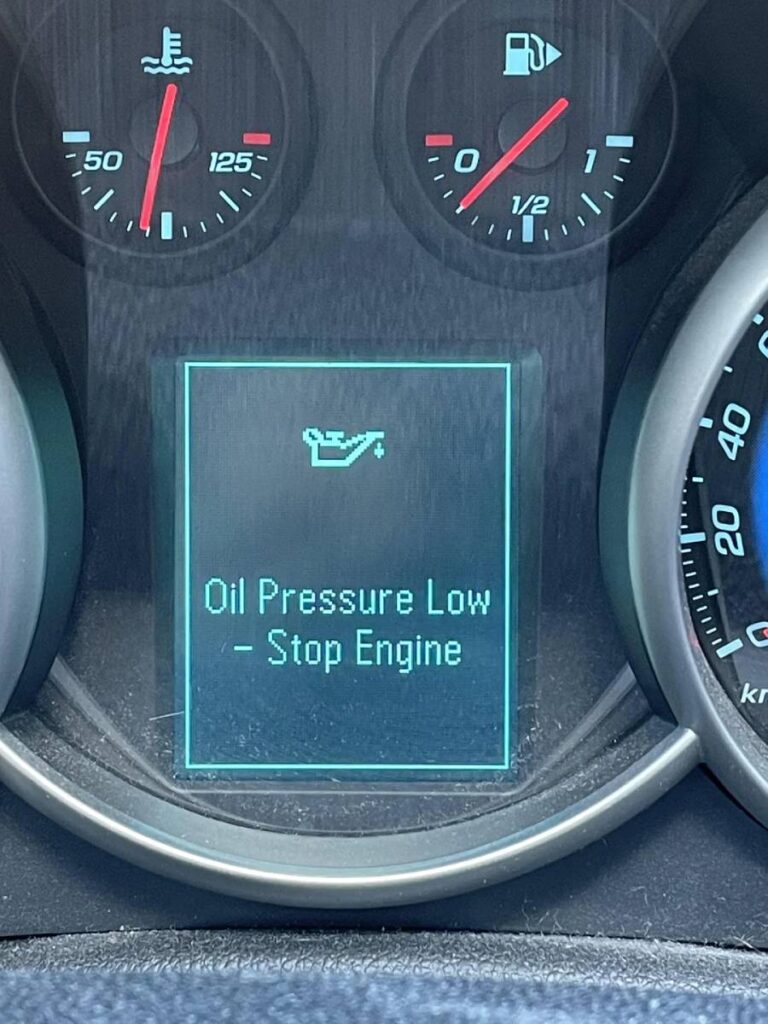
What Does “Engine Oil Pressure Low Stop Engine” Mean?
The “Engine Oil Pressure Low Stop Engine” message means the vehicle has detected oil pressure below the expected range or received a signal indicating that oil pressure is too low. Engine oil pressure is created as the oil pump moves engine oil through passages to lubricate components such as crankshaft bearings, camshafts, and valvetrain parts. Adequate oil flow and pressure allow these moving surfaces to operate with a protective oil film between them.
The warning is more serious than a routine oil-change reminder because it concerns the engine’s lubrication system while the engine is operating. When actual oil pressure drops too far, oil may not circulate adequately through critical lubrication points. Friction and heat can then increase between moving metal surfaces, accelerating wear and potentially damaging internal engine components.
Low oil pressure and low oil level are related but are not the same condition. A low oil level can cause pressure to fall when the oil pump cannot maintain an adequate supply of oil. However, an engine can have the correct amount of oil and still develop low pressure because of a worn oil pump, restricted oil pickup, unsuitable oil viscosity, excessive internal clearances, or another lubrication-system problem.
The warning can also appear when actual oil pressure is normal but the monitoring system reports an incorrect value. A faulty oil pressure sensor, pressure switch, wiring connection, or related electrical problem can produce an inaccurate warning. For this reason, the dashboard message identifies a condition that requires attention; it does not by itself identify the failed component. Actual oil pressure must be verified when basic oil-level checks do not explain the warning.
Should You Stop the Engine When the Low Oil Pressure Warning Appears?
Yes. Stop the vehicle in a safe location and switch off the engine as soon as safely possible when the low oil pressure warning appears. Turning the engine off stops most moving internal components from continuing to operate under potentially inadequate lubrication. The objective is to minimize engine operating time until the cause of the warning is understood.
Safety comes first when the warning appears while driving. Move away from active traffic and stop in a safe location before shutting down the engine. Once parked, allow the vehicle to sit as required by its oil-level checking procedure and check the engine oil level according to the owner’s manual. Look for obvious evidence of oil loss, including oil underneath the vehicle or visible leakage around accessible areas of the engine.
A low reading on the dipstick provides a possible explanation for the warning, but the correct oil must be added according to the vehicle manufacturer’s specification rather than filling the engine indiscriminately. Overfilling the crankcase creates a separate lubrication problem, while using an incorrect oil specification or viscosity can affect lubrication-system performance. The source of significant oil loss also requires attention because topping up the oil does not repair a leak or excessive oil consumption.
Do not assume the engine is safe to restart simply because the oil level is normal. Correct oil quantity does not prove that the oil pump is producing adequate pressure. A normal dipstick reading combined with a low-pressure warning can point toward problems such as a restricted pickup, pump wear, excessive bearing clearance, or an inaccurate sensor signal.
Restarting also should not be used repeatedly as a test to see whether the warning disappears. Each period of operation adds exposure to possible lubrication loss when actual pressure is low. If the warning persists, returns immediately, or is accompanied by mechanical noises such as ticking, tapping, or knocking, professional diagnosis and towing are safer than continuing to operate the engine.
Can You Drive With the “Engine Oil Pressure Low Stop Engine” Warning?
You should not continue driving with an “Engine Oil Pressure Low Stop Engine” warning until the cause has been identified and adequate oil pressure has been confirmed. Genuine low oil pressure can damage internal engine components because those components depend on continuous lubrication while the crankshaft, camshaft, bearings, and other parts are moving.
Driving only a short distance does not eliminate this risk. The amount of damage depends on factors such as the actual pressure loss, engine load, engine speed, oil temperature, and the component affected. A severe loss of lubrication can therefore become expensive engine damage before the driver reaches a nearby destination or repair facility.
The warning disappearing after a restart also does not prove that the underlying problem has been resolved. Intermittent oil-pressure problems can occur under specific operating conditions, including when the engine is hot or running at low RPM. Electrical faults can also produce intermittent warnings. The relevant question is not whether the dashboard message temporarily disappears, but whether the engine has adequate oil pressure under the operating conditions specified by the manufacturer.
Towing is appropriate when the oil level is normal but the warning remains, the engine has lost a substantial amount of oil, an active leak is visible, or abnormal mechanical noise accompanies the warning. These conditions provide no reliable basis for assuming that continued engine operation is safe.
A suspected faulty oil pressure sensor is also not a reason to ignore the warning. Sensor failure is one possible cause, but it should be distinguished from genuine low pressure through diagnosis. A technician can measure actual engine oil pressure and compare the result with the manufacturer’s specification. This separates a lubrication-system failure from a sensor or electrical fault without risking engine damage based on an assumption.
What Are the Main Causes of Low Engine Oil Pressure?
There are 7 main causes of a low engine oil pressure warning: low oil level, incorrect oil viscosity, a restricted oil filter, a clogged oil pickup, a worn oil pump, excessive internal engine wear, and a faulty oil pressure sensor or circuit. These causes do not affect the lubrication system in the same way. Some reduce the amount of oil available to the pump, some restrict oil flow or prevent the system from maintaining pressure, and others create a false warning even when actual oil pressure is within specification.
Low engine oil level can cause low oil pressure when the oil pump cannot maintain a consistent supply of oil. The engine can lose oil through external leaks, internal oil consumption, or an insufficient refill during service. When the level becomes low enough, the pickup may not remain adequately supplied under all operating conditions. Pressure can then fluctuate or fall, particularly as oil moves inside the oil pan during acceleration, braking, or cornering. Checking the dipstick is therefore one of the first steps after an oil-pressure warning, but finding a low level also requires determining why the oil was lost.
Incorrect oil viscosity can affect the pressure produced within the lubrication system. Engine oil becomes less viscous as its temperature increases, and each engine is designed to operate with oil that meets specified viscosity and performance requirements. Oil that is unsuitable for the engine or operating conditions can alter pressure and lubrication characteristics. This is especially relevant when an oil-pressure warning first appears after an oil change or after the wrong oil has been added. The correct specification should be confirmed using the vehicle manufacturer’s requirements rather than choosing oil solely by brand or general vehicle type.
A restricted oil filter can interfere with normal oil circulation when contamination or deposits limit flow through the filter. The filter removes particles from the oil before the lubricant continues through the engine, so its condition forms part of the lubrication circuit. Filter design and bypass systems vary by engine, which means a restricted filter does not produce identical symptoms in every vehicle. A filter problem should be considered alongside oil condition, service history, and actual pressure measurements instead of being assumed from the warning message alone.
A clogged oil pickup screen or pickup tube can restrict the amount of oil reaching the oil pump. The pickup is positioned in the oil pan so the pump can draw oil from the engine’s stored supply. Sludge, debris, or another restriction at this point can reduce the pump’s available oil supply even when the dipstick indicates that the crankcase contains the correct quantity. This explains why adding more oil does not solve every low-pressure condition: oil quantity can be correct while oil delivery through the lubrication circuit remains restricted.
A worn or failing oil pump can prevent the lubrication system from maintaining the required oil flow and pressure. The pump must circulate oil whenever the engine is operating, and its performance is influenced by pump condition, engine speed, oil properties, and the design of the lubrication system. Internal pump wear or another pump-related failure can therefore produce genuine low pressure despite a normal oil level. A suspected pump should be evaluated through pressure testing and further inspection rather than replaced solely because the dashboard displays a low-pressure warning.
Excessive internal engine wear can cause oil pressure to fall by increasing clearances through which oil flows. Engine bearings depend on controlled clearances to maintain an effective lubricating oil film. As components such as crankshaft main bearings and connecting-rod bearings wear, larger clearances can allow oil to escape more readily from the pressurized lubrication circuit. The result can be lower pressure, particularly when the engine and oil are hot. This type of problem is more significant than simply replacing a sensor because correcting it may require internal engine repair.
A faulty oil pressure sensor, pressure switch, wiring connection, or related circuit can trigger the warning even when mechanical oil pressure is adequate. The vehicle relies on the oil-pressure monitoring system to determine whether a warning should be displayed. An inaccurate sensor signal can therefore make an electrical fault appear similar to a lubrication failure from the driver’s perspective. The distinction must be verified rather than assumed. Measuring actual oil pressure provides evidence for determining whether the problem is mechanical or confined to the monitoring system.
These 7 causes also explain why the “Engine Oil Pressure Low Stop Engine” message does not identify one specific repair. Adding oil addresses an insufficient oil quantity but does not repair a worn pump, blocked pickup, excessive bearing clearance, or faulty sensor circuit. Diagnosis should identify which part of the oil-pressure system is responsible before components are replaced.
What Symptoms Can Occur With Low Engine Oil Pressure?
Low engine oil pressure can be associated with 6 important signs: an oil-pressure warning, an abnormal pressure-gauge reading, ticking, tapping, knocking, and other abnormal engine behavior as lubrication deteriorates. The dashboard warning is often the first indication because a pressure sensor or switch can detect a problem before the driver notices an obvious mechanical symptom. Additional symptoms become particularly important when they occur at the same time as the warning.
An illuminated oil-pressure light or an “Engine Oil Pressure Low Stop Engine” message is the most direct warning-system symptom. Depending on vehicle design, the message can appear continuously or under particular conditions such as hot idle. An intermittent warning still requires investigation because actual oil pressure can change with engine speed and oil temperature. The warning system can also malfunction, so the message establishes the need for diagnosis rather than proving the mechanical cause.
An oil-pressure gauge can provide another indication on vehicles equipped with one. A reading that is abnormally low for the specific engine and operating condition can support the presence of an oil-pressure problem, but there is no single pressure reading that applies to every engine. Correct interpretation requires comparison with the manufacturer’s specification while considering factors such as engine RPM and oil temperature.
Ticking or tapping can occur when engine components are not receiving adequate lubrication or hydraulic components are not operating as intended. Valvetrain components are one area where abnormal noise may become noticeable. However, ticking has several possible causes unrelated to oil pressure, so the sound should be treated as supporting evidence rather than a standalone diagnosis.
Knocking is a more concerning mechanical symptom when it appears together with a low oil-pressure warning. Components such as crankshaft and connecting-rod bearings rely on an oil film to separate moving surfaces. Insufficient lubrication can increase contact and accelerate bearing damage. Continuing to operate an engine that displays a low-pressure warning while producing new knocking noises increases the risk of turning an oil-pressure problem into major internal engine damage.
Other abnormal engine behavior can appear as the lubrication problem becomes more severe, but symptoms vary with engine design and the component affected. A turbocharged engine, for example, also depends on engine oil to lubricate turbocharger bearings. The absence of noise does not establish that oil pressure is safe, just as the presence of a noise does not prove that low oil pressure caused it.
The combination of a low oil-pressure warning and abnormal mechanical noise should be treated more seriously than the warning alone. Shut the engine off rather than running it to identify the source of the sound. Actual oil pressure can then be tested without relying on dashboard behavior or subjective engine noise to determine whether the lubrication system is functioning correctly.
What Is the Difference Between Low Oil Level and Low Oil Pressure?
Low oil level means the engine does not contain the required quantity of oil, while low oil pressure means the lubrication system is not maintaining the required pressure while the engine operates. The two conditions are connected, but they describe different measurements. Oil level concerns how much oil is available in the engine, whereas oil pressure concerns how effectively that oil is being circulated through the lubrication system.
Engine oil level is typically checked using a dipstick or an electronic oil-level monitoring system, depending on vehicle design. The measurement indicates whether the quantity of oil is within the manufacturer’s specified range. A low level can result from external oil leaks, internal oil consumption, or an insufficient amount of oil being added during service. If the level becomes sufficiently low, the oil pump may not receive a consistent oil supply and pressure can fall.
Engine oil pressure exists while the oil pump circulates lubricant through the engine. The pump draws oil from the oil pan through the pickup and moves it through the lubrication circuit to components such as crankshaft bearings, connecting-rod bearings, camshafts, and valvetrain parts. Pressure is influenced by the complete system, including oil viscosity, pump condition, restrictions, internal engine clearances, engine speed, and oil temperature.
This distinction explains why an engine can have the correct oil level and still have low oil pressure. For example, the dipstick can show a normal quantity of oil while a restricted pickup reduces the oil supply to the pump. A worn pump may fail to maintain the required pressure, while excessive bearing clearance can allow pressure to drop within the lubrication circuit. In another case, actual pressure may be normal while a faulty oil pressure sensor incorrectly triggers the dashboard warning.
| Factor | Low Oil Level | Low Oil Pressure |
|---|---|---|
| What it describes | Quantity of engine oil | Pressure in the lubrication system |
| Basic check | Dipstick or oil-level system | Oil-pressure measurement |
| Common causes | Leaks, oil consumption, insufficient refill | Low oil level, viscosity issues, restrictions, pump wear, internal wear, sensor faults |
| Can adding oil fix it? | Yes, when insufficient oil is the cause, but the source of oil loss still requires attention | Only when low oil quantity caused the pressure loss |
| Does a normal dipstick reading rule it out? | It generally indicates the oil quantity is within the checked range | No |
| Main concern | Insufficient oil supply | Inadequate lubrication or an incorrect pressure signal |
Adding oil should therefore not be treated as the universal fix for an oil-pressure warning. Adding the manufacturer-specified oil is appropriate when the oil level is below the required range, but the cause of the loss still needs to be identified. If the oil level is already correct, adding more oil can overfill the engine without addressing the actual pressure problem.
The same distinction applies when the warning disappears after oil is added. If insufficient oil caused the pressure loss and the correct level has been restored, the immediate condition may change. However, significant oil loss indicates another issue, such as a leak or excessive oil consumption, that requires investigation. Repeatedly topping up the engine without identifying why the level falls does not correct the underlying problem.
How Do You Check the Engine After a Low Oil Pressure Warning?
Check the engine by shutting it off safely, verifying the oil level, looking for obvious oil loss, and determining whether the vehicle requires professional oil-pressure testing. These checks can identify a basic oil-quantity problem, but they cannot confirm that mechanical oil pressure is adequate.
First, park the vehicle on a safe surface and switch off the engine. Follow the oil-level checking procedure specified for the vehicle because manufacturers can differ in how and when the measurement should be taken. Some engines use a conventional dipstick, while others use an electronic oil-level system. The objective is to obtain a valid oil-level reading rather than checking immediately under conditions that can produce a misleading result.
Second, determine whether the oil quantity is below, within, or above the specified range. Add only the correct engine oil when the level is below specification. The required viscosity, performance specification, and filling procedure should match the vehicle manufacturer’s requirements. Add oil in controlled amounts and recheck the level rather than pouring in an estimated quantity, because overfilling can create additional problems.
Third, look for obvious evidence of oil loss. Examples include fresh oil beneath the vehicle, wet areas around accessible engine components, or a sudden substantial reduction in the measured oil level. A visual inspection cannot identify every leak because oil can escape only while the engine is running, collect on shields or undertrays, or be consumed internally without leaving a puddle underneath the vehicle.
Fourth, consider whether the warning began after recent maintenance. An oil-pressure warning that appears after an oil change makes factors such as the oil level, oil specification, filter installation, and other service-related conditions relevant to the diagnosis. This timing does not prove that the service caused the warning, but it gives the technician useful context for deciding what should be inspected first.
Do not continue troubleshooting by repeatedly running the engine when the oil level is normal and the warning remains. A dipstick cannot show whether the pump is producing adequate pressure, whether the pickup is restricted, or whether excessive internal clearance is reducing pressure. It also cannot determine whether the pressure sensor is sending an incorrect signal.
Professional diagnosis becomes the appropriate next step when the oil level is normal but the warning persists, when a substantial leak is present, when the warning returns after the oil level has been corrected, or when the engine produces abnormal mechanical noise. The vehicle may need to be towed rather than driven because the basic checks have not established that the engine has adequate lubrication.
The key distinction is simple: checking oil level answers “Is there enough oil in the engine?” while testing oil pressure answers “Is the lubrication system maintaining the pressure required by this engine?” Both questions matter after an “Engine Oil Pressure Low Stop Engine” warning, and a satisfactory answer to the first does not automatically provide a satisfactory answer to the second.
How Is Low Engine Oil Pressure Diagnosed?
Low engine oil pressure is diagnosed by verifying the oil condition and level, measuring actual oil pressure, checking the pressure sensor and circuit, and inspecting mechanical parts of the lubrication system when the measured pressure is below specification. The diagnostic process should establish whether the engine genuinely has insufficient oil pressure before parts such as the sensor, oil pump, or internal engine components are replaced.
The first step is to confirm basic conditions that can influence the warning. A technician can check the engine oil level, oil condition, correct oil specification, visible leakage, oil filter, and relevant service history. Recent work is particularly relevant when the warning began immediately after an oil or filter change. These checks can reveal an obvious cause, but a normal oil level alone does not establish that the lubrication system is producing adequate pressure.
The next step is to determine whether the dashboard warning represents actual low pressure or an incorrect signal. This distinction prevents two diagnostic mistakes: replacing an oil pressure sensor when the engine genuinely has a lubrication problem, or performing unnecessary mechanical repairs when actual oil pressure is normal and the fault exists in the monitoring circuit.
How Does a Mechanic Test Actual Engine Oil Pressure?
A mechanic can verify actual engine oil pressure with an appropriate mechanical pressure gauge and compare the measured pressure with the vehicle manufacturer’s specification. This test provides a direct measurement rather than relying only on the dashboard warning, pressure gauge, or sensor signal.
Oil pressure must be interpreted under the conditions specified for the engine. Engine speed and oil temperature matter because pressure does not remain at one fixed value during all operating conditions. A reading taken from one engine also should not be compared blindly with a generic pressure figure from another engine. The manufacturer’s specification for the particular engine provides the relevant reference.
When measured mechanical pressure is within specification but the vehicle continues to report low oil pressure, the diagnostic focus can move toward the monitoring system. The oil pressure sensor or switch, electrical connector, wiring, and related circuit can then be inspected or tested. This sequence provides evidence for an electrical diagnosis instead of assuming that a warning message automatically means the sensor has failed.
When the mechanical test confirms pressure below specification, diagnosis moves deeper into the lubrication system. The technician can investigate restrictions in the oil supply, oil filter or pickup condition, oil pump performance, oil viscosity, and internal engine clearances. The exact inspection sequence depends on the engine design and the results of earlier tests.
Oil pressure behavior can also provide diagnostic information. For example, a pressure problem that becomes more noticeable after the engine reaches operating temperature can require evaluation of oil viscosity, pump condition, and internal clearances. This occurs because oil becomes less viscous as temperature rises, making excessive clearances or wear more apparent in certain engines. The observation narrows the diagnostic direction but does not identify the failed component by itself.
The correct diagnostic sequence moves from verification to measurement and then to component inspection. Replacing the oil pressure sensor first because it is easier or less expensive can leave genuine low oil pressure unresolved. Replacing an oil pump without confirming pressure and investigating the rest of the lubrication system can create the opposite problem: an expensive repair that does not address the actual cause.
What Damage Can Low Engine Oil Pressure Cause?
Low engine oil pressure can damage bearings, valvetrain components, crankshaft surfaces, turbocharger bearings on applicable engines, and other internal parts that depend on pressurized lubrication. The severity depends on how far the pressure has fallen, how long the engine continues operating, engine speed and load, oil temperature, and the lubrication requirements of the affected components.
Engine bearings are particularly dependent on a continuous oil film. Crankshaft main bearings and connecting-rod bearings operate with controlled clearances that allow pressurized oil to separate moving surfaces. When lubrication becomes inadequate, friction and heat increase while the protective oil film becomes less effective. Continued operation can accelerate bearing wear and increase clearances, which can further reduce oil pressure and create a worsening cycle.
Valvetrain components can also be affected because oil must reach the upper portions of the engine. Depending on engine design, components such as camshaft surfaces, followers, hydraulic lifters, and related parts rely on the lubrication system to control friction and wear. Ticking or tapping associated with an oil-pressure warning can therefore be significant, although the sound alone does not prove that oil pressure is the cause.
Turbocharged engines add another lubrication-dependent component. A turbocharger uses engine oil to lubricate and cool its bearing system on designs that share the engine lubrication circuit. A significant interruption in oil supply can therefore affect the turbocharger as well as the engine itself. This is one reason a low-pressure warning should not be evaluated only by whether the engine still appears to run normally.
Severe lubrication loss can progress from accelerated wear to major internal damage. Bearing surfaces can deteriorate, moving components can overheat, and clearances can change as damage develops. In extreme oil-starvation conditions, internal components can seize or fail, turning a lubrication-system problem into an engine repair or replacement problem.
The relationship between low oil pressure and engine damage can become self-reinforcing. Low pressure reduces effective lubrication; inadequate lubrication accelerates wear; increased internal clearance can then contribute to even lower pressure. An engine with significant bearing wear may therefore require more than an oil pump or sensor replacement because the pressure loss can be a consequence of existing internal damage.
The time required for damage to occur cannot be reduced to a universal number of minutes or miles. An engine with a marginal pressure reading at hot idle represents a different mechanical condition from an engine experiencing severe oil starvation throughout the lubrication circuit. For the driver, however, this uncertainty is precisely why continuing to drive is unsafe: the dashboard warning does not reveal how much lubrication remains at each critical component.
Stopping the engine limits additional operating time under potentially inadequate lubrication. Diagnosis can then determine whether the warning came from low oil quantity, a lubrication-system failure, excessive internal wear, or an inaccurate pressure signal before unnecessary engine operation creates further damage.
How Do You Fix a Low Engine Oil Pressure Warning?
You fix a low engine oil pressure warning by correcting the specific mechanical, lubrication, or electrical problem that caused it. There is no single repair for every low-pressure warning because low oil level, incorrect oil viscosity, a restricted pickup, a failing oil pump, internal engine wear, and a faulty pressure sensor require different solutions. Actual oil pressure should be verified when basic checks do not identify the cause.
Low engine oil level requires restoring the oil to the manufacturer-specified range with the correct oil, followed by identifying why the level became low. External leaks can occur at several locations, including seals, gaskets, oil lines, the oil pan, or other lubrication-system components depending on engine design. An engine can also lose oil through internal consumption. Adding oil restores quantity but does not repair the condition responsible for repeated oil loss.
Incorrect engine oil requires correcting the oil specification or viscosity according to the vehicle manufacturer’s requirements. This possibility is particularly relevant when the warning begins after an oil change or after oil has recently been added. The engine should not be filled with a thicker oil simply as an attempt to increase the pressure reading because viscosity selection must account for the engine’s lubrication requirements rather than the warning alone.
A restricted filter, pickup screen, or pickup tube requires addressing the restriction and its underlying cause. Deposits and sludge can indicate a broader lubrication or maintenance problem rather than an isolated blocked component. Removing the restriction without considering why contamination accumulated can allow the same condition to return.
A worn or damaged oil pump requires repair or replacement when diagnosis confirms that the pump cannot maintain the required lubrication performance. The pump should not be replaced solely because low oil pressure appears on the dashboard. Low pressure can also result from excessive internal clearances, so pressure testing and mechanical inspection are necessary to distinguish pump failure from engine wear.
Excessive bearing clearance or other significant internal engine wear requires a different repair path. Worn crankshaft main bearings, connecting-rod bearings, and related surfaces can allow pressure to escape through increased clearances. Correcting this condition can require internal engine repair, rebuilding, or engine replacement depending on the extent of damage and the repair strategy appropriate for the vehicle.
A faulty oil pressure sensor, pressure switch, connector, or wiring requires repair of the affected monitoring component when actual mechanical oil pressure has been confirmed as acceptable. In this situation, the warning is caused by incorrect pressure information rather than insufficient lubrication. Confirming normal mechanical pressure first prevents a genuine lubrication problem from being dismissed as an electrical fault.
The repair should therefore follow a clear sequence: identify the warning, verify basic oil conditions, measure actual pressure when necessary, isolate the cause, and repair the failed system or component. Clearing a warning message without correcting its cause does not establish that the engine is safe to operate.
Read more: How to Change a Blower Motor Resistor: Step-by-Step Guide
What Is Normal Engine Oil Pressure?
Normal engine oil pressure is the pressure range specified by the manufacturer for a particular engine under defined operating conditions. There is no single PSI value that represents normal pressure for every gasoline or diesel engine. Engine design, RPM, oil temperature, oil viscosity, pump characteristics, and internal clearances all influence the measured pressure.
Oil pressure changes while the engine operates. Cold engine oil is generally more viscous than oil at normal operating temperature, while increasing engine speed changes oil-pump operation and lubrication-system flow. A pressure reading should therefore be interpreted with information about the engine’s temperature and speed rather than compared with an isolated universal number.
Engine condition also affects pressure. Controlled clearances between lubricated components form part of the system that determines how oil flows through the engine. As internal components wear and clearances increase, pressure characteristics can change. This relationship is one reason oil-pressure measurements can provide useful information when diagnosing an older or worn engine.
The correct specification should come from service information applicable to the exact engine. Two vehicles from the same manufacturer can use different engines with different lubrication-system designs and pressure requirements. A generic internet value cannot replace the specified test conditions for the engine being diagnosed.
Why Is Oil Pressure Lower at Idle Than at Higher RPM?
Oil pressure is commonly lower at idle because the engine and oil pump are operating at a lower speed than they are at higher RPM. As engine speed increases, pump operation and oil flow change, which generally affects system pressure until pressure-regulating mechanisms control it according to the lubrication-system design.
Oil temperature also influences the difference. After the engine reaches operating temperature, the oil is less viscous than it was during a cold start. Hot-idle pressure can therefore differ substantially from pressure measured with a cold engine or at higher RPM. This behavior is why an oil-pressure specification may include defined temperature and engine-speed conditions.
A lower pressure reading at idle is not automatically evidence of a fault. The relevant question is whether the measured pressure remains within the manufacturer’s specification for that engine under the specified test condition. Conversely, a warning that repeatedly appears at hot idle should not automatically be dismissed as normal merely because it disappears when engine RPM increases. The underlying pressure should be tested if the vehicle reports a low-pressure condition.
Can Low Engine Oil Pressure Be Prevented?
The risk of low engine oil pressure can be reduced by maintaining the correct oil level, using the specified engine oil, servicing the lubrication system at the required intervals, repairing oil leaks, and investigating pressure warnings when they first appear. Preventive maintenance cannot eliminate every mechanical or electrical failure, but it can reduce several conditions that contribute to lubrication problems.
Maintain the engine oil within the manufacturer’s specified level range. Periodic level checks can identify oil loss before the quantity becomes low enough to interfere with lubrication. A falling level should also be investigated rather than managed indefinitely through repeated top-ups, because leaks and excessive oil consumption can continue to reduce the available oil supply.
Use engine oil that meets the viscosity and performance specifications required for the vehicle. The correct lubricant is selected to operate across the temperature and load conditions anticipated by the engine manufacturer. Substituting a different viscosity solely to alter an oil-pressure reading can mask symptoms without correcting mechanical wear or another underlying fault.
Replace engine oil and the oil filter according to the service requirements applicable to the vehicle and its operating conditions. Oil condition and contamination affect the lubrication system, while filters are responsible for removing particles from circulating oil. Appropriate servicing also provides opportunities to identify abnormal oil consumption, leakage, or contamination before these issues develop further.
Repair significant oil leaks instead of relying only on additional oil. A leak can lower the oil quantity between checks, and the rate of loss can change over time. Locating the source provides a more reliable solution than assuming that a vehicle will continue losing oil at the same rate.
Investigate recurring oil-pressure warnings even when they disappear after the engine is restarted. An intermittent warning can be associated with actual pressure behavior or a problem in the sensor circuit. Establishing the cause early provides a better opportunity to correct a sensor, oil-supply, pump, or internal-wear problem before a genuine lubrication failure produces more extensive damage.
Pay attention to abnormal engine noises that occur with an oil-pressure warning. Ticking, tapping, or knocking has several possible causes, but combining a new mechanical noise with a pressure warning increases the need to stop the engine and diagnose the condition rather than continue driving.
The most important preventive response is to treat an oil-pressure warning as a lubrication-system warning, not simply as a reminder to add oil. Correct oil quantity is only one part of maintaining oil pressure. The pickup, pump, oil passages, filter, internal clearances, pressure-monitoring components, and specified lubricant all contribute to the system that protects the engine while it operates.