The “Service Power Steering Drive with Care” message means the vehicle has detected a fault that may reduce or disable power steering assistance. The steering wheel remains mechanically connected to the wheels in many systems, but turning it can require substantially more effort if power assist is lost. The warning should therefore be taken seriously, especially when the steering suddenly feels heavier or behaves differently.
Whether you can continue driving depends on how the steering system is operating when the message appears. A vehicle that still steers normally may be driven cautiously for a short distance to a safe location or repair facility. Stop driving when steering effort increases significantly, assistance becomes intermittent, or the vehicle becomes difficult to control.
Several faults can trigger the warning, and the steering rack itself is not always the cause. Depending on the vehicle and its power steering design, possible sources include low battery voltage, charging-system faults, damaged wiring or connections, sensor problems, a faulty power steering control module, or failure within the steering motor or rack. Correct diagnosis is therefore necessary before replacing components. This guide explains what the warning means, the symptoms and causes associated with it, how to diagnose and fix the problem, and what the repair may cost.
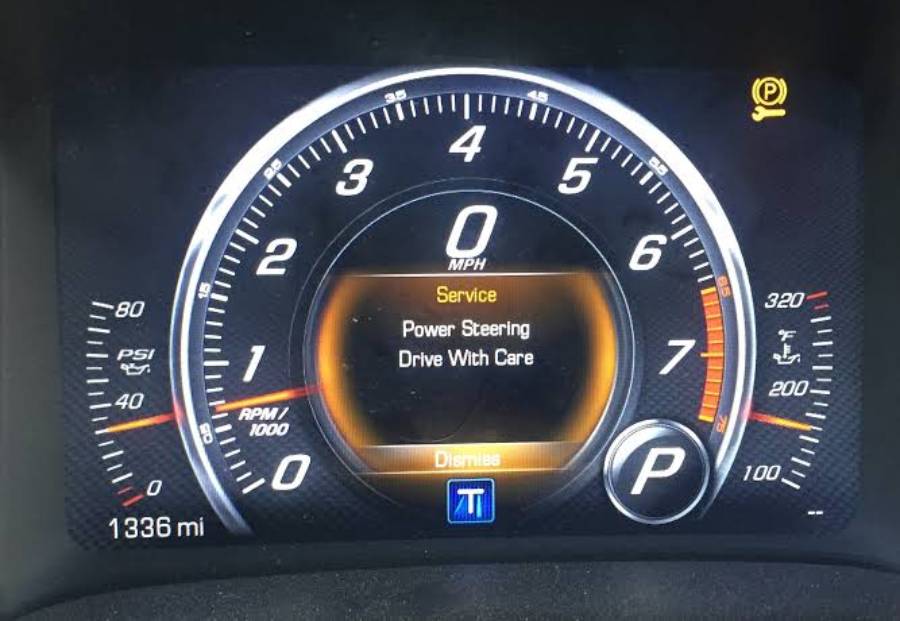
What Does “Service Power Steering Drive with Care” Mean?
“Service Power Steering Drive with Care” means the vehicle has detected a problem with the power steering system that may reduce or interrupt steering assistance. The warning tells the driver that the steering system requires inspection while also indicating that extra caution is necessary until the underlying fault is diagnosed.
In vehicles equipped with electric power steering (EPS), an electric motor supplies assistance that reduces the effort required to turn the steering wheel. The power steering control system uses inputs from components such as torque sensors, steering-related sensors, electrical circuits, and control modules to determine how much assistance is required. A fault affecting this process can cause the vehicle to display a service warning.
The message does not automatically mean that the steering rack has failed or that the vehicle has completely lost steering control. A low-voltage condition, electrical connection problem, sensor fault, control-module issue, or failure within the steering-assist hardware can produce similar warnings. The exact cause must be identified through diagnosis rather than the dashboard message alone.
“Drive with Care” is particularly important because power steering assistance can change after the warning appears. When assistance is reduced, the steering wheel requires more physical effort to turn, especially during low-speed maneuvers such as parking or making tight turns. A complete loss of assistance can make steering considerably harder even when a mechanical connection between the steering wheel and road wheels remains.
Can You Drive with the “Service Power Steering Drive with Care” Warning?
You should only continue driving with a “Service Power Steering Drive with Care” warning when the vehicle remains controllable and the steering operates normally. Drive cautiously for the shortest practical distance to a safe location or repair facility, and avoid treating the warning as something that can be ignored simply because the steering currently feels normal.
The immediate condition of the steering system determines the level of risk. For example, a warning caused by an intermittent electrical or voltage problem may appear while steering assistance is still functioning. The vehicle may remain controllable in that condition, but assistance can potentially change if the underlying fault develops further. Continuing a normal journey without diagnosing the warning therefore creates unnecessary risk.
Pay particular attention to steering effort and consistency. Increased effort while parking, a steering wheel that suddenly becomes harder to turn, or assistance that changes during the same trip indicates that the system is no longer operating normally. Additional electrical or steering warnings can also indicate that the problem extends beyond a temporary dashboard message.
When Should You Stop Driving the Vehicle?
Stop driving when the steering becomes significantly heavier, power assistance disappears or becomes intermittent, or the vehicle becomes difficult to control. Move to a safe location as soon as conditions allow rather than attempting to complete the journey with abnormal steering behavior.
A sudden increase in steering effort is especially important at low speeds because power assistance normally performs much of the work required to turn the wheels. Loss of assistance can therefore become obvious while parking, negotiating tight turns, or maneuvering through traffic. An intermittent fault can create another hazard because the amount of assistance may change unexpectedly while the driver is steering.
Arrange professional diagnosis or towing when safe vehicle control cannot be maintained. The dashboard message alone cannot establish whether the fault comes from the battery, charging system, electrical circuit, sensor, control module, steering motor, or steering rack. Driving decisions should therefore be based first on vehicle controllability and steering behavior, followed by diagnosis of the specific fault.
What Symptoms Can Appear with a “Service Power Steering” Warning?
There are 5 common signs that can accompany a “Service Power Steering” warning: heavier steering, increased effort at low speeds, intermittent steering assistance, a power steering warning light, and abnormal steering response. The exact symptoms depend on the type and severity of the fault, so the dashboard message can appear before the driver notices a major change in steering behavior.
A heavy steering wheel is one of the clearest signs of reduced power assistance. The difference is often most noticeable during parking, U-turns, and other low-speed maneuvers because these situations require greater steering assistance. If the system continues providing partial assistance, the steering may feel heavier than normal without becoming completely unassisted.
Intermittent steering assistance creates a different symptom. The steering may initially feel normal and then require more effort, or the warning may disappear and return during later trips. This pattern can occur when an electrical supply, connection, sensor, or steering-assist component develops an intermittent fault. A warning that disappears should therefore not be treated as proof that the underlying problem has been repaired.
A power steering warning light may also appear with the text message, depending on how the vehicle communicates steering faults. The most important symptom, however, is a change in vehicle control. Steering that becomes unexpectedly heavy, inconsistent, or difficult to operate requires more immediate attention than a warning message accompanied by otherwise normal steering.
What Causes the “Service Power Steering Drive with Care” Warning?
The “Service Power Steering Drive with Care” warning can result from faults in the electrical supply, charging system, wiring, steering sensors, control electronics, steering motor, or steering rack. These causes can produce similar dashboard messages even though their repair requirements differ substantially. Diagnosis should identify the fault before any steering component is replaced.
The cause also depends on the type of power steering system installed in the vehicle. Electric power steering relies heavily on electrical power, electronic inputs, and a motor to provide steering assistance. A fault affecting voltage or communication can therefore trigger a warning without a mechanical steering component being physically damaged. Component failure becomes a stronger possibility when diagnostic testing identifies a steering-specific fault or when the warning is accompanied by persistent loss of assistance.
Can Battery or Alternator Problems Cause the Warning?
A weak battery or charging-system problem can trigger a power steering warning when the steering system does not receive the electrical conditions required for normal operation. This relationship is particularly relevant to electric power steering because its motor and electronic controls depend on the vehicle’s electrical system.
Battery voltage can fall during starting or under electrical load when the battery is weak. A control module that detects voltage outside its expected operating range may record a fault and display a warning. This explains why a steering warning can sometimes appear alongside battery, charging, or other electrical warnings even when the steering hardware itself has not failed.
The alternator creates a related problem when it cannot maintain the vehicle’s electrical supply while the engine is running. An undercharging condition can affect several electronically controlled systems, including electric steering assistance. For this reason, replacing the steering rack before testing battery and charging-system condition can lead to an unnecessary and considerably more expensive repair.
Battery replacement is not a universal fix for a power steering warning. The battery and charging system should be tested first because similar symptoms can originate from an alternator, electrical connection, control module, or steering component. A confirmed voltage problem provides a diagnostic reason to repair the electrical supply rather than simply clearing the warning and waiting for it to return.
Can Electrical or Sensor Problems Cause the Warning?
Electrical circuit and sensor faults can cause the power steering system to display a service warning because steering assistance depends on reliable power, communication, and input signals. Relevant electrical problems can include a blown fuse, damaged wiring, loose or corroded connectors, and poor ground connections.
A damaged connection can create either a persistent or intermittent warning. For example, a loose connector may maintain contact under some conditions but interrupt a circuit when vibration or movement occurs. This can help explain a warning that appears during one trip, disappears after restarting the vehicle, and returns later. The correct repair in such a case is to locate and repair the circuit fault rather than repeatedly reset the warning.
Steering-related sensors provide another potential source of faults. A torque sensor helps the system determine the driver’s steering input, while steering-position or steering-angle information may be used by electronic vehicle systems depending on the vehicle design. Incorrect, missing, or implausible sensor data can cause the control system to detect a fault and modify or disable assistance as a protective response.
A sensor-related diagnostic trouble code does not automatically prove that the sensor itself requires replacement. Wiring, connectors, electrical supply, calibration, communication, or another component in the same circuit can produce related codes. Diagnostic testing should therefore confirm the failed part before replacement.
Can the Power Steering Module, Motor, or Rack Cause the Warning?
A faulty power steering control module, electric steering motor, or steering rack can trigger the warning and may cause partial or complete loss of steering assistance. These components represent more substantial steering-system faults than a simple connection or low-voltage problem and can require more extensive diagnosis and repair.
The power steering control module processes system inputs and controls steering assistance. A module fault or communication failure can prevent the system from calculating or delivering the required assistance. Diagnostic trouble codes and module communication tests help distinguish this type of failure from battery, wiring, or sensor problems.
In an electric power steering system, the motor generates the assistance that reduces the driver’s steering effort. A motor or related internal fault can therefore produce heavy steering when the system can no longer provide the expected assistance. Some vehicle designs integrate the motor and electronic components with the steering rack or steering column assembly, which can affect which components are serviceable separately.
Steering rack replacement should not be the first response to the dashboard warning alone. The same warning can originate from several less extensive faults, including voltage and circuit problems. A rack, motor, or module should be repaired or replaced when diagnostic testing identifies that component as the source of the failure, especially when the vehicle also has persistent loss of steering assistance.
How Do You Diagnose a “Service Power Steering Drive with Care” Warning?
Diagnose a “Service Power Steering Drive with Care” warning by checking the vehicle’s electrical supply first, reading stored diagnostic trouble codes, and then testing the steering components indicated by those results. This sequence helps separate battery or charging faults from wiring, sensor, module, motor, and steering rack problems before expensive parts are replaced.
Start by noting exactly when the warning appears and whether steering assistance changes at the same time. A warning that appears immediately after starting the vehicle can point the diagnosis toward electrical supply or system initialization, while a warning accompanied by consistently heavy steering indicates that the steering-assist system requires closer inspection. Record any additional battery, charging, stability-control, or steering warnings because multiple messages can provide useful diagnostic context.
Check battery and charging-system condition early in the process when the vehicle uses electric power steering. Battery voltage, terminal condition, charging output, power steering fuses, accessible wiring, connectors, and ground connections should be inspected before assuming that a major steering component has failed. A poor electrical connection can produce intermittent symptoms that resemble a sensor or control-module problem.
The next step is to scan the vehicle for diagnostic trouble codes. A basic OBD-II scanner primarily designed for engine-related codes may not provide access to every steering or chassis control module. A scan tool with vehicle-specific module access may be required to retrieve power steering faults, view relevant data, or perform steering-related diagnostic procedures.
A diagnostic trouble code identifies the system or circuit where a fault was detected; it does not necessarily identify the component that must be replaced. For example, a sensor-related code can result from the sensor itself, its wiring, a connector, electrical supply, calibration, or communication with another module. The code should therefore guide further testing rather than serve as an automatic instruction to install a new part.
Component testing comes after the electrical checks and fault-code scan. The technician can use the retrieved codes, live data, voltage measurements, circuit tests, and steering behavior to narrow the problem to a specific system. This process reduces the risk of replacing a battery, sensor, module, motor, or steering rack without evidence that the component has actually failed.
How Do You Fix the “Service Power Steering Drive with Care” Warning?
Fix the “Service Power Steering Drive with Care” warning by repairing the fault identified during diagnosis rather than replacing the steering system based on the warning message alone. The required repair can range from correcting an electrical supply problem to replacing a failed steering component, so there is no single reset or replacement procedure that fixes every case.
Begin with confirmed electrical faults because the steering system requires stable electrical power and communication to operate correctly. A weak battery should be replaced when testing confirms that it can no longer maintain the required condition. A failing alternator or charging-system fault requires its own repair because installing a new battery without correcting the charging problem can allow the warning to return.
Fuse, wiring, connector, and ground problems require targeted electrical repairs. A blown fuse should not simply be replaced repeatedly without investigating why it failed. Damaged wiring needs to be repaired correctly, while loose, contaminated, or corroded connections should be restored so the steering system receives reliable power and signals.
Sensor and electronic faults require diagnosis at the affected circuit or module. Depending on the vehicle, the repair may involve correcting a connection, performing a required calibration, repairing a circuit, or replacing a confirmed failed component. Vehicle-specific service procedures matter because steering-system architecture and calibration requirements differ between models.
Can Restarting the Car or Fixing an Electrical Problem Clear the Warning?
Restarting the vehicle may make an intermittent power steering warning disappear, but a disappearing message does not prove that the underlying fault has been repaired. Cycling the ignition can allow an electronic system to initialize again, which may temporarily restore normal operation when the original problem is intermittent.
The distinction between clearing a warning and repairing a fault is important. If low voltage, a loose connection, or another intermittent electrical condition triggered the warning, the system may operate normally after restarting until the same condition occurs again. A stored diagnostic trouble code may also remain available even after the dashboard message disappears.
Electrical repair can permanently resolve the warning when testing confirms that the electrical fault caused it. Examples include restoring a damaged connection, correcting a ground problem, repairing wiring, replacing a failed battery, or repairing the charging system. The repair should correspond to the diagnosed cause rather than being selected because it is the cheapest or easiest component to replace.
Avoid repeatedly disconnecting the battery or clearing codes simply to remove the message. Erasing diagnostic information before identifying the fault can remove useful evidence and make an intermittent problem more difficult to trace. Confirm the repair by checking that steering assistance operates normally and that the relevant fault does not return.
When Does a Power Steering Component Need Repair or Replacement?
A power steering sensor, control module, motor, or steering rack should be repaired or replaced when diagnostic testing confirms that the component is responsible for the fault. Persistent heavy steering combined with relevant fault codes and component-level test results provides stronger evidence of a steering-system failure than the dashboard warning alone.
A sensor may require replacement when its output remains incorrect after its circuit, electrical supply, connectors, and applicable calibration have been checked. A control module requires similar confirmation because communication or voltage problems elsewhere in the vehicle can sometimes produce symptoms that appear to originate from the module.
A failed electric steering motor can prevent the system from supplying the assistance required to reduce steering effort. The repair procedure depends on vehicle design because the motor may be serviceable separately on one system but integrated into a larger steering assembly on another. The same principle applies to control electronics and other EPS components.
Steering rack replacement becomes appropriate when diagnosis confirms an internal rack or integrated steering-assist failure that cannot be repaired separately. Because a steering rack can represent a substantially larger repair than a battery, connector, or sensor fault, replacing it without component-level diagnosis creates unnecessary cost and may leave the original problem unresolved.
How Much Does It Cost to Fix a “Service Power Steering” Warning?
The cost to fix a “Service Power Steering” warning depends primarily on the failed component, vehicle make and model, and labor required to complete the repair. A minor electrical fault can require a relatively simple repair, while replacement of an integrated electric power steering rack can involve substantially more parts and labor. The warning message alone cannot provide an accurate repair estimate.
Diagnosis should therefore come before estimating the total repair cost. A technician may need to test the battery and charging system, retrieve steering-related diagnostic trouble codes, inspect electrical circuits, and test individual steering components. This diagnostic process determines whether the problem originates outside the steering assembly or requires component-level repair.
Electrical supply problems are generally different in scope from major steering-component failures. A weak battery may require battery replacement, while an alternator fault requires charging-system repair. A damaged connector, fuse circuit, ground, or section of wiring may require only targeted electrical work. The final price depends on which part of the circuit has failed and how difficult it is to access.
Sensor and control-module problems can involve additional diagnostic and calibration requirements. Replacing a component may not complete the repair when the vehicle requires programming, initialization, or calibration afterward. These procedures vary by manufacturer and steering-system design, which is one reason the same warning can result in different repair costs between vehicles.
A steering motor or rack failure generally represents a more extensive repair because some electric power steering systems integrate the motor, electronics, and steering mechanism into larger assemblies. Labor requirements also vary according to component location and vehicle design. An accurate estimate should therefore be based on the confirmed fault and the repair procedure for the specific year, make, and model rather than a generic price attached to the dashboard message.
Read more: Service Engine Soon Light Blinking: Causes, Risks, and What to Do
Can You Prevent the “Service Power Steering” Warning from Coming Back?
You can reduce the likelihood of some recurring power steering warnings by maintaining the electrical system, repairing intermittent faults early, and addressing steering problems when they first appear. Preventive maintenance cannot eliminate every power steering failure because sensors, motors, modules, and mechanical components can eventually develop internal faults.
Battery and charging-system condition are particularly relevant to vehicles equipped with electric power steering. A deteriorating battery, poor terminal connection, charging fault, or unstable electrical supply can affect electronically controlled vehicle systems. Testing an aging or problematic battery and correcting charging-system faults can prevent repeated low-voltage conditions from interfering with steering operation.
Electrical connections should also be addressed when inspection identifies damage, looseness, corrosion, or poor grounding. An intermittent connection can cause a warning to disappear and return, making the problem appear less serious than a permanent failure. Repairing the connection when symptoms first develop can prevent repeated faults and simplify diagnosis.
Do not ignore a warning simply because restarting the vehicle makes it disappear. Record when the warning occurs, note whether steering effort changes, and retain diagnostic information until the cause has been identified. These details can help distinguish an intermittent electrical problem from a developing sensor, module, motor, or steering-rack fault.
Regular vehicle servicing can identify battery, charging, suspension, and steering problems before they develop into more noticeable symptoms, but no maintenance schedule guarantees that an electronic steering component will not fail. The practical goal is to maintain reliable electrical conditions and investigate abnormal steering behavior early rather than attempt to prevent every possible power steering fault.
What Is the Difference Between a Power Steering Warning Light and “Service Power Steering”?
A power steering warning light is a visual dashboard indicator, while “Service Power Steering” is a text message telling the driver that the vehicle has detected a steering-system fault that requires attention. Both can indicate a problem with steering assistance, but the exact warning format and meaning depend on the vehicle manufacturer, model, and steering system.
A warning light commonly uses a steering-wheel symbol or another manufacturer-defined indicator to alert the driver. A text message can provide additional instructions such as “Service Power Steering” or “Drive with Care.” Some vehicles can display both forms of warning when the same system fault occurs.
Neither the warning light nor the service message should be confused with a diagnostic trouble code. The dashboard warning communicates the problem to the driver, whereas a DTC records diagnostic information that can help a technician identify the affected system or circuit. In practical terms, the sequence is system detects an abnormal condition → diagnostic information is stored when applicable → dashboard warning informs the driver → diagnostic testing identifies the cause.
The warning itself also does not establish how much steering assistance remains available. A driver may receive a service message while the steering still feels normal, while another fault can produce both a warning and noticeably heavier steering. Vehicle behavior therefore remains important when deciding whether to continue for a short distance or stop driving.
Check the owner’s manual for the exact meaning of a steering indicator or message on a specific vehicle. Manufacturers use different warning terminology and system designs, so vehicle-specific information should take priority over assuming that every “Service Power Steering” message represents the same component failure.