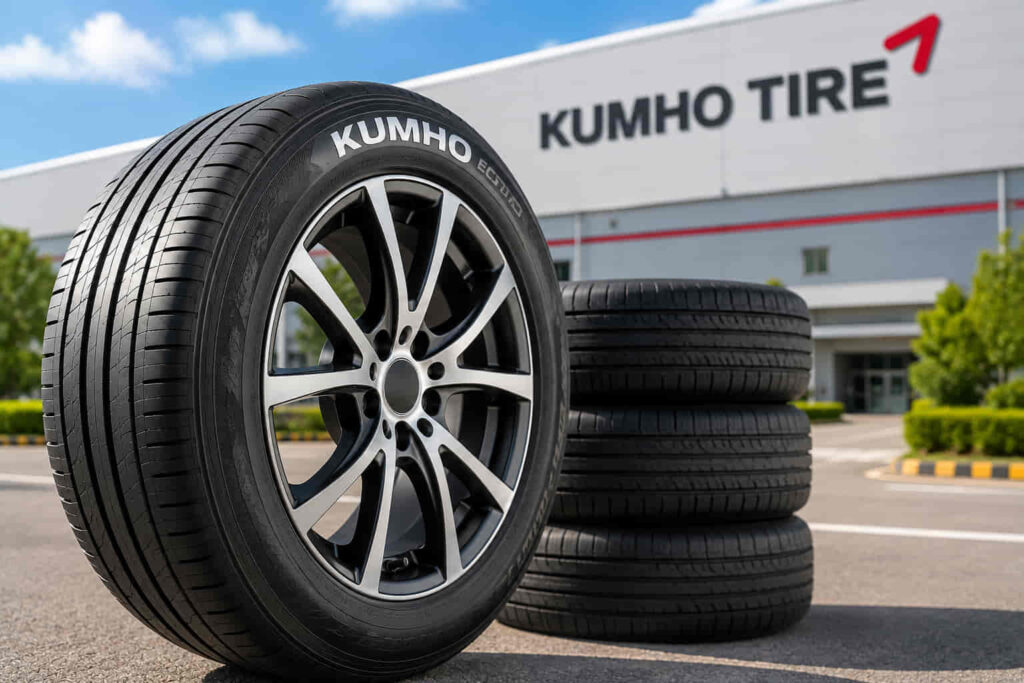
Kumho Tires are made by Kumho Tire Co., Inc., a South Korean tire manufacturer that produces passenger car, SUV, commercial, and replacement tires for customers around the world. The company has developed from a regional tire manufacturer into a global brand that supplies tires for everyday drivers, vehicle manufacturers, and commercial applications.
Understanding who makes Kumho Tires helps explain the company’s position in the global tire industry. A tire brand’s manufacturer influences important factors such as production standards, research and development capability, product quality, and long-term reliability. Kumho Tire operates its own manufacturing facilities and develops tire technologies for different vehicle categories, including passenger vehicles, performance cars, SUVs, trucks, and commercial vehicles.
Kumho is widely recognized as one of South Korea’s major tire manufacturers, competing in the international market alongside brands such as Hankook, Michelin, Bridgestone, Continental, and Goodyear. The company produces a wide range of tire products, from daily commuting tires to performance and all-terrain options.
This guide explains who owns Kumho Tire, where Kumho tires are made, how the company developed, what products it manufactures, its relationship with vehicle manufacturers, and why Kumho has become a recognized name in the global tire market.
What Is Kumho Tire Known For?
Kumho Tire is known for being a global South Korean tire manufacturer that develops and produces tires for passenger vehicles, SUVs, trucks, commercial vehicles, and original equipment applications. The company has established its position in the tire industry by focusing on a combination of product diversity, manufacturing capability, and technology development.
Kumho Tire operates as an independent tire manufacturer rather than simply being a private label brand. This means the company is responsible for developing tire designs, engineering compounds, conducting testing, and managing production processes for its own product lines. This manufacturing structure allows Kumho to control important aspects of tire development, from research and development to final production.
The company produces tires across multiple categories to serve different driving requirements. Its passenger vehicle tire range includes touring and performance products designed for everyday commuting and responsive handling. For SUVs and crossover vehicles, Kumho develops products focused on stability, comfort, and durability. The company also manufactures commercial tires designed for trucks, buses, and business applications where load capacity and reliability are important.
Kumho is also recognized for its focus on technology development. The company invests in tire research to improve areas such as tread design, rubber compounds, fuel efficiency, handling performance, and driving comfort. These developments allow Kumho to compete in different segments of the global tire market rather than focusing only on low-cost replacement products.
Compared with smaller budget tire brands, Kumho has a stronger global manufacturing presence and a longer history of tire production. Compared with premium manufacturers, Kumho generally positions itself as a value-focused alternative that aims to balance performance and affordability.
For example, a driver choosing Kumho tires for a family sedan may benefit from the company’s experience in producing everyday passenger tires, while an SUV owner may choose Kumho because of its dedicated product lines designed for larger vehicles.
Where Did Kumho Tire Start?
Kumho Tire started in South Korea and developed from a domestic tire company into an international manufacturer serving markets around the world. The company’s growth reflects the expansion of South Korea’s automotive industry and the increasing global demand for reliable tire suppliers.
Kumho was founded in 1960 and originally operated under the name Samyang Tire. During its early development, the company focused on supplying tires for the growing Korean automotive market. As vehicle ownership increased and South Korea’s automotive sector expanded, Kumho developed greater manufacturing capabilities and expanded its product range.
Over time, Kumho increased its investment in research, production facilities, and international distribution. This expansion allowed the company to move beyond its domestic market and compete with established tire manufacturers worldwide.
The company’s development followed a similar path to other major Asian tire manufacturers. Instead of competing only through lower prices, Kumho invested in engineering capabilities, product innovation, and partnerships with vehicle manufacturers. This helped the brand establish recognition among consumers and automotive companies.
Today, Kumho Tire operates as a global tire manufacturer with products distributed across multiple international markets. Its history demonstrates the company’s transition from a regional manufacturer into a recognized participant in the global tire industry.
For example, a customer purchasing Kumho tires today is buying products from a company with decades of manufacturing experience rather than a newly established budget tire brand.
Read more: Are Arroyo Tires Good
Who Owns Kumho Tire Today?
Kumho Tire Co., Inc. is the company behind the Kumho Tires brand, with its ownership structure changing over time as the company expanded and underwent strategic transitions. Understanding who owns Kumho Tire helps explain how the company operates, invests in manufacturing, and competes in the global tire market.
Kumho Tire was historically connected with the Kumho Asiana Group, one of South Korea’s major business groups. During its development, the company expanded its production capacity and international presence while building recognition as a global tire manufacturer.
The ownership structure of Kumho Tire changed after financial challenges and restructuring processes led to a transition in control. The company later became associated with Doublestar, a Chinese tire manufacturer, which acquired a controlling stake in Kumho Tire. Despite changes in ownership, Kumho Tire has continued operating under its own brand identity, maintaining its product development, manufacturing operations, and global market activities.
Ownership changes do not automatically determine tire quality. The reliability of a tire manufacturer depends more on factors such as engineering capability, production standards, quality control systems, research investment, and manufacturing experience. Kumho continues to operate as an established tire producer with its own product lines and technical development programs.
The company’s ability to maintain its brand identity after ownership changes shows the strength of Kumho’s existing manufacturing infrastructure and market recognition. Drivers purchasing Kumho tires are buying products developed and produced under the Kumho Tire brand rather than a generic tire label.
For example, a customer choosing Kumho Ecsta performance tires or Kumho Crugen SUV tires is selecting a product from a manufacturer with established engineering processes and global production experience.
Where Are Kumho Tires Made?
Kumho Tires are manufactured at production facilities located in multiple countries, including South Korea, China, Vietnam, and other international manufacturing locations. The company uses a global production network to supply different markets and meet demand from both replacement tire customers and vehicle manufacturers.
Kumho’s manufacturing strategy allows the company to produce tires closer to important regional markets while maintaining consistent product standards. Global production facilities help reduce transportation costs, improve supply chain efficiency, and support the company’s international distribution network.
South Korea remains an important part of Kumho’s identity as a Korean tire manufacturer. The company maintains research and manufacturing capabilities in its home country while also operating overseas facilities to support global demand.
Vietnam has become an important production location for Kumho Tire, particularly for expanding manufacturing capacity and serving international markets. The company also operates production facilities in China and other regions as part of its global manufacturing system.
The country where a specific Kumho tire is produced can vary depending on the tire model, market destination, and production schedule. However, production location alone does not determine tire quality. Large global tire manufacturers typically use standardized engineering processes, quality control procedures, and testing requirements across their facilities.
For example, a Kumho tire produced at an overseas facility still follows the company’s specifications and manufacturing requirements, allowing Kumho to maintain consistency across different markets.
What Types of Tires Does Kumho Manufacture?
Kumho Tire manufactures a wide range of tire products designed for passenger vehicles, SUVs, performance cars, trucks, buses, and commercial applications. The company’s broad product portfolio allows it to serve different segments of the automotive market instead of focusing on only one type of vehicle or driving condition.
For passenger vehicles, Kumho produces touring and all-season tires designed around everyday driving requirements such as comfort, stability, and predictable handling. These products are commonly used by drivers who need reliable tires for commuting, highway travel, and general transportation.
Kumho also develops performance-oriented tires through its Ecsta product line. These tires focus on handling response, cornering stability, and driving performance for customers who want a more engaging driving experience compared with standard touring tires.
For SUVs and crossover vehicles, Kumho offers products such as the Crugen line, which is designed around the needs of larger vehicles. SUV tires require different characteristics compared with passenger car tires because they must support higher vehicle weight while maintaining comfort and stability.
The Road Venture product family represents Kumho’s focus on light trucks and all-terrain applications. These tires are designed for drivers who need additional durability and traction for pickup trucks, SUVs, and vehicles that may encounter mixed road conditions.
Kumho also manufactures winter tires and commercial tires. Winter-focused products are developed to provide improved traction in cold conditions, while commercial tires are designed for vehicles that require higher load capability and consistent performance.
The diversity of Kumho’s product range demonstrates the company’s position as a full-line tire manufacturer. Instead of competing only in the budget replacement market, Kumho serves multiple categories across the automotive industry.
For example, a compact car owner may choose Kumho Solus tires for daily commuting, while a truck owner may select Kumho Road Venture tires for additional durability and versatility.
Does Kumho Supply Tires to Car Manufacturers?
Kumho Tire supplies tires for original equipment applications, meaning some vehicle manufacturers use Kumho tires as factory-installed equipment on new vehicles. This relationship demonstrates that Kumho meets the technical requirements needed by automotive manufacturers.
Original equipment manufacturing requires tire companies to pass strict evaluation processes related to performance, safety, durability, and consistency. Vehicle manufacturers select tire suppliers based on factors such as handling characteristics, ride quality, fuel efficiency, and compatibility with specific vehicle designs.
Kumho’s OEM partnerships have helped strengthen its reputation beyond the replacement tire market. Being selected by automotive manufacturers indicates that the company has developed engineering capabilities and production standards suitable for large-scale vehicle production.
OEM supply is also important because tires influence the overall driving experience of a vehicle. Manufacturers carefully match tire characteristics with suspension systems, vehicle weight, and intended driving behavior.
Kumho’s involvement in OEM applications supports its position as more than a low-cost tire producer. The company operates in the same global industry as other established tire manufacturers and competes through a combination of technology, manufacturing capacity, and product diversity.
For example, a vehicle equipped with Kumho tires from the factory demonstrates that the brand has met the requirements of automotive engineers, not only consumer replacement demand.
How Does Kumho Compare With Other Tire Manufacturers?
Kumho is positioned as a global tire manufacturer that offers a balance between technology, performance, and affordability compared with both budget and premium competitors. The company occupies a middle position in the tire market, providing more engineering depth than many low-cost brands while generally remaining more affordable than premium manufacturers.
Compared with other Korean tire manufacturers such as Hankook and Nexen, Kumho competes through similar strengths, including manufacturing experience, global distribution, and a wide product range. The differences between these brands often depend on specific tire models, vehicle applications, and pricing.
Compared with premium brands such as Michelin, Bridgestone, and Continental, Kumho typically focuses on delivering strong value rather than competing solely through maximum performance or luxury refinement. Premium brands often have advantages in areas such as advanced materials, specialized technologies, and extensive global testing programs.
Kumho’s market position allows it to appeal to drivers who want dependable tires with modern features but do not necessarily need the highest-priced option available. This balance has helped the company maintain a strong presence in both replacement and OEM markets.
For example, a driver looking for a reliable touring tire may consider Kumho as an alternative to premium brands, while someone seeking the highest level of performance for motorsport or extreme driving may choose a specialized premium tire manufacturer.
Is Kumho a Reliable Tire Manufacturer?
Kumho Tire is a reliable tire manufacturer with decades of production experience, global manufacturing capability, and a presence in both replacement and original equipment markets. The company’s reliability comes from its long operating history, engineering development, manufacturing infrastructure, and ability to serve different vehicle categories.
One important factor behind Kumho’s reputation is its experience in the tire industry. A manufacturer that has operated for decades must continuously maintain production standards, develop new technologies, and adapt to changing vehicle requirements. Kumho has expanded from a domestic Korean tire company into a global manufacturer supplying products to customers in multiple regions.
Kumho’s manufacturing capability also contributes to its reliability. The company operates international production facilities and uses structured quality control processes to maintain consistency across different markets. Large-scale manufacturing experience allows Kumho to produce tires for various applications, from passenger vehicles to commercial transportation.
The company’s OEM relationships provide another indicator of technical capability. Supplying tires for vehicle manufacturers requires meeting strict requirements related to safety, performance, durability, and consistency. This demonstrates that Kumho has developed engineering processes that meet industry standards beyond the consumer replacement market.
However, Kumho’s position should be understood correctly. It is generally considered a value-focused global tire manufacturer rather than a top-tier premium brand competing only on maximum performance. Drivers who need specialized racing tires, extreme off-road capability, or the highest level of luxury refinement may choose other manufacturers with specific advantages in those areas.
For most everyday drivers, Kumho represents a reliable balance between quality, performance, and cost. The brand provides a practical option for customers who want products from an established global manufacturer without paying premium prices.