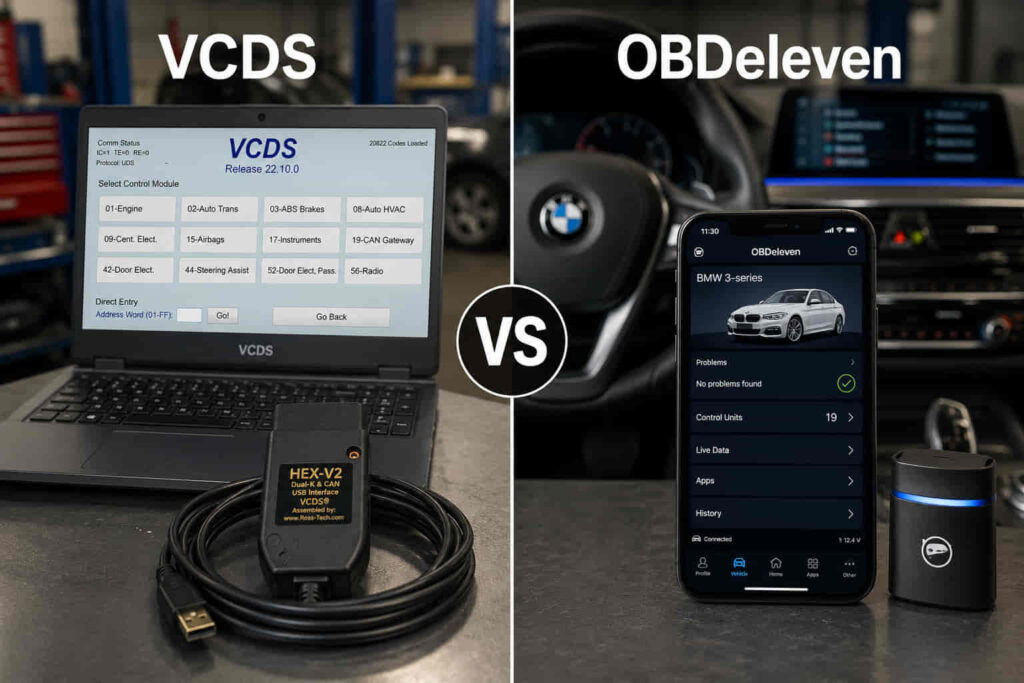
VCDS and OBDeleven can both provide diagnostic, coding, adaptation, and service-related functions for supported vehicles, but they differ significantly in workflow, platform, accessibility, and how users interact with advanced vehicle functions. VCDS is built around a more technical, computer-based diagnostic environment focused on Volkswagen Group vehicles, while OBDeleven emphasizes a portable, mobile-oriented workflow with manual diagnostic functions and guided features such as supported One-Click Apps.
The better choice depends less on which tool has the longer feature list and more on what the owner actually needs to do. A user who regularly troubleshoots control modules, analyzes diagnostic information, and performs manual coding or adaptations has different requirements from an owner who wants convenient smartphone access for fault scanning, maintenance functions, and supported vehicle modifications. Vehicle compatibility also matters because a function available in the platform does not automatically mean that function is supported on every model, control module, or model year.
There are 7 key differences between VCDS and OBDeleven that matter when choosing between them: diagnostic workflow, coding and adaptation control, ease of use, device requirements, advanced diagnostic access, pricing and licensing structure, and intended user type. Comparing these attributes directly provides a more useful buying decision than declaring either VCDS or OBDeleven universally better.
What Are the 7 Key Differences Between VCDS and OBDeleven?
The 7 key differences between VCDS and OBDeleven are their diagnostic workflow, coding and adaptation workflow, ease of use, device and platform requirements, advanced diagnostic control, pricing and licensing structure, and the type of user each platform best serves. Both tools can overlap in several diagnostic and vehicle-configuration tasks on supported vehicles, but the way those functions are accessed and used can make one platform substantially better suited to a particular owner.
The first major difference is diagnostic workflow. VCDS is structured around direct interaction with vehicle control modules in a technical diagnostic environment. This approach is useful when the objective extends beyond reading a fault code and clearing it. A user investigating a vehicle problem may need to enter the relevant control module, review fault information, examine available measuring or live data, and use applicable diagnostic functions to determine why the fault occurred. The workflow therefore favors users who want to interact directly with the diagnostic structure of supported Volkswagen Group vehicles.
OBDeleven also provides diagnostic access on supported vehicles, but its mobile-oriented environment changes how that interaction takes place. A smartphone-based workflow can make scanning the vehicle, checking faults, accessing supported control-unit information, and performing applicable functions more convenient when a computer-based setup is undesirable. The practical difference is therefore not simply whether both tools can read diagnostic trouble codes, but how the user wants to move from a stored fault toward actual troubleshooting.
The second difference is how VCDS and OBDeleven approach coding and adaptations. VCDS emphasizes direct interaction with applicable coding, adaptation, and control-module functions. This suits owners and technicians who want to understand what is being changed and work manually within the supported vehicle configuration. The advantage becomes more meaningful when the user needs repeatable access to vehicle settings rather than only a convenient method of activating a popular modification.
OBDeleven combines manual diagnostic and configuration capabilities with a more guided ecosystem for supported functions, including One-Click Apps. These apps can reduce the number of manual steps required for certain vehicle modifications by packaging a supported change into a simpler workflow. That convenience is valuable for owners who know the result they want but do not necessarily want to navigate every underlying configuration step manually.
One-Click Apps should not, however, be treated as the complete definition of OBDeleven coding. OBDeleven’s capabilities extend beyond these guided functions, while the exact coding or adaptation options depend on the supported vehicle, module, platform access, and applicable product conditions. The meaningful comparison is therefore manual control versus the availability of more guided workflows, not “VCDS has coding while OBDeleven only has apps.”
The third difference is ease of use. OBDeleven’s mobile-first approach can reduce the initial access barrier for many DIY owners because the diagnostic interface is used through a familiar smartphone environment. Portability also makes it convenient to connect to the vehicle without setting up a conventional computer-based diagnostic workspace. For routine scanning or supported modifications, this can make the workflow feel more approachable.
VCDS presents a more technical environment because its value is strongly connected to direct diagnostic interaction. A user may need to understand control-module terminology, fault information, measuring values, adaptations, coding, and the consequences of changing vehicle configuration. That learning requirement is not automatically a disadvantage. For someone who wants to develop deeper VAG diagnostic knowledge, the technical workflow itself can be part of the platform’s value.
Ease of use should therefore remain separate from diagnostic capability. A simpler path to a function does not prove that the underlying tool is universally more capable, while a more technical interface does not prove that every user will obtain more value from it. The better interface is the one that matches the user’s knowledge and the complexity of the work being performed.
The fourth difference is the device and platform workflow. VCDS is fundamentally associated with a computer-oriented diagnostic setup using compatible Ross-Tech hardware and software. This creates a working environment that can suit longer diagnostic sessions where the user wants vehicle information presented through a dedicated desktop-style interface.
OBDeleven emphasizes portability through a mobile-device workflow. This can be advantageous when an owner wants a compact diagnostic interface that can remain with the vehicle and be accessed through a supported smartphone or mobile device. For a user who regularly checks vehicles away from a workshop environment, portability can influence the purchase decision independently of the actual diagnostic feature set.
The device distinction matters because diagnostic tools are not used in an abstract feature comparison. A tool can technically support a required operation yet still be inconvenient for a particular workflow. Someone comfortable bringing a computer to the vehicle may place little value on mobile access, while another owner may consider smartphone operation one of the most important reasons to choose a diagnostic platform.
The fifth difference is advanced diagnostic control. VCDS is particularly relevant when a user wants detailed interaction with supported Volkswagen Group control modules and diagnostic functions. Troubleshooting can require more than retrieving a DTC because a fault code identifies a detected condition rather than automatically proving which component should be replaced. Access to relevant module information, measuring data, adaptations, basic settings, and other applicable diagnostic functions can help move the process from fault detection toward diagnosis.
OBDeleven can also provide substantial diagnostic functionality on supported vehicles, so advanced use should not be reduced to a claim that one tool performs “real diagnostics” and the other does not. The actual question is whether the functions required for the exact vehicle and diagnostic task are supported and how efficiently the user can access them. A feature that exists generally within a platform has limited value if it is unavailable for the control module or vehicle being worked on.
This makes vehicle compatibility more important than raw feature count. Diagnostic capability should be evaluated as tool capability connected to a specific vehicle, module, and task, not as a marketing list detached from the car.
The sixth difference is pricing and licensing structure. VCDS and OBDeleven should not be compared only by the initial cost of obtaining an interface because access models can differ. Hardware, software access, vehicle limitations where applicable, subscription or plan requirements, and access to particular functions can all affect the actual ownership cost.
OBDeleven’s ecosystem can involve different plans or access conditions for particular functions, while VCDS purchasing decisions can depend on the applicable Ross-Tech interface and product configuration. Because these structures can change, a useful comparison should evaluate what the user needs to access rather than treating one current price as a permanent characteristic of either platform.
A lower entry cost also does not automatically produce the lower long-term cost for every user. Someone who needs only occasional basic functions has a different cost equation from a person who expects to perform repeated diagnostics and coding over several years. Price should therefore be evaluated after the required functions and usage pattern are established.
The seventh and most important difference is the user each tool best serves. VCDS generally makes more sense when the priority is a detailed VAG-focused diagnostic environment, direct manual interaction with control modules, and a technical workflow that the user expects to use repeatedly. Its value increases when diagnostics itself is part of the owner’s or technician’s skill set rather than merely a way to clear warning lights.
OBDeleven can make more sense when portability, mobile access, convenient diagnostics, and easier access to supported vehicle functions are higher priorities. An owner interested in scanning faults, performing applicable maintenance functions, and making supported vehicle changes from a smartphone can value this workflow more than the additional technical interaction of a computer-based platform.
Neither user profile makes one tool universally superior. A beginner who wants to learn detailed Volkswagen Group diagnostics may prefer VCDS despite its more technical workflow, while an experienced owner may still prefer OBDeleven because mobile portability fits the work being performed. Expertise alone does not determine the choice; the required tasks and preferred workflow do.
The central difference between VCDS and OBDeleven is therefore not whether one has diagnostics and the other has coding, because their supported functions overlap in important areas. The difference is how those capabilities are delivered and how well that workflow matches the vehicle and user. VCDS favors deeper technical interaction in a VAG-focused computer-based environment, while OBDeleven emphasizes portable mobile access and more accessible workflows for supported functions. Vehicle compatibility and required functions should be checked first, workflow preference second, and cost only after those requirements are established.
Read more: bmw paint codes location
Is VCDS or OBDeleven Better for Diagnostics?
VCDS is generally the stronger choice for users who prioritize a detailed, technical Volkswagen Group diagnostic workflow, while OBDeleven is often the more convenient choice for users who want capable diagnostics through a portable mobile interface. Both platforms can perform diagnostic functions on supported vehicles, so the meaningful difference is not simply whether they can read fault codes. The stronger comparison is how each tool helps the user move from detecting a fault to understanding and troubleshooting it.
Reading a diagnostic trouble code is only the beginning of diagnosis. A DTC records a condition detected by a control module, but it does not automatically prove that the component named or associated with the code has failed. Effective troubleshooting can require access to the relevant module, additional fault information, live or measuring data, basic settings, adaptations, and other supported diagnostic functions. The value of a diagnostic platform therefore increases when it provides the information and control required to test the fault rather than encouraging immediate parts replacement from a code alone.
VCDS fits this type of work particularly well because its workflow is centered on direct interaction with supported Volkswagen Group control modules. A user investigating an engine, transmission, ABS, airbag, climate-control, convenience, or other electronic-system problem can work within the relevant module and use the diagnostic information available for that vehicle. This structure favors users who want to understand how different module functions contribute to the diagnosis instead of relying primarily on a simplified scan result.
The technical nature of VCDS also makes it useful for repeated troubleshooting. When a fault is intermittent, for example, simply clearing the code and waiting for it to return provides limited information. A more structured diagnostic process can involve reviewing the stored fault, examining relevant operating data, checking the conditions under which the problem occurs, performing applicable tests or settings, and then evaluating whether the repair changed the vehicle’s behavior. The diagnostic tool becomes part of a process rather than just a warning-light reset device.
OBDeleven offers a different advantage because it puts supported diagnostic functions into a mobile-oriented environment. An owner can connect to the vehicle without establishing a conventional computer-based diagnostic setup, making the platform convenient for quick scans, fault checks, vehicle monitoring, and applicable service or diagnostic work. This portability can matter significantly to a DIY owner who wants a diagnostic tool available in the vehicle or regularly works away from a fixed garage environment.
Mobile convenience does not mean OBDeleven should be classified as a basic code reader. Its supported capabilities can extend into control-unit diagnostics, live information, adaptations, coding, and other vehicle functions. However, the exact capability must always be evaluated against the specific vehicle and module. The fact that a diagnostic function exists within the OBDeleven ecosystem does not establish that it is available in the same way for every Volkswagen Group model or control unit.
The same compatibility rule applies to VCDS. A platform’s general reputation for diagnostic depth does not mean every possible operation exists on every vehicle. Model year, vehicle platform, control-module implementation, security requirements, and supported functions determine what the user can actually do. For this reason, comparing VCDS and OBDeleven by counting advertised features is less useful than checking whether the exact diagnostic operations required for the target vehicle are supported.
The better diagnostic tool therefore depends on the depth and workflow the user requires. A Volkswagen or Audi enthusiast who routinely diagnoses module-level faults and wants a technical environment for repeated troubleshooting can obtain more value from VCDS. An owner who prioritizes smartphone access, portability, convenient vehicle scans, and supported diagnostic functions can find OBDeleven more practical even when a computer-based tool offers a more technical workflow.
For diagnostics, VCDS generally has the advantage when detailed VAG-focused troubleshooting and direct technical interaction are the priorities, while OBDeleven has the advantage when capable mobile diagnostics and portability matter more. The final decision should still be based on support for the specific vehicle, module, and diagnostic task rather than the assumption that either tool can perform every function on every supported brand.
Is VCDS or OBDeleven Better for Coding?
VCDS is generally better suited to users who want direct manual control over supported coding and adaptation functions, while OBDeleven is particularly attractive to users who value mobile coding access and guided functions such as supported One-Click Apps. Both platforms can provide vehicle-configuration capabilities, but they differ in how much interaction the user has with the underlying change and how easily common modifications can be performed.
Vehicle coding changes configuration within supported electronic control modules. Adaptations can modify applicable stored settings or operating parameters, while other procedures can involve basic settings or service-related functions. These operations should not be treated as interchangeable simply because they all appear within a diagnostic platform. The correct function depends on what the control module supports and what the user is attempting to change.
VCDS favors a manual approach to this interaction. For users who understand the applicable control module and the setting being modified, direct coding or adaptation access provides greater visibility into the change being made. This is valuable when the objective is not merely to activate a popular convenience feature but to understand the configuration, document the original value, make a controlled change, and reverse that change if necessary.
That manual workflow also creates responsibility. Direct access does not make every available modification safe or appropriate. Changing a value without understanding its function can create unexpected vehicle behavior, fault codes, or a configuration that is difficult to reconstruct later. Recording original values and understanding the specific procedure are therefore part of responsible coding, regardless of the tool being used.
OBDeleven reduces friction for certain supported modifications through its One-Click App ecosystem. Instead of manually navigating every underlying coding or adaptation step, a supported app can package a predefined vehicle change into a guided action. This can be valuable for an owner who wants a specific supported feature and prefers not to reproduce a technical coding procedure manually.
One-Click Apps are nevertheless only one part of the OBDeleven platform. Treating OBDeleven as a collection of automated coding buttons ignores its broader manual diagnostic and configuration capabilities on supported vehicles. The practical distinction is that OBDeleven provides an additional convenience layer for certain modifications, while VCDS is more strongly associated with direct technical interaction as the normal workflow.
The guided approach also does not remove the need to understand the consequence of a modification. A change can be easier to initiate without becoming mechanically or electronically risk-free. If a supported app changes vehicle behavior, the owner should still understand what the feature does, whether it applies to the exact vehicle, and how the modification affects the original configuration. Fewer user inputs do not eliminate the importance of vehicle compatibility.
Coding support also varies by vehicle generation and electronic architecture. A procedure that works on one Volkswagen or Audi cannot automatically be transferred to another model simply because both vehicles use the same diagnostic tool. Control modules, software versions, security mechanisms, and available channels can differ. The correct comparison therefore asks whether VCDS or OBDeleven supports the desired change on the exact vehicle rather than whether either platform broadly advertises coding.
This creates two different forms of value. VCDS provides greater appeal when the user wants a technical coding workflow, expects to perform manual adaptations repeatedly, and values understanding or controlling the configuration process. OBDeleven provides greater appeal when the user wants portable access, manual functions where supported, and a simpler route to selected modifications through supported One-Click Apps.
For coding, VCDS generally fits users who prioritize manual control and a technical VAG-focused workflow, while OBDeleven fits users who prioritize mobile convenience and easier access to supported modifications. Neither approach makes every coding change appropriate or available. The better tool is the one that supports the required function on the specific vehicle while giving the user the level of control and guidance appropriate for that task.
Is OBDeleven Easier to Use Than VCDS?
OBDeleven is generally easier to approach for many DIY users because its mobile-oriented interface reduces setup friction and provides more guided access to supported vehicle functions, while VCDS uses a more technical diagnostic workflow that requires greater familiarity with Volkswagen Group control modules and diagnostic terminology. This usability difference matters most to owners who want to perform common diagnostic or coding tasks without first learning a desktop-style diagnostic environment.
OBDeleven’s smartphone-based workflow contributes directly to that accessibility. The user can connect the compatible interface to the vehicle and interact with supported diagnostic functions through a mobile device, which can be more familiar than bringing a computer to the car. For tasks such as scanning for faults, reviewing supported vehicle information, or accessing an available modification, this lower setup barrier can make the tool more convenient for occasional DIY use.
Guided functions can reduce the learning requirement further. Supported One-Click Apps allow certain vehicle changes to be performed without manually reproducing every underlying coding or adaptation step. This is useful when the owner understands the modification they want but does not need direct interaction with every technical value involved in making that change. The benefit is workflow efficiency rather than proof that the underlying vehicle configuration has become simpler.
VCDS takes a different approach because its interface exposes the user more directly to the diagnostic structure of supported Volkswagen Group vehicles. Control modules, fault information, measuring data, coding, adaptations, basic settings, and other applicable functions form part of a technical environment designed around interaction with the vehicle’s electronic systems. A new user may therefore need more time to understand where a function belongs and what a particular value or procedure represents.
That learning curve can become an advantage when the objective is to develop diagnostic skill. A user who repeatedly works with Volkswagen Group vehicles can learn how control modules relate to specific systems, how diagnostic trouble codes connect to operating data, and how configuration changes are performed. Instead of hiding much of that structure behind a simplified action, VCDS can make the diagnostic process itself more visible.
Ease of use also changes according to the task. Clearing a known fault after a completed repair, checking a service-related function, and investigating an intermittent electronic problem do not require the same level of interaction. A guided mobile workflow may be more efficient for the first type of task, while a technical interface can become more useful when the user needs to investigate several related data points or module functions.
The user’s existing knowledge therefore affects perceived difficulty. Someone already familiar with VAG diagnostic terminology may not consider VCDS difficult to use, while an owner with little coding or diagnostic experience may find OBDeleven easier to approach. Conversely, a simplified workflow does not protect an inexperienced user from every incorrect decision. A coding change or diagnostic conclusion can still be wrong even when the interface makes the action easy to perform.
OBDeleven generally has the advantage in initial ease of use and mobile convenience, while VCDS can provide a more transparent technical workflow for users willing to learn it. Ease of use should therefore be evaluated as the amount of friction between the user and the required task, not as evidence that the easier tool necessarily provides better diagnostics or greater coding capability.
Does VCDS Have More Features Than OBDeleven?
VCDS should not be considered better than OBDeleven simply because one platform appears to expose more technical functions, because useful feature depth depends on the specific vehicle, control module, required operation, and way the function is implemented. A meaningful VCDS vs OBDeleven comparison should evaluate whether each tool can perform the required task on the target vehicle rather than count menu items or advertised capabilities.
Both platforms cover overlapping diagnostic and configuration categories on supported vehicles. These can include fault-code access, control-module interaction, live or measuring information, adaptations, coding, service-related functions, and other applicable operations. The presence of the same broad category on both platforms does not guarantee identical implementation, access, workflow, or vehicle coverage.
VCDS has particular value in the way it exposes a technical Volkswagen Group diagnostic environment. For an advanced user, feature depth is not merely the ability to open a control module. The value comes from being able to use the available diagnostic information and applicable module functions as part of a structured troubleshooting or configuration process. A function becomes more useful when the user can connect it to the fault, data, system behavior, and required procedure.
OBDeleven approaches feature access through a different interface while combining manual capabilities with guided functionality where supported. This creates a broader usability range because the same platform can serve an owner performing a relatively simple scan and another user accessing more detailed vehicle functions. Its One-Click Apps add another layer by turning selected supported modifications into predefined workflows, but these apps should not be counted as if they represent the entire technical capability of the platform.
Vehicle compatibility places a hard boundary around any feature comparison. A coding, adaptation, diagnostic, or service function has practical value only when it is supported on the exact vehicle and relevant control module. A feature advertised at platform level can be irrelevant to an owner if their model year, electronic architecture, module software, or other vehicle-specific condition does not support the intended operation.
The same principle applies when comparing advanced functions. A user should first define the required operation, such as diagnosing a particular module, viewing specific data, performing an adaptation, or changing a supported configuration. The next question is whether each platform provides the required access for that vehicle. Only after that capability is established does workflow become the deciding factor.
This approach also prevents feature quantity from being confused with user value. An owner who needs fault scanning and a small number of supported modifications may obtain little benefit from technical functions they never use. A frequent DIY diagnostician or specialist working repeatedly with Volkswagen Group vehicles can place much greater value on direct module interaction because those functions are central to the work being performed.
Feature availability can also evolve as vehicle architectures, software, security requirements, and the diagnostic platforms themselves change. A static claim that one tool universally “has more features” can therefore become less useful than a capability-based comparison. The required vehicle and operation should remain the stable reference point.
VCDS has an advantage when the required value is detailed technical interaction with supported Volkswagen Group systems, while OBDeleven can provide a strong combination of manual functionality, mobile access, and guided features on supported vehicles. Instead of asking which platform has the largest feature count, the more useful question is which one supports the exact diagnostic, coding, adaptation, or service functions you need on the vehicle you own.
Is VCDS or OBDeleven Better for Beginners?
OBDeleven is generally easier for beginners who prioritize mobile access, convenient diagnostics, and guided supported functions, while VCDS can be the better starting point for beginners who specifically want to learn detailed Volkswagen Group diagnostics and manual coding workflows. The right choice therefore depends on whether the beginner’s objective is to reduce technical friction or develop deeper diagnostic control.
OBDeleven lowers the initial access barrier by placing diagnostic and vehicle-configuration functions in a mobile-oriented environment. For an owner whose immediate goals include scanning the vehicle, checking diagnostic trouble codes, accessing applicable service functions, or making supported modifications, a smartphone-based workflow can be easier to approach than a more technical computer-oriented diagnostic interface. This accessibility is especially useful when the tool will be used occasionally rather than as part of repeated troubleshooting work.
Supported One-Click Apps can make selected vehicle modifications more approachable because the user does not have to reproduce every underlying coding or adaptation step manually. This reduces procedural complexity, but it does not eliminate the need to understand what the modification changes. A beginner can still create an undesirable result by activating a function without understanding whether it is appropriate for the specific vehicle.
VCDS creates a steeper learning path because the user interacts more directly with control modules and applicable diagnostic functions. That additional complexity can be valuable when learning is part of the objective. A beginner who wants to understand how Volkswagen Group electronic systems are diagnosed can develop familiarity with fault information, measuring data, adaptations, coding, basic settings, and module-specific procedures rather than focusing only on the quickest route to a desired change.
This difference means that “beginner-friendly” should not be interpreted as one universal characteristic. A beginner who wants to perform several common convenience modifications may value OBDeleven’s accessibility more. A beginner restoring, maintaining, or repeatedly troubleshooting a Volkswagen or Audi may prefer investing time in VCDS because the technical workflow aligns better with the skills they want to develop.
Vehicle compatibility remains more important than beginner status. An easy interface provides little value if the required function is not supported on the specific vehicle, while a more technical tool is unnecessary if the owner never intends to use its relevant capabilities. The first purchase question should therefore remain what the owner needs to do with the exact vehicle.
OBDeleven generally makes more sense for beginners who want a lower-friction mobile workflow, while VCDS can make more sense for beginners who want to build deeper VAG diagnostic and coding knowledge. The better beginner tool is the one whose learning curve matches the user’s actual objective rather than simply the platform with the simplest interface.
Is VCDS or OBDeleven Better for Advanced Users?
VCDS is generally better suited to advanced users who prioritize detailed VAG-focused diagnostics, direct module interaction, and manual control over supported coding and adaptation functions, while OBDeleven remains valuable to advanced users who prioritize portability and mobile access to supported vehicle functions. Advanced experience increases the importance of workflow and control, but it does not make one platform automatically correct for every task.
Advanced diagnostic work often requires the user to connect several pieces of information rather than respond to one fault code. A stored DTC can establish what condition a control module detected, while measuring information, system behavior, previous repair history, and applicable diagnostic procedures provide the context required to determine the actual cause. VCDS aligns strongly with this process because direct technical interaction with supported Volkswagen Group modules is central to its workflow.
Manual access also matters when coding and adaptations are performed repeatedly. An experienced user may want to identify the original configuration, record existing values, make a controlled modification, test the result, and reverse the change if necessary. In this context, the value comes from understanding and controlling the process rather than simply reaching the modified state with fewer steps.
OBDeleven can still fit an advanced workflow when mobility is important. An experienced owner does not become less interested in convenience simply because they understand vehicle diagnostics. Smartphone access can be useful for quick checks, work away from a conventional diagnostic setup, and supported functions that do not justify establishing a computer-based session. Guided features can also remain useful when they accomplish a known task efficiently.
Advanced users should therefore avoid choosing solely from reputation. The technically deeper-looking platform is not automatically the better tool if the required operation can be performed more efficiently with the other platform. Conversely, portability should not outweigh diagnostic control when the work requires information or functions better suited to a detailed technical workflow.
The number and type of vehicles being serviced also affect the decision. A user who works repeatedly with compatible Volkswagen Group vehicles can place substantial value on a dedicated VAG-focused diagnostic environment. An owner working primarily on one supported vehicle and prioritizing portable access can reach a different conclusion even with comparable technical knowledge.
VCDS generally has the stronger fit for advanced users whose work centers on detailed Volkswagen Group diagnostics and manual configuration, while OBDeleven remains a practical advanced tool when mobile convenience and supported functionality match the task. Advanced use should be defined by the diagnostic or coding requirement, not simply by choosing whichever platform appears more complicated.
Should You Buy VCDS or OBDeleven?
You should choose VCDS if your priority is detailed Volkswagen Group diagnostics, direct technical interaction with control modules, and manual coding or adaptation workflows; choose OBDeleven if your priority is portable mobile diagnostics, convenient access, and easier use of supported functions and modifications. Neither platform is universally better because the correct purchase depends on the vehicle, required functions, frequency of use, and preferred workflow.
VCDS is the stronger fit when diagnosis itself is a major reason for buying the tool. An owner who expects to investigate faults repeatedly, examine module-level information, work with measuring data, perform applicable basic settings, and make controlled coding or adaptation changes can benefit from a technical environment built around those tasks. The value becomes greater when the tool will be used regularly on compatible Volkswagen Group vehicles.
OBDeleven becomes more attractive when portability and access speed are central requirements. A compact interface combined with a supported mobile device can provide a practical setup for an owner who wants diagnostics available without carrying a conventional computer-based system. Supported guided functions can further reduce the effort required for common modifications, making the platform particularly attractive when convenience is part of the purchase objective.
The decision changes again when coding is the primary use case. A user who wants to understand and manually control configuration changes can favor VCDS, while someone interested primarily in supported convenience modifications may obtain more value from OBDeleven’s guided ecosystem. Neither workflow removes the need to verify vehicle compatibility or understand the consequences of changing module configuration.
Cost should be evaluated only after the required capabilities have been established. Hardware price, licensing, plans, subscriptions, function access, and usage frequency can affect total value differently for different owners. Buying the cheaper option is not economical if it lacks a required function, while paying for a more technical platform creates little additional value when its deeper capabilities will never be used.
The strongest purchase decision therefore begins with the exact vehicle and exact task. Determine which diagnostic, coding, adaptation, or service functions are required and verify that they are supported for the relevant vehicle and control modules. The next consideration is whether a technical computer-oriented workflow or a portable mobile workflow better fits how the tool will actually be used. Pricing can then be compared within that defined requirement.
For most buyers, VCDS vs OBDeleven should be decided by vehicle compatibility and required functions first, workflow preference second, and price third. VCDS is generally the better fit for deeper VAG-focused technical work, while OBDeleven is generally the better fit for mobile convenience and accessible supported functions. The better tool is ultimately the one that performs the required work on the specific vehicle in the workflow the owner will actually use.