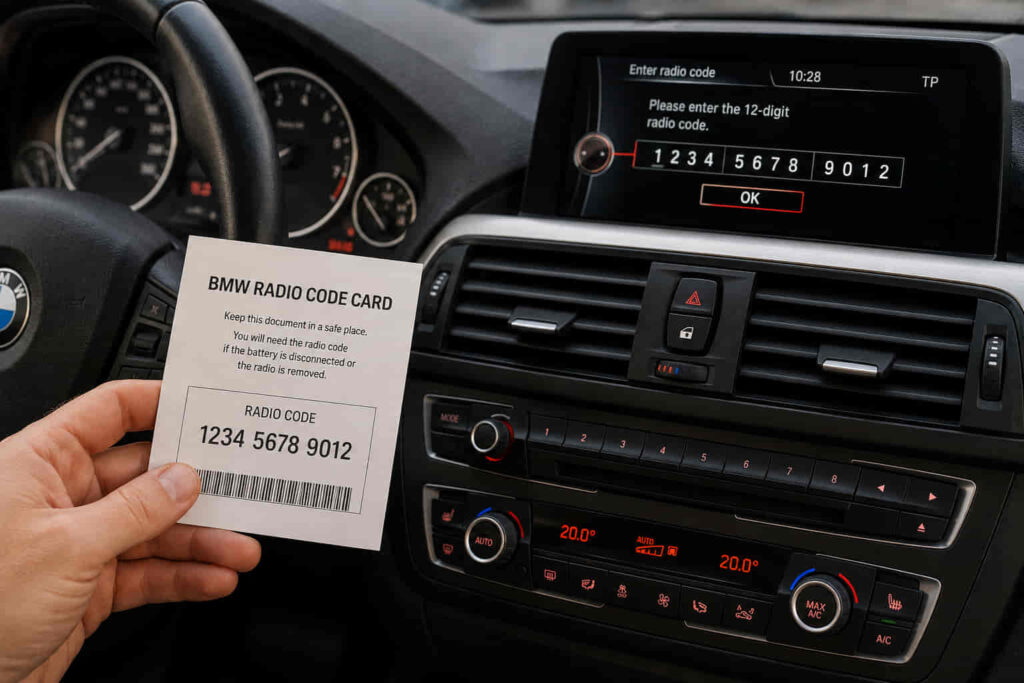
A BMW radio code is a security code used by certain BMW radios or head units to restore access when the unit requires anti-theft authorization, but not every BMW uses the same radio-code system. The requirement depends on the specific radio, vehicle generation, and installed audio equipment, so there is no universal BMW radio code that can unlock every factory radio.
A CODE or security prompt can appear when an applicable radio requires authorization, including in some situations involving loss of power or changes to the installed audio unit. However, a battery disconnect does not automatically mean every BMW will request a radio code. Before entering any number, the radio or head unit should be identified and the applicable security process confirmed. This is especially important if the vehicle has had a replacement radio, because the unit currently installed may not correspond to the vehicle’s original radio information.
Finding the correct BMW radio code therefore starts with radio identification rather than guessing possible codes. The vehicle VIN, radio serial number, available documentation, and legitimate vehicle- or radio-specific information can help establish the correct retrieval path. Understanding why the code appears, where the required information comes from, how the code is entered, and what happens after an incorrect attempt helps restore radio access without creating additional lockout problems.
What Are the 7 Things to Know About a BMW Radio Code?
The 7 most important things to know about a BMW radio code are that not every BMW uses the same security-code system, the code belongs to an applicable radio security context, a CODE message can indicate an authorization request, battery disconnection matters only on applicable systems, the radio may need to be identified before code retrieval, repeated incorrect entries can create additional access problems, and a replacement radio can change which information is needed. These distinctions matter because solving a radio-code problem starts with identifying the installed unit rather than searching for a universal BMW unlock number.
The first thing to know is that not every BMW uses the same radio-code process. BMW vehicles span different generations and audio architectures, and the security method used by one radio should not automatically be applied to another. An older radio that requests a security code after a relevant event and a newer infotainment system can handle authorization differently. The first diagnostic question is therefore whether the specific radio installed in the vehicle actually uses a user-entered security code.
This distinction prevents unnecessary troubleshooting. An owner may search for a BMW radio code because the audio system has stopped working after a battery or electrical event, even though the actual problem is not a missing security code. A genuine CODE prompt should be interpreted according to the installed radio, while a blank display, loss of sound, rebooting unit, or other infotainment fault can require a different diagnostic path.
The second thing to know is that there is no single BMW radio code that unlocks every vehicle. A security code, when required, belongs to the applicable radio or security context rather than to the BMW brand as a whole. Random numbers described as default or universal BMW codes should therefore not be treated as substitutes for identifying the correct unit and retrieving its applicable authorization information.
This is also why guessing a code from another BMW is unreliable. Two cars of the same model or generation do not necessarily provide an interchangeable security context, and previous replacement of the audio unit can further separate the installed radio from the vehicle’s original configuration. The correct code must be connected to the radio that is actually requesting authorization.
The third thing to know is that a CODE message can represent an anti-theft authorization state rather than a hardware failure. When an applicable radio displays a code request, the unit may be preventing normal operation until the correct authorization is provided. In that situation, replacing the radio simply because it will not play audio would address the wrong problem if the hardware itself remains functional.
The displayed message still needs to be interpreted according to the specific radio. Not every warning, blank screen, or audio malfunction is a security-code request. A genuine authorization prompt creates a different troubleshooting path from a radio that has no power, produces no sound, loses communication, or has an internal electronic fault. Correctly identifying the state prevents a security issue from being confused with a component failure.
The fourth thing to know is that battery disconnection can be relevant, but it does not create the same radio-code requirement on every BMW. On an applicable security design, a power-related event can be part of the context in which the radio requests authorization before normal operation resumes. This explains why radio-code searches are often associated with battery replacement or disconnection, particularly when dealing with certain older audio systems.
The causal relationship must nevertheless remain vehicle-specific. Battery power being removed does not prove that a BMW will subsequently need a user-entered radio code. If the audio system behaves differently after battery service, the actual display and installed head unit should determine the next step. Searching for and entering a security code is appropriate only when that radio’s security process requires one.
The fifth thing to know is that identifying the radio can be necessary before retrieving the correct code. Vehicle model information alone may not provide enough precision because the security information belongs to the applicable installed unit. The radio model, serial information, vehicle information, and available documentation can establish which unit is present and which retrieval process applies.
The radio serial number can be particularly important because it identifies the unit more specifically than a general description such as “BMW radio.” The way that serial information is obtained can vary with the radio model, so one universal button sequence or physical location should not be assumed for every BMW. The correct procedure begins with identifying the unit rather than forcing instructions from a different radio onto it.
The VIN serves a different function. It identifies the vehicle and can support an appropriate vehicle-specific retrieval process, but the VIN itself is not the BMW radio code. This difference becomes especially important when the installed radio is not the original unit because vehicle identity and radio identity may no longer point to the same equipment history.
The sixth thing to know is that repeatedly entering unverified codes can make the problem harder to resolve. Applicable radios can respond to incorrect authorization attempts with additional waiting or lock behavior. The exact number of attempts and the resulting procedure should not be generalized across every BMW radio because those details depend on the specific unit.
For this reason, a rejected code should trigger verification rather than another sequence of guesses. The radio identity, serial information where applicable, and source of the retrieved code should be checked before another attempt is made. This approach treats a failed entry as evidence that something in the identification or retrieval chain may be wrong.
Guessing also provides little diagnostic value. If several random codes are tried and rejected, the owner still does not know whether the radio was identified correctly, whether the retrieved information belongs to that unit, or whether a different security process applies. Verification resolves those uncertainties before further input is attempted.
The seventh thing to know is that a replacement radio can change the entire code-retrieval context. A BMW can retain its original VIN and vehicle records while the factory radio has been replaced during its service life. If another OEM radio or an aftermarket unit is now installed, information associated with the vehicle’s original audio equipment may not describe the security requirements of the current unit.
A replacement OEM radio should therefore be identified as the installed radio rather than assumed to share all security information with the original equipment. An aftermarket radio creates an even clearer distinction because its security process, if one exists, belongs to that manufacturer’s system rather than to the original BMW radio-code procedure.
This replacement history explains why vehicle information and installed-unit information must be evaluated together. The VIN answers which vehicle is being serviced, while the radio model or serial information answers which audio unit is requesting access. When those two histories no longer match, solving the installed radio’s security requirement takes priority over assuming the vehicle’s original radio information still applies.
The correct BMW radio-code process is therefore identification first, retrieval second, and code entry only after verification. Determine whether the installed radio actually uses a security code, identify the unit requesting authorization, establish the legitimate vehicle or radio information required to retrieve that code, and avoid repeated guesses if an entry is rejected. This sequence addresses the specific radio instead of treating every BMW CODE message as the same problem.
Why Is My BMW Radio Asking for a Code?
A BMW radio asks for a code when an applicable radio security system requires authorization before normal operation can resume. The CODE prompt is therefore primarily an access-control state rather than proof that the radio itself has suffered a hardware failure. Whether this process applies depends on the specific radio or head unit installed in the vehicle.
Power loss can be relevant on radio systems designed to require security authorization after an applicable electrical event. This is why some owners encounter a CODE display after battery replacement, battery disconnection, electrical repair, or another situation in which radio power has been interrupted. The important distinction is that the behavior belongs to the design of the particular radio; battery disconnection does not create a universal code requirement across every BMW generation.
A CODE request can also become more complicated when the installed radio is not the unit originally supplied with the vehicle. An OEM replacement radio may carry its own unit identity and security context, while an aftermarket head unit can use an entirely different anti-theft process established by its manufacturer. In these situations, assuming that the vehicle’s original radio information automatically applies to the installed unit can lead to an incorrect retrieval attempt.
The displayed state should also be separated from other radio problems. A radio that clearly requests a security code presents a different condition from a head unit with no power, a display that repeatedly restarts, a system that turns on but produces no sound, or an infotainment system with a communication fault. Those symptoms can involve electrical, electronic, amplifier, communication, or other system problems rather than a missing radio security code.
This distinction changes the correct diagnostic action. When the radio genuinely requests authorization, the next step is to identify the specific unit and retrieve the applicable code through legitimate vehicle or radio information. When no CODE or equivalent security state exists, searching for a radio code may not address the actual reason the audio system is not operating.
Incorrect previous entries can create another layer of confusion. If an applicable radio has already rejected several attempts, the display or input behavior may change because the unit has entered a waiting or lock state. That condition should not automatically be interpreted as a new radio failure. The radio identity and code should be verified rather than continuing to enter possible numbers.
A BMW radio asking for a code is therefore indicating that the applicable unit needs security authorization, not that every BMW audio problem can be solved with a code. Identify the displayed state, confirm that the installed radio uses a code-based security process, and determine whether the unit is original or replaced before attempting to restore access.
How Do You Find a BMW Radio Code?
To find the correct BMW radio code, first identify the exact radio or head unit requesting authorization, then establish the applicable vehicle and radio information, check any relevant documentation, obtain the unit’s serial information when required, and use a legitimate BMW- or radio-specific retrieval source to verify the code before entering it. The objective is to connect the security code to the installed radio rather than search for a universal BMW unlock number.
Radio identification comes first because “BMW radio” describes many different audio units used across multiple vehicle generations. A retrieval procedure that applies to one radio should not automatically be used for another. Establishing the model or type of head unit narrows the problem to the security mechanism that actually exists in the vehicle.
Available vehicle documentation can then be checked for information associated with the audio system. The value of documentation depends on what was supplied with and retained for the specific vehicle, so it should not be assumed that every BMW owner’s manual or document contains a usable radio code. Existing records are useful when they connect clearly to the installed radio rather than merely to the vehicle in general.
The radio serial number can become an important identification attribute when the applicable retrieval process requires unit-specific information. A serial number distinguishes the radio more precisely than the vehicle model alone and can help connect the installed unit to its security information. The method used to locate or display that serial number varies by radio, which is why a button sequence intended for one BMW head unit should not be presented as a universal retrieval method.
The VIN can provide additional vehicle context but performs a different function. It identifies the BMW, not the security code itself. An appropriate retrieval process may use vehicle information alongside radio information to establish the applicable code, but entering the VIN as though it were the radio password confuses vehicle identity with security authorization.
The relationship between VIN and radio identity becomes especially important when the head unit has been replaced. The VIN continues to identify the same BMW after a radio swap, but the installed radio may carry a different serial number and security history. If the replacement unit requires its own code, retrieving information solely from the vehicle’s original audio configuration may not solve the authorization request.
Once the required identifying information has been established, the code should come from a legitimate source capable of connecting that information to the applicable radio. This is safer and more reliable than using random online code lists, trying numbers associated with another vehicle, or assuming that a common default code applies to every BMW. A security code is useful only when it corresponds to the unit requesting authorization.
The retrieved code should also be verified before entry, particularly if the radio is already showing signs of previous failed attempts. A rejected code is a reason to recheck the unit identity, serial information, replacement history, and retrieval source. Continuing to guess can add a lock or waiting condition without resolving the original identification problem.
Finding a BMW radio code is therefore an identification process rather than a guessing process. Start with the exact installed radio, connect it to the required serial and vehicle information, obtain the applicable security code through a legitimate retrieval route, and verify that information before entering it. This sequence provides the shortest reliable path from a CODE display to restored radio access.
Can You Find a BMW Radio Code From the VIN?
The VIN can help identify the BMW and support a legitimate radio-code retrieval process, but the VIN itself is not the BMW radio code. The VIN identifies the vehicle, while the radio code belongs to the applicable security system of the installed radio or head unit. This distinction becomes especially important when the vehicle’s original radio has been replaced.
Vehicle identification through the VIN can provide useful information about the BMW’s original equipment and configuration. When an appropriate BMW or radio-specific retrieval process connects that vehicle information with the applicable audio system, the VIN can become part of the information used to establish the correct security code. The exact information available depends on the vehicle and radio system, so entering a VIN into a generic decoder should not automatically be treated as proof that the resulting information includes the required radio code.
The installed radio must still be considered separately. A BMW can retain the same VIN throughout its life while its radio is replaced because of a fault, theft, upgrade, or previous repair. If the current head unit is different from the original equipment, the original vehicle information may not be sufficient to identify the security information for the installed unit. Radio identity and vehicle identity must therefore be connected rather than treated as interchangeable.
This is where the radio serial number can become important. The VIN establishes which vehicle is being serviced, while the radio’s identifying information establishes which unit is requesting authorization. When both pieces of information are available, they create a stronger basis for determining which security-code retrieval process applies.
The VIN is therefore a vehicle-identification tool, not a universal BMW radio password. Use it to establish the vehicle context and support the applicable retrieval process, then verify that the resulting code belongs to the specific radio that is displaying the security prompt.
Where Can You Find the BMW Radio Serial Number?
The BMW radio serial number is the identifying information associated with the specific radio or head unit, and the method used to obtain it depends on the radio model and generation. There is no single physical location or universal button sequence that applies to every BMW radio, so the installed unit must be identified before a serial-number procedure is selected.
On some applicable radio systems, identifying information can be accessed through the unit’s display or controls. Other systems may require information from a label on the radio itself, which can mean removing the unit from the vehicle. The difference matters because a procedure designed for one BMW radio can produce no useful result on another system even when both radios are factory BMW equipment.
The serial number should also be distinguished from other numbers displayed or printed on the radio. A BMW head unit can contain production information, part numbers, model identifiers, and other technical references. Finding a number is not enough; the number must be identified as the information required by the applicable security-code retrieval process.
The radio’s replacement history should be checked at the same time. If the head unit has been replaced, its serial number may identify equipment that differs from the radio originally installed in the vehicle. This explains why a code associated with the original radio can fail to authorize a replacement unit even though the VIN and the rest of the vehicle remain unchanged.
If the serial number cannot be obtained confidently through the available radio controls or documentation, the next step should be to use a legitimate BMW or radio-specific identification route rather than guessing which number on the unit is relevant. A correct serial number creates a precise connection between the physical head unit and its security information.
The radio serial number matters because it identifies the unit that actually needs authorization. Once the correct radio has been identified, its applicable serial and vehicle information can be used to establish the correct retrieval path instead of relying on the BMW model, VIN, or an unrelated number alone.
How Do You Enter a BMW Radio Code?
You enter a BMW radio code only after confirming that the specific radio requires a security code and verifying that the code belongs to that unit. The exact input procedure varies by radio model and generation, so a single button sequence should not be presented as a universal BMW procedure.
An applicable radio normally provides a security or CODE state that indicates it is waiting for authorization. The user then enters the verified code through the controls supported by that particular radio. A correct entry allows the unit to complete its applicable authorization process and resume normal operation when no other fault is present.
The important step occurs before the first button is pressed. The code should be matched to the installed radio rather than simply to the vehicle model. If the radio has been replaced, information from the original factory unit may not authorize the current head unit. The radio’s identity, applicable serial information, and retrieval source should therefore be verified before code entry.
The input process can also differ according to the type of radio. Older factory radios may use physical buttons or a display-based sequence, while other systems can use different controls or security procedures. Applying instructions from an unrelated BMW radio can lead to incorrect entries or confusion about the displayed state.
A code that is rejected should not be followed by random attempts. An incorrect entry can cause an applicable radio to enter a waiting or temporary lock condition, and the exact behavior varies by unit. The appropriate response is to stop, verify the radio identification and code source, and follow the procedure applicable to that specific head unit.
Entering a correct code also does not repair unrelated faults. If the radio has no power, repeatedly restarts, has a communication problem, or has another hardware or audio-system failure, successful security authorization may not restore normal operation. The code solves an authorization requirement; it does not replace diagnosis of an independent radio fault.
The safest BMW radio-code procedure is therefore to identify the exact radio, verify the applicable security code, follow that radio’s specific input method, and stop if the code is rejected. This approach avoids treating different BMW audio systems as identical and keeps security-code entry separate from broader radio troubleshooting.
What Happens If You Enter the Wrong BMW Radio Code?
Entering an incorrect BMW radio code can cause the applicable radio to enter a waiting or temporary lock state, so repeated guessing should be avoided. The exact response depends on the radio model and security system, which means a universal number of attempts or a universal waiting period should not be applied to every BMW.
A rejected code is useful diagnostic information because it indicates that the authorization information entered does not match what the radio expects, but it does not automatically prove that the radio itself is defective. The problem can come from an incorrect code, an incorrectly identified radio, a mismatch caused by a replacement unit, or an inappropriate retrieval procedure.
The correct response is to stop entering additional numbers and verify the identification chain. The installed radio should be confirmed first, followed by its applicable serial or unit information and the source from which the security code was obtained. If the radio has been replaced, information associated with the original factory unit should not automatically be assumed to apply to the current radio.
A temporary lock or waiting condition should also be allowed to resolve according to the procedure for the specific unit. Continuing to enter guessed codes during a security lock can make the situation more difficult without providing useful diagnostic information. The objective should be to establish the correct code rather than increase the number of attempts.
A wrong BMW radio code should therefore trigger verification, not another guess. Confirm the radio identity, verify the code against that unit, and follow the applicable recovery procedure before attempting another entry.
Does Disconnecting the Battery Always Reset a BMW Radio?
Disconnecting the battery does not create one universal radio-code or reset behavior across all BMW vehicles and audio systems. Some applicable radio systems can request security authorization after a relevant power interruption, while other BMW audio and infotainment systems use different security or initialization processes.
This distinction explains why battery replacement is often associated with BMW radio-code searches without making the relationship universal. On a radio designed to require authorization after a relevant power event, restoring electrical power can leave the unit waiting for its security code. The radio is protecting access according to its security design rather than developing a fault simply because the battery was disconnected.
A battery disconnect also does not mean that every radio problem can be solved by entering a code. If the radio does not power on, repeatedly reboots, loses audio output, or displays another system error instead of a CODE or security prompt, the underlying problem may involve power supply, communication, amplifier operation, or another component. Resetting or entering a code does not substitute for diagnosing those conditions.
The vehicle generation and installed head unit remain the decisive context. BMW has used different audio and infotainment architectures over time, so instructions developed for an older security-code radio should not automatically be applied to a newer system. The displayed message and exact equipment should determine which procedure is relevant.
Battery disconnection is therefore a possible trigger for a radio-code request on applicable systems, not a universal BMW radio reset procedure. If the radio displays a genuine security prompt after power has been restored, identify the unit and follow its applicable code-retrieval process rather than assuming every BMW follows the same sequence.
What If Your BMW Has a Replacement or Aftermarket Radio?
A replacement or aftermarket radio can change the BMW radio-code retrieval process because the security information belongs to the installed audio unit and its applicable security system. The VIN remains associated with the vehicle, but the current radio may have a different identity, serial number, security code, or manufacturer-specific authorization process.
An OEM replacement radio should first be treated as the unit currently installed. Its identifying information may differ from the original factory radio, which means a code associated with the original unit may not authorize the replacement. The correct retrieval process must therefore establish which radio is physically installed before relying on historical vehicle information.
This situation is particularly important when a previous owner or repair shop has changed the head unit. A BMW can retain the same VIN, model, and registration information while carrying a radio that was installed later. Searching for the code using only the original vehicle configuration can then produce information that is technically associated with the BMW but irrelevant to the radio currently requesting authorization.
An aftermarket radio creates a separate boundary. Its security or unlock procedure, if one exists, belongs to the manufacturer and model of that aftermarket unit rather than the original BMW factory-radio process. Applying an OEM BMW radio-code procedure to an aftermarket head unit can therefore send the troubleshooting process in the wrong direction.
The physical appearance of a replacement unit should not be used as the sole method of identification either. An OEM-style replacement can look almost identical to the original while carrying different unit information. The radio model, part information, serial information, and installation history provide a stronger basis for determining which security process applies.
When a BMW has a replacement radio, identify the installed unit before retrieving or entering a code. The vehicle’s VIN establishes the vehicle identity, but the installed radio establishes which audio system actually needs authorization.
What Should You Do If You Cannot Retrieve the BMW Radio Code?
If you cannot retrieve the BMW radio code, stop entering guessed numbers and establish the exact identity of the installed radio before seeking the applicable legitimate retrieval route. The most reliable solution is to resolve the identification problem rather than bypass the radio’s security mechanism.
Start by confirming that the display is actually requesting a security code. A CODE message or equivalent authorization prompt points toward the radio’s security process, while a blank display, no-power condition, repeated reboot, or loss of sound may indicate a different fault. Solving the wrong problem with a radio code will not restore a head unit that has an independent electrical or hardware failure.
Next, establish whether the radio is original or replaced. This distinction determines whether the vehicle’s original audio information is likely to describe the unit currently installed. If the radio was replaced, the current unit’s model and identifying information should take priority when determining the applicable retrieval process.
The radio’s serial or unit information should then be verified where the specific system requires it. The VIN can provide vehicle context, but it should not be treated as the security code. Combining accurate vehicle information with accurate radio identification provides a stronger basis for obtaining the correct code than relying on a generic BMW model, color of the radio display, or a number found in an unrelated online list.
If the code still cannot be established, the appropriate route is manufacturer- or radio-specific support that can verify the relevant vehicle and unit information. This approach maintains the distinction between legitimate code retrieval and attempts to defeat an anti-theft system. It also reduces the risk of repeatedly entering incorrect information and placing the radio into a more restrictive state.
The key to solving a missing BMW radio code is to identify the radio before trying to identify the code. Once the exact unit, its applicable security system, and the relevant vehicle information have been established, the correct retrieval path becomes much clearer. If those relationships cannot be verified, further guessing should stop rather than risk additional lockout.
The complete search journey is therefore straightforward: confirm the security prompt, identify the installed radio, distinguish the VIN from the radio’s identifying information, retrieve the applicable code through a legitimate source, and enter it only after verification. This process works from the actual security context of the vehicle instead of assuming that every BMW radio follows the same code or reset procedure.