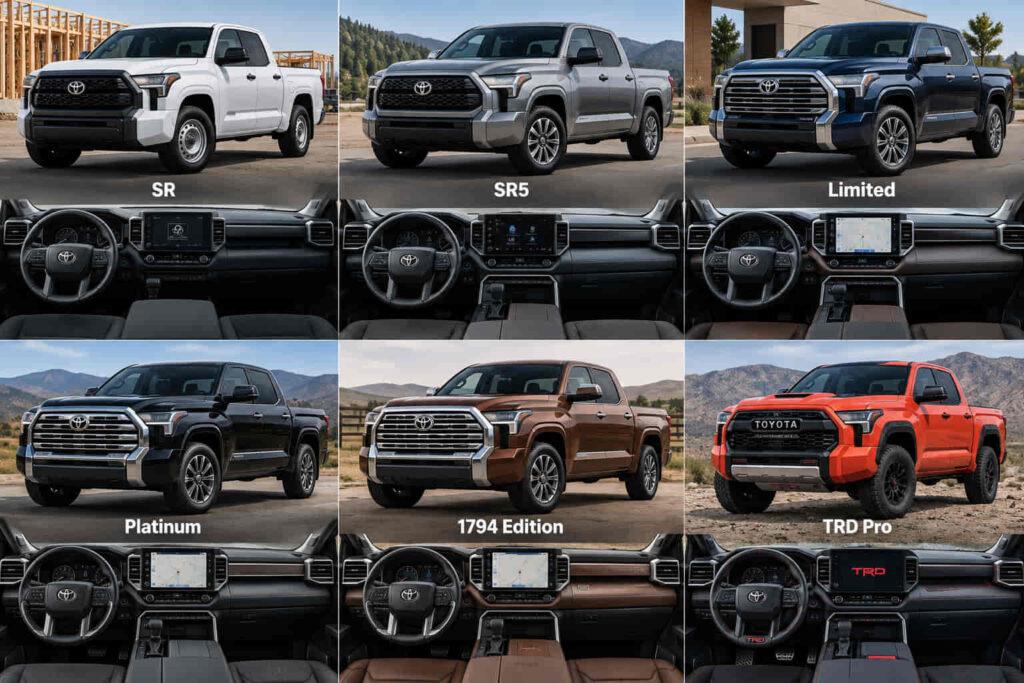
The 2026 Toyota Tundra is available in seven main trim levels: SR, SR5, Limited, Platinum, 1794 Edition, TRD Pro, and Capstone. These trims move from the work-focused SR and more versatile SR5 to the comfort-oriented Limited, premium Platinum and 1794 Edition, off-road-focused TRD Pro, and flagship Capstone. The differences extend beyond interior features because powertrain availability, drivetrain, cab and bed configurations, off-road equipment, and optional packages can also change across the Tundra lineup.
A Toyota Tundra trim is not the same as an optional package. SR5, Limited, and TRD Pro, for example, are grades within the Tundra lineup, while equipment groups such as the TRD Off-Road Package can be added to applicable configurations. This distinction matters because choosing a Tundra involves both selecting the underlying trim and determining which powertrain, drivetrain, body configuration, and available packages fit the intended use.
The right Tundra trim therefore depends on what the truck needs to do. A buyer prioritizing basic truck utility has different requirements from someone seeking off-road hardware, premium interior materials, or the highest level of luxury equipment. This guide compares the Toyota Tundra trim packages from SR through Capstone, explains the differences between the major grades and TRD options, and shows which configurations are better aligned with work, everyday driving, off-road use, and premium comfort.
What Are the Toyota Tundra Trim Packages?
The 2026 Toyota Tundra lineup consists of seven main grades: SR, SR5, Limited, Platinum, 1794 Edition, TRD Pro, and Capstone. These trims form a progression from a work-oriented entry model to more versatile, premium, off-road-focused, and luxury configurations. The trim name establishes the truck’s primary equipment level, but the complete configuration can also depend on powertrain, drivetrain, cab style, bed length, and optional packages.
SR forms the entry point to the Tundra lineup and emphasizes the fundamental capability expected from a full-size pickup rather than premium equipment. SR5 builds on that foundation with additional equipment and greater flexibility for buyers who want a truck that can serve both practical and everyday-driving roles. This distinction makes SR and SR5 particularly relevant to buyers who prioritize utility and value before luxury features.
Limited moves the Tundra farther toward comfort, convenience, and technology. It represents an important transition in the lineup because the truck remains capability-focused while adding equipment that makes daily driving and longer trips more comfortable. For buyers who use a Tundra as both a working vehicle and a personal vehicle, Limited occupies a different position from the more basic SR and SR5 grades.
Platinum and 1794 Edition move deeper into the premium side of the lineup. Both target buyers seeking a higher level of interior and convenience equipment, but their positioning is not identical. Platinum follows a contemporary premium direction, while 1794 Edition uses distinctive design details and materials to create a separate luxury identity. The difference is therefore not simply that one trim sits above another in a feature count.
TRD Pro follows another branch of the Tundra hierarchy because its primary differentiation is off-road capability rather than increasing luxury. It incorporates specialized off-road equipment and chassis components, including TRD-focused suspension hardware, to create a factory configuration intended for more demanding terrain. TRD Pro should consequently be compared with other trims according to intended use rather than treated as the next conventional luxury step above 1794 Edition.
Capstone occupies the flagship luxury position. Its purpose is to provide the highest-end Tundra experience through premium materials, technology, comfort, and distinctive exterior and interior treatment. A buyer comparing Capstone with TRD Pro is therefore comparing two different priorities: luxury and refinement on one side and specialized off-road capability on the other.
Optional packages create another layer within this hierarchy. A Tundra equipped with the TRD Off-Road Package, for example, does not become a separate trim equivalent to TRD Pro. The underlying grade remains the foundation of the truck, while the package adds applicable equipment to that configuration. Understanding this relationship between trim, powertrain, drivetrain, body configuration, and packages is necessary for an accurate Tundra comparison.
What Does the Toyota Tundra SR Trim Include?
The Toyota Tundra SR is the entry-level grade designed around essential full-size truck utility rather than the premium equipment found higher in the lineup. It provides the basic Tundra platform for buyers who prioritize functional capability, a lower entry price, and fewer luxury-oriented features. This positioning makes SR particularly relevant to work-focused buyers and owners who do not need the additional comfort or appearance equipment of higher grades.
SR should not be interpreted as a mechanically unrelated version of the Tundra. It belongs to the same broader truck family and shares the underlying Tundra architecture, while its equipment and available configurations establish its position at the beginning of the trim hierarchy. The important difference is how Toyota combines powertrain, convenience, appearance, and configuration choices at this grade.
Powertrain specification also matters when evaluating the SR. The Tundra lineup uses Toyota’s twin-turbocharged V6 powertrain family, but output and powertrain availability are not necessarily identical across every grade and configuration. A buyer should therefore match the SR designation with the exact engine specification rather than assuming that every Tundra trim provides the same powertrain configuration.
Cab, bed, and drivetrain choices add another dimension to the SR’s utility. A Tundra is not fully defined by its trim badge because the combination of cab configuration, bed length, and two- or four-wheel drive can materially change how the truck fits a work or ownership requirement. The useful comparison is therefore between complete configurations rather than trim names in isolation.
The primary tradeoff becomes clearer when SR is compared with the next grade. SR provides the entry point for buyers who need the fundamental Tundra platform, while SR5 expands the truck’s equipment and configuration possibilities. A buyer who wants additional convenience, appearance choices, or access to certain optional equipment may therefore find that moving to SR5 provides more value than adding requirements to an SR that was intentionally positioned as the more basic truck.
SR is consequently best understood as the utility baseline for the Tundra range. It establishes what the truck provides before Toyota adds the additional comfort, technology, styling, package availability, and specialized equipment that differentiate SR5 and the higher trims. This baseline also makes the SR-to-SR5 comparison more useful than evaluating SR only by counting individual standard features.
Read more: Toyota P0113
What Is the Difference Between the Toyota Tundra SR and SR5?
The main difference between the Toyota Tundra SR and SR5 is that SR is positioned as the more basic, work-oriented grade, while SR5 adds equipment and configuration flexibility for buyers who want a more versatile truck. Both belong near the practical end of the Tundra lineup, but SR5 creates a stronger bridge between basic utility and the comfort, appearance, and optional equipment available on higher trims.
The SR establishes the starting point of the Tundra range. Its value comes from providing the fundamental truck platform without making premium interior appointments or specialized equipment the central reason to buy it. This positioning can make SR appropriate for commercial use, fleet applications, or buyers whose priorities center on the truck itself rather than additional convenience and appearance features.
SR5 broadens that formula. Instead of moving directly into the more comfort-oriented positioning of Limited, it retains the practical character of the lower Tundra grades while giving buyers more opportunity to configure the truck around personal use. This makes SR5 particularly relevant to owners who need pickup capability during work or recreation but also expect to use the truck regularly for commuting, travel, and everyday driving.
Optional equipment is another important reason to distinguish SR5 from SR. Package availability can expand what an SR5 is designed to do without changing its underlying grade. An SR5 equipped with an applicable TRD package, for example, remains an SR5 rather than becoming a TRD Pro. The package modifies the equipment and capability of the SR5 configuration, while TRD Pro is a separate grade with its own factory positioning.
This distinction also explains why two SR5 trucks can differ substantially from each other. Drivetrain, cab, bed, powertrain, and optional equipment can change the final configuration even when both trucks carry the same SR5 badge. Comparing only the trim names can therefore hide differences that matter for off-road use, passenger space, cargo requirements, towing configuration, and everyday comfort.
The better choice between SR and SR5 depends on how much flexibility the buyer needs beyond basic truck utility. SR makes more sense when the objective is a straightforward Tundra configuration without paying for equipment that will provide little practical value. SR5 becomes more compelling when the truck needs to combine utility with broader convenience, appearance, and package choices.
SR5 should therefore be understood as an expansion of the Tundra’s practical foundation rather than simply an SR with a few additional features. It occupies a strategic position in the trim hierarchy because it allows buyers to add capability and equipment while remaining below the more comfort-focused Limited grade.
What Does the Toyota Tundra Limited Add Over the SR5?
The Toyota Tundra Limited adds a stronger emphasis on comfort, technology, convenience, and interior refinement over the SR5. The change is significant because Limited marks the point where the Tundra moves beyond a primarily utility-oriented configuration and becomes more deliberately suited to buyers who want full-size truck capability combined with a more comfortable everyday-driving environment.
Interior positioning is one of the clearest differences. SR5 remains closer to the practical side of the lineup, while Limited introduces a more upscale cabin treatment and additional comfort-oriented equipment. This matters most for owners who spend substantial time inside the truck, because improvements to seating, cabin materials, climate comfort, controls, and convenience can affect daily ownership more consistently than an exterior styling difference.
Technology also plays a larger role in the Limited grade. Toyota uses the progression through the Tundra lineup to increase the availability or inclusion of infotainment, driver-convenience, and other cabin technologies. Limited therefore appeals to buyers who want a truck that performs practical duties without maintaining the more basic equipment philosophy of SR or SR5.
Powertrain configuration creates another reason to evaluate Limited separately. Depending on the applicable 2026 configuration, Limited can be associated with Toyota’s i-FORCE powertrain choices as well as an available i-FORCE MAX electrified configuration. The trim badge alone should not be used to infer the exact engine system installed in a particular truck because powertrain availability must be matched with the complete configuration.
The distinction between Limited and SR5 is also important when optional packages are considered. A heavily optioned SR5 can reduce the equipment gap between the two grades in specific areas, but adding packages does not automatically reproduce the complete positioning of Limited. Limited begins from a different equipment level and is designed around a stronger combination of comfort, technology, and refinement.
This creates a practical purchase decision. A buyer who primarily wants truck utility with selected upgrades may find SR5 more efficient because optional equipment can be chosen around specific needs. A buyer who already values a more refined cabin and broader comfort or technology content may find Limited to be the more coherent starting point rather than building upward from SR5.
Limited is therefore not simply the next name in the Tundra trim sequence. It represents a change in emphasis from configurable utility toward a more balanced combination of capability and comfort. That distinction becomes especially important before moving farther up the lineup, where Platinum and 1794 Edition place even greater emphasis on premium equipment and design.
What Is the Difference Between the Toyota Tundra Platinum and Limited?
The Toyota Tundra Platinum moves beyond the Limited by placing greater emphasis on premium comfort, interior refinement, convenience technology, and upscale exterior treatment. Limited already represents a substantial step above the utility-focused SR5, but Platinum targets buyers who want the Tundra to function as a premium daily-use truck rather than simply a capable pickup with additional comfort features.
The distinction begins with how the two trims are positioned. Limited balances truck capability with comfort and technology, making it suitable for buyers who want a well-equipped Tundra without moving fully into the premium end of the lineup. Platinum starts from a more luxury-oriented position, so its additional equipment is intended to improve the experience for both the driver and passengers rather than fundamentally change what type of truck the Tundra is.
Interior refinement is consequently a major reason to move from Limited to Platinum. Higher-grade cabin materials, premium seating treatment, and additional comfort equipment give Platinum a more upscale character. These differences become more relevant for owners who use the Tundra for commuting, family travel, or long-distance driving because cabin quality and convenience are experienced every time the truck is used.
Technology and driver convenience further separate the grades. Platinum incorporates a broader premium-equipment strategy, including features intended to improve visibility, convenience, entertainment, and long-distance comfort where included in the applicable configuration. Limited already provides a technology-focused step above SR5, but Platinum reduces the need to build a premium truck through individual options by starting from a higher equipment level.
Exterior treatment also helps identify Platinum as a different grade rather than a heavily equipped Limited. Toyota gives higher Tundra trims distinct wheel, grille, lighting, trim, and appearance details so that the progression is visible outside the cabin as well as inside it. These design changes do not create additional basic truck capability by themselves, but they matter to buyers choosing a Tundra partly for premium appearance.
The choice between Limited and Platinum therefore depends more on desired ownership experience than on whether one truck can perform ordinary pickup duties. Limited is the stronger fit when the buyer wants a combination of capability, technology, and comfort without making luxury the primary purchase criterion. Platinum becomes more relevant when premium cabin equipment, passenger comfort, technology, and exterior presentation justify moving farther up the trim hierarchy.
Neither trim should be evaluated without considering its complete configuration. Powertrain, drivetrain, cab and bed choices, and available equipment can change the specification of an individual truck. Comparing two actual Tundras therefore requires more than comparing the Limited and Platinum badges; the complete configurations must also be matched.
Platinum ultimately represents a shift from the balanced premium character of Limited toward a more complete luxury-truck experience. This positioning also explains why the next comparison in the Tundra lineup is not simply about adding more equipment. The 1794 Edition uses premium content to create a different design identity rather than functioning only as another conventional step above Platinum.
What Makes the Toyota Tundra 1794 Edition Different?
The Toyota Tundra 1794 Edition is distinguished by a premium design theme that combines high-end Tundra equipment with unique interior and exterior styling. Its purpose is not simply to provide more features than lower trims. The 1794 Edition creates a recognizable luxury identity for buyers who want premium comfort while preferring a distinctive design direction over the more contemporary character of Platinum.
Interior treatment is central to that identity. The 1794 Edition uses upscale materials and model-specific design details to differentiate its cabin, including American walnut wood-grain trim elements in the 2026 lineup. These materials create a visual and tactile distinction that cannot be explained simply by counting convenience features against another grade.
This approach separates 1794 Edition from Platinum even when the two trims overlap in premium equipment. Platinum emphasizes a modern high-end Tundra experience, while 1794 Edition adds a more distinctive theme through its materials, colors, trim details, and overall presentation. The practical question for a buyer is therefore not necessarily which one is objectively more luxurious, but which premium design direction better matches the desired truck.
Exterior details reinforce the same positioning. Grade-specific styling allows the 1794 Edition to establish its identity before the cabin is considered. Wheels, trim treatment, badging, grille details, and other applicable exterior elements work together with the interior design to distinguish it from a similarly equipped Platinum.
The 1794 Edition remains a Tundra first, so selecting it does not eliminate the need to examine powertrain and configuration. The exact truck should still be evaluated according to its engine system, drivetrain, cab and bed configuration, and available packages. A premium grade describes the truck’s equipment and positioning, while those additional attributes determine the complete vehicle specification.
The 1794 Edition is consequently most appropriate for a buyer who already wants a premium Tundra but values a distinctive luxury theme as part of the purchase. Someone primarily interested in off-road hardware has a different search path toward TRD Pro or an applicable TRD package, while someone seeking the flagship expression of Tundra luxury should continue toward Capstone.
This distinction prevents the upper Tundra lineup from being interpreted as a simple ladder where every higher-priced grade performs the same role with more features. Platinum, 1794 Edition, TRD Pro, and Capstone represent different combinations of premium comfort, design identity, specialized off-road capability, and flagship luxury. The best grade therefore depends on which of those attributes has the highest value for the buyer.
What Does the Toyota Tundra TRD Pro Package Include?
The 2026 Toyota Tundra TRD Pro is a dedicated trim level rather than an optional package added to another Tundra grade. It is positioned as the factory off-road-focused model in the lineup and combines the Tundra platform with specialized suspension, wheels, tires, chassis technology, and exterior details intended for more demanding terrain. This makes TRD Pro fundamentally different from adding a TRD Off-Road Package to an SR5, Limited, or another applicable configuration.
Suspension hardware is one of the defining differences. The TRD Pro uses off-road-focused FOX shocks and TRD-specific suspension components designed to provide greater capability when the truck leaves paved roads. Suspension tuning matters because off-road performance depends on how the truck controls wheel movement, absorbs uneven terrain, and maintains useful tire contact rather than on appearance features alone.
The wheel and tire configuration supports the same purpose. The 2026 TRD Pro uses 18-inch BBS forged-aluminum wheels paired with all-terrain tires, creating a setup oriented toward off-pavement use rather than the larger luxury-focused wheels found on some premium Tundra trims. Wheel diameter, tire construction, and sidewall characteristics all influence how a truck behaves over rough surfaces, so this equipment forms part of the functional distinction between TRD Pro and luxury-oriented grades.
TRD Pro also receives model-specific exterior treatment that communicates its position in the Tundra range. The heritage-inspired TOYOTA grille, TRD Pro identification, and other applicable design details separate it visually from SR5, Limited, Platinum, and Capstone. These styling elements support the trim’s identity, but the suspension and off-road hardware provide the more important mechanical reason for choosing TRD Pro.
Powertrain is another major part of the TRD Pro configuration. For the 2026 lineup, TRD Pro is associated with Toyota’s i-FORCE MAX hybrid powertrain, combining the twin-turbocharged V6 with an electric motor system. This means a buyer comparing TRD Pro with another Tundra should evaluate both the off-road equipment and the powertrain rather than assuming the difference is limited to suspension and exterior styling.
The most important comparison is between TRD Pro and a Tundra equipped with an optional TRD package. A TRD Off-Road-equipped truck can add meaningful off-road capability to an applicable underlying grade, but it remains that grade. TRD Pro begins as a dedicated factory trim whose overall configuration is centered more directly on off-road use.
TRD Pro therefore makes the most sense when specialized off-road capability is a primary purchase requirement rather than an occasional secondary use. A buyer who mainly wants additional traction and trail-oriented equipment may be able to meet those requirements with another Tundra grade and an applicable TRD package. A buyer who wants the Tundra lineup’s dedicated off-road grade has a clearer path to TRD Pro.
What Is the Toyota Tundra Capstone Trim?
The Toyota Tundra Capstone is the flagship luxury grade in the 2026 Tundra lineup. It sits at the premium end of the range and emphasizes upscale materials, passenger comfort, technology, and distinctive styling rather than the specialized off-road focus of TRD Pro. Capstone is therefore designed for buyers who want the Tundra platform in its most luxury-oriented factory configuration.
Interior materials are central to Capstone’s positioning. The cabin receives premium treatment intended to distinguish it from the already well-equipped Limited, Platinum, and 1794 Edition grades. Higher-end seating surfaces, trim materials, and detailed interior finishes create an environment aimed at buyers comparing the Tundra not only with other pickups but also with premium vehicles used for commuting and long-distance travel.
Comfort and technology reinforce that premium direction. Features intended to improve passenger convenience, cabin experience, visibility, and everyday usability become more important at this level of the lineup because Capstone is not attempting to justify its position through additional basic truck utility. Its value comes from combining Tundra capability with a more comprehensive luxury experience.
Capstone’s exterior design follows the same strategy. Distinctive wheels, grille treatment, trim details, and other premium exterior elements separate the flagship grade from the more rugged appearance of TRD Pro and the different luxury identity of 1794 Edition. The visual differences help communicate that Capstone occupies a separate branch of the Tundra range rather than functioning as an off-road upgrade.
The powertrain is equally important to the complete Capstone configuration. In the 2026 lineup, Capstone is paired with the i-FORCE MAX hybrid powertrain. This reinforces why trim comparisons should include the engine and electrified powertrain configuration instead of treating equipment level as the only difference between two Tundras.
Capstone, Platinum, and 1794 Edition can all appeal to buyers seeking a premium truck, but they do not serve exactly the same preference. Platinum provides a modern premium configuration, while 1794 Edition creates a distinctive luxury theme through its design and materials. Capstone moves farther toward the flagship end of the spectrum, making maximum factory luxury and refinement its defining attributes.
The difference between Capstone and TRD Pro is even clearer. Both occupy the upper Tundra lineup, but their primary purposes diverge. TRD Pro directs its specialized equipment toward off-road performance, while Capstone directs its additional equipment toward luxury, comfort, and premium presentation. A higher position in the lineup therefore does not mean that one trim is universally better than another.
Capstone is best suited to a buyer who wants the most luxury-focused Tundra rather than the most specialized off-road Tundra. This distinction completes the main trim hierarchy from SR’s utility-focused starting point through SR5 and Limited, into the premium Platinum and 1794 Edition grades, and finally toward the specialized TRD Pro and flagship Capstone configurations.
What Is the Toyota Tundra TRD Off-Road Package?
The Toyota Tundra TRD Off-Road Package is an optional equipment package that adds off-road-focused hardware and vehicle-control features to applicable Tundra trims. It is not a separate trim level and should not be confused with the Tundra TRD Pro, which is a dedicated grade. A truck equipped with the TRD Off-Road Package retains its underlying trim identity while gaining equipment designed to improve capability away from paved roads.
The package changes more than the appearance of the truck. Toyota equips applicable TRD Off-Road configurations with off-road-oriented suspension components and supporting hardware intended to improve control and durability over uneven terrain. This distinction matters because a styling package can change how a truck looks without materially changing how it operates, while the TRD Off-Road Package incorporates functional equipment associated with off-pavement driving.
Multi-Terrain Select is one of the systems associated with TRD Off-Road-equipped Tundras. It allows the driver to select operating modes designed to manage wheelspin across different terrain conditions. Instead of relying only on conventional traction control behavior, the system adjusts vehicle responses according to the selected terrain mode and applicable powertrain configuration.
Crawl Control adds another layer of low-speed off-road assistance. The system can manage vehicle speed during difficult low-speed terrain so the driver can concentrate more heavily on steering. This function is particularly relevant on surfaces where maintaining a controlled, consistent pace can be more useful than repeatedly modulating the accelerator and brake pedals.
An electronically locking rear differential further separates the package from appearance-oriented upgrades. When engaged under the appropriate operating conditions, the locking differential allows the rear wheels to rotate together to improve available traction when one side encounters a low-grip surface. Toyota also equips applicable TRD Off-Road configurations with Multi-Terrain Monitor, which uses camera views to help the driver observe obstacles around the truck during off-road operation.
The TRD Off-Road Package therefore provides an intermediate path between a standard Tundra configuration and the dedicated TRD Pro grade. A buyer can start with an applicable trim that better matches requirements for comfort, technology, or luxury and then add meaningful off-road equipment without changing to TRD Pro. This is especially relevant when the truck must perform both everyday-driving and recreational off-road roles.
TRD Pro still represents a different level of factory specialization. Its dedicated grade combines unique suspension hardware, FOX shocks, off-road wheels and tires, protective equipment, and model-specific design features into a configuration built around off-road performance from the beginning. The TRD Off-Road Package instead modifies an applicable existing grade, allowing the buyer to preserve more of that trim’s original positioning.
Choosing between the TRD Off-Road Package and TRD Pro should therefore depend on the degree of off-road specialization required. The package makes sense when a buyer wants additional trail capability while retaining another Tundra trim as the foundation. TRD Pro becomes the more direct choice when specialized factory off-road equipment is one of the primary reasons for purchasing the truck.
What Is the Toyota Tundra TRD Rally Package?
The Toyota Tundra TRD Rally Package is an off-road-oriented package that combines functional trail equipment with styling inspired by Toyota’s Baja racing heritage. Rather than functioning as another Tundra trim, the Rally Package creates a specific configuration by adding TRD equipment and distinctive visual details to its applicable underlying truck.
The Rally Package is immediately differentiated by Toyota’s red, orange, and yellow heritage-inspired graphics and design accents. These colors connect the truck visually with Toyota’s racing history and distinguish the package from the more conventional appearance of a TRD Off-Road-equipped Tundra. The same theme extends into the cabin through applicable TRD Rally design details, creating a consistent identity rather than limiting the package to exterior decals.
The package also has a functional off-road foundation. Its configuration incorporates TRD off-road wheels, all-terrain tires, Bilstein shock absorbers, skid-plate protection, and off-road control technologies. These components give the Rally Package mechanical relevance beyond its heritage-inspired appearance because suspension, tire, traction, and underbody-protection changes directly affect how the truck is prepared for unpaved terrain.
An electronically locking rear differential, Multi-Terrain Select, and Crawl Control further support that capability. The locking differential can improve traction under appropriate low-grip conditions, while Multi-Terrain Select changes vehicle-control behavior for different surfaces. Crawl Control assists with controlled low-speed movement through challenging terrain. Together, these systems connect the Rally Package with the broader TRD off-road technology used within the Tundra range.
For the 2026 model year, Toyota expands the Rally Package’s available equipment by making the TRD 3-inch lift kit and Tow Tech Package available with the configuration. The lift option can further change the truck’s stance and off-road setup, while the towing-related package extends the configuration toward owners who need trailer technology in addition to recreational capability. These options demonstrate why a package should be evaluated as part of a complete truck configuration rather than from its name alone.
The TRD Rally Package and TRD Off-Road Package consequently overlap in off-road intent but do not have identical identities. TRD Off-Road is the more direct capability-oriented package concept, while TRD Rally combines off-road equipment with a stronger Baja-inspired visual theme. The appropriate choice depends on whether the buyer primarily wants functional off-road upgrades or also values the Rally Package’s distinctive heritage styling.
Neither package should be treated as another name for TRD Pro. TRD Pro remains a dedicated Tundra grade with its own factory-selected suspension, wheels, tires, powertrain configuration, and model-specific equipment. TRD Off-Road and TRD Rally instead demonstrate how Toyota can modify an applicable underlying Tundra through optional equipment without creating a separate grade.
Understanding these distinctions makes the Tundra lineup easier to compare. A trim such as SR5, Limited, Platinum, or 1794 Edition establishes the truck’s fundamental equipment position, while an applicable TRD package can modify its off-road capability or character. TRD Pro follows a different structure because off-road specialization is already built into the identity of the grade itself.
What Is the Difference Between a Toyota Tundra Trim and a Package?
A Toyota Tundra trim is the truck’s primary equipment grade, while a package is a group of additional features or equipment offered on an applicable trim. SR, SR5, Limited, Platinum, 1794 Edition, TRD Pro, and Capstone are Tundra grades, whereas options such as the TRD Off-Road Package modify an eligible underlying configuration without becoming a separate trim.
The trim establishes the truck’s basic position within the Tundra lineup. An SR starts from a utility-oriented equipment level, SR5 adds greater flexibility, Limited moves toward additional comfort and technology, and Platinum, 1794 Edition, TRD Pro, and Capstone each develop a more specialized premium or capability-focused identity. Selecting a trim therefore determines much of the truck’s starting equipment and the range of configurations available to the buyer.
A package works differently because it adds a defined group of equipment to that foundation. An SR5 equipped with an available TRD Off-Road Package remains an SR5. The package can change suspension, wheels, tires, off-road technology, appearance, or other applicable equipment, but it does not move the truck into the TRD Pro grade. This distinction is important because two trucks can share an SR5 badge while having significantly different equipment due to their optional packages.
TRD terminology makes the distinction particularly important. TRD Pro is a dedicated Tundra grade whose factory configuration is centered on specialized off-road performance. TRD Off-Road is an optional package for applicable configurations, so it provides another route to increased off-road capability without requiring the buyer to select TRD Pro. TRD Rally follows the package structure as well, combining off-road equipment with its own heritage-inspired appearance.
Packages can also affect comparisons between adjacent trims. A well-optioned lower trim can contain individual features that overlap with a higher grade, but this does not make the two configurations identical. The higher trim begins from a different standard-equipment position and can have its own materials, styling, technology, powertrain availability, and additional option structure.
This is why Toyota Tundra trim comparisons should be based on the complete vehicle configuration rather than the trim badge alone. The grade establishes the foundation, while packages modify that foundation. Powertrain, drivetrain, cab style, bed length, and individual options can then create further differences between two trucks carrying the same trim name.
Understanding this hierarchy makes the term “Toyota Tundra trim packages” more precise. The Tundra lineup consists of distinct grades, and Toyota then offers applicable packages and configuration choices within that structure. Keeping these entities separate allows buyers to determine whether they actually need a higher trim or whether an optional package on a lower grade provides the equipment required for their use.
Does Every Toyota Tundra Trim Have the Same Engine?
No. Every 2026 Toyota Tundra trim does not have the same powertrain configuration. The lineup uses Toyota’s i-FORCE twin-turbocharged V6 powertrain family and the more powerful i-FORCE MAX hybrid system, but availability varies across grades and configurations. A trim name therefore should not be used by itself to determine which Tundra powertrain a specific truck has.
The i-FORCE system provides the conventional non-hybrid path through the Tundra lineup, while i-FORCE MAX integrates an electric motor into the powertrain to increase combined output and change the truck’s performance characteristics. These systems are related through the Tundra’s broader twin-turbo V6 architecture, but they are not interchangeable descriptions for the same powertrain.
Toyota distributes these powertrains according to grade and configuration rather than making every option universally available. Lower and midrange trims can follow different powertrain combinations from specialized upper grades. TRD Pro and Capstone, for example, are associated with the i-FORCE MAX powertrain in the 2026 lineup, which means their powertrain specification forms part of the identity of those grades rather than functioning merely as an unrelated engine option.
Limited demonstrates why a buyer should evaluate trim and powertrain together. Moving into Limited changes the truck’s comfort and technology position, while applicable configurations can also introduce i-FORCE MAX as another consideration. A buyer comparing an i-FORCE SR5 with an i-FORCE MAX Limited is therefore changing more than interior equipment because the comparison also involves a different powertrain.
Powertrain choice can affect other purchase attributes as well. Output, vehicle weight, fuel-economy characteristics, pricing, and the configuration’s towing or payload specifications can differ when the powertrain changes. This means the highest trim is not automatically the configuration with the highest value for a buyer whose primary requirement is a particular towing, payload, or ownership objective.
The same principle applies to drivetrain and body configuration. Two Tundras with related powertrains can still differ because one uses two-wheel drive while another uses four-wheel drive, or because their cab and bed combinations are different. These attributes work together to define the complete truck and should not be collapsed into the trim name.
The correct comparison sequence is therefore to identify the desired Tundra trim and then verify the powertrain, drivetrain, cab, bed, and packages available with that configuration. This approach prevents a buyer from selecting a grade based on interior or exterior equipment and later discovering that the desired engine system or truck configuration is not offered in the expected combination.
Toyota Tundra trim packages are ultimately part of a configuration system rather than a simple seven-step equipment ladder. The trim determines the starting position, the powertrain determines how the truck produces power, and the drivetrain, body configuration, and packages further define how that individual Tundra is equipped and intended to be used.
Which Toyota Tundra Trim Is Best for Off-Roading?
The Toyota Tundra TRD Pro is the best factory trim for buyers who prioritize off-road capability because its configuration is specifically built around off-road suspension, tires, chassis equipment, and terrain-management technology. Unlike an optional TRD package added to another Tundra grade, TRD Pro begins as a dedicated off-road-focused trim, making specialized trail capability part of the truck’s core configuration.
The suspension is one of the strongest reasons to choose TRD Pro. Its TRD-tuned setup and FOX shock absorbers are designed around controlling the truck over rough and uneven surfaces rather than simply creating a more rugged appearance. The 18-inch BBS forged-aluminum wheels and all-terrain tires further support this purpose by creating a wheel-and-tire combination oriented toward off-pavement conditions.
Electronic off-road systems complement the mechanical hardware. Multi-Terrain Select allows the truck’s control systems to respond to different surface conditions, while Crawl Control assists with controlled low-speed movement through difficult terrain. An electronically locking rear differential can improve traction when the operating conditions require both rear wheels to work together rather than allowing a low-traction wheel to determine available drive force.
TRD Pro is not the only useful Tundra configuration for off-road driving. An applicable SR5, Limited, or other eligible grade equipped with the TRD Off-Road Package can provide meaningful off-road hardware and terrain-management features while retaining the comfort, equipment, and pricing position of its underlying trim. This creates a different value proposition for someone who drives primarily on pavement but wants additional capability for trails, unpaved roads, camping, or recreational use.
The distinction is therefore based on the degree of specialization. A Tundra with the TRD Off-Road Package adds off-road capability to an existing trim, while TRD Pro organizes the truck more comprehensively around that purpose. A buyer who wants occasional or moderate off-road capability may not receive enough additional value from TRD Pro to justify choosing it over a properly configured lower grade.
The TRD Rally Package provides another alternative when the buyer wants off-road equipment combined with a more distinctive Baja-inspired appearance. Its heritage graphics and TRD styling create a different visual identity, while the associated off-road equipment gives the package functional relevance. It should still be evaluated as a package configuration rather than as a replacement name for the TRD Pro grade.
TRD Pro is consequently the clearest answer when the question is which Toyota Tundra trim is most focused on off-roading from the factory. The better purchase for an individual owner can still be an SR5 or Limited with an applicable TRD package when everyday comfort, price, towing requirements, or other configuration priorities carry more weight than maximum factory off-road specialization.
Which Toyota Tundra Trim Is the Most Luxurious?
The Toyota Tundra Capstone is the most luxury-focused trim in the 2026 lineup. It occupies the flagship position above the mainstream and premium grades by emphasizing high-end interior materials, passenger comfort, technology, and distinctive exterior treatment. Buyers seeking the Tundra with the strongest factory emphasis on luxury should therefore start with Capstone rather than assuming TRD Pro or another high-end grade serves the same purpose.
Capstone’s cabin is central to this positioning. Premium seating surfaces, upscale trim materials, and additional attention to interior finish distinguish it from lower Tundra grades. These differences are most valuable to owners who spend substantial time commuting or traveling in the truck because seating comfort, cabin quality, noise management, and convenience features affect the ownership experience repeatedly rather than only under specialized driving conditions.
Technology supports the same luxury objective. At the flagship level, equipment related to infotainment, driver assistance, visibility, passenger convenience, and cabin experience becomes part of the reason to select the trim. Capstone therefore competes on refinement and feature integration rather than attempting to justify its position through additional basic pickup capability.
The 1794 Edition provides the strongest alternative for buyers who want luxury with a more distinctive design identity. Its premium cabin is combined with model-specific styling and American walnut wood-grain interior details, giving it a different character from Capstone. A buyer can therefore prefer 1794 Edition without necessarily prioritizing the highest possible position in the trim hierarchy.
Platinum offers another premium path. It moves substantially beyond Limited in comfort and equipment but maintains a more contemporary premium identity. For buyers who want a luxury-oriented Tundra without moving to the flagship Capstone, Platinum can occupy a more balanced position between price, premium equipment, and everyday usability.
TRD Pro should be separated from these luxury comparisons even though it is an upper-level Tundra. Its additional value is concentrated on off-road specialization, including suspension and terrain-oriented equipment. A buyer paying more for TRD Pro is therefore purchasing a different capability emphasis from someone moving into Capstone for premium materials and refinement.
The most luxurious Tundra and the best off-road Tundra are consequently different configurations because Toyota uses the upper end of the lineup to serve separate buyer intents. Capstone represents the flagship luxury direction, 1794 Edition provides premium equipment with a distinctive design theme, Platinum offers a more conventional premium progression, and TRD Pro concentrates its specialized equipment on off-road performance.
Capstone is the strongest choice when luxury itself is the primary requirement. Buyers who place greater value on a specific combination of price, styling, off-road equipment, towing configuration, or everyday utility should compare the complete specification rather than selecting Capstone simply because it occupies the flagship luxury position.
Which Toyota Tundra Trim Should You Buy?
The Toyota Tundra trim you should buy depends on whether your priority is basic truck utility, balanced everyday equipment, additional comfort, premium luxury, or specialized off-road capability. There is no single Tundra trim that is best for every buyer because SR, SR5, Limited, Platinum, 1794 Edition, TRD Pro, and Capstone are positioned around different combinations of equipment, capability, comfort, and price.
The Tundra SR makes the most sense when basic truck utility is the primary requirement. It establishes the entry point to the lineup without making premium cabin equipment or specialized appearance features central to the configuration. Buyers using the truck primarily for work, commercial duties, or straightforward transportation can benefit from starting with SR rather than paying for features that provide little value for their intended use.
SR5 is the stronger starting point for buyers who want to combine practical truck capability with greater flexibility for everyday ownership. It retains the utility-oriented character of the lower lineup while opening the door to additional convenience, appearance, and applicable package choices. This makes SR5 particularly relevant when the Tundra needs to serve several roles, such as commuting during the week and towing, hauling, camping, or recreational use at other times.
Limited becomes more appropriate when comfort and technology carry greater weight. It moves beyond the practical positioning of SR5 and provides a more refined foundation for buyers who spend substantial time inside the truck. Someone who wants Tundra capability but also values cabin comfort, technology, and a more upscale daily-driving experience can justify moving to Limited without necessarily entering the highest luxury grades.
Platinum is suited to buyers who want a more comprehensive premium experience. The reason to move from Limited to Platinum is not that the truck suddenly becomes capable of basic tasks that Limited cannot perform. The value comes from additional refinement, convenience, premium equipment, and presentation. Buyers should therefore evaluate whether those improvements will materially affect their ownership experience before paying to move farther up the lineup.
The 1794 Edition targets a similar premium buyer but adds a distinctive design identity. Its interior and exterior treatment, including characteristic luxury materials and styling details, makes it particularly relevant to someone who wants a high-end Tundra with a different visual character from Platinum. The decision between these grades is consequently influenced by design preference as well as equipment.
TRD Pro is the clearest choice when specialized factory off-road capability is a primary requirement. Its suspension, FOX shocks, off-road wheels and tires, terrain-management systems, and other TRD-specific equipment create a configuration designed around demanding off-pavement use. Buyers who only need occasional trail capability should still compare it with an SR5, Limited, or another applicable grade equipped with a TRD Off-Road Package because the less specialized configuration may better balance cost, comfort, and capability.
Capstone is the appropriate endpoint when flagship luxury is the priority. It places the strongest emphasis on premium materials, comfort, technology, and upscale presentation within the Tundra lineup. This makes Capstone attractive to buyers who want full-size pickup capability without treating utility or off-road specialization as the only reasons for choosing the truck.
The trim decision should not end with the grade name. Powertrain availability can change between configurations, and the choice between i-FORCE and i-FORCE MAX can affect performance characteristics, price, and other vehicle specifications. Drivetrain also matters because two- and four-wheel-drive configurations serve different requirements, while cab and bed combinations affect passenger space, cargo utility, dimensions, and the way the truck can be configured.
Towing and payload requirements should be checked against the exact truck rather than inferred from the trim hierarchy. A more expensive Tundra is not automatically the configuration with the highest useful towing or payload rating for a particular buyer. Powertrain, drivetrain, cab, bed, equipment, and other configuration factors can influence the applicable specifications, so buyers with a defined trailer or payload requirement should verify the rating of the specific configuration being considered.
Optional packages create the final layer of the decision. A buyer may discover that an SR5 or Limited equipped with the right package provides the required capability without moving to TRD Pro, or that a premium trim already includes equipment that would otherwise need to be added individually. Comparing complete configurations therefore provides a more accurate value assessment than comparing base trims alone.
For most buyers, the correct Toyota Tundra trim is the lowest grade that provides the required combination of capability, comfort, technology, and available configuration without paying for equipment that will rarely be used. SR prioritizes basic utility, SR5 provides broader versatility, Limited adds comfort and technology, Platinum increases premium refinement, 1794 Edition adds a distinctive luxury identity, TRD Pro specializes in off-road performance, and Capstone represents flagship luxury. The final choice should then be verified against the desired powertrain, drivetrain, cab, bed, packages, towing requirements, and actual vehicle specifications.