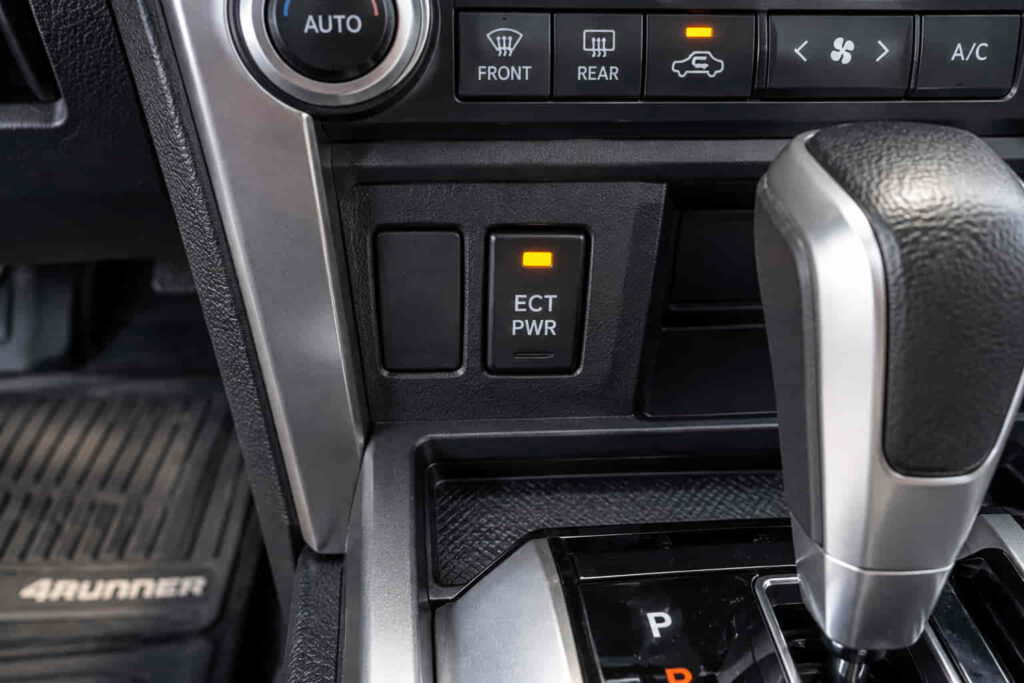
Toyota 4Runner ECT Power is a transmission control mode designed to make the automatic transmission respond differently when stronger acceleration or more sustained power delivery is needed. ECT stands for Electronically Controlled Transmission, and activating ECT Power changes transmission behavior rather than simply adding horsepower to the engine. The driver may notice the transmission holding a gear longer or responding more readily to increased throttle demand, allowing the engine to operate in a range better suited to acceleration and higher-load driving conditions.
This distinction explains why a 4Runner can feel more responsive with ECT Power selected even though the button should not be understood as a direct engine-horsepower switch. The change comes primarily from how the available engine output is managed through the transmission. That behavior can be useful when additional response is needed, including certain towing, uphill-driving, passing, or highway-acceleration situations.
ECT Power is not necessary for every trip, and its exact operation should be interpreted in the context of the specific 4Runner model and model year. Understanding when to use it requires understanding what it changes first. This guide explains how Toyota 4Runner ECT Power affects shifting, why the vehicle can feel different when it is activated, when the mode is useful, and what drivers should know about fuel economy and regular use.
What Does ECT Power Mean on a Toyota 4Runner?
ECT Power on a Toyota 4Runner refers to a power-oriented operating mode for the Electronically Controlled Transmission. ECT stands for Electronically Controlled Transmission, which means transmission operation is managed electronically according to vehicle inputs and programmed control logic rather than relying only on a fixed mechanical shift pattern. Selecting ECT Power changes the transmission control strategy to favor stronger response when driving demand increases.
The word “Power” describes the transmission mode rather than a separate source of engine power. The automatic transmission determines when to remain in a gear, when to upshift, and when a lower gear is appropriate based on operating conditions and driver demand. ECT Power modifies this behavior so the transmission can make greater use of the engine’s available performance instead of prioritizing the same shift characteristics used during normal driving.
This is why the driver can notice a change without any modification to the engine. When acceleration demand increases, transmission gear selection affects the engine speed and the amount of usable response available at the wheels. Holding an appropriate gear longer or changing the transmission’s response to driver input can keep the engine operating in a range that supports stronger acceleration.
ECT Power should therefore be understood as part of the 4Runner’s transmission-control strategy. It is not a separate transmission, an additional physical gear, or a general-purpose engine modification. The feature changes how the automatic transmission uses the engine’s available output in response to driving demand. This distinction provides the foundation for understanding why ECT Power can make a Toyota 4Runner feel more responsive.
What Does ECT Power Do on a Toyota 4Runner?
ECT Power changes the Toyota 4Runner’s automatic transmission control strategy so the transmission can favor a more responsive shift pattern under increased driving demand. The practical effect is created through gear selection and shift timing, which influence how quickly the vehicle responds when the driver asks for stronger acceleration.
Under lighter driving demand, an automatic transmission can select gears in a way that supports smooth operation and efficient cruising. When ECT Power is selected, the control strategy can favor keeping the transmission in a useful lower gear longer before an upshift or responding differently when increased throttle input requires additional acceleration. This allows the engine to operate at a speed better suited to the requested performance.
The mechanism matters because an engine does not deliver the same usable response at every operating speed. Transmission gearing determines how engine output is applied as vehicle speed and load change. If the transmission remains in a higher gear while the driver needs stronger acceleration, the response can feel less immediate. Selecting a more appropriate lower gear raises engine speed and can make more of the engine’s available performance accessible for the current driving condition.
For example, when a driver increases throttle to accelerate onto a highway or respond to an uphill load, transmission gear selection directly affects how the 4Runner responds. ECT Power can alter the transmission strategy so it is less eager to move toward a higher gear when continued acceleration is required. The driver can consequently perceive a stronger or more immediate response even though the mode itself is not adding a new source of engine output.
ECT Power also does not establish one fixed shift point that applies to every driving situation. Transmission behavior depends on operating inputs and on the control system used by the specific 4Runner. Vehicle generation, model year, transmission configuration, speed, throttle demand, and load can affect how the resulting behavior is experienced.
The central function of ECT Power is therefore transmission management: it changes how the 4Runner selects and holds gears to provide a more performance-oriented response when conditions demand it. Understanding that mechanism separates the actual function of ECT Power from the common assumption that pressing the button simply increases engine horsepower.
Read more: Toyota Vehicle Exchange Program
Does ECT Power Increase Horsepower on a Toyota 4Runner?
ECT Power does not directly increase the Toyota 4Runner engine’s rated horsepower; it changes how the automatic transmission uses the engine’s available output. The stronger response a driver feels comes from transmission behavior, particularly gear selection and shift strategy, rather than the ECT Power button creating additional engine power.
Horsepower describes engine output, while the transmission determines how that output is delivered through different gear ratios as vehicle speed and driving demand change. These are connected but separate functions. Changing transmission strategy can make the same engine feel more responsive because the transmission can keep the engine operating in a range where stronger acceleration is available.
For example, imagine the 4Runner is traveling in a higher gear and the driver requests stronger acceleration. Remaining in that gear may produce a more gradual response. A lower gear increases engine speed and changes the mechanical relationship between engine speed and wheel speed, allowing the vehicle to use its available engine output differently. ECT Power can influence the transmission strategy involved in producing that response.
This explains why the word “Power” can be misleading when interpreted as an engine-performance claim. The driver presses the ECT Power button, transmission behavior changes, engine speed may remain higher during acceleration, and the vehicle can feel stronger. That sequence can create the impression that additional horsepower has been activated even though the noticeable difference is primarily the result of how the transmission manages the power already available.
The distinction also matters when comparing ECT Power with an actual engine modification. Increasing rated engine output requires a change that affects the engine’s ability to produce power. A transmission mode instead changes how existing output is used across driving conditions. ECT Power should therefore be viewed as a transmission-response feature, not a horsepower-boost function.
How Does ECT Power Change Transmission Shifting?
ECT Power changes transmission shifting by using a more performance-oriented shift strategy when the Toyota 4Runner responds to driver demand. In practical driving, this can mean holding an appropriate gear longer before upshifting and making greater use of lower gears when stronger acceleration is required.
An upshift reduces engine speed relative to remaining in the lower gear at the same road speed. During light-load driving, moving into a higher gear can support quieter and more efficient cruising. During stronger acceleration, however, an early upshift can move the engine away from an operating range better suited to the requested response. A power-oriented transmission strategy can delay that transition when driving demand justifies remaining in the current gear.
Downshift behavior is connected to the same objective. When the driver increases throttle demand, selecting a lower gear can raise engine speed and provide stronger acceleration than remaining in a taller gear. The transmission control system determines the appropriate response from its operating inputs rather than requiring the driver to manually select every gear during normal automatic operation.
The result can be especially noticeable when vehicle demand changes quickly. During highway acceleration, for example, the driver may increase throttle substantially to gain speed. Transmission strategy influences whether the vehicle remains in its existing gear, selects a lower gear, and how long it stays there as acceleration continues. ECT Power changes this control behavior toward the response expected from its power-oriented setting.
ECT Power does not mean the transmission permanently stays in the lowest possible gear or shifts at one predetermined engine speed. The control system still responds to operating conditions. The exact shift behavior can also differ across 4Runner generations, model years, engines, and transmission configurations, so one specific RPM value should not be treated as a universal ECT Power shift point.
The important change is the shift strategy rather than a fixed shift number. By changing when the transmission favors an upshift, holds a useful gear, or responds to increased driving demand, ECT Power can make the 4Runner feel more responsive without changing the engine’s rated horsepower.
When Should You Use ECT Power on a Toyota 4Runner?
ECT Power is most useful when a Toyota 4Runner needs a more responsive transmission strategy under increased acceleration or load demand. The mode changes how the automatic transmission responds rather than providing additional engine horsepower, so its practical value appears when gear selection and shift timing can help the engine use its available output more effectively.
Higher-load driving creates a clear context for this behavior. When the 4Runner encounters a grade, carries additional load, or operates under another condition that requires more sustained engine output, moving into a higher gear too readily can reduce the response available at that moment. ECT Power can favor transmission behavior that keeps an appropriate gear available longer when driving demand remains elevated.
The same principle applies when stronger acceleration is required. During highway merging or passing, the driver may need the 4Runner to gain speed more quickly than during steady cruising. Transmission gear selection affects how readily the vehicle responds to that throttle demand. A power-oriented shift strategy can make the response feel more immediate by allowing greater use of a suitable gear and engine operating range during acceleration.
ECT Power is less relevant when the vehicle is cruising steadily under light load and the driver does not need additional transmission responsiveness. In those conditions, the normal transmission strategy can manage routine acceleration and cruising without requiring the power-oriented mode. Keeping ECT Power available for higher-demand situations allows the driver to use the mode according to its function rather than assuming it must be activated for normal 4Runner operation.
The decision should therefore be based on driving demand rather than on a fixed vehicle speed. ECT Power is useful when the driver wants the automatic transmission to prioritize stronger response, particularly when acceleration or vehicle load makes gear selection more important. The specific operating guidance for a particular 4Runner should still follow the owner’s manual for its model year and configuration.
Should You Use ECT Power When Towing With a Toyota 4Runner?
ECT Power can be useful when towing with a Toyota 4Runner because towing increases vehicle load and can create conditions in which a more responsive transmission strategy is beneficial. The mode can affect how the transmission selects and holds gears as the engine responds to the additional demand created by the trailer.
Towing changes the amount of work required to accelerate the combined vehicle and trailer. The transmission must select gears while the engine responds to this increased load, particularly during acceleration and changes in road grade. A transmission strategy that makes greater use of an appropriate lower gear can help keep the engine operating in a range suited to the required response instead of moving toward a higher gear while substantial load remains.
Uphill towing illustrates the relationship. As road grade increases, maintaining speed requires additional engine output. Gear selection becomes important because staying in an unsuitable higher gear can produce less responsive acceleration and may lead the transmission to change gears as demand varies. ECT Power can alter the shift strategy toward the more responsive behavior intended by the mode.
However, activating ECT Power does not increase the 4Runner’s towing capacity. Transmission shift strategy and maximum permitted towing load are separate issues. The amount a specific 4Runner can tow depends on its applicable vehicle specifications, configuration, equipment, trailer requirements, and Toyota’s instructions. ECT Power should never be used as justification for exceeding those limits.
ECT Power also does not replace other transmission or towing instructions that may apply to a particular 4Runner. Toyota has produced the 4Runner across different generations with different powertrains and control systems, so the correct gear-selection and towing guidance should be taken from information for the exact model year and configuration.
The useful role of ECT Power during towing is therefore specific: it can change automatic transmission behavior when the additional load creates a need for stronger response. It does not create extra towing capacity or remove the need to follow vehicle-specific towing limits and operating instructions.
Should You Use ECT Power When Driving Uphill?
ECT Power can be useful when driving a Toyota 4Runner uphill because an incline increases the power required to maintain or increase vehicle speed, making transmission gear selection more important. The mode can favor a more responsive shift strategy so the transmission makes better use of an appropriate gear while the engine is operating under increased demand.
Driving uphill changes the load acting against the vehicle. On level ground, the 4Runner may maintain speed with relatively modest engine output and a higher transmission gear. As the grade increases, more engine output is required to overcome the additional resistance created by the climb. Remaining in a gear that keeps engine speed too low for the required response can make the vehicle feel less responsive when the driver applies more throttle.
A lower gear changes that operating relationship. The engine can run at a higher speed while the transmission provides a gear ratio better suited to the increased demand. ECT Power can influence the automatic transmission strategy so it is more willing to maintain or select a gear that supports stronger response instead of prioritizing an earlier upshift.
This behavior can become more noticeable when uphill driving is combined with additional load. Passengers, cargo, or a trailer increase the amount of work required from the powertrain, and a steeper grade increases that demand further. ECT Power does not reduce the physical load on the vehicle, but its transmission strategy can help the powertrain respond to that load through more suitable gear selection.
ECT Power should not be confused with a dedicated hill-control feature. It does not change the steepness of a grade, increase the engine’s rated horsepower, or override the vehicle’s operating limits. Other transmission or gear-selection instructions can also apply to specific driving conditions, so vehicle-specific guidance remains important.
The reason to use ECT Power uphill is therefore transmission response, not additional engine power. When the grade creates higher demand, the mode can help the automatic transmission use gears in a way that keeps the 4Runner more responsive to the driver’s throttle input.
Is ECT Power Useful for Passing and Highway Acceleration?
ECT Power can be useful for passing and highway acceleration because these situations require the Toyota 4Runner to respond quickly to increased throttle demand. A more responsive transmission strategy can help the vehicle access an appropriate gear and engine operating range while additional acceleration is required.
Steady highway cruising and highway acceleration place different demands on the powertrain. During steady cruising, the transmission can use a higher gear because maintaining speed generally requires less immediate acceleration. When the driver requests substantially more acceleration, remaining in that cruising gear may not provide the desired response. A downshift or longer use of a lower gear can place the engine in a more suitable operating range.
ECT Power influences this transmission behavior rather than generating additional engine output. If the transmission responds more readily to increased throttle demand or delays an upshift while acceleration continues, the driver can experience stronger response from the same engine. This is the same mechanism that makes ECT Power useful in other higher-demand situations: gear selection changes how effectively the available engine output is applied.
Passing provides a practical example because the required acceleration is temporary. The driver may move from steady cruising to a period of increased throttle demand and then return to a stable speed after completing the maneuver. ECT Power can support the acceleration phase through its shift strategy, but the mode does not change the fundamental requirement to judge available distance, traffic conditions, and vehicle speed safely.
Highway merging follows a similar mechanical principle. Increasing speed to match traffic requires more acceleration than maintaining a constant cruising speed. Transmission response becomes more important during that transition because the engine must provide greater output for a limited period. A power-oriented shift strategy can help the 4Runner respond to that demand without implying that ECT Power increases its rated horsepower.
ECT Power is therefore useful for passing or highway acceleration when the driver benefits from more responsive automatic transmission behavior. Its role is to influence how the transmission uses the engine’s available performance; it does not create additional road space, increase safe passing distance, or replace the driver’s responsibility to select an appropriate maneuver.
Does ECT Power Use More Gas on a Toyota 4Runner?
ECT Power can increase fuel consumption when its transmission strategy causes the Toyota 4Runner to operate at higher engine speeds or remain in lower gears longer than it otherwise would under the same driving conditions. However, there is no single fuel-economy penalty that applies every time ECT Power is activated because actual fuel use depends on driving demand, vehicle load, speed, terrain, and driver input.
The connection between ECT Power and fuel consumption begins with transmission behavior. During light-load driving, an automatic transmission can move toward higher gears as conditions allow, reducing engine speed during steady cruising. ECT Power uses a more response-oriented strategy, so the transmission can favor holding a useful lower gear when acceleration or load demand remains elevated. That behavior can keep the engine operating at a higher RPM than it would under a more economy-oriented shift pattern.
Higher engine speed does not mean fuel consumption increases by a fixed amount. Fuel use depends on how much work the engine is performing as well as how the vehicle is being driven. A 4Runner climbing a grade, towing, or accelerating strongly already requires more energy than the same vehicle cruising steadily on level ground. ECT Power changes transmission response within those conditions; it does not independently determine the entire fuel-consumption result.
Driver behavior can have an equally important effect. Selecting ECT Power and repeatedly using heavy throttle will produce a different fuel-economy outcome from selecting the mode while maintaining relatively steady driving. The stronger response available from the transmission can encourage more frequent acceleration, but that additional fuel use comes from the combination of transmission strategy and driving demand rather than from the ECT Power indicator itself.
For this reason, a claim that ECT Power reduces fuel economy by one specific percentage would not apply reliably across all Toyota 4Runners and driving conditions. The practical trade-off is responsiveness versus efficiency: when ECT Power keeps the transmission in a more performance-oriented operating strategy, fuel consumption can increase compared with lighter-load driving that allows earlier use of higher gears.
Can You Leave ECT Power On All the Time?
ECT Power does not need to be used all the time because its more responsive transmission strategy provides the greatest value when driving demand justifies it. Normal driving conditions do not always require the transmission to favor the same gear-holding and response characteristics that are useful during stronger acceleration, towing, or uphill driving.
During steady cruising and routine low-load driving, the 4Runner does not continuously need maximum transmission responsiveness. The normal control strategy can manage acceleration, cruising, and ordinary changes in vehicle speed without the driver selecting ECT Power. Using the standard mode in these conditions allows transmission behavior to remain oriented toward its normal operating strategy.
Leaving ECT Power selected should also be distinguished from actively driving the vehicle hard. The mode changes transmission control behavior, but vehicle load and driver input still determine how much performance is being demanded from the powertrain. A 4Runner traveling at a steady speed with ECT Power selected is not experiencing the same operating conditions as one accelerating heavily uphill or pulling a trailer.
The more relevant question is therefore whether the power-oriented shift strategy provides a benefit during the current driving condition. If stronger response is not needed, keeping ECT Power selected offers less practical advantage and may allow the engine to spend more time in operating conditions that prioritize response over fuel efficiency. When additional transmission responsiveness becomes useful, the driver can select the mode for that purpose.
The exact behavior of the ECT Power selection can vary with the 4Runner’s model year and transmission-control design. Owners who need to know whether a particular vehicle retains the selected mode after the ignition is cycled, or how Toyota specifies its operation, should use the owner’s manual for that exact model year rather than assume every 4Runner behaves identically.
ECT Power is best treated as a selectable transmission strategy for higher-demand driving rather than a setting that must remain active for normal operation. Its usefulness depends on the driving condition, while model-specific instructions determine how the feature should be operated on a particular Toyota 4Runner.
Does ECT Power Damage the Transmission?
Using ECT Power as an intended Toyota 4Runner transmission mode does not by itself mean the transmission is being damaged. ECT Power is part of the vehicle’s transmission-control strategy, so selecting the mode should be distinguished from a transmission malfunction, excessive vehicle loading, improper operation, or an existing mechanical problem.
The misconception often comes from the change in engine speed and shifting behavior. With ECT Power selected, the transmission can hold an appropriate lower gear longer or use a more responsive shift strategy when driving demand increases. The engine may consequently operate at a higher RPM during acceleration than the driver normally experiences in a more economy-oriented driving condition. Higher RPM during an intended operating condition is not, by itself, evidence of transmission damage.
Vehicle load still matters because ECT Power does not remove the physical limits of the powertrain. Towing beyond the applicable vehicle rating, operating with an existing transmission problem, or ignoring abnormal symptoms creates a different situation from simply selecting ECT Power. The mode changes transmission strategy; it does not increase the 4Runner’s mechanical limits or make inappropriate operating conditions acceptable.
Abnormal transmission behavior should therefore be evaluated independently from the ECT Power button. Harsh or unexpected shifting, slipping, delayed engagement, unusual noises, warning indicators, or other changes in operation can indicate a condition that requires diagnosis. Those symptoms should not automatically be attributed to ECT Power merely because they become noticeable while the mode is selected. Increased driving demand can make an existing problem easier to notice without proving that the mode caused it.
Model-specific maintenance and operating instructions remain important because Toyota 4Runners use different transmissions and control systems across generations. Correct fluid requirements, service procedures, towing limitations, and operational guidance should come from information applicable to the exact vehicle rather than from assumptions about ECT Power across the entire 4Runner range.
ECT Power should therefore be treated as a factory transmission-control function, not as an inherently damaging setting. If a 4Runner develops abnormal transmission symptoms, the correct response is to diagnose the symptoms and underlying system condition instead of assuming that normal use of ECT Power is the root cause.
What Is the Difference Between ECT Power and Normal Mode?
The main difference between ECT Power and Normal mode is the transmission shift strategy: ECT Power favors stronger response, while Normal mode provides the standard transmission behavior for routine driving. Both modes use the same engine and automatic transmission, but the control strategy determines how the transmission responds as throttle demand, vehicle speed, and load change.
Normal mode is appropriate for ordinary driving because the transmission can balance routine acceleration with steady cruising without continuously prioritizing a power-oriented response. When driving demand is light, moving toward an appropriate higher gear can reduce engine speed and support smoother, more efficient cruising. When additional acceleration becomes necessary, the transmission can still respond without ECT Power being selected.
ECT Power changes that emphasis. When driving demand increases, the transmission can favor holding a useful gear longer or responding in a way that keeps the engine in an operating range better suited to acceleration. The driver may notice higher engine speed before an upshift or a stronger response to increased throttle input. These characteristics explain why the vehicle can feel more responsive even though its rated engine horsepower has not increased.
The practical difference becomes clearest when driving conditions change. During steady, low-load cruising, Normal mode generally provides the transmission behavior required for the situation. During stronger acceleration, uphill driving, or other higher-demand conditions, ECT Power can provide a shift strategy better aligned with the driver’s request for response. The distinction is therefore based on transmission-control priorities rather than one mode being universally better than the other.
Fuel consumption can also differ because the two strategies can place the engine in different operating conditions. A mode that keeps the transmission in lower gears longer during higher demand can result in higher engine speeds than a strategy that allows earlier use of higher gears. Actual fuel consumption still depends on throttle input, load, terrain, speed, and other operating conditions rather than the mode name alone.
Normal mode is the standard strategy for everyday operation, while ECT Power shifts the transmission’s priority toward responsiveness when additional performance is useful. Choosing between them should therefore depend on driving demand rather than the assumption that ECT Power provides more engine horsepower or that Normal mode prevents the 4Runner from accelerating strongly.
Does ECT Power Work the Same on Every Toyota 4Runner?
ECT Power should not be assumed to operate identically on every Toyota 4Runner because transmission hardware, electronic controls, powertrains, and operating instructions can differ by generation and model year. The general purpose remains related to transmission response, but the exact behavior of a specific vehicle should be determined from information applicable to that 4Runner.
The 4Runner has existed across multiple generations, and changes to engines, automatic transmissions, control modules, and electronic management can change how transmission behavior is implemented. A description that accurately reflects one model year should therefore not automatically be converted into a precise shift specification for another. This is particularly important when discussing exact shift points, engine RPM, gear behavior, or how a selected mode is retained.
The driver can still use the same underlying concept to understand ECT Power. The mode is associated with an electronically controlled transmission strategy that favors a more responsive relationship between driving demand and gear selection. What should remain vehicle-specific is exactly how the transmission executes that strategy under a given combination of throttle input, speed, load, and operating conditions.
Model-specific information becomes especially important for towing and other higher-load operation. ECT Power can influence transmission response, but it does not establish towing capacity, replace gear-selection instructions, or override operating limits for a particular 4Runner. Those requirements depend on the vehicle’s configuration and the guidance Toyota provides for that model year.
The owner’s manual is therefore the appropriate reference when a driver needs exact instructions for the ECT Power control on a specific 4Runner. Vehicle-specific service information becomes relevant when the concern involves abnormal shifting, warning indicators, or a suspected transmission fault rather than normal feature operation.
The consistent principle across the topic is that ECT Power changes transmission-control behavior to favor responsiveness, while the exact implementation depends on the Toyota 4Runner being driven. Keeping that distinction prevents a feature description from one generation from being treated as a universal specification for every 4Runner.