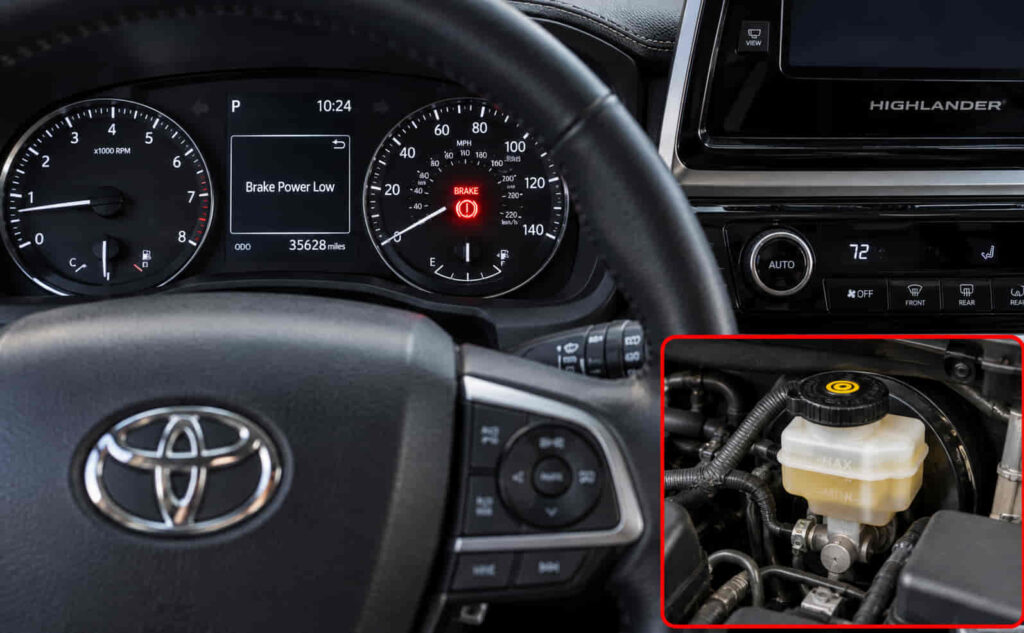
The Toyota Highlander Brake Power Low warning means the vehicle has detected a condition that can reduce normal braking or brake-assist performance. The warning should be taken seriously because reduced brake assist can require more pedal force to slow or stop the vehicle. However, the message does not automatically mean that the brake booster has failed. The exact cause depends on the Highlander model year, powertrain, brake-assist system, and diagnostic trouble codes stored when the warning appears.
Several systems can contribute to a Brake Power Low warning. Depending on the Highlander configuration, the problem may involve insufficient brake-booster vacuum, a vacuum supply or pump fault, a leaking hose or check valve, an electrical supply problem, or a fault within the electronically controlled braking system. Low system voltage can also affect control-system operation during startup, while simultaneous ABS, VSC, brake, or check-engine warnings can provide additional diagnostic information. The warning message alone is therefore not enough to identify the failed component.
This guide explains what Brake Power Low means on a Toyota Highlander, whether the vehicle is safe to drive, the conditions that can trigger the warning, and how brake booster, vacuum, battery, electrical, and control-system faults should be diagnosed before parts are replaced.
What Does Brake Power Low Mean on a Toyota Highlander?
The Toyota Highlander Brake Power Low warning means the vehicle has detected a braking-system condition serious enough that normal braking performance may not be available. On Toyota documentation that displays the message “Braking Power Low Stop in a Safe Place See Owner’s Manual,” the specified response is to stop the vehicle immediately in a safe place and contact a Toyota dealer. Toyota documentation for applicable Highlander systems also associates the warning with low brake fluid or a brake-system malfunction, so the message should be treated as a system-level warning rather than a diagnosis of one failed component.
This distinction is important because “braking power” describes the system condition experienced or detected by the vehicle, while the root cause can exist in different parts of the braking system. A loss of brake assist, for example, can make the brake pedal require substantially more driver force even though a mechanical connection between the pedal and hydraulic brakes remains. A hydraulic-system problem can create a different pedal response. The warning message therefore tells the driver that braking capability needs immediate attention, but it does not by itself establish whether the brake booster, vacuum source, hydraulic circuit, electrical system, or another brake-control component has failed.
Toyota’s 2018 safety recall involving certain Highlander and Sienna vehicles demonstrates why the warning cannot be reduced to a generic “bad brake booster” diagnosis. The recall involved a brake vacuum pump condition that could cause a sudden loss of braking assist. Toyota stated that affected drivers could see a brake warning and “Braking Power Low” message and could need to press the brake pedal harder to stop the vehicle. This establishes a direct relationship between insufficient brake-assist vacuum and the warning on affected vehicles, but it does not mean every Highlander displaying the message has the recall condition. Recall applicability is VIN-specific, and other braking-system faults can produce a low-braking-power warning.
The Highlander’s model year and powertrain also matter. Toyota has used conventional and hybrid braking architectures across the Highlander range, and later Highlander Hybrid documentation identifies “Braking Power Low” among messages that may indicate a malfunction requiring the vehicle to be stopped safely. Service information for applicable Highlander Hybrid systems also associates a low-braking-power message with the electronically controlled brake system. A diagnosis based only on a repair that worked on a different Highlander generation can therefore target the wrong system.
Brake pedal behavior provides useful context but should not replace system diagnosis. A hard pedal can be consistent with reduced brake assist because the driver must supply more of the force that the assist system would normally provide. Other brake-system faults can produce different pedal behavior. Toyota’s recall communication specifically noted that an affected vehicle could require greater pedal force to stop, illustrating why a vehicle can still produce some braking force while the system is no longer operating as designed.
The Brake Power Low message should therefore be interpreted as a warning about braking-system performance, not as a component replacement instruction. The correct diagnosis starts by identifying the Highlander’s year and powertrain, observing the accompanying brake warnings and pedal behavior, and retrieving the relevant diagnostic trouble codes before deciding whether the problem involves brake assist, vacuum supply, hydraulics, electrical power, or another control-system fault.
Is It Safe to Drive a Toyota Highlander With Brake Power Low?
No assumption should be made that a Toyota Highlander is safe to continue driving after the “Braking Power Low Stop in a Safe Place See Owner’s Manual” message appears. Toyota instructs the driver to stop the vehicle immediately in a safe place and contact a Toyota dealer for this warning. This instruction is more important than whether the vehicle appears to brake normally during the first few pedal applications because the warning indicates that the braking system may not be functioning as intended.
Reduced brake assist illustrates the risk. The brake booster is designed to reduce the physical force the driver must apply to generate the required braking action. If the assist source is lost, the pedal can become considerably harder and stopping can require greater pedal force. Toyota’s safety-recall communication for affected Highlanders specifically warned that a brake vacuum pump condition could cause a sudden loss of braking assist and require the driver to press the pedal harder to stop. The existence of residual or unassisted braking does not make that condition equivalent to normal braking performance.
Pedal feel should therefore be treated as an immediate safety signal. A pedal that suddenly becomes unusually hard, requires substantially more force, or is accompanied by noticeably reduced braking response indicates that normal brake assistance may not be available. A warning that appears together with the red brake warning light also requires particular attention because Toyota’s documentation treats the combination as a condition requiring the vehicle to be stopped rather than driven until a convenient repair time.
The warning should not be ignored simply because it disappears after the engine is restarted. An intermittent vacuum, electrical, hydraulic, sensor, or control-system condition can cease to be detected temporarily while the underlying fault remains. Restarting also does not establish that normal brake-assist reserve or system pressure has returned. Diagnostic information should be retrieved before repeated restarts or battery disconnection erase useful evidence about when the fault occurred.
There is also no reliable universal distance that can be recommended after this warning appears. A statement such as “it is safe to drive five miles to a repair shop” would conflict with Toyota’s instruction to stop safely and would ignore differences in the underlying failure. A vehicle experiencing a brake-assist problem on level roads at low speed does not face the same braking demand as a vehicle descending a grade, operating in traffic, or making repeated stops.
The 2018 Highlander recall provides a concrete example of why model-specific investigation matters. Toyota recalled certain vehicles because a manufacturing condition in the vacuum pump could cause the pump to stop operating, resulting in loss of braking assist. The warning message could accompany this condition, but only specific vehicles were included in that safety campaign. A 2018 Highlander displaying Brake Power Low should therefore have its VIN checked for applicable campaigns while still receiving a normal diagnosis if the vehicle is outside the recall population.
The safest response to a Toyota Highlander Brake Power Low warning is to follow the displayed instruction: stop in a safe place and have the braking system evaluated rather than continuing to drive based on pedal feel alone. The next diagnostic objective is to determine why braking power or assistance has been reduced, which requires separating vacuum and brake-booster problems from hydraulic, electrical, and control-system faults.
Read more: Toyota Knock Sensor Location
What Causes Brake Power Low on a Toyota Highlander?
A Toyota Highlander can display Brake Power Low when the braking system cannot maintain the braking or brake-assist condition expected by the vehicle’s control system. The root cause is not limited to one component. Depending on the model year and powertrain, the fault can originate from insufficient brake-booster vacuum, a vacuum pump or vacuum-supply problem, a brake-system malfunction, low brake fluid, or a fault detected by an electronically controlled braking system. This is why the warning message identifies a braking condition rather than naming a specific failed part.
Loss of brake-assist vacuum is one established cause on applicable Highlanders. Toyota recalled certain 2018 Highlander vehicles because a component inside the brake vacuum pump could separate and cause the pump to stop operating. If that happened, braking assist could be lost, the driver could be required to apply substantially more pedal force, and a brake warning accompanied by a “Braking Power Low” message could appear. The mechanism is direct: the brake booster depends on an adequate vacuum source for assistance, so a failure that prevents the vacuum pump from supplying that source can reduce the amount of assistance available to the driver.
A vacuum-supply problem does not automatically mean the vacuum pump itself has failed. The complete assist system can include the vacuum source, hoses or pipes, check-valve functions, connections, and the brake booster. A leak or restriction in the path between the vacuum source and booster can prevent the booster from receiving or retaining the vacuum it requires even when the source itself is capable of operating. The diagnostic question is therefore whether adequate vacuum reaches and remains available to the booster, not simply whether the pump makes noise or appears to operate.
Brake-system faults outside the vacuum-assist path can also produce a low-braking-power warning. Toyota owner information for applicable Highlander configurations associates “Braking Power Low Stop in a Safe Place See Owner’s Manual” with a brake-system condition requiring the vehicle to be stopped safely. Toyota documentation can also associate the warning condition with low brake fluid or another brake-system malfunction. This expands the diagnostic scope beyond the booster and demonstrates why fluid level, hydraulic condition, warning lights, and stored brake-system codes must be considered together rather than treating Brake Power Low as a synonym for vacuum failure.
Hybrid Highlanders require additional distinction because their braking architecture differs from a conventional vacuum-assisted system. Toyota Highlander Hybrid models use electronically controlled braking functions that coordinate hydraulic braking with regenerative braking. A malfunction affecting brake control, actuator operation, pressure generation, electrical supply, or related control logic therefore cannot be diagnosed using the same assumptions as a conventional Highlander with a vacuum-assisted brake booster. The warning text may be similar while the component responsible for producing or controlling braking assistance is different.
Electrical conditions can also influence electronically controlled brake components and control modules. A weak 12-volt supply, poor electrical connection, damaged wiring, or component power-supply problem can interfere with system initialization or operation on applicable vehicles. However, the appearance of Brake Power Low after a weak battery event does not establish that the battery is the root cause. Voltage must be measured and diagnostic codes retrieved because replacing the battery cannot correct a mechanical vacuum failure, hydraulic fault, or defective brake-control component.
The warning can also appear together with ABS, VSC, master warning, or check-engine indications. Multiple warnings do not necessarily mean that several independent components failed simultaneously. Toyota vehicle systems exchange information between control modules, and one underlying fault can affect more than one control function or cause secondary warnings. Conversely, two warnings can represent separate faults. The stored diagnostic trouble codes and their detection conditions are needed to establish whether the warnings share a causal relationship.
Model year is therefore a critical diagnostic attribute. A repair that applies to a recalled 2018 Highlander vacuum pump should not automatically be applied to a different generation or a Highlander Hybrid. Toyota has changed engines, brake-assist configurations, electronic control systems, and hybrid braking architecture across Highlander generations. The same dashboard phrase must be interpreted within the system installed on the specific vehicle.
The cause of Toyota Highlander Brake Power Low should therefore be identified by determining which part of the braking system has lost its expected operating condition. On a vacuum-assisted system, diagnosis should establish whether the booster receives and retains sufficient vacuum. On an electronically controlled or hybrid system, brake-control pressure, electrical supply, actuator operation, and stored control-module faults become more important. The warning defines the problem area; testing identifies the component responsible.
Can a Brake Booster Problem Cause Brake Power Low on a Toyota Highlander?
Yes, a brake booster or a loss of the assistance supplied to it can cause a Brake Power Low condition on applicable Toyota Highlanders, but the warning alone does not prove that the brake booster assembly has failed. The booster is part of the system that reduces the physical effort required at the brake pedal. When normal assistance is unavailable, the driver may still be capable of applying the brakes mechanically, but considerably greater pedal force can be required to produce the expected braking response.
A vacuum brake booster works by using a pressure difference to multiply the force applied through the brake pedal. Under normal operation, vacuum is supplied to the booster and retained so assistance is available when the driver presses the pedal. If adequate vacuum is unavailable, the booster cannot provide its normal force multiplication. The driver then supplies a larger proportion of the force needed to operate the master cylinder, which is why reduced assist is commonly associated with an unusually firm or hard brake pedal.
Toyota’s Highlander vacuum-pump recall illustrates the distinction between a booster problem and a booster-supply problem. In the affected vehicles, Toyota identified the vacuum pump as the component that could stop operating. The resulting condition could cause loss of braking assist and require increased brake-pedal effort even though the brake booster itself was not necessarily defective. The “Braking Power Low” message could appear because the system-level result was reduced braking assistance. Replacing the booster in that situation would not address the documented root cause.
The same diagnostic principle applies to the vacuum path. If a hose, pipe, connection, or check-valve function prevents adequate vacuum from reaching or remaining in the booster, the symptoms can resemble booster failure. The pedal can become harder because the booster no longer has the pressure differential required to multiply pedal force. Testing the vacuum supply and the booster’s ability to maintain assistance separates a supply fault from an internal booster fault.
Brake pedal feel provides evidence but not a complete diagnosis. A hard pedal supports investigation of brake-assist loss, while other pedal conditions can point toward hydraulic or control-system problems. Pedal feel must therefore be interpreted with the dashboard warning, brake-fluid condition, vacuum measurements where applicable, diagnostic trouble codes, and the specific brake architecture of the vehicle. A single symptom cannot reliably distinguish a failed booster from a failed vacuum source.
This distinction becomes even more important when comparing conventional and hybrid Highlanders. A component described casually as the “brake booster” in consumer discussions may refer to different brake-assist or actuator assemblies depending on the vehicle. Highlander Hybrid braking integrates electronic and hydraulic control with regenerative braking, so diagnosis must use the terminology and test procedure for the exact model year rather than assuming that every Brake Power Low warning originates from a conventional vacuum booster.
Replacing the brake booster based only on the warning is therefore an inefficient diagnostic strategy. A booster can be an expensive and labor-intensive component, while the actual fault may exist in its vacuum supply, a related valve or hose, electrical power, wiring, or another brake-control component. Confirming the failed mechanism before replacement reduces both unnecessary parts cost and the risk that the warning returns immediately after repair.
A Toyota Highlander brake booster becomes a valid repair target only when diagnosis confirms that the booster itself cannot provide or maintain the required assistance. If vacuum is not reaching the booster, the supply system must be diagnosed first. If the vehicle uses a different electronically controlled brake-assist architecture, its actuator and control system must be tested according to that configuration. Brake Power Low identifies reduced braking capability; it does not identify the brake booster as the failed part by itself.
Can Low Brake Booster Vacuum Trigger the Brake Power Low Warning?
Yes, insufficient brake booster vacuum can trigger a Brake Power Low condition on Toyota Highlanders that use vacuum-assisted braking. The brake booster depends on a sufficient pressure difference to multiply the force applied by the driver at the brake pedal. When the available vacuum falls below the level required for normal assistance, the driver may need to apply substantially more pedal force, and the vehicle can detect a braking-assist condition that requires a warning.
Brake booster vacuum is therefore an operating condition rather than a component. The system must first generate vacuum, deliver it to the booster, and retain enough of it for brake assistance. A fault at any point in that path can reduce the vacuum available at the booster. This is why a low-vacuum diagnosis should not immediately be converted into a vacuum-pump replacement.
The relationship is demonstrated by Toyota’s safety recall involving certain 2018 Highlander vehicles. Toyota reported that a component within the vacuum pump could separate and cause the pump to stop operating. If the pump stopped, braking assist could be lost, greater brake-pedal force could be required, and the driver could receive a brake warning together with a “Braking Power Low” message. In this case, insufficient vacuum was the mechanism connecting the failed pump to the change in braking performance.
A vacuum leak can create a similar system-level result through a different mechanism. If the vacuum source operates correctly but a hose, connection, valve, or other part of the vacuum path cannot maintain the required pressure difference, the booster receives less assistance than intended. The symptom can resemble a defective booster or vacuum pump because all three conditions ultimately reduce the amount of assist available at the pedal.
The ability to retain vacuum is also important. A brake-assist system needs more than momentary vacuum generation. A check-valve function and sealed vacuum path help preserve the pressure difference required by the booster. If vacuum is generated but rapidly lost, brake assistance can deteriorate even though a test confirms that the vacuum source operates at some point. Diagnosis therefore needs to consider both vacuum generation and vacuum retention.
Pedal behavior provides a mechanical clue. When vacuum assistance is substantially reduced, the brake pedal can feel harder because the booster contributes less force to the master cylinder. The driver must compensate by pressing harder. Toyota’s recall documentation specifically describes increased pedal effort after loss of brake-assist vacuum, establishing the relationship between vacuum supply and pedal force on affected Highlanders.
A hard pedal is not sufficient evidence to replace the booster, however. The same basic symptom can result when the booster is structurally capable of operating but does not receive its required vacuum supply. Diagnosis must establish whether vacuum is being generated, whether it reaches the booster, whether it is retained, and whether the booster responds correctly when that vacuum is available. This separates the source, delivery path, and booster into distinct diagnostic units.
Engine operating conditions can also matter on systems whose vacuum supply is related to engine operation. Vacuum availability can change between engine-off, startup, idle, and repeated brake applications. A warning that appears mainly during startup or after several pedal applications therefore needs to be evaluated under the conditions in which the fault occurs rather than from a single static inspection.
The model year and powertrain must still be identified before applying this explanation. Toyota Highlander generations do not all use an identical brake-assist architecture, and Highlander Hybrid systems introduce electronically controlled braking functions that cannot be reduced to the same conventional vacuum-booster diagnosis. A vacuum test is meaningful only when the specific vehicle uses that vacuum circuit as part of its brake-assist system.
Low brake booster vacuum should therefore be treated as a measurable condition that requires a cause, not as the final diagnosis. If the vacuum is below specification, the diagnostic path should determine whether the problem comes from vacuum generation, a leak or restriction in the supply path, loss of vacuum retention, or the booster itself. That distinction prevents the Brake Power Low warning from being incorrectly attributed to the most expensive component in the system.
Can a Vacuum Pump Cause Brake Power Low on a Toyota Highlander?
Yes, a failed brake vacuum pump can cause Brake Power Low on Toyota Highlanders equipped with a vacuum pump that supplies the brake-assist system. If the pump cannot generate the vacuum required by the brake booster, normal braking assistance can be reduced or lost. The resulting increase in pedal effort can occur even though the hydraulic brakes still retain a mechanical means of applying braking force.
Toyota documented this failure mechanism in Safety Recall J0K for certain 2018 Highlander vehicles equipped with specific non-hybrid powertrains. According to Toyota’s recall documentation, a component inside the vacuum pump could separate during vehicle operation and cause the pump to stop providing vacuum to the brake booster. Toyota stated that the condition could result in a sudden loss of braking assist, increase stopping distance, and increase the risk of a crash.
The recall is particularly useful for understanding the causal chain behind the warning. The vacuum pump did not directly apply the wheel brakes. Its role was to provide the vacuum needed for brake assistance. When the pump stopped supplying that vacuum, the booster lost the operating condition it needed to reduce pedal effort. The system-level consequence was reduced brake assistance, which could then be accompanied by the “Braking Power Low” message.
This does not mean that every Highlander displaying Brake Power Low needs a vacuum pump. The 2018 campaign applied to a defined population of vehicles, and recall eligibility is determined by the specific vehicle rather than by warning message alone. A different Highlander model year can use a different engine or braking architecture, while a Highlander Hybrid can require a fundamentally different diagnostic approach.
Even on a vehicle equipped with a brake vacuum pump, insufficient vacuum does not prove that the pump has failed internally. A leak downstream of the pump can prevent the system from developing or retaining adequate vacuum. A restricted or damaged vacuum path can interfere with delivery. A connection problem can affect an electrically operated pump where applicable. The measured result at the booster can therefore be inadequate vacuum even when the root cause lies outside the pump assembly.
The warning condition should be reproduced and measured whenever the applicable service procedure permits it. If the complaint occurs primarily at startup, after the vehicle has been parked, or after repeated brake applications, those conditions provide diagnostic information about how quickly vacuum is generated and retained. A system that develops normal vacuum but cannot hold it points toward a different failure mechanism from a system in which the vacuum source never produces the required condition.
Diagnostic trouble codes and accompanying warnings can further narrow the investigation. Brake-system codes can identify monitored electrical or control faults, while engine-related codes can reveal another condition occurring at the same time. The absence of a generic engine code does not establish that the brake-assist system is healthy, because relevant information may be stored in a brake or chassis control module rather than the ECM.
Recall status should also be checked by VIN when the vehicle falls within a potentially affected model year. A model-year match alone does not prove that a Highlander was included in a campaign, and the presence of Brake Power Low does not prove that an open recall exists. VIN-based verification distinguishes an applicable manufacturer campaign from an unrelated repair that happens to produce a similar warning.
The vacuum pump should therefore be replaced only when diagnosis confirms that it cannot provide the required brake-assist vacuum or when an applicable manufacturer campaign specifies the repair for that vehicle. Brake Power Low establishes the need to investigate braking performance; vacuum measurement, system integrity, model-specific service information, and VIN applicability determine whether the vacuum pump is actually responsible.
Can a Weak Battery Cause Brake Power Low on a Toyota Highlander?
A weak 12-volt battery can contribute to brake-system warnings on a Toyota Highlander when low system voltage prevents electronically controlled components from initializing or operating normally, but Brake Power Low does not prove that the battery is the root cause. Modern Highlander braking systems depend on electrical control modules, sensors, actuators, relays, and communication networks in addition to mechanical and hydraulic components. If supply voltage drops far enough during startup, several systems can detect abnormal operating conditions at the same time.
Startup is the condition in which battery voltage becomes particularly relevant. A battery can show enough open-circuit voltage to illuminate the dashboard yet experience a substantial voltage drop when electrical demand increases. Control modules require voltage to remain within their operating range while the vehicle initializes. If voltage falls outside that range, a module can record a fault or fail to complete a normal system check even though the underlying brake hardware has not mechanically failed.
This mechanism also explains why a low-voltage event can produce several warnings together. ABS, VSC, electric parking brake, hybrid-system, engine, and braking functions can depend on electrical power and communication between control modules. An unstable power supply can therefore affect more than one module during the same startup event. Multiple dashboard messages appearing immediately after a weak start provide a reason to test the 12-volt electrical system, but they do not prove that every warning originates from the battery.
The relationship is especially important on a Highlander Hybrid. The 12-volt battery does not propel the vehicle, but it is still required to power control electronics and allow vehicle systems to initialize before READY operation. Electronically controlled braking relies on functioning electrical and control systems, so inadequate 12-volt power can create a different diagnostic situation from a conventional vacuum-booster failure. The correct system architecture must therefore be identified before applying a non-hybrid brake-booster diagnosis to a hybrid vehicle.
Battery age alone is not an adequate test. A recently installed battery can still be discharged, have a poor terminal connection, or receive inadequate charging, while an older battery can remain serviceable. Diagnosis should evaluate actual battery and charging-system performance under the conditions in which the warning occurs. A voltage problem confirmed during startup has much greater diagnostic value than assuming the battery is responsible because the warning appeared on a cold morning.
Electrical connections deserve the same attention. Resistance at battery terminals, grounds, power connections, or related circuits can reduce the voltage that reaches a control module even when battery voltage measured directly at the posts appears acceptable. In this situation, replacing the battery can temporarily change system behavior without correcting the connection responsible for the voltage drop.
A warning that disappears after charging or replacing a weak battery also requires verification. If the message was produced only by low voltage, normal system operation should return and relevant faults should not recur once stable electrical power has been restored. If Brake Power Low returns despite a verified electrical supply, diagnosis must continue into the braking system rather than repeatedly attributing the fault to the battery.
The opposite diagnostic error is equally important. A normal battery does not rule out Brake Power Low because many causes are unrelated to battery condition. A vacuum pump that cannot supply brake-assist vacuum, a vacuum leak, a hydraulic problem, or an electronically controlled brake-system fault will not be repaired by installing a stronger 12-volt battery. The warning must always be interpreted with pedal behavior, accompanying warning lights, stored DTCs, and the Highlander’s braking architecture.
For this reason, disconnecting the battery simply to make the warning disappear is not a diagnosis. Power interruption can clear or reset information that would otherwise help identify the original condition. Reading relevant diagnostic information before deliberately resetting the system preserves evidence about which module detected the fault and under what operating conditions.
A weak battery should therefore be considered a possible electrical contributor to Toyota Highlander Brake Power Low only when testing confirms abnormal system voltage or related electrical faults. If voltage and electrical supply are normal, the diagnostic path should move to the brake-assist, hydraulic, actuator, wiring, or control-system condition indicated by the vehicle’s actual symptoms and stored codes.
Can Low Brake Fluid Cause a Toyota Highlander Brake Power Low Warning?
Low brake fluid can be associated with a Toyota Highlander braking-system warning, but adding brake fluid should not be treated as an automatic fix for Brake Power Low. Toyota owner information for applicable Highlander models identifies low brake fluid level or a brake-system malfunction as conditions associated with brake warnings that require immediate attention. The fluid level therefore needs to be checked when investigating a braking warning, but the reason for a low level is more important than the act of filling the reservoir.
Brake fluid transmits hydraulic pressure from the brake-control or master-cylinder side of the system to the wheel brakes. The hydraulic circuit must remain properly filled and sealed for predictable braking operation. A substantial loss of fluid can indicate a hydraulic-system problem capable of affecting braking performance, which makes it fundamentally different from a cosmetic maintenance issue.
Low brake fluid has two broad contexts that must be distinguished. Fluid level can gradually change as brake friction components wear and hydraulic components compensate for that wear, or the level can fall because fluid is escaping from the hydraulic system. A leak is the more serious condition because the system is losing the medium used to transmit braking force. Simply topping off the reservoir can hide the visible symptom while leaving the hydraulic failure unresolved.
The location of the fluid relative to the reservoir markings provides useful information, but fluid level alone cannot identify the source of a Brake Power Low message. The braking system also contains assist, control, sensing, and electrical functions. A reservoir at the correct level cannot rule out loss of brake-booster vacuum, a vacuum-pump fault, actuator malfunction, electrical supply problem, or another brake-control failure.
The reverse is also true: finding a low reservoir does not prove that every accompanying warning has the same cause. A Highlander can store diagnostic information that identifies an additional electrical or control-system fault. The fluid condition and DTCs should therefore be interpreted together rather than stopping diagnosis as soon as one abnormal observation is found.
Pedal behavior can help establish whether a hydraulic problem requires immediate attention. Loss of brake assist commonly produces a harder pedal because the driver has lost force multiplication. A hydraulic fault can produce a different pedal response, including excessive travel or reduced resistance depending on the failure. These differences are diagnostically useful because Brake Power Low describes the resulting braking concern rather than specifying which mechanism produced it.
Brake fluid should also not be repeatedly added without determining where it is going. If the reservoir level falls again after being corrected, the change provides evidence that the system requires inspection. Hydraulic connections, lines, hoses, calipers, and other applicable brake components must remain sealed. A continuing reduction in fluid level is therefore a condition to diagnose rather than a normal reason for periodic topping off.
Toyota’s instruction associated with a low-braking-power warning remains the controlling safety context. When the display instructs the driver to stop in a safe place, checking the reservoir should not be used as justification for continuing to drive simply because fluid is visible. The warning can represent a braking-system malfunction that is not apparent from a reservoir inspection.
Fluid specification also matters if service is required. Brake fluid is a functional hydraulic material with manufacturer requirements, not a generic liquid that should be added solely because the reservoir appears low. The correct specification and service procedure should be taken from the information for the exact Highlander model year. Mixing an inappropriate fluid or contaminating the hydraulic system creates an additional problem rather than resolving the original warning.
Low brake fluid is therefore a diagnostic finding, not a complete diagnosis of Toyota Highlander Brake Power Low. If the level is below specification, the cause of the reduction must be established and the hydraulic system evaluated. If the fluid level is normal, diagnosis should continue into the brake-assist, electrical, actuator, and control systems instead of assuming the warning is false.
Why Does Brake Power Low Appear When Starting a Toyota Highlander?
Brake Power Low can appear when starting a Toyota Highlander because startup is the point at which the vehicle initializes its braking and control systems while electrical voltage and brake-assist conditions are changing. A warning that occurs specifically at startup can therefore point toward an electrical supply, brake-assist, vacuum, or control-system condition that becomes detectable during initialization. The timing of the warning is diagnostically useful, but it does not identify the failed component by itself.
The 12-volt electrical system is one reason startup matters. Starting a conventional gasoline Highlander creates a high electrical demand, and a weak battery or poor connection can cause system voltage to fall while control modules are beginning their self-checks. If a brake-related module does not receive stable voltage during this period, it can detect abnormal operation or fail to initialize normally. This becomes more plausible when Brake Power Low appears together with several unrelated-looking system warnings immediately after startup.
A Highlander Hybrid has a different starting sequence, but the 12-volt electrical supply remains important. The auxiliary battery powers control electronics and allows the vehicle’s systems to initialize before READY operation. A weak 12-volt supply can therefore create control-system problems even though the high-voltage hybrid battery is responsible for vehicle propulsion. The presence of a large traction battery does not eliminate the need to test the 12-volt system when multiple warnings appear during initialization.
Brake-assist conditions can also change while a conventional Highlander is being started. A vacuum-assisted system requires sufficient vacuum to provide normal booster assistance. If stored vacuum has been lost while the vehicle was parked, the system must restore the required condition after startup. A leak, poor vacuum retention, or a vacuum-generation problem can therefore become more apparent after the vehicle has been sitting than after it has already been running.
Pedal behavior provides additional context in this situation. If Brake Power Low appears at startup and the pedal is unusually hard, the combination supports investigation of brake-assist availability rather than treating the dashboard message as an isolated electrical glitch. A hard pedal occurs when the driver receives less force multiplication from the assist system and must provide more of the braking input directly.
Repeated brake applications can provide another clue because each assisted application can change the available reserve in a vacuum-assisted system. A healthy system is designed to generate and maintain the operating condition required for assistance. If the warning appears after the vehicle has been parked or after brake applications have reduced the available reserve, diagnosis should determine whether the vacuum source and retention path are functioning correctly.
Toyota’s recall involving certain 2018 Highlanders provides a documented example of a vacuum-generation fault capable of reducing brake assistance. Toyota identified a condition in which a component inside the vacuum pump could separate, causing the pump to stop supplying vacuum to the brake booster. Loss of that assistance could increase the pedal force required to stop the vehicle and could be accompanied by a “Braking Power Low” warning. The recall demonstrates the mechanism but should not be generalized to every Highlander that displays the warning during startup.
A warning that disappears shortly after startup should still be investigated if it repeatedly returns. A transient condition can stop being detected after battery voltage rises, vacuum becomes available, or a control module completes another operating cycle. The disappearance of the message only establishes that the display condition is no longer active at that moment; it does not prove that the condition that initially triggered it has been repaired.
The most useful diagnostic distinction is whether the warning occurs once or follows a repeatable pattern. A message that consistently appears after an overnight park, during a weak start, after repeated brake applications, or under another specific condition provides information about the mechanism involved. That pattern can then be compared with voltage measurements, brake-assist behavior, stored DTCs, and the applicable service procedure.
Brake Power Low at startup should therefore be diagnosed by reproducing the conditions under which the warning appears and determining what changes during that period. Stable 12-volt power, normal brake-assist availability, expected pedal feel, and the absence of relevant brake-system faults provide stronger evidence than simply restarting the Highlander until the warning disappears.
Why Does Brake Power Low Appear With a Check Engine Light?
Brake Power Low and the Check Engine Light can appear together on a Toyota Highlander when one fault affects systems that interact with both engine management and braking, but the two warnings do not automatically have the same root cause. The Check Engine Light primarily indicates that the ECM has detected a powertrain or emissions-related fault, while Brake Power Low identifies a condition affecting braking performance or brake-system operation. Diagnosis must determine whether the two events are causally connected or merely occurred at the same time.
A vacuum-related condition provides one possible connection on applicable non-hybrid Highlanders. If brake assistance depends on a vacuum source associated with the engine or an engine-driven system, a fault affecting vacuum generation can have consequences beyond the brake pedal. The braking system can detect insufficient assistance while the engine-management system records information relevant to the operating condition. The exact relationship depends on the engine and model year, so the presence of both warnings should lead to code retrieval rather than an assumption that the engine itself has mechanically failed.
Electrical supply provides another mechanism capable of producing simultaneous warnings. Low voltage or a poor power connection can affect more than one control module during the same startup event. The ECM can detect abnormal operation while a brake-control module also records a fault. In that case, several dashboard indicators may share an electrical cause even though they represent different vehicle systems.
Control modules also exchange information over the vehicle communication network. Braking and stability functions can depend on engine information such as operating state, torque-related data, or other signals required for coordinated vehicle control. If one module cannot provide valid information, another system can restrict a function or illuminate an additional warning. This means a brake warning can sometimes be secondary to a fault detected elsewhere without the brake hardware itself being the original failed component.
The opposite situation is also possible. The Highlander can have an engine fault and a separate braking fault at the same time. A Check Engine Light caused by an emissions-related problem, for example, should not automatically be used to explain an abnormal brake pedal or loss of brake assistance. Temporal proximity is not proof of causation. The diagnostic trouble codes from both systems must establish a technical relationship before the faults are treated as one repair.
This is why reading only generic powertrain codes is insufficient when Brake Power Low is present. A basic OBD-II reader may retrieve an ECM code while failing to access brake, ABS, stability-control, or other chassis modules. The result can be a misleading diagnosis in which the only visible code is assumed to explain every dashboard warning. A scan tool capable of communicating with the relevant Toyota control systems provides a more complete fault picture.
Code chronology can also matter. If diagnostic information shows that several modules recorded faults during the same low-voltage event, a shared electrical cause becomes more plausible. If the Check Engine Light existed for days before Brake Power Low appeared, the two conditions may be unrelated. Freeze-frame or event-related data can provide additional context about engine state, voltage, speed, and other conditions present when a fault was detected.
The brake pedal remains an important independent source of information. If the Check Engine Light appears with Brake Power Low but pedal effort and braking response have changed, the brake warning must be treated as a braking concern regardless of the engine code. Toyota’s instruction to stop safely when a low-braking-power warning is displayed should not be overridden because a technician suspects that the dashboard messages share an electrical cause.
Clearing the engine code is also not a valid test of the braking system. A scan-tool reset or battery disconnect can turn warning indicators off temporarily without restoring vacuum, hydraulic pressure, electrical integrity, or actuator function. The meaningful test is whether the confirmed fault has been repaired and whether both systems subsequently operate normally without returning DTCs.
When Brake Power Low and the Check Engine Light appear together, the correct diagnostic approach is to retrieve faults from both the engine and braking systems and establish whether they share a mechanical, electrical, or communication-related cause. The warnings should only be treated as one problem when diagnostic evidence connects them; otherwise, each system requires its own diagnosis.
Why Does Brake Power Low Appear With ABS or VSC Warnings?
Brake Power Low can appear together with ABS or VSC warnings on a Toyota Highlander because these functions are connected through the vehicle’s electronically controlled braking and stability systems. A fault that prevents the braking system from operating normally can therefore affect more than one control function and produce several dashboard warnings from a single underlying condition. The presence of three warnings does not automatically mean that the Highlander has three separate failed components.
ABS controls wheel slip during braking by monitoring wheel-speed information and regulating braking pressure when necessary. VSC uses braking and powertrain control to help stabilize the vehicle when actual vehicle movement differs from the driver’s intended path. Because these functions depend on brake-system information and control capability, a fault that compromises the braking system can cause ABS or stability functions to become unavailable or restricted at the same time.
This relationship is especially relevant on Highlander configurations with electronically controlled brake components. Brake pressure, actuator operation, sensor signals, control-module communication, and electrical supply can all contribute to multiple functions. If a component or circuit required by several functions becomes unavailable, the system can illuminate more than one warning even though diagnosis eventually identifies one root cause.
A shared electrical problem can create a similar pattern. Low system voltage, a poor power connection, or an abnormal ground can affect several control modules during the same operating event. Brake Power Low, ABS, VSC, and other warnings appearing together immediately after a weak startup therefore justify testing electrical supply and retrieving DTCs from all relevant modules. They do not justify replacing an ABS actuator or brake booster solely because its warning is visible.
Sensor and communication faults also need to be interpreted by function. ABS and stability control depend on valid vehicle-state information. If a required signal becomes unavailable, a control system may disable or restrict a function because it can no longer calculate the intervention accurately. A secondary ABS or VSC warning can therefore describe the consequence of another fault rather than identify the component that originally failed.
The diagnostic trouble codes establish which interpretation is correct. One module may contain the primary fault while another stores a communication or secondary system code. Reading only the engine ECM can miss this relationship because brake and stability faults can be stored in chassis-related control modules. Diagnosis of simultaneous Brake Power Low, ABS, and VSC warnings therefore requires a scan tool capable of communicating with the relevant Toyota systems.
Pedal behavior must still take priority over attempts to interpret the dashboard electronically. If the pedal becomes unusually hard, braking response changes, or the vehicle displays an instruction to stop because braking power is low, the condition should be treated as a braking-performance concern. ABS or VSC warnings do not reduce the significance of the Brake Power Low message.
The warnings also should not be diagnosed independently until their stored faults are compared. Replacing a wheel-speed sensor because the ABS light is on, replacing a brake booster because Brake Power Low is displayed, and replacing another component because VSC is unavailable can produce unnecessary repairs if all three warnings originated from one shared electrical, hydraulic, or control-system fault.
When Brake Power Low appears with ABS or VSC warnings, the diagnostic objective is to identify the primary fault and determine which warnings are secondary consequences. Stored DTCs, electrical supply, brake-system operation, sensor data, and control-module communication provide the evidence needed to establish that relationship. The number of warning lights should never be used as a count of failed components.
Will Restarting the Toyota Highlander Clear Brake Power Low?
Restarting a Toyota Highlander may make the Brake Power Low message disappear temporarily, but a disappearing warning does not prove that the underlying braking-system fault has been repaired. A restart causes control modules to initialize again and reevaluate current operating conditions. If the abnormal condition is not detected during the new initialization cycle, the dashboard message can disappear even though the condition that triggered it can recur.
Electrical voltage provides one example. If low voltage during the first startup prevents a brake-related module from initializing normally, a second start made after voltage has recovered can produce different dashboard behavior. The warning may disappear because the module now receives adequate voltage. That result makes an electrical-supply problem worth investigating, but it does not establish whether the battery, charging system, connection, or another temporary condition caused the original voltage drop.
Vacuum availability can create another transient pattern on applicable vacuum-assisted Highlanders. If the system begins with insufficient brake-assist vacuum but subsequently generates enough vacuum while the engine operates, the immediate condition can change. A warning that disappears after the system has been running therefore does not prove that vacuum generation and retention meet specification under every operating condition. A leak or weak vacuum source can still produce the same warning after the vehicle sits again.
Intermittent electrical faults can behave similarly. A loose connection, high-resistance terminal, damaged harness, or component that fails only under specific temperature or vibration conditions can operate normally during one ignition cycle and abnormally during another. Restarting changes the operating event but does not repair the physical connection.
Stored diagnostic information is particularly valuable when the warning is intermittent. A control module can retain a DTC or fault history after the dashboard message is no longer active. That information can identify the circuit or system that detected the abnormal condition and provide a more reliable starting point than attempting to reproduce the warning by repeatedly restarting the vehicle.
For the same reason, disconnecting the battery to clear Brake Power Low should not be used as a repair method. Removing power can erase or reset diagnostic information and make an intermittent problem harder to trace. The dashboard may initially appear normal after reconnection while the root cause remains unchanged and returns when the detection conditions occur again.
The distinction is between warning reset and fault correction. A warning reset changes what the driver sees. Fault correction restores the vacuum, hydraulic, electrical, actuator, sensor, or control condition that caused the braking system to detect a problem. Only the second outcome represents a repair.
A repeatable restart pattern can still provide useful diagnostic evidence. If Brake Power Low consistently appears on the first startup after the Highlander has been parked for several hours but disappears after restarting, the time-dependent pattern can guide testing toward conditions that change while the vehicle sits or runs. If the warning instead appears randomly while driving, a different diagnostic strategy may be required.
Safety instructions remain applicable even when the message has disappeared once. If the Highlander previously displayed a low-braking-power warning accompanied by abnormal pedal feel or reduced braking response, a successful restart should not be used as evidence that normal braking is guaranteed. The system needs to be evaluated for the condition that generated the warning.
Restarting the Highlander can therefore clear the displayed Brake Power Low message without clearing its root cause. The warning should be considered resolved only after the relevant fault has been diagnosed, the confirmed cause has been corrected, braking operation has returned to normal, and the warning or associated DTC does not return under the conditions that previously triggered it.
How Do You Diagnose Toyota Highlander Brake Power Low?
Diagnosing Toyota Highlander Brake Power Low requires identifying the exact braking system, evaluating actual braking performance, retrieving diagnostic trouble codes, and then testing the system indicated by those findings. The warning should not be diagnosed by replacing the brake booster, vacuum pump, battery, or brake actuator based on the dashboard message alone. Each of those components can be relevant on specific Highlander configurations, but they represent different failure mechanisms.
The first diagnostic distinction is the Highlander’s model year and powertrain. A conventional gasoline Highlander with vacuum-assisted brakes does not have the same diagnostic architecture as a Highlander Hybrid with electronically controlled braking and regenerative brake integration. Even within non-hybrid generations, Toyota has changed engines and brake-assist components. The vehicle configuration therefore determines whether vacuum supply, an electrically controlled brake component, hydraulic pressure, or another system should receive priority.
Actual brake behavior provides the next diagnostic context. An unusually hard pedal points toward reduced brake assistance because the driver must supply more of the force normally multiplied by the assist system. Excessive pedal travel or another abnormal hydraulic response points toward a different mechanism. The warning message and pedal condition should be interpreted together because “Brake Power Low” describes the system-level problem while pedal behavior provides evidence about how braking performance has changed.
The diagnostic trouble codes should then be retrieved before codes are cleared or the battery is disconnected. This requires access to the modules responsible for the affected systems. A basic OBD-II reader designed primarily for generic powertrain codes may show a Check Engine Light fault while providing no useful information from the ABS, stability-control, or brake-control system. A Toyota-capable or sufficiently comprehensive scan tool can reveal chassis and brake-system DTCs that more directly identify the circuit or operating condition associated with the warning.
Multiple codes must be interpreted according to their relationship rather than treated as separate replacement instructions. If several modules record low-voltage or communication faults during the same startup event, electrical supply becomes a stronger common-cause candidate. If the brake-control system records a specific pressure, actuator, sensor, or assist-related fault while system voltage remains normal, diagnosis should follow that circuit instead. A DTC narrows the diagnostic area; it does not automatically identify the component that must be replaced.
On a Highlander using vacuum brake assistance, the next objective is to establish whether sufficient vacuum is available to the booster. Vacuum generation, delivery, and retention are separate functions. A pump or engine-related vacuum source can generate vacuum correctly while a leaking connection prevents it from reaching the booster. The system can also initially develop vacuum but fail to retain it. Measuring the condition at the appropriate points distinguishes a weak source from a leaking delivery path or a booster that cannot maintain normal assistance.
The 2018 Highlander vacuum-pump recall demonstrates why this distinction matters. Toyota identified a specific internal vacuum-pump condition capable of stopping vacuum supply to the brake booster, resulting in loss of assist and increased pedal effort. That documented failure makes the pump an important diagnostic entity on an applicable vehicle, but recall status and the actual fault still need to be confirmed rather than inferred from the warning alone.
Electrical testing becomes important when the warning appears during startup or alongside several system warnings. Battery condition should be evaluated under load rather than from age or resting voltage alone. Power and ground integrity also matter because a healthy battery cannot compensate for excessive resistance at a terminal, ground, connector, or circuit supplying a control module. If the electrical system is verified as stable, diagnosis can move away from the battery hypothesis.
Brake fluid and hydraulic condition provide another diagnostic branch. The reservoir should contain the correct fluid at the specified level, but finding low fluid requires determining why the level is low. A hydraulic leak and normal level change associated with component condition are not equivalent faults. If fluid loss or abnormal pedal travel indicates a hydraulic problem, that issue requires investigation regardless of whether a brake-assist fault is also present.
Intermittent warnings should be diagnosed under the conditions that reproduce them. A Brake Power Low message that appears only after an overnight park provides different evidence from one that occurs after repeated braking or during normal driving. Startup voltage, stored brake-assist reserve, temperature, vibration, and system initialization can change between these conditions. Reproducing the pattern makes the diagnostic process more specific.
VIN-based recall verification should be included when the model year and vehicle configuration overlap a known Toyota safety campaign. A recall can define a manufacturer-approved repair for a specific defect, but model year alone is not enough to establish eligibility. The VIN determines whether the individual Highlander falls within the affected population.
A complete Toyota Highlander Brake Power Low diagnosis therefore connects four types of evidence: the exact vehicle configuration, physical brake behavior, stored control-module information, and measured system performance. Parts should be selected only after those findings identify whether the fault originates in brake-assist vacuum, hydraulics, electrical supply, wiring, an actuator or control component, or another monitored braking-system condition.
How Do You Fix Brake Power Low on a Toyota Highlander?
The correct fix for Toyota Highlander Brake Power Low is to repair the condition that caused braking performance or brake assistance to fall outside normal operation. There is no single Brake Power Low part to replace because the warning can result from different mechanical, hydraulic, electrical, and electronically controlled brake-system faults. Repair should follow a confirmed diagnosis rather than the warning text alone.
If testing confirms inadequate brake-booster vacuum because the vacuum source cannot generate the required condition, the failed vacuum-generation component becomes the repair target. On certain recalled 2018 Highlanders, Toyota identified an internal vacuum-pump defect and specified replacement under the applicable safety campaign. This is a cause-based repair: the pump is replaced because its failure has been established for the affected vehicle, not simply because Brake Power Low appeared on the instrument panel.
A vacuum leak requires a different repair. If the vacuum source operates correctly but the booster does not receive or retain the required vacuum, the leaking or defective part of the supply path must be corrected. Replacing a functioning vacuum pump would leave this mechanism unchanged. The same principle applies if testing proves that the booster itself cannot maintain or provide normal assistance despite receiving the correct vacuum supply; only then does the booster become the appropriate repair target.
An electrical-supply problem also requires its own repair path. A battery that fails an appropriate load or capacity test can require replacement, while a discharged battery can point toward charging or parasitic-draw diagnosis instead. High resistance at a battery terminal or ground requires correcting the connection rather than replacing unrelated braking components. Stable voltage should be verified after repair because electronically controlled braking functions depend on reliable electrical power.
If low brake fluid is found, the repair is not simply to fill the reservoir. The hydraulic system must first be evaluated for the reason the level dropped. A confirmed leak requires repair of the affected hydraulic component and restoration of the system according to the applicable service procedure. Brake fluid should then be brought to the correct condition using the manufacturer-specified fluid and bleeding procedure where required.
Electronically controlled brake faults require a different level of diagnosis. A DTC identifying an actuator, pressure-control, sensor, wiring, communication, or power-supply problem should be followed through the service procedure for the exact Highlander. Replacing an actuator because ABS, VSC, and Brake Power Low appear together is not justified unless testing confirms the actuator or its integrated component is responsible.
Wiring repairs deserve particular attention because electrical faults can imitate component failures. An open circuit, damaged terminal, poor connector contact, abnormal resistance, or power/ground problem can prevent a correctly functioning component from communicating or operating as expected. If circuit testing identifies wiring as the root cause, repairing that circuit is the fix even when the DTC description contains the name of a brake component.
A Highlander Hybrid must be repaired according to its electronically controlled braking architecture rather than a conventional vacuum-booster assumption. Hybrid braking coordinates hydraulic and regenerative functions, so the relevant actuator, accumulator, pressure-control, sensor, power-supply, and control-system information must be interpreted for that vehicle. A repair procedure from a non-hybrid Highlander should not be transferred simply because both vehicles display similar dashboard wording.
After the confirmed repair, diagnostic codes should be handled according to the applicable procedure and the braking system should be verified under the conditions that previously produced the warning. A successful repair restores normal brake operation; it does more than turn off the dashboard message. If the warning returns, the original root cause has either not been corrected or another fault remains.
The repair should also address applicable safety campaigns before the customer pays for a component covered by an open recall. When a Highlander matches a potentially affected model year, VIN-based verification establishes whether Toyota has an outstanding campaign for that individual vehicle. A campaign repair and a customer-pay diagnosis are not interchangeable simply because they involve the same general brake-assist system.
Toyota Highlander Brake Power Low is therefore fixed by matching the repair to the confirmed failure mechanism. Vacuum-source failure requires restoring vacuum generation, a leak requires restoring system integrity, an electrical fault requires stable power or circuit repair, a hydraulic fault requires restoring the hydraulic system, and an electronically controlled brake fault requires repair of the verified component or circuit. The warning is resolved only when normal braking performance returns and the fault no longer recurs.
How Much Does It Cost to Fix Toyota Highlander Brake Power Low?
The cost to fix Toyota Highlander Brake Power Low depends on the confirmed cause because the warning does not identify a single component that needs replacement. A voltage or wiring problem, vacuum leak, vacuum pump failure, brake booster problem, hydraulic fault, and electronically controlled brake-system failure can all require different parts and substantially different amounts of diagnostic and repair labor. A useful estimate therefore starts with diagnosis rather than with an average price attached to the warning message.
Relatively simple faults can remain at the lower end of the repair range because they involve fewer parts and less disassembly. A poor electrical connection, damaged vacuum hose, or similar localized problem can require primarily diagnostic time plus a relatively inexpensive component. However, even a low-cost part can produce a larger bill if the fault is intermittent and requires extensive testing to reproduce.
Battery-related repairs should also be separated from brake-component repairs. If testing confirms that unstable 12-volt power caused the warning, the cost may involve battery replacement, terminal or ground repair, or diagnosis of the charging system. Installing a battery without confirming low voltage is not a valid way to estimate or repair Brake Power Low because the actual fault may remain elsewhere in the braking system.
Vacuum pump and brake booster repairs can cost more because the component price is only one part of the job. Access requirements, model year, engine configuration, and the amount of surrounding equipment that must be removed determine labor time. A vacuum pump should therefore not be priced as the expected repair until testing confirms inadequate vacuum generation rather than a leak or another brake-assist problem.
Recall coverage can change the customer’s cost completely. Certain 2018 Highlanders were included in Toyota’s brake vacuum-pump safety recall, and the manufacturer’s specified remedy for an affected vehicle is different from an unrelated customer-pay repair. A Highlander from a potentially affected period should therefore have recall applicability checked by VIN before an owner assumes that a vacuum-pump repair must be paid for out of pocket.
Hydraulic and electronically controlled brake repairs have an even wider cost range. A localized hydraulic leak does not involve the same repair as a brake actuator or integrated electronically controlled brake component. Highlander Hybrid models can also use braking hardware and control architecture that differ significantly from conventional Highlanders, making a generic “brake booster replacement cost” particularly misleading.
Labor rates create another source of variation. Toyota dealerships and independent repair facilities can charge different hourly rates, and diagnostic procedures can require different amounts of time depending on whether the fault is active, intermittent, or already accompanied by useful DTCs. Geographic location and parts availability further change the final invoice.
For these reasons, a single statement such as “Brake Power Low costs $500 to fix” has little diagnostic value. The same dashboard message can lead to a minor circuit repair on one Highlander and a substantially more complex brake-control repair on another. Quoting one broad number before identifying the failed system can create a false expectation about both the repair and its urgency.
The most accurate Toyota Highlander Brake Power Low repair estimate is obtained after the root cause has been confirmed and the required parts, labor, calibration, bleeding, or diagnostic procedures are known. The warning itself defines the affected function; it does not define the repair bill.
How Do You Confirm the Brake Power Low Problem Is Fixed?
A Toyota Highlander Brake Power Low problem is confirmed as fixed when normal braking operation has been restored, the diagnosed fault condition is no longer present, and the warning or related DTC does not return under the conditions that originally triggered it. Turning the dashboard message off is not sufficient because clearing codes or cycling the ignition can remove a warning temporarily without repairing its root cause.
Verification should correspond directly to the original diagnosis. If insufficient brake-booster vacuum caused the warning, the repaired system must generate and retain the required vacuum and provide normal assistance. If a weak electrical supply caused abnormal system initialization, voltage must remain stable during the operating conditions that previously triggered the fault. If a hydraulic problem was repaired, the system must maintain correct fluid condition and normal hydraulic operation without leakage.
Brake pedal behavior provides an immediate functional check. A pedal that was abnormally hard because of lost brake assistance should return to the expected assisted feel after the underlying assist problem is corrected. The driver should not need the excessive pedal force that was present during the fault. A hydraulic repair should likewise restore the pedal characteristics expected from a correctly operating system rather than merely eliminate a dashboard message.
Diagnostic information provides the electronic confirmation. After the repair and any manufacturer-specified code-clearing procedure, the relevant brake, ABS, stability-control, engine, or hybrid modules should be checked for returning faults. A code that immediately resets indicates that the monitored fault remains active. A code that returns only under particular driving or startup conditions shows that the repair must be verified under those same conditions.
This is particularly important for intermittent Brake Power Low complaints. If the original warning appeared only after the Highlander sat overnight, testing immediately after repair may not reproduce the detection conditions. If it appeared during startup, after repeated brake applications, or together with a voltage drop, the repaired vehicle should be evaluated when those circumstances can be recreated safely.
Multiple dashboard warnings should also return to their normal state for the correct reason. If Brake Power Low originally appeared with ABS or VSC warnings because one underlying brake-system fault affected several functions, correcting that root cause should restore the related systems once their normal operating conditions are satisfied. Individually clearing each warning without establishing why it appeared does not provide the same verification.
A replaced component must solve the measured failure mechanism. For example, installing a vacuum pump is only a successful repair if vacuum generation was previously inadequate and becomes correct afterward. Replacing a battery is only confirmed as relevant when electrical supply remains stable and the associated low-voltage behavior no longer occurs. This before-and-after relationship prevents a coincidental disappearance of the warning from being mistaken for proof of repair.
The final verification is therefore based on system performance rather than dashboard appearance alone. Normal brake assistance, normal pedal behavior, correct electrical or hydraulic conditions, no active related DTCs, and no recurrence of the warning together provide much stronger evidence that the fault has been resolved.
Toyota Highlander Brake Power Low should be considered repaired only after the condition that originally reduced or threatened braking performance has been corrected and verified. When the system operates normally under the same circumstances that previously produced the warning, and the relevant fault does not return, the repair has addressed the root cause rather than merely resetting the message.