The 2026 Toyota 4Runner lineup includes nine trim levels: SR5, TRD Sport, TRD Sport Premium, TRD Off-Road, TRD Off-Road Premium, Limited, Platinum, Trailhunter, and TRD Pro. These trims use the same body-on-frame 4Runner platform but target different priorities, ranging from everyday driving and value to premium comfort, overlanding, and demanding off-road use. Choosing the right trim therefore depends less on finding the highest specification and more on matching its equipment to how you plan to use the SUV.
SR5 provides the entry point for buyers who want essential 4Runner capability without specialized equipment. TRD Sport and TRD Sport Premium shift the focus toward on-road driving, styling, and cabin features, while TRD Off-Road and TRD Off-Road Premium add hardware designed for more challenging terrain. Limited and Platinum prioritize comfort and premium equipment. At the top of the off-road range, Trailhunter is configured primarily for overlanding, whereas TRD Pro emphasizes high-performance trail driving.
This guide compares the Toyota 4Runner trim packages by price, powertrain, drivetrain, standard features, off-road hardware, comfort, and intended use. It also explains what each step up the trim ladder adds so you can determine which 4Runner provides the right balance of capability, equipment, and value.
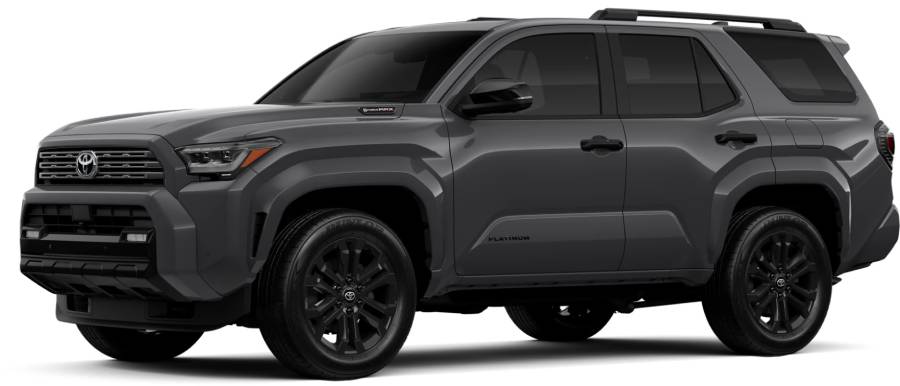
What Are the 2026 Toyota 4Runner Trim Levels?
The 2026 Toyota 4Runner is available in nine trim levels: SR5, TRD Sport, TRD Sport Premium, TRD Off-Road, TRD Off-Road Premium, Limited, Platinum, Trailhunter, and TRD Pro. The lineup progresses from the value-focused SR5 to trims designed specifically for on-road comfort, off-road capability, premium features, and overlanding.
The differences between Toyota 4Runner trim packages extend beyond interior equipment and exterior styling. Moving through the lineup changes important attributes such as drivetrain availability, suspension tuning, tires, traction hardware, powertrain options, and cabin technology. For example, the TRD Sport uses a sport-tuned suspension for a more road-focused setup, while the TRD Off-Road adds equipment such as an electronic locking rear differential and terrain-management systems for driving beyond paved roads.
The i-FORCE MAX hybrid powertrain also separates several upper trims from the standard lineup. The standard i-FORCE 2.4-liter turbocharged four-cylinder produces up to 278 horsepower and 317 lb-ft of torque. The i-FORCE MAX combines the turbocharged engine with an electric motor to produce up to 326 horsepower and 465 lb-ft of torque. Platinum, Trailhunter, and TRD Pro use i-FORCE MAX as standard equipment, while it is available on selected other trims.
The table below shows how the nine trims fit into the 2026 4Runner lineup.
| 2026 4Runner Trim | Starting MSRP | Primary Focus |
|---|---|---|
| SR5 | $42,270 | Value and everyday use |
| TRD Sport | $48,750 | On-road driving and styling |
| TRD Off-Road | $50,690 | Off-road capability |
| TRD Sport Premium | $54,110 | Sport-oriented driving with added comfort |
| TRD Off-Road Premium | $56,470 | Off-road capability with premium features |
| Limited | $56,900 | Comfort and everyday driving |
| Platinum | $64,360 | Premium features and hybrid performance |
| Trailhunter | $68,400 | Overlanding |
| TRD Pro | $68,600 | High-performance off-roading |
The trim hierarchy means the most expensive 4Runner is not automatically the best choice for every buyer. A driver who spends most of the time commuting may receive little practical benefit from the specialized equipment fitted to a Trailhunter or TRD Pro. Conversely, a buyer planning frequent trail use may benefit more from the locking rear differential and off-road systems of a TRD Off-Road than from the comfort-oriented upgrades of a Limited.
What Does the Toyota 4Runner SR5 Include?
The 2026 Toyota 4Runner SR5 is the entry-level trim and provides the core powertrain, utility, technology, and safety equipment without the specialized hardware found on higher trims. With a starting MSRP of $42,270, it establishes the baseline against which the additional equipment and price of every other 4Runner trim can be compared.
The SR5 uses Toyota’s i-FORCE 2.4-liter turbocharged four-cylinder engine, producing up to 278 horsepower and 317 lb-ft of torque through an eight-speed automatic transmission. This powertrain gives the SR5 the fundamental performance of the non-hybrid 4Runner without requiring buyers to move into a more expensive TRD or premium configuration. Drivetrain availability also allows buyers to select a configuration appropriate for normal road use or additional traction requirements rather than paying specifically for advanced trail hardware.
Toyota equips the SR5 with 17-inch alloy wheels and an 8-inch multimedia touchscreen. The trim also includes the core technology and driver-assistance equipment expected from the current-generation 4Runner, including Toyota Safety Sense 3.0. Available third-row seating gives the SR5 another advantage for buyers whose priorities include passenger capacity rather than specialized off-road equipment.
The largest limitation of the SR5 becomes apparent when its equipment is compared with the TRD Off-Road models. The SR5 does not package the same combination of dedicated trail equipment, such as the TRD Off-Road’s electronic locking rear differential, specialized suspension components, and additional terrain-management technology. Buyers who regularly encounter demanding trails therefore gain functional capability by moving higher in the lineup rather than simply receiving cosmetic changes.
The SR5 is the best starting point for buyers who want 4Runner utility and capability at the lowest price in the lineup. It makes the most sense for commuting, family transportation, road trips, light recreational use, and buyers who do not need factory-installed specialized off-road equipment. The money saved over higher trims can also be more valuable than unused premium or trail features when the vehicle will spend most of its time on paved roads.
What Does the Toyota 4Runner TRD Sport Add Over the SR5?
The 2026 Toyota 4Runner TRD Sport adds a sport-tuned suspension, 20-inch wheels, TRD-specific styling, a 12.3-inch digital gauge cluster, and additional technology over the SR5. Starting at $48,750, the TRD Sport is positioned primarily for drivers who want a more road-focused 4Runner rather than the specialized trail hardware included with the TRD Off-Road.
The suspension is one of the most important differences between the SR5 and TRD Sport. Toyota gives the TRD Sport a sport-tuned suspension designed to provide a more controlled on-road driving character. The 20-inch wheels also distinguish it from the SR5’s 17-inch wheels and reinforce its street-oriented configuration. These changes matter most to drivers who spend the majority of their time on highways, suburban roads, and city streets rather than technical trails.
The TRD Sport also changes the appearance of the 4Runner with TRD-specific exterior details. Inside, a 12.3-inch digital gauge cluster provides a substantial technology upgrade over the entry-level configuration. Wireless smartphone charging is another convenience feature included as part of the move up the trim ladder. Together, these upgrades make the TRD Sport more than a cosmetic package, although its functional improvements remain focused primarily on road use.
The distinction between TRD Sport and TRD Off-Road is particularly important. The word “TRD” does not mean both trims have the same purpose. TRD Sport prioritizes on-road driving, while TRD Off-Road prioritizes traction and control on difficult terrain. Buyers expecting equipment such as an electronic locking rear differential and dedicated terrain-management systems should therefore look at the TRD Off-Road rather than choosing the TRD Sport based on the TRD badge alone.
At $48,750, the TRD Sport costs $6,480 more than the $42,270 SR5 based on the starting MSRP figures used in this comparison. That premium makes sense for buyers who specifically value the sport-tuned setup, larger wheels, TRD appearance, and upgraded cabin technology. The SR5 remains the stronger value when those features are not priorities.
Choose the TRD Sport over the SR5 when on-road character, larger wheels, TRD styling, and additional technology justify the higher price. Choose the SR5 when the objective is obtaining the essential 4Runner experience for less money.
What Is the Difference Between TRD Sport and TRD Sport Premium?
The 2026 Toyota 4Runner TRD Sport Premium builds on the TRD Sport by adding more interior comfort, multimedia technology, audio equipment, and convenience features. It preserves the road-focused character of the TRD Sport while moving the cabin closer to the premium side of the 4Runner lineup.
One of the most noticeable upgrades is the multimedia system. The TRD Sport Premium receives a 14-inch touchscreen, providing a larger interface than the equipment found lower in the lineup. A JBL premium audio system further separates the Premium model for drivers who place greater value on in-cabin entertainment. These additions do not increase trail capability, but they affect the experience every time the vehicle is driven.
The seating equipment also changes. SofTex-trimmed power-adjustable seats provide a more premium cabin environment than the standard TRD Sport configuration. A heated steering wheel adds another comfort feature, particularly for drivers in colder climates. The value of these upgrades therefore depends on how much importance the buyer places on everyday cabin comfort rather than additional mechanical capability.
Toyota also adds convenience and visibility technology to the TRD Sport Premium. A Panoramic View Monitor provides additional camera perspectives around the vehicle, while a hands-free power liftgate makes accessing the cargo area easier when carrying luggage, groceries, or other equipment. These are practical upgrades for everyday ownership rather than performance modifications.
The starting MSRP illustrates the trade-off. At $54,110, the TRD Sport Premium costs $5,360 more than the $48,750 TRD Sport using the starting prices in this comparison. The additional money primarily buys comfort, technology, audio, and convenience equipment rather than a fundamentally different driving purpose.
The TRD Sport Premium is worth choosing when you want the road-focused character of the TRD Sport but also value a larger touchscreen, premium audio, upgraded seating, additional cameras, and convenience features. The standard TRD Sport is the more cost-efficient choice when those cabin upgrades do not justify an additional $5,360.
What Off-Road Features Does the Toyota 4Runner TRD Off-Road Include?
The 2026 Toyota 4Runner TRD Off-Road adds dedicated trail hardware, including an electronic locking rear differential, Multi-Terrain Select, Crawl Control, Bilstein shocks, 18-inch wheels, and 33-inch all-terrain tires. Starting at $50,690, this trim is designed for buyers who need functional off-road capability rather than the road-focused upgrades of the TRD Sport.
The electronic locking rear differential is one of the most important upgrades. Locking the rear differential allows the rear wheels to rotate together instead of permitting one wheel to receive disproportionate power when traction is limited. This provides an advantage when the 4Runner encounters loose dirt, rocks, mud, or situations where one rear wheel loses contact with the ground. The feature gives the TRD Off-Road a mechanical traction advantage that matters more on difficult terrain than appearance-focused upgrades.
Multi-Terrain Select and Crawl Control add electronic assistance for low-speed off-road driving. Multi-Terrain Select allows the vehicle’s traction systems to adapt their operation to different surfaces, while Crawl Control can manage low-speed acceleration and braking so the driver can concentrate more on steering through difficult sections. These systems are particularly useful when maintaining consistent traction is more important than maintaining speed.
The TRD Off-Road also receives Bilstein monotube shocks and 18-inch wheels with 33-inch all-terrain tires. This combination reflects a different objective from the TRD Sport’s 20-inch wheel setup. A tire with more sidewall is better suited to absorbing impacts and maintaining contact over uneven terrain, while the off-road-oriented suspension is configured for greater control away from smooth pavement. Underbody protection provides another layer of protection when rocks, ruts, or uneven surfaces bring obstacles closer to components underneath the vehicle.
The TRD Off-Road is better suited to demanding off-road driving than the TRD Sport because its upgrades directly improve traction, protection, and low-speed terrain control. The TRD Sport instead prioritizes road-oriented suspension tuning, larger wheels, styling, and everyday driving characteristics. The two trims therefore serve different purposes despite sharing the TRD name.
Price also makes the comparison significant. Based on the starting MSRP figures used in this guide, the TRD Off-Road starts at $50,690 compared with $48,750 for the TRD Sport, a difference of $1,940. Buyers who expect to use their 4Runner regularly on trails receive substantially more specialized off-road hardware for that additional cost. Drivers who primarily remain on pavement may get more relevant benefits from the TRD Sport.
Choose the TRD Off-Road when trail capability is a priority and you will use equipment such as the locking rear differential, terrain-management systems, all-terrain tires, and off-road suspension. It provides a stronger functional starting point for off-road driving than paying for premium cabin equipment that does not improve traction or terrain capability.
What Does the TRD Off-Road Premium Add Over the TRD Off-Road?
The 2026 Toyota 4Runner TRD Off-Road Premium combines the trail capability of the TRD Off-Road with additional seating, multimedia, audio, camera, and convenience equipment. Starting at $56,470, it is intended for buyers who want dedicated off-road hardware without giving up the cabin features available farther up the 4Runner range.
The most important distinction is what does not change: the purpose of the vehicle. Moving to the Premium version does not transform the TRD Off-Road into a different category of 4Runner. Instead, Toyota retains its off-road-oriented foundation while upgrading the areas that affect comfort and daily usability. This makes the trim particularly relevant to buyers who use one vehicle for both trail trips and regular commuting.
Inside, SofTex-trimmed power-adjustable seats provide a more premium seating environment. The TRD Off-Road Premium also adds a 14-inch multimedia touchscreen and JBL premium audio system. These features have little effect on whether the vehicle can negotiate difficult terrain, but they become relevant during long highway drives, daily commuting, and extended trips to off-road destinations.
The Multi-Terrain Monitor is a more functionally relevant upgrade for trail driving. Its camera views can help the driver see areas around the vehicle that are difficult to observe directly from the driver’s seat. On narrow or obstacle-filled trails, additional visibility can help with wheel placement and identifying nearby rocks or terrain features. This makes the camera system an example of an upgrade that contributes to both technology and practical off-road usability.
Additional convenience equipment includes features such as a hands-free power liftgate and heated steering wheel. These upgrades address everyday ownership rather than increasing the vehicle’s fundamental trail capability. A buyer therefore should not select the Premium version simply because the word “Premium” suggests a more capable off-road vehicle.
The price difference clarifies the decision. The TRD Off-Road Premium starts at $56,470 compared with $50,690 for the TRD Off-Road, producing a $5,780 difference based on the starting MSRP figures used here. That additional cost primarily pays for comfort, multimedia, audio, camera, and convenience equipment.
Choose the TRD Off-Road Premium when you want genuine trail capability and expect to benefit regularly from its upgraded cabin and technology features. Choose the standard TRD Off-Road when off-road hardware is the priority and keeping the purchase price lower matters more than premium interior equipment. For buyers planning aftermarket modifications, the standard TRD Off-Road can also leave more of the vehicle budget available for equipment selected specifically for their intended terrain.
What Does the Toyota 4Runner Limited Include?
The 2026 Toyota 4Runner Limited prioritizes comfort, interior technology, and everyday usability rather than specialized off-road performance. Starting at $56,900, the Limited is positioned for buyers who want the capability and utility of a 4Runner but expect to spend more time commuting, traveling on highways, and carrying passengers than tackling difficult trails.
The Limited separates itself from the TRD Off-Road models through its equipment priorities. Instead of concentrating on features such as an electronic locking rear differential and trail-focused suspension hardware, it adds equipment intended to improve the driving and passenger experience. Leather-trimmed heated and ventilated front seats provide additional comfort in both hot and cold conditions, making these features relevant during everyday use rather than only during specific recreational activities.
A 14-inch multimedia touchscreen and JBL premium audio system strengthen the technology package. The larger display provides more screen area for navigation, vehicle controls, and connected functions, while the upgraded audio system targets buyers who spend substantial time inside the vehicle. These features do not increase the 4Runner’s mechanical capability, but they affect the ownership experience on virtually every trip.
The Limited also uses 20-inch wheels, reinforcing its road-oriented positioning within the Toyota 4Runner trim lineup. This setup differs from the smaller wheels and all-terrain-focused tire combinations used by trims designed for more demanding trail conditions. The distinction reflects the Limited’s emphasis on paved-road use, appearance, and comfort rather than maximizing tire sidewall and off-road durability.
Available third-row seating is another important consideration for buyers using the 4Runner as a family SUV. The extra seating can increase passenger flexibility when carrying more people, although buyers should evaluate the specific configuration they plan to purchase because powertrain and seating choices can affect how a 4Runner is configured.
The Limited is particularly close in starting price to the TRD Off-Road Premium. Based on the figures used in this comparison, the Limited starts at $56,900 while the TRD Off-Road Premium starts at $56,470, a difference of only $430. The decision between them therefore depends more on intended use than purchase price. The TRD Off-Road Premium directs more of its equipment toward trail capability, while the Limited directs more of its configuration toward comfort and everyday driving.
Choose the 4Runner Limited when premium seating, passenger comfort, cabin technology, and daily usability matter more than dedicated off-road hardware. Buyers who regularly drive difficult trails should instead consider the TRD Off-Road family, while buyers who mainly use their 4Runner on pavement can benefit more frequently from the Limited’s comfort-oriented equipment.
What Does the Toyota 4Runner Platinum Add Over the Limited?
The 2026 Toyota 4Runner Platinum adds the i-FORCE MAX hybrid powertrain, full-time four-wheel drive, additional premium equipment, and more driver-focused technology over the Limited. Starting at $64,360, Platinum represents the luxury-oriented end of the 4Runner range rather than competing directly with the specialized Trailhunter and TRD Pro on off-road hardware.
Powertrain is one of the most substantial differences. The Platinum receives the i-FORCE MAX hybrid system as standard equipment. This powertrain combines the 2.4-liter turbocharged gasoline engine with an electric motor to produce up to 326 horsepower and 465 lb-ft of torque. The standard i-FORCE engine produces up to 278 horsepower and 317 lb-ft, giving the i-FORCE MAX an advantage of 48 horsepower and 148 lb-ft of torque. The additional torque is particularly relevant during acceleration, climbing, towing, and situations where strong low-speed response is useful.
Platinum also uses full-time four-wheel drive. Unlike a system that requires the driver to select four-wheel drive for particular conditions, a full-time system can distribute power through all four wheels during normal operation. This configuration supports the Platinum’s role as a premium all-weather 4Runner rather than turning it into a direct replacement for the trail-specialized TRD Pro or Trailhunter.
Interior equipment further distinguishes Platinum from Limited. Premium leather-trimmed seating and heated second-row outboard seats extend comfort upgrades beyond the front occupants. This matters for buyers who regularly carry adult passengers or use the 4Runner for longer family trips, where rear-seat comfort becomes part of the purchase decision rather than an occasional benefit.
The Platinum also adds technology such as a Head-Up Display, which places selected driving information within the driver’s forward field of view. Rain-sensing windshield wipers and additional towing-related technology further expand the equipment package. These additions reinforce the Platinum’s purpose: combining the 4Runner platform with a higher level of convenience, technology, and powertrain performance.
Price creates a clear separation between the two comfort-oriented trims. Based on the starting MSRP figures used in this guide, Platinum starts at $64,360 compared with $56,900 for Limited, a difference of $7,460. That premium should therefore be evaluated against specific upgrades rather than the Platinum badge itself.
Choose the Platinum over the Limited when the standard i-FORCE MAX powertrain, full-time four-wheel drive, additional rear-seat comfort, and premium technology justify the $7,460 difference. The Limited remains the more economical comfort-focused choice when those additions are unnecessary.
The Platinum is also not automatically the best 4Runner simply because it sits near the top of the price range. Its strengths are premium equipment, everyday comfort, hybrid performance, and all-weather usability. Buyers whose main objective is overlanding or demanding off-road driving receive more purpose-built equipment from the Trailhunter or TRD Pro, which use their higher prices differently.
What Makes the Toyota 4Runner Trailhunter Different?
The 2026 Toyota 4Runner Trailhunter is the overlanding-focused trim, combining the i-FORCE MAX hybrid powertrain with specialized suspension, all-terrain tires, an onboard air compressor, a high-mount air intake, and expedition-oriented equipment. Starting at $68,400, it is designed for buyers who want a factory-equipped 4Runner for extended off-road travel rather than simply a more luxurious version of the SUV.
The Trailhunter uses the i-FORCE MAX hybrid powertrain as standard equipment. Its 2.4-liter turbocharged engine and electric motor produce up to 326 horsepower and 465 lb-ft of torque. The high torque output supports the Trailhunter’s intended use because overlanding can involve climbing steep terrain, traveling at low speeds over obstacles, and carrying camping or recovery equipment for extended trips.
Suspension hardware is another defining feature. The Trailhunter uses 2.5-inch Old Man Emu forged shocks developed for demanding off-road conditions. It also rides on 33-inch Toyo all-terrain tires. This combination focuses on maintaining control and durability over uneven terrain rather than providing the road-oriented characteristics of trims such as the TRD Sport.
The Stabilizer Disconnect Mechanism further supports trail use by allowing greater suspension articulation when needed. Greater articulation helps the wheels maintain contact with uneven terrain when opposite sides of the vehicle encounter obstacles at different heights. Maintaining tire contact is important because traction systems cannot generate useful forward movement through a tire that has lost effective contact with the ground.
Toyota also equips the Trailhunter with features specifically relevant to overlanding. A high-mount air intake moves the engine’s air intake point higher than a conventional arrangement, while an onboard air compressor gives owners a factory-integrated way to manage tire pressure and related needs away from normal service facilities. An ARB roof rack provides additional utility for carrying equipment associated with extended trips.
These features explain why the Trailhunter should not be viewed simply as another premium 4Runner. Its equipment is organized around self-supported travel, carrying gear, managing changing terrain, and spending extended periods away from paved roads. Buyers who mainly commute or drive on highways would pay for specialized hardware they may rarely use.
Choose the Trailhunter when overlanding and extended off-road travel are central to how you plan to use the 4Runner. Its combination of hybrid torque, Old Man Emu suspension, 33-inch all-terrain tires, onboard air equipment, and expedition-oriented accessories makes it more purpose-specific than the SR5, Limited, or road-focused TRD Sport trims.
What Makes the Toyota 4Runner TRD Pro Different?
The 2026 Toyota 4Runner TRD Pro is the performance-focused off-road trim, combining the standard i-FORCE MAX powertrain with FOX suspension, 33-inch all-terrain tires, specialized TRD equipment, and terrain-focused hardware. Starting at $68,600, it targets buyers who place demanding trail performance above luxury-oriented equipment or an overlanding-specific configuration.
The TRD Pro uses the same maximum i-FORCE MAX output of 326 horsepower and 465 lb-ft of torque found in the hybrid-equipped 4Runner lineup. The importance of this powertrain is not limited to peak horsepower. Its 465 lb-ft of torque provides the strong response needed when the vehicle must accelerate, climb, or maintain controlled progress through demanding terrain.
Its suspension distinguishes the TRD Pro more clearly. Toyota equips the trim with 2.5-inch FOX Internal Bypass QS3 shocks. Internal-bypass shock technology controls damping through different portions of suspension travel, allowing the suspension to respond differently as conditions and loads change. This supports the TRD Pro’s performance-oriented objective when traveling across rough and uneven surfaces.
The TRD Pro also uses 33-inch Toyo all-terrain tires and the Stabilizer Disconnect Mechanism. The tires provide a trail-oriented contact surface and additional sidewall compared with large road-focused wheel-and-tire combinations. The disconnect mechanism increases available suspension articulation in conditions where maintaining wheel contact becomes more important than minimizing body movement.
TRD-specific performance equipment further separates this trim from the rest of the lineup. Components such as the TRD performance intake and exhaust reinforce its performance positioning. The complete package is designed around the interaction between powertrain output, suspension control, traction, tire capability, and terrain management rather than one individual feature.
Choose the TRD Pro when high-performance off-road driving is the main reason for buying a 4Runner. Buyers primarily interested in daily comfort should consider Limited or Platinum, while buyers building their vehicle around extended overlanding trips should compare the TRD Pro directly with the Trailhunter.
What Is the Difference Between the 4Runner TRD Pro and Trailhunter?
The main difference between the 2026 4Runner TRD Pro and Trailhunter is their intended use: the TRD Pro focuses on performance off-roading, while the Trailhunter focuses on overlanding and extended off-road travel. Their starting prices are only $200 apart in this comparison, so choosing between them should be based primarily on equipment and use case rather than price.
Both trims start with several similar fundamentals. Each uses the i-FORCE MAX hybrid powertrain producing up to 326 horsepower and 465 lb-ft of torque, and both use 33-inch Toyo all-terrain tires. Both are therefore positioned well beyond the everyday-driving requirements addressed by trims such as SR5 or Limited.
Their suspension systems reveal the clearest difference. TRD Pro uses 2.5-inch FOX Internal Bypass QS3 shocks, while Trailhunter uses 2.5-inch Old Man Emu forged shocks. The TRD Pro configuration supports its performance-oriented identity, while the Trailhunter suspension forms part of a broader package developed around loaded, extended off-road travel.
Trailhunter also includes equipment that directly addresses overlanding logistics. Its onboard air compressor can support tire-pressure management after airing down for terrain, while its ARB roof rack expands external gear-carrying capability. The high-mount air intake is another feature tied specifically to operating away from conventional roads and infrastructure.
TRD Pro directs more of its identity toward trail performance and TRD-developed equipment instead of expedition accessories. Its FOX suspension and TRD performance components make more sense for a buyer whose priority is how the vehicle performs while actively tackling difficult terrain rather than how comprehensively it supports a multi-day overlanding setup.
Choose the TRD Pro for performance-focused off-roading and choose the Trailhunter for overlanding. The Trailhunter is the stronger factory configuration when expedition equipment such as an onboard air compressor, roof rack, and high-mount intake directly matches the planned use. The TRD Pro is the stronger match when specialized suspension performance and the TRD off-road configuration are the priorities.
Which Toyota 4Runner Trims Have the i-FORCE MAX Hybrid Engine?
The 2026 Toyota 4Runner offers the i-FORCE MAX hybrid powertrain on six trims: TRD Off-Road, TRD Off-Road Premium, Limited, Platinum, Trailhunter, and TRD Pro. It is standard on Platinum, Trailhunter, and TRD Pro, while TRD Off-Road, TRD Off-Road Premium, and Limited can be configured with it.
The i-FORCE MAX combines a 2.4-liter turbocharged four-cylinder engine with an electric motor integrated into the powertrain. The system produces up to 326 horsepower and 465 lb-ft of torque. By comparison, the standard i-FORCE 2.4-liter turbocharged engine produces up to 278 horsepower and 317 lb-ft of torque. The hybrid system therefore provides 48 additional horsepower and 148 additional lb-ft of torque.
The torque difference is particularly relevant when choosing a 4Runner for demanding use. Higher torque provides stronger response when accelerating, climbing grades, traveling at low speeds over difficult terrain, or moving a heavily loaded vehicle. This helps explain why Toyota makes i-FORCE MAX standard on both Trailhunter and TRD Pro, the two trims most heavily focused on specialized off-road use.
Choosing i-FORCE MAX does not automatically make one 4Runner trim better than another because the powertrain is only one part of the vehicle’s configuration. A TRD Off-Road and Trailhunter can both use i-FORCE MAX, for example, but their suspension, tires, accessories, and intended applications remain different. The same principle applies to Limited and Platinum: hybrid performance does not erase the differences in premium equipment and drivetrain configuration between the two trims.
Choose i-FORCE MAX when its additional 48 horsepower and 148 lb-ft of torque provide a meaningful advantage for your intended use. Buyers prioritizing stronger performance, demanding off-road travel, or a higher-output 4Runner have a clear reason to consider it. Buyers primarily interested in everyday transportation should evaluate the added capability and trim price against how frequently they will actually use it.
Which Toyota 4Runner Trim Is Best for You?
The best Toyota 4Runner trim depends on how you will use the SUV: SR5 suits value-focused buyers, TRD Sport suits road-focused drivers, TRD Off-Road suits trail users, Limited and Platinum prioritize comfort, Trailhunter targets overlanding, and TRD Pro targets performance off-roading. There is no practical advantage in paying for specialized equipment that does not match the vehicle’s intended use.
The table below maps each 2026 Toyota 4Runner trim to its strongest use case.
| Buyer Need | Recommended 4Runner Trim | Main Reason |
|---|---|---|
| Lowest-priced entry into the lineup | SR5 | Core 4Runner capability without specialized equipment |
| Road-focused driving and TRD styling | TRD Sport | Sport-tuned suspension and 20-inch wheels |
| Road-focused driving with more cabin features | TRD Sport Premium | TRD Sport setup with upgraded comfort and technology |
| Off-road capability at a lower price | TRD Off-Road | Locking rear differential and dedicated trail systems |
| Off-road capability with more comfort | TRD Off-Road Premium | Trail hardware plus premium cabin technology |
| Comfortable daily driving | Limited | Premium seating, technology, and road-oriented equipment |
| Premium 4Runner experience | Platinum | Standard i-FORCE MAX, full-time 4WD, and premium features |
| Overlanding | Trailhunter | Expedition-oriented factory equipment |
| Performance off-roading | TRD Pro | FOX suspension and performance-focused trail setup |
Choose the SR5 if price and general-purpose capability are the priorities. At $42,270 in the pricing used for this comparison, it is the least expensive 4Runner trim. Its 278-horsepower i-FORCE engine provides the core powertrain without requiring buyers to pay for equipment developed for more specialized applications. It is therefore the logical starting point for commuting, road trips, family transportation, and light recreational use.
Choose the TRD Sport if most driving takes place on pavement but you want a more road-focused setup than the SR5. Its sport-tuned suspension, 20-inch wheels, TRD styling, and technology upgrades distinguish it without moving into dedicated trail hardware. TRD Sport Premium serves the same general buyer but adds a 14-inch multimedia display, premium audio, SofTex seating, and additional convenience equipment.
Choose the TRD Off-Road if actual trail capability matters more than appearance or luxury equipment. Its electronic locking rear differential, Multi-Terrain Select, Crawl Control, Bilstein shocks, 18-inch wheels, and 33-inch all-terrain tires address traction and vehicle control on difficult surfaces. TRD Off-Road Premium is the better fit when you want that same off-road orientation combined with upgraded seating, multimedia, cameras, audio, and convenience features.
Choose the Limited if the 4Runner will primarily serve as a comfortable daily driver or family SUV. Its leather-trimmed heated and ventilated front seats, larger multimedia system, premium audio, and available passenger-oriented equipment provide benefits that can be used every day. This makes Limited more relevant than a trail-focused trim for buyers whose 4Runner will spend most of its life on paved roads.
Choose the Platinum if you want the premium end of the 4Runner lineup with i-FORCE MAX performance. The standard 326-horsepower hybrid powertrain, 465 lb-ft of torque, full-time four-wheel drive, upgraded seating, and additional driver technology distinguish it from Limited. Its higher price is easier to justify when both powertrain performance and premium equipment are priorities.
Choose the Trailhunter if overlanding is the primary use case. Its Old Man Emu suspension, 33-inch all-terrain tires, onboard air compressor, high-mount air intake, ARB roof rack, and i-FORCE MAX powertrain create a factory package centered on extended travel beyond paved roads. These features are more relevant to expedition-style use than to a conventional daily commute.
Choose the TRD Pro if performance-focused off-roading is the priority. Its 2.5-inch FOX Internal Bypass QS3 shocks, 33-inch all-terrain tires, Stabilizer Disconnect Mechanism, TRD performance equipment, and standard i-FORCE MAX powertrain form the most performance-oriented trail package in the lineup. With only a small starting-price difference between TRD Pro and Trailhunter, intended use should determine the choice rather than price alone.
The most effective way to select among Toyota 4Runner trim packages is therefore to identify the equipment you will use before comparing prices. SR5 covers the fundamentals, the Sport trims focus on road use, the Off-Road trims add trail capability, Limited and Platinum prioritize comfort, Trailhunter specializes in overlanding, and TRD Pro specializes in performance off-roading. This distinction eliminates trims whose additional equipment does not serve the buyer’s actual driving requirements.
Read more: Toyota 4Runner Door Lock Problems: Common Causes and Fixes
Which Toyota 4Runner Trim Offers the Best Value?
The Toyota 4Runner SR5 offers the best value for general-purpose buyers, while the TRD Off-Road provides the strongest value for off-road use and the Limited provides better value for comfort-focused buyers. The best-value trim is not necessarily the cheapest model because value depends on how much useful equipment a buyer receives for the additional price.
The SR5 provides the clearest value proposition for drivers who primarily need a 4Runner for commuting, family transportation, road trips, and light recreational use. At a starting MSRP of $42,270 in this comparison, it costs $6,480 less than the TRD Sport and $8,420 less than the TRD Off-Road. Buyers still receive the standard i-FORCE 2.4-liter turbocharged engine with up to 278 horsepower and 317 lb-ft of torque, along with the fundamental utility, technology, and safety features of the current 4Runner platform. Paying more makes sense only when equipment on the higher trim serves a specific purpose.
The TRD Off-Road offers stronger value for buyers who regularly leave paved roads. Its $50,690 starting MSRP is $8,420 higher than the SR5, but that difference buys functional equipment rather than primarily cosmetic changes. An electronic locking rear differential, Multi-Terrain Select, Crawl Control, Bilstein shocks, 18-inch wheels, 33-inch all-terrain tires, and additional underbody protection directly affect traction, control, and durability on difficult terrain. Buyers planning frequent trail use can therefore benefit from these features rather than adding equivalent capability individually after purchasing a lower trim.
The TRD Off-Road also creates a compelling comparison with the TRD Off-Road Premium. Moving from the $50,690 TRD Off-Road to the $56,470 Premium version adds $5,780 to the starting price. That additional money primarily goes toward features such as SofTex seating, a 14-inch multimedia display, JBL premium audio, additional camera technology, and convenience equipment. These upgrades improve ownership comfort, but the standard TRD Off-Road remains the stronger value when trail capability is the primary objective.
The Limited provides a different type of value. At $56,900, it is only $430 more than the $56,470 TRD Off-Road Premium based on the starting prices used here, yet its equipment is organized around a different buyer. Leather-trimmed heated and ventilated front seats, premium multimedia and audio equipment, 20-inch wheels, and passenger-focused features make more sense for drivers who use their 4Runner primarily on paved roads. The Limited therefore provides better value than an off-road-focused trim when cabin comfort is used daily but specialized trail hardware would rarely be used.
Platinum, Trailhunter, and TRD Pro should be evaluated differently because each asks buyers to pay for a more specialized configuration. Platinum starts at $64,360 and combines the standard i-FORCE MAX powertrain, full-time four-wheel drive, and additional premium equipment. Its value depends on whether the buyer specifically wants both hybrid performance and higher-end comfort rather than simply a well-equipped daily driver.
Trailhunter and TRD Pro sit at the top of the lineup at $68,400 and $68,600 respectively in this comparison. Their value comes from purpose-built hardware rather than broad affordability. Trailhunter makes its strongest case for overlanding because equipment such as Old Man Emu shocks, an onboard air compressor, a high-mount air intake, an ARB roof rack, 33-inch all-terrain tires, and the i-FORCE MAX powertrain are relevant to extended off-road travel. TRD Pro justifies its price for performance-focused trail users through equipment such as FOX Internal Bypass QS3 shocks, TRD performance components, 33-inch all-terrain tires, and the standard i-FORCE MAX powertrain.
For most buyers, the SR5 is the value choice because it provides the essential 4Runner experience at the lowest starting price. For regular trail users, the TRD Off-Road is the better value because the additional cost buys functional off-road hardware. For comfort-focused buyers, the Limited provides the strongest balance of premium equipment and price. Trailhunter and TRD Pro become better-value choices only when their specialized equipment matches how the vehicle will actually be used.
Choosing among the Toyota 4Runner trim packages should therefore start with intended use rather than trim hierarchy. Paying for equipment that will be used regularly creates value; paying for a higher trim simply because it sits farther up the lineup does not.