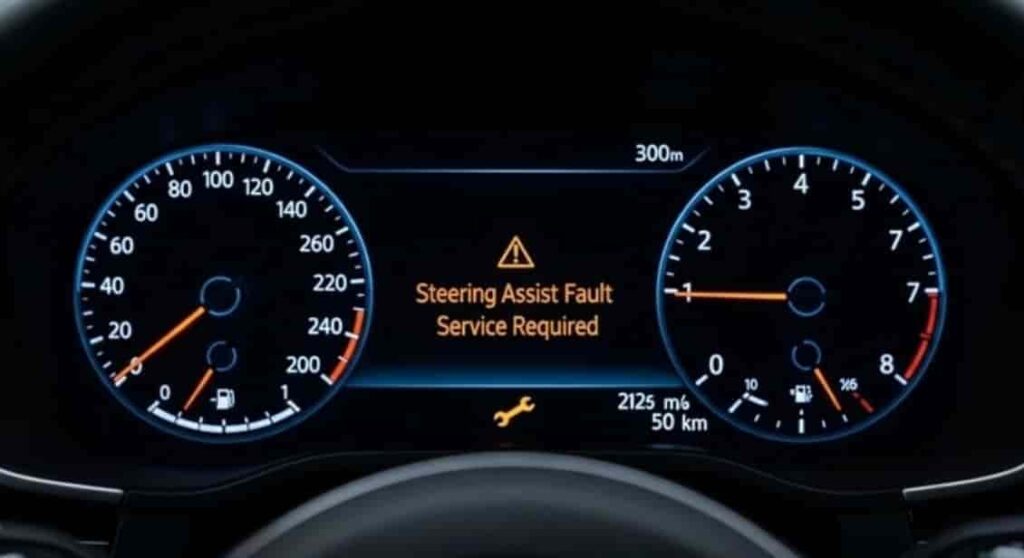
Seeing the warning “Steering Assist Fault Service Required” suddenly appear on your dashboard can be alarming, especially when your steering wheel starts to feel heavier than usual. Many drivers experience this issue without warning, often in the middle of daily commutes or long trips, raising immediate concerns about safety, control, and repair costs.
So what does this message really mean? Is it safe to continue driving, or should you stop immediately? More importantly, how serious is the problem and how much will it cost to fix?
This warning is directly related to your vehicle’s Electric Power Steering system, commonly known as EPS. This system is responsible for making steering smooth and effortless. When it fails or detects abnormal signals, your car alerts you with the message “Steering Assist Fault Service Required” to prevent potential risks.
The problem can range from something minor like a weak battery or temporary software glitch to more serious issues such as a faulty steering motor or control module. Ignoring it may lead to difficult handling and increased danger, especially in tight turns or emergency situations.
In this guide, you will learn the exact causes of the “Steering Assist Fault Service Required” warning, how to fix it step by step, and how to ensure safe driving while dealing with this issue.
Contents
- What Does “Steering Assist Fault Service Required” Mean?
- 7 Common Causes of “Steering Assist Fault Service Required”
- Is It Safe to Drive with “Steering Assist Fault Service Required”?
- How to Fix “Steering Assist Fault Service Required”
- Repair Cost of “Steering Assist Fault Service Required”
- Prevention Tips to Avoid Steering Assist Fault
- Conclusion
What Does “Steering Assist Fault Service Required” Mean?
The warning “Steering Assist Fault Service Required” indicates a problem within your vehicle’s Electric Power Steering system, often referred to as EPS. This system is designed to reduce the effort needed to turn the steering wheel by using an electric motor instead of traditional hydraulic pressure.
Under normal conditions, the EPS system continuously receives data from multiple sensors, including the steering angle sensor and vehicle speed sensor. Based on this data, it calculates how much assistance the driver needs and applies the appropriate level of support. This is why modern cars feel light and responsive when steering, especially at low speeds.
When this warning appears, it means the system has detected an abnormal signal or failure. As a safety measure, the EPS may reduce or completely disable steering assistance. This results in a noticeably heavier steering wheel, which can make the vehicle harder to control, particularly in situations like parking, making sharp turns, or navigating tight spaces.
In some cases, the issue may be temporary, such as a voltage drop or a minor electronic glitch. However, it can also signal more serious problems like sensor failure, wiring issues, or a malfunctioning control module. The key concern is that the system is no longer functioning as intended, which directly impacts driving comfort and safety.
Understanding what this warning means is the first step toward diagnosing the issue and deciding whether you can continue driving or need immediate service.
7 Common Causes of “Steering Assist Fault Service Required”
Understanding the root causes of the “Steering Assist Fault Service Required” warning is essential if you want to fix the issue quickly and avoid unnecessary repair costs. Below are the most common reasons behind this problem.
The first and very common cause is a faulty steering angle sensor. This sensor tells the system how much you are turning the wheel. When it sends incorrect data, the EPS system cannot calculate the right level of assistance, which triggers the warning.
Another frequent issue is low battery voltage. The Electric Power Steering system relies heavily on stable electrical power. If your battery is weak or recently drained, the system may shut down partially or completely.
Blown fuses or damaged wiring can also interrupt communication within the steering system. Even a small electrical fault can prevent the EPS from functioning properly, leading to the warning message.
A more serious cause is EPS motor failure. The motor is responsible for providing steering assistance. When it starts to fail, you may notice a heavy steering wheel along with unusual noises.
ECU malfunction is another possibility. The Electronic Control Unit acts as the brain of the system. If it fails, the entire steering assist function can become unreliable or stop working entirely.
Software glitches can also trigger the warning, especially after a system reset or battery replacement. In these cases, the issue may not be mechanical but still requires recalibration.
Finally, many drivers encounter this warning after replacing the car battery. The system may lose its calibration and require a reset procedure to function normally again.
Each of these causes varies in severity, which is why proper diagnosis is critical before attempting any repair.
Is It Safe to Drive with “Steering Assist Fault Service Required”?
The short answer is no, it is not recommended to continue driving for an extended period when the “Steering Assist Fault Service Required” warning appears. While your car may still be operational, the level of control you have over the steering system is significantly reduced.
When the Electric Power Steering system stops providing assistance, the steering wheel becomes much heavier than normal. This may not seem like a major issue at high speeds on a straight road, but it becomes a serious risk in real driving conditions. Situations such as parking, making sharp turns, navigating crowded streets, or reacting quickly to unexpected obstacles require precise and effortless steering. Without proper assist, your reaction time slows down and the risk of losing control increases.
In some mild cases, you may still be able to drive the vehicle for a short distance. For example, if the warning appears suddenly but the steering is still manageable, you can carefully drive to the nearest repair shop. However, this should only be a temporary solution.
You should stop driving immediately if the steering wheel becomes extremely stiff, if you hear unusual noises, or if the vehicle feels unstable when turning. These are signs that the problem may be more serious and could lead to dangerous situations.
Ultimately, your safety should always come first. Treat this warning as urgent and address it as soon as possible to avoid further complications.
How to Fix “Steering Assist Fault Service Required”
Fixing the “Steering Assist Fault Service Required” warning depends on identifying the exact cause, but there are several practical steps you can take before heading to a repair shop.
Start with a simple restart of your vehicle. Turn off the engine, wait a few minutes, and then start it again. In some cases, this can reset temporary electronic glitches and clear the warning. If the message disappears and does not return, the issue may have been minor.
Next, check your battery condition. Since the Electric Power Steering system depends on stable voltage, a weak or failing battery can trigger the warning. If your car struggles to start or the lights appear dim, it is a strong indication that the battery needs attention.
You should also inspect the fuse box. A blown fuse related to the steering system can interrupt power flow and cause the EPS to stop working. Replacing a fuse is a simple and inexpensive fix, but it can make a big difference.
Using an OBD2 scanner is one of the most effective ways to diagnose the issue. This tool reads error codes stored in your vehicle’s system and helps pinpoint whether the problem is related to sensors, wiring, or the control module.
If the warning appears after replacing the battery, the system may require recalibration. Some vehicles can perform this automatically after driving a short distance, while others may need manual calibration using diagnostic tools.
If none of these steps resolve the issue, it is best to visit a professional mechanic. More complex problems such as a faulty EPS motor or ECU require specialized equipment and expertise to repair safely.
Repair Cost of “Steering Assist Fault Service Required”
The cost of fixing the “Steering Assist Fault Service Required” issue can vary widely depending on the root cause. Some problems are simple and inexpensive to fix, while others can be significantly more costly if major components are involved.
For minor issues, such as a blown fuse or basic system reset, the cost can be very low or even free if you handle it yourself. Replacing a fuse typically costs only a few dollars, making it one of the easiest fixes.
If the problem is related to the battery, you may need to spend between 80 and 200 dollars for a replacement, depending on the type and quality of the battery. This is a common cause and often one of the more affordable solutions.
When it comes to sensors, such as the steering angle sensor, repair costs usually range from 100 to 300 dollars. These components are essential for proper system function, but they are still relatively manageable in terms of pricing.
However, more serious issues can quickly become expensive. Replacing an EPS motor can cost anywhere from 500 to 1500 dollars, depending on the vehicle model. If the problem lies within the Electronic Control Unit, the cost may increase to 800 to 2000 dollars due to the complexity of the system.
To save money, it is important to diagnose the problem early and avoid unnecessary part replacements. Regular maintenance and timely checks can also help prevent costly repairs in the future.
Prevention Tips to Avoid Steering Assist Fault
Preventing the “Steering Assist Fault Service Required” warning is not always possible, but with proper maintenance and good driving habits, you can significantly reduce the risk of encountering this issue.
One of the most important factors is maintaining a healthy battery. Since the Electric Power Steering system depends entirely on electrical power, a weak or unstable battery can easily trigger faults. Regularly check your battery condition, especially if your vehicle is more than two years old or shows signs of slow engine starts.
You should also avoid leaving your car unused for long periods. When a vehicle sits idle, the battery gradually loses charge, which can affect electronic systems including EPS. If you do not drive often, consider starting your car periodically or using a battery maintainer.
Keeping your vehicle’s software up to date is another key step. Modern cars rely heavily on electronic control systems, and manufacturers often release updates to fix bugs or improve performance. Ignoring these updates can lead to unexpected system errors.
Pay attention to early warning signs such as a slightly heavier steering wheel, unusual noises when turning, or intermittent warning lights. These small indicators often appear before a major failure and give you a chance to act early.
Finally, regular inspections by a qualified technician can help detect hidden issues before they become serious. Preventive maintenance is always more affordable and safer than dealing with sudden failures on the road.
Conclusion
The warning “Steering Assist Fault Service Required” is not something you should ignore. While it may sometimes be triggered by minor issues such as low battery voltage or temporary software glitches, it can also indicate more serious problems within your Electric Power Steering system. In all cases, it directly affects your ability to control the vehicle safely.
Throughout this guide, you have learned what this warning means, the most common causes behind it, and the practical steps you can take to fix the issue. From simple solutions like restarting your car or checking the battery to more advanced diagnostics using an OBD2 scanner, early action can save you both time and money.
Most importantly, safety should always be your top priority. Driving with reduced steering assistance increases the risk of accidents, especially in situations that require quick and precise control. If the problem persists or worsens, seeking professional help is the best decision.
Understanding the “Steering Assist Fault Service Required” warning empowers you to respond confidently instead of reacting with uncertainty. The sooner you address the issue, the safer and smoother your driving experience will be.
Have you ever experienced this warning while driving? Identifying the cause early could make all the difference.