The “Service Electronic Brake System” warning means the vehicle has detected a fault in the electronically controlled braking system or a component that supports its operation. The warning does not always mean the vehicle has lost its brakes completely. However, it indicates that functions involving the anti-lock braking system (ABS), electronic parking brake, wheel speed sensors, control modules, or related electrical circuits may not operate as intended.
There are 6 common areas that can trigger a Service Electronic Brake System warning: a faulty wheel speed sensor, low brake fluid or another brake-system problem, low battery voltage, damaged wiring or connectors, an ABS control module fault, and an electronic parking brake malfunction. The exact cause cannot be determined from the dashboard message alone because several components communicate electronically to control braking functions.
The severity of the warning depends on the underlying fault and the symptoms that appear with it. A vehicle with normal braking behavior requires a different response from one with reduced braking performance, an abnormal brake pedal, or a brake fluid leak. This guide explains what the Service Electronic Brake System warning means, what causes it, whether the vehicle is safe to drive, how to diagnose the fault, and which repairs can resolve the warning.
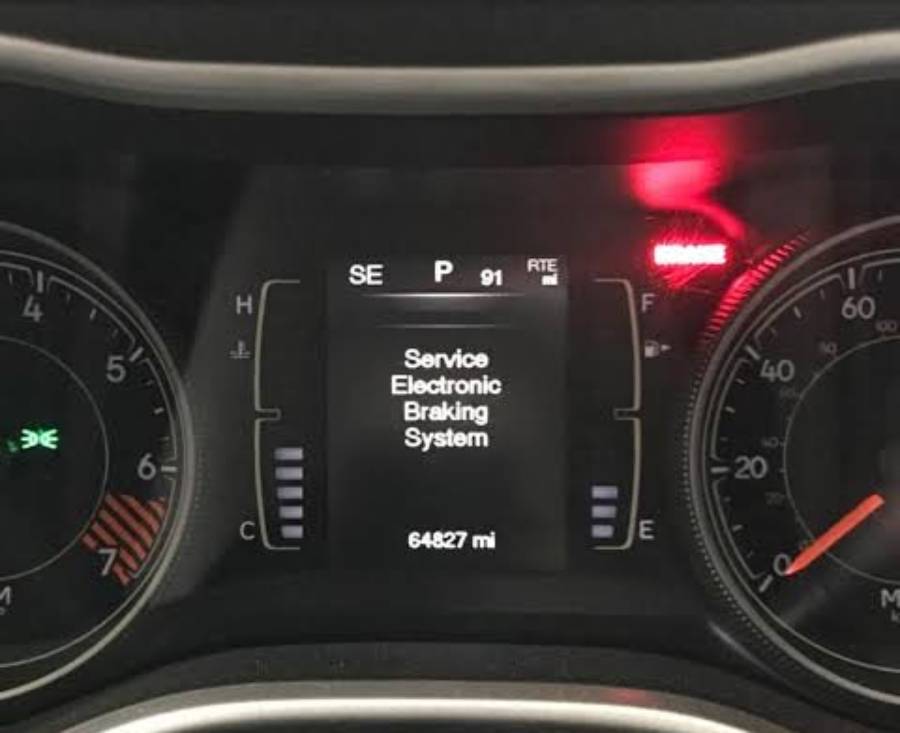
What Does “Service Electronic Brake System” Mean?
The “Service Electronic Brake System” message means the vehicle has detected a fault affecting its electronically controlled braking functions or a component that the braking system relies on. Depending on the vehicle, the electronic brake system can interact with the anti-lock braking system (ABS), electronic parking brake, traction and stability control systems, wheel speed sensors, and one or more control modules. A fault in these components or their electrical circuits can cause the vehicle to display the warning.
The warning does not necessarily mean the vehicle’s mechanical brakes have stopped working. Modern vehicles combine hydraulic braking components with electronic systems that monitor wheel speed, control brake pressure, operate the parking brake, or assist stability functions. A fault can therefore disable an electronic feature while the basic hydraulic brakes continue to operate. For example, a failed wheel speed sensor can prevent the ABS control module from receiving accurate wheel-speed data, potentially disabling ABS or stability-control functions while conventional braking remains available.
The dashboard message alone does not identify which component has failed. The electronic brake system monitors multiple sensors, circuits, and modules, so different faults can produce a similar warning. Related warning lights provide additional diagnostic information. An ABS light appearing with the Service Electronic Brake System message, for example, directs attention toward the ABS and components that supply data to it.
A diagnostic scan is usually required to narrow down the cause. Diagnostic trouble codes (DTCs) stored in the relevant brake or ABS control module can identify the affected system or circuit. However, a trouble code should be treated as a starting point for diagnosis rather than proof that a particular component requires replacement.
What Causes the Service Electronic Brake System Warning?
There are 6 main areas to investigate when the Service Electronic Brake System warning appears: wheel speed sensors, brake-system faults, low system voltage, wiring and connectors, the ABS control module, and the electronic parking brake. The exact cause varies by vehicle because manufacturers use different braking-system designs, modules, sensors, and warning strategies.
A faulty wheel speed sensor can trigger the warning because the electronic braking system needs accurate wheel-speed information to control ABS and related stability functions. Each sensor monitors the rotational speed of a wheel and sends that information to a control module. A damaged sensor, contaminated sensing area, damaged tone ring where applicable, or interrupted sensor circuit can produce missing or implausible wheel-speed data. The vehicle may consequently illuminate the ABS or traction-control light together with the electronic brake warning.
Low brake fluid or another brake-system fault can also activate a brake-related warning. Brake fluid transfers hydraulic pressure from the brake pedal toward the wheel brakes, while the vehicle can monitor fluid level and other braking conditions electronically. Low fluid should not simply be topped off without identifying why the level dropped. Worn brake components can affect reservoir level, while a hydraulic leak represents a more serious condition that requires immediate inspection. Visible fluid leakage, reduced braking performance, or abnormal pedal feel requires more urgent attention than an electronic warning appearing by itself.
A weak battery or low electrical-system voltage can interfere with electronic brake modules because these components require stable electrical power. Low voltage during starting or an electrical supply problem can cause control modules to record faults or communicate incorrectly. This possibility becomes particularly relevant when the brake warning appears alongside several unrelated dashboard warnings. Battery condition and charging-system voltage should therefore be checked before replacing expensive electronic brake components when the symptoms point toward a broader electrical problem.
Damaged wiring and electrical connectors can interrupt communication between sensors, actuators, and control modules. Wheel-area wiring is particularly exposed to water, road debris, vibration, and movement. A broken wire, loose connector, corroded terminal, or damaged harness can create an open circuit, short circuit, excessive resistance, or intermittent signal. Intermittent electrical faults can explain why the Service Electronic Brake System message appears during one drive and disappears during another.
An ABS control module fault is another possible cause because the module processes wheel-speed information and controls anti-lock braking functions. A module-related diagnostic code does not automatically mean the ABS module itself has failed. Loss of power, poor grounding, damaged wiring, communication faults, or sensor problems can prevent a functioning module from operating correctly. Testing its power supply, grounds, communication circuits, and related components helps distinguish an actual module failure from an external electrical fault.
An electronic parking brake fault can trigger the message on vehicles that integrate parking-brake operation with the electronic braking architecture. The system can include a parking-brake switch, electric actuator, wiring, sensors, and a control module. A malfunction can prevent the parking brake from applying or releasing correctly and may generate additional parking-brake messages on the dashboard. Diagnosis should identify whether the problem originates from the actuator, switch, electrical circuit, control system, or another component before parts are replaced.
What Symptoms Can Appear With the Service Electronic Brake System Warning?
The Service Electronic Brake System warning can appear with ABS, brake, traction-control, stability-control, or electronic parking brake warnings, depending on which part of the system has developed a fault. The warning message itself identifies a problem category rather than a specific failed component, so the accompanying symptoms provide important diagnostic information.
An ABS warning light indicates that the anti-lock braking system has detected a fault or has been disabled. The ABS normally helps prevent wheel lock during hard braking by monitoring wheel speed and adjusting brake pressure. A wheel speed sensor fault, damaged sensor wiring, electrical problem, or ABS control fault can therefore cause the ABS light and Service Electronic Brake System message to appear together. Conventional braking may remain available even when the ABS function is unavailable, but the vehicle may not provide the same anti-lock protection during emergency braking.
A brake warning light requires greater attention because it can indicate a condition involving the primary braking system rather than an auxiliary electronic function alone. Depending on the vehicle, the warning may be associated with low brake fluid, the parking brake, or another brake-system fault. Check the vehicle owner’s manual to identify the exact meaning of the brake warning indicator for that make and model. Reduced braking performance, a soft or sinking brake pedal, or visible brake fluid leakage increases the urgency of the warning.
Traction-control or stability-control warnings can appear because these systems share information and components with the electronic braking system. Electronic stability systems use wheel-speed information and selective braking to help control wheel slip and vehicle movement. A failed wheel speed sensor can consequently affect several systems at once, causing ABS, traction-control, stability-control, and electronic brake warnings to appear from a single underlying fault.
An electronic parking brake malfunction can produce symptoms such as a parking brake that does not apply, does not release, or displays its own fault message. Electronic parking brake systems rely on switches, actuators, wiring, and control electronics instead of a purely mechanical handbrake mechanism. The combination of a Service Electronic Brake System warning and abnormal parking-brake operation therefore provides a useful clue about which part of the system requires diagnosis.
Changes in brake pedal feel or braking performance are more important than the warning message alone. A pedal that becomes unusually soft, sinks toward the floor, feels substantially different from normal, or accompanies noticeably reduced braking performance can indicate a more serious braking problem. These symptoms should not be treated as a routine electronic warning because the vehicle’s ability to slow or stop may be affected.
Multiple dashboard warnings appearing at the same time can also indicate an electrical or communication problem rather than several independent component failures. For example, unstable system voltage can affect multiple control modules during the same operating cycle. Diagnostic trouble codes from the affected modules, combined with battery and charging-system testing, help distinguish a common electrical cause from separate faults.
Is It Safe to Drive With the Service Electronic Brake System Warning?
Driving with a Service Electronic Brake System warning is not automatically safe or unsafe; the decision depends on braking performance, accompanying warning lights, and the underlying fault. A warning caused by an unavailable electronic assistance function presents a different level of risk from a hydraulic brake failure. The first priority is therefore to determine whether the vehicle can still brake normally and whether any critical brake symptoms are present.
The vehicle should not be treated as operating normally simply because the brake pedal still works. ABS, stability control, or another electronic braking function may be unavailable even when conventional braking remains functional. This difference becomes particularly important during emergency braking or low-traction conditions, where electronic brake and stability systems are designed to assist vehicle control.
When Should You Stop Driving Immediately?
Stop driving as soon as it is safe to do so when the warning is accompanied by reduced braking performance, an abnormal brake pedal, evidence of brake fluid leakage, or another indication that the primary braking system is compromised. Continuing to drive under these conditions increases the risk that the vehicle will not slow or stop as expected.
A soft or sinking brake pedal, substantially increased stopping distance, or a sudden change in braking response requires immediate attention. Visible fluid around a wheel, underneath the vehicle, or near brake-system components can indicate a hydraulic leak. Smoke, a burning smell from a wheel area, or severe abnormal behavior from the brakes also warrants stopping rather than attempting to continue a normal trip.
Treat a red brake warning more cautiously when it remains illuminated after confirming that the parking brake is fully released. Warning-light meanings vary by manufacturer, so the owner’s manual should be used to interpret the specific indicator. When the warning is accompanied by physical braking symptoms, diagnosis should take priority over driving the vehicle to determine whether the message disappears on its own.
When Can You Drive the Vehicle to a Repair Shop?
A short drive to a repair facility may be reasonable when braking performance remains completely normal, no signs of a hydraulic brake problem are present, and the vehicle manufacturer does not instruct the driver to stop immediately. This situation can occur when a fault disables ABS, a wheel speed sensor, an electronic parking brake function, or another electronically controlled feature without disabling conventional braking.
The vehicle should still be driven cautiously because an electronic safety function may be unavailable. Allow additional following distance, avoid unnecessary high speeds or hard braking, and avoid treating the absence of obvious symptoms as confirmation that the system is functioning correctly. A stored fault can remain relevant even when the warning disappears after restarting the vehicle.
Check the owner’s manual before continuing because the meaning and required response for a Service Electronic Brake System message vary between manufacturers and models. If braking behavior changes while driving to a repair facility, stop driving and arrange appropriate roadside assistance or towing rather than continuing with compromised brakes.
How Do You Diagnose a Service Electronic Brake System Warning?
Diagnose a Service Electronic Brake System warning by checking the basic brake and electrical conditions first, scanning the brake-related control modules for diagnostic trouble codes, and then testing the circuit or component identified by the results. This sequence prevents unnecessary parts replacement because the dashboard warning alone does not identify the failed component.
Start by checking the brake fluid level and visible condition of the braking system. Low fluid deserves further investigation because adding fluid does not identify why the reservoir level dropped. Inspect for visible leakage and pay attention to changes in brake pedal feel or braking performance. A hydraulic problem accompanied by reduced braking ability should be addressed before electronic troubleshooting continues.
Check the battery and charging system when the brake warning appears with several unrelated electrical warnings or after a weak start. Electronic brake modules depend on stable voltage to communicate with sensors and other control units. A weak battery, charging fault, poor electrical connection, or voltage drop can therefore create multiple fault messages. Confirming that the electrical supply is functioning correctly helps prevent misdiagnosing a voltage-related problem as a failed brake module.
Inspect accessible wiring and electrical connectors, especially around wheel speed sensors and other exposed components. Look for broken wires, damaged insulation, loose plugs, corrosion, moisture intrusion, or physical damage. An intermittent connection can cause a warning to appear only under certain conditions, such as after driving over bumps, during wet weather, or when wheel and suspension movement affects a damaged harness.
Next, scan the vehicle for diagnostic trouble codes (DTCs). A basic engine-code reader may not provide access to the ABS, electronic parking brake, or other chassis control modules, so the diagnostic tool must support the relevant systems on the specific vehicle. Record the codes before clearing them because stored and history codes can provide evidence about where the fault occurred.
Use each DTC to determine which circuit or system needs testing rather than which part should automatically be replaced. For example, a wheel speed sensor-related code can result from the sensor itself, its wiring, a connector, or another problem affecting the signal. Comparing wheel-speed data from all four wheels with a capable scan tool can help identify a sensor that reports implausible or missing information.
Professional diagnosis becomes appropriate when the warning involves abnormal braking performance, persistent communication codes, suspected ABS module failure, an electronic parking brake that cannot apply or release correctly, or an intermittent electrical fault that cannot be reproduced through basic inspection. These faults can require manufacturer-specific diagnostic information, bidirectional scan-tool functions, electrical measurements, or component calibration procedures.
How Do You Fix the Service Electronic Brake System Warning?
Fix the Service Electronic Brake System warning by repairing the fault that triggered it, then clearing the stored codes and verifying that the warning does not return. Replacing parts based only on the dashboard message is unreliable because several brake, electrical, and control-system faults can generate similar warnings.
How Do You Fix Sensor and Brake System Problems?
Repair sensor-related faults by confirming whether the problem is in the sensor, its signal source, wiring, or connector before replacing the sensor. For a wheel speed sensor fault, inspect the sensor and its wiring for physical damage and check the associated sensing components where applicable. Diagnostic data can then be used to compare wheel-speed signals and confirm which wheel is producing abnormal information.
Replace a wheel speed sensor when testing confirms that the sensor itself has failed. Repair the wiring or connector instead when the sensor is functional but its signal cannot reach the control module correctly. This distinction matters because installing a new sensor will not correct a broken wire, corroded terminal, damaged connector, or another interruption in the circuit.
Correct a low brake fluid condition only after determining why the level is low. Brake fluid level can change as brake components wear, while a leak can allow hydraulic fluid to escape from the system. Inspect the relevant braking components when the reservoir is unexpectedly low. A confirmed hydraulic leak requires repair rather than repeatedly adding fluid.
Brake-system repairs must also account for symptoms beyond the electronic warning. A soft pedal, fluid leak, abnormal braking response, or reduced stopping performance indicates that the repair process needs to address the physical braking system rather than focusing only on clearing electronic codes.
How Do You Fix Battery, Wiring, and Electrical Problems?
Correct low-voltage faults by testing the battery, charging system, power connections, and grounds before replacing electronic brake components. A weak electrical supply can cause modules to record faults even when the modules themselves are operational. Repairing the voltage problem can therefore resolve several apparently unrelated dashboard warnings at the same time.
A battery that fails appropriate testing should be replaced, while a charging-system fault requires diagnosis of the component or circuit preventing correct charging. Battery terminals and major ground connections should also be inspected for looseness, corrosion, or excessive resistance because a healthy battery cannot provide stable module voltage through a poor electrical connection.
Repair damaged brake-system wiring according to the actual circuit fault. A broken conductor requires restoration of electrical continuity, while a corroded or loose terminal requires connector repair. Harnesses located near the wheels require particular attention because they operate close to moving suspension components and are exposed to water, dirt, road debris, and vibration.
After an electrical repair, scan the affected control modules again and confirm that communication and sensor data have returned to normal. Clearing a code before repairing the circuit may temporarily remove the dashboard warning, but the control module can set the fault again as soon as it detects the same electrical problem.
How Do You Fix ABS Module or Electronic Parking Brake Problems?
Confirm the ABS module’s power supply, grounds, communication circuits, sensors, and related wiring before diagnosing the module itself as defective. A module that cannot receive adequate voltage or communicate through the vehicle network can appear faulty even when its internal electronics remain functional. Module replacement should therefore follow systematic testing rather than being the first response to an ABS-related code.
An ABS module that is confirmed defective may require repair or replacement depending on the vehicle and the type of failure. Some vehicles also require programming, coding, initialization, or calibration after a replacement control module is installed. The exact procedure depends on the manufacturer and braking-system architecture.
Electronic parking brake faults require diagnosis of the switch, actuator, wiring, electrical supply, and control system. For example, an actuator that does not operate could have an internal mechanical or electrical fault, but the same symptom can occur when power does not reach the actuator. Testing the circuit distinguishes these causes before replacement parts are installed.
Electronic parking brake repairs can also require a compatible scan tool for service functions, calibration, or fault clearing. Follow the manufacturer-specific service procedure when the system requires electronic control of actuator position, brake service mode, or initialization. The repair is complete only after normal brake operation is restored, relevant fault codes are addressed, and the Service Electronic Brake System warning no longer returns.
Can You Reset the Service Electronic Brake System Warning?
You can clear a Service Electronic Brake System warning after the underlying fault has been diagnosed and repaired, but resetting the warning does not fix the problem that caused it. If the control module detects the same fault again, the warning and associated diagnostic trouble code can return immediately or after the vehicle completes another self-check.
The correct sequence is to diagnose the fault, repair the affected component or circuit, clear the stored DTCs with a compatible diagnostic scanner when required, and then operate or test the vehicle to confirm that the fault does not return. Some vehicles can remove an inactive warning automatically after the system completes enough successful checks, while others require codes to be cleared with a scan tool. The exact procedure depends on the vehicle manufacturer and control system.
Disconnecting the battery is not a reliable repair method. Removing power may reset certain modules or temporarily remove some warning information, but it does not repair a failed wheel speed sensor, damaged wiring, hydraulic brake problem, ABS module fault, or defective electronic parking brake component. Disconnecting the battery can also affect stored settings or require initialization procedures on some vehicles.
Avoid repeatedly clearing the warning without recording the DTCs first. Stored codes, freeze-frame information where available, and module data provide useful diagnostic evidence. Clearing this information before troubleshooting can make an intermittent fault more difficult to identify.
How Much Does It Cost to Fix a Service Electronic Brake System Warning?
The cost to fix a Service Electronic Brake System warning depends on the component or circuit that caused the fault, so the warning itself does not have one standard repair price. A wiring connection or sensor problem can require a relatively minor repair, while an ABS control module or electronic parking brake failure can require substantially more labor, parts, programming, or calibration.
A wheel speed sensor fault generally involves diagnosis of the sensor, wiring, connector, and related sensing components before replacement. The final cost therefore depends on whether the sensor itself has failed or whether the actual problem is located elsewhere in its circuit. Accessibility and vehicle design also affect labor requirements.
Battery and electrical-supply problems create a separate cost category. The repair may involve a battery, charging-system component, terminal connection, ground, fuse, or damaged circuit. Wiring costs are particularly variable because repairing an accessible damaged connector requires different labor from tracing an intermittent fault through a larger wiring harness.
ABS control module and electronic parking brake repairs can be more expensive because they may involve higher-cost electronic components and additional diagnostic procedures. Certain module replacements also require programming, coding, calibration, or initialization before the vehicle recognizes and operates the new component correctly.
A useful way to compare the potential repairs is:
| Possible cause | Typical repair | Relative repair cost |
|---|---|---|
| Low brake fluid | Diagnose fluid loss and correct the cause | Low to variable |
| Wheel speed sensor fault | Repair circuit or replace sensor | Low to medium |
| Battery or voltage fault | Repair electrical supply or replace failed component | Low to medium |
| Wiring or connector damage | Repair wiring, terminals, or connectors | Variable |
| Electronic parking brake fault | Repair switch, wiring, actuator, or control system | Medium to high |
| ABS control module fault | Diagnose, repair, or replace module | High |
These categories are more useful than assigning one price to the warning because labor rates, parts prices, vehicle design, and the actual failed component vary substantially. A repair estimate should therefore follow diagnosis rather than be based solely on the dashboard message.
How Can You Prevent Electronic Brake System Problems?
Electronic brake system problems cannot all be prevented, but regular brake maintenance, electrical-system care, and early diagnosis can reduce avoidable faults and prevent minor problems from developing into larger repairs. The electronic brake system depends on both mechanical braking components and electronic sensors, wiring, modules, and power supplies.
Maintain the braking system according to the vehicle manufacturer’s service schedule and investigate unexpected changes in brake fluid level. Brake fluid should not be treated as an isolated maintenance item when its level drops unexpectedly because a leak or another brake-system condition may require attention. Changes in brake pedal feel or stopping behavior also deserve inspection even when no electronic warning is present.
Maintain the battery and charging system because stable voltage is necessary for electronic brake modules and sensors to function correctly. Slow starting, recurring low-voltage faults, corroded battery terminals, or multiple unrelated warning lights can indicate an electrical problem that should be addressed before it begins affecting additional vehicle systems.
Inspect wheel-area wiring and connectors when related components are serviced or when an ABS or wheel speed sensor fault occurs. These circuits operate in an exposed environment where moisture, debris, vibration, and suspension movement can damage connectors or wiring. Identifying physical damage early can prevent an intermittent signal problem from becoming a permanent circuit failure.
Diagnose recurring dashboard warnings instead of repeatedly clearing them. A warning that disappears after restarting the vehicle can still leave a stored or history DTC that helps identify an intermittent fault. Recording and diagnosing the code preserves information that may otherwise be lost before the problem becomes easier to reproduce.
What Should You Do When the Service Electronic Brake System Warning Appears?
When the Service Electronic Brake System warning appears, first assess braking performance, then check for critical brake symptoms, perform basic brake and electrical inspections, scan the appropriate control modules, repair the confirmed fault, and verify the repair. This order prioritizes vehicle safety while preventing unnecessary component replacement.
Start by determining whether the brake pedal and stopping performance feel normal. Stop driving when braking is reduced, the pedal behaves abnormally, brake fluid is visibly leaking, or another symptom indicates that the primary braking system may be compromised. Arrange professional assistance or towing when the vehicle cannot be driven safely.
Check basic conditions when braking remains normal. Inspect the brake fluid level, note every related dashboard warning, consider the condition of the battery and charging system, and inspect accessible wiring or connectors for obvious damage. These observations can provide useful context before electronic diagnosis begins.
Scan the ABS, brake, and electronic parking brake modules with a diagnostic tool capable of communicating with the relevant systems. Record the DTCs before clearing them, then use the codes and live data as diagnostic evidence. Test the indicated circuit or component rather than replacing whichever part appears in the code description.
Repair the confirmed cause and clear the applicable fault codes after the repair. Finally, verify normal braking operation and confirm that the warning does not return during the appropriate vehicle or system test. A Service Electronic Brake System warning is resolved when its underlying fault has been corrected, not simply when the dashboard message has been erased.