The “Active Tuned Mass Module Temporarily Unavailable” message means the vehicle cannot currently operate its active tuned mass system as intended. The system is associated with controlling unwanted vibration, so the message indicates that this vibration-control function has become unavailable. However, “temporarily unavailable” does not automatically mean the Active Tuned Mass Module has permanently failed or needs replacement.
The warning can appear when an operating condition prevents the system from functioning correctly. The exact cause must be diagnosed for the specific vehicle rather than assumed from the dashboard message alone. Depending on the vehicle and diagnostic findings, the investigation may involve the 12-volt electrical system, power or ground connections, module communication, wiring, or the Active Tuned Mass Module and its related components. These are diagnostic categories rather than confirmed causes for every vehicle displaying the warning.
The next step is to determine whether the message disappears, repeatedly returns, or appears with other symptoms such as abnormal vibration, electrical warnings, or drivability problems. This guide explains what the Active Tuned Mass Module Temporarily Unavailable message means, the potential causes that should be investigated, whether you can continue driving, and how the warning should be diagnosed and corrected.
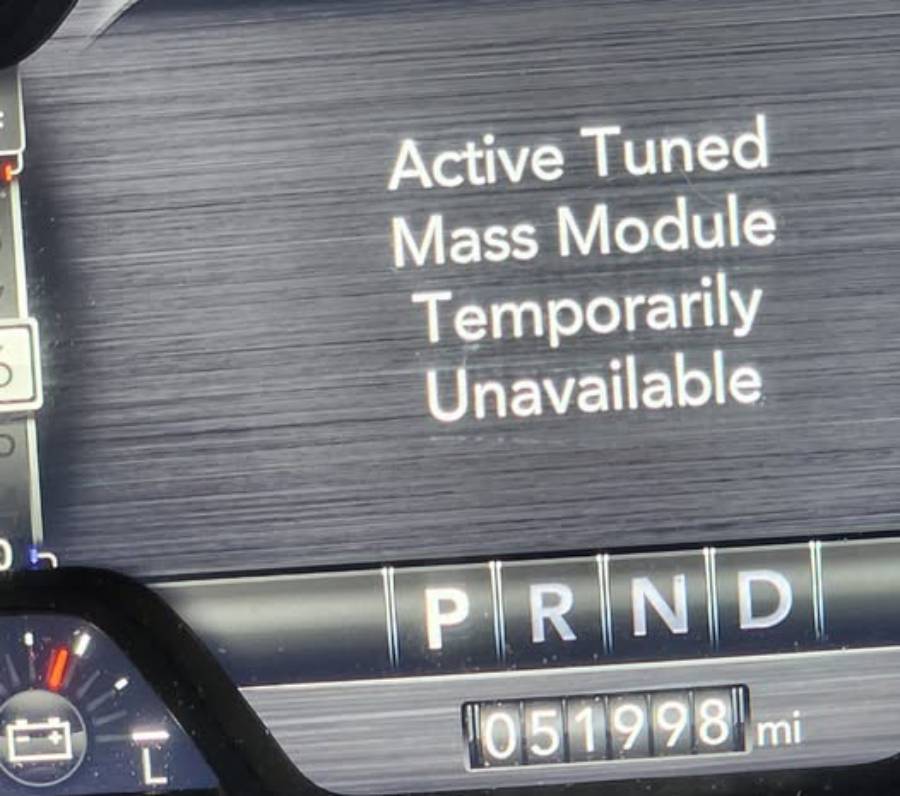
“Active Tuned Mass Module Temporarily Unavailable” means the vehicle has temporarily lost the intended operation of its active tuned mass system. The message describes the availability of the system rather than confirming that the module itself has permanently failed. When the conditions required for normal operation are restored, a temporarily disabled system may become available again. A warning that remains active or repeatedly returns requires further diagnosis to identify the underlying condition.
The Active Tuned Mass Module is associated with managing unwanted vibration in the vehicle. A tuned mass system uses a controlled mass to counter vibration transmitted through the vehicle structure. An active system can adjust its response according to operating conditions instead of relying exclusively on the fixed mechanical characteristics of a passive tuned mass damper. The intended result is less vibration reaching the body and passenger compartment.
When the ATMM becomes unavailable, the vehicle temporarily loses this active vibration-control function. This does not mean every driver will immediately experience severe vibration. The noticeable effect depends on the operating condition, vibration source, and whether the system is unavailable temporarily or because of a persistent fault. The dashboard message therefore identifies the affected function but does not, by itself, identify the component responsible for the condition.
The warning message should also be distinguished from a diagnostic trouble code. A dashboard message communicates the condition to the driver, while diagnostic trouble codes provide technicians with more specific information about faults detected by vehicle control systems. For example, two vehicles could display a similar availability warning while storing different diagnostic information. Reading the relevant DTCs is therefore an important step when the warning persists or returns.
No, “temporarily unavailable” does not by itself mean the Active Tuned Mass Module has failed. It confirms that the system cannot currently perform its intended function, but the dashboard message alone does not establish whether the condition originates inside the module or elsewhere in the system.
There are three conditions that should be distinguished. A temporary unavailable condition occurs when the system cannot operate under the current circumstances but can resume operation after those circumstances disappear. A diagnostic fault means a vehicle control system has detected an abnormal condition and may have stored diagnostic information. A confirmed module failure requires diagnostic evidence showing that the module or a related component is actually defective. Treating all three conditions as the same problem can lead to unnecessary component replacement.
The behavior of the warning provides useful diagnostic context. A message that disappears after the vehicle is restarted and never returns represents a different diagnostic situation from a warning that appears during every drive cycle. A warning accompanied by abnormal vibration, electrical messages, or additional system faults also requires more investigation than an isolated message that disappears and does not return.
For this reason, replacing the Active Tuned Mass Module should not be the first response to the warning. The next step is to determine why the system became unavailable, including whether the condition is associated with its electrical supply, connections, communication with other control systems, or the ATMM hardware itself.
The Active Tuned Mass Module Temporarily Unavailable message can appear when an electrical, communication, or system-specific condition prevents the Active Tuned Mass Module from operating normally. The dashboard message alone does not identify which condition caused the system to become unavailable, so the cause should be determined from diagnostic trouble codes, other warning messages, electrical tests, and vehicle-specific service information.
The first diagnostic category is the 12-volt electrical supply. Electronic control modules require a stable power supply to initialize, communicate, and operate correctly. A weak battery, discharged battery, temporary voltage drop, or charging-system problem can affect electronic systems when available voltage falls outside their required operating range. This relationship makes battery condition and system voltage relevant diagnostic checks when an ATMM warning appears alongside other electrical symptoms. However, low battery voltage should not be treated as the confirmed cause of this specific warning until diagnostic data for the vehicle supports that conclusion.
Wiring and electrical connections are another diagnostic category. The ATMM and related control components depend on power, ground, and signal circuits. A damaged wire, loose connector, poor ground connection, corrosion, or intermittent circuit can interrupt one of these paths. An intermittent connection can also explain why a warning appears during one drive cycle, disappears later, and then returns. The appropriate response is to inspect circuits identified by diagnostic information rather than replace wiring or connectors based on the dashboard message alone.
Communication between electronic control modules can also affect system availability. Modern vehicle functions commonly depend on information exchanged between multiple controllers. When a required message or signal is unavailable, a dependent system may stop operating even though the hardware responsible for the final function has not mechanically failed. Diagnostic trouble codes are important in this situation because they can help distinguish a communication-related condition from a fault located inside the Active Tuned Mass Module itself.
The Active Tuned Mass Module or one of its related components can also be responsible when diagnostic evidence identifies an internal or hardware fault. A persistent module-related DTC, failed electrical test, or manufacturer diagnostic procedure may eventually point to the module, actuator, sensor, or another associated component. Component replacement should follow this evidence rather than the assumption that an ATMM warning automatically means the module needs to be replaced.
There are therefore five useful diagnostic categories to investigate: 12-volt supply conditions, battery or charging-system problems, wiring and connections, control-module communication, and ATMM-related component faults. These categories do not have equal probability on every vehicle. Vehicle model, model year, stored DTCs, warning history, and accompanying symptoms determine which diagnostic path should receive priority.
The timing of the message provides additional context. A warning that appears immediately after a low-voltage event creates a different diagnostic pattern from one that repeatedly appears while the electrical system tests normally. Likewise, an ATMM message accompanied by several electronic-system warnings points toward a different investigation than an isolated ATMM warning accompanied by unusual vibration. Recording when the message appears and which other symptoms occur at the same time can therefore make subsequent diagnosis more precise.
Whether you can continue driving with the Active Tuned Mass Module Temporarily Unavailable warning depends on the warning itself, the vehicle’s behavior, and any additional messages displayed at the same time. An ATMM availability message alone does not establish that the vehicle has a critical mechanical failure. However, the warning should not be ignored when it persists, repeatedly returns, or appears with abnormal vehicle behavior.
The Active Tuned Mass Module is associated with controlling unwanted vibration, so loss of the system’s intended function can affect vibration management. This is different from a failure in a primary system such as braking or steering. The ATMM message therefore needs to be evaluated according to the symptoms and additional faults present rather than treated as proof that the vehicle is immediately unsafe to operate.
A warning that appears once and then disappears without abnormal vibration or other dashboard messages represents a different situation from a persistent warning. In the first case, record when the warning occurred and monitor whether it returns. A recurring message requires diagnosis because repeated loss of system availability indicates that the triggering condition has not been permanently resolved.
Additional warning messages increase the importance of diagnosis. For example, an ATMM warning accompanied by battery, charging-system, or multiple electronic-system messages provides evidence that the problem may extend beyond a single vibration-control function. Likewise, noticeable changes in vehicle behavior should be evaluated separately rather than attributed automatically to the ATMM.
When Should You Stop Driving and Have the Vehicle Checked?
Stop driving or seek prompt professional assessment when the ATMM warning appears with severe new vibration, abnormal vehicle behavior, critical dashboard warnings, or symptoms that make the vehicle difficult to control safely. The additional symptoms matter because the ATMM message alone cannot identify every fault affecting the vehicle.
There are four conditions that justify greater caution: severe or suddenly increased vibration, abnormal drivability, multiple system warnings, and a warning that remains active or repeatedly returns. Severe vibration can indicate a problem that requires diagnosis beyond the ATMM message. Drivability changes require attention because they may involve another vehicle system. Multiple warnings can indicate a broader electrical or communication problem. A persistent ATMM warning indicates that the system has not returned to reliable normal operation.
Do not use the disappearance of the dashboard message as the only proof that the underlying condition has been repaired. An intermittent electrical, communication, or component problem can stop triggering the warning temporarily and then return during a later drive cycle. Recording when the message appears, whether the vehicle was just started, and which other warnings or symptoms occurred can provide useful information for diagnosis.
Follow the vehicle manufacturer’s instructions when the owner’s manual or dashboard provides a specific action for the warning. Vehicle-specific guidance takes priority over a general troubleshooting article because the meaning, operating restrictions, and diagnostic procedures can differ by model and model year.
Fix the Active Tuned Mass Module Temporarily Unavailable warning by identifying and correcting the condition that caused the system to become unavailable. A practical diagnostic sequence starts with restarting the vehicle and checking other warnings, then progresses to the 12-volt electrical system, diagnostic trouble codes, relevant wiring and connections, and manufacturer-specific ATMM diagnosis. Replacing the Active Tuned Mass Module should not be the first step unless testing confirms that the module or an associated component has failed.
Start by turning the vehicle off normally, waiting for the vehicle systems to shut down, and restarting it. This step helps determine whether the warning represents a temporary condition or a persistent problem. Check whether the message disappears immediately, remains displayed, or returns during the same or a later drive cycle. A restart can restore system availability after a temporary condition has ended, but it does not repair an electrical or hardware fault that remains present.
Check the 12-volt battery and charging system when the warning appears with slow starting, battery-related messages, multiple electronic warnings, or other evidence of unstable electrical power. Electronic modules require an adequate and stable supply voltage to initialize and operate. Battery condition, terminal connections, charging performance, and relevant power or ground circuits therefore provide useful diagnostic information. Do not replace the battery solely because the ATMM message appears; verify the electrical condition first.
Check the instrument cluster for other warning messages before focusing exclusively on the Active Tuned Mass Module. Multiple electronic warnings occurring at approximately the same time can provide a diagnostic pattern that an isolated ATMM message cannot. For example, simultaneous battery or charging warnings would justify investigating the electrical supply, while abnormal vibration without broader electrical symptoms creates a different diagnostic direction.
Should You Scan the Vehicle for Diagnostic Trouble Codes?
Yes, scan the vehicle for diagnostic trouble codes when the Active Tuned Mass Module warning persists or repeatedly returns. DTCs can identify the control system that detected the abnormal condition and provide a more precise starting point than the dashboard message alone.
Do not assume that a basic generic OBD-II code reader can access every code relevant to the warning. Vehicles contain multiple electronic control modules, and manufacturer-specific systems may require a scan tool capable of communicating with modules beyond the basic powertrain functions available through generic OBD-II diagnostics. A scan that reports no generic engine codes therefore does not prove that no ATMM-related diagnostic information is stored.
Record the complete DTCs before clearing them. Diagnostic codes, their status, and related vehicle information can help distinguish a current fault from an intermittent or previously detected condition. Clearing codes before recording them removes information that can help identify why the system became unavailable. The diagnostic process should use the retrieved codes to determine which circuit, communication path, or component requires further testing.
Inspect wiring, connectors, power supplies, and grounds when the diagnostic information points toward an electrical circuit. The objective is to verify the affected circuit rather than visually inspect unrelated wiring throughout the vehicle. A loose connection, damaged conductor, poor ground, or intermittent connector problem can interrupt the electrical path required for normal module operation. Repair the verified circuit fault and then confirm that the warning does not return.
Move to manufacturer-specific ATMM diagnosis when the warning remains after basic electrical conditions have been checked or when stored codes identify the Active Tuned Mass Module or its related components. Vehicle-specific service procedures can include circuit tests, communication checks, module tests, calibration procedures, or other diagnostic steps. The required procedure depends on the manufacturer, model, model year, and diagnostic codes present.
Replace the Active Tuned Mass Module only after diagnostic evidence identifies it as the failed component. The warning itself is not sufficient evidence because system availability can depend on electrical supply, communication, wiring, and related components. Following the sequence warning verification → electrical checks → DTC scan → circuit diagnosis → module-specific testing reduces the risk of replacing an expensive component without correcting the actual cause.
Resetting the Active Tuned Mass Module Temporarily Unavailable warning depends on whether the condition that disabled the system has been corrected. A temporary warning may disappear after the triggering condition ends and the vehicle completes a normal restart. A persistent warning requires diagnosis and correction of the underlying fault rather than repeated attempts to clear the message.
Start with a normal vehicle shutdown and restart. Check the instrument cluster after restarting and observe whether the warning remains active. When the message disappears and does not return, the system may have regained availability after a temporary operating condition ended. However, the disappearance of the message does not prove that an intermittent problem has been permanently corrected.
Diagnostic trouble codes should be read before they are cleared when the warning persists or returns. Stored codes provide information about the system or condition that caused the vehicle to register a fault. Clearing them before recording the codes can remove useful diagnostic evidence. A scan tool with access to the relevant manufacturer-specific control systems may be required because a generic OBD-II reader does not necessarily communicate with every vehicle module.
There are three possible outcomes after the warning is cleared or disappears. First, the warning does not return because the temporary condition has ended. Second, the message disappears but returns when the same intermittent condition occurs again. Third, the warning remains active because a current fault continues to prevent normal system operation. The second and third outcomes require diagnosis rather than repeated resetting.
Avoid treating battery disconnection as a universal ATMM reset procedure. Disconnecting the 12-volt battery can affect stored settings, learned values, and other electronic systems, while failing to repair the condition responsible for the warning. Use a manufacturer-specific reset, calibration, or service procedure when the vehicle’s technical information requires one.
Why Does the Active Tuned Mass Module Warning Go Away and Then Come Back?
An Active Tuned Mass Module warning that disappears and later returns indicates that the condition affecting system availability may be intermittent rather than continuously present. The system can regain normal operation when the triggering condition disappears and become unavailable again when that condition returns.
Intermittent electrical conditions provide one diagnostic path. A power supply, ground, connector, or wiring problem does not need to remain faulty continuously. Vehicle movement, temperature changes, electrical load, or another operating condition can alter an intermittent connection. The system may consequently operate normally during one drive cycle and register an unavailable condition during another. The warning pattern alone cannot identify which electrical component is responsible.
Communication problems between vehicle control systems provide another diagnostic path. An electronic function that depends on information from another controller may become unavailable when required communication is interrupted. Normal operation can resume after communication is restored, which creates a warning that appears and disappears without proving that the ATMM hardware itself has failed.
An intermittent condition within the Active Tuned Mass Module or a related component also remains possible when diagnostic evidence points toward that system. The distinction must come from stored DTCs, circuit testing, warning history, and manufacturer-specific diagnostic procedures. Replacing the module based only on a recurring dashboard message skips the evidence needed to distinguish a component failure from an external electrical or communication problem.
Record when the warning appears, how long it remains displayed, whether it occurs during startup or driving, and which other warnings or symptoms occur at the same time. For example, a message that repeatedly appears with other electrical warnings creates a different diagnostic pattern from one accompanied only by a change in vehicle vibration. This information helps a technician reproduce the condition and select the appropriate tests.
A warning that repeatedly disappears should therefore not automatically be considered resolved. The recurrence of the message is itself useful diagnostic evidence. Read and record the relevant DTCs while diagnostic information remains available, then investigate the condition identified by the vehicle’s diagnostic system instead of repeatedly clearing the warning.
How Does an Active Tuned Mass Module Reduce Vehicle Vibration?
An Active Tuned Mass Module reduces unwanted vibration by using controlled mass movement to counter vibration transmitted through the vehicle structure. Instead of allowing all vibration energy to reach the body and passenger compartment, the system creates a response intended to reduce the vibration experienced at targeted operating conditions.
A conventional tuned mass damper uses a mass designed to respond to vibration within a particular frequency range. The movement of that mass opposes the motion of the structure to which it is attached, reducing the resulting vibration. An active tuned mass system adds electronic control, allowing the vibration-control response to be managed according to system inputs and operating conditions.
This explains why the Active Tuned Mass Module Temporarily Unavailable warning concerns system availability rather than necessarily indicating a broader drivability failure. When the active function becomes unavailable, the vehicle loses the vibration-control contribution provided by that system. The resulting effect depends on the vehicle, operating condition, vibration source, and duration of the unavailable state.
The ATMM should therefore be viewed as part of a vibration-management system rather than a component that eliminates every type of vehicle vibration. Tires, wheels, engine operation, driveline components, suspension parts, and road conditions can produce vibration independently of the ATMM. A vibration complaint should be diagnosed according to its frequency, location, operating conditions, and associated faults instead of being attributed automatically to the dashboard warning.
Can the Active Tuned Mass Module Warning Cause More Vehicle Vibration?
The warning message itself does not cause additional vibration, but loss of the Active Tuned Mass Module’s intended vibration-control function can change how much vibration reaches the vehicle body or occupants. This distinction matters because the dashboard message reports a system condition; it is not the physical source of vibration.
A driver may notice a change in vibration when the system is unavailable, particularly under operating conditions where the ATMM would normally contribute to vibration reduction. However, noticeable vibration does not prove that the Active Tuned Mass Module has failed. The vehicle contains several mechanical systems capable of producing vibration, and those sources can exist independently of the ATMM warning.
There are several characteristics worth recording when new vibration occurs: when it begins, where it is felt, whether it changes with vehicle speed or engine speed, and whether it appears at the same time as the ATMM warning. For example, vibration that changes consistently with road speed creates a different diagnostic pattern from vibration associated with engine operating conditions. These observations help separate correlation with the ATMM warning from an unrelated mechanical vibration.
Severe or rapidly increasing vibration requires greater attention regardless of whether the ATMM warning is displayed. Do not assume that the vibration is simply the expected consequence of losing active vibration control. A separate tire, wheel, suspension, driveline, engine, or other mechanical problem may require diagnosis.
How Can You Prevent the Active Tuned Mass Module Warning From Returning?
Prevent the Active Tuned Mass Module warning from returning by correcting the diagnosed condition that caused the system to become unavailable rather than repeatedly clearing the message. There is no single preventive action that applies to every ATMM warning because electrical supply problems, circuit faults, communication conditions, and ATMM-related faults require different repairs.
Maintain the 12-volt electrical system when diagnosis identifies unstable power as a contributing condition. This includes addressing a deteriorated battery, poor terminal connection, charging-system fault, or relevant power and ground problem when testing confirms it. Stable electrical supply is important because electronic control modules depend on adequate power for initialization, communication, and operation.
Repair wiring and connector faults when circuit testing identifies them. An intermittent connection can repeatedly disable a system without producing a permanent warning during every drive cycle. Correcting the verified wiring, connector, power, or ground problem removes the electrical condition instead of temporarily hiding its dashboard symptom.
Investigate recurring DTCs rather than repeatedly clearing them. A code that returns after clearing indicates that the diagnostic system has detected the relevant condition again. Recording the complete code and following the corresponding manufacturer diagnostic procedure provides more value than repeatedly resetting the warning.
Use vehicle-specific service procedures when diagnosis identifies an ATMM-related component, calibration, or control issue. The required repair can differ by manufacturer, model, model year, and stored fault. Preventing recurrence therefore depends on repairing the verified cause rather than applying one universal ATMM reset or replacement procedure.
When Should You Take the Vehicle to a Dealer or Repair Shop?
Take the vehicle to a qualified repair facility when the Active Tuned Mass Module Temporarily Unavailable warning remains active, repeatedly returns, is accompanied by abnormal vibration, or requires diagnostic access beyond the equipment available to you. Professional diagnosis becomes more important when the problem cannot be isolated through basic warning checks and electrical-system evaluation.
The appropriate response can be divided into three levels: monitor, diagnose, and seek prompt service. Monitor the vehicle when the warning appears temporarily, disappears, does not return, and no abnormal symptoms or critical warnings are present. Record the event so that recurrence can be identified instead of assuming the system has been permanently repaired.
Diagnose the vehicle when the warning remains displayed or returns during subsequent drive cycles. At this stage, stored DTCs, electrical measurements, circuit tests, and manufacturer-specific diagnostic information can identify why the system repeatedly loses availability. A repair shop with a scan tool capable of accessing the relevant vehicle modules may be necessary when a generic OBD-II reader cannot retrieve the required information.
Seek prompt professional service when the warning occurs with severe new vibration, abnormal drivability, multiple electrical faults, or critical dashboard warnings. These symptoms can indicate a condition extending beyond the Active Tuned Mass Module itself. Diagnose the complete symptom pattern rather than assuming every warning originates from one component.
A dealer may be appropriate when diagnosis requires manufacturer-specific software, programming, calibration, technical service information, or module-level procedures. An independent repair facility can also be appropriate when it has the required diagnostic equipment and vehicle-specific information. The important requirement is access to the systems necessary to identify the fault before replacing parts.
Do not replace the Active Tuned Mass Module solely because the dashboard says it is temporarily unavailable. Confirm the cause through diagnostic evidence first. This approach separates a temporary availability condition from an electrical problem, communication fault, related-component problem, or confirmed ATMM failure and reduces the risk of replacing a functioning component.