The main difference between the Lexus TX and Toyota Grand Highlander is their positioning: the Grand Highlander prioritizes value and family practicality, while the TX adds a more premium interior, luxury-focused features, and distinct powertrain options at a higher price. The two three-row SUVs are closely related and share the GA-K vehicle architecture, but Lexus and Toyota target different buyers with their equipment, driving experience, and pricing.
The Lexus TX is positioned as the luxury choice, with the TX 350, TX 500h, and plug-in-hybrid TX 550h+ providing different levels of performance and electrification. The Toyota Grand Highlander takes a more value-focused approach with gasoline, Hybrid, and Hybrid MAX powertrains while retaining three-row seating and substantial cargo capacity for family use.
Choosing between them therefore requires more than comparing their badges. Price differences need to be weighed against power, fuel economy, passenger and cargo space, interior quality, technology, safety equipment, towing capability, and expected ownership costs. This Lexus TX vs Grand Highlander comparison examines those differences individually to determine what the Lexus premium buys and which SUV provides better value for different types of buyers.
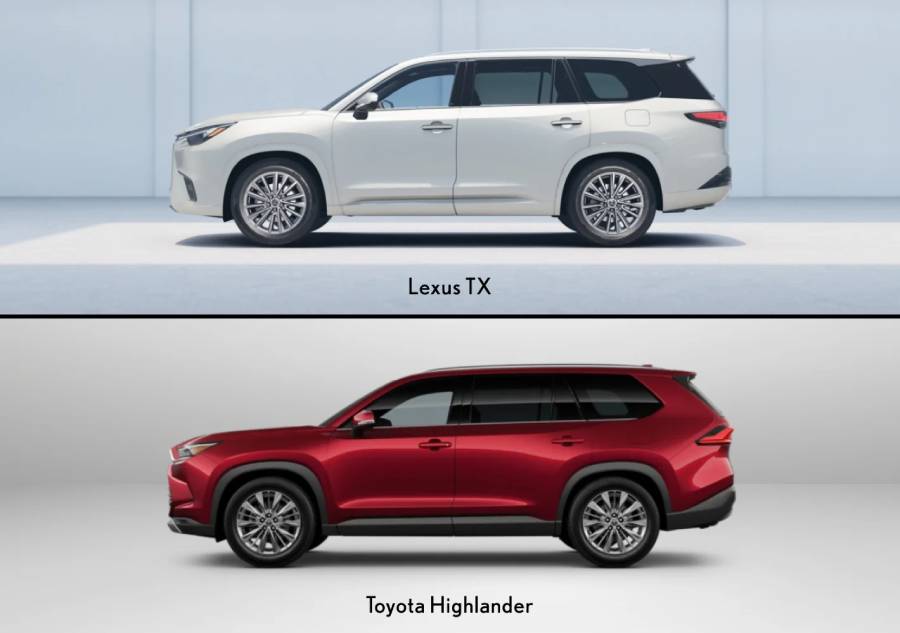
What Are the Main Differences Between the Lexus TX and Toyota Grand Highlander?
The main differences between the Lexus TX and Toyota Grand Highlander are price, luxury level, powertrain choices, interior refinement, technology, and overall ownership experience. Both are three-row SUVs built on Toyota’s GA-K architecture, so they have similar proportions and family-oriented packaging. The Grand Highlander is positioned as the value-focused Toyota, while the TX uses the shared architecture as the basis for a more premium Lexus product.
The powertrain lineups also separate the two SUVs. The Lexus TX lineup includes the TX 350, TX 500h, and TX 550h+, covering turbocharged gasoline, performance-oriented hybrid, and plug-in-hybrid configurations. The Grand Highlander offers gasoline, conventional Hybrid, and Hybrid MAX configurations. This gives both models multiple levels of performance and efficiency, but the TX 550h+ adds a plug-in-hybrid option that changes how buyers can use electric driving for shorter daily trips.
Interior execution is another major distinction. The TX applies Lexus-specific materials, styling, comfort features, and luxury positioning to its cabin, while the Grand Highlander concentrates on usable passenger space, cargo capacity, and family-oriented value. The difference is therefore not simply that one SUV carries a Lexus badge. Buyers are paying for a different combination of refinement, equipment, powertrain availability, and premium positioning.
| Comparison | Lexus TX | Toyota Grand Highlander |
|---|---|---|
| Brand positioning | Luxury | Mainstream |
| Vehicle type | Three-row SUV | Three-row SUV |
| Architecture | GA-K | GA-K |
| Gasoline option | TX 350 | Available |
| Hybrid option | TX 500h | Hybrid / Hybrid MAX |
| Plug-in hybrid | TX 550h+ | Not offered |
| Primary advantage | Luxury and refinement | Value and practicality |
| Typical buyer priority | Premium experience | Family utility per dollar |
This shared-platform relationship is important when comparing value. The Grand Highlander already provides many of the fundamental qualities buyers expect from this vehicle format, including three rows and substantial interior utility. The central question is therefore whether the TX’s additional refinement, equipment, and powertrain choices justify its higher purchase price.
How Much More Does the Lexus TX Cost Than the Toyota Grand Highlander?
The Lexus TX costs substantially more than the Toyota Grand Highlander because Lexus positions it in the premium three-row SUV segment rather than the mainstream family-SUV segment. The exact price difference depends on model year, trim, drivetrain, and powertrain, so the most accurate comparison pairs equivalent configurations instead of comparing the least expensive Grand Highlander with the most expensive TX.
The price gap also changes as buyers move through the respective lineups. A gasoline TX 350 should be evaluated against a comparable gasoline Grand Highlander, while the TX 500h is more meaningfully compared with the performance-oriented Grand Highlander Hybrid MAX. The TX 550h+ requires separate consideration because the Grand Highlander lineup does not provide a direct plug-in-hybrid counterpart. Comparing powertrains this way prevents the MSRP difference from being presented without its mechanical context.
The additional cost of the Lexus TX primarily pays for premium cabin execution, Lexus-specific equipment and tuning, and access to powertrain configurations not duplicated exactly in the Grand Highlander lineup. Interior materials and comfort are particularly important because both SUVs already provide a similar fundamental three-row format. Buyers are therefore not paying the Lexus premium simply to gain an additional row of seats or move into an entirely different vehicle size class.
Value depends on how much the buyer uses those upgrades. A family primarily concerned with three-row passenger capacity, cargo utility, and purchase price has less reason to pay the TX premium. A buyer who places greater value on cabin refinement, luxury equipment, a premium ownership experience, or the TX 550h+ plug-in-hybrid powertrain has stronger reasons to move to the Lexus. The later comparisons of interior, performance, technology, and ownership costs determine whether those advantages are large enough to justify the price difference for each buyer.
What Engines and Powertrains Do the Lexus TX and Grand Highlander Offer?
The Lexus TX has three distinct powertrain choices—gasoline, hybrid, and plug-in hybrid—while the Toyota Grand Highlander offers gasoline and two hybrid configurations. This is one of the clearest mechanical differences between the two SUVs because buyers can choose between efficiency and performance at different points in each lineup.
The Lexus lineup consists of the TX 350, TX 500h, and TX 550h+. The TX 350 uses a turbocharged gasoline engine and serves as the conventional entry point to the range. The TX 500h combines turbocharged gasoline and electric power in a performance-oriented hybrid system. The TX 550h+ takes a different approach by using a plug-in-hybrid system that allows the battery to be charged externally and enables electric-only driving for part of a trip.
The Grand Highlander lineup follows a similar hierarchy without a plug-in hybrid. Its gasoline powertrain provides the conventional option, while the Grand Highlander Hybrid prioritizes fuel efficiency. Hybrid MAX combines a turbocharged engine with electric assistance and targets buyers who want substantially more output than the standard Hybrid provides.
| Powertrain type | Lexus TX | Toyota Grand Highlander |
|---|---|---|
| Gasoline | TX 350 | Gas model |
| Efficiency-focused hybrid | — | Grand Highlander Hybrid |
| Performance hybrid | TX 500h | Grand Highlander Hybrid MAX |
| Plug-in hybrid | TX 550h+ | Not available |
| Electric-only driving capability | TX 550h+ | Not available as a PHEV |
The most important distinction is the TX 550h+. The Grand Highlander has no direct equivalent to the Lexus TX plug-in hybrid. Buyers who want a three-row vehicle from this closely related Toyota-Lexus family with externally rechargeable battery power must therefore look to the TX rather than the Grand Highlander. Conversely, buyers primarily seeking conventional hybrid efficiency have a dedicated option in the Grand Highlander Hybrid.
Which Is More Powerful, the Lexus TX or Toyota Grand Highlander?
Neither the Lexus TX nor Grand Highlander is universally more powerful because output depends on the powertrain being compared. The relevant comparison is between corresponding gasoline and hybrid configurations rather than between the two nameplates as a whole.
At the performance end, both manufacturers offer electrified powertrains designed to deliver considerably more output than their conventional configurations. The TX 500h is the Lexus performance-hybrid choice, while Hybrid MAX serves that role in the Grand Highlander lineup. The TX 550h+ adds another performance level while combining its gasoline engine with a larger rechargeable battery and electric motors.
Horsepower also needs to be interpreted alongside drivetrain and power delivery. A higher-output electrified system can provide stronger acceleration and more immediate response because electric motors deliver torque differently from an internal-combustion engine alone. This matters when merging onto a highway, passing at speed, climbing grades, or accelerating with passengers and cargo onboard.
The lower-output configurations serve a different purpose. Buyers using either SUV primarily for commuting, school runs, and routine family transportation do not necessarily benefit enough from maximum horsepower to justify a more expensive powertrain. Performance should therefore be compared against price and fuel consumption rather than treated as an isolated measure of which SUV is better.
For the published article, horsepower and torque figures should be presented in a single model-year-specific table. This prevents specifications from different model years or discontinued configurations from being combined into one comparison.
Which Gets Better Gas Mileage, the Lexus TX or Grand Highlander?
The Toyota Grand Highlander Hybrid is the efficiency-focused choice between the two lineups for buyers who want a conventional hybrid, while the Lexus TX 550h+ approaches efficiency differently through plug-in-hybrid technology. The correct comparison depends on whether the buyer wants gasoline, conventional hybrid, performance hybrid, or plug-in-hybrid operation.
The Grand Highlander Hybrid is engineered around reducing fuel consumption rather than maximizing performance. Its hybrid system can recover energy during deceleration and use electric assistance to reduce the amount of gasoline required during everyday driving. This makes it particularly relevant for buyers who cover substantial mileage but do not want to plug their vehicle into an external charging source.
Performance-oriented hybrids create a different trade-off. The Lexus TX 500h and Grand Highlander Hybrid MAX use electrification partly to increase performance, so they should not be evaluated solely against an efficiency-focused hybrid. Their additional output can be valuable for acceleration and loaded driving, but maximum fuel economy is not their only design objective.
The TX 550h+ changes the comparison because a plug-in hybrid can complete part of a driver’s routine using externally supplied electricity instead of gasoline. Its real-world gasoline consumption therefore depends heavily on charging behavior and trip length. A driver who charges regularly and makes shorter daily trips can use the system differently from someone who rarely plugs in and routinely drives beyond the available electric range.
EPA figures should consequently be compared within equivalent powertrain categories. Gasoline should be compared with gasoline, conventional hybrid with the closest conventional hybrid, and performance hybrids with each other. The TX 550h+ should be shown separately with its electric range and applicable efficiency measurements. This produces a more useful comparison than naming one model the fuel-economy winner without accounting for how its powertrain operates.
Is the Lexus TX Bigger Than the Toyota Grand Highlander?
The Lexus TX is slightly longer than the Toyota Grand Highlander, but the two SUVs are very similar in overall size because they share the GA-K architecture. Both are designed as large three-row crossovers with a long wheelbase that prioritizes passenger and cargo space rather than compact exterior dimensions.
The difference in exterior length does not place the TX in an entirely different size category. Width, height, and wheelbase remain close between the two vehicles, which explains why their basic cabin proportions are similar. Lexus uses different exterior styling, body details, and packaging around the shared architecture rather than creating a substantially larger vehicle.
The similar footprint also produces similar considerations in everyday use. Both vehicles require more parking space than smaller two-row crossovers, while their long wheelbases help create usable space for three seating rows. A small difference in overall length matters less to most buyers than how efficiently each manufacturer uses that footprint for passengers and luggage.
Exact dimensions should be compared using the same model year because specifications can vary by configuration. The final comparison table should include overall length, width, height, and wheelbase in both inches and millimeters where useful. This allows readers to see the actual size difference instead of relying on descriptions such as “larger” or “slightly smaller.”
Which Has More Passenger Space, the Lexus TX or Grand Highlander?
The Lexus TX and Toyota Grand Highlander provide similar overall passenger packaging, but seating capacity and configuration can differ depending on trim and second-row layout. Both vehicles are designed to make the third row a functional part of the cabin rather than treating it exclusively as occasional emergency seating.
Second-row configuration is one of the practical differences buyers need to check. Depending on configuration, a bench seat increases maximum passenger capacity, while captain’s chairs reduce the number of seating positions but provide greater separation between passengers and easier access to the third row. This trade-off matters for families deciding between maximum seating capacity and second-row comfort.
Third-row space is particularly important because both vehicles compete as family-oriented three-row SUVs. Legroom and headroom should be evaluated separately rather than assuming that similar exterior dimensions produce identical passenger space. A usable third row allows older children or adults to sit more comfortably on longer journeys, while limited legroom can turn the third row into a space primarily suited to smaller passengers.
Passenger-space specifications also need context. An extra inch of legroom is more meaningful when it changes seating comfort or third-row usability than when it merely produces a larger number on a specification sheet. Seat shape, floor height, second-row adjustment, and access to the rear seats all influence how useful the available dimensions are in daily family use.
For buyers who regularly carry six or seven occupants, seating configuration should therefore be checked before luxury equipment or cosmetic differences. Buyers who use the third row only occasionally can place greater weight on second-row comfort, while larger families should prioritize maximum seating capacity and third-row accessibility.
Which Has More Cargo Space, the Lexus TX or Grand Highlander?
The Lexus TX and Toyota Grand Highlander both provide substantial cargo capacity, but the most useful measurement is the space available behind the third row rather than maximum cargo volume alone. Families often need luggage, groceries, backpacks, or strollers in the cargo area while all three seating rows remain occupied.
Cargo capacity should be compared in three configurations: behind the third row, behind the second row, and with the rear seating areas folded for maximum capacity. The first measurement represents normal three-row family use. The second shows how much space becomes available when the third row is not needed, while maximum capacity indicates whether the SUV can handle larger loads when passenger capacity is temporarily sacrificed.
The shared architecture helps explain why neither model has a fundamentally different cargo-space concept. Both use their long bodies and relatively upright rear sections to preserve luggage room behind the third row. Differences in interior trim, seat mechanisms, and cargo-area design can nevertheless change the final usable volume.
Cargo shape also matters alongside cubic-foot measurements. A broad, relatively flat loading area makes bulky items easier to position, while folding the second and third rows expands the vehicle’s usefulness for furniture, recreational equipment, or other large objects. Buyers who regularly travel with every seat occupied should pay particular attention to behind-third-row capacity because maximum cargo volume does not represent that use case.
Cargo space is unlikely to be the sole reason to pay the Lexus premium if the Grand Highlander already meets the buyer’s passenger and luggage requirements. The TX becomes more compelling when similar fundamental practicality is combined with the luxury, comfort, technology, or powertrain advantages that the buyer values. This distinction is central to the overall comparison: the Grand Highlander emphasizes practical utility for the money, while the TX builds a more premium experience around a closely related three-row format.
How Is the Lexus TX Interior Different From the Grand Highlander?
The Lexus TX has a more luxury-focused interior than the Toyota Grand Highlander, while the Grand Highlander prioritizes family practicality and value. The difference is not primarily cabin size because the two SUVs use closely related vehicle architecture. Lexus instead differentiates the TX through cabin presentation, materials, comfort equipment, and the overall level of refinement expected from a luxury-brand three-row SUV.
Materials are one of the clearest distinctions. The TX uses Lexus-specific upholstery, trim, dashboard treatments, and interior detailing to create a more premium environment. The Grand Highlander also offers higher-grade materials as buyers move through its trim range, but its cabin remains positioned around the requirements of a mainstream family SUV. This distinction becomes more relevant when comparing a well-equipped Grand Highlander with an equivalent TX because the Toyota can narrow the equipment gap without adopting the Lexus’s full luxury positioning.
Comfort follows the same pattern. Both SUVs can provide family-friendly features such as multi-zone climate control, configurable second-row seating, heated or ventilated seats depending on trim, and numerous storage areas. The TX places greater emphasis on how these features are integrated into the cabin and how the vehicle isolates passengers from the driving environment. The result is a cabin intended to feel more premium rather than simply provide a longer list of equipment.
The difference matters most to buyers who spend substantial time in the vehicle. A family using its SUV for long highway trips may place greater value on seat comfort, cabin refinement, and reduced fatigue than a buyer primarily making short local journeys. Conversely, buyers who need three usable rows and substantial cargo capacity but place less value on luxury materials can obtain the fundamental family utility from the Grand Highlander without moving to the Lexus.
The TX’s interior is therefore one of the strongest reasons to pay the Lexus premium, but only when cabin refinement is a purchasing priority. Buyers focused primarily on space per dollar will find the Grand Highlander’s closely related packaging more important than the TX’s premium cabin treatment.
Which Has Better Technology, the Lexus TX or Grand Highlander?
The Lexus TX provides a more premium technology experience, but the Toyota Grand Highlander includes many of the connectivity and infotainment functions most buyers use every day. The meaningful difference is therefore found in specific standard and optional equipment rather than assuming every Lexus technology feature is unavailable in the Toyota.
Both vehicles offer modern touchscreen-based infotainment and smartphone connectivity. Features such as Apple CarPlay and Android Auto reduce the practical difference between their native infotainment systems because drivers can access navigation, music, calls, and compatible apps through a familiar phone interface. USB connectivity and charging options are also particularly important in a three-row SUV because multiple passengers may need to power devices simultaneously.
Higher trims introduce more meaningful differences. Premium audio systems, digital displays, camera systems, driver information features, convenience technology, and other equipment can vary by model and trim. A feature that is standard on one TX configuration may require a higher trim or package on the Grand Highlander, so technology comparisons should account for the price required to obtain equivalent equipment rather than simply marking features as available.
This distinction affects value. A technology feature creates a Lexus advantage when it is unavailable on the Grand Highlander, functions materially better in the TX, or is included at a configuration where the Toyota requires additional spending. Features available on both vehicles provide much less justification for the Lexus price premium.
Buyers should consequently compare the specific TX and Grand Highlander trims they intend to purchase. Comparing the entire model ranges can exaggerate differences because an entry-level configuration from one vehicle and a fully equipped configuration from the other represent different price points and equipment levels.
Which Is Safer, the Lexus TX or Toyota Grand Highlander?
The Lexus TX and Toyota Grand Highlander both provide extensive active-safety and driver-assistance technology, but neither should be declared safer solely because it has more listed electronic features. A meaningful safety comparison requires three types of evidence: standard driver-assistance equipment, independent crash-test performance, and differences between specific model-year configurations.
Both Lexus and Toyota package multiple driver-assistance functions into their respective safety systems. Depending on model year and configuration, these systems can include technologies designed to assist with collision avoidance, lane positioning, highway driving, and vehicle awareness. These features reduce specific driving risks, but availability and functionality should be checked against the exact model year being compared.
Crashworthiness requires separate evidence. Ratings from organizations such as the IIHS and NHTSA evaluate aspects of vehicle protection that cannot be inferred from an infotainment feature list or brand positioning. Results should only be compared when both vehicles have applicable tests under the same or sufficiently comparable testing protocols. A newer or missing test result does not prove that one vehicle provides less protection.
Vehicle size also does not establish a winner because the TX and Grand Highlander have closely related dimensions and architecture. Safety outcomes depend on structural performance, restraint systems, crash circumstances, and active-safety technology rather than exterior dimensions alone.
For a buyer, the useful question is whether either SUV lacks a safety feature or demonstrated crash-performance characteristic that matters to the intended use. If both satisfy those requirements, safety becomes less decisive than price, powertrain, interior refinement, and ownership costs. The final published comparison should therefore use model-year-specific IIHS, NHTSA, Lexus, and Toyota data before assigning either SUV a measurable safety advantage.
Which Can Tow More, the Lexus TX or Toyota Grand Highlander?
The Lexus TX and Toyota Grand Highlander have closely matched towing capability in properly equipped configurations, so towing is not a major reason to choose one over the other. Maximum capacity depends on powertrain, drivetrain, equipment, and model year rather than the Lexus or Toyota badge alone.
For buyers, maximum towing capacity should be treated as a configuration-specific specification. A vehicle’s highest advertised rating does not mean every trim can tow the same amount. The applicable rating needs to match the exact engine, hybrid system, drivetrain, and towing equipment on the vehicle being purchased.
The practical requirement also matters more than winning the specification comparison. A family towing a small utility trailer has different requirements from one towing a loaded recreational trailer. Trailer weight, passengers, cargo, and tongue weight all affect how much capacity remains available, so buyers should maintain an appropriate margin below the vehicle’s applicable limits rather than selecting a vehicle based solely on its headline maximum.
Because the TX and Grand Highlander are closely related in their underlying architecture and both offer configurations intended to support towing, buyers who remain within the capabilities of both vehicles should use price, powertrain, comfort, and equipment as stronger deciding factors. The final published article should list towing ratings for the exact model year and configuration being compared rather than applying one maximum figure to every version.
Are the Lexus TX and Toyota Grand Highlander Built on the Same Platform?
Yes. The Lexus TX and Toyota Grand Highlander are built on Toyota’s GA-K architecture, which helps explain their similar size, three-row packaging, and mechanical relationship. Sharing an architecture does not mean the TX is simply a Grand Highlander with Lexus badges because a platform establishes underlying engineering parameters rather than every characteristic of the finished vehicle.
GA-K is a unibody architecture used for multiple Toyota and Lexus vehicles. For the TX and Grand Highlander, the shared foundation allows both manufacturers to create long-wheelbase three-row SUVs with substantial passenger and cargo space. This relationship is visible in their similar proportions and in parts of their powertrain strategies.
Lexus differentiates the TX after that common foundation through model-specific design, equipment, cabin treatment, powertrain availability, and luxury positioning. These changes matter because vehicle character is determined by more than the basic architecture. Interior execution, sound insulation, suspension and powertrain calibration, feature packaging, and other model-specific decisions can produce different ownership experiences even when two vehicles share structural origins.
The shared platform strengthens the Grand Highlander’s value proposition because buyers can obtain similar fundamental three-row packaging without paying for Lexus luxury positioning. It also benefits the TX because Lexus can start with a practical family-SUV architecture and concentrate its differentiation on refinement, equipment, and premium features. The platform relationship therefore explains both why the vehicles are similar and why the price difference requires closer examination.
Is the Lexus TX More Reliable Than the Toyota Grand Highlander?
There is not enough long-term evidence to state that the Lexus TX is inherently more reliable than the Toyota Grand Highlander solely because it is a Lexus. Both nameplates are relatively recent compared with long-established models, and their multiple gasoline, hybrid, and plug-in-hybrid configurations make a single model-wide reliability conclusion less useful.
The shared GA-K architecture provides mechanical commonality, but reliability depends on more than the platform. Engines, hybrid components, electrical systems, model-specific equipment, software, and other components can create different failure patterns. The TX 350, TX 500h, and TX 550h+ should therefore not automatically receive the same reliability expectation because their powertrains differ substantially.
Powertrain complexity is especially relevant when evaluating long-term ownership. A conventional gasoline system, traditional hybrid, performance hybrid, and plug-in hybrid contain different combinations of engines, electric motors, batteries, charging hardware, and control systems. Greater complexity does not prove that a configuration will be unreliable, but it changes the components that may require diagnosis, maintenance, or repair during ownership.
Warranty coverage can reduce some financial risk during the applicable period, but warranty length is not a reliability measurement. Reliability should be evaluated using model-year-specific owner data, recall information, technical service information, and long-term evidence as those records develop. Brand reputation can provide context, but it should not replace evidence for the specific TX or Grand Highlander configuration being considered.
Is the Lexus TX More Expensive to Maintain Than the Grand Highlander?
The Lexus TX is likely to carry higher overall ownership expenses in several areas, but the exact maintenance difference depends on powertrain, service requirements, mileage, and where the vehicle is serviced. Purchase price alone does not determine long-term cost, so buyers should evaluate scheduled maintenance, repairs, tires, insurance, fuel or electricity, depreciation, and financing together.
Some routine service requirements can be similar because the vehicles come from related Toyota and Lexus engineering families. However, a luxury vehicle can introduce higher costs through premium components, larger or more expensive wheel-and-tire combinations, specialized equipment, and dealer service pricing. The actual difference needs to be calculated for comparable configurations rather than assuming every TX service visit will cost a fixed percentage more.
Powertrain choice can produce a larger ownership-cost difference than the badge itself. A Grand Highlander Hybrid buyer has different fuel and maintenance considerations from a TX 550h+ owner who regularly charges at home. Likewise, comparing a gasoline Grand Highlander with a performance-oriented TX 500h combines differences in purchase price, fuel use, equipment, and mechanical configuration.
Depreciation and insurance also belong in the ownership calculation even though they are not routine maintenance expenses. A higher initial vehicle value can affect insurance premiums and the absolute amount of money lost through depreciation. Conversely, resale value can offset part of that cost if the vehicle retains a stronger percentage of its original price.
The Grand Highlander is the stronger choice when minimizing acquisition and ownership costs is the priority, while the TX asks buyers to accept a higher-cost luxury proposition in exchange for additional refinement and equipment. The final decision should therefore consider total ownership value rather than asking whether an oil change or individual scheduled service costs more on one vehicle.
Should You Buy the Lexus TX or Toyota Grand Highlander?
Buy the Lexus TX if luxury, cabin refinement, premium features, and access to its specific powertrains matter enough to justify a higher price. Buy the Toyota Grand Highlander if three-row practicality, passenger and cargo space, and overall value are the priorities. Their shared architecture gives the two SUVs similar fundamental packaging, so the decision depends less on basic family utility and more on how much a buyer values the upgrades Lexus adds to the TX.
The Grand Highlander makes the stronger value argument. It provides three-row seating, substantial cargo utility, gasoline and hybrid choices, modern technology, and family-focused packaging without requiring buyers to move into a luxury price bracket. For households primarily concerned with transporting passengers, luggage, and everyday family gear, these characteristics address the central reasons for buying a large three-row SUV.
The TX makes a different argument. Lexus takes a closely related foundation and adds a more premium cabin environment, luxury-oriented equipment, model-specific tuning and powertrain choices, including the TX 550h+ plug-in hybrid. These differences become more valuable when the vehicle is used frequently for long trips or when comfort and refinement carry substantial weight in the purchase decision.
Price remains the central trade-off. Buyers should compare equivalent configurations rather than asking whether the TX as a whole is better than the Grand Highlander. A feature or performance advantage only justifies the Lexus premium when the buyer actually values and uses it.
Who Should Buy the Lexus TX?
The Lexus TX is the better choice for buyers who prioritize 4 attributes: luxury, refinement, premium equipment, and access to Lexus-specific powertrain configurations. It retains the practical three-row format of the closely related Grand Highlander while moving the ownership proposition toward the luxury SUV segment.
Cabin quality provides one of the strongest reasons to choose it. Buyers who spend several hours per week in their vehicle are more likely to benefit from improvements in seating, materials, cabin presentation, comfort equipment, and overall refinement. These attributes have greater everyday value for a long-distance commuter or family taking frequent road trips than for someone using the SUV primarily for short local journeys.
Powertrain choice can provide another reason. The TX 550h+ is particularly relevant because the Grand Highlander does not offer a direct plug-in-hybrid equivalent. Buyers specifically seeking externally rechargeable electrification within this Toyota-Lexus three-row vehicle family therefore have a reason to select the TX that goes beyond luxury branding.
Choose the TX when these differences solve an actual requirement. Paying more solely for the Lexus badge creates a weaker value case because the Grand Highlander already supplies much of the underlying passenger and cargo practicality.
Read more: Lexus Shift Lock Override Button Facts You Should Know
Who Should Buy the Toyota Grand Highlander?
The Toyota Grand Highlander is the better choice for buyers who prioritize 4 attributes: purchase value, family practicality, cargo utility, and conventional hybrid availability. It captures much of the fundamental utility associated with the TX without requiring buyers to pay for a luxury-focused cabin and premium brand positioning.
This advantage is strongest for families. Three-row seating and substantial cargo capacity address passenger and luggage requirements directly, while multiple powertrain choices allow buyers to balance acquisition cost, performance, and fuel consumption. The conventional Grand Highlander Hybrid is especially relevant for drivers who want improved fuel efficiency without needing to charge a plug-in vehicle.
The Grand Highlander also makes sense when additional luxury equipment would not materially change how the vehicle is used. A family transporting children to school, carrying sports equipment, making grocery trips, and taking occasional road trips can place greater value on usable space and lower acquisition cost than on premium cabin materials.
Choosing the Toyota does involve giving up some of the TX’s luxury positioning, refinement, and powertrain options. The trade-off is worthwhile when the money saved has greater value to the buyer than those Lexus-specific upgrades.
Is the Lexus TX Worth the Extra Money Over the Grand Highlander?
The Lexus TX is worth the extra money for buyers who specifically value its more premium cabin, additional refinement, luxury equipment, and unique powertrain choices; it is not automatically worth the premium for buyers primarily seeking a practical three-row SUV. This distinction is the central result of the Lexus TX vs Grand Highlander comparison.
The two vehicles’ shared GA-K architecture makes this value question particularly important. Moving from the Grand Highlander to the TX does not mean moving from an inadequate family vehicle to a practical one. The Toyota already delivers the fundamental three-row format. The additional spending instead moves the buyer from a mainstream interpretation of that format toward a luxury interpretation.
A buyer should therefore identify which TX advantages would be used regularly and then compare their value with the actual price difference between equivalent trims. Interior refinement matters every time the vehicle is driven. A plug-in-hybrid powertrain can materially change daily energy use when it is regularly charged. Premium convenience features can improve ownership when they address genuine needs. Equipment that is rarely used provides a much weaker justification for thousands of dollars in additional purchase cost.
For most value-focused families, the Toyota Grand Highlander is the more rational purchase. For buyers who want Grand Highlander-like three-row practicality with a more premium experience—and are prepared to pay for it—the Lexus TX is the stronger fit. Neither vehicle is universally better; each provides a different value proposition around a closely related three-row SUV foundation.