The Multi-Displacement System (MDS) is a cylinder deactivation technology used in many Chrysler, Dodge, Jeep, and RAM HEMI V8 engines to improve fuel economy. Under light engine loads, MDS temporarily shuts down four of the eight cylinders, allowing the engine to operate as a V4 before seamlessly returning to V8 mode when additional power is needed. This design reduces fuel consumption without requiring driver intervention.
Despite its efficiency benefits, many HEMI owners choose to disable MDS. Common reasons include concerns about long-term lifter and camshaft reliability, a preference for consistent V8 performance, improved throttle response, and eliminating the exhaust tone changes that occur when the engine switches between four- and eight-cylinder operation. Others simply want a more predictable driving experience for towing, performance driving, or aftermarket modifications.
There are several ways to disable MDS, ranging from temporary solutions such as driving modes and handheld programmers to permanent options including ECU tuning and complete MDS delete kits. Each method differs in cost, complexity, reversibility, and its impact on engine performance, fuel economy, emissions compliance, and warranty coverage.
This guide explains how to disable MDS on a HEMI engine, compares every available method, outlines the advantages and disadvantages of each approach, and helps you determine which solution best fits your vehicle, driving habits, and long-term ownership goals.
What Is MDS on a HEMI Engine?
How does the Multi-Displacement System work?
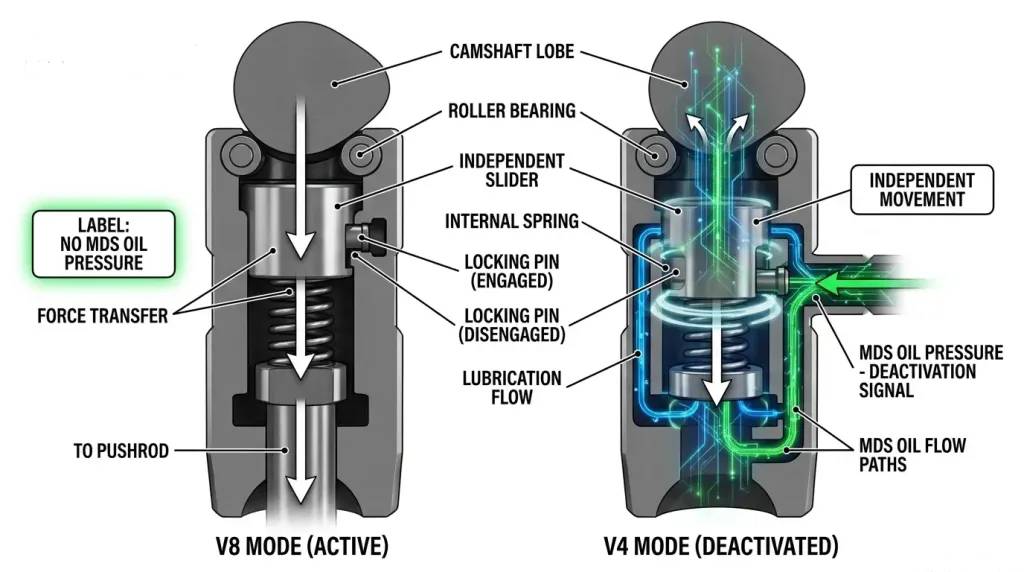
The Multi-Displacement System (MDS) is a cylinder deactivation technology that improves fuel efficiency by allowing a HEMI V8 engine to operate on four cylinders during light-load driving. The Powertrain Control Module (PCM) continuously monitors engine speed, throttle position, vehicle load, oil pressure, and other operating parameters. When conditions are suitable, it activates MDS solenoids that redirect engine oil pressure to collapse specific hydraulic lifters. This action keeps the intake and exhaust valves on four designated cylinders closed while fuel injection and ignition for those cylinders are suspended. The remaining four cylinders continue producing enough power to maintain cruising speed, and the engine returns to full V8 operation within fractions of a second whenever additional acceleration is required.
This transition is designed to be nearly seamless for daily driving. Drivers may notice a subtle change in engine sound or exhaust tone, but under normal conditions the switch between V8 and V4 operation occurs automatically without affecting drivability. The primary objective is to reduce pumping losses and fuel consumption during highway cruising or steady-speed operation.
Which HEMI engines use MDS?
MDS is available on many Chrysler, Dodge, Jeep, and RAM vehicles equipped with HEMI V8 engines, although availability depends on the engine generation, model year, transmission, and vehicle configuration. Common applications include the 5.7L HEMI found in the RAM 1500, Dodge Charger, Dodge Challenger, Chrysler 300, Jeep Grand Cherokee, and Dodge Durango. Some performance-oriented models or manual-transmission vehicles may not use MDS because they prioritize continuous power delivery over maximum fuel economy.
Before attempting any modification, owners should verify whether their specific engine calibration supports MDS. Vehicle documentation, factory build sheets, VIN information, or diagnostic tools can confirm whether the system is installed and active.
Why did Chrysler develop MDS?
Chrysler developed MDS to improve fuel economy without sacrificing the performance expected from a V8 engine. Large-displacement engines consume relatively little power while cruising, making eight active cylinders unnecessary during light-load conditions. By temporarily disabling four cylinders, MDS reduces fuel consumption and helps manufacturers meet increasingly strict fuel economy and emissions standards while preserving full V8 performance whenever higher engine output is demanded.
For most drivers, MDS provides a balance between efficiency and performance. The engine continues to deliver the characteristic torque of a HEMI during acceleration while consuming less fuel during highway driving, making the technology particularly beneficial for daily commuters and long-distance travel.
Why Do People Disable MDS on HEMI?
Does MDS affect engine reliability?
MDS itself is designed to operate reliably under normal driving conditions, but many owners disable it because they want to reduce the complexity of the valvetrain system. The MDS mechanism relies on specialized hydraulic lifters, oil control solenoids, and precise oil pressure management. As engine mileage increases, these additional components introduce more potential wear points than a conventional non-MDS valvetrain.
Owners planning long-term vehicle ownership, heavy towing, or performance modifications often prefer a permanently active V8 configuration because it eliminates the repeated activation and deactivation cycle of the MDS components. While this does not guarantee improved reliability, it simplifies engine operation and is commonly viewed as a preventive modification within the HEMI enthusiast community.
Can MDS cause lifter or camshaft problems?
Many HEMI owners associate MDS with lifter and camshaft failures because the system uses specialized hydraulic lifters that repeatedly engage and disengage during normal operation. If lubrication becomes inadequate or internal lifter components wear over time, the lifter may fail to lock or unlock correctly. Continued operation under these conditions can accelerate camshaft lobe wear and eventually require extensive engine repairs.
For this reason, some owners choose an MDS delete kit during an engine rebuild. These kits typically replace the factory MDS lifters with conventional non-MDS lifters and are often installed alongside a compatible camshaft. This approach removes the MDS mechanism entirely rather than simply disabling it through software.
Does disabling MDS improve throttle response?
Disabling MDS often produces a more consistent throttle response because the engine remains in V8 mode under all driving conditions. Without cylinder deactivation, engine output remains predictable during acceleration, lane changes, and towing. Many drivers report smoother power delivery and more immediate throttle input because the PCM no longer transitions between four-cylinder and eight-cylinder operation.
The improvement is primarily related to driving feel rather than a measurable increase in horsepower. Peak engine output generally remains unchanged unless additional performance tuning accompanies the MDS modification.
Does MDS change exhaust sound?
Yes. MDS changes the exhaust note because the engine alternates between four-cylinder and eight-cylinder operation. During steady cruising, some aftermarket exhaust systems amplify the lower-frequency sound generated while MDS is active, producing what many owners describe as exhaust drone inside the cabin.
Keeping the engine in full-time V8 mode eliminates these transitions, creating a more consistent exhaust tone across different driving conditions. This is one of the most common reasons enthusiasts disable MDS after installing performance exhaust systems, especially cat-back or axle-back upgrades that make cylinder deactivation more noticeable.
What Are the Different Ways to Disable MDS on HEMI?
There are four primary methods for disabling the Multi-Displacement System on a HEMI engine. They vary in cost, installation difficulty, permanence, and suitability for different driving needs. Choosing the right option depends on whether you want a temporary solution, a reversible modification, or a permanent engine conversion.
Can you disable MDS with an ECU tune?
An ECU tune is the most common and effective software-based method for disabling MDS permanently. The engine’s Powertrain Control Module (PCM) is recalibrated so it no longer commands cylinder deactivation. Once the updated calibration is flashed to the PCM, the engine remains in V8 mode under all driving conditions while retaining normal ignition, fuel delivery, transmission behavior, and other factory control strategies.
An ECU tune is popular because it requires no internal engine modifications. Many performance tuning companies also combine MDS deactivation with throttle response improvements, transmission optimization, revised shift schedules, or premium-fuel performance calibrations. This makes ECU tuning an attractive solution for owners seeking both improved drivability and additional engine refinement.
Can a handheld tuner disable MDS?
Many handheld programmers can disable MDS without requiring a custom dyno tune. Devices from manufacturers such as HP Tuners, DiabloSport, Superchips, and Pulsar provide software options that allow owners to modify the factory calibration through the vehicle’s OBD-II diagnostic port.
The available features differ between products and vehicle model years. Some programmers permanently disable MDS until the factory tune is restored, while others allow users to switch between multiple calibrations depending on driving conditions. This flexibility makes handheld tuners an excellent choice for owners who want an easy installation process without opening the engine.
Can Tow/Haul Mode temporarily disable MDS?
Tow/Haul Mode can temporarily reduce or eliminate MDS activation on many RAM trucks, but it is not a permanent MDS disable solution. This driving mode changes transmission shift logic and keeps engine load higher during towing or hauling. Because MDS generally operates only under light-load conditions, the system activates less frequently or may remain inactive while Tow/Haul Mode is engaged.
Although this method requires no additional hardware or tuning, it only works under specific driving conditions. Once Tow/Haul Mode is turned off or engine operating conditions change, MDS functions normally again. Drivers looking for full-time V8 operation should consider ECU tuning or an MDS delete kit instead.
What is an MDS delete kit?
An MDS delete kit permanently removes the cylinder deactivation system by replacing the components required for MDS operation. Unlike software-based solutions that simply prevent activation, a delete kit eliminates the mechanical hardware inside the engine.
A complete MDS delete kit typically includes non-MDS hydraulic lifters, lifter trays, valley cover components, updated gaskets, and supporting hardware. Many engine builders also recommend installing a compatible non-MDS camshaft during the conversion because the factory camshaft is designed to work with MDS lifters. After installation, the PCM must still be recalibrated so it no longer attempts to control the removed MDS components.
This approach is commonly chosen during engine rebuilds, camshaft upgrades, or lifter replacement because much of the engine has already been disassembled.
Which method is best for daily driving?
An ECU tune is generally the best option for most daily-driven HEMI vehicles because it provides permanent MDS deactivation without requiring engine disassembly. Installation is relatively simple, the factory engine remains mechanically unchanged, and the vehicle can often be returned to its original calibration if necessary.
Drivers planning significant performance upgrades or repairing failed MDS lifters may benefit more from a complete MDS delete kit. Although the installation cost is considerably higher, removing the MDS hardware permanently simplifies the valvetrain and eliminates dependence on specialized MDS lifters.
How Do You Disable MDS with an ECU Tune?
What tools are required?
Disabling MDS through ECU tuning requires compatible tuning hardware, calibration software, and a stable vehicle power supply. Most owners use an OBD-II programming device connected to a laptop or handheld tuner. During the flashing process, maintaining stable battery voltage is critical because an interruption can corrupt the PCM calibration.
Before beginning, verify that the tuning device supports your vehicle’s model year, engine, and PCM version. Some newer HEMI vehicles require PCM unlocking before custom calibrations can be installed.
How does the tuning process work?
The tuning process modifies the factory calibration so the PCM never commands cylinder deactivation. The tuner first reads the original calibration and stores it as a backup. A revised calibration with MDS disabled is then written back to the PCM through the vehicle’s OBD-II port.
After programming is complete, the engine should remain in eight-cylinder operation regardless of cruising speed or throttle position. Many tuners verify successful installation by monitoring live engine data to confirm that MDS activation parameters remain inactive during road testing.
What should you check before flashing the PCM?
Several checks should be completed before programming the PCM to minimize the risk of installation problems. The vehicle battery should be fully charged or connected to a regulated battery maintainer throughout the flashing process. Any active diagnostic trouble codes should be diagnosed and repaired before installing a new calibration because existing engine faults may interfere with tuning.
It is also recommended to save a copy of the original factory calibration. Keeping the original file allows the PCM to be restored if warranty work, emissions inspections, or future software updates require returning the vehicle to stock configuration.
How Do You Install an MDS Delete Kit?
Which engine parts must be replaced?
Installing an MDS delete kit requires replacing the components responsible for cylinder deactivation. Because the MDS system is integrated into the engine’s valvetrain, removing it involves partial engine disassembly rather than a simple software update. Most installations require removing the intake manifold, cylinder heads, valve train components, and valley cover to access the MDS lifters.
A complete MDS delete kit typically includes non-MDS hydraulic lifters, new lifter trays, a non-MDS valley cover or valley plate, replacement gaskets, head bolts, and various seals. Depending on the engine generation and manufacturer, additional hardware may also be supplied to simplify installation and ensure compatibility.
Since the engine must already be opened, many owners perform other preventative maintenance at the same time, including replacing timing components, oil pump parts, water pump, or worn seals. Completing these repairs during the same service reduces future labor costs because much of the engine has already been disassembled.
Why are non-MDS lifters required?
Non-MDS lifters are required because factory MDS lifters are specifically designed to collapse when activated by oil pressure. Standard hydraulic lifters remain mechanically locked during engine operation, allowing every cylinder to continue opening and closing its valves continuously.
Replacing MDS lifters removes the moving components responsible for cylinder deactivation. This creates a simpler valvetrain with fewer hydraulic mechanisms that depend on oil pressure for normal operation. Many engine builders prefer this configuration for high-mileage engines, towing applications, or performance builds where long-term durability is prioritized over fuel economy.
Installing non-MDS lifters without recalibrating the PCM is not sufficient. The engine control module must also be programmed so it no longer attempts to activate MDS solenoids that have been removed from the engine.
Should the camshaft also be replaced?
Replacing the camshaft is strongly recommended during a complete MDS delete, even though it is not mandatory for every build. Factory MDS camshafts are engineered to work with MDS lifters and their unique operating characteristics. Installing a compatible non-MDS camshaft ensures that the new lifters operate correctly and reduces the likelihood of abnormal wear patterns developing over time.
Many owners also use this opportunity to install a mild performance camshaft that increases airflow and improves engine output. Because camshaft replacement requires much of the same labor as an MDS delete, combining both upgrades is often more cost-effective than performing them separately.
The appropriate camshaft should always match the intended vehicle use. A daily-driven truck, a towing vehicle, and a street-performance build each benefit from different camshaft profiles.
Can you keep the factory PCM after the delete?
Yes, the factory PCM can usually remain in the vehicle after an MDS delete, but its calibration must be updated. Once the mechanical MDS components have been removed, the original software still expects to control cylinder deactivation. If the calibration is not modified, diagnostic trouble codes, warning lights, and improper engine operation may occur.
Most professional installers perform a custom PCM tune immediately after completing the mechanical conversion. This updated calibration disables MDS logic while preserving normal engine management functions, transmission operation, and drivability.
What Happens After Disabling MDS?
Does horsepower increase?
Disabling MDS alone does not significantly increase peak horsepower because the engine’s airflow, compression ratio, and ignition system remain unchanged. The primary difference is that the engine continuously operates as a V8 instead of alternating between four and eight cylinders during light-load driving.
If an ECU tune accompanies the MDS modification, some owners may notice improved throttle response, revised transmission behavior, and stronger acceleration feel. These improvements result from calibration changes rather than from disabling MDS itself.
Vehicles that receive additional upgrades such as performance camshafts, intake systems, cylinder head improvements, or exhaust modifications may experience measurable horsepower gains, but these increases should not be attributed solely to removing MDS.
Does fuel economy decrease?
Fuel economy generally decreases after disabling MDS because the engine continues firing all eight cylinders during cruising conditions. The exact reduction depends on vehicle weight, driving style, terrain, gearing, and highway usage. Drivers who spend most of their time on long highway trips typically notice a greater reduction than those who primarily drive in urban traffic.
For owners who prioritize towing capability, engine consistency, or long-term reliability, the decrease in fuel efficiency is often considered an acceptable trade-off. Others who rely on maximum fuel economy for daily commuting may prefer to keep the factory MDS system active.
Does engine temperature change?
Disabling MDS has little direct effect on normal engine operating temperature. The cooling system, thermostat, radiator, water pump, and electric fans continue regulating engine temperature according to factory specifications. Under normal driving conditions, coolant temperatures remain largely unchanged.
Some drivers report slightly different oil temperatures or exhaust temperatures after disabling MDS because all cylinders remain active continuously. These changes are generally minor and do not require modifications to the factory cooling system on otherwise stock vehicles.
Does engine longevity improve?
Disabling MDS can simplify the valvetrain, but it does not automatically guarantee a longer engine life. Engine longevity depends on multiple factors, including oil quality, maintenance intervals, driving habits, operating temperature, and overall engine condition.
A complete MDS delete removes specialized hydraulic lifters that some owners believe contribute to common valvetrain failures on high-mileage HEMI engines. However, other engine components continue to experience normal wear throughout the vehicle’s lifetime. Routine maintenance, high-quality engine oil, and timely repairs remain the most important factors affecting long-term durability regardless of whether MDS is enabled or disabled.
What Are the Risks of Disabling MDS?
Can the check engine light appear?
Yes, the check engine light can appear if MDS is disabled incorrectly or if the PCM calibration does not match the engine configuration. The factory PCM continuously monitors MDS solenoids, oil pressure circuits, and cylinder deactivation commands. If the system detects missing components or receives unexpected sensor feedback, it may store diagnostic trouble codes (DTCs) and illuminate the malfunction indicator lamp.
This issue most commonly occurs when mechanical MDS components are removed without updating the PCM software. A properly calibrated ECU tune disables MDS control logic and prevents the PCM from attempting to activate hardware that is no longer installed.
Owners should also verify that all electrical connectors, sensors, and wiring harnesses are properly reinstalled after mechanical work. An unrelated installation error can trigger warning lights that may be mistaken for an MDS-related problem.
Does disabling MDS affect emissions compliance?
Disabling MDS may affect emissions compliance depending on local regulations and the modification method used. The factory MDS system contributes to lower fuel consumption and reduced carbon dioxide emissions during light-load driving. Removing or disabling the system changes how the engine operates, even if tailpipe emissions remain within acceptable limits.
Many regions prohibit modifications that alter factory-certified emissions systems on vehicles driven on public roads. Some inspection programs also verify PCM calibration or emissions readiness monitors, which may identify unauthorized software modifications.
Before disabling MDS, owners should review local emissions regulations to determine whether ECU tuning or mechanical engine modifications are permitted for their specific vehicle.
Can it void the vehicle warranty?
Disabling MDS can affect warranty coverage if a manufacturer determines that the modification contributed to a component failure. Software tuning, PCM recalibration, and internal engine modifications differ significantly from the factory vehicle specification. If an engine, transmission, or emissions-related failure occurs, the manufacturer or dealer may investigate whether aftermarket modifications influenced the problem.
Warranty decisions vary depending on the vehicle’s age, remaining factory coverage, local consumer protection laws, and the nature of the failure. Some unrelated repairs may still be covered, while claims involving modified engine components could be denied.
Owners of newer vehicles should carefully evaluate the potential warranty implications before installing an ECU tune or complete MDS delete kit.
What mistakes should you avoid?
There are five common mistakes that increase the risk of problems after disabling MDS.
The first mistake is choosing an unsupported tuner or installing a calibration that is not designed for the vehicle’s exact model year and PCM version.
The second mistake is deleting the mechanical MDS hardware without updating the PCM software, which often results in diagnostic trouble codes and poor engine operation.
The third mistake is reusing worn lifters, camshaft components, head bolts, or engine gaskets during an MDS delete. Replacing these wear items while the engine is disassembled helps prevent premature failures after reassembly.
The fourth mistake is ignoring engine oil quality and maintenance intervals. Proper lubrication remains essential regardless of whether MDS is enabled or removed.
The fifth mistake is attempting a complete MDS delete without sufficient mechanical experience. Because the procedure requires extensive engine disassembly and precise torque specifications, many owners choose experienced HEMI engine builders to perform the conversion.
Which HEMI Engines Support MDS?
Not every HEMI engine is equipped with the Multi-Displacement System. MDS is primarily found on 5.7L HEMI V8 engines used in Chrysler, Dodge, Jeep, and RAM vehicles. Availability varies according to production year, transmission type, emissions package, and vehicle application.
Many RAM 1500 models use MDS to improve highway fuel economy, while Dodge Charger, Challenger, Chrysler 300, Jeep Grand Cherokee, and Dodge Durango models equipped with the 5.7L HEMI may also include the system. Certain performance models, manual-transmission vehicles, and some heavy-duty truck applications either never received MDS or use different engine configurations.
The most reliable way to determine whether a vehicle supports MDS is to verify the VIN, review the factory build sheet, or inspect the PCM calibration using a compatible diagnostic scan tool.
How Is MDS Different from GM Active Fuel Management?
MDS and GM Active Fuel Management (AFM) share the same objective but use different engineering approaches and control strategies. Both technologies deactivate selected cylinders during light-load driving to reduce fuel consumption, but each system is designed specifically for its manufacturer’s engine architecture.
MDS is used on Chrysler’s HEMI V8 engines and relies on dedicated hydraulic lifters controlled by oil-pressure solenoids. GM’s Active Fuel Management also uses collapsible lifters but operates with different lifter designs, oil manifolds, control logic, and engine calibration.
The aftermarket solutions also differ between the two systems. Products, tuning software, replacement components, and delete kits designed for GM AFM are not compatible with Chrysler HEMI engines. Owners should always purchase components specifically engineered for their engine platform rather than assuming the two systems use interchangeable parts.
What Are the Best Tuners for Disabling MDS?
The best tuner depends on the owner’s technical experience, modification goals, and desired level of customization. Entry-level users often prefer handheld programmers because they provide simple installation and preloaded calibrations through the OBD-II port. These devices typically require minimal technical knowledge and can restore the factory tune if necessary.
Enthusiasts and professional tuners frequently choose advanced calibration platforms that allow detailed adjustment of ignition timing, fuel mapping, transmission behavior, throttle response, and MDS operation. These systems provide greater flexibility but require more tuning knowledge and careful calibration.
Before purchasing any tuning device, owners should confirm compatibility with their engine generation, PCM version, model year, and any factory security requirements such as PCM unlocking.
When Should You Keep MDS Enabled?
Keeping MDS enabled is often the better choice for owners who prioritize fuel economy, factory drivability, and warranty protection. Drivers who spend most of their time on highways may benefit from the fuel savings provided by cylinder deactivation, while owners of newer vehicles may prefer avoiding aftermarket modifications that could complicate future warranty claims.
Vehicles that remain mechanically stock and operate without lifter-related issues generally continue to benefit from the factory MDS calibration. If reliability concerns have not developed and the vehicle meets the owner’s performance expectations, there may be little practical advantage to disabling the system.
Conversely, owners planning major engine upgrades, repairing failed MDS lifters, or building a dedicated towing or performance vehicle may find that removing the system better aligns with their long-term objectives.
Frequently Asked Questions About Disabling MDS
Can MDS be turned back on?
Yes, MDS can usually be re-enabled if it was disabled through ECU tuning or a handheld programmer. Most tuning devices create a backup of the factory PCM calibration before installing a modified tune. Restoring this original calibration allows the PCM to resume controlling the Multi-Displacement System as designed by the manufacturer.
The situation is different after a complete MDS delete. Once the engine has been converted with non-MDS lifters, a non-MDS camshaft, and other replacement components, restoring the original system requires reinstalling the factory MDS hardware and flashing the PCM back to a compatible calibration. This process involves substantial labor and is generally not considered practical unless the engine is already being rebuilt.
Does disabling MDS increase oil consumption?
Disabling MDS alone does not directly increase engine oil consumption. Oil usage is primarily influenced by piston ring condition, valve seals, PCV system performance, engine wear, oil viscosity, and maintenance history rather than whether cylinder deactivation is active.
Some owners mistakenly attribute oil consumption changes to MDS removal because the modification often occurs alongside camshaft replacement, lifter repairs, or other major engine work. If oil consumption changes significantly after an MDS delete, the cause is more likely related to engine condition, installation quality, or another mechanical issue instead of the absence of cylinder deactivation.
Regularly checking oil level and following the manufacturer’s recommended oil specifications remain essential regardless of whether MDS is enabled or disabled.
Will disabling MDS improve towing performance?
Disabling MDS can improve driving consistency while towing, but it does not increase the engine’s maximum towing capacity. The official towing rating is determined by factors such as engine output, transmission design, axle ratio, cooling capacity, chassis strength, suspension, and braking system rather than the presence of cylinder deactivation.
Many truck owners prefer operating with MDS disabled because the engine remains in full V8 mode without repeatedly switching between four and eight cylinders during changing road conditions. This consistent power delivery may produce smoother acceleration, more predictable throttle response, and improved confidence when towing heavy trailers through hills or mountainous terrain.
For vehicles used primarily for towing, an ECU tune combined with transmission optimization often provides a more noticeable improvement than disabling MDS alone.
Is disabling MDS legal?
The legality of disabling MDS depends on local vehicle modification and emissions regulations. In some jurisdictions, recalibrating the PCM or modifying factory emissions-related systems may not be permitted for vehicles operated on public roads. Other regions only perform basic safety inspections and may not evaluate factory engine calibrations.
Owners should verify applicable regulations before performing either software tuning or mechanical engine modifications. This consideration is especially important for vehicles that must pass annual emissions inspections or comply with strict environmental standards.
If regulatory compliance is a priority, consulting local inspection authorities or qualified automotive professionals before modifying the vehicle can help avoid unexpected registration or inspection issues.
Can you disable MDS without modifying the engine?
Yes, MDS can be disabled without opening the engine by using an ECU tune or a compatible handheld programmer. These software-based solutions prevent the PCM from activating cylinder deactivation while leaving the engine’s internal components unchanged.
This approach is considerably less expensive than installing a complete MDS delete kit and can often be completed in less than an hour using an OBD-II programming device. Because the engine remains mechanically stock, software-based solutions are the preferred option for owners seeking full-time V8 operation without the cost and complexity of internal engine modifications.
However, software tuning does not remove the factory MDS lifters or other related hardware. Owners experiencing lifter failure, camshaft damage, or major engine wear generally require mechanical repairs rather than calibration changes alone.