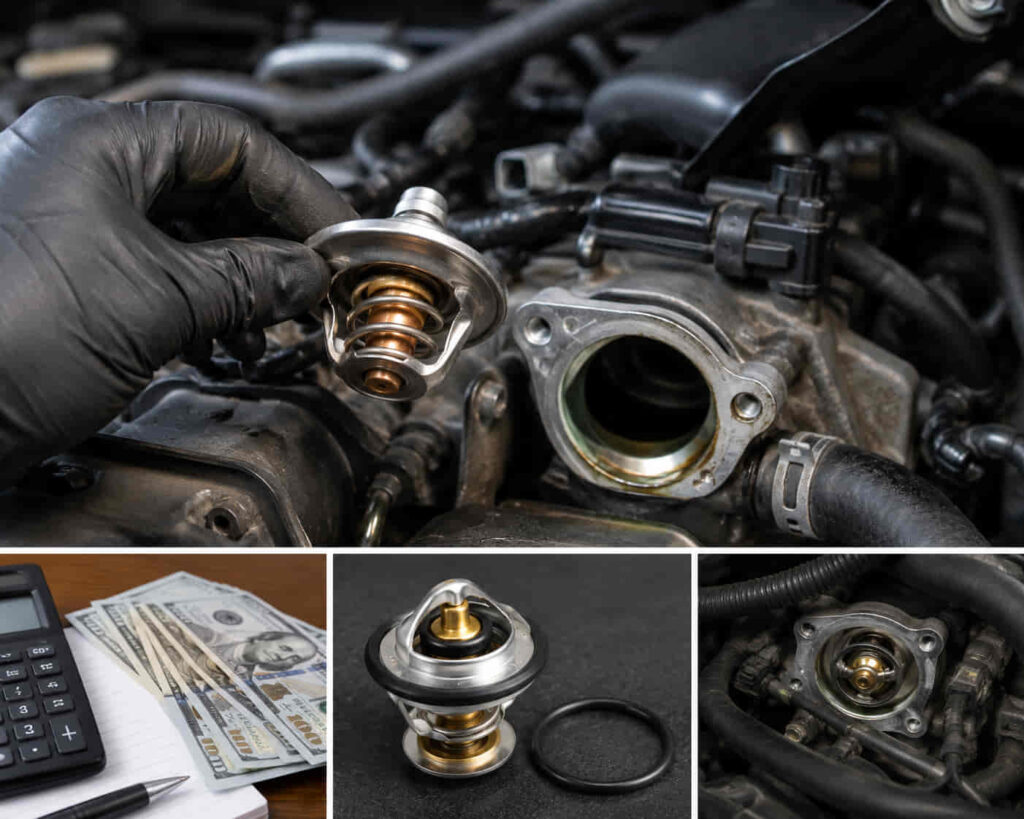
The average cost to replace a car thermostat ranges from $150 to $500, depending on the vehicle, labor rates, thermostat type, and any additional cooling system repairs required. While the thermostat itself is an inexpensive component on most vehicles, the total replacement cost often varies because labor time, engine layout, coolant replacement, and related parts can significantly affect the final invoice. As a result, two vehicles with similar thermostat prices may have repair bills that differ by several hundred dollars.
A faulty thermostat should not be ignored because it directly regulates engine operating temperature. When it becomes stuck open or closed, it can cause engine overheating, poor fuel efficiency, weak cabin heating, or accelerated engine wear. In many cases, replacing the thermostat early prevents more expensive repairs involving the radiator, water pump, head gasket, or even the engine itself.
Understanding what determines thermostat replacement cost allows vehicle owners to estimate repair expenses more accurately and avoid unnecessary charges. Rather than focusing only on the price of the thermostat, it is more useful to evaluate the complete repair, including labor, coolant service, diagnostic work, and any additional components that may need replacement during the same visit. The following sections explain the ten most important factors that influence how much it costs to replace a thermostat in a car and when paying more may actually reduce long-term maintenance expenses.
What Is the Average Cost to Replace a Car Thermostat?
The average cost to replace a car thermostat typically falls between $150 and $500 in the United States, with most drivers paying around $250 to $350 for a complete repair. This total usually combines the price of the thermostat, labor charges, fresh coolant, and minor replacement materials such as gaskets or seals. Vehicles with easily accessible thermostat housings generally remain near the lower end of the price range, while luxury models and vehicles with tightly packaged engine bays often require additional labor that substantially increases the final cost.
The thermostat itself is rarely the most expensive part of the repair. Most aftermarket thermostats cost between $20 and $80, while OEM components commonly range from $50 to $150 depending on the manufacturer. The larger portion of the bill usually comes from labor because technicians must partially drain the cooling system, remove surrounding components when necessary, install the new thermostat, refill coolant, and bleed air from the cooling system to restore normal engine operation. Even a relatively inexpensive thermostat can result in a repair bill exceeding $300 when labor time reaches two or three hours.
Labor rates also vary significantly between repair facilities. Independent repair shops generally offer lower hourly rates than dealership service centers, making them a more economical option for routine thermostat replacement on out-of-warranty vehicles. However, dealerships may be the preferred choice for newer vehicles because they use manufacturer-approved replacement parts and follow factory repair procedures that reduce compatibility issues.
Another factor affecting the average replacement cost is whether additional cooling system maintenance is performed during the same appointment. Since coolant must normally be drained before replacing the thermostat, many technicians recommend replacing old coolant or performing a complete coolant flush if the existing fluid has exceeded its service interval. Although this increases the immediate repair cost, combining both services often costs less than scheduling them separately and helps maintain proper engine temperature, corrosion protection, and cooling system efficiency over the long term.
Knowing the national average provides a useful starting point, but it does not explain why repair costs vary so widely between vehicles. The next section examines the most influential factor: how your vehicle’s make and model directly affect thermostat replacement cost.
How Does Your Vehicle Make and Model Affect Thermostat Replacement Cost?
Your vehicle’s make and model are the biggest factors affecting thermostat replacement cost because they determine parts pricing, engine accessibility, labor time, and the complexity of the cooling system. Two vehicles can require the same replacement procedure yet differ by more than $300 in total repair cost simply because one has a compact engine layout while the other requires technicians to remove multiple components before reaching the thermostat housing.
Economy cars generally have the lowest thermostat replacement costs because manufacturers prioritize simple engine designs and inexpensive replacement parts. Popular models from Toyota, Honda, Hyundai, Kia, Chevrolet, Nissan, and Ford often place the thermostat near the front of the engine, allowing technicians to complete the repair within one to two labor hours. In addition, replacement parts for these high-production vehicles are widely available from both OEM and aftermarket suppliers, creating competitive pricing and reducing repair expenses.
Mid-size SUVs, pickup trucks, and crossover vehicles typically fall into the middle price range. Although these vehicles often provide more engine bay space than compact cars, many use larger cooling systems with additional hoses, thermostat housings, sensors, or integrated coolant passages. Servicing these systems frequently requires draining more coolant and performing extra bleeding procedures after installation, increasing labor time and material costs even when the thermostat itself remains relatively inexpensive.
Luxury vehicles usually command significantly higher replacement costs because their cooling systems are engineered for performance rather than serviceability. Brands such as BMW, Mercedes-Benz, Audi, Land Rover, and Porsche commonly package engine components tightly to maximize efficiency and reduce engine size. As a result, technicians may need to remove intake manifolds, engine covers, coolant pipes, or accessory components before accessing the thermostat. Additional labor hours often contribute more to the repair bill than the replacement part itself.
European manufacturers also frequently use integrated thermostat assemblies instead of a standalone thermostat. Rather than replacing only the thermostat valve, technicians must install a complete housing that may include coolant passages, sensors, and electronic control components. These assemblies are considerably more expensive than traditional thermostats and contribute to higher repair costs across many European models.
Vehicle age also influences replacement pricing. Older models often benefit from lower-cost aftermarket components and simpler mechanical designs, reducing the overall repair bill. However, discontinued vehicles or models with limited production numbers may require special-order OEM parts that increase both repair cost and turnaround time. In contrast, newer vehicles equipped with electronically controlled cooling systems or active thermal management technology often require more sophisticated diagnostic procedures before replacement, adding diagnostic charges to the final invoice.
Engine configuration is another overlooked variable. Inline four-cylinder engines generally offer easier access to the thermostat than transverse V6 engines, turbocharged powertrains, or longitudinal V8 engines. On some modern vehicles, the thermostat is positioned beneath the intake manifold or behind multiple cooling components, extending labor time by several hours. Because labor accounts for a significant portion of the total repair cost, engine design often has a greater financial impact than the thermostat itself.
For example, replacing the thermostat on a Toyota Corolla or Honda Civic is typically among the least expensive repairs because of accessible engine layouts and abundant replacement parts. The same repair on a BMW X5, Audi Q7, or Land Rover Discovery may cost substantially more due to integrated thermostat housings, additional labor requirements, and higher OEM parts prices. Although both repairs address the same faulty component, the engineering behind each vehicle creates dramatically different repair costs.
Vehicle make and model establish the baseline cost, but they are only part of the equation. The thermostat’s physical location inside the engine often determines whether the repair takes one hour or several, making accessibility one of the most important cost factors.
How Does Thermostat Location Change Labor Cost?
The location of the thermostat is one of the most important factors influencing replacement cost because it directly determines how much labor is required to access and install the new component. While most thermostats perform the same function of regulating coolant flow between the engine and radiator, manufacturers place them in different locations depending on engine design, packaging constraints, and cooling system architecture. This difference in accessibility often has a greater impact on the final repair bill than the price of the thermostat itself.
Vehicles with front-mounted thermostats generally have the lowest labor costs because technicians can reach the housing with minimal disassembly. On many naturally aspirated four-cylinder engines, the thermostat sits near the upper radiator hose where coolant exits the engine. After draining part of the cooling system, the technician can remove the housing, replace the thermostat, install a new gasket, refill the coolant, and bleed trapped air within one to two hours. Because fewer components need to be removed, labor charges remain relatively low and the risk of damaging surrounding parts is minimized.
The repair becomes more expensive when the thermostat is positioned beneath other engine components. Many modern V6 engines, turbocharged powertrains, and compact engine bays require technicians to remove the air intake assembly, coolant pipes, engine covers, accessory brackets, or even the intake manifold before accessing the thermostat housing. Each additional step increases labor time and introduces more opportunities for worn seals, brittle hoses, or aging plastic fittings to require replacement during reassembly. Consequently, the overall repair cost rises even though the thermostat itself remains an inexpensive part.
Engine orientation also affects accessibility. Transversely mounted engines, which are common in front-wheel-drive vehicles, often have limited working space between the engine and the firewall. If the thermostat is located on the rear side of the engine, technicians must work in confined areas or remove surrounding components to gain proper access. In contrast, many longitudinal engine layouts used in rear-wheel-drive vehicles provide better access to the front of the engine, although luxury models may offset this advantage with more complex cooling system designs.
Turbocharging and hybrid technology have further increased thermostat replacement complexity. Modern engines frequently incorporate multiple coolant circuits to manage engine temperature, turbocharger cooling, battery thermal management, or exhaust emission systems. Instead of servicing a simple thermostat housing, technicians may encounter electronically controlled thermostat modules, additional coolant lines, integrated sensors, and sophisticated bleeding procedures. These systems require more diagnostic verification after installation to ensure that coolant flows correctly and that no air remains trapped inside the cooling circuit.
Another contributor to labor cost is the need to protect sensitive engine components during the repair. Coolant spilled onto electrical connectors, ignition coils, or serpentine belts can create secondary problems if the work is performed carelessly. Professional technicians often spend additional time cleaning sealing surfaces, inspecting hoses, replacing worn O-rings, and pressure-testing the cooling system before returning the vehicle to the customer. Although these steps increase labor time slightly, they significantly reduce the likelihood of coolant leaks and repeat repairs.
The difference in accessibility explains why thermostat replacement times vary so widely across vehicles. A compact sedan with an exposed thermostat housing may require less than one hour of labor, while a luxury SUV with an integrated cooling system can require three to five hours of disassembly and reassembly. Because repair shops calculate labor based on standardized service times or hourly rates, longer procedures translate directly into higher repair costs.
Thermostat location determines how much labor is required, but the choice between an OEM and an aftermarket thermostat also influences the final repair bill. The next section explains how replacement part quality affects both upfront cost and long-term reliability.
Read more: Ford Paint Code WB
Does OEM or Aftermarket Thermostat Change the Total Price?
Choosing between an OEM thermostat and an aftermarket thermostat can significantly affect both the immediate replacement cost and the long-term reliability of the cooling system. Although both options are designed to regulate engine temperature, they differ in manufacturing standards, quality control, warranty coverage, and compatibility with specific vehicle models. For most thermostat replacements, the price difference between the two parts is relatively small compared to labor costs, but selecting the right component can help prevent future cooling system failures and unnecessary repeat repairs.
An Original Equipment Manufacturer (OEM) thermostat is produced by the vehicle manufacturer or one of its approved suppliers. These thermostats are built according to the exact specifications used when the vehicle was originally assembled, ensuring the correct opening temperature, coolant flow characteristics, and fitment. Because they are engineered specifically for a particular engine, OEM thermostats generally provide the highest level of compatibility and require fewer installation adjustments. This consistency is especially important on modern vehicles equipped with electronically controlled cooling systems, where even slight variations in operating temperature can affect engine performance, fuel economy, and emissions.
The primary disadvantage of OEM components is their higher purchase price. Depending on the manufacturer, an OEM thermostat may cost anywhere from $50 to more than $150, and integrated thermostat housings used on many European vehicles can cost several hundred dollars. Dealerships also tend to install genuine replacement parts by default, increasing the overall repair bill compared with independent repair shops that offer alternative brands.
Aftermarket thermostats provide a more affordable alternative for many vehicle owners. Reputable manufacturers produce replacement thermostats that meet or closely match OEM specifications while selling them at a lower price. For common passenger vehicles, quality aftermarket thermostats often range between $20 and $80, making them an attractive option for owners seeking to reduce repair costs without sacrificing reliability. Because these parts are widely available through automotive parts retailers, they also shorten repair times by eliminating the need to order factory components.
However, not all aftermarket thermostats are manufactured to the same quality standard. Lower-cost products may use inferior sealing materials, weaker springs, or less precise temperature calibration. Even a small variation in opening temperature can disrupt coolant circulation, causing the engine to warm up too slowly, operate hotter than intended, or fluctuate between normal and excessive temperatures. In severe cases, a poorly manufactured thermostat can fail prematurely, forcing the entire replacement procedure to be repeated and increasing total ownership costs far beyond the initial savings.
The quality of the gasket or sealing surface is another important consideration. Many coolant leaks that appear shortly after thermostat replacement are not caused by installation errors but by low-quality sealing materials that deteriorate under repeated heating and cooling cycles. Choosing a trusted aftermarket brand or an OEM component significantly reduces the likelihood of coolant leaks developing after installation.
Vehicle age also influences the most practical choice. Older vehicles with high mileage often benefit from premium aftermarket thermostats because they offer excellent value while maintaining dependable cooling system performance. In contrast, newer vehicles, luxury models, and engines with electronically managed cooling systems generally benefit from OEM components, where exact specifications and manufacturer compatibility outweigh the additional purchase cost.
When evaluating the overall repair bill, it is important to recognize that the thermostat itself usually represents only a small portion of the total expense. Saving $30 to $50 on a replacement part has little financial value if a lower-quality component fails within a short period and requires paying labor charges again. For this reason, experienced technicians often recommend prioritizing reliability over the lowest purchase price, particularly since labor commonly accounts for the largest share of thermostat replacement costs.
The replacement part influences material costs, but labor rates differ just as much between repair facilities. The next section explains why the same thermostat replacement can cost considerably more at one repair shop than another.
Why Does Labor Cost Vary Between Repair Shops?
Labor cost is often the largest contributor to thermostat replacement cost because repair shops charge different hourly rates, follow different pricing models, and require varying amounts of time to complete the same repair. While the thermostat itself may cost less than $100, labor charges can range from under $100 to more than $500 depending on where the vehicle is serviced. Understanding what drives these differences helps vehicle owners compare repair estimates more accurately instead of focusing solely on the total price.
One of the primary reasons labor costs vary is the repair facility itself. Independent repair shops generally offer lower hourly labor rates because they have lower operating expenses than authorized dealerships. These shops often service a wide range of vehicle brands and can source both OEM and high-quality aftermarket parts, giving customers more flexibility in controlling repair costs. For routine thermostat replacement on out-of-warranty vehicles, an experienced independent mechanic can often perform the repair to the same standard as a dealership while charging substantially less for labor.
Dealership service centers typically charge higher hourly rates because they specialize in a single manufacturer and invest heavily in factory-certified technicians, proprietary diagnostic equipment, and manufacturer-approved repair procedures. Although the labor cost is usually higher, dealerships provide advantages for newer vehicles by ensuring software updates, technical service bulletins, and factory repair specifications are followed throughout the repair process. For vehicles still covered by a manufacturer’s warranty or extended service plan, dealership repairs may also be required to maintain warranty compliance.
Geographic location is another major factor influencing labor rates. Repair facilities in large metropolitan areas generally charge more than those in suburban or rural regions due to higher wages, commercial rent, insurance, and operating costs. A thermostat replacement that costs approximately $180 in a small town may exceed $350 in a major city even when the same replacement part is installed. These regional differences explain why national average repair costs should be viewed as reference points rather than fixed prices.
Vehicle complexity also affects how repair shops calculate labor charges. Most professional mechanics use standardized labor guides that estimate the number of hours required for specific repairs based on the vehicle’s make, model, engine, and production year. If a thermostat can be accessed quickly without removing surrounding components, the estimated labor time remains low. Conversely, vehicles requiring extensive disassembly receive higher labor allowances because technicians must remove and reinstall multiple components before reaching the thermostat housing.
The technician’s experience can also influence the overall repair process. Experienced mechanics who regularly service a particular vehicle platform often complete thermostat replacements more efficiently because they are familiar with common fastener locations, coolant bleeding procedures, and manufacturer-specific service techniques. Although customers rarely pay less simply because a technician works faster, experienced professionals reduce the likelihood of installation errors, coolant leaks, damaged connectors, or trapped air within the cooling system that could lead to costly return visits.
Some repair estimates also include services that extend beyond the thermostat replacement itself. Cooling system inspections, diagnostic scans, pressure testing, coolant disposal fees, shop supplies, environmental charges, and taxes may all appear as separate line items on the final invoice. While these additional charges increase the total repair cost, they often reflect procedures that help verify the cooling system operates correctly after the new thermostat has been installed. A lower estimate that excludes these services is not always the better value if additional problems remain undetected.
Comparing repair quotes therefore requires more than looking at the final dollar amount. Vehicle owners should confirm whether the estimate includes new coolant, replacement gaskets, pressure testing, warranty coverage, diagnostic work, and the quality of replacement parts being installed. A repair shop offering a slightly higher price may ultimately provide greater long-term value if the estimate covers all necessary services and reduces the risk of future cooling system failures.
Labor rates explain much of the variation between repair estimates, but coolant service is another expense that surprises many vehicle owners. The next section examines why replacing coolant during thermostat replacement is often recommended and how it affects the total repair cost.
Do You Need to Replace Coolant at the Same Time?
Yes, replacing or at least refilling coolant is usually necessary when replacing a car thermostat because the cooling system must be partially drained before the old thermostat can be removed. Since the thermostat sits within the engine’s coolant circuit, technicians cannot replace it without allowing coolant to escape. As a result, coolant service is commonly included in the total thermostat replacement cost, making it one of the most frequent additional charges on a repair estimate.
The amount of coolant that needs to be replaced depends on the repair procedure and the condition of the existing coolant. If the coolant is relatively new and uncontaminated, a technician may drain only enough fluid to access the thermostat before refilling the system with the same coolant specification. In this situation, the additional material cost remains relatively low because only a portion of the coolant needs replacement. However, if the coolant has reached its recommended service interval or shows signs of contamination, corrosion, or discoloration, a complete coolant replacement becomes the more practical solution.
Replacing aged coolant during thermostat service improves the overall performance of the cooling system. Engine coolant does far more than prevent overheating. It also transfers heat away from the engine, protects aluminum components from corrosion, lubricates the water pump, and prevents freezing in cold climates. Over time, the additives responsible for these protective functions gradually break down. Once they become depleted, the cooling system becomes more susceptible to rust, mineral deposits, and internal corrosion that can shorten the lifespan of expensive components such as the radiator, heater core, and water pump.
Many repair shops recommend performing a coolant flush instead of simply refilling the system when the coolant is old or contaminated. A coolant refill replaces only the coolant that is lost during thermostat replacement, while a coolant flush removes most of the old coolant, flushes contaminants from the cooling passages, and fills the system with fresh coolant. Although a coolant flush increases the immediate repair cost, it restores the cooling system’s protective properties and reduces the likelihood of future cooling system problems caused by degraded coolant.
Another important reason for replacing coolant is to eliminate trapped air after the new thermostat has been installed. Air pockets inside the cooling system can interfere with coolant circulation, create inaccurate temperature readings, reduce heater performance, and even cause localized engine overheating. Professional technicians follow manufacturer-recommended bleeding procedures to remove trapped air before returning the vehicle to service. Modern vehicles may require specialized bleeding equipment or electronic service procedures because complex cooling systems often contain multiple coolant circuits that are difficult to purge manually.
Using the correct coolant specification is equally important. Vehicle manufacturers formulate coolant with different chemical compositions, including Organic Acid Technology (OAT), Hybrid Organic Acid Technology (HOAT), and Inorganic Additive Technology (IAT). Mixing incompatible coolant types can reduce corrosion protection, damage seals, and accelerate deposits inside the cooling system. For this reason, technicians typically refill the system with coolant that matches the manufacturer’s specification rather than selecting a universal product based solely on color.
The additional cost associated with coolant replacement is relatively small compared with the overall repair expense, yet it can significantly extend the life of the cooling system. Attempting to reuse old coolant simply to reduce repair costs often provides only short-term savings while increasing the risk of corrosion, overheating, and premature component failure. Since the cooling system is already open during thermostat replacement, servicing the coolant at the same time is generally the most cost-effective approach.
Vehicle owners should also review repair estimates carefully to determine exactly what coolant service is included. Some estimates cover only a partial refill, while others include a complete coolant flush, air bleeding, pressure testing, and disposal of old coolant. Understanding these differences allows for a more accurate comparison between repair quotes and helps explain why two shops may offer noticeably different prices for what appears to be the same thermostat replacement.
Coolant replacement is one of the most common additional expenses, but it is not the only one. Another component that can significantly increase the repair bill is the thermostat housing, particularly on modern vehicles where the thermostat and housing are manufactured as a single assembly.
When Does Thermostat Housing Increase Repair Cost?
The thermostat housing increases replacement cost when it is damaged, integrated with the thermostat, or must be replaced to ensure a reliable seal within the cooling system. On older vehicles, the thermostat and housing are often separate components, allowing technicians to replace only the thermostat while reusing the existing housing if it remains in good condition. Many modern vehicles, however, use integrated thermostat assemblies that combine the thermostat, housing, sensors, and coolant passages into a single unit. When one component fails, the entire assembly typically requires replacement, resulting in higher parts costs.
The material used to manufacture the thermostat housing also affects repair expenses. Older engines frequently use aluminum housings, which offer excellent durability and can often remain in service for the life of the vehicle unless corrosion or physical damage occurs. Modern manufacturers increasingly use reinforced plastic housings to reduce vehicle weight and production costs. Although these plastic components perform well under normal operating conditions, repeated heating and cooling cycles gradually weaken the material. Over time, plastic housings may develop hairline cracks, become brittle, or warp enough to prevent the gasket from maintaining a proper seal.
A cracked thermostat housing frequently produces symptoms similar to a failing thermostat. Drivers may notice coolant leaking beneath the vehicle, an unexplained drop in coolant level, visible coolant residue around the housing, or recurring engine overheating caused by coolant loss. Because these symptoms often appear simultaneously, technicians inspect both the thermostat and its housing during diagnosis. Replacing only the thermostat while reinstalling a damaged housing usually results in continued coolant leaks and the need for another repair shortly afterward.
Integrated thermostat housings contribute significantly to replacement costs because they contain multiple cooling system components within a single assembly. Instead of purchasing a standalone thermostat costing less than $100, vehicle owners may need to replace an assembly priced between $150 and $400 or more, depending on the manufacturer. Luxury European vehicles are particularly known for using integrated cooling modules that include coolant outlets, temperature sensors, electronic actuators, and molded coolant passages. Although this design improves manufacturing efficiency and cooling system performance, it substantially increases replacement costs when any individual component fails.
The condition of the housing gasket is another factor that influences repair decisions. Every time the thermostat housing is removed, the sealing gasket or O-ring should also be replaced. These seals are designed to compress only once, and reinstalling an old gasket increases the risk of coolant leaks after the repair. While the gasket itself is inexpensive, replacing it is essential to maintaining the proper pressure inside the cooling system and preventing future coolant loss.
Corrosion around the thermostat housing can also increase labor requirements. If coolant has leaked for an extended period, corrosion may develop on the housing mounting surface or nearby engine components. Technicians must carefully clean these surfaces before installing the new thermostat to ensure a proper seal. In severe cases, corrosion can damage bolts or threaded mounting holes, requiring additional repair work that extends labor time beyond the standard thermostat replacement procedure.
Vehicle age further affects the likelihood of housing replacement. On high-mileage vehicles, plastic cooling system components often deteriorate at similar rates. Even if the housing has not yet failed, many experienced technicians recommend replacing it proactively when installing a new thermostat. Since most of the labor required to access the thermostat has already been completed, replacing the housing during the same repair minimizes the risk of paying labor charges again if the original housing fails a few months later.
From a long-term maintenance perspective, replacing a questionable thermostat housing during thermostat service is often more economical than delaying the repair. The additional cost of the housing is usually far less than the expense of repeating the entire labor-intensive replacement process after a coolant leak develops. This preventive approach is particularly valuable on vehicles with complex engine layouts where thermostat access requires significant disassembly.
Although the thermostat housing can noticeably increase repair costs, it is only one of several cooling system components that may require attention during the same visit. The next section examines how related repairs—such as replacing the water pump, temperature sensor, hoses, or damaged gaskets—can further increase the total cost of thermostat replacement.
Can Additional Cooling System Repairs Raise the Final Bill?
Yes, additional cooling system repairs can significantly increase the total thermostat replacement cost because technicians often discover worn or failing components once the cooling system has been opened. A thermostat rarely fails in complete isolation. It operates alongside the radiator, water pump, coolant hoses, temperature sensors, thermostat housing, and numerous seals that experience the same heat cycles throughout the vehicle’s lifetime. If one cooling system component has deteriorated, nearby parts may also be approaching the end of their service life, making additional repairs both common and economically practical.
One of the most frequently recommended repairs involves the engine coolant temperature sensor. This sensor continuously monitors coolant temperature and sends data to the engine control module, allowing it to regulate fuel injection, ignition timing, radiator fan operation, and dashboard temperature readings. Although the sensor does not always require replacement with the thermostat, technicians often inspect it during the repair because inaccurate temperature readings can produce symptoms similar to a faulty thermostat. Replacing a worn sensor while the cooling system is already disassembled usually adds only a small amount to the overall repair cost while preventing future diagnostic visits.
The water pump is another component that can substantially increase the final invoice. Both the thermostat and water pump work together to regulate engine temperature by controlling coolant flow throughout the engine and radiator. If technicians observe coolant leaking from the water pump, excessive bearing play, or signs of impending failure, replacing it during thermostat service may be the most cost-effective solution. Although a water pump replacement is considerably more expensive than a thermostat replacement alone, performing both repairs simultaneously often reduces total labor costs because many of the same components have already been removed.
Radiator hoses also deserve careful inspection during thermostat replacement. Rubber coolant hoses gradually harden, swell, crack, or soften after years of exposure to high temperatures and coolant pressure. Even if a hose has not yet failed, disturbing it during thermostat removal may expose hidden weaknesses that later develop into coolant leaks. Replacing aging radiator hoses during the same repair minimizes the risk of losing coolant shortly after installing a new thermostat and eliminates the need to reopen the cooling system for another repair.
Gaskets and sealing components are equally important. Every thermostat replacement requires a new gasket or O-ring to create a reliable seal between the thermostat housing and the engine. However, technicians may also discover deteriorated seals on nearby coolant pipes, crossover tubes, or housing connections. These inexpensive sealing components play a critical role in maintaining cooling system pressure. Reusing worn seals to reduce immediate repair costs often results in coolant leaks that require additional labor to correct later.
Coolant leaks discovered during the repair can further increase expenses. In some cases, a thermostat appears to be the source of coolant loss when the actual problem originates from a cracked radiator, damaged expansion tank, corroded metal coolant pipe, or loose hose connection. Because the cooling system is already drained and accessible, technicians typically recommend repairing these leaks before reinstalling the new thermostat. Addressing every identified leak during a single service visit restores proper cooling system pressure and helps prevent recurring overheating problems.
Pressure testing is another service that may appear on the final invoice. After installing the new thermostat and refilling the cooling system, professional repair facilities often perform a cooling system pressure test to verify that no coolant escapes under operating pressure. This procedure helps identify small leaks that may not be visible immediately after installation. Although pressure testing adds a modest diagnostic charge, it significantly reduces the likelihood of customer comebacks caused by undetected coolant leaks.
Modern vehicles with electronically controlled cooling systems sometimes require additional diagnostic procedures after thermostat replacement. Technicians may use factory scan tools to confirm that the engine reaches its specified operating temperature, verify radiator fan operation, monitor coolant temperature sensor data, and clear diagnostic trouble codes related to the cooling system. These post-repair verification steps increase labor time slightly but ensure that the thermostat replacement resolves the original problem without introducing new issues.
From a long-term maintenance perspective, combining related cooling system repairs into one service appointment is often more economical than repairing each component separately. Since labor represents a significant portion of repair costs, replacing multiple worn components while the cooling system is already disassembled reduces duplicate labor charges and minimizes future vehicle downtime. Although the initial invoice may be higher, comprehensive cooling system maintenance generally provides better value than performing several individual repairs over a short period.
Additional repairs explain why thermostat replacement costs sometimes exceed initial estimates, but location also plays an important role. The next section explores how regional labor rates and local market conditions affect thermostat replacement costs across different areas.
Does Vehicle Location Affect Thermostat Replacement Cost?
Yes, vehicle location can significantly affect thermostat replacement cost because labor rates, operating expenses, local demand, and parts availability vary from one region to another. Even when two repair shops install the same thermostat on the same vehicle, the final invoice can differ substantially simply because they operate in different cities or states. This explains why online repair estimates often provide broad price ranges instead of a single fixed figure.
Labor rates are the most obvious reason for these regional differences. Repair shops in major metropolitan areas generally charge higher hourly rates than those in suburban or rural communities. Higher commercial rents, employee wages, insurance premiums, utilities, and local taxes all contribute to increased operating costs, which are reflected in customer repair bills. As a result, a thermostat replacement performed in cities such as New York, Los Angeles, or San Francisco typically costs considerably more than the same repair completed in a smaller town with lower business expenses.
Regional market competition also influences pricing. Areas with numerous independent repair shops often experience stronger price competition, encouraging businesses to offer more competitive labor rates or package services such as coolant replacement and diagnostic inspections into a single repair quote. In contrast, locations with fewer repair facilities or limited access to specialized technicians may have less competitive pricing, giving customers fewer opportunities to compare estimates.
Parts availability is another important factor. Popular vehicle models usually benefit from a well-established supply chain, allowing local parts distributors to keep thermostats, gaskets, and coolant in stock. Ready access to replacement parts reduces delivery delays and helps stabilize repair costs. However, owners of luxury vehicles, imported models, or discontinued vehicles may need to order OEM components from regional warehouses or directly from manufacturers. Shipping costs and extended delivery times can increase the total repair expense while also leaving the vehicle out of service for a longer period.
Climate can indirectly influence thermostat replacement costs as well. Regions that experience extreme winter temperatures often place greater demand on the cooling system because coolant must provide both freeze protection and efficient heat transfer. Likewise, consistently hot climates expose cooling system components to prolonged thermal stress, accelerating wear on plastic thermostat housings, rubber hoses, and sealing materials. Although climate itself does not increase labor rates, it can lead to additional component replacements during thermostat service, raising the overall repair bill.
Local vehicle ownership trends also affect technician experience. Repair facilities that regularly service certain manufacturers become more familiar with common thermostat failures, manufacturer-specific repair procedures, and frequently stocked replacement parts. This familiarity can improve repair efficiency and reduce unnecessary diagnostic time. Conversely, technicians working on uncommon or specialty vehicles may require additional time to verify repair procedures or source less common components, increasing labor costs accordingly.
Taxes and environmental regulations represent another regional cost difference that many vehicle owners overlook. Some states and municipalities impose disposal fees for used coolant, environmental handling charges, or higher sales taxes on automotive repairs. Although these individual charges are relatively small, they contribute to variations in final invoices between different locations. Customers comparing repair estimates from separate regions should therefore evaluate the complete invoice rather than focusing solely on advertised labor rates.
The type of repair facility available within a region also plays a role. Areas with multiple dealership service centers, national repair chains, and independent mechanics provide consumers with greater pricing flexibility. Vehicle owners can compare warranty coverage, replacement part quality, diagnostic procedures, and labor charges before selecting a repair provider. In smaller communities where only one or two repair facilities are available, pricing may remain relatively consistent because competitive pressure is limited.
For this reason, obtaining multiple written estimates is one of the most effective ways to manage thermostat replacement costs. Comparing quotes allows vehicle owners to determine whether differences in price are caused by labor rates, OEM versus aftermarket parts, coolant service, warranty coverage, or additional cooling system repairs. A slightly higher estimate may represent better long-term value if it includes a complete coolant replacement, pressure testing, and a longer workmanship warranty.
Location influences labor and operating costs, but vehicle owners still have one final opportunity to reduce expenses. The next section explains whether replacing a thermostat yourself is a practical way to save money and when professional installation remains the better investment.
Can You Save Money by Replacing the Thermostat Yourself?
Yes, replacing a car thermostat yourself can reduce repair costs, but the actual savings depend on your mechanical experience, the vehicle’s engine design, and your ability to properly service the cooling system. For vehicles with a simple thermostat location and easy engine access, a DIY replacement may eliminate labor charges entirely. However, on many modern vehicles, the complexity of the cooling system means that improper installation can lead to coolant leaks, engine overheating, or costly engine damage that far outweighs the initial savings.
The most obvious financial benefit of a DIY thermostat replacement comes from avoiding professional labor costs. Since labor often represents more than half of the total repair bill, completing the work yourself may reduce the overall expense by $100 to $300 or more, depending on local repair rates. The remaining costs generally include the replacement thermostat, a new gasket or O-ring, replacement coolant, and basic workshop supplies. For older vehicles with conventional cooling systems, this can make DIY replacement an attractive option for experienced vehicle owners.
However, replacing a thermostat involves more than simply swapping one part for another. The cooling system must be drained carefully to prevent contamination, the thermostat must be installed in the correct orientation, and all sealing surfaces must be cleaned before the new gasket is fitted. Even a minor installation mistake, such as leaving old gasket material on the mounting surface or overtightening the housing bolts, can create coolant leaks that require the entire repair to be repeated.
Bleeding the cooling system is often the most challenging part of the repair. After installing the new thermostat, trapped air must be completely removed from the cooling passages to restore normal coolant circulation. Air pockets can prevent coolant from reaching critical engine components, resulting in unstable temperature readings, poor heater performance, repeated overheating, or false symptoms that appear similar to another thermostat failure. Some manufacturers specify detailed bleeding procedures, while others require specialized vacuum-filling equipment or electronic service functions to remove trapped air from complex cooling systems.
Modern vehicles equipped with electronically controlled thermostats present additional challenges for DIY repairs. These systems may integrate electronic actuators, temperature sensors, or engine management software that require diagnostic verification after installation. Without professional diagnostic equipment, it may be difficult to confirm that the cooling system is operating correctly or determine whether another component contributed to the original overheating problem. In these situations, replacing the thermostat alone may not fully resolve the issue.
Access to the thermostat is another important consideration. On some vehicles, the thermostat housing is located directly behind the upper radiator hose and can be reached within minutes. On others, technicians must remove the intake manifold, engine covers, coolant pipes, accessory brackets, or multiple electrical connectors before gaining access. Attempting these more complex repairs without proper tools or repair information increases the risk of damaging surrounding components, extending repair time, and increasing overall expenses.
Warranty protection should also be considered before choosing a DIY repair. Professional repair facilities typically provide warranties covering both replacement parts and workmanship. If a coolant leak develops or the replacement thermostat fails shortly after installation, the repair shop generally corrects the issue without additional labor charges. DIY repairs offer no comparable protection, leaving the vehicle owner responsible for any mistakes, replacement parts, or repeat repairs that become necessary.
DIY replacement is generally most appropriate for older vehicles with simple cooling system designs, readily accessible thermostat housings, and owners who have previous automotive repair experience. In contrast, vehicles with turbocharged engines, hybrid powertrains, electronically controlled cooling systems, or integrated thermostat assemblies usually benefit from professional service because these systems require specialized procedures that reduce the risk of installation errors.
Ultimately, the lowest repair bill is not always the lowest ownership cost. Saving a few hundred dollars on labor provides little value if improper installation leads to engine overheating, repeated coolant leaks, or premature failure of the new thermostat. For many vehicle owners, professional installation represents a worthwhile investment because it ensures the cooling system is correctly reassembled, properly bled, pressure tested, and verified before the vehicle returns to normal operation.
Whether you choose a DIY repair or professional installation, recognizing the warning signs of a failing thermostat is essential. Replacing the component before it causes severe overheating can prevent significantly more expensive engine repairs, which is why the next section examines the symptoms that indicate a thermostat should be replaced as soon as possible.
What Symptoms Mean You Should Replace the Thermostat Soon?
A faulty thermostat usually produces several warning signs before it fails completely, and recognizing these symptoms early can prevent severe engine damage and significantly reduce repair costs. Because the thermostat controls coolant circulation between the engine and radiator, any malfunction disrupts the engine’s ability to maintain its designed operating temperature. Whether the thermostat becomes stuck closed or remains stuck open, the cooling system can no longer regulate heat efficiently, causing noticeable changes in engine performance, fuel economy, and driving comfort.
Engine overheating is the most common symptom of a failing thermostat. When the thermostat becomes stuck in the closed position, coolant cannot circulate through the radiator to dissipate heat. As combustion continues to generate high temperatures, heat accumulates rapidly inside the engine, causing the temperature gauge to climb toward the red zone. If the vehicle continues to operate under these conditions, excessive heat can warp the cylinder head, damage the head gasket, distort engine components, and eventually require repairs costing thousands of dollars. For this reason, persistent overheating should never be ignored, even if it occurs only during heavy traffic or extended idling.
A fluctuating temperature gauge is another strong indication that the thermostat is no longer regulating coolant flow correctly. Instead of maintaining a stable operating temperature, the gauge may repeatedly rise and fall while driving. These fluctuations occur because the thermostat opens and closes irregularly or sticks intermittently, allowing coolant flow to become inconsistent. Although a fluctuating gauge can also indicate low coolant levels or other cooling system faults, thermostat failure remains one of the most common causes and should be investigated promptly.
A thermostat that becomes stuck open creates a different set of problems. Rather than overheating, the engine may take much longer than normal to reach its optimal operating temperature. Continuous coolant circulation prevents the engine from warming efficiently, especially during cold weather. As a result, the engine management system may continue operating in a cold-start enrichment mode, injecting more fuel than necessary and reducing overall fuel efficiency. Drivers often notice lower gas mileage, sluggish engine performance during warm-up, and increased emissions because the engine never reaches its intended operating temperature.
Poor cabin heater performance is another symptom commonly associated with a thermostat stuck open. The vehicle’s heater relies on hot engine coolant flowing through the heater core to generate warm air inside the cabin. When coolant temperature remains too low, the heater cannot produce sufficient heat, leaving occupants with weak or inconsistent cabin heating even after driving for an extended period. While heater problems can also result from a clogged heater core or low coolant level, an engine that struggles to warm up often points directly to thermostat failure.
Coolant leaks around the thermostat housing may also indicate that replacement is necessary. Although the thermostat itself does not typically leak, a deteriorated housing gasket, cracked plastic housing, or corrosion around the mounting surface can allow coolant to escape. Drivers may observe coolant stains beneath the vehicle, dried coolant residue near the thermostat housing, or a gradual decline in coolant level without an obvious external leak elsewhere in the system. Even a slow coolant leak reduces the cooling system’s ability to maintain proper pressure and eventually increases the risk of engine overheating.
The Check Engine Light can also illuminate when the thermostat fails to regulate engine temperature correctly. Modern vehicles continuously monitor coolant temperature through electronic sensors. If the engine warms too slowly, overheats repeatedly, or operates outside its expected temperature range, the engine control module may store diagnostic trouble codes related to cooling system performance. While these fault codes do not automatically confirm thermostat failure, they provide valuable diagnostic information that helps technicians identify the underlying problem more efficiently.
Ignoring these warning signs can transform a relatively inexpensive thermostat replacement into a major engine repair. Continuing to drive with an overheating engine increases the likelihood of cylinder head warping, head gasket failure, coolant contamination, piston damage, and premature wear of internal engine components. Even if the vehicle appears to drive normally for a short period, repeated exposure to abnormal engine temperatures accelerates long-term mechanical wear and substantially increases future repair costs.
Replacing a faulty thermostat at the first sign of abnormal cooling system behavior is therefore one of the most cost-effective preventive maintenance decisions a vehicle owner can make. Compared with the expense of rebuilding or replacing an overheated engine, thermostat replacement represents a relatively minor investment that protects the entire cooling system and helps maintain reliable engine performance for years to come.
Recognizing these symptoms helps determine when replacement is necessary, but many drivers still wonder whether they can continue driving until the repair is scheduled. The final section answers that question by explaining the risks of driving with a bad thermostat and when the vehicle should be stopped immediately.
Is It Safe to Drive With a Bad Thermostat?
No, it is generally not safe to drive with a bad thermostat because it prevents the cooling system from maintaining the engine’s normal operating temperature. Whether the thermostat is stuck closed or stuck open, continued driving increases mechanical stress on the engine and can eventually lead to expensive repairs that far exceed the cost of replacing the thermostat. The severity of the risk depends on how the thermostat has failed, but neither condition should be ignored for an extended period.
A thermostat that is stuck closed presents the greatest danger because it prevents coolant from flowing from the engine to the radiator. As engine temperature rises, heat remains trapped inside the cylinder block and cylinder head instead of being dissipated through the radiator. The temperature gauge will often climb rapidly into the red zone, steam may begin escaping from the engine compartment, and the cooling fans may run continuously without reducing engine temperature. If driving continues under these conditions, excessive heat can damage the head gasket, warp the aluminum cylinder head, crack engine components, or seize internal moving parts. These failures frequently require repairs costing several thousand dollars and, in severe cases, complete engine replacement.
A thermostat that is stuck open is generally less likely to cause immediate engine damage, but it should still be repaired as soon as possible. Because coolant circulates continuously, the engine struggles to reach its designed operating temperature. Running below the optimal temperature causes the engine control module to maintain a richer air-fuel mixture for longer than necessary, increasing fuel consumption and exhaust emissions. Over time, incomplete combustion can accelerate carbon deposits inside the combustion chamber and exhaust system while reducing overall engine efficiency. Drivers may also experience poor heater performance during cold weather because the coolant never becomes sufficiently hot to produce adequate cabin heat.
Driving with an improperly functioning thermostat can also affect other cooling system components. The radiator, water pump, cooling fans, temperature sensors, and coolant hoses are all designed to operate within a controlled temperature range. Continuous overheating or unstable coolant temperatures place additional stress on these components, increasing the likelihood of secondary failures. What begins as a relatively inexpensive thermostat replacement can eventually require replacement of multiple cooling system parts if abnormal operating temperatures continue for an extended period.
Modern vehicles provide several warning signs that should not be ignored. An illuminated Check Engine Light, an overheating warning message, a rapidly rising temperature gauge, or visible steam from under the hood all indicate that the cooling system is no longer operating normally. If any of these symptoms occur while driving, the safest response is to stop the vehicle as soon as it is safe to do so, switch off the engine, and allow it to cool completely before inspecting the coolant level or arranging professional repairs. Continuing to drive in an overheated condition, even for a short distance, significantly increases the risk of permanent engine damage.
There are situations where a vehicle with a thermostat stuck open may still appear to drive normally, particularly during mild weather or on short trips. However, normal drivability should not be mistaken for normal engine operation. Prolonged operation below the designed coolant temperature reduces engine efficiency, increases fuel consumption, and accelerates wear caused by incomplete engine warm-up. Scheduling thermostat replacement promptly remains the most cost-effective solution, even if severe symptoms have not yet developed.
The safest approach is to treat thermostat failure as an early-stage cooling system problem rather than waiting for complete engine overheating. Replacing the thermostat at the first sign of abnormal temperature behavior protects expensive engine components, maintains optimal fuel efficiency, and restores the cooling system’s ability to regulate engine temperature under all driving conditions. Compared with the potential cost of repairing an overheated engine, thermostat replacement is a relatively inexpensive preventive repair that delivers substantial long-term value.
For vehicle owners, the most practical strategy is not to ask whether it is possible to continue driving with a faulty thermostat, but rather how quickly the repair should be completed. In nearly every case, scheduling replacement as soon as symptoms appear minimizes repair costs, reduces the likelihood of secondary cooling system failures, and helps ensure the engine continues operating within its intended temperature range.