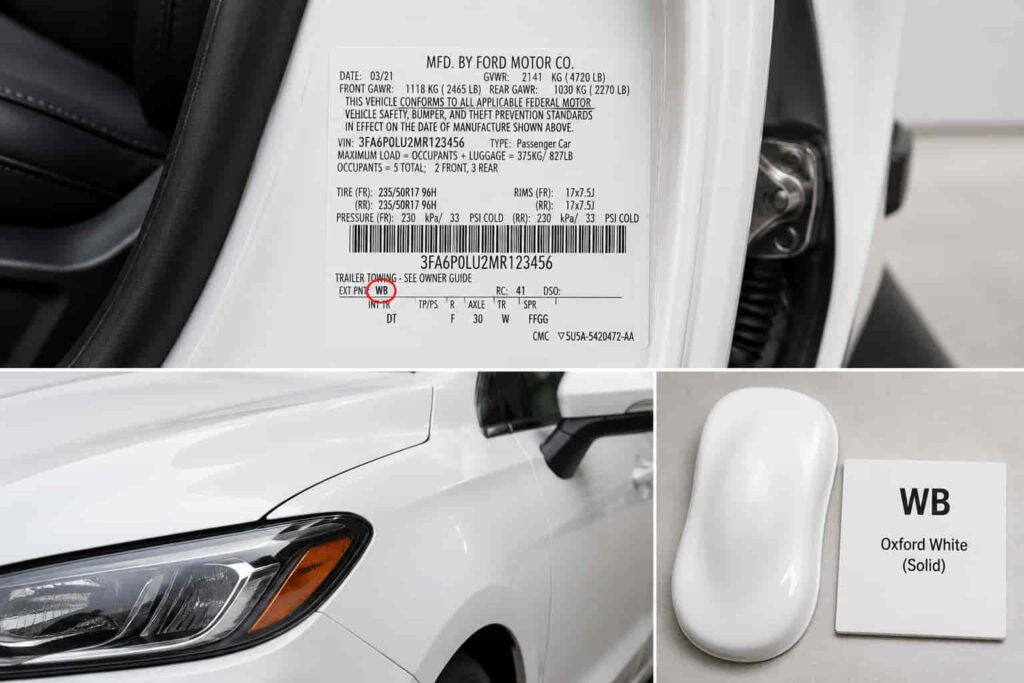
Choosing the correct paint for a Ford vehicle starts with identifying the exact factory paint code, not simply matching the visible color. Ford Paint Code WB is an OEM color identifier that helps manufacturers, collision repair centers, paint suppliers, and vehicle owners reproduce the original factory finish with the highest possible accuracy. Although many Ford colors appear similar to the naked eye, even slight differences in paint formulation, metallic content, or production batches can result in noticeable color mismatches after a repair.
Many vehicle owners assume that knowing the color name is enough to order touch-up paint or repaint a damaged panel. In reality, Ford assigns paint codes to distinguish specific factory formulations, allowing technicians to mix paint according to the manufacturer’s original specifications. This process becomes especially important when repairing scratches, replacing body panels, or restoring a vehicle after an accident, where maintaining a seamless factory appearance is the primary goal.
This guide explains seven essential facts about Ford Paint Code WB, including what the code represents, which Ford models may use it, where to locate the paint code on your vehicle, why identical paint codes can still produce slight visual differences, and how professionals achieve accurate color matching before applying new paint. By understanding how Ford’s paint identification system works, you can avoid ordering the wrong product, reduce the risk of expensive repainting, and achieve a finish that closely matches the vehicle’s original factory color.
What Color Is Ford Paint Code WB?
Ford Paint Code WB identifies a specific factory paint formulation used by Ford rather than a generic color name. Like other OEM paint codes, WB serves as a manufacturing reference that allows Ford and authorized paint suppliers to reproduce the exact finish applied during vehicle production. While owners often describe a vehicle by its visible color, such as white, silver, blue, or gray, professional repair facilities rely on the paint code because it represents the precise pigment formula, metallic content, pearl additives, and mixing ratios specified by the manufacturer.
Understanding the difference between a paint code and a commercial color name is essential before purchasing touch-up paint or scheduling collision repairs. A color name is primarily used for marketing and customer recognition, whereas a paint code functions as a technical identifier throughout the manufacturing and refinishing process. Ford may use similar color names across multiple model years, yet each version can have a different paint formulation due to updates in pigments, environmental regulations, or supplier changes. For this reason, ordering paint based solely on the visible color often increases the risk of receiving a finish that does not accurately match the original factory coating.
Ford Paint Code WB also represents a standardized reference within the automotive refinishing industry. Paint manufacturers such as PPG, BASF, Axalta, Sherwin-Williams, and other OEM-approved suppliers maintain databases that convert Ford paint codes into proprietary mixing formulas. Instead of manually matching a vehicle’s appearance, technicians retrieve the corresponding formula associated with the WB code and prepare the paint according to the manufacturer’s specifications. This standardized process improves consistency across repair facilities while reducing the possibility of significant color variation.
Although Ford Paint Code WB refers to a specific factory color, the final appearance may still vary slightly between vehicles. Factory paint naturally changes over time as it is exposed to ultraviolet radiation, moisture, road contaminants, oxidation, and regular washing. These environmental factors gradually alter the surface finish, meaning that a newly mixed OEM paint may appear slightly brighter or deeper than the surrounding original panels. Professional body shops compensate for this difference by performing spray-out tests and blending the new paint into adjacent panels instead of painting only the damaged area, creating a smoother visual transition.
Another important consideration is that a single Ford paint code may include multiple color variants. During mass production, Ford sources paint from different manufacturing plants and approved suppliers, each following the same OEM specification while producing minor variations in shade or metallic orientation. Professional paint databases often provide several formulas for the same paint code, allowing technicians to compare variants before selecting the closest match for a specific vehicle. This additional verification significantly improves refinishing accuracy, particularly on metallic and pearl finishes where small differences become more noticeable under changing lighting conditions.
For vehicle owners, Ford Paint Code WB should always be treated as the primary reference when ordering touch-up paint, aerosol paint, or professional refinishing materials. Using the correct OEM paint code ensures that suppliers can identify the appropriate factory formulation before preparing the product. Verifying the paint code before purchasing materials reduces unnecessary costs, minimizes repainting errors, and provides the best opportunity to restore the vehicle’s original appearance with an accurate factory color match.
Which Ford Models Use Paint Code WB?
Ford Paint Code WB is not assigned to every Ford vehicle because paint codes are linked to specific production programs, model years, manufacturing plants, and regional markets. Unlike engine components or mechanical parts that may be shared across multiple vehicle lines, exterior paint colors are selected according to market demand and product planning. As a result, the same paint code may appear on several Ford models produced during a particular period while being completely absent from others.
This distinction is important because many vehicle owners assume that if two Ford vehicles appear to have the same exterior color, they must also share the same paint code. In reality, Ford can apply different paint formulations that look nearly identical under normal lighting conditions. Small differences in metallic flakes, pearl pigments, gloss level, or pigment concentration are often invisible to the human eye but become noticeable after a repair if the wrong OEM formula is used. For this reason, professional repair shops always verify the factory paint code instead of relying on visual inspection alone.
Ford Paint Code WB may be found on selected passenger cars, SUVs, pickup trucks, or commercial vehicles depending on the production year and destination market. Ford continuously updates its color portfolio to reflect changing design trends, manufacturing technologies, and environmental regulations. A paint color introduced on one model may later be extended to additional vehicle lines, discontinued after several years, or replaced by a revised formulation carrying a different paint code. This means compatibility is determined by the official factory paint code rather than by the vehicle model alone.
Regional differences also influence where Ford Paint Code WB is used. Ford manufactures vehicles in multiple facilities across North America, Europe, Asia-Pacific, South America, and other global markets. Each region offers its own combination of exterior colors based on customer preferences, regulatory requirements, and local production capabilities. Consequently, a Ford vehicle built for the North American market may not share the same paint options as an equivalent model manufactured for Europe or Australia, even if both vehicles carry the same model name.
Another factor affecting paint code usage is the model year. Automotive manufacturers routinely refresh their color palettes during product updates, mid-cycle facelifts, or new-generation launches. A particular paint code may only remain available for a limited production period before being replaced by another factory formulation with improved durability, revised pigments, or compliance with updated environmental standards. Therefore, knowing only the vehicle model is rarely sufficient to confirm whether Ford Paint Code WB is the correct factory color.
Professional paint suppliers avoid these uncertainties by identifying the vehicle through multiple data points before recommending a paint formula. They typically verify the paint code displayed on the certification label, compare the model year and production information, and, when necessary, cross-reference the Vehicle Identification Number (VIN). This verification process significantly reduces the possibility of selecting an incorrect formula and ensures that the refinishing material matches the original factory specifications.
For Ford owners, the safest approach is to treat Paint Code WB as the definitive identifier rather than assuming compatibility based on vehicle appearance or model designation. Even when two vehicles seem identical, confirming the factory paint code before purchasing touch-up paint or refinishing materials provides the highest level of color accuracy and helps preserve the vehicle’s original factory finish.
Where Can You Find Ford Paint Code WB on Your Vehicle?
The easiest way to verify Ford Paint Code WB is by locating the factory certification label attached to your vehicle. Ford places this label on specific parts of the vehicle during production, allowing owners, dealerships, collision repair centers, and paint suppliers to identify the original factory paint without relying on visual inspection. Since exterior colors can fade over time or appear different under changing lighting conditions, the factory paint code remains the most reliable reference for ordering touch-up paint or reproducing the original finish.
On most modern Ford vehicles, the paint code is printed on the certification label positioned inside the driver’s door jamb. Opening the driver’s side door usually reveals a rectangular sticker containing several factory specifications, including the Vehicle Identification Number (VIN), manufacturing date, axle information, tire pressure recommendations, and the paint code. Depending on the production year and market, the paint information may appear beside labels such as “EXT PNT,” “Paint,” “Exterior Paint,” or simply “Color.” If the correct factory finish is WB, that code will be displayed in this section of the label.
Some Ford models may place the certification label in a slightly different location. Certain commercial vehicles, imported models, or older production years may carry the sticker on the driver’s door itself, the B-pillar, the door edge, or another factory-designated identification plate. Although the label location can vary, Ford consistently records the original paint code as part of the vehicle’s manufacturing data, making it possible to identify the correct factory color without removing body panels or performing manual color comparisons.
Many owners mistakenly believe that the Vehicle Identification Number can directly reveal the paint color. In reality, the VIN and the paint code serve different purposes. The VIN is a unique identifier assigned to each vehicle and contains information about the manufacturer, production plant, engine configuration, model year, and serial number. The paint code, however, specifies the original exterior finish applied during production. While the VIN does not normally include the paint code within its visible characters, Ford dealerships and authorized service providers can often retrieve the original factory paint information by accessing the manufacturer’s production database using the VIN.
This VIN verification process becomes particularly valuable when the certification label is damaged, missing, or no longer readable. Vehicles that have undergone extensive repairs, door replacements, restorations, or repainting may lose the original factory sticker, making direct identification impossible. Instead of estimating the color visually, professional paint suppliers use the VIN together with Ford production records to determine the original paint specification before preparing a matching formula. This additional verification significantly reduces the risk of selecting the wrong paint, especially when multiple factory colors appear visually similar.
Even after confirming that the vehicle carries Ford Paint Code WB, professional repair facilities rarely begin mixing paint immediately. Experienced technicians compare the factory code with digital paint databases that contain OEM formulas, manufacturer updates, and documented color variants. Some databases identify several approved formulas for the same paint code because slight production differences may exist between manufacturing plants or paint suppliers. Selecting the most appropriate variant before refinishing helps produce a closer visual match and minimizes noticeable differences after the repair has been completed.
Verifying Ford Paint Code WB before purchasing paint is one of the simplest ways to avoid expensive refinishing mistakes. Ordering paint based solely on a vehicle’s appearance or commercial color name can result in a finish that differs from the factory coating, particularly on metallic or pearl colors where small formulation changes become highly visible. Confirming the paint code directly from the certification label—or through VIN verification when necessary—provides the highest level of confidence that the selected paint corresponds to the vehicle’s original factory specification.
Read more: GM Extended Warranty Cost
Why Can Ford Paint Code WB Look Different on Two Vehicles?
Two Ford vehicles can display noticeably different paint appearances even when both use Ford Paint Code WB because a paint code identifies the original factory formula, not the exact visual condition of every vehicle throughout its lifetime. Automotive paint continuously changes after leaving the production line as it is exposed to sunlight, weather, road debris, chemicals, and routine maintenance. These environmental influences gradually alter the surface characteristics of the paint, making color matching significantly more complex than simply reproducing the original OEM formula.
One of the primary reasons for color variation is natural paint aging. Every factory finish undergoes oxidation as it interacts with oxygen, ultraviolet radiation, moisture, and airborne contaminants. Over several years, these factors slowly reduce gloss, soften color saturation, and alter the way light reflects from the painted surface. A vehicle that has spent most of its life outdoors in direct sunlight often exhibits more noticeable fading than an identical vehicle stored primarily inside a garage. Although both vehicles originally left the factory with Ford Paint Code WB, years of environmental exposure can create visible differences that become apparent during repair work.
Lighting conditions also play a significant role in how automotive paint is perceived. Modern OEM finishes frequently contain metallic flakes, pearl pigments, or mica particles that reflect light differently depending on the viewing angle and surrounding illumination. Under bright daylight, the paint may appear lighter and reveal more metallic sparkle, while the same surface can look deeper or darker under overcast skies, LED lighting, or indoor workshop conditions. This optical phenomenon, commonly known as flop, explains why a repaired panel that appears perfectly matched inside a paint booth may show slight differences when viewed outdoors.
Manufacturing tolerances represent another important factor. Although Ford establishes strict specifications for every OEM paint code, automotive paint is produced in multiple manufacturing facilities using approved suppliers around the world. Small differences in raw materials, pigment batches, metallic particle orientation, and production equipment can create subtle color variations while remaining within Ford’s acceptable quality standards. As a result, professional refinishing systems often include several color variants for the same paint code, allowing technicians to select the formula that most closely matches the vehicle being repaired rather than relying on a single universal mixture.
Previous repair history can further complicate color matching. A vehicle carrying Ford Paint Code WB may already have been repainted after a collision, cosmetic repair, or restoration project. If the earlier repair used an aftermarket formula, an incorrectly mixed color, or different application techniques, the current finish may no longer represent the original factory specification. Matching new paint to an existing non-OEM finish requires technicians to evaluate the vehicle’s actual appearance instead of assuming that the factory paint code alone guarantees an exact match.
Application technique has an equally significant impact on the final appearance. Automotive paint does not achieve its finished color solely through its chemical formulation. Spray gun pressure, nozzle size, spraying distance, overlap pattern, drying temperature, flash time, and clear coat thickness all influence how metallic particles settle within the paint film. Two technicians using the same Ford Paint Code WB formula can produce slightly different visual results if their application methods vary. For this reason, experienced body shops follow standardized spraying procedures and create spray-out cards before painting the vehicle to verify the final color under multiple lighting conditions.
Professional collision repair centers rarely repaint only the damaged panel when working with colors that contain metallic or pearl pigments. Instead, they use a blend repair technique that gradually feathers the new paint into adjacent panels, allowing the human eye to perceive a continuous color transition rather than a sharp boundary between old and new finishes. Blending compensates for minor differences caused by paint aging, manufacturing tolerances, and environmental exposure while preserving the overall appearance of the vehicle.
Understanding these factors helps explain why Ford Paint Code WB should be viewed as the starting point of the color-matching process rather than its final step. The factory paint code provides the correct OEM formula, but achieving an invisible repair requires technicians to evaluate the vehicle’s current paint condition, compare available color variants, perform test panels, and adjust the refinishing process when necessary. Combining factory paint data with professional color-matching techniques produces the closest possible result and maintains the original appearance of the vehicle long after the repair is complete.
How Do You Match Ford Paint Code WB Accurately?
Accurately matching Ford Paint Code WB requires more than simply selecting the correct OEM paint code because the factory formula is only one part of the refinishing process. Professional color matching combines factory paint information with vehicle inspection, color variant selection, controlled paint mixing, and standardized application techniques to reproduce a finish that blends naturally with the surrounding panels. Following every step of this process minimizes visible color differences and helps preserve the vehicle’s original factory appearance after repairs.
The first step is confirming that Ford Paint Code WB is the correct factory paint code for the vehicle. Professional repair facilities begin by inspecting the certification label or retrieving the original production information through the VIN if the label is missing or damaged. This verification prevents technicians from preparing paint based on assumptions or visual estimates, both of which can lead to expensive refinishing errors. Even when two Ford vehicles appear identical, the factory paint code remains the only reliable reference for identifying the original paint formulation.
After confirming the paint code, technicians retrieve the corresponding OEM mixing formula from professional refinishing software. Paint manufacturers such as PPG, BASF, Axalta, Sherwin-Williams, and other approved suppliers maintain extensive color databases that translate Ford Paint Code WB into precise mixing formulas using individual toner components. These digital libraries are regularly updated as manufacturers introduce revised formulations, newly identified color variants, or improvements to existing paint systems. Using an approved OEM formula ensures the mixed paint remains consistent with Ford’s original production specifications.
Selecting the correct color variant is equally important. Although Ford Paint Code WB represents a single factory paint code, professional databases often contain multiple approved variants developed from production samples collected from different manufacturing plants or assembly periods. These variants compensate for the minor differences that naturally occur during large-scale vehicle production. Instead of automatically choosing the default formula, experienced technicians compare available variants with the vehicle’s existing finish to determine which version most closely matches the current color.
Before any paint is applied to the vehicle, professional body shops create a spray-out card using the selected formula. This test panel is sprayed with the same base coat and clear coat system that will be used during the repair, then evaluated under multiple lighting conditions. Comparing the spray-out card with the surrounding body panels allows technicians to identify slight differences in brightness, metallic orientation, or color depth before work begins. If necessary, another variant or an adjusted formula can be tested until the closest possible match is achieved. This verification process significantly reduces the likelihood of discovering color mismatches after the repair has already been completed.
Application technique is another critical factor in achieving an accurate match. Metallic and pearl finishes respond differently depending on spray gun pressure, atomization, spraying distance, overlap pattern, flash time, and clear coat thickness. Even when the correct Ford Paint Code WB formula has been selected, inconsistent spraying techniques can alter how metallic particles settle within the paint film, causing the repaired area to appear lighter, darker, or more reflective than the surrounding panels. Professional refinishers therefore follow controlled application procedures designed specifically for each paint system to maintain consistent color and texture.
Rather than repainting only the damaged component, collision repair specialists frequently perform blend refinishing across adjacent panels. This technique gradually transitions the new paint into the original finish, making minor differences in color or metallic orientation virtually impossible to detect. Blending is widely considered the industry standard for repairing modern OEM finishes because it produces a smoother visual transition than painting a single isolated panel. The result is a repair that appears continuous under both natural sunlight and artificial lighting.
Once the paint has fully cured, technicians perform a final inspection to verify color accuracy, gloss consistency, and surface texture. The repaired area is examined from multiple viewing angles and under different lighting environments to ensure it integrates naturally with the surrounding factory finish. Any remaining imperfections are corrected before the vehicle is returned to the owner. This comprehensive quality control process confirms that the refinishing work meets professional standards and preserves the appearance intended by the original manufacturer.
Accurate color matching for Ford Paint Code WB is therefore achieved through a combination of verified factory data, professional color databases, variant selection, controlled application techniques, and careful quality inspection. Treating the OEM paint code as the foundation of a complete refinishing process—rather than the only requirement—produces the closest possible match to the vehicle’s original factory finish while minimizing the need for future corrective repairs.
When Should You Verify Ford Paint Code WB with the VIN?
You should verify Ford Paint Code WB with the Vehicle Identification Number (VIN) whenever the factory paint label is missing, damaged, unreadable, or when there is any uncertainty about the vehicle’s original paint specification. Although the paint code printed on the certification label is the primary reference for ordering OEM paint, there are situations where relying on the label alone is not sufficient. In these cases, the VIN provides access to the vehicle’s original production records, allowing dealerships and authorized paint suppliers to confirm the factory paint information before any refinishing work begins.
One of the most common reasons for VIN verification is the loss of the original certification label. During a vehicle’s lifetime, doors may be replaced following collision damage, restoration projects may remove factory stickers, or years of exposure may cause the label to become faded and unreadable. Without a visible paint code, attempting to identify the correct color through visual comparison alone introduces unnecessary risk because many Ford colors appear nearly identical under normal lighting conditions. Retrieving the original paint information through the VIN provides a far more reliable starting point for accurate color matching.
VIN verification is equally valuable when purchasing a used Ford vehicle with an unknown repair history. A vehicle may still display Ford Paint Code WB on its certification label even though one or more panels have already been repainted using a non-OEM formula or an incorrect aftermarket color. In these situations, the VIN confirms the factory specification rather than the vehicle’s current appearance. Professional refinishers can then compare the original OEM color with the existing finish to determine whether additional color adjustment or blending will be necessary during the repair.
Imported vehicles also benefit from VIN-based verification. Ford manufactures vehicles for multiple global markets, and paint availability often differs by production region. A model built for North America may not share exactly the same exterior color options as one produced for Europe, Australia, or Asia, even if both vehicles carry similar model names. Because the VIN contains manufacturing information such as the production plant, model year, and market destination, authorized Ford databases can identify the correct factory paint specification associated with that individual vehicle rather than relying on assumptions based on its appearance or sales market.
VIN verification becomes especially important when paint suppliers encounter multiple formulas associated with Ford Paint Code WB. Professional refinishing databases frequently include several approved color variants developed from different production batches or manufacturing facilities. While the paint code identifies the correct OEM color family, production records obtained through the VIN help technicians narrow the search and eliminate formulas that do not correspond to the vehicle’s original manufacturing specifications. This additional level of verification improves the accuracy of the initial color selection before spray-out testing begins.
It is equally important to understand what the VIN can and cannot do. The VIN itself does not visibly display the paint code within its sequence of characters. Instead, it serves as a unique production identifier that links the vehicle to Ford’s manufacturing database. Authorized dealerships, OEM repair networks, and professional paint distributors use this database to retrieve original factory information, including the paint specification assigned during production. The VIN therefore acts as a gateway to verified manufacturing records rather than functioning as a paint code itself.
Even after the original paint specification has been confirmed through the VIN, experienced technicians do not rely exclusively on production records. The vehicle’s current paint condition must still be evaluated because years of weather exposure, oxidation, previous repairs, and normal wear can alter the appearance of the original finish. Spray-out cards, digital color measurement, and blend refinishing remain essential steps in producing a repair that matches the surrounding panels as closely as possible.
Using the VIN as a secondary verification tool significantly reduces the likelihood of ordering incorrect refinishing materials, particularly when factory labels are unavailable or the vehicle’s history is uncertain. Combining VIN verification with the original paint code, professional color databases, and practical color-matching procedures provides the highest level of confidence that Ford Paint Code WB will be reproduced as accurately as possible while maintaining the vehicle’s original factory appearance.
What Should You Know Before Ordering Ford Paint Code WB Touch-Up Paint?
Ordering Ford Paint Code WB touch-up paint should always begin with verifying the factory paint code rather than selecting paint based on the vehicle’s visible color or a commercial color name. Many Ford finishes appear nearly identical under normal lighting, yet small differences in pigment composition, metallic particles, or pearl additives can produce a repair that stands out once the paint has cured. Confirming the correct OEM paint code before placing an order is the most effective way to ensure that the refinishing material corresponds to the vehicle’s original factory specification.
The first consideration is choosing a product that matches both the paint code and the type of repair being performed. Minor stone chips and light scratches are typically repaired with a touch-up paint pen or brush bottle, while larger damaged areas often require aerosol paint or professional spray equipment. Although each product may use the same Ford Paint Code WB formula, the application method influences the quality of the final repair. Selecting the appropriate product allows the paint to be applied more evenly and helps achieve a finish that integrates naturally with the surrounding body panels.
It is equally important to verify whether the paint system requires both a base coat and a clear coat. Most modern Ford factory finishes use a two-stage paint system in which the base coat provides the color and the clear coat supplies gloss, ultraviolet protection, and long-term durability. Applying only the colored paint without the recommended clear coat often produces a surface with reduced shine, lower weather resistance, and a visible difference from the adjacent factory finish. Following the correct paint system recommended by the manufacturer is essential for reproducing the appearance of the original coating.
Vehicle age should also be considered before ordering touch-up paint. Even when Ford Paint Code WB is confirmed as the correct factory specification, years of exposure to sunlight, moisture, road salt, and environmental contaminants gradually change the appearance of automotive paint. Freshly mixed OEM paint represents the original production formula rather than the weathered finish currently visible on the vehicle. Professional repair facilities compensate for this natural aging through color variant selection, spray-out testing, and blending techniques. Owners performing small cosmetic repairs should therefore expect slight differences to be more noticeable on older vehicles than on newer ones.
Purchasing paint from a supplier that specializes in OEM automotive refinishing further improves the likelihood of achieving an accurate color match. Professional suppliers maintain updated formula databases provided by major paint manufacturers and routinely incorporate revised color variants released after production. This allows them to prepare paint using the most current refinishing information instead of relying on outdated formulas or generic aftermarket color references. Access to professional color libraries becomes especially valuable when Ford Paint Code WB has multiple approved variants developed for different production batches or assembly plants.
Providing additional vehicle information when placing an order can further improve color accuracy. Many professional paint suppliers request the vehicle’s model, production year, and Vehicle Identification Number alongside the paint code. These details allow technicians to cross-reference factory production records, identify potential color variants, and verify compatibility before mixing the paint. This extra verification step reduces the possibility of ordering an incorrect formula and minimizes delays caused by replacement orders or unnecessary repainting.
Price should never be the only factor when selecting touch-up paint. Lower-cost products that advertise compatibility with multiple manufacturers or broad color categories often sacrifice formulation accuracy in favor of wider application. While these products may appear similar immediately after application, differences in color depth, metallic orientation, gloss level, and weather resistance become increasingly noticeable over time. Choosing paint prepared specifically for Ford Paint Code WB provides a significantly higher probability of maintaining the vehicle’s original appearance and long-term durability.
Ultimately, ordering Ford Paint Code WB touch-up paint is not simply about purchasing a matching color—it is about reproducing the original factory finish as accurately as possible. Verifying the OEM paint code, selecting the appropriate refinishing system, considering the vehicle’s current paint condition, and working with a reputable automotive paint supplier all contribute to a more precise repair. Following these practices reduces the risk of color mismatch, improves the overall quality of the repair, and helps preserve the factory appearance that Ford intended when the vehicle left the assembly line.
Conclusion
Ford Paint Code WB is the most reliable reference for identifying your vehicle’s original factory paint and achieving an accurate color match during touch-up or refinishing work. While the paint code provides the official OEM formulation, achieving a seamless repair depends on more than simply ordering paint with the correct code. Vehicle age, environmental exposure, manufacturing variations, application techniques, and professional color-matching procedures all influence the final appearance of the repaired surface.
Throughout this guide, you have learned that Ford Paint Code WB identifies a factory-approved paint formulation rather than a commercial color name, making it the foundation of every successful refinishing project. You have also seen why the same paint code may appear on different Ford models, how to locate the paint code on your vehicle, when VIN verification becomes necessary, and why two vehicles with the same paint code can still display subtle visual differences after years of use. Understanding these factors allows vehicle owners to make informed decisions before purchasing touch-up paint or scheduling collision repairs.
Whether you are repairing a small paint chip, restoring a damaged body panel, or performing a complete repaint, verifying Ford Paint Code WB before ordering refinishing materials is one of the most effective ways to avoid color mismatch and unnecessary repair costs. Working with suppliers that use OEM paint formulas, checking for available color variants, and following professional refinishing practices significantly improve the chances of reproducing the original factory finish.
As Ford continues to update its vehicle lineup and paint technologies, factory paint codes remain the universal language connecting manufacturers, dealerships, collision repair centers, and automotive paint suppliers. By using Ford Paint Code WB as the starting point of the refinishing process—and combining it with proper verification and professional color-matching techniques—you can preserve your vehicle’s original appearance, maintain its value, and achieve a repair that blends naturally with the surrounding factory finish.