The Jeep Grand Cherokee Trackhawk produces 707 horsepower at 6,000 RPM and 645 lb-ft of torque at 4,800 RPM from its supercharged 6.2-liter HEMI V8 engine. This factory-rated output makes the Trackhawk one of the most powerful gasoline-powered SUVs of its era, combining muscle-car performance with the practicality of a five-passenger SUV.
Introduced for the 2018 model year, the Jeep Grand Cherokee Trackhawk uses a high-performance engine derived from the Dodge Hellcat family. Its supercharger forces additional air into the combustion chambers, allowing the engine to generate substantially more power than the naturally aspirated 6.4-liter V8 found in the Grand Cherokee SRT. The Trackhawk delivers 232 more horsepower than the 475-horsepower SRT, making it the most powerful production Grand Cherokee of its generation.
The Trackhawk’s 707 horsepower translates into impressive acceleration. According to Jeep’s factory specifications, the SUV accelerates from 0 to 60 mph in 3.5 seconds, completes the quarter-mile in 11.6 seconds, and reaches a top speed of 180 mph. Its eight-speed automatic transmission and Quadra-Trac four-wheel-drive system help transfer engine power to the road.
This article explains the Trackhawk’s horsepower specifications, supercharged engine, acceleration capabilities, and power differences compared with Hellcat models and the Grand Cherokee SRT. It also examines horsepower ratings across model years and the potential output of modified Trackhawks.
How Much Horsepower Does a Stock Jeep Trackhawk Have?
A stock Jeep Grand Cherokee Trackhawk produces 707 horsepower at 6,000 RPM and 645 lb-ft of torque at 4,800 RPM. These figures represent the engine’s factory-rated output at the crankshaft, before power passes through the transmission, transfer case, and four-wheel-drive system. Jeep maintained these horsepower and torque ratings throughout the Trackhawk’s 2018–2021 production run.
The Trackhawk’s 707 horsepower comes from a supercharged 6.2-liter HEMI V8, making it significantly more powerful than the standard Grand Cherokee’s engine options. Its 645 lb-ft of torque provides substantial rotational force for acceleration, while horsepower determines how quickly the engine can perform work as RPM increases. Together, these characteristics allow the Trackhawk to deliver strong acceleration across a broad engine-speed range.
The factory horsepower rating differs from the power measured at the wheels. A chassis dynamometer measures wheel horsepower (WHP), which is lower than crankshaft horsepower because the drivetrain consumes energy through mechanical friction and other losses. Consequently, a stock Trackhawk does not deliver all 707 horsepower directly to its tires. Actual dynamometer results vary according to testing equipment, environmental conditions, and measurement procedures.
The following table summarizes the stock Jeep Grand Cherokee Trackhawk’s primary engine specifications.
| Specification | Factory Rating |
|---|---|
| Engine | 6.2L Supercharged HEMI V8 |
| Horsepower | 707 hp at 6,000 RPM |
| Torque | 645 lb-ft at 4,800 RPM |
| Engine Displacement | 6,166 cc |
| Cylinder Configuration | V8 |
| Aspiration | Supercharged |
| Transmission | 8-speed automatic |
| Drivetrain | Four-wheel drive |
| Production Model Years | 2018–2021 |
What Engine Produces the Trackhawk’s 707 Horsepower?
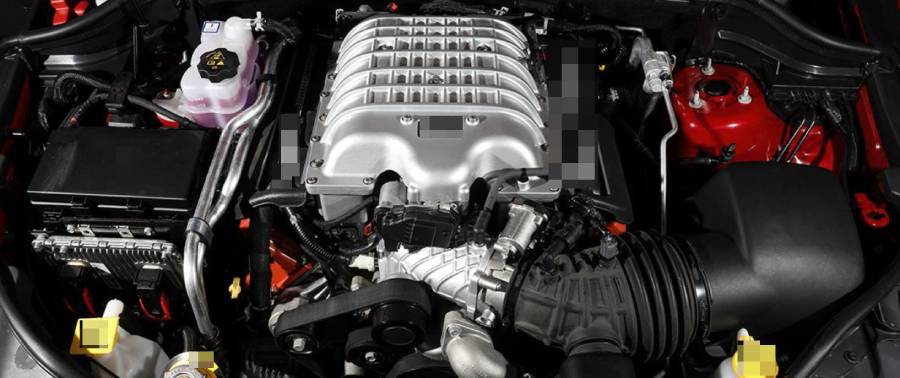
The Jeep Grand Cherokee Trackhawk’s supercharged 6.2-liter HEMI V8 engine produces 707 horsepower by combining a large-displacement V8 configuration with forced induction. Unlike a naturally aspirated engine, which relies on atmospheric pressure to draw air into its cylinders, the Trackhawk uses a mechanically driven supercharger to increase intake-air pressure and support greater power production.
The engine features a 2.4-liter twin-screw supercharger capable of producing approximately 11.6 psi of boost pressure. The supercharger compresses incoming air before it enters the combustion chambers, allowing the engine to burn more fuel and generate greater combustion pressure. This process increases torque output and enables the V8 to produce 707 horsepower without requiring extremely high engine speeds.
The Trackhawk’s HEMI V8 also uses a cast-iron engine block, aluminum cylinder heads, and a forged-steel crankshaft designed to withstand the substantial mechanical loads created by forced induction. Its intercooling system reduces the temperature of compressed intake air, improving air density and helping the engine maintain consistent performance under demanding operating conditions.
Engine displacement also contributes to the Trackhawk’s performance. Its 6,166 cc capacity allows eight cylinders to process a substantial volume of air and fuel during each combustion cycle. Combined with supercharging, this displacement produces 645 lb-ft of torque at 4,800 RPM, supporting rapid acceleration without relying exclusively on high-RPM horsepower.
The Trackhawk shares its basic supercharged HEMI engine architecture with the Dodge Challenger SRT Hellcat, although the SUV uses an application-specific powertrain configuration. Its eight-speed TorqueFlite automatic transmission distributes engine output through a four-wheel-drive system, improving traction during hard acceleration. This combination of engine power, transmission gearing, and driven-wheel traction allows the Trackhawk to achieve performance figures associated with dedicated sports cars.
How Fast Is a Jeep Trackhawk With 707 Horsepower?
The Jeep Grand Cherokee Trackhawk accelerates from 0 to 60 mph in 3.5 seconds and reaches a top speed of 180 mph (290 km/h), according to Jeep’s factory performance specifications. Its 707-horsepower supercharged V8, 645 lb-ft of torque, and four-wheel-drive system allow this high-performance SUV to deliver acceleration comparable to that of dedicated sports cars.
The Trackhawk completes the quarter-mile in approximately 11.6 seconds at a trap speed of 116 mph under manufacturer-specified testing conditions. Its eight-speed TorqueFlite automatic transmission helps maintain acceleration by selecting gear ratios that keep the engine within its effective power range. The transmission also features launch control, which manages engine torque during standing-start acceleration to improve traction and reduce excessive wheelspin.
The Trackhawk’s Quadra-Trac four-wheel-drive system plays a significant role in converting engine output into forward motion. Unlike rear-wheel-drive performance cars, which transmit power through two driven wheels, the Trackhawk distributes torque between the front and rear axles. This arrangement helps the SUV maintain traction when accelerating from a standstill, particularly when the engine delivers substantial torque at relatively low speeds.
Despite weighing approximately 5,363 pounds (2,433 kg), the Trackhawk achieves its rapid acceleration through a combination of high engine output, responsive transmission gearing, and all-wheel traction. Its power-to-weight ratio is approximately 7.6 pounds per horsepower, illustrating how the 707-horsepower engine compensates for the SUV’s considerable mass.
The following table summarizes the Jeep Grand Cherokee Trackhawk’s factory performance specifications.
| Performance Metric | Factory Specification |
|---|---|
| Horsepower | 707 hp |
| Torque | 645 lb-ft |
| 0–60 mph | 3.5 seconds |
| Quarter-mile time | 11.6 seconds |
| Quarter-mile trap speed | 116 mph |
| Top speed | 180 mph (290 km/h) |
| Curb weight | Approximately 5,363 lbs |
| Power-to-weight ratio | Approximately 7.6 lbs/hp |
The Trackhawk’s maximum speed depends on more than engine horsepower alone. Aerodynamic drag increases substantially as vehicle speed rises, requiring progressively greater engine power to maintain acceleration. The SUV’s transmission gearing, tire specifications, and aerodynamic characteristics also influence its achievable top speed. Although its 707-horsepower engine provides considerable high-speed capability, the Trackhawk’s factory-rated maximum remains 180 mph.
Actual acceleration results vary with road conditions, tire grip, ambient temperature, vehicle load, and testing methods. Independent automotive tests may therefore record different 0–60 mph or quarter-mile times from Jeep’s published figures. Nevertheless, the factory specifications demonstrate how the Trackhawk combines supercharged V8 power with a performance-oriented four-wheel-drive system to achieve exceptional acceleration for a production SUV.
Does a Trackhawk Have More Horsepower Than a Hellcat?
The Jeep Grand Cherokee Trackhawk produces 707 horsepower, matching the original Dodge Challenger SRT Hellcat but producing 3 horsepower less than the Dodge Durango SRT Hellcat. All three vehicles use versions of the supercharged 6.2-liter HEMI V8 engine, although their factory horsepower ratings, drivetrain configurations, and performance characteristics differ.
The original Dodge Challenger SRT Hellcat, introduced for the 2015 model year, produces 707 horsepower and 650 lb-ft of torque. The Trackhawk matches its horsepower rating but generates 645 lb-ft of torque, a difference of 5 lb-ft. Despite sharing the same basic engine architecture, the Challenger uses a rear-wheel-drive configuration, while the Trackhawk employs a four-wheel-drive system designed to distribute engine torque between both axles.
The Dodge Durango SRT Hellcat produces 710 horsepower and 645 lb-ft of torque from its supercharged 6.2-liter HEMI V8. This gives the Durango a 3-horsepower advantage over the Trackhawk while maintaining an identical factory torque rating. However, the small horsepower difference does not automatically make the Durango quicker because acceleration also depends on vehicle weight, transmission calibration, gearing, and traction.
The following table compares the factory horsepower and torque ratings of these Hellcat-powered vehicles.
| Vehicle | Horsepower | Torque | Drivetrain |
|---|---|---|---|
| Jeep Grand Cherokee Trackhawk | 707 hp | 645 lb-ft | 4WD |
| Dodge Challenger SRT Hellcat (Original) | 707 hp | 650 lb-ft | RWD |
| Dodge Charger SRT Hellcat (Original) | 707 hp | 650 lb-ft | RWD |
| Dodge Durango SRT Hellcat | 710 hp | 645 lb-ft | AWD |
The Trackhawk’s four-wheel-drive system provides a traction advantage during standing-start acceleration by distributing power across four driven wheels. Jeep rates the Trackhawk’s 0–60 mph acceleration at 3.5 seconds, while the original Challenger SRT Hellcat’s published acceleration figures are generally around 3.5–3.6 seconds, depending on testing conditions and transmission configuration.
Not every Hellcat produces 707 horsepower. Later Challenger and Charger Hellcat variants received higher-output engine configurations, including the 717-horsepower Hellcat and 797-horsepower Hellcat Redeye. Therefore, the Trackhawk matches the original Hellcat’s horsepower but produces less power than several later Hellcat models.
How Much Horsepower Does a Trackhawk Have Compared to a Grand Cherokee SRT?
The Jeep Grand Cherokee Trackhawk produces 232 more horsepower than the Grand Cherokee SRT, with factory ratings of 707 horsepower and 475 horsepower, respectively. The difference comes primarily from their engine configurations: the Trackhawk uses a supercharged 6.2-liter HEMI V8, while the Grand Cherokee SRT uses a naturally aspirated 6.4-liter HEMI V8.
The Grand Cherokee SRT generates 475 horsepower at 6,000 RPM and 470 lb-ft of torque at 4,300 RPM. In comparison, the Trackhawk produces 707 horsepower at 6,000 RPM and 645 lb-ft of torque at 4,800 RPM. This represents approximately 49% more horsepower and 37% more torque than the SRT, giving the Trackhawk a substantial advantage in engine output.
Although the SRT has a larger engine displacement of 6.4 liters compared with the Trackhawk’s 6.2 liters, displacement alone does not determine horsepower. The Trackhawk’s supercharger compresses intake air, allowing more oxygen and fuel to enter the combustion chambers during each engine cycle. This forced-induction system enables the smaller-displacement engine to generate considerably greater power than the naturally aspirated SRT engine.
The following table highlights the primary performance differences between the two Grand Cherokee models.
| Specification | Trackhawk | Grand Cherokee SRT |
|---|---|---|
| Engine | 6.2L Supercharged V8 | 6.4L Naturally Aspirated V8 |
| Horsepower | 707 hp | 475 hp |
| Torque | 645 lb-ft | 470 lb-ft |
| 0–60 mph | 3.5 seconds | 4.3 seconds |
| Top Speed | 180 mph | Approximately 160 mph |
| Transmission | 8-speed automatic | 8-speed automatic |
| Drivetrain | 4WD | 4WD |
The Trackhawk’s additional 232 horsepower contributes to a factory-rated 0–60 mph time approximately 0.8 seconds quicker than the Grand Cherokee SRT. Its higher torque output also provides greater acceleration potential when overtaking or accelerating at highway speeds, although actual performance depends on vehicle speed, selected gear, and available traction.
Both SUVs use eight-speed automatic transmissions and performance-oriented four-wheel-drive systems, but the Trackhawk includes powertrain and drivetrain components engineered to accommodate its substantially higher output. Its upgraded cooling systems, braking hardware, and performance calibration support the demands of the supercharged engine.
The Grand Cherokee SRT remains a high-performance SUV with a powerful naturally aspirated V8, but the Trackhawk delivers significantly greater factory horsepower, torque, and acceleration. For drivers comparing these models primarily on engine performance, the Trackhawk holds a clear advantage.
Does Trackhawk Horsepower Vary by Model Year?
The Jeep Grand Cherokee Trackhawk produces 707 horsepower and 645 lb-ft of torque across all four production model years, from 2018 through 2021. Jeep retained the same supercharged 6.2-liter HEMI V8 engine throughout the Trackhawk’s production run without introducing factory horsepower increases or higher-output variants.
The 2018 Trackhawk debuted with 707 horsepower at 6,000 RPM and 645 lb-ft of torque at 4,800 RPM. The 2019, 2020, and 2021 models maintained these specifications, along with the eight-speed automatic transmission and Quadra-Trac four-wheel-drive system. Although equipment packages, exterior colors, and available features changed between model years, these updates did not affect the engine’s factory-rated output.
The following table compares Trackhawk horsepower and torque across its production years.
| Model Year | Horsepower | Torque | Engine |
|---|---|---|---|
| 2018 Trackhawk | 707 hp | 645 lb-ft | 6.2L Supercharged V8 |
| 2019 Trackhawk | 707 hp | 645 lb-ft | 6.2L Supercharged V8 |
| 2020 Trackhawk | 707 hp | 645 lb-ft | 6.2L Supercharged V8 |
| 2021 Trackhawk | 707 hp | 645 lb-ft | 6.2L Supercharged V8 |
The Trackhawk was discontinued after the 2021 model year as Jeep transitioned to the next generation of the Grand Cherokee. The redesigned Grand Cherokee lineup did not include a direct Trackhawk replacement with the same 707-horsepower supercharged V8. Consequently, the 2021 Trackhawk remains the final production model year of this particular high-performance Grand Cherokee.
For buyers comparing used Trackhawks, model year alone does not determine horsepower. A properly maintained, unmodified 2018 Trackhawk has the same factory-rated engine output as a 2021 model. Differences in actual performance are more likely to result from vehicle condition, maintenance history, tire specifications, environmental conditions, and aftermarket modifications.
Read more: 6R140 Valve Body Replacement: Step-by-Step Guide
How Much Horsepower Can a Modified Trackhawk Make?
A modified Jeep Grand Cherokee Trackhawk can produce more than its factory-rated 707 horsepower, with heavily upgraded builds exceeding 1,000 horsepower at the crankshaft. The actual output depends on the combination of ECU tuning, supercharger modifications, fuel-system capacity, engine components, and supporting cooling upgrades. Horsepower figures must also distinguish between crankshaft output and power measured at the wheels.
ECU tuning is one method of increasing Trackhawk horsepower. The engine control unit regulates operating parameters such as ignition timing, fuel delivery, and commanded engine behavior. A performance calibration adjusts these parameters to accommodate the vehicle’s hardware configuration and fuel quality. However, tuning results depend on the engine’s mechanical condition, available octane, and the calibration’s operating limits.
Supercharger pulley upgrades provide another method of increasing engine output. Installing a smaller drive pulley can increase supercharger speed and boost pressure, allowing more compressed air to enter the engine. Additional airflow supports greater fuel combustion and torque production, provided the fuel system and cooling components can accommodate the increased demand. Higher boost also increases heat generation and mechanical stress, making appropriate supporting modifications essential.
Modified Trackhawks may also require upgraded fuel injectors, fuel pumps, heat exchangers, and intake components. These upgrades support increased airflow, maintain fuel delivery, and help manage intake-air temperatures during demanding operation. Extreme horsepower builds may require strengthened internal engine components and transmission upgrades to withstand the additional torque.
The following table illustrates broad horsepower categories for different Trackhawk configurations. These are approximate build targets rather than guaranteed results.
| Trackhawk Configuration | Approximate Crank Horsepower |
|---|---|
| Stock engine | 707 hp |
| ECU-tuned setup | Above 707 hp; varies by calibration |
| Pulley and supporting upgrades | 800–950 hp |
| Extensive supercharger and fuel-system upgrades | 950–1,100+ hp |
| Fully built high-performance engine | 1,100+ hp, depending on configuration |
These ranges are illustrative, not manufacturer-certified specifications. Individual builds require dynamometer testing and documentation to establish their actual horsepower.
Wheel horsepower is particularly important when evaluating modified Trackhawks. The factory’s 707-horsepower rating measures engine output at the crankshaft, while a chassis dynamometer measures the power delivered through the drivetrain to the wheels. Mechanical losses in the transmission, transfer case, differentials, and other rotating components reduce the measured output.
For example, a hypothetical Trackhawk producing 850 horsepower at the crankshaft would deliver approximately 680 wheel horsepower if total drivetrain losses were assumed to be 20%. This calculation illustrates the difference between the two measurements rather than establishing a fixed drivetrain-loss percentage. Actual losses depend on drivetrain design, operating conditions, and the dynamometer’s measurement method.
Increasing Trackhawk horsepower also introduces mechanical and ownership considerations. Higher boost pressure and combustion loads place additional demands on the engine, transmission, cooling system, and drivetrain. Poorly calibrated modifications can increase the risk of detonation, overheating, and premature component failure. Aftermarket tuning may also affect emissions compliance, manufacturer warranty coverage, and long-term reliability.
For owners seeking greater performance, the most meaningful horsepower figure is a verified measurement accompanied by details of the vehicle’s modifications, fuel type, and testing conditions. Comparing two modified Trackhawks solely by advertised horsepower can be misleading when one figure represents crankshaft output and the other represents wheel horsepower.
Is the Jeep Trackhawk Still One of the Most Powerful SUVs?
The Jeep Grand Cherokee Trackhawk remains one of the most powerful gasoline-powered SUVs of its generation, producing 707 horsepower and 645 lb-ft of torque. However, newer high-performance SUVs have surpassed its factory horsepower rating, including the 710-horsepower Dodge Durango SRT Hellcat, 738-horsepower Lamborghini Urus SE, and 771-horsepower Porsche Cayenne Turbo E-Hybrid.
When Jeep introduced the Trackhawk for the 2018 model year, its supercharged 6.2-liter HEMI V8 delivered exceptional output for a production SUV. Its 707 horsepower exceeded the ratings of several contemporary performance SUVs, including the 567-horsepower BMW X5 M and 577-horsepower Mercedes-AMG GLE 63 S. The Trackhawk also combined this power with four-wheel drive, enabling a factory-rated 0–60 mph acceleration time of 3.5 seconds.
Modern performance SUVs achieve higher horsepower through different powertrain technologies. The Lamborghini Urus SE combines a twin-turbocharged V8 with an electric motor to produce approximately 738 mechanical horsepower, while the Porsche Cayenne Turbo E-Hybrid generates approximately 771 mechanical horsepower from its plug-in hybrid system. Unlike these electrified models, the Trackhawk generates its entire 707-horsepower output through a supercharged gasoline engine.
The following table compares the Trackhawk with several higher-output performance SUVs.
| Performance SUV | Horsepower | Powertrain |
|---|---|---|
| Jeep Grand Cherokee Trackhawk | 707 hp | 6.2L Supercharged V8 |
| Dodge Durango SRT Hellcat | 710 hp | 6.2L Supercharged V8 |
| Lamborghini Urus SE | Approx. 738 hp | 4.0L Twin-Turbo V8 Hybrid |
| Porsche Cayenne Turbo E-Hybrid | Approx. 771 hp | 4.0L Twin-Turbo V8 Hybrid |
| Aston Martin DBX707 | Approx. 697 hp | 4.0L Twin-Turbo V8 |
Horsepower alone does not determine which SUV accelerates fastest. Vehicle weight, torque delivery, transmission gearing, tire traction, and drivetrain configuration influence acceleration. Electric motors in hybrid performance SUVs can also provide immediate torque assistance, improving low-speed acceleration even when the difference in peak horsepower is relatively small.
The Trackhawk’s performance remains competitive because its 707-horsepower engine works with an eight-speed automatic transmission and a four-wheel-drive system designed to manage substantial torque. Although newer SUVs offer greater peak output and advanced hybrid technology, the Trackhawk retains its distinction as the most powerful factory-produced Jeep Grand Cherokee of its generation.