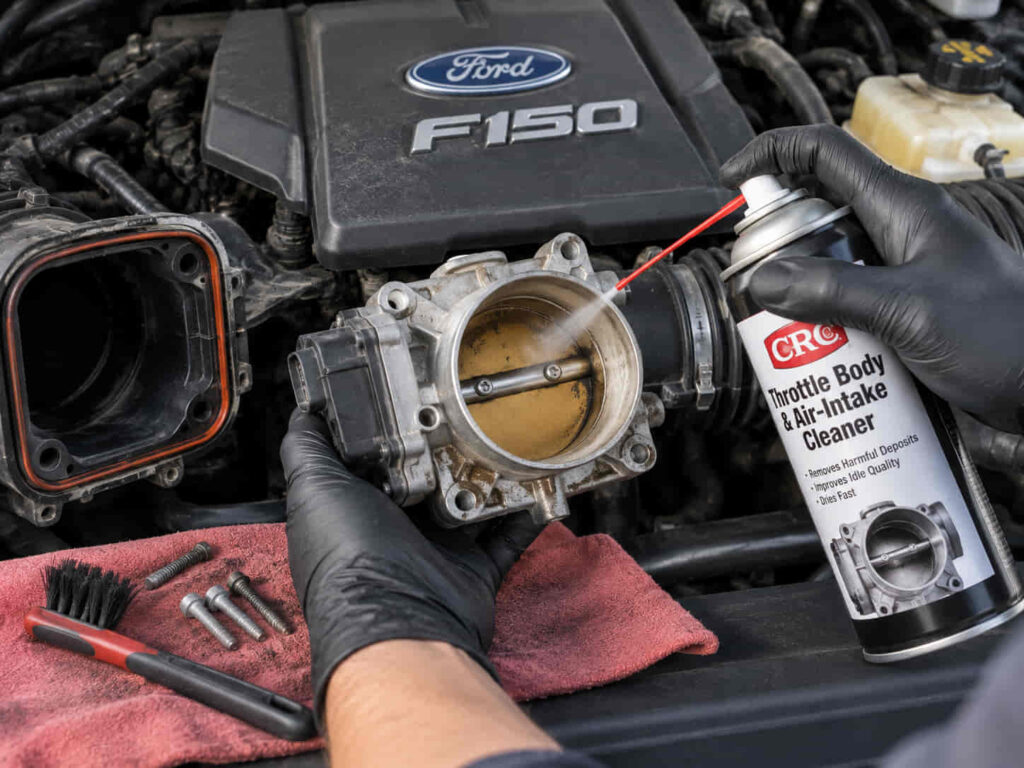
A dirty throttle body can affect the way a Ford F-150 responds to the accelerator, maintains idle speed, and delivers smooth engine performance. Over time, oil vapor, dust, and carbon deposits from the intake system can accumulate around the throttle plate and its housing. When that buildup becomes significant, the engine may struggle to maintain a stable idle or respond as cleanly as it normally should. For an owner trying to diagnose rough running or inconsistent throttle response, the throttle body is therefore an important component to understand.
Cleaning the throttle body may sound like a simple maintenance task, but modern F-150 models use electronic throttle control, which means the procedure requires more care than simply spraying cleaner into the intake. The construction of the throttle body, electrical connections, throttle plate, and post-cleaning throttle adaptation can vary depending on the F-150’s model year and engine.
This Ford F-150 throttle body cleaning guide explains what the throttle body does, why carbon buildup occurs, how to determine whether cleaning is appropriate, and how to approach the cleaning process safely. It also covers what to check after cleaning and when a dirty throttle body may actually indicate a deeper intake or engine problem. The goal is not simply to remove visible deposits, but to restore proper airflow while avoiding damage to the electronic throttle system.
What Does the Throttle Body Do on a Ford F-150?
The throttle body plays a central role in controlling how much air enters the engine of a Ford F-150. In modern F-150 models, the throttle system is electronically controlled rather than relying on a traditional mechanical cable connected directly to the accelerator pedal. When the driver presses the accelerator, the engine control system interprets that input and commands the throttle body to adjust the throttle plate. This allows the engine to regulate airflow according to operating conditions, driver demand, and other inputs from the vehicle’s control systems.
Because airflow through the throttle body directly affects engine operation, deposits around the throttle plate can become relevant when they interfere with normal airflow. Oil vapor from the crankcase ventilation system can enter the intake tract, where it can mix with dust and other contaminants. Over time, this material may accumulate around the throttle plate and the inner surface of the throttle body. The amount of buildup can vary considerably depending on the engine, mileage, driving conditions, maintenance history, and condition of the intake system.
A small amount of residue does not necessarily mean the throttle body needs immediate cleaning. Throttle bodies are designed to operate with some contamination, and cleaning should be considered in the context of actual symptoms and the vehicle’s maintenance requirements. Problems such as unstable idle, hesitation, inconsistent throttle response, or an illuminated check engine light can have many possible causes, including sensors, vacuum leaks, ignition problems, fuel delivery issues, or electronic throttle control faults.
This distinction is important because cleaning the throttle body is not a universal solution for every drivability problem. If the throttle body is heavily contaminated, cleaning may help restore the intended airflow characteristics. If the underlying problem is electrical, mechanical, or related to another component, however, cleaning alone will not correct it.
Understanding how the throttle body interacts with the intake system also explains why the cleaning process deserves care. The component contains sensitive electronic and mechanical parts, and aggressive handling or inappropriate cleaning products can cause damage. Before beginning a Ford F-150 throttle body cleaning procedure, the specific engine and model year should therefore be identified so the appropriate service procedure can be followed.
Read more: Ford F150 Rear Differential Gear Oil Type
Signs Your Ford F-150 Throttle Body May Need Cleaning
A Ford F-150 does not always provide an obvious warning when deposits begin accumulating inside the throttle body. In many cases, the first indication is a subtle change in how the engine behaves at idle or responds to accelerator input. Because the throttle body controls the amount of air entering the engine, significant contamination around the throttle plate can interfere with the airflow characteristics the engine control system expects.
One possible sign is an unstable or unusually rough idle. The engine may appear to struggle to maintain a consistent idle speed, particularly when coming to a stop or immediately after starting. A hesitation when accelerating can also attract attention, especially if the truck previously responded smoothly to small changes in accelerator input. Some drivers may notice that the engine feels less responsive or that throttle behavior is inconsistent during low-speed driving.
Another potential symptom is an unusual change in idle speed after the engine reaches operating temperature. A throttle body with substantial deposits may affect the amount of air passing around the throttle plate when it is near its closed position. However, idle problems can also originate from vacuum leaks, sensors, ignition components, fuel system issues, or software and electronic throttle control faults. The symptom alone is therefore not enough to confirm that cleaning is necessary.
A check engine light can provide another clue, but it should not automatically be interpreted as evidence of a dirty throttle body. Modern F-150 models continuously monitor the electronic throttle system and other engine parameters. If a diagnostic trouble code is present, reading the code and understanding its associated system is more useful than replacing or cleaning components based solely on the warning light.
Physical inspection can provide additional information when access to the throttle body is appropriate. Visible deposits around the throttle plate or throttle bore may indicate that contamination has accumulated, although the presence of some residue does not necessarily mean that the component is malfunctioning. The condition of the intake tract should also be considered because excessive contamination may point toward an underlying source of oil vapor or other deposits.
The most important point is that throttle body cleaning should be treated as a maintenance and diagnostic decision rather than a guaranteed cure for drivability problems. If symptoms are severe, persistent, or accompanied by warning lights, proper diagnosis should come before cleaning. Once significant buildup is confirmed and other potential causes have been considered, cleaning the throttle body can become a sensible step toward restoring normal airflow and throttle response.
What You Need Before Cleaning the Throttle Body
Before starting a Ford F-150 throttle body cleaning procedure, the most important preparation is identifying the exact truck and engine configuration. The F-150 has been offered with multiple engines and generations of electronic throttle systems, so the location, access procedure, electrical connections, and recommended service method can differ between model years. A procedure that is appropriate for one engine should not automatically be assumed to apply to another.
The engine should be completely cool before work begins. Working around the intake system on a hot engine can create unnecessary burn risks and make the cleaning process more difficult. Once the truck is safely parked, the ignition should remain off while the throttle body and its electrical connections are being accessed. If the manufacturer’s service procedure calls for battery disconnection or another specific precaution, that procedure should take priority.
The cleaning product also deserves attention. A cleaner specifically intended for throttle bodies is generally a safer choice than using an aggressive solvent simply because it removes deposits quickly. The throttle body contains surfaces, seals, and electronic components that may not tolerate every type of chemical exposure. The goal is to dissolve contamination without damaging the throttle plate, protective coatings, seals, wiring, or electronic actuator.
Clean, lint-free cloths are useful for removing softened deposits from accessible surfaces. Abrasive materials should be avoided because the inside of the throttle body and the throttle plate are precision components. The throttle plate should also not be forced aggressively by hand, particularly on electronically controlled systems where the actuator and internal mechanism can be sensitive to improper movement.
Access to the throttle body normally requires removing part of the intake tract. During this process, inspect the intake tubing, clamps, connectors, and surrounding components for cracks, loose connections, or signs of contamination. A problem in the intake system can sometimes produce symptoms that appear similar to those associated with a dirty throttle body.
Preparation is therefore more than gathering cleaner and a cloth. It is about confirming the correct service approach, protecting the electronic throttle system, and ensuring that the source of the drivability complaint is understood. Taking a few extra minutes before cleaning can reduce the risk of damaging a component that may be considerably more expensive to replace than the original maintenance task.
How to Clean the Throttle Body on a Ford F-150
Once the engine is cool and the correct service procedure for the specific F-150 has been confirmed, the cleaning process can begin. The first step is gaining access to the throttle body by removing the intake duct or other components that obstruct it. Before disconnecting anything, it is worth noting the position of clamps, connectors, and hoses so they can be returned to their original locations. The intake opening should also be protected from dirt or loose debris while the throttle body is being serviced.
With the throttle body exposed, inspect the area before applying any cleaner. Look for visible deposits around the throttle plate and bore, as well as damaged wiring, loose connectors, cracked intake components, or signs of an air leak. This inspection can reveal problems that cleaning alone would not solve. If the throttle body appears excessively contaminated or physically damaged, further diagnosis may be appropriate before continuing.
Apply a suitable throttle body cleaner to a clean, lint-free cloth rather than indiscriminately flooding the electronic assembly with solvent. The cleaner should be used according to its manufacturer’s instructions, with particular care taken to keep unnecessary liquid away from electrical connectors and sensitive electronic components. The objective is to soften and remove deposits from the accessible surfaces rather than saturate the entire assembly.
The throttle plate should be cleaned carefully, especially around its edges where deposits can accumulate. On an electronic throttle body, the plate should not be forced open aggressively or manipulated beyond what the applicable service procedure allows. Excessive force can place unnecessary stress on the actuator mechanism. Gently working the cloth against accessible deposits is preferable to using abrasive tools that could scratch or damage the surface.
As contamination is removed, use clean sections of the cloth to prevent dissolved deposits from simply being redistributed around the throttle bore. If substantial buildup is present, several light cleaning passes may be safer and more effective than attempting to remove everything with a single aggressive application. The throttle body should then be allowed to dry appropriately before the intake components are reinstalled.
Once the component is clean and dry, reconnect the intake ducting, electrical connectors, hoses, and clamps exactly as required for the specific F-150. Every connection should be secure because even a small intake leak downstream of the airflow measurement system can create drivability problems. A loose clamp or disconnected hose can produce symptoms that may initially be mistaken for a throttle body problem.
The final stage is starting the engine and checking its behavior after the cleaning procedure. Depending on the model year and engine, the electronic throttle system may require an idle or throttle adaptation procedure after service. Some vehicles can perform the necessary adaptation automatically under the appropriate conditions, while others may require a specific procedure. The correct process should therefore be verified for the particular F-150 rather than applying a universal reset method.
A successful cleaning should leave the throttle plate and surrounding bore free from excessive deposits without introducing new intake leaks or electrical problems. If the engine continues to exhibit rough idle, hesitation, warning lights, or abnormal throttle behavior afterward, further diagnosis is warranted instead of repeatedly cleaning the same component.
What to Do After Cleaning the Ford F-150 Throttle Body
Cleaning the throttle body is not necessarily the final step of the service. After the component has been reinstalled, the Ford F-150 needs to return to normal operation while the electronic throttle system and engine control system establish the appropriate operating conditions. The exact behavior after cleaning can vary by model year and engine, particularly if the throttle body was heavily contaminated or the battery was disconnected during the work.
The first priority is making sure everything has been reassembled correctly. The intake duct should be properly seated, clamps should be tight, electrical connectors should be fully engaged, and any hoses removed during access should be securely connected. An intake leak can introduce unmetered air and create symptoms such as unstable idle or poor throttle response, making it appear that the cleaning procedure failed when the actual problem is a loose or incorrectly installed component.
After the engine is started, the idle may not immediately feel exactly the same as before the service. The engine control system may need to adapt to the changed airflow characteristics of the cleaner throttle body. Depending on the particular F-150, a throttle or idle relearn procedure may be necessary. Because the required procedure can vary by vehicle, owners should follow the applicable Ford service information rather than relying on a generic sequence found online.
The engine should then be monitored for stable idle, normal accelerator response, and warning lights. If the throttle response improves and the engine operates normally, the cleaning may have addressed the original issue. If the same symptoms remain, however, cleaning should not be repeated indefinitely. Persistent problems can originate from vacuum leaks, sensors, ignition components, fuel delivery, wiring, or the electronic throttle actuator itself.
A diagnostic scan can be particularly useful when a check engine light remains illuminated or returns after cleaning. Diagnostic trouble codes can help determine whether the issue is related to throttle position, airflow, electronic throttle control, or another engine management system. Clearing a code without identifying its cause may temporarily remove the warning while leaving the underlying fault unresolved.
It is also worth paying attention to how the truck behaves during the first drive after service. Smooth acceleration, consistent idle speed, and normal throttle response are positive signs. Any new clicking, abnormal actuator noise, severe hesitation, or persistent warning light should be treated as a reason to stop and investigate rather than assuming the system simply needs more time to adapt.
The purpose of post-cleaning checks is therefore to confirm that the throttle body is clean, correctly installed, and communicating normally with the engine control system. A careful verification process protects against turning a straightforward maintenance task into a more complicated drivability problem.
How Often Should You Clean a Ford F-150 Throttle Body?
There is no universal mileage interval that requires every Ford F-150 to have its throttle body cleaned. Unlike engine oil or other scheduled maintenance items, throttle body cleaning is often more dependent on the condition of the component, the engine, driving environment, and symptoms than on a fixed number printed on a maintenance calendar. Cleaning a throttle body simply because the truck has reached a certain mileage may be unnecessary if the component remains clean and the engine is operating normally.
Driving conditions can influence how quickly deposits develop. An F-150 that frequently makes short trips, operates in dusty environments, spends considerable time idling, or accumulates substantial mileage may experience different intake contamination from a truck that primarily travels long highway distances. The condition of the crankcase ventilation system and the amount of oil vapor entering the intake can also influence deposits around the throttle plate.
Mileage can still be useful as a general reason to inspect the throttle body, particularly on a higher-mileage truck or when performing other intake-related maintenance. However, inspection is more informative than automatically cleaning the component at a predetermined interval. If the throttle body shows only light residue and the engine has stable idle and normal throttle response, aggressive cleaning may provide little practical benefit.
Symptoms should receive greater attention. A persistent rough idle, hesitation, inconsistent throttle response, or other drivability changes can justify inspecting the throttle body as part of a broader diagnostic process. The presence of deposits may support cleaning, but the symptoms should not be attributed to the throttle body without considering other possible causes.
A change in driving behavior after cleaning can also provide useful information. If the engine runs more smoothly and throttle response improves after significant contamination has been removed, the service may have addressed part of the problem. If there is no meaningful improvement, continuing to clean the throttle body is unlikely to solve an unrelated electrical, fuel, ignition, or air-intake fault.
For this reason, a condition-based approach is generally more sensible than treating throttle body cleaning as routine maintenance at every specific mileage milestone. Inspect the component when symptoms, service history, or the condition of the intake system provide a reasonable reason to do so, and always follow the maintenance recommendations applicable to the specific F-150 model and engine.
When Cleaning Is Not Enough and the Throttle Body May Need Replacement
Cleaning can remove accumulated deposits from a Ford F-150 throttle body, but it cannot repair a component that has an electrical, mechanical, or structural failure. If the truck continues to experience severe hesitation, unstable idle, abnormal throttle response, or recurring warning lights after the throttle body has been properly cleaned and reinstalled, the next step should be diagnosis rather than another cleaning attempt.
Electronic throttle bodies contain an actuator and position-sensing components that communicate with the engine control system. A fault in the actuator, wiring, connector, or position feedback system can produce symptoms that closely resemble those associated with carbon buildup. In these situations, removing deposits from the throttle plate will not restore normal operation because the underlying problem is not airflow contamination.
Physical damage is another reason cleaning may not be sufficient. A throttle plate that does not move as intended, damaged wiring, a compromised connector, or evidence of mechanical wear can require further inspection. The same applies when diagnostic trouble codes repeatedly point toward an electronic throttle control or position-related fault. A scan tool and appropriate diagnostic procedure can help determine whether the problem originates inside the throttle body or elsewhere in the engine management system.
It is also important to consider the intake system before replacing the throttle body. A vacuum leak, damaged intake duct, loose connection, contaminated sensor, or problem with the crankcase ventilation system can create symptoms that appear to be caused by the throttle body. Replacing an expensive component without confirming the fault can therefore solve nothing while adding unnecessary repair costs.
For owners dealing with a persistent drivability problem, the most reliable approach is to combine physical inspection with diagnostic information. If the throttle body is visibly dirty but otherwise functions correctly, cleaning may be appropriate. If the component remains problematic despite proper cleaning and the diagnostic evidence supports an electronic or mechanical failure, replacement may become the more appropriate repair.
This distinction can save both time and money. A dirty throttle body is a maintenance issue that may be resolved with careful cleaning, while a defective throttle body is a component-level problem that requires diagnosis and potentially replacement. Understanding the difference helps prevent repeated cleaning attempts when the real issue lies within the electronic throttle system or another part of the engine.
When Cleaning Is Not Enough and the Throttle Body May Need Replacement
Cleaning can remove accumulated deposits from a Ford F-150 throttle body, but it cannot repair a component that has an electrical, mechanical, or structural failure. If the truck continues to experience severe hesitation, unstable idle, abnormal throttle response, or recurring warning lights after the throttle body has been properly cleaned and reinstalled, the next step should be diagnosis rather than another cleaning attempt.
Electronic throttle bodies contain an actuator and position-sensing components that communicate with the engine control system. A fault in the actuator, wiring, connector, or position feedback system can produce symptoms that closely resemble those associated with carbon buildup. In these situations, removing deposits from the throttle plate will not restore normal operation because the underlying problem is not airflow contamination.
Physical damage is another reason cleaning may not be sufficient. A throttle plate that does not move as intended, damaged wiring, a compromised connector, or evidence of mechanical wear can require further inspection. The same applies when diagnostic trouble codes repeatedly point toward an electronic throttle control or position-related fault. A scan tool and appropriate diagnostic procedure can help determine whether the problem originates inside the throttle body or elsewhere in the engine management system.
It is also important to consider the intake system before replacing the throttle body. A vacuum leak, damaged intake duct, loose connection, contaminated sensor, or problem with the crankcase ventilation system can create symptoms that appear to be caused by the throttle body. Replacing an expensive component without confirming the fault can therefore solve nothing while adding unnecessary repair costs.
For owners dealing with a persistent drivability problem, the most reliable approach is to combine physical inspection with diagnostic information. If the throttle body is visibly dirty but otherwise functions correctly, cleaning may be appropriate. If the component remains problematic despite proper cleaning and the diagnostic evidence supports an electronic or mechanical failure, replacement may become the more appropriate repair.
This distinction can save both time and money. A dirty throttle body is a maintenance issue that may be resolved with careful cleaning, while a defective throttle body is a component-level problem that requires diagnosis and potentially replacement. Understanding the difference helps prevent repeated cleaning attempts when the real issue lies within the electronic throttle system or another part of the engine.
Final Thoughts on Ford F-150 Throttle Body Cleaning
A Ford F-150 throttle body does not usually require cleaning simply because the truck has reached a particular mileage. The more useful approach is to consider the condition of the component, the vehicle’s symptoms, driving environment, and the specific engine and model year. When deposits accumulate around the throttle plate and begin affecting airflow, careful cleaning can help restore the intended operation of the intake system.
The cleaning process should be approached with particular care because modern F-150 models use electronic throttle control. Using an appropriate cleaner, protecting electrical components, avoiding excessive force on the throttle plate, and ensuring that every intake connection is correctly reinstalled are all important parts of the procedure. Afterward, the engine may require an appropriate adaptation or relearn process depending on the vehicle configuration.
It is equally important to remember that throttle body contamination is only one possible cause of rough idle, hesitation, or inconsistent acceleration. If symptoms remain after cleaning, continued troubleshooting should focus on the wider engine management and intake systems rather than repeatedly cleaning the same component. Diagnostic trouble codes, vacuum leaks, sensors, wiring, and throttle actuator operation may all need to be considered.
When performed correctly, throttle body cleaning can be a useful maintenance procedure for the right Ford F-150. The key is to clean the component when there is a genuine reason to do so, follow the procedure appropriate for the specific truck, and distinguish normal deposits from an actual component failure. That approach can improve the chances of restoring smooth throttle response without turning a simple maintenance task into an unnecessary repair.