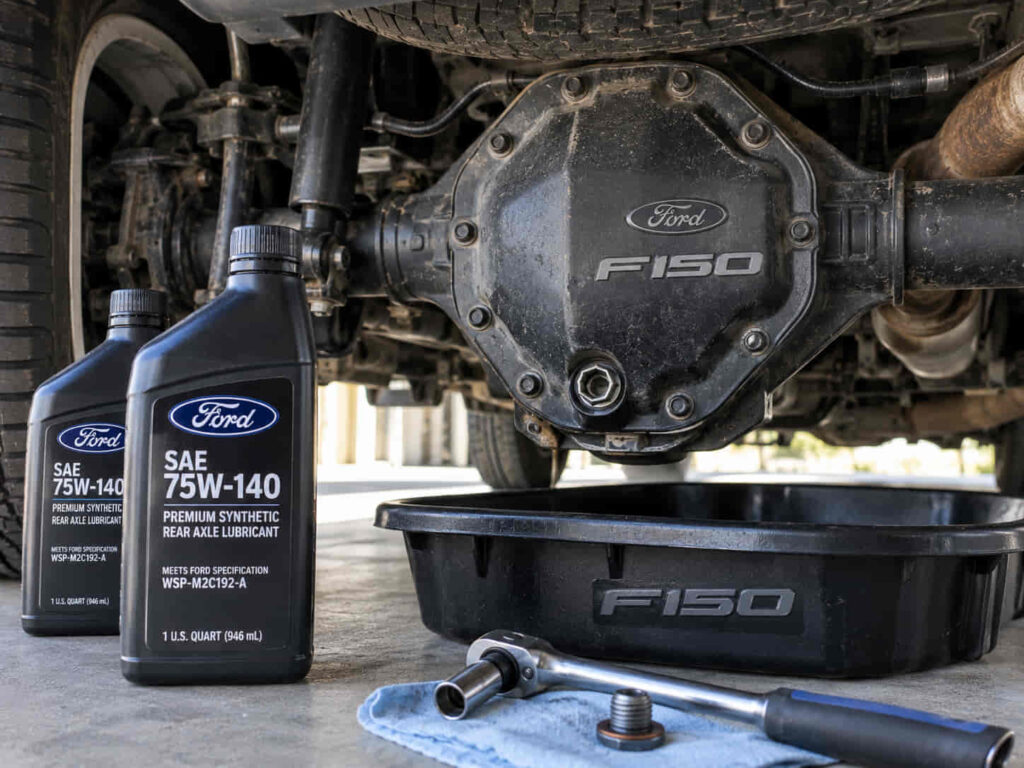
Choosing the best rear differential gear oil for a Ford F-150 is not simply a matter of picking the most expensive bottle on the shelf. The rear axle operates under significant pressure as the differential transfers engine torque to the wheels, and the lubricant inside it must protect gears, bearings, and other components against friction, heat, and wear. The right fluid becomes even more important when an F-150 is regularly used for towing, hauling, off-road driving, or other demanding conditions.
One common mistake is assuming that every F-150 can use the same gear oil. Ford has produced the F-150 with different axle configurations, engines, model years, and drivetrain systems, so the appropriate lubricant can depend on the specific vehicle. Viscosity, manufacturer specifications, synthetic formulation, and limited-slip requirements can all influence the correct choice.
In this guide, we will examine the best rear differential gear oil options for the Ford F-150 and explain what actually matters when selecting one. Rather than focusing only on brand names, we will look at protection, temperature performance, towing capability, compatibility, durability, and overall value. The goal is to help you choose a gear oil that matches your F-150 and its real-world driving demands while avoiding costly lubrication mistakes.
What Makes a Rear Differential Gear Oil a Good Choice for Ford F-150?
The best rear differential gear oil for a Ford F-150 should do more than simply reduce friction between the gears. Inside the rear axle, hypoid gears operate under high contact pressure while generating heat as torque is transferred from the driveshaft to the wheels. A suitable lubricant creates a protective film between these metal surfaces, helping reduce wear while keeping the differential operating smoothly over time. This becomes particularly important when an F-150 spends much of its life towing a trailer, carrying heavy loads, or driving in hot conditions.
One of the most important factors to consider is viscosity. Gear oils such as 75W-90 and 75W-140 are designed to behave differently across temperature ranges and operating conditions. A lower-viscosity lubricant can provide useful cold-temperature flow and may be appropriate for applications specified by Ford, while a heavier gear oil can offer greater resistance to thinning when the axle experiences sustained heat and heavy loads. However, heavier does not automatically mean better. Using a viscosity that does not match the axle manufacturer’s requirements can negatively affect lubrication and differential performance.
The formulation also matters. Full synthetic gear oil generally provides stronger resistance to oxidation and thermal breakdown than conventional formulations, making it particularly attractive for F-150 owners who regularly tow or operate their trucks under demanding conditions. Synthetic lubricants can maintain more consistent performance as temperatures fluctuate, helping protect the differential during both cold starts and prolonged high-temperature operation.
Another consideration is differential design. Some F-150 configurations use limited-slip technology, which can require a lubricant with the appropriate friction characteristics or an approved limited-slip additive. Using an incompatible fluid can contribute to undesirable differential behavior, including noise or chatter during turns. For this reason, the vehicle’s model year, axle configuration, and factory fluid specification should always be verified before selecting a product.
Ultimately, the best gear oil is not necessarily the one with the highest viscosity, the longest list of marketing claims, or the highest price. It is the lubricant that satisfies the required specification while matching the way the F-150 is actually used. A truck driven primarily on highways may have different lubrication demands from one that regularly pulls a heavy trailer or spends weekends on rough terrain. Understanding that distinction is the first step toward making a reliable choice.
Read more: Ford F150 OBD II Drive Cycle
75W-90 vs. 75W-140: Which Gear Oil Is Right for a Ford F-150?
When choosing rear differential gear oil for a Ford F-150, one of the most important decisions often comes down to viscosity. The difference between 75W-90 and 75W-140 is not simply a matter of one oil being better than the other. These viscosity grades are formulated to behave differently as temperatures change, and the correct choice depends on the axle specification and operating conditions of the truck.
A 75W-90 gear oil generally offers a useful balance between low-temperature flow and protection at normal operating temperatures. Because it can remain relatively fluid in colder conditions while still providing suitable protection under load, this viscosity is often associated with applications where everyday driving, highway use, and moderate-duty operation are the primary concerns. For an F-150 owner who spends most of the time commuting or driving unloaded, this type of fluid can provide an appropriate combination of efficiency and protection when it matches the manufacturer’s specification.
A 75W-140 formulation is designed to maintain a thicker protective film as temperatures rise. This characteristic can become valuable when the rear differential experiences prolonged heat and heavy mechanical loads. An F-150 used frequently for towing, hauling, steep grades, or demanding off-road conditions can place substantially more stress on the rear axle than a truck used primarily for light daily driving. Under those circumstances, the additional high-temperature viscosity of 75W-140 can provide an important layer of protection, provided that the axle is designed for that viscosity.
However, selecting 75W-140 simply because it appears more robust can be a mistake. Gear oil viscosity is part of the vehicle’s engineering specification, and changing to a heavier lubricant without confirming compatibility can affect how the differential operates. The same principle applies to switching to a thinner fluid merely because it may flow more easily. The correct viscosity should therefore be determined from the specific F-150’s factory requirements rather than from general assumptions about truck usage.
Driving conditions also influence how quickly differential fluid reaches high operating temperatures. Continuous towing, high ambient temperatures, heavy payloads, and repeated acceleration can increase thermal stress inside the axle. Synthetic gear oils can be particularly useful in these situations because their formulation is designed to maintain performance over a broad temperature range. Nevertheless, the fluid still needs to meet the required specification for the particular rear axle.
For that reason, the question should not simply be whether 75W-90 or 75W-140 is the better gear oil. The more useful question is which viscosity Ford specifies for the exact F-150 configuration and whether the truck’s normal operating conditions justify paying particular attention to high-temperature protection. Matching the fluid to the axle remains more important than choosing a viscosity based solely on perceived strength or popularity.
Why Synthetic Gear Oil Can Matter for a Ford F-150
The rear differential of a Ford F-150 can operate under considerable thermal and mechanical stress, particularly when the truck is used for towing or hauling. Every time the engine produces torque, the differential gears transfer that force to the drive wheels while operating under substantial contact pressure. As temperatures rise, the quality and stability of the lubricant become increasingly important because degraded or overheated gear oil may provide less effective protection for the components inside the axle.
This is where synthetic gear oil can offer an advantage. A high-quality full synthetic formulation is engineered to maintain its protective characteristics across a wide range of operating temperatures. Compared with conventional lubricants, synthetic formulations can offer strong resistance to oxidation and thermal breakdown, which is particularly relevant when an F-150 spends long periods under heavy load. The benefit is not that synthetic oil makes the differential immune to wear, but that the lubricant can provide a more stable protective environment when operating conditions become demanding.
Towing is one of the clearest examples of why differential lubrication deserves attention. Pulling a trailer increases the amount of work required from the drivetrain, and sustained load can cause the rear axle to generate more heat than it would during unloaded highway driving. Long climbs, frequent acceleration, high ambient temperatures, and heavy trailer weights can compound that thermal stress. For an F-150 that regularly performs these tasks, choosing the correct synthetic gear oil can be an important part of maintaining the rear differential.
However, synthetic does not automatically mean that a particular product is suitable for every F-150. The lubricant still needs to meet the required specification and viscosity for the specific rear axle. A premium synthetic product with the wrong viscosity or incompatible friction characteristics is not a better choice simply because its formulation is more advanced.
Another advantage of synthetic gear oil is its potential to maintain consistent performance during temperature changes. An F-150 may start a winter morning with a cold differential and later operate at elevated temperatures while towing on a highway. The lubricant must function effectively throughout that temperature range. This makes the combination of the correct viscosity, appropriate specification, and high-quality formulation more important than brand reputation alone.
For owners who use their F-150 primarily for light commuting, the benefits of a premium synthetic lubricant may be less dramatic than they are for a truck that regularly works hard. For those who tow, haul, travel long distances, or operate in severe conditions, however, investing in the correct high-quality gear oil can provide greater confidence that the rear differential is properly protected when the drivetrain is under pressure.
Limited-Slip Differential Compatibility Matters
Not every Ford F-150 rear differential has exactly the same lubrication requirements, which is why limited-slip compatibility deserves careful attention when selecting gear oil. A limited-slip differential is designed to help manage differences in wheel speed and distribute torque more effectively when traction varies between the drive wheels. Because its internal components can interact differently from those in a conventional open differential, the lubricant needs to provide the appropriate friction characteristics as well as protection against gear and bearing wear.
The friction behavior of the gear oil becomes particularly important when clutch-type limited-slip components are involved. If the lubricant does not provide the characteristics required by the differential, the internal clutch packs can behave improperly during turns. In some cases, this may contribute to chatter, shuddering, or unusual noises that can be mistaken for a mechanical failure. The problem may not necessarily be a damaged differential. It can sometimes begin with an unsuitable lubricant or an incorrect additive combination.
This is why F-150 owners should not assume that a generic “limited-slip compatible” label automatically makes a gear oil suitable for their particular axle. The exact factory requirement should take priority. Some lubricants are formulated with friction modifiers already incorporated into the product, while other applications may require an additional additive. Adding an unnecessary friction modifier can also be counterproductive if the axle specification does not call for it.
The same principle applies when choosing between conventional and synthetic gear oils. A full synthetic product can provide excellent thermal and wear protection, but those advantages do not override the need for correct compatibility. The fluid must satisfy the requirements of the differential rather than simply having desirable characteristics in isolation.
For F-150 owners who are unsure about their axle configuration, checking the vehicle’s owner’s manual, factory service information, or the identification information associated with the rear axle is a safer approach than relying on assumptions based on the truck’s trim level. Model year, drivetrain configuration, axle design, and optional equipment can all influence the appropriate lubricant.
Ultimately, the best rear differential gear oil for a Ford F-150 is one that works with the entire axle system rather than only the gears themselves. Proper viscosity protects against friction and heat, while the correct friction characteristics help ensure that limited-slip components operate as intended. Paying attention to both factors can prevent unnecessary noise, premature wear, and the expense of correcting a lubrication mistake later.
When Should You Change the Rear Differential Fluid on a Ford F-150?
Choosing the right rear differential gear oil is only part of maintaining a Ford F-150. Even a high-quality lubricant cannot protect the rear axle indefinitely. Gear oil gradually becomes contaminated by microscopic wear particles, moisture, oxidation, and the byproducts of prolonged exposure to heat. As the lubricant ages, its ability to protect the gears and bearings can decline, particularly when the truck is regularly subjected to heavy loads.
There is no single fluid-change interval that applies equally to every Ford F-150. Maintenance requirements can vary according to model year, axle configuration, driving conditions, and how the truck is used. An F-150 that spends most of its time on the highway under light loads experiences very different conditions from one that regularly tows a trailer, carries heavy payloads, drives through water or mud, or operates in extreme temperatures. Severe-duty use can place considerably more stress on the rear axle and may require more frequent attention.
Changes in the condition of the fluid can also provide useful clues. A healthy gear lubricant generally has a characteristic oil appearance, while severely darkened fluid, a burnt odor, excessive contamination, or visible metallic particles can indicate that the lubricant has experienced significant deterioration or that internal components may be wearing. Unusual whining, humming, grinding, or differential noise should not automatically be blamed on old fluid, but these symptoms deserve investigation before the vehicle continues to operate under heavy loads.
Leaks are another reason to inspect the rear differential rather than simply topping off the lubricant. A low fluid level can reduce the amount of oil available to lubricate the gears and bearings, increasing friction and heat. A small leak that appears insignificant can eventually become a serious drivetrain problem if it allows the differential to operate with insufficient lubrication.
When replacing the fluid, the most important step is using the correct specification and quantity for the particular F-150. Overfilling or underfilling the differential can create its own problems, while using an incorrect lubricant may compromise protection or limited-slip operation. The service should therefore be treated as a specification-driven maintenance procedure rather than simply an opportunity to install a more expensive oil.
For owners who regularly tow or use their F-150 under severe conditions, inspecting the rear differential should be part of a broader drivetrain maintenance routine. Monitoring leaks, fluid condition, unusual noises, and axle temperature can help identify potential problems before they become expensive repairs. In many cases, preventative differential maintenance costs far less than replacing damaged gears, bearings, or other internal components.
Choosing the Best Gear Oil Based on How You Use Your F-150
The best rear differential gear oil for a Ford F-150 depends not only on the truck itself but also on what the truck is expected to do. Two F-150s with similar specifications can place very different demands on their rear axles. A pickup used primarily for commuting and highway driving may rarely expose its differential to extreme heat, while another F-150 may spend much of its life towing trailers, carrying heavy equipment, or traveling over rough terrain. The ideal lubricant should therefore satisfy the factory requirement while also making sense for the truck’s operating environment.
For an F-150 used mainly as a daily driver, consistent lubrication and reliable cold-temperature performance can be more important than choosing a lubricant designed primarily for extreme loads. Frequent short trips and normal highway driving generally place less thermal stress on the rear axle than continuous towing. A quality gear oil that meets the required specification can provide the protection needed without selecting a heavier formulation simply because it appears more durable.
Towing changes the equation. Pulling a trailer increases drivetrain workload and can raise temperatures throughout the rear axle, particularly during long climbs, extended highway trips, and operation in hot weather. Owners who regularly tow should pay closer attention to the lubricant’s high-temperature performance and ensure that the selected viscosity and specification are appropriate for the axle. A high-quality synthetic formulation can be particularly attractive in this environment because thermal stability becomes a more significant concern.
Heavy hauling can create similar demands. Carrying substantial payloads increases the amount of torque required to move the truck, placing additional stress on the drivetrain. Although the rear differential does not experience exactly the same conditions as the engine or transmission, sustained load can increase heat generation and mechanical pressure within the axle. Using the correct lubricant and maintaining the proper fluid level become increasingly important as workload rises.
Off-road driving introduces another set of concerns. Low-speed operation under high torque, steep terrain, mud, sand, and repeated changes in traction can subject the differential to demanding conditions. Water contamination can also become a concern if the axle is exposed to deep water. In these circumstances, choosing the correct fluid is only one part of the maintenance strategy. Regular inspection for leaks, contamination, and changes in fluid condition can be equally important.
The key is to avoid treating gear oil selection as a simple upgrade path where a heavier or more expensive product is automatically considered superior. The correct lubricant is determined by the relationship between the F-150’s axle specification and its actual operating conditions. When those two factors are considered together, owners can choose a fluid that provides appropriate protection without introducing unnecessary compatibility or performance issues.
How to Avoid Choosing the Wrong Rear Differential Gear Oil
Selecting rear differential gear oil for a Ford F-150 can become surprisingly complicated when different model years, axle configurations, drivetrain systems, and operating conditions are considered. The biggest mistake is often assuming that a gear oil marketed for trucks is automatically suitable for every F-150. Product labels can contain impressive claims about extreme pressure protection, synthetic technology, or limited-slip performance, but none of those claims replace the vehicle’s required specification.
The first step is to identify the exact requirements for the F-150. The model year and drivetrain configuration provide useful starting points, but they may not tell the entire story. Different axle configurations can have different lubricant requirements, so the appropriate viscosity and specification should be verified through the owner’s manual or applicable Ford service information. This is especially important when purchasing gear oil online, where products with similar names can have significantly different specifications.
Another common mistake is choosing fluid based solely on viscosity. Seeing 75W-140 on a bottle may make it appear more suitable for a heavy-duty pickup than 75W-90, but viscosity alone does not determine compatibility. The correct lubricant must have the characteristics required by the specific rear axle. A fluid with the wrong specification can potentially create problems even when its viscosity appears reasonable.
It is also worth paying attention to limited-slip requirements. If the differential requires particular friction characteristics, the gear oil must be compatible with that system. Adding an aftermarket friction modifier without confirming that it is needed can be just as unnecessary as using a fluid without the required characteristics. The safest approach is to follow the manufacturer’s requirements rather than attempting to create a custom fluid combination.
Quantity matters as well. Filling the differential with too little lubricant can leave gears and bearings inadequately protected, while overfilling can cause its own problems. The correct fill procedure should account for the specific axle design and service instructions rather than relying on a generic capacity figure found online.
Finally, avoid treating gear oil as a lifetime component simply because the truck appears to be operating normally. A differential can continue functioning while its lubricant gradually loses quality. Regular inspection becomes particularly valuable for high-mileage F-150s, trucks that tow frequently, and vehicles exposed to water, dirt, extreme temperatures, or other severe conditions.
The best rear differential gear oil for a Ford F-150 is ultimately the product that satisfies the correct specification, viscosity, and compatibility requirements for the specific axle. Once those fundamentals are established, factors such as synthetic formulation, brand reputation, thermal performance, and price can be used to make the final purchasing decision. This approach is far more reliable than choosing a product simply because it is popular or marketed as heavy-duty.
Final Thoughts on the Best Rear Differential Gear Oil for Ford F-150
Finding the best rear differential gear oil for a Ford F-150 is ultimately about compatibility rather than choosing the most expensive or highest-viscosity product available. The correct lubricant needs to match the requirements of the specific rear axle, including its recommended viscosity, fluid specification, and any limited-slip compatibility requirements. These details matter because the differential relies on the lubricant to control friction, manage heat, and protect gears and bearings under constantly changing loads.
Driving conditions should also influence the decision. An F-150 used primarily for commuting may have different lubrication demands from one that regularly tows heavy trailers, carries substantial payloads, or operates off-road. For demanding applications, thermal stability and the quality of the lubricant become increasingly important, making a suitable synthetic gear oil an attractive option when it meets the vehicle’s required specification.
Before purchasing any rear differential fluid, verify the requirements for your specific F-150 rather than relying on a generic recommendation. Model year, axle configuration, drivetrain, and factory specifications can all affect the correct choice. Checking these details can prevent problems caused by the wrong viscosity, incompatible friction characteristics, incorrect fluid level, or an unsuitable formulation.
A properly maintained rear differential may be easy to overlook because it normally operates without much attention. Yet choosing the right gear oil and replacing it when necessary can play an important role in protecting the drivetrain over the long term. If you know your F-150’s model year, engine, drivetrain, and axle configuration, you can narrow down the correct lubricant far more confidently and avoid an expensive lubrication mistake.