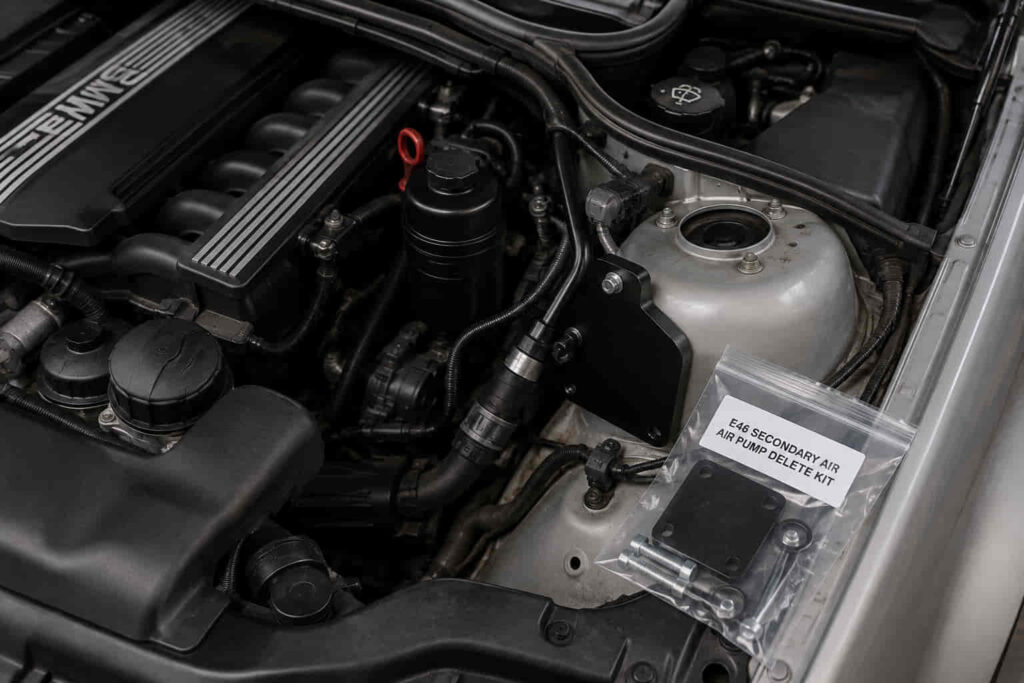
An E46 secondary air pump delete removes or disables part of the secondary air injection system used on applicable BMW E46 engines. Before considering this modification, it is important to understand what the system does, why it can trigger a fault, and whether the problem actually comes from the pump itself. A secondary air fault does not automatically mean that the pump needs to be deleted or replaced.
The secondary air injection system operates primarily during the engine’s cold-start phase. It introduces fresh air into the exhaust system to support faster catalytic-converter warm-up and is monitored by the engine management system. When the system does not achieve the expected operation, the E46 can store a fault and, depending on the vehicle configuration, illuminate the Check Engine Light.
This guide explains 10 important things to understand before considering an E46 secondary air pump delete. It covers the purpose of the system, compatible E46 engine configurations, common failure points, fault codes, Check Engine Light implications, emissions considerations, and the difference between repairing the system and modifying it. The goal is to help E46 owners identify the actual cause of a secondary-air fault before deciding what solution makes sense for their vehicle.
What is an E46 secondary air pump delete?
An E46 secondary air pump delete is a modification that removes or disables the secondary air injection system on a BMW E46 rather than restoring the system to its original operating condition. The exact meaning depends on the E46 engine and software configuration because BMW used different secondary-air strategies across E46 applications. BMW documentation specifically identifies E46 applications with engines including the M43TU, M52TU, M54, and S54, while a separate BMW service document describes an official secondary-air disablement for certain early N42 EU3 vehicles.
The secondary air pump is not the component responsible for supplying the engine’s normal intake air. Its purpose is connected to emissions control during engine warm-up. BMW’s technical training material explains that fresh air is injected into the exhaust stream after a cold start to reduce hydrocarbon and carbon-monoxide emissions while the catalytic converter reaches operating temperature. The engine control module activates the pump through a relay and monitors the system using the pre-catalyst oxygen sensors.
That distinction is important when evaluating a delete. Deleting the secondary air pump is a modification to an emissions-related system, not simply another name for repairing a failed pump. A failed pump, relay, check valve, vacuum line, or electrical connection can produce a secondary-air fault, and BMW’s own diagnostic guidance states that the pump itself is not always the failed component.
For that reason, an E46 owner should identify the exact engine, stored DME fault, and condition of the secondary air system before deciding whether a delete is appropriate. A repair restores the intended system operation, while a delete changes the vehicle from its original configuration and can have different emissions or inspection consequences depending on the vehicle and jurisdiction.
Read more: BMW X5 Fuel Mileage
Why do E46 owners consider a secondary air pump delete?
E46 owners may consider a secondary air pump delete when the secondary air system develops a recurring fault, but a fault in this system does not automatically mean that the pump itself has failed. BMW’s diagnostic guidance states that secondary-air problems can originate from the check valve or the actuating relay rather than from the pump. The same guidance instructs technicians to activate and test the system, check the pump, inspect the relay, and verify the electrical connections before condemning the pump.
A failed pump is nevertheless a legitimate repair concern. BMW’s service information notes that a seized pump must be replaced and specifically warns that moisture inside the pump can be associated with an improperly operating non-return valve. If the underlying valve problem is not addressed, replacing the pump alone may leave the vehicle vulnerable to another failure.
The motivation for considering a delete therefore usually comes from the cost, complexity, or recurring nature of repairing an emissions-related system on an older E46. Some owners may prefer to simplify a vehicle that is being modified for a particular use, while others are simply looking for an alternative after experiencing repeated secondary-air faults.
However, considering a delete and determining that a delete is the correct repair are two different decisions. The secondary air system has a specific emissions function, and the E46’s DME monitors its operation. A modification that removes the system can therefore produce consequences that would not occur if the original system were properly repaired.
What does the secondary air pump do on an E46?
The E46 secondary air pump supplies fresh air to the exhaust system during the cold-start phase to help reduce hydrocarbon and carbon-monoxide emissions while the catalytic converter reaches operating temperature. It is therefore an emissions-control component rather than part of the engine’s normal intake-air supply.
BMW’s E46 technical training material explains that, following a cold engine start, fresh air or oxygen is injected directly into the exhaust stream. The resulting oxygen-rich exhaust supports the oxidation of hydrocarbons and carbon monoxide and helps the catalytic converter reach effective operating conditions more quickly. The training material states that the pump can operate for approximately 90 seconds after startup, although actual operation depends on the vehicle’s control strategy and operating conditions.
The system is controlled by the engine control module through a relay. BMW’s documentation explains that the ECM activates the secondary air pump relay, which supplies voltage to the pump. The ECM then monitors the resulting change through the pre-catalyst oxygen sensors. If the expected sensor response does not occur after the pump is activated, the system can set a fault for the affected bank.
This operating principle explains why a secondary air pump delete does not normally represent a modification to the engine’s primary combustion-air supply. The system’s main function occurs during a limited period after cold start and is associated with emissions control and catalyst warm-up. Removing it therefore changes an emissions-control function rather than directly removing a system responsible for normal engine airflow.
Understanding this mechanism is important before evaluating the modification. If an owner experiences a secondary-air fault, the correct diagnostic question is not simply whether the pump should be deleted. The more useful question is why the DME is detecting insufficient or incorrect secondary-air operation.
Which E46 engines use a secondary air injection system?
The E46 secondary air injection system is associated with specific engine and emissions configurations rather than every E46 being mechanically identical. BMW’s failure-analysis documentation identifies E46 applications with M43TU, M52TU, M54, and S54 engines among the vehicles affected by secondary-air system faults.
This engine-specific distinction matters because the physical components, control strategy, diagnostic information, and emissions configuration can vary between vehicles. The BMW service bulletin covering secondary-air faults specifically lists M52, M54, S52, and S54 engines and identifies different fault-code behavior depending on the engine family. For M52, M54, S52, and S54 applications, BMW identifies fault codes 245 and 246 for secondary-air injection faults affecting bank 1 and bank 2.
The E46 designation alone is therefore not enough to determine the exact secondary-air configuration. Model year, engine family, market, and emissions specification can affect whether the vehicle was equipped with the system and how its DME monitors it. This is particularly important when researching a delete because information written for one E46 engine should not automatically be applied to another.
Before evaluating a secondary air pump delete, an owner should identify the exact engine and emissions configuration of the vehicle. That establishes which components should be present, which fault codes are relevant, and which diagnostic procedure applies. The correct starting point is the specific E46 configuration, not the E46 badge alone.
Which E46 secondary air faults should be diagnosed before a delete?
A secondary air fault on a BMW E46 should be diagnosed at the system level before considering a delete because the pump is only one component of the secondary air injection system. A fault indicating insufficient secondary-air operation can originate from the pump, check valve, relay, vacuum control, hoses, wiring, or electrical connections.
BMW’s service information specifically instructs technicians to test the secondary air system rather than immediately replacing the pump. The diagnostic process includes activating the system, checking whether the pump operates, inspecting the actuating relay, and verifying the relevant electrical connections. BMW also identifies the check valve as a possible source of the problem.
The secondary air pump itself can fail mechanically or electrically. A pump that does not operate when commanded cannot provide the airflow required by the system, but the absence of pump operation does not by itself prove that the pump is defective. A failed relay, wiring problem, power-supply issue, or control problem can produce a similar symptom.
The secondary air check valve is another important diagnostic point because it controls the direction of airflow into the exhaust system. BMW service information specifically discusses moisture entering the pump when the non-return valve does not function correctly. That means replacing a damaged pump without addressing the associated valve problem can leave the underlying failure mechanism unresolved.
Vacuum hoses and control lines also deserve attention on applicable E46 configurations. A leak or disconnected line can prevent the system from operating as intended even when the pump itself is functional. Electrical connections and wiring should likewise be inspected when the DME records a secondary-air fault.
The practical conclusion is straightforward: a secondary air pump delete should not be used to bypass an undiagnosed fault. Identifying whether the problem is the pump, valve, relay, vacuum system, or wiring provides a much more accurate basis for deciding between repair, replacement, or modification.
BMW E46 secondary air faults can appear as BMW-specific DME fault codes or as OBD-related codes depending on the engine, diagnostic equipment, and vehicle configuration. The exact code should therefore be interpreted together with the engine family and the operating conditions under which the DME detected the fault.
BMW’s service documentation for the E46 identifies fault codes 245 and 246 for secondary-air injection problems affecting bank 1 and bank 2 on applicable M52, M54, S52, and S54 applications. These codes indicate that the DME has detected a problem with secondary-air injection rather than proving that the physical pump itself has failed.
Generic OBD terminology can also appear in diagnostic tools. Codes such as P0411, P0491, and P0492 are commonly associated with secondary-air injection performance or insufficient-flow conditions. Their precise applicability should still be verified against the specific E46 engine and diagnostic system because not every E46 uses the same engine-management configuration.
The distinction between a component failure and a system-performance fault is important. A “secondary air flow too low” type fault means that the DME did not observe the expected system behavior. Several mechanical and electrical causes can produce that result. For example, a pump that runs but cannot move the required air can produce a different diagnostic path from a pump that never receives electrical power.
The fault code should therefore be treated as the starting point for diagnosis rather than the final diagnosis itself. The code identifies the monitored system or condition, while testing determines which component has caused the abnormal result. This is particularly important when evaluating an E46 secondary air pump delete because deleting the pump does not necessarily address the underlying reason the original fault was stored.
Can a secondary air pump failure cause an E46 Check Engine Light?
Yes, a secondary air system malfunction can cause the BMW E46 Check Engine Light to illuminate when the DME determines that the monitored system is not operating as expected. The system is actively monitored, so a failure is not necessarily limited to a physical symptom such as an unusual noise from the pump.
BMW’s technical documentation explains that the engine control module monitors secondary-air operation through the pre-catalyst oxygen sensors. When the pump is activated, the additional oxygen entering the exhaust should create a detectable change in the oxygen-sensor signal. If the expected response is not detected, the DME can recognize the secondary-air system as malfunctioning and store a corresponding fault.
This monitoring strategy explains why an E46 can drive normally even while displaying a secondary-air fault. The secondary air system primarily operates during the cold-start phase to support catalyst warm-up. Once that operating phase has ended, the vehicle does not depend on the secondary air pump for its normal intake airflow or basic combustion process.
However, the absence of an obvious drivability problem does not mean the fault should be ignored. A Check Engine Light indicates that the engine management system has detected a condition requiring attention. The stored fault should be read and diagnosed before deciding whether the pump, valve, relay, vacuum system, or another component requires service.
An E46 owner considering a delete should therefore understand the relationship between secondary air injection, DME monitoring, and the Check Engine Light. Simply removing a component without addressing the monitoring strategy can leave the underlying fault condition unresolved. The appropriate response depends on the vehicle’s engine, emissions configuration, stored fault, and applicable repair or inspection requirements.
Does an E46 secondary air pump affect engine performance?
The E46 secondary air pump primarily affects emissions control during cold start rather than supplying air required for normal engine combustion. This distinction is important because removing the pump should not automatically be described as a performance modification that increases horsepower or changes the engine’s normal intake airflow.
BMW’s technical training material describes the secondary air system as an emissions-control system that operates after a cold start. The pump introduces fresh air into the exhaust stream, where additional oxygen supports oxidation of hydrocarbons and carbon monoxide while the catalytic converter is warming toward its operating temperature. The system therefore operates downstream of the engine’s primary combustion process.
Once the cold-start phase has ended, the secondary air pump is not responsible for supplying the engine with the air it uses for normal combustion. The engine’s intake system, throttle, airflow measurement, fuel system, ignition system, and other powertrain components perform those functions. This is why a healthy E46 can continue to drive normally even when a secondary-air fault has been stored.
A secondary-air malfunction can nevertheless create an ownership problem because the DME monitors the system. A failed pump or another secondary-air component can trigger a fault code and, on applicable vehicles, illuminate the Check Engine Light. The resulting issue is therefore primarily associated with emissions-system operation and diagnostic status rather than an immediate loss of engine power.
For an E46 owner considering a delete, this distinction prevents an important misunderstanding. Deleting the secondary air pump should not be presented as a guaranteed horsepower modification. Its primary effect is on an emissions-control system that operates during cold start, while normal engine performance is governed by the vehicle’s primary intake, fuel, ignition, and engine-management systems.
What are the emissions consequences of an E46 secondary air pump delete?
An E46 secondary air pump delete changes an emissions-control system that BMW designed to reduce cold-start emissions and accelerate catalytic-converter warm-up. The secondary air system introduces oxygen into the exhaust shortly after startup, supporting oxidation of hydrocarbons and carbon monoxide before the catalytic converter reaches its normal operating temperature.
This function explains why the system exists even though it has little connection to normal engine power. During a cold start, the catalytic converter is not yet at its most effective operating temperature. Secondary air injection helps create conditions that allow oxidation reactions to occur while the catalyst is warming. Removing the system therefore eliminates a function that was designed specifically for this phase of operation.
The emissions consequence is not limited to the physical removal of the pump. The E46 DME monitors secondary-air operation, and the system’s performance can be evaluated through oxygen-sensor feedback. If the expected response is not detected, the DME can store a fault and illuminate the Check Engine Light on applicable vehicles.
A delete can also have inspection or regulatory consequences. Emissions-control requirements differ by jurisdiction, vehicle registration, and inspection program, so an owner should verify the rules that apply to the specific E46 before modifying an emissions-related component. A modification that does not create an immediate drivability problem can still affect emissions compliance or inspection readiness.
For this reason, an E46 secondary air pump delete should be evaluated as an emissions-system modification rather than simply a mechanical simplification. Owners who need the vehicle to retain its original emissions configuration generally have a stronger reason to diagnose and repair the underlying fault instead of removing the system.
Is an E46 secondary air pump delete better than repairing the system?
Repairing the secondary air system is generally the more direct approach when the goal is to restore the E46 to its intended factory operating condition. A delete changes the configuration of an emissions-control system, while repair addresses the component or condition that caused the original fault.
The correct repair depends on the actual failure. If the pump has failed, replacing the pump addresses the loss of airflow. If the relay or electrical connection is defective, replacing a pump without correcting the electrical problem does not resolve the root cause. If the check valve is malfunctioning, the valve needs attention because BMW service information identifies it as a potential cause of secondary-air problems and notes its relationship to moisture-related pump damage.
Vacuum and control problems create another diagnostic path. On applicable E46 configurations, the secondary air system depends on control components and vacuum operation in addition to the pump itself. A leak or control fault can therefore produce symptoms that look like a pump problem when the pump is actually functional.
The repair-versus-delete decision also depends on how the vehicle will be used. An E46 that must satisfy emissions requirements has different priorities from a heavily modified vehicle used outside normal road-registration requirements. Even in a modified vehicle, however, the original fault should be understood before a component is removed because the diagnostic information can reveal other problems in the system.
The most reliable decision process is therefore diagnosis first, followed by repair or modification based on the vehicle’s purpose and applicable requirements. A secondary-air fault code identifies a monitored problem, but it does not by itself prove that deleting the pump is the appropriate solution.
What should E46 owners check before deciding on a secondary air pump delete?
An E46 owner should identify the exact engine, read the stored DME fault codes, and verify the condition of the secondary air pump and its supporting components before deciding on a delete. This approach separates an actual pump failure from a broader secondary-air system problem.
The first step is identifying the engine and emissions configuration because the E46 was produced with different engine families and secondary-air strategies. The applicable diagnostic information can change with the engine, so a procedure or fault-code interpretation for one E46 should not automatically be applied to another.
The stored DME fault is the next important piece of information. A secondary-air code indicates that the engine management system detected an unexpected result, but the code does not necessarily identify the failed physical component. BMW’s diagnostic information directs technicians to test the system and inspect the pump, relay, electrical connections, and check valve rather than assuming that the pump itself is defective.
The condition of the check valve deserves particular attention when a pump has failed. BMW service information describes cases in which a defective non-return valve allows moisture to reach the pump and contribute to pump seizure. In that situation, replacing or deleting the pump without understanding the valve problem leaves the original failure mechanism unexplained.
The owner should also consider the vehicle’s intended use and applicable emissions requirements. If the E46 is driven on public roads in a jurisdiction with emissions inspections, removing an emissions-control component can create compliance or inspection issues even when the vehicle continues to drive normally.
The goal of this evaluation is not simply to determine whether the pump works. It is to determine why the DME detected a secondary-air problem and whether changing the system is actually necessary. That distinction prevents an expensive or irreversible modification from being used to solve a problem that could have been caused by a relay, valve, vacuum line, wiring fault, or another component.
How should an E46 owner decide between secondary air pump repair and delete?
An E46 owner should generally choose repair when the objective is to restore the vehicle’s factory emissions system, while a delete represents a separate modification decision that should account for emissions requirements, vehicle use, and the actual cause of the fault. The two options should not be treated as interchangeable forms of maintenance.
Repair restores the original system by addressing the failed component. A defective pump can be replaced, a failed relay can be corrected, a damaged vacuum line can be repaired, and a malfunctioning check valve can be addressed according to the applicable diagnostic procedure. This approach preserves the secondary air system’s intended cold-start emissions function.
A delete takes a different path because it removes or disables that function. Since the DME monitors secondary-air operation, simply removing the hardware does not necessarily eliminate the diagnostic consequences associated with the system. The modification can therefore introduce a different set of considerations involving fault monitoring, emissions performance, and vehicle inspection.
The best decision also depends on the E46’s purpose. A vehicle being maintained as a road-going car has different requirements from a dedicated competition or non-road vehicle. For a road-registered E46, local emissions regulations should be checked before modifying an emissions-control system. For any vehicle, understanding the original fault remains important because the same diagnostic information can reveal related problems that should not be ignored.
Ultimately, the correct sequence is diagnosis, identification of the root cause, evaluation of the vehicle’s requirements, and then selection of repair or modification. This sequence is more reliable than beginning with a delete simply because the secondary air pump has generated a fault.
An E46 secondary air pump delete can therefore be a subject worth researching for owners of older or modified BMWs, but it should not be presented as a universal repair for secondary-air faults. Understanding the system first allows the owner to make a decision based on the actual vehicle rather than on a generic E46 modification recipe.