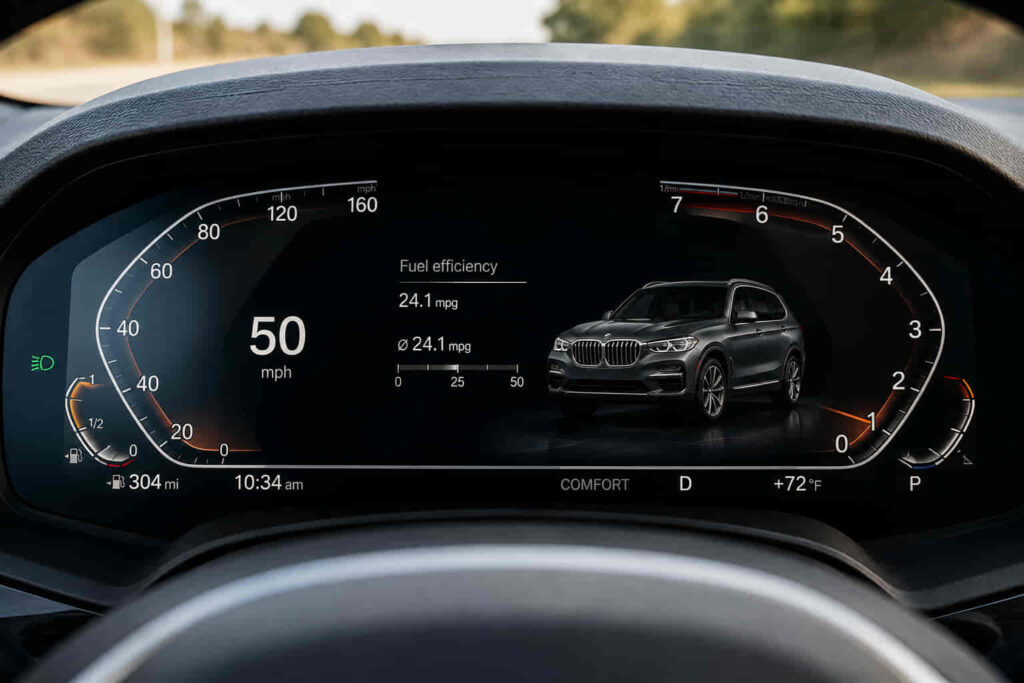
BMW X5 fuel mileage varies by model year, engine, trim, drivetrain, and driving conditions, so there is no single MPG figure that applies to every BMW X5. A model equipped with one powertrain can consume fuel differently from another X5 with a different engine or configuration, while the same vehicle can also achieve different mileage in city and highway driving.
Fuel mileage is usually expressed through city MPG, highway MPG, and combined MPG. These figures provide a useful way to compare BMW X5 configurations, but real-world fuel economy can differ because actual driving involves traffic, acceleration, speed changes, vehicle load, weather, tire pressure, and road conditions.
This guide explains 10 important BMW X5 fuel mileage facts that help owners understand how fuel economy works in real driving. It covers the factors that influence MPG, including the engine, trim, xDrive drivetrain, driving habits, tire pressure, vehicle weight, and maintenance. It also explains how fuel mileage affects driving range and fuel costs, giving BMW X5 owners a clearer basis for evaluating efficiency beyond a single MPG number.
What is the fuel mileage of a BMW X5?
BMW X5 fuel mileage depends on the specific model year, engine, trim, drivetrain, and driving conditions, so there is no single MPG rating for every BMW X5. The most useful way to evaluate X5 fuel economy is to separate city MPG, highway MPG, and combined MPG for the exact configuration being considered.
City MPG measures fuel consumption during urban-style driving with frequent stops, acceleration, and changes in speed. Highway MPG represents more consistent driving at higher speeds, while combined MPG provides a standardized overall figure that combines city and highway test results. These measurements allow different BMW X5 configurations to be compared without treating one vehicle’s fuel economy as representative of the entire X5 range.
The difference between these measurements matters because the same BMW X5 can consume fuel differently depending on how it is driven. Frequent acceleration and braking increase energy demand, while steady-speed highway driving generally creates a different fuel-consumption pattern. Vehicle load, weather, road grade, tire pressure, and traffic can further change the amount of fuel required to cover the same distance.
For this reason, the correct BMW X5 fuel mileage figure should always be tied to a specific model year and powertrain. A published MPG figure is useful for comparing configurations, but it should not be interpreted as a guaranteed real-world result for every driver. The most accurate evaluation combines the official fuel-economy rating with the X5’s actual engine, drivetrain, driving environment, and usage pattern.
Read more: BMW X3 Service Schedule
How does BMW X5 city MPG compare with highway MPG?
BMW X5 highway MPG is higher than city MPG in the current gasoline-powered configurations because steady highway driving generally requires less frequent acceleration and braking than urban driving. BMW’s published technical data for the X5 sDrive40i and xDrive40i, for example, lists 23 mpg city and 27 mpg highway.
The difference comes from how the vehicle uses energy in each driving environment. City driving repeatedly converts fuel energy into acceleration, followed by braking that dissipates much of that energy. Traffic lights, congestion, intersections, and frequent speed changes therefore create a less efficient operating pattern. Highway driving allows the X5 to maintain a relatively consistent speed for longer periods, reducing the number of acceleration and braking events.
The difference between city and highway MPG should not be interpreted as a guarantee of what every driver will achieve. A highway trip involving high speeds, steep grades, strong headwinds, or frequent overtaking can consume considerably more fuel than a steady cruise. Conversely, light urban traffic with smooth acceleration can produce better fuel mileage than severe stop-and-go conditions.
This distinction is important when evaluating BMW X5 fuel mileage for a specific driving pattern. An owner who spends most of the year commuting through dense urban traffic should pay more attention to the city rating, while an owner who frequently travels long distances on major highways will place greater practical value on highway fuel economy.
Which BMW X5 engines get the best fuel mileage?
BMW X5 fuel mileage changes significantly with the engine and powertrain because different engines have different power outputs, displacement, vehicle weight, and operating characteristics. BMW’s current X5 range illustrates this directly: the lineup includes six-cylinder gasoline powertrains, a plug-in-hybrid X5 xDrive50e, and the V8-powered X5 M60i.
The current X5 xDrive40i uses a 3.0-liter inline-six engine with a 48-volt mild-hybrid system and is rated at 23 mpg city and 27 mpg highway in BMW’s published technical data. The X5 M60i uses a 4.4-liter V8 with 523 horsepower and is rated at 17 mpg city and 22 mpg highway. These figures show why engine selection is one of the strongest determinants of X5 fuel mileage.
The comparison is not simply about engine size. The X5 M60i is designed around substantially higher performance, with BMW listing 523 horsepower, while the xDrive40i uses a six-cylinder powertrain producing 375 horsepower. The additional performance capability, larger engine, and different vehicle configuration are associated with a different fuel-economy profile.
The X5 xDrive50e introduces another type of powertrain because it combines a gasoline engine with an integrated electric motor. BMW lists it separately from the gasoline-only X5 configurations, so its fuel-economy characteristics should be evaluated using the appropriate plug-in-hybrid metrics rather than directly comparing one gasoline MPG figure with a conventional gasoline X5.
Therefore, there is no universally “best” BMW X5 engine for fuel mileage without defining the model year and powertrain. For a current gasoline X5 comparison, the six-cylinder X5 40i is more fuel-efficient than the V8 M60i in BMW’s published city and highway ratings. The plug-in-hybrid xDrive50e requires a separate evaluation based on charging behavior and driving pattern.
How does BMW X5 trim affect fuel mileage?
BMW X5 trim can affect fuel mileage because trim level is connected to the vehicle’s engine, drivetrain, performance equipment, wheels, tires, and overall configuration. The effect is therefore not caused by the trim name itself; it comes from the mechanical and equipment differences associated with that configuration.
BMW’s current X5 lineup includes the sDrive40i, xDrive40i, xDrive50e, M60i, and X5 M Competition, which represent substantially different powertrains and performance levels. BMW lists the M60i with a 4.4-liter V8 and 523 horsepower, while the X5 M Competition uses a high-performance 4.4-liter V8 producing 617 horsepower.
Vehicle configuration also changes curb weight and drivetrain characteristics. BMW’s technical data lists the X5 xDrive40i at 4,998 pounds and the M60i at 5,355 pounds, while the published city/highway ratings are 23/27 mpg for the xDrive40i and 17/22 mpg for the M60i. These figures demonstrate how fuel mileage reflects the complete vehicle configuration rather than one isolated specification.
Wheels and tires can also influence efficiency because they affect rolling resistance and vehicle dynamics. The effect varies by specification, so a precise comparison should use the official fuel-economy rating for the exact configuration rather than assuming that every X5 with the same engine achieves an identical result.
For buyers comparing BMW X5 trims primarily for fuel economy, the correct approach is to compare engine, drivetrain, vehicle configuration, and official MPG together. Looking only at the trim name can hide the mechanical differences that actually determine fuel consumption.
How does xDrive affect BMW X5 fuel mileage?
BMW X5 xDrive can affect fuel mileage because the all-wheel-drive system adds drivetrain components and changes how engine power is distributed to the wheels. The effect should be evaluated together with the engine, transmission, vehicle weight, wheels, tires, and model year rather than treated as one fixed MPG penalty for every X5.
The current BMW X5 range demonstrates why drivetrain configuration matters. BMW offers the X5 in both sDrive and xDrive configurations for selected powertrains, while other powertrains use xDrive as part of their standard configuration. The xDrive40i, for example, combines BMW’s 3.0-liter inline-six engine with all-wheel drive, whereas the sDrive40i uses the same basic engine configuration with rear-wheel drive.
An all-wheel-drive system can require additional mechanical components to transfer power between the engine and multiple axles. Those components add weight and create additional drivetrain losses, which can influence energy consumption. The actual effect depends on how the system operates and on the complete vehicle configuration.
Driving conditions also influence whether the difference becomes noticeable. An X5 driven primarily on smooth highways can produce a different fuel-economy result from one driven in heavy traffic, snow, steep terrain, or frequent acceleration. xDrive can provide traction advantages in conditions where maintaining control and grip matters, but those benefits should not be confused with improved fuel economy.
For fuel-mileage comparisons, therefore, xDrive should be treated as one variable within the complete BMW X5 powertrain rather than as a standalone MPG determinant. The most reliable comparison is the official fuel-economy rating for the exact X5 model, engine, drivetrain, and wheel-and-tire configuration.
Why does BMW X5 real-world fuel mileage differ from EPA MPG?
BMW X5 real-world fuel mileage differs from EPA MPG because official fuel-economy testing uses standardized conditions, while actual driving combines different speeds, traffic patterns, weather, road conditions, vehicle loads, and driving habits. EPA ratings provide a consistent basis for comparing vehicles, but they are not a promise that every driver will achieve the same MPG.
The EPA explains that fuel-economy values are determined through standardized testing designed to represent different driving conditions. The resulting city, highway, and combined figures allow consumers to compare vehicles using the same methodology. Real-world driving, however, does not reproduce those test conditions exactly.
For a BMW X5, traffic is one important difference. Frequent acceleration from a stop requires additional energy, while repeated braking removes kinetic energy that was previously produced by the engine. A driver traveling through dense urban traffic can therefore obtain lower fuel mileage than the published highway rating even when the vehicle is mechanically healthy.
Speed, weather, road grade, vehicle load, and tire pressure create additional variation. A heavily loaded X5 traveling at high highway speeds against a strong headwind has a different energy demand from an unloaded X5 traveling at a steady moderate speed on level pavement. The official MPG figure remains useful, but the actual result reflects the conditions under which the vehicle operates.
Driving style also matters. Rapid acceleration, frequent speed changes, and unnecessary idling can increase fuel consumption, while smoother acceleration and consistent cruising can reduce energy demand. This is why two owners driving the same BMW X5 can record different average MPG figures over the same distance.
EPA MPG is therefore best used as a standardized comparison value, while real-world MPG is a measurement of how efficiently a particular X5 operates under a particular driver’s conditions. Comparing both values provides a more accurate understanding of BMW X5 fuel mileage than treating either number as universally representative.
Does driving speed affect BMW X5 fuel mileage?
Yes, driving speed affects BMW X5 fuel mileage because aerodynamic resistance increases as vehicle speed rises, requiring more energy from the powertrain to maintain motion. The effect becomes increasingly relevant during highway driving, where aerodynamic drag represents a major part of the energy required to move the vehicle through the air.
At low and moderate speeds, rolling resistance and drivetrain losses account for a significant share of the energy required to move the X5. As speed increases, aerodynamic drag becomes progressively more important. The engine must therefore produce additional power to maintain a higher cruising speed, which increases fuel consumption even when the driver does not accelerate.
This relationship explains why highway fuel economy is not simply determined by driving on a highway. A driver maintaining a moderate and steady speed can use less fuel than another driver covering the same highway route at substantially higher speeds. Wind direction and road grade can amplify the difference because the engine must overcome additional aerodynamic or gravitational resistance.
Frequent changes in speed create another source of fuel consumption. Accelerating requires additional energy to increase the vehicle’s kinetic energy, while braking converts that energy primarily into heat. Maintaining a reasonably consistent cruising speed avoids unnecessary cycles of acceleration and braking when traffic conditions permit.
For BMW X5 owners, smooth and consistent highway driving is generally more favorable to fuel mileage than sustained high-speed driving or repeated acceleration. The exact MPG result still depends on the engine, drivetrain, tires, vehicle load, weather, and road conditions, so speed should be considered one factor within the larger fuel-economy system.
How does BMW X5 tire pressure affect fuel mileage?
BMW X5 tire pressure affects fuel mileage because incorrect inflation changes rolling resistance between the tires and the road. When a tire is significantly underinflated, more of the tire deforms as it rotates, increasing resistance and requiring additional energy from the powertrain to maintain the vehicle’s speed.
Tire pressure also affects the way the BMW X5 handles and distributes wear across the tread. Underinflation can increase tire shoulder wear, while incorrect pressure in either direction can change the tire’s contact characteristics. Maintaining the pressure specified for the particular X5 therefore supports both efficient operation and predictable handling.
The correct pressure is not necessarily the maximum pressure printed on the tire sidewall. BMW specifies tire-pressure requirements for the vehicle based on its particular wheel-and-tire configuration and load conditions. Owners should use the vehicle’s specified pressure information rather than applying one universal PSI value to every BMW X5.
Temperature also matters when evaluating tire pressure. Air pressure changes as temperature changes, so a reading taken under one set of conditions can differ from a reading taken under another. This is one reason tire pressure should be checked consistently and maintained according to the manufacturer’s specifications.
The effect on fuel mileage is only one reason to maintain correct pressure. Proper tire inflation reduces unnecessary rolling resistance while helping the BMW X5 maintain the handling, braking, tire wear, and stability characteristics intended for its configuration. Tire pressure should therefore be treated as a regular part of fuel-economy and vehicle-maintenance management.
How do driving habits affect BMW X5 fuel mileage?
Driving habits can significantly affect BMW X5 fuel mileage because acceleration, braking, idling, and speed changes determine how efficiently the vehicle’s energy is used. The same X5 can produce different fuel-economy results depending on how aggressively or smoothly it is driven.
Hard acceleration requires the engine to produce a large amount of power over a short period. When the vehicle then brakes soon afterward, much of the kinetic energy created during acceleration is dissipated as heat through the braking system. Repeating this cycle in heavy traffic increases fuel consumption without producing additional useful distance.
Smooth acceleration creates a different energy pattern. Gradually increasing speed allows the powertrain to deliver the required energy with fewer abrupt changes in engine load. Maintaining a relatively consistent cruising speed can also reduce unnecessary acceleration and braking when traffic conditions allow it.
Idling is another source of fuel consumption because the engine continues to burn fuel while the vehicle is stationary. Extended periods of unnecessary idling therefore reduce average fuel mileage even though the X5 is not traveling any additional distance.
Driving habits become especially important when comparing an owner’s actual MPG with the official rating. A BMW X5 driven smoothly in predictable traffic can achieve a different fuel-economy result from the same X5 driven aggressively through congested roads. This variation does not necessarily indicate a mechanical problem; it can reflect the operating conditions and driving behavior of the vehicle.
For owners trying to improve BMW X5 fuel mileage, the most useful approach is to reduce unnecessary energy losses rather than focus on one isolated driving technique. Smooth acceleration, predictable braking, reasonable cruising speeds, and avoiding unnecessary idling create a more efficient overall driving pattern.
How does BMW X5 vehicle load affect fuel mileage?
Additional vehicle weight can reduce BMW X5 fuel mileage because the powertrain must provide more energy to accelerate a heavier vehicle. The effect is most apparent during repeated acceleration, where increasing the mass of the vehicle requires additional energy every time the X5 gains speed.
Passengers and cargo increase the X5’s total operating mass. A vehicle carrying several passengers and a full cargo area therefore requires more energy to accelerate than the same vehicle traveling with a light load. The difference becomes more relevant during urban driving because city traffic creates repeated acceleration from relatively low speeds.
Cargo carried outside the vehicle can introduce another efficiency factor. A roof-mounted box, rack, or other external equipment can increase aerodynamic drag as well as weight. At highway speeds, aerodynamic resistance becomes increasingly important, so external cargo can affect fuel consumption through both additional mass and changes to airflow around the vehicle.
The practical effect depends on the amount and location of the additional load. Carrying a small amount of necessary cargo does not transform the X5’s fuel economy, but carrying unnecessary heavy equipment for long periods creates an avoidable energy demand. Removing items that are not needed can therefore support more efficient operation.
BMW X5 fuel mileage is determined by the energy required to move the complete vehicle, not just the engine’s efficiency in isolation. Engine configuration, drivetrain, tires, driving behavior, vehicle mass, and aerodynamic resistance all interact. Managing unnecessary weight is therefore one part of a broader strategy for maintaining efficient fuel consumption.
How does maintenance affect BMW X5 fuel mileage?
BMW X5 maintenance supports fuel mileage by keeping the engine, tires, fluids, and other mechanical systems operating in their intended condition. Maintenance does not guarantee a specific MPG improvement, but neglected components can create conditions that increase fuel consumption or prevent the vehicle from operating efficiently.
Tire pressure is one direct example because underinflated tires increase rolling resistance. Regular inspection can also identify tire wear, alignment issues, fluid leaks, or warning conditions that may affect how efficiently the X5 operates. These checks are especially relevant because fuel economy can decline gradually without producing an immediate and obvious mechanical failure.
Engine-related maintenance also matters because the combustion system depends on appropriate lubrication, clean intake air, and properly functioning ignition components. Engine oil, air filters, spark plugs, and other scheduled maintenance items each serve different functions, so one service should not be presented as a universal solution for poor fuel mileage.
A sudden decline in MPG should therefore be treated as a diagnostic signal rather than automatically attributed to normal vehicle behavior. Changes in driving conditions, weather, tire pressure, traffic, vehicle load, and fuel formulation can all affect fuel consumption. If the change is persistent and cannot be explained by operating conditions, the vehicle should be inspected for an underlying mechanical or maintenance issue.
Following the appropriate BMW X5 service schedule helps maintain the vehicle’s operating condition, but fuel economy should remain one of several maintenance outcomes. Reliability, braking performance, tire condition, engine operation, and overall vehicle safety remain equally important.
How far can a BMW X5 travel on a full tank?
BMW X5 driving range depends on fuel-tank capacity and actual fuel mileage, so the range changes with the specific X5 configuration and driving conditions. A larger fuel tank does not automatically mean better fuel economy; it simply allows the vehicle to carry more fuel before refueling.
The basic relationship is straightforward: estimated driving range increases when the vehicle carries more usable fuel or achieves higher MPG. For example, an X5 that averages 25 MPG will travel farther on the same quantity of fuel than an X5 averaging 18 MPG. This illustrates why fuel mileage and fuel-tank capacity need to be evaluated together when estimating range.
Actual range also changes during normal driving. Highway travel can produce a different MPG result from city driving, while high speeds, heavy traffic, steep terrain, cold weather, additional cargo, and tire-pressure differences can reduce efficiency. As fuel mileage changes, the distance available from the same tank changes as well.
The range displayed by the vehicle should therefore be treated as an estimate rather than a guaranteed distance. BMW X5 drivers should also avoid planning a trip around the theoretical maximum range because fuel consumption can change during the journey.
For practical ownership, BMW X5 fuel mileage is more useful when considered alongside driving range. MPG tells the owner how efficiently the vehicle uses fuel, while range indicates how that efficiency translates into the distance between refueling stops.
How much does BMW X5 fuel mileage affect annual fuel cost?
BMW X5 fuel mileage has a direct effect on annual fuel cost because a lower MPG rating requires more gallons of fuel to cover the same annual distance. The relationship becomes more significant as yearly mileage increases.
For example, assume an X5 owner drives 15,000 miles per year. At an average of 25 MPG, the vehicle would require approximately 600 gallons of fuel. At 20 MPG, the same 15,000 miles would require approximately 750 gallons. The difference is 150 gallons per year before accounting for the local fuel price.
Fuel price then converts the difference in fuel consumption into an annual ownership cost. If fuel costs $3.50 per gallon, the additional 150 gallons would represent approximately $525 in annual fuel expense. This example demonstrates why a seemingly modest MPG difference can become financially meaningful over thousands of miles.
The calculation should use real-world average MPG rather than assuming the vehicle will always achieve its official highway rating. A driver who spends most of the year in city traffic will generally experience a different average from a driver who spends most of the year on highways. Driving habits, weather, tire pressure, vehicle load, and traffic further affect the actual result.
Fuel mileage is therefore an important part of BMW X5 ownership cost, but it is not the only cost variable. Purchase price, insurance, maintenance, tires, repairs, and depreciation can also influence total ownership expenses. MPG is most useful when it is incorporated into the broader cost of operating the vehicle.
Which BMW X5 is best for fuel mileage?
The BMW X5 with the best fuel mileage depends on the model year, powertrain, drivetrain, and how the vehicle is driven, so there is no single X5 that is the most efficient in every situation. For a meaningful comparison, the vehicles must be evaluated using the same model year and the same fuel-economy measurement.
Among the current gasoline-powered configurations discussed above, the six-cylinder X5 40i provides better published fuel economy than the V8-powered X5 M60i. BMW lists the X5 xDrive40i at 23 mpg city and 27 mpg highway, while the X5 M60i is rated at 17 mpg city and 22 mpg highway. The difference reflects their substantially different powertrains and performance characteristics.
The X5 xDrive50e requires a different evaluation because it combines a gasoline engine with an electric motor and is designed as a plug-in hybrid. Its fuel consumption depends partly on how frequently the battery is charged and how much of the driver’s daily travel can be completed using electric power. Comparing its gasoline MPG directly with a conventional gasoline X5 can therefore produce a misleading conclusion.
Driving pattern should also determine which X5 is considered “best” for fuel mileage. A driver who regularly travels long highway distances may prioritize highway MPG, while a driver with a short urban commute may place greater importance on city efficiency. A plug-in-hybrid owner with regular access to charging has another efficiency profile from an owner who rarely charges the vehicle.
The best BMW X5 for fuel mileage is therefore the configuration that combines an efficient powertrain with the driving conditions and usage pattern of its owner. Comparing the official MPG ratings for the exact model year and configuration provides the appropriate starting point, while real-world driving determines the final result.
How can BMW X5 owners improve fuel mileage?
BMW X5 owners can improve fuel mileage by reducing unnecessary energy consumption through correct tire pressure, smoother acceleration, consistent cruising, reduced vehicle load, limited unnecessary idling, and proper maintenance. These actions work because they reduce rolling resistance, aerodynamic losses, unnecessary acceleration, or mechanical inefficiencies.
Maintaining the correct tire pressure is one of the simplest measures because tire inflation directly affects rolling resistance. Owners should use the pressure specified for their particular X5 rather than applying a generic value. Correct inflation also supports tire wear, handling, and braking performance, making it a maintenance priority beyond fuel economy.
Driving behavior has an equally important role in real-world MPG. Smooth acceleration and predictable braking reduce repeated energy losses, while maintaining a consistent speed on suitable roads avoids unnecessary changes in engine load. Avoiding prolonged unnecessary idling also prevents fuel from being consumed while the vehicle is stationary.
Removing unnecessary cargo can reduce the mass the X5 must accelerate. External cargo equipment can also increase aerodynamic drag, particularly at highway speeds. For drivers who regularly carry equipment that is not needed for the journey, reducing unnecessary load can support more efficient operation.
Maintenance should complete the strategy rather than serve as a shortcut for poor driving habits. Correct tire pressure, appropriate oil service, clean filters, functioning ignition components, and timely diagnosis of warning conditions help the X5 operate as designed. Maintenance cannot guarantee a fixed MPG increase, but neglected components can contribute to inefficient operation.
Finally, owners should measure their own fuel mileage rather than relying exclusively on published ratings. Recording fuel used and miles driven over several refueling cycles provides a more representative average for a particular BMW X5. The most useful measure of fuel efficiency is therefore the MPG achieved consistently under the owner’s actual driving conditions.